


154,99 €
Mehr erfahren.
- Herausgeber: John Wiley & Sons
- Kategorie: Wissenschaft und neue Technologien
- Sprache: Englisch
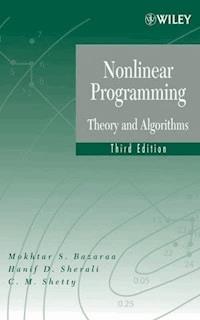
COMPREHENSIVE COVERAGE OF NONLINEAR PROGRAMMING THEORY AND ALGORITHMS, THOROUGHLY REVISED AND EXPANDED
Nonlinear Programming: Theory and Algorithms—now in an extensively updated Third Edition—addresses the problem of optimizing an objective function in the presence of equality and inequality constraints. Many realistic problems cannot be adequately represented as a linear program owing to the nature of the nonlinearity of the objective function and/or the nonlinearity of any constraints. The Third Edition begins with a general introduction to nonlinear programming with illustrative examples and guidelines for model construction.
Concentration on the three major parts of nonlinear programming is provided:
- Convex analysis with discussion of topological properties of convex sets, separation and support of convex sets, polyhedral sets, extreme points and extreme directions of polyhedral sets, and linear programming
- Optimality conditions and duality with coverage of the nature, interpretation, and value of the classical Fritz John (FJ) and the Karush-Kuhn-Tucker (KKT) optimality conditions; the interrelationships between various proposed constraint qualifications; and Lagrangian duality and saddle point optimality conditions
- Algorithms and their convergence, with a presentation of algorithms for solving both unconstrained and constrained nonlinear programming problems
Important features of the Third Edition include:
- New topics such as second interior point methods, nonconvex optimization, nondifferentiable optimization, and more
- Updated discussion and new applications in each chapter
- Detailed numerical examples and graphical illustrations
- Essential coverage of modeling and formulating nonlinear programs
- Simple numerical problems
- Advanced theoretical exercises
The book is a solid reference for professionals as well as a useful text for students in the fields of operations research, management science, industrial engineering, applied mathematics, and also in engineering disciplines that deal with analytical optimization techniques. The logical and self-contained format uniquely covers nonlinear programming techniques with a great depth of information and an abundance of valuable examples and illustrations that showcase the most current advances in nonlinear problems.
Sie lesen das E-Book in den Legimi-Apps auf:
Seitenzahl: 1432
Veröffentlichungsjahr: 2013
Ähnliche



















Contents
Chapter 1 Introduction
1.1 Problem Statement and Basic Definitions
1.2 Illustrative Examples
1.3 Guidelines for Model Construction
Exercises
Notes and References
Part 1 Convex Analysis
Chapter 2 Convex Sets
2.1 Convex Hulls
2.2 Closure and Interior of a Set
2.3 Weierstrass’s Theorem
2.4 Separation and Support of Sets
2.5 Convex Cones and Polarity
2.6 Polyhedral Sets, Extreme Points, and Extreme Directions
2.7 Linear Programming and the Simplex Method
Exercises
Notes and References
Chapter 3 Convex Functions and Generalizations
3.1 Definitions and Basic Properties
3.2 Subgradients of Convex Functions
3.3 Differentiable Convex Functions
3.4 Minima and Maxima of Convex Functions
3.5 Generalizations of Convex Functions
Exercises
Notes and References
Part 2 Optimality Conditions and Duality
Chapter 4 The Fritz John and Karush–Kuhn–Tucker Optimality Conditions
4.1 Unconstrained Problems
4.2 Problems Having Inequality Constraints
4.3 Problems Having Inequality and Equality Constraints
4.4 Second-Order Necessary and Sufficient Optimality Conditions for Constrained Problems
Exercises
Notes and References
Chapter 5 Constraint Qualifications
5.1 Cone of Tangents
5.2 Other Constraint Qualifications
5.3 Problems Having Inequality and Equality Constraints
Exercises
Notes and References
Chapter 6 Lagrangian Duality and Saddle Point Optimality Conditions
6.1 Lagrangian Dual Problem
6.2 Duality Theorems and Saddle Point Optimality Conditions
6.3 Properties of the Dual Function
6.4 Formulating and Solving the Dual Problem
6.5 Getting the Primal Solution
6.6 Linear and Quadratic Programs
Exercises
Notes and References
Part 3 Algorithms and Their Convergence
Chapter 7 The Concept of an Algorithm
7.1 Algorithms and Algorithmic Maps
7.2 Closed Maps and Convergence
7.3 Composition of Mappings
7.4 Comparison Among Algorithms
Exercises
Notes and References
Chapter 8 Unconstrained Optimization
8.1 Line Search Without Using Derivatives
8.2 Line Search Using Derivatives
8.3 Some Practical Line Search Methods
8.4 Closedness of the Line Search Algorithmic Map
8.5 Multidimensional Search Without Using Derivatives
8.6 Multidimensional Search Using Derivatives
8.7 Modification of Newton’s Method: Levenberg-Marquardt and Trust Region Methods
8.8 Methods Using Conjugate Directions: Quasi-Newton and Conjugate Gradient Methods
8.9 Subgradient Optimization Methods
Exercises
Notes and References
Chapter 9 Penalty and Barrier Functions
9.1 Concept of Penalty Functions
9.2 Exterior Penalty Function Methods
9.3 Exact Absolute Value and Augmented Lagrangian Penalty Methods
9.4 Barrier Function Methods
9.5 Polynomial-Time Interior Point Algorithms for Linear Programming Based on a Barrier Function
Exercises
Notes and References
Chapter 10 Methods of Feasible Directions
10.1 Method of Zoutendijk
10.2 Convergence Analysis of the Method of Zoutendijk
10.3 Successive Linear Programming Approach
10.4 Successive Quadratic Programming or Projected Lagrangian Approach
10.5 Gradient Projection Method of Rosen
10.6 Reduced Gradient Method of Wolfe and Generalized Reduced Gradient Method
10.7 Convex-Simplex Method of Zangwill
10.8 Effective First- and Second-Order Variants of the Reduced Gradient Method
Exercises
Notes and References
Chapter 11 Linear Complementary Problem, and Quadratic, Separable, Fractional, and Geometric Programming
11.1 Linear Complementary Problem
11.2 Convex and Nonconvex Quadratic Programming: Global Optimization Approaches
11.3 Separable Programming
11.4 Linear Fractional Programming
11.5 Geometric Programming
Exercises
Notes and References
Appendix A Mathematical Review
Appendix B Summary of Convexity, Optimality Conditions, and Duality
Bibliography
Index
Copyright © 2006 by John Wiley & Sons, Inc. All rights reserved.
Published by John Wiley & Sons, Inc., Hoboken, New Jersey.
Published simultaneously in Canada.
No part of this publication may be reproduced, stored in a retrieval system, or transmitted in any form or by any means, electronic, mechanical, photocopying, recording, scanning, or otherwise, except as permitted under Section 107 or 108 of the 1976 United States Copyright Act, without either the prior written permission of the Publisher, or authorization through payment of the appropriate per-copy fee to the Copyright Clearance Center, Inc., 222 Rosewood Drive, Danvers, MA 01923, (978) 750-8400, fax (978) 750-4470, or on the web at www.copyright.com. Requests to the Publisher for permission should be addressed to the Permissions Department, John Wiley & Sons, Inc., 111 River Street, Hoboken, NJ 07030, (201) 748-6011, fax (201) 748-6008, or online at http://www.wiley.com/go/permission.
Limit of Liability/Disclaimer of Warranty: While the publisher and author have used their best efforts in preparing this book, they make no representations or warranties with respect to the accuracy or completeness of the contents of this book and specifically disclaim any implied warranties of merchantability or fitness for a particular purpose. No warranty may be created or extended by sales representatives or written sales materials. The advice and strategies contained herein may not be suitable for your situation. You should consult with a professional where appropriate. Neither the publisher nor author shall be liable for any loss of profit or any other commercial damages, including but not limited to special, incidental, consequential, or other damages.
For general information on our other products and services or for technical support, please contact our Customer Care Department within the United States at (800) 762-2974, outside the United States at (317) 572-3993 or fax (317) 572-4002.
Wiley also publishes its books in a variety of electronic formats. Some content that appears in print may not be available in electronic format. For information about Wiley products, visit our web site at www.wiley.com.
Library of Congress Cataloging-in-Publication Data:
Bazaraa, M. S.
Nonlinear programming : theory and algorithms / Mokhtar S. Bazaraa, Hanif D. Sherali, C. M. Shetty.—3rd ed.
p. cm.
“Wiley-Interscience.”
Includes bibliographical references and index.
ISBN-13: 978-0-471-48600-8 (cloth: alk. paper)
ISBN-10: 0-471-48600-0 (cloth: alk. paper)
1. Nonlinear programming. I. Sherali, Hanif D., 1952–. II. Shetty, C. M, 1929–. III Title.
T57.8.B39 2006
519.7′6—dc22
2005054230
10 9 8 7 6 5 4 3 2 1
Dedicated to our parents
Preface
Nonlinear programming deals with the problem of optimizing an objective function in the presence of equality and inequality constraints. If all the functions are linear, we obviously have a linear program. Otherwise, the problem is called a nonlinear program. The development of highly efficient and robust algorithms and software for linear programming, the advent of high-speed computers, and the education of managers and practitioners in regard to the advantages and profitability of mathematical modeling and analysis have made linear programming an important tool for solving problems in diverse fields. However, many realistic problems cannot be adequately represented or approximated as a linear program, owing to the nature of the nonlinearity of the objective function and/or the nonlinearity of any of the constraints. Efforts to solve such nonlinear problems efficiently have made rapid progress during the past four decades. This book presents these developments in a logical and self-contained form.
The book is divided into three major parts dealing, respectively, with convex analysis, optimality conditions and duality, and computational methods. Convex analysis involves convex sets and convex functions and is central to the study of the field of optimization. The ultimate goal in optimization studies is to develop efficient computational schemes for solving the problem at hand. Optimality conditions and duality can be used not only to develop termination criteria but also to motivate and design the computational method itself.
In preparing this book, a special effort has been made to make certain that it is self-contained and that it is suitable both as a text and as a reference. Within each chapter, detailed numerical examples and graphical illustrations have been provided to aid the reader in understanding the concepts and methods discussed. In addition, each chapter contains many exercises. These include (1) simple numerical problems to reinforce the material discussed in the text, (2) problems introducing new material related to that developed in the text, and (3) theoretical exercises meant for advanced students. At the end of each chapter, extensions, references, and material related to that covered in the text are presented. These notes should be useful to the reader for further study. The book also contains an extensive bibliography.
Chapter 1 gives several examples of problems from different engineering disciplines that can be viewed as nonlinear programs. Problems involving optimal control, both discrete and continuous, are discussed and illustrated by examples from production, inventory control, and highway design. Examples of a two-bar truss design and a two-bearing journal design are given. Steady-state conditions of an electrical network are discussed from the point of view of obtaining an optimal solution to a quadratic program. A large-scale nonlinear model arising in the management of water resources is developed, and nonlinear models arising in stochastic programming and in location theory are discussed. Finally, we provide an important discussion on modeling and on formulating nonlinear programs from the viewpoint of favorably influencing the performance of algorithms that will ultimately be used for solving them.
The remaining chapters are divided into three parts. Part 1, consisting of Chapters 2 and 3, deals with convex sets and convex functions. Topological properties of convex sets, separation and support of convex sets, polyhedral sets, extreme points and extreme directions of polyhedral sets, and linear programming are discussed in Chapter 2. Properties of convex functions, including subdifferentiability and minima and maxima over a convex set, are discussed in Chapter 3. Generalizations of convex functions and their interrelationships are also included, since nonlinear programming algorithms suitable for convex functions can be used for a more general class involving pseudoconvex and quasiconvex functions. The appendix provides additional tests for checking generalized convexity properties, and we discuss the concept of convex envelopes and their uses in global optimization methods through the exercises.
Part 2, which includes Chapters 4 through 6, covers optimality conditions and duality. In Chapter 4, the classical Fritz John (FJ) and the Karush–Kuhn–Tucker (KKT) optimality conditions are developed for both inequality- and equality-constrained problems. First- and second-order optimality conditions are derived and higher-order conditions are discussed along with some cautionary examples. The nature, interpretation, and value of FJ and KKT points are also described and emphasized. Some foundational material on both first- and second-order constraint qualifications is presented in Chapter 5. We discuss interrelationships between various proposed constraint qualifications and provide insights through many illustrations. Chapter 6 deals with Lagrangian duality and saddle point optimality conditions. Duality theorems, properties of the dual function, and both differentiable and nondifferentiable methods for solving the dual problem are discussed. We also derive necessary and sufficient conditions for the absence of a duality gap and interpret this in terms of a suitable perturbation function. In addition, we relate Lagrangian duality to other special forms of duals for linear and quadratic programming problems. Besides Lagrangian duality, there are several other duality formulations in nonlinear programming, such as conjugate duality, min-max duality, surrogate duality, composite Lagrangian and surrogate duality, and symmetric duality. Among these, the Lagrangian duality seems to be the most promising in the areas of theoretical and algorithmic developments. Moreover, the results that can be obtained via these alternative duality formulations are closely related. In view of this, and for brevity, we have elected to discuss Lagrangian duality in the text and to introduce other duality formulations only in the exercises.
Part 3, consisting of Chapters 7 through 11, presents algorithms for solving both unconstrained and constrained nonlinear programming problems. Chapter 7 deals exclusively with convergence theorems, viewing algorithms as point-to-set maps. These theorems are used actively throughout the remainder of the book to establish the convergence of the various algorithms. Likewise, we discuss the issue of rates of convergence and provide a brief discussion on criteria that can be used to evaluate algorithms.
Chapter 8 deals with the topic of unconstrained optimization. To begin, we discuss several methods for performing both exact and inexact line searches, as well as methods for minimizing a function of several variables. Methods using both derivative and derivative-free information are presented. Newton’s method and its variants based on trust region and the Levenberg-Marquardt approaches are discussed. Methods that are based on the concept of conjugacy are also covered. In particular, we present quasi-Newton (variable metric) and conjugate gradient (fixed metric) algorithms that have gained a great deal of popularity in practice. We also introduce the subject of subgradient optimization methods for nondifferentiable problems and discuss variants fashioned in the spirit of conjugate gradient and variable metric methods. Throughout, we address the issue of convergence and rates of convergence for the various algorithms, as well as practical implementation aspects.
In Chapter 9 we discuss penalty and barrier function methods for solving nonlinear programs, in which the problem is essentially solved as a sequence of unconstrained problems. We describe general exterior penalty function methods, as well as the particular exact absolute value and the augmented Lagrangian penalty function approaches, along with the method of multipliers. We also present interior barrier function penalty approaches. In all cases, implementation issues and convergence rate characteristics are addressed. We conclude this chapter by describing a polynomial-time primal-dual path-following algorithm for linear programming based on a logarithmic barrier function approach. This method can also be extended to solve convex quadratic programs polynomially. More computationally effective predictor-corrector variants of this method are also discussed.
Chapter 10 deals with the method of feasible directions, in which, given a feasible point, a feasible improving direction is first found and then a new, improved feasible point is determined by minimizing the objective function along that direction. The original methods proposed by Zoutendijk and subsequently modified by Topkis and Veinott to assure convergence are presented. This is followed by the popular successive linear and quadratic programming approaches, including the use of penalty functions either directly in the direction-finding subproblems or as merit functions to assure global convergence. Convergence rates and the Maratos effect are also discussed. This chapter also describes the gradient projection method of Rosen along with its convergent variants, the reduced gradient method of Wolfe and the generalized reduced gradient method, along with its specialization to Zangwill’s convex simplex method. In addition, we unify and extend the reduced gradient and the convex simplex methods through the concept of suboptimization and the superbasic-basic-nonbasic partitioning scheme. Effective first- and second-order variants of this approach are discussed.
Finally, Chapter 11 deals with some special problems that arise in different applications as well as in the solution of other nonlinear programming problems. In particular, we present the linear complementary, quadratic separable, linear fractional, and geometric programming problems. Methodologies used for solving these problems, such as the use of Lagrangian duality concepts in the algorithmic development for geometric programs, serve to strengthen the ideas described in the preceding chapters. Moreover, in the context of solving nonconvex quadratic problems, we introduce the concept of the reformulation-linearization/convexification technique (RLT) as a global optimization methodology for finding an optimal solution. The RLT can also be applied to general nonconvex polynomial and factorable programming problems to determine global optimal solutions. Some of these extensions are pursued in the exercises in Chapter 11. The Notes and References section provides directions for further study.
This book can be used both as a reference for topics in nonlinear programming and as a text in the fields of operations research, management science, industrial engineering, applied mathematics, and in engineering disciplines that deal with analytical optimization techniques. The material discussed requires some mathematical maturity and a working knowledge of linear algebra and calculus. For the convenience of the reader, Appendix A summarizes some mathematical topics used frequently in the book, including matrix factorization techniques.
As a text, the book can be used (1) in a course on foundations of optimization and (2) in a course on computational methods as detailed below. It can also be used in a two-course sequence covering all the topics.
1. Foundations of Optimization
This course is meant for undergraduate students in applied mathematics and for graduate students in other disciplines. The suggested coverage is given schematically below, and it can be covered in the equivalent of a one-semester course. Chapter 5 could be omitted without loss of continuity. A reader familiar with linear programming may also skip Section 2.7.
2. Computational Methods in Nonlinear Programming
This course is meant for graduate students who are interested in algorithms for solving nonlinear programs. The suggested coverage is given schematically below, and it can be covered in the equivalent of a one-semester course. The reader who is not interested in convergence analyses may skip Chapter 7 and the discussion related to convergence in Chapters 8 through 11. The minimal background on convex analysis and optimality conditions needed to study Chapters 8 through 11 is summarized in Appendix B for the convenience of the reader. Chapter 1, which gives many examples of nonlinear programming problems, provides a good introduction to the course, but no continuity will be lost if this chapter is skipped.
Acknowledgements
We again express our thanks to Dr. Robert N. Lehrer, former director of the School of Industrial and Systems Engineering at the Georgia Institute of Technology, for his support in the preparation of the first edition of this book; to Dr. Jamie J. Goode of the School of Mathematics, Georgia Institute of Technology, for his friendship and active cooperation; and to Mrs. Carolyn Piersma, Mrs. Joene Owen, and Ms. Kaye Watkins for their typing of the first edition of this book.
In the preparation of the second edition of this book, we thank Professor Robert D. Dryden, head of the Department of Industrial and Systems Engineering at Virginia Polytechnic Institute and State University, for his support. We thank Dr. Gyunghyun Choi, Dr. Ravi Krishnamurthy, and Mrs. Semeen Sherali for their typing efforts, and Dr. Joanna Leleno for her diligent preparation of the (partial) solutions manual.
We thank Professor G. Don Taylor, head of the Department of Industrial and Systems Engineering at Virginia Polytechnic Institute and State University, for his support during the preparation of the present edition of the book. We also acknowledge the National Science Foundation, Grant Number 0094462, for supporting research on nonconvex optimization that is covered in Chapter 11. This edition was typed from scratch, including figures and tables, by Ms. Sandy Dalton. We thank her immensely for her painstaking and diligent effort at accomplishing this formidable task. We also thank Dr. Barbara Fraticelli for her insightful comments and laboriously careful reading of the manuscript.
Mokhtar S. BazaraaHanif D. SheraliC. M. Shetty
Chapter 1
Introduction
Operations research analysts, engineers, managers, and planners are traditionally confronted by problems that need solving. The problems may involve arriving at an optimal design, allocating scarce resources, planning industrial operations, or finding the trajectory of a rocket. In the past, a wide range of solutions was considered acceptable. In engineering design, for example, it was common to include a large safety factor. However, because of continued competition, it is no longer adequate to develop only an acceptable design. In other instances, such as in space vehicle design, the acceptable designs themselves may be limited. Hence, there is a real need to answer such questions as: Are we making the most effective use of our scarce resources? Can we obtain a more economical design? Are we taking risks within acceptable limits? In response to an ever-enlarging domain of such inquiries, there has been a very rapid growth of optimization models and techniques. Fortunately, the parallel growth of faster and more accurate sophisticated computing facilities has aided substantially in the use of the techniques developed.
Another aspect that has stimulated the use of a systematic approach to problem solving is the rapid increase in the size and complexity of problems as a result of the technological growth since World War II. Engineers and managers are called upon to study all facets of a problem and their complicated interrelationships. Some of these interrelationships may not even be well understood. Before a system can be viewed as a whole, it is necessary to understand how the components of the system interact. Advances in the techniques of measurement, coupled with statistical methods to test hypotheses, have aided significantly in this process of studying the interaction between components of the system.
The acceptance of the field of operations research in the study of industrial, business, military, and governmental activities can be attributed, at least in part, to the extent to which the operations research approach and methodology have aided the decision makers. Early postwar applications of operations research in the industrial context were mainly in the area of linear programming and the use of statistical analyses. Since that time, efficient procedures and computer codes have been developed to handle such problems. This book is concerned with nonlinear programming, including the characterization of optimal solutions and the development of algorithmic procedures.
In this chapter we introduce the nonlinear programming problem and discuss some simple situations that give rise to such a problem. Our purpose is only to provide some background on nonlinear problems; indeed, an exhaustive discussion of potential applications of nonlinear programming can be the subject matter of an entire book. We also provide some guidelines here for constructing models and problem formulations from the viewpoint of enhancing algorithmic efficiency and problem solvability. Although many of these remarks will be better appreciated as the reader progresses through the book, it is best to bear these general fundamental comments in mind at the very onset.
1.1 Problem Statement and Basic Definitions
Consider the following nonlinear programming problem:
where f, g1,…,gm, h1,…,hℓ are functions defined on Rn, X is a subset of Rn, and x is a vector of n components x1,…, xn. The above problem must be solved for the values of the variables x1,…, xn that satisfy the restrictions and meanwhile minimize the function f.
To illustrate, consider the following problem:
The objective function and the three inequality constraints are
Lesen Sie weiter in der vollständigen Ausgabe!
Lesen Sie weiter in der vollständigen Ausgabe!
Lesen Sie weiter in der vollständigen Ausgabe!
Lesen Sie weiter in der vollständigen Ausgabe!
Lesen Sie weiter in der vollständigen Ausgabe!
Lesen Sie weiter in der vollständigen Ausgabe!
Lesen Sie weiter in der vollständigen Ausgabe!
Lesen Sie weiter in der vollständigen Ausgabe!
Lesen Sie weiter in der vollständigen Ausgabe!
Lesen Sie weiter in der vollständigen Ausgabe!
Lesen Sie weiter in der vollständigen Ausgabe!
Lesen Sie weiter in der vollständigen Ausgabe!
Lesen Sie weiter in der vollständigen Ausgabe!
Lesen Sie weiter in der vollständigen Ausgabe!
Lesen Sie weiter in der vollständigen Ausgabe!
Lesen Sie weiter in der vollständigen Ausgabe!
Lesen Sie weiter in der vollständigen Ausgabe!
Lesen Sie weiter in der vollständigen Ausgabe!
Lesen Sie weiter in der vollständigen Ausgabe!




