


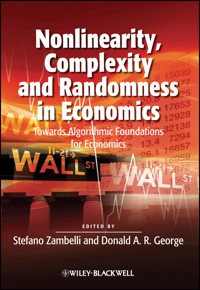
Nonlinearity, Complexity and Randomness in Economics E-Book
21,99 €
Mehr erfahren.
- Herausgeber: John Wiley & Sons
- Kategorie: Fachliteratur
- Serie: Surveys of Recent Research in Economics
- Sprache: Englisch
Nonlinearity, Complexity and Randomness in Economics presents a variety of papers by leading economists, scientists, and philosophers who focus on different aspects of nonlinearity, complexity and randomness, and their implications for economics. A theme of the book is that economics should be based on algorithmic, computable mathematical foundations.
- Features an interdisciplinary collection of papers by economists, scientists, and philosophers
- Presents new approaches to macroeconomic modelling, agent-based modelling, financial markets, and emergent complexity
- Reveals how economics today must be based on algorithmic, computable mathematical foundations
Sie lesen das E-Book in den Legimi-Apps auf:
Seitenzahl: 505
Veröffentlichungsjahr: 2012
Ähnliche




















Contents
Cover
Title Page
Copyright
Notes on Contributors
1: INTRODUCTION
1. Background, Motivation and Initiatives
2. Summary and Outline of the Contributions
3. Concluding Notes and Lessons for the Future
Notes
References
2: TOWARDS AN ALGORITHMIC REVOLUTION IN ECONOMIC THEORY
1. A Foundational Preamble
2. Machines, Mechanisms, Computation and Algorithms
3. The Legacy of Hilbert's Dogma in Mathematical Economics
4. Reconstructing Economic Theory in the Algorithmic Mode29
Acknowledgments
Notes
References
3: AN ALGORITHMIC INFORMATION-THEORETIC APPROACH TO THE BEHAVIOUR OF FINANCIAL MARKETS
1. Introduction
2. The Traditional Stochastic Approach
3. Apparent Randomness in Financial Markets
4. An Information-Theoretic Approach
5. The Study of the Real Time Series versus the Simulation of an Algorithmic Market
6. Experiments and Results
7. Further Considerations
8. Conclusions and Further Work
Acknowledgments
Notes
References
4: COMPLEXITY AND RANDOMNESS IN MATHEMATICS: PHILOSOPHICAL REFLECTIONS ON THE RELEVANCE FOR ECONOMIC MODELLING
1. The Complexity of Mathematics
2. Emergence and Meaning
3. Meaning and Mathematics
4. Applicability of Mathematics and Complexity: Lessons from Economics
5. Satisficing, Bounded Rationality and Modelling
Acknowledgements
Notes
References
5: BEHAVIOURAL COMPLEXITY
1. Introduction
2. Economics of a Nonconvex World
3. Nature of Complex Systems
4. Modelling Complex Systems
5. Relative Behaviour
6. Behavioural Complexity1
7. Results
8. Conclusions
Acknowledgements
Notes
References
6: BOUNDED RATIONALITY AND THE EMERGENCE OF SIMPLICITY AMIDST COMPLEXITY
1. Introduction
2. Rationality
3. Bounded Rationality
4. Bounded Rationality and the Complexity of Environment
5. The Emergence of Simplicity Amidst Complexity
6. Concluding Remarks
Acknowledgements
Notes
References
7: EMERGENT COMPLEXITY IN AGENT-BASED COMPUTATIONAL ECONOMICS
1. Motivation and Introduction
2. Agent-based Models with Simple Agents
3. Agent-based Models with Autonomous Agents
4. Intelligence in Experimental Economics
5. Intelligence in Agent-based Computational Economics
6. Modularity in Agent-based Computational Economics
7. Concluding Remarks
Acknowledgements
Notes
References
8: NON-LINEAR DYNAMICS, COMPLEXITY AND RANDOMNESS: ALGORITHMIC FOUNDATIONS
1. Non-linear Dynamics, Complexity and Randomness – General Algorithmic Considerations
2. Non-linear Dynamics and Dynamic Complexity
3. A Complex (Non-linear) Dynamical System
4. Beyond Dynamic Complexities – Towards an Algorithmic Formalization of Emergence
Acknowledgements
Notes
References
9: STOCK-FLOW INTERACTIONS, DISEQUILIBRIUM MACROECONOMICS AND THE ROLE OF ECONOMIC POLICY
1. Introduction
2. Macroeconomic Portfolio Choice and Keynesian Business Cycle Theory; the KMGT Model
3. Long-Term Bonds, Not Money, as the Primary Financing Instrument of the Government
4. Intensive Form of the Model
5. Keynesian Fiscal Policy Rules and Stability of Balanced Growth
6. Conclusions
Notes
References
10: EQUILIBRIUM VERSUS MARKET EFFICIENCY Randomness versus Complexity in Finance Markets
1. Introduction
2. ‘Value’ in a Stochastic Market
3. Stationarity and Statistical Equilibrium
4. Trading Strategy in an Equilibrium Market
5. Efficient Markets
6. Recurrence in Finance Markets
Acknowledgments
References
11: FLEXIBLE ACCELERATOR ECONOMIC SYSTEMS AS COUPLED OSCILLATORS
1. Introduction
2. Frisch's Rocking Horse: A Linear Accelerator Time-to-Build Model
3. Hicks–Goodwin ‘Perpetual Motion’: A Nonlinear Model
4. Coupled Oscillators in Goodwin's Model: The Two National Systems Case
5. Mode locking, Devil's Staircases and Chaotic Dynamics
6. Back to Goodwin and the Fermi–Pasta–Ulam Problem
7. Concluding Note
Notes
References
Appendix
12: SHIFTING SANDS: NON-LINEARITY, COMPLEXITY AND RANDOMNESS IN ECONOMICS
Note
References
Index
This edition first published 2012 Chapters © 2012 The Authors Book compilation © 2012 Blackwell Publishing Ltd Originally published as a special issue of the Journal of Economic Surveys (Volume 25, Issue 3)
Blackwell Publishing was acquired by John Wiley & Sons in February 2007. Blackwell's publishing program has been merged with Wiley's global Scientific, Technical, and Medical business to form Wiley-Blackwell.
Registered Office John Wiley & Sons Ltd, The Atrium, Southern Gate, Chichester, West Sussex, PO19 8SQ, United Kingdom
Editorial Offices 350 Main Street, Malden, MA 02148-5020, USA 9600 Garsington Road, Oxford, OX4 2DQ, UK The Atrium, Southern Gate, Chichester, West Sussex, PO19 8SQ, UK
For details of our global editorial offices, for customer services, and for information about how to apply for permission to reuse the copyright material in this book please see our website at www.wiley.com/wiley-blackwell.
The right of Stefano Zambelli and Donald A.R. George to be identified as the authors of the editorial material in this work has been asserted in accordance with the UK Copyright, Designs and Patents Act 1988.
All rights reserved. No part of this publication may be reproduced, stored in a retrieval system, or transmitted, in any form or by any means, electronic, mechanical, photocopying, recording or otherwise, except as permitted by the UK Copyright, Designs and Patents Act 1988, without the prior permission of the publisher.
Wiley also publishes its books in a variety of electronic formats. Some content that appears in print may not be available in electronic books.
Designations used by companies to distinguish their products are often claimed as trademarks. All brand names and product names used in this book are trade names, service marks, trademarks or registered trademarks of their respective owners. The publisher is not associated with any product or vendor mentioned in this book. This publication is designed to provide accurate and authoritative information in regard to the subject matter covered. It is sold on the understanding that the publisher is not engaged in rendering professional services. If professional advice or other expert assistance is required, the services of a competent professional should be sought.
Library of Congress Cataloging-in-Publication Data
Nonlinearity, complexity and randomness in economics : towards algorithmic foundations for economics / edited by Stefano Zambelli and Donald A.R. George. p. cm. Includes index. ISBN 978-1-4443-5031-9 (pbk.) 1. Economics, Mathematical. 2. Econometrics. I. Zambelli, Stefano. II. George, Donald A.R., 1953– HB135.N662 2012 330.01′519–dc23 2011038342
A catalogue record for this book is available from the British Library.
Notes on Contributors
Stefano ZambelliUniversity of TrentoK. Vela VelupillaiUniversity of TrentoHector ZenilIHPST, Université de Paris (Panthéon-Sorbonne) Dept. of Computer Science, University of SheffieldJean-Paul DelahayeLaboratoire d'Informatique Fondamentale de Lille (USTL)Sundar Sarukkai Manipal Centre for Philosophy and Humanities, Manipal UniversitySami Al-Suwailem Islamic Development Bank GroupCassey LeeSchool of Economics, University of WollongongShu-Heng ChenNational Chengchi UniversityShu G. WangNational Chengchi UniversityToichiro AsadaChuo UniversityCarl ChiarellaUniversity of Technology, SydneyPeter FlaschelBielefeld UniversityTarik MouakilUniversity of CambridgeChristian ProañoNew School UniversityWilli Semmler New School UniversityJoseph L. McCauleyUniversity of HoustonDonald A.R. GeorgeUniversity of Edinburgh1
INTRODUCTION
1. Background, Motivation and Initiatives
Almost exactly two years ago,1 Vela Velupillai wrote to the Editor of the Journal of Economic Surveys, Professor Donald George, with a tentative query, in the form of a proposal for a Special Issue on the broad themes of Complexity, Nonlinearity and Randomness. Donald George responded quite immediately – on the very next day, in fact – in characteristically generous and open-minded mode as follows:
‘Special Issue topics for 2009 and 2010 are already decided, and 2011 is the Journal's 25th year so we are intending some form of “special Special Issue” to mark that. However I’ll forward your email to the other editors and see what they think. Your proposed topic is certainly of interest to me (as you know!)’
By the time the Conference was officially announced, in the summer of 2009, the official title had metamorphosed into Nonlinearity, Complexity and Randomness, but without any specific intention to emphasise, by the reordering, any one of the triptych of themes more than any other.2 On the other hand, somehow, the dominant, even unifying, theme of the collection of papers viewed as a whole turned out to be one or another notion of complexity, with Nonlinearity and Randomness remaining important, but implicit, underpinning themes.3
There were, however, two unfortunate absences in the final list of contributors at the Conference. Professor Tönu Puu's participation was made impossible by administrative and bureaucratic obduracy.4 Professor Joe McCauley's actual presence at the Conference was eventually made impossible due to unfortunate logistical details of conflicting commitments. However, Professor McCauley was able to present the paper, which is now appearing in this Special Issue at a seminar in Trento in Spring, 2010.
Nonlinearity, Complexity and Randomness are themes which have characterised Velupillai's own research and teaching for almost 40 years, with the latter two topics originated from his deep interest in, and commitment to, what he has come to refer to as Computable Economics. This refers to his pioneering attempt to re-found the basis of economic theory in the mathematics of classical computability theory,5 a research programme he initiated more than a quarter of a century ago.
That there are many varieties of theories of complexity is, by now, almost a cliché. One can, without too much effort, easily list at least seven varieties of theories of complexity6: computational complexity, Kolmogorov complexity/algorithmic information theory, stochastic complexity, descriptive complexity theory, information-based theory of complexity, Diophantine complexity and plain, old-fashioned, (nonlinear) dynamic complexity. Correspondingly, there are also many varieties of theories of randomness (cf., for example, Downey and Hirschfeldt, 2010; Nies, 2009). Surely, there are also varieties of nonlinear dynamics, beginning with the obvious dichotomy between continuous and discrete dynamical systems, but also at least, in addition, in terms of symbolic dynamics, random dynamical systems and ergodic theory (cf., Bedford et al., 1991; Nillson, 2010) and, once again, plain, simple, stochastic dynamics (cf. Lichtenberg and Lieberman, 1983).
It was Velupillai's early insight (already explicitly expressed in Velupillai, 2000 and elaborated further in Velupillai, 2010a) that all three of these concepts should – and could – be underpinned in a theory of computability. It is this insight that led him to develop the idea of computationally universal dynamical systems, within a computable economics context, even before he delivered the Arne Ryde Lectures of 1994.7 This early insight continues to be vindicated by frontier research in complexity theory, algorithmic randomness and in dynamical systems theory.
The triptych of themes for the conference, the outcome of which are the contents of this Special Issue, crystallized out of further developments of this early insight. However, to these were added work Velupillai was doing, in what he has come to call Classical Behavioural Economics,8 which encapsulated bounded rationality, satisficing and adaptive behaviour within the more general9 framework of Diophantine decision problems. He was able to use the concept of computationally universal dynamical systems to formalise bounded rationality, satisficing and adaptive behaviour, and link Diophantine decision problems with dynamical systems theory underpinned by the notion of universal computation in the sense of Turing computability (cf., Velupillai, 2010b). Some of the contributions in this Special Issue – for example, those by Cassey Lee, Sami al Suwailem and Sundar Sarukkai – reflect aspects of these latter developments.
2. Summary and Outline of the Contributions
The 10 contributions to this Special Issue could, perhaps, be grouped in four sub-classes as follows: Towards and Algorithmic Revolution in Economic Theory by Velupillai, the lead article, and Sundar Sarukkai's contributions could be considered as unifying, methodological essays on the main three themes of the Conference. The contributions by Asada et al. and Zambelli to nonlinear macrodynamics; The papers by Cassey Lee, Shu-Heng Chen (jointly with Geroge Wang) and Sami al Suwailem are best viewed as contributions to behavioural and emergent complexity investigations in agent-based models. Hector Zenil's and Velupillai's (second contribution) could be viewed as contributions to aspects of dynamical systems theory, algorithmic complexity theory, touching also on the notion of algorithmic randomness. Joe MCauley's stimulating paper is, surely, not only a contribution to a fresh vision of finance theory but also to the imaginative use to which the classic recurrence theorem of Poincaré can be put in such theories, when formulated dynamically in an interesting way.
Velupillai, in the closely reasoned, meticulously documented, lead article, delineates a possible path towards an algorithmic revolution in economic theory, based on foundational debates in mathematics. He shows, by exposing the non-computational content of classical mathematics, and its foundations, that both set theory and the tertium non datur can be dispensed with, as foundational concepts. It follows that an economic theory that bases its theoretical underpinning on classical mathematics can be freed from these foundations and can be made naturally algorithmic. This will make the subject face absolutely (algorithmically) undecidable decision problems. The thrust of the path towards an algorithmic revolution in economics lies, according to Velupillai, in pointing out that only a radically new mathematical vision of microeconomics, macroeconomics, behavioural economics, game theory, dynamical systems theory and probability theory can lead us towards making economic theory a meaningfully applied science and free of mysticism and subjectivism.
Sundar Sarukkai's penetrating contribution can be considered a meta-level aspect of the core of Velupillai's thesis. He considers mathematics itself as a complex system and makes the fertile point that the process of applying mathematics to models leads to (dynamic) complexities. Hence, using mathematics in modelling is a process of deciding what kinds of models to construct and what types of mathematics to use. Modelling, from Sarukkai's point of view, can be seen as a decision-making process where the scientists are the agents. However in choosing mathematical structures the scientist is not being optimally rational. In fact, fertile uses of mathematics in the sciences show a complicated use of mathematics that cannot be reduced to a method or to rational principles. This paper argues that the discourse of satisficing and bounded rationality well describes the process of choice and decision inherent in modelling.10
The innovative contributions by Shu-Heng Chen (jointly with George Wang) and Sami Al-Suwailem can be considered to be new and interesting applications of agent-based economic modelling in providing insights into behaviour, both from orthodox and non-orthodox theoretical points of view. Moreover, when used as in Sami Al-Suwailem's paper, agent-based modelling, coupled to a complexity vision, could expose some of the weaknesses in orthodox neoclassical theory. Emergence has become one of the much maligned buzzwords in the fashionable complexity literature. However the way Chen and Wang have generated it, in a variety of agent-based models, suggests new possibilities to go beyond sterile modelling exercises in conventional modern behavioural economics.
In a broad sense, Cassey Lee's approach is tied to an implicit belief in the fertility of agent-based modelling in giving content to the fertile concepts introduced by Simon, to model behaviour that is empirically meaningful. Lee's framework is more philosophical than epistemological and, therefore, somewhat tangential to what I consider is the hallmark of Simon's modelling strategy and epistemological stance. Yet, his reflective paper contributes to a kind of bridge between the mathematics of modelling bounded rational agents and the philosophy that must underpin such an exercise. In some ways, it is also a companion piece to Sarukkai's stimulating challenges to orthodoxy in mathematical modelling philosophy.
Asada et al., contribute the latest version of their sustained research program of providing alternatives to the arid macrodynamics of the newclassicals and the newkeynesisans. Nonlinearities pervade the foundations of all their modelling exercises in macrodynamics and this paper follows that noble tradition with new insights and ingenuity, especially in the techniques harnessed for stability analysis.
Zambelli goes beyond the conventional nonlinear dynamic modelling emanating from the Kaldor, Hicks-Goodwin tradition by coupling, nonlinearly, economies to study their analytically untameable dynamic paths and behaviour. In a sense, this is an exercise in the grand tradition of the Fermi-Pasta-Ulam exercise and thus falls squarely within the defining themes of the conference. The forced nonlinear dynamics of coupled oscillators, linking nonlinear dynamics with randomness via ergodic theory, leads, in this case to definably complex dynamics, too. Characterising them remains a challenge for the future.
In a strong sense, there is a unifying theme in the contributions by Zambelli and McCauley, even though they appear to concentrate on modelling the dynamics of different aspects of an economic system: national economies in the aggregate in the former; financial markets, in the latter. However, of course, the stochastic dynamics of the latter and the nonlinear dynamics of the latter have ergodic theory to unify them. Eventually it should be possible to underpin both exercises in a theory of algorithmic randomness for coupled dynamical systems capable of computation universality.
3. Concluding Notes and Lessons for the Future
The notions of Nonlinearity, Randomness and Complexity, when underpinned by model of computation in the sense of computability theory may well provide the disciplining framework for the mathematical modelling of economic systems and economic agents in an age when the digital computer is all pervasive. Almost all mathematical modelling exercises in economic dynamics, even in the agent-based tradition, remain largely outside the computability tradition. Yet most exercises and discussions of complexity, whether of individual behaviour or of aggregate dynamics or of institutions and organizations, are not underpinned by a model of computation. Furthermore, no formal modelling exercise emphasizing nonlinear dynamic modelling in macroeconomics (or even microeconomics) is based on algorithmic formalisations.
Velupillai's fundamental modelling philosophy – and, indeed, also its epistemology – is that nonlinearity, complexity and randomness should be harnessed for the mathematical modelling of economic entitites, but based on algorithmic foundations. Computationally universal dynamical systems, computational complexity and algorithmic randomness are what he hopes the way to invoke the triptych of nonlinearity, complexity and randomness for the purposes of economic theory in the mathematical mode.
The contributions to this Special Issue try, each in their own way, with more and less success, to make some sense of Velupillai's fundamental stance against the arid visions of orthodoxy. In line with one of Velupillai's choice of quotations it is as if we were echoing that visionary call by Tennyson's Ulysses:
Come, my friends. ‘T is not too late to seek a newer world. ……… … . Tho’ much is taken, much abides; and tho’ We are not now that strength which in old days Moved earth and heaven, that which we are, we are, – One equal temper of heroic hearts, Made weak by time and fate, but strong in will To strive, to seek, to find, and not to yield.
Notes
1. To be precise, on exactly 24 February, 2009! However, there was a curious mistake in Velupillai's original e-mail, in that his suggested date for the conference, which was to lead to a set of papers for the Special Issue contents, was stated as 27/28 October, 2010 (and not 2009, which was when it was actually held)! Somehow, this mistake was never noticed, nor needed any special correction, in the ensuing correspondence and planning.
2. By the 23rd of April, 2009, Velupillai had received Donald's approval, with the consent of his fellow editors, for the publication of the proceedings of the envisaged conference in a ‘Themed Issue’ of the Journal, in 2011. Shortly thereafter it was also decided, after e-mail interchanges between Donald George, Vela Velupillai and Stefano Zambelli, that the Themed Issue would be Guest Edited by Zambelli, under the general editorial guidance of Donald. Now, in the most recent correspondence, Donald has informed me that the editorial board of JOES had finally decided to change the status from ‘Themed’ to ‘Special’, which also implies that this issue will be published, eventually, in book form by Blackwell Publishing.
3. Except in the case of the contributions by Chiarella et al. and Zambelli, where nonlinearity was the dominant theme, and McCauley's paper, where the emphasis was on the interaction between dynamics and randomness, especially via an invoking of the Poincaré Recurrence theorem.
4. Even as late as July, 2009 Velupillai and Puu were in correspondence, the former finalising the Conference structure with the latter expected to give the lead talk on the general topic of Nonlinearity in Economics. That our noble intentions were unable to be realised remains a source of deep sadness to us and, for now at least, all we can do is to offer our public apologies to Professor Puu and regrets to the readership of JOES, who have been prevented from the benefits of a panoramic view on a topic to which he has contributed enormously.
5. In his much more recent work he has ‘expanded’ the mathematical basis of computable economics to include, in addition to classical recursion theory, also Brouwerian Constructive Mathematics, itself underpinned by Intuitionistic logic, especially because of the careful use of the teritum non datur in the latter and, hence, in the construction of implementable algorithms in economic decision problems. He deals with these issues in some detail in his lead contribution to this Special Issue: Towards an Algorithmic Revolution in Economic Theory.
6. After all, there have been the Seven Pillars of Wisdom, Seven Varieties of Convexity, Seven Schools of Macroeconomics and even the Seven Deadly Sins – so why not also Seven Varieties of Complexity? And, surely, a case can also be made for Seven Varieties of Randomness.
7. Which appeared, largely, as Velupillai (0p.cit), more than six years later.
8. In contrast to Modern Behavioural Economics, so called (cf., Camerer, et.al., 2004, pp. xxi-xxii), this characterizes Herbert Simon's kind of computationally underpinned behavioural economics.
9. ‘More general’ than the classical optimization paradigm of orthodox economic theory and, in particular, modern behavioural economics.
10. This contribution by Sarukkai is a refreshing antidote to the Panglossian platitudes of the rational expectations modeller in economics.
References
Bedford, T., Keane, M. and Series, C. (eds.) (1991) Ergodic Theory, Symbolic Dynamics and Hyperbolic Spaces. Oxford: Oxford University Press.
Camerer, C.F., Loewenstein, G. and Rabin, M. (eds.) (2004) Advances in Behavioral Economics. Princeton, New Jersey: Princeton University Press.
Downey, R.G. and Hirschfeldt, D.R. (2010) Algorithmic Randomness and Complexity. New York: Springer Science + Business Media LLC.
Lichtenberg, A.J. and Lieberman, M.A. (1983) Regular and Stochastic Motion. New York: Springer-Verlag.
Nies, A. (2009) Computability and Randomness. Oxford: Oxford University Press.
Nillson, R. (2010) Randomness and Recurrence in Dynamical Systems, The Carus Mathematical Monographs, Number 31. Washington, DC: The Mathematical Association of America.
Velupillai, K.V. (2000) Computable Economics. Oxford: Oxford University Press.
Velupillai, K.V. (2010a) Computable Foundations for Economics. Oxon, UK: Routledge.
Velupillai, K.V. (2010b) Foundations of boundedly rational choice and satisficing decisions, Advances in Decision Sciences.
2
TOWARDS AN ALGORITHMIC REVOLUTION IN ECONOMIC THEORY
K. Vela Velupillai
1. A Foundational Preamble
Hilbert's vision of a universal algorithm to solve mathematical theorems1 required a unification of Logic, Set Theory and Number Theory. This project was initiated by Frege, rerouted by Russell, repaired by Whitehead, derailed by Gödel, restored by Zermelo, Frankel, Bernays and von Neumann, shaken by Church and finally demolished by Turing. Hence, to say that the interest in algorithmic methods in mathematics or the progress in logic was engendered by the computer is wrong way around. For these subjects it is more correct to observe the revolution in computing that was inspired by mathematics. Cohen (1991, p. 324; italics added)
It is in the above sense – of a ‘revolution in computing that was inspired by mathematics’ – that I seek to advocate an ‘algorithmic revolution in economic theory inspired by mathematics’. I have argued elsewhere, (see Velupillai, 2010a), that a strong case can be made to the effect that ‘the revolution in computing was inspired by mathematics’ – more specifically by the debates in the foundations of mathematics, in particular those brought to a head by the Grundlagenkrise (see Section 3, below for a partial summary, in the context of the aims of this paper). Although this debate had the unfortunate by-product of ‘silencing’ Brouwer, pro tempore, it did bring about the ‘derailing by Gödel’, the ‘shaking by Church’ and the ‘final demolition by Turing’ of the Hilbert project of a Universal Algorithm to solve all mathematical problems.2
Before I proceed any further on a ‘foundational preamble’, let me make it clear that the path towards an algorithmic revolution in economics is not envisaged as one on Robert Frost's famous ‘Roads Not Taken’. Algorithmic behavioural economics, algorithmic statistics, algorithmic probability theory, algorithmic learning theory, algorithmic dynamics and algorithmic game theory have already cleared the initial roughness of the path for me.
Lesen Sie weiter in der vollständigen Ausgabe!
Lesen Sie weiter in der vollständigen Ausgabe!
Lesen Sie weiter in der vollständigen Ausgabe!
Lesen Sie weiter in der vollständigen Ausgabe!
Lesen Sie weiter in der vollständigen Ausgabe!
Lesen Sie weiter in der vollständigen Ausgabe!
Lesen Sie weiter in der vollständigen Ausgabe!
Lesen Sie weiter in der vollständigen Ausgabe!
Lesen Sie weiter in der vollständigen Ausgabe!
Lesen Sie weiter in der vollständigen Ausgabe!
Lesen Sie weiter in der vollständigen Ausgabe!




