


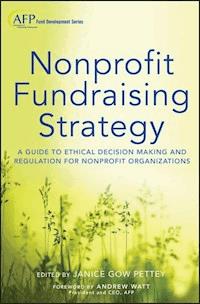
Nonprofit Fundraising Strategy E-Book
52,99 €
Mehr erfahren.
- Herausgeber: John Wiley & Sons
- Kategorie: Fachliteratur
- Serie: The AFP/Wiley Fund Development Series
- Sprache: Englisch
Practical tools and techniques to incorporate ethical standards and practices in nonprofit fundraising Nonprofit Fundraising Strategy is a helpful and inspiring resource for nonprofits large and small, young and mature, local and international. The insightful guidance and case studies found within these pages will help you understand how to address specific ethical issues within your nonprofit and leave plenty of food for thought and discussion. * Adds new materials on new business practice codes, the Ethics Assessment Inventory, coverage of new ethics standards * Now includes an ethics assessment tool on the Ethical Fundraising, Second Edition companion website * Considers essential topics including: appearance of impropriety, rights of donors, tainted money, using donations as intended, choosing a leadership role, ethical decision-making, restoring public confidence in the nonprofit sector, and the ethics of grant making and grant seeking * Written by luminaries in the field of ethics in fundraising * Explores a topic that all professional fundraisers must engage with in order to build the trust and confidence of the giving public * Offers an invaluable collection of essays based on the rich experience of philanthropic leaders * Presents wise reflections on the central role of ethics in fundraising Featuring contributions from a host of well-known and respected senior-level fundraising professionals, several of whom are members of the AFP Ethics Committee, Nonprofit Fundraising Strategy features a wealth of practical tools to help fundraising practitioners, board members, and governing boards implement these essential concepts into their own organizations.
Sie lesen das E-Book in den Legimi-Apps auf:
Seitenzahl: 670
Veröffentlichungsjahr: 2013
Ähnliche




















Table of Contents
Title Page
Copyright
The AFP Fund Development Series
2012–2013 AFP Publishing Advisory Committee
Acknowledgments
About the Editor
Contributing Authors
Foreword
Preface
Introduction
Case Studies
Chapter 1: Fundraisers and the Good Life
Defining the Virtues
Obstacles to Living the Good Life
Growing as Ethical Fundraisers
About the Author
Chapter 2: The Appearance of Impropriety
The Link between Ethics and Fiduciary Duty
Reputation Management and Impropriety
Conflict of Interest and the Appearance of Impropriety
The Continuum of Suspect Behavior
A Test for Impropriety beyond Conflict of Interest
A Word about Diversity
Common Rationalizations
In Defense of Impropriety
About the Author
Chapter 3: Rights of Donors
Is It Donor Relations or Donors’ Rights?
A Donor Bill of Rights
Stewardship of Donors' Rights
Conclusion
About the Author
Chapter 4: Public Privacy: An Exploration of Issues of Privacy and Fundraising
The “Right” to Privacy
The Internet Explosion
Privacy and Security
Donors' Rights, Fundraisers' Responsibilities
The Dilemma of Privacy
Prospecting for Donors
Donors and Donor Interest
Gift Restrictions
Donor Wishes about Privacy of Information
Controversial Donors
Inside Your Organization
Donor Recognition
Databases
Some Principles
About the Author
Chapter 5: Tainted Money
Definitions of Tainted Money
The AFP Code of Ethical Principles and Standards and Tainted Money
Tainted-Money Dilemmas
Policies and Procedures for Dealing with Tainted Money
Conclusion
About the Author
Chapter 6: Compensation
Impact of Professional Ethics and Standards
Acceptable Compensation and Incentives
The AFP Code and Business
About the Author
Chapter 7: Using Donations as Intended
Before the Gift
After the Gift
Conclusion
About the Author
Chapter 8: Ethical Considerations of Making the Ask
What Is at the Heart of Soliciting Gifts?
How Are You Approaching Donor Prospects for Gifts?
What Solicitation Laws and Regulations Does a Charity Need to Comply With?
What Policies Create the Best Environment for Making the Ask?
About the Author
Chapter 9: Honesty and Full Disclosure
Honesty
Full Disclosure
Conclusion
About the Author
Chapter 10: Choosing a Leadership Role: A Vision for Action
Step 1: Initiating Dialog
Step 2: Dissemination and Promulgation
Teaching Steps to Ethical Decision Making
The Plan for Dissemination
Public Affairs and Public Policy
About the Author
Chapter 11: The Context and Development of International Codes and Standards
Civil Society and Globalization: Two Key Influences on the Development of Regulatory and Self-Regulatory Structures
Civil Society
Moving Towards Regulation of Nonprofits in a Global Society
Cross-Border Regulation
Accountability
Self-Regulation
Fundraising Associations and Their Differing Approaches to Self-Regulation
Dutch Code of Conduct for Fundraisers
French Code of Professional Ethics
International Codes of Professional Ethics
About the Author
Chapter 12: Turning a Profit in the Nonprofit World: The Ethical Responsibilities of Businesses in the Fundraising Sector
Standard No. 14
Standard No. 7
About the Author
Chapter 13: Ethical Decision Making
Frameworks for Ethical Decision Making
Codes, Creeds, and Standards
About the Author
Chapter 14: Between the Real and the Ideal: A Meditation on the Future of Ethical Reflection for Philanthropic Fundraisers
Philanthropy Is a Public Practice
Fundraising as Vocation
Reflective Practice
About the Author
Chapter 15: Assessing Ethical Fundraising: The Creation and Use of the AFP Ethics Assessment Inventory
Background
Building the AFP Ethics Assessment Inventory
Critical Dimensions of Ethical Fundraising
Taking the AFP Ethics Assessment Inventory
Using the AFP Ethics Assessment Inventory
What We Are Learning
Frequently Asked Questions (FAQs)
About the Author
Note
Chapter 16: Regulation, Ethics, and Philanthropy
Content Presentations
Discussion Summaries
Case Studies
About the Authors
Chapter 17: Leadership, Governance, and Giving
Content Presentations
Discussion Summaries
About the Author
Chapter 18: Both Sides Now: The Ethics of Grantmaking and Grantseeking
The Trust Relationship
The Grants Process
Accountability
Public Goods
About the Author
Chapter 19: Ethical Relationships between Grantees and Funders
First: Ethics Needs to Be Viewed as a Bottom-Line Issue for Nonprofits and Foundations Alike
Second: We Need to Actively Practice Our Ethical Principles
Third: We're at the Same Table
Fourth: While Most of Us Have Accepted the Challenge of Striving to Be Personally and Institutionally Ethical and Accountable, We Have a Much Larger Ethical Obligation across the Sector and Society That Requires Time and Attention
One Final Point
About the Author
Chapter 20: Regulation in the Nonprofit Sector: Symbolic Politics and the Social Construction of Accountability
Perspectives on Regulation
Ethics and a Culture of Integrity
About the Author
Chapter 21: Restoring Public Confidence in the Nonprofit Sector
Public Confidence
Faith-Based Institutions in the Nonprofit Sector
An Approach for the Future
About the Author
Appendix A: Ethical Codes and Standards: Association of Fundraising Professionals (AFP) Code of Ethical Principles
Association for Healthcare Philanthropy (AHP) Statement of Professional Standards and Conduct
Association of Professional Researchers for Advancement (APRA) Statement of Ethics (Revised August 2004)
American Society of Association Executives (ASAE) Standards of Conduct
Council for Advancement and Support of Education (CASE) Statement of Ethics
ePhilanthropy Code of Ethical Online Philanthropic Practices
Giving USA Foundation Standards of Practice and Code of Ethics: Professional Code of Ethics
Independent Sector: Obedience to the Unenforceable
The Salvation Army Fundraising Code of Ethics
Statement of Ethics and Accountability for Washington Grantmakers
Appendix B: Websites for International Fundraising Codes of Ethics and Standards
Appendix C: Statement of Values and Standards for Excellence of the Tucson Symphony Society dba Tucson Symphony Orchestra
Introduction
Statement of Values
References
Index
Cover Design: John Wiley & Sons, Inc.
Copyright © 2013 by John Wiley & Sons, Inc. All rights reserved.
Published by John Wiley & Sons, Inc., Hoboken, New Jersey.
First edition published in 2008 by John Wiley & Sons, Inc. as Ethical Fundraising: A Guide for Nonprofit Boards and Fundraisers.
Published simultaneously in Canada.
No part of this publication may be reproduced, stored in a retrieval system, or transmitted in any form or by any means, electronic, mechanical, photocopying, recording, scanning, or otherwise, except as permitted under Section 107 or 108 of the 1976 United States Copyright Act, without either the prior written permission of the Publisher, or authorization through payment of the appropriate per-copy fee to the Copyright Clearance Center, Inc., 222 Rosewood Drive, Danvers, MA 01923, (978) 750-8400, fax (978) 646-8600, or on the Web at www.copyright.com. Requests to the Publisher for permission should be addressed to the Permissions Department, John Wiley & Sons, Inc., 111 River Street, Hoboken, NJ 07030, (201) 748-6011, fax (201) 748-6008, or online at http://www.wiley.com/go/permissions.
Limit of Liability/Disclaimer of Warranty: While the publisher and author have used their best efforts in preparing this book, they make no representations or warranties with respect to the accuracy or completeness of the contents of this book and specifically disclaim any implied warranties of merchantability or fitness for a particular purpose. No warranty may be created or extended by sales representatives or written sales materials. The advice and strategies contained herein may not be suitable for your situation. You should consult with a professional where appropriate. Neither the publisher nor author shall be liable for any loss of profit or any other commercial damages, including but not limited to special, incidental, consequential, or other damages.
For general information on our other products and services or for technical support, please contact our Customer Care Department within the United States at (800) 762-2974, outside the United States at (317) 572-3993 or fax (317) 572-4002.
Wiley also publishes its books in a variety of electronic formats. Some content that appears in print may not be available in electronic books. For more information about Wiley products, visit our web site at www.wiley.com.
Library of Congress Cataloging-in-Publication Data:
Pettey, Janice Gow.
Nonprofit fundraising strategy : a guide to ethical decision making and regulation for nonprofit organizations / Janice Gow Pettey.
pages cm. – (The AFP fund development series)
Includes index.
ISBN 978-1-118-48757-0 (hbk.) – ISBN 978-1-118-61421-1 (ebk) – ISBN 978-1-118-61405-1 (ebk) – ISBN 978-1-118-61490-7 (ebk) 1. Fund raising. 2. Nonprofit organizations–Finance. I. Title.
HG177.P486 2013
658.15′224–dc23
2012048296
The AFP Fund Development Series
The AFP Fund Development Series is intended to provide fund development professionals and volunteers, including board members (and others interested in the nonprofit sector), with top-quality publications that help advance philanthropy as voluntary action for the public good. Our goal is to provide practical, timely guidance and information on fundraising, charitable giving, and related subjects. The Association of Fundraising Professionals (AFP) and Wiley each bring to this innovative collaboration unique and important resources that result in a whole greater than the sum of its parts. For information on other books in the series, please visit www.afpnet.org.
The Association of Fundraising Professionals
The Association of Fundraising Professionals (AFP) represents over 30,000 members in more than 207 chapters throughout the United States, Canada, Mexico, and China, working to advance philanthropy through advocacy, research, education, and certification programs.
The association fosters development and growth of fundraising professionals and promotes high ethical standards in the fundraising profession. For more information or to join the world's largest association of fundraising professionals, visit www.afpnet.org.
2012–2013 AFP Publishing Advisory Committee
CHAIR: Steven P. Miller, CFRE
Vice President, Resource Development, Reston Interfaith
D. C. Dreger, ACFRE
Director of Campaigns for the Americas, Habitat for Humanity International
Nina P. Berkheiser, CFRE
Principal Consultant, Your Nonprofit Advisor
Patricia G. Egan, CFRE
Fundraising Consultant
Scott Fortnum, ACFRE
Chief Development Officer, Saint Elizabeth Health Care Foundation
Audrey P. Kintzi, ACFRE
Senior Development Director, Saint Mary's University of Minnesota
Marilyn Foster Kirk, CFRE
Associate Vice Chancellor, University of Illinois at Chicago
Benjamin T. Mohler, CFRE
Director of Development, UNC Charlotte
Robert J. Mueller, CFRE
Assistant Vice President, Hosparus
Maria-Elena Noriega
Director, Noriega Malo y Asociados. S.C.
Ligia Pena, CFRE
Fundraising Consultant, Diversa
John Rivas, CFRE
Chief Development Officer, Florida United Methodist Home
John Wiley & Sons, Inc.:
Susan McDermott
Senior Editor (Professional/Trade Division)
AFP Staff:
Jacklyn P. Boice
Editor-in-Chief, Advancing Philanthropy
Chris Griffin
Professional Advancement Coordinator
Rhonda Starr
Vice President, Education and Training
Reed Stockman
Acknowledgments
I am grateful for the following colleagues who are contributing authors: Sam Gough, Jim Greenfield, Bob Herman, Barb Levy, Dianne Lister, Paulette Maehara, Paul Marcus, Paul Pribennow, Carleen Rhodes, Jerry Rohrbach, Gene Scanlan, William Schambra, Bruce Sievers, Gene Tempel, Andrew Watt, Bob Fogal, Audrey Kintzi, Bob Shoemake, Owen Watkins, and Cathy Williams. Without them this book would not exist.
Cathy Williams deserves special thanks for assisting in the editing of this book. My thanks to the Publishing Advisory Council for their attentiveness and support, and to the team of editors at Wiley—Susan McDermott, Claire New, and Jennifer MacDonald. To the wonderful staff at AFP, Andrew Watt, Rhonda Starr, Rebecca Knight, thank you for your support in this endeavor.
Serving as Chair of AFP's Ethics Committee was one of the most enriching volunteer experiences of my career and I am indebted to my colleagues on the committee for their support of ethics education for our profession.
To my husband, Marv, our sons and daughter-in-law, thank you for your constant support.
About the Editor
Janice Gow Pettey, EdD, CFRE, is the editor of Nonprofit Fundraising Strategy: A Guide to Ethical Decision Making and Regulation for Nonprofit Organizations. She is chair emeritus of AFP's International Ethics Committee and served on the committee for ten years. An acknowledged authority on the topics of diversity and ethics, Janice has taught and presented on ethics and diversity on three continents and many states. She has served as an expert witness on nonprofit ethics on a federal case and she has been interviewed by the International Herald Tribune, San Francisco Chronicle, Chronicle of Philanthropy, and the Sacramento Bee. Her award-winning book, Cultivating Diversity in Fundraising, was published by John Wiley & Sons in 2002. She has written numerous articles, which have been published in various journals and other print media.
She is the Vice President for Resource Development at the Asia Foundation and is the founder of J.G. Pettey & Associates, a consulting firm based in San Francisco. Janice is the recipient of a lifetime achievement in philanthropy award from the Golden Gate chapter of the Association of Fundraising Professionals.
Janice is an adjunct professor at the University of San Francisco, where she teaches courses in fundraising, strategic planning, and board governance. She is also on the faculty of the Fund Raising School, housed at the Center on Philanthropy, Indiana University.
She is a former Peace Corps volunteer, having served in Korea as a public health specialist. She earned a B.A. degree in literature from Park College and a master's in Nonprofit Management from Regis University. She earned her EdD from the University of San Francisco. Janice and her husband live in San Francisco. They have three sons.
Contributing Authors
Foreword
The first edition of Ethical Fundraising was published in 2008. I doubt that many of us who were involved in Janice Gow Pettey's endeavor saw much significance in that. Hindsight adds a different perspective to the picture.
In 2008, the world stood on the edge of a financial precipice. As I write these words we are in the final countdown to a U.S. presidential election. The fate of the candidates will be determined on how they are perceived to have addressed the consequences of that financial collapse and how they propose to help all of us move forward.
Over the last four years government funding has been slashed. The social compact between governments and citizens around the world has, sometimes, been viewed as a luxury. Corporate support for the work of our communities has diminished and consequently the demand for what we do has never been greater.
All of the organizations that we work for, in health, education, community development, social impact and the arts have one thing in common: we work to create an environment in which all of us can be proud to live, side by side, with our fellow human beings.
So no one can say we're not under pressure to deliver. And people under pressure, organizations under pressure, need to deliver results—and deliver them fast. And at that point there can be an overwhelming temptation to take short cuts, precisely because the need for what we do is so great.
Taking the fastest route comes with risk. Risk to reputation, financial risk, and above all, risk to our beneficiaries. It is that last risk that needs to be at the forefront of our minds. If we fail, for whatever reason, so we fail those we serve.
Our reputation is a fragile thing built on trust—a bond between us and the philanthropic communities who trust us to deliver on their vision, using their resources. Once destroyed, that trust is overwhelmingly difficult to rebuild. So what can we do to mitigate that risk?
In my mind, there are three things critical to that bond; trust, confidence, and accountability. All of them rest on one platform—Ethics. An ethical framework for what we do is non-negotiable. The stakes are too high for us to fail to understand that. We are entrusted with implementing a vision of the world as a just, equitable and inspiring place for all and to risk failure is not an option.
So why ethics? Working within an ethical framework commits us, publicly, to certain values; it builds trust in our integrity; it builds confidence in our ability to support the work our organizations are committed to do; and it demonstrates that we are committed to communicating our impact—and what it took to deliver it.
These factors are critical to building an integrated platform for change. Without them the bond between all of us who work for change would be weaker, our relationships less clearly defined and our ability to serve impaired.
We don't have to talk ethics to support this. We do have to live ethics, understand ethics, to demonstrate leadership through the example we set. And that's where Nonprofit Fundraising Strategy comes in.
Under Janice's leadership, this team of authors has addressed the context and framework of ethics. They put the issues under a microscope that we don't normally apply and help us to understand those things that we normally take for granted. They help us to understand the concerns of the world around us, the impact of impropriety, the impact of our approach, how perceptions are formed and trust built—above all, the context for the decisions we make.
The knowledge and understanding of the contributors to this book is formidable. To have that knowledge at our disposal provides us with a phenomenal tool to help us as we help others.
On behalf of all those who read this book, I need to thank those contributors and above all, thank Janice for her commitment to this project. Without the investment she has made, this updated edition would not have seen the light of day. This is a resource that we should all keep constantly to hand. It's a source of inspiration and understanding; it's also a supremely practical tool for all of us who place ethics at the heart of everything we do.
Andrew Watt President and CEO, AFP November 2012
Preface: Ethical Will
Remarks by Dr. Robert L. Payton (from the 2005 AFP Think Tank on Ethics)*
* Robert L. Payton, born August 23, 1926, in South Bend, IN, passed away on May 19, 2011. Philanthropist; first-ever professor of philanthropic studies; founding director of the Center on Philanthropy at Indiana University; author; foundation executive; university president; U.S. Ambassador; WWII veteran. Above all, a remarkable public teacher, inspiring action through books, ideas, talk.
When I turned 75 a few years ago, I decided that I was certifiably old and therefore, arguably, wise, and that if I had anything to pass along to a successor generation I should attend to it. It then occurred to me that I could use as a starting point an idea that I came upon more than 20 years ago. It was in a book entitled So That Your Values Live On, about the ancient Jewish tradition of the “ethical will.” The ethical will is a document analogous to the will with which one designates the disposition of one's goods and property and other material of economic value. The ethical will summarizes the disposition—passing on of the stewardship—of one's moral values.
I've been working on that document for a long time. I won't bore you with it here. (But I may try to bore you with it somewhere else.) These remarks will reflect on the professional values I most want to pass on to a successor generation, to you and to those who follow you. To sharpen the focus I will try to compress the philosophy of philanthropy that I've been working on for 50 years into reflections on the ethics of fundraising. To show respect for my elders, I will use the framework of the three-sector society that was given to us 30 years ago by some very wise people—John Gardner, Brian O'Connell, John Simon, Cathy McDermott, Virginia Hodgkinson, and many others, including a fundraising practitioner and teacher named Henry Rosso.
“Ethics and Civil Society,” which was the way the topic was proposed to me, will be examined here as the morality of fundraising. “Ethics and Civil Society” casts the topic in elevated language; “the morality of fundraising” is intended to bring the subject back down to earth, “into the trenches,” as people used to say who remembered World War I. That image of fundraising is of a struggle that is grubby, grimy, tough, and very determined.
The first image loses touch with the reality of the hard work and commitment that fundraising requires. The second image loses touch with the nobility of the causes that fundraising serves. We seem to shift or stumble or stagger from one to the other, or we choose images of ourselves either as hard-headed or visionary, practical or idealistic—given that we must be both.
When we set out to bring the study of philanthropy into the university as a serious academic subject, we had to decide where it belonged. Most were of the opinion that philanthropy should be studied as “nonprofit management” and that as such it belonged in the business school or the school of public administration. Some of us were convinced that the roots of the subject were to be found in philosophy and history and literature and economics and sociology and that the study of philanthropy should be integrated into the liberal arts.
The educational philosophy I inherited contended that specialized studies were greatly strengthened by being based on two years or even four years of general education. It didn't matter whether you wanted to specialize in medicine or engineering or law or social work or music or television; you would be better at it if you had a grasp of what they called at the University of Chicago “the organization, methods, and principles of knowledge.” I bought that philosophy lock, stock, and barrel; hook, line, and sinker.
To move from the University of Chicago in 1950 to the Association of Fundraising Professionals in 2005 is not a long or mysterious journey. My professional life took me from publishing to public relations to higher education to diplomacy to philanthropy—five or six careers over a working lifetime, as began to be the norm of my generation and will be part of yours. My preparation was a liberal and general education: I was supposed to be able to respond to opportunities that I had never anticipated. None of the endless waves of new technologies was going to leave me redundant and out of work or unemployable.
Over the course of my career I found myself doing all sorts of things I hadn't been trained to do. One of those was fundraising. It just happened. The grand ideas and prestigious institutions I served were not sustained by hope and glory only; they needed money.
Over the course of many years I came to share the prejudice against money that characterizes so many academics and other intellectuals. I found in working for the State Department and for Exxon Corporation that people in business and government are more mature in their attitudes toward money than are college and university faculty members. There are reasons for that. The most familiar one goes back at least to the 1930s: that faculty disputes over salaries are so bitter because the stakes are so low. People in the fields where I was educated—in the humanities and social sciences—disdained the search for funds but envied their colleagues who had funds for research and travel and books and graduate students and other things among the precious goods of higher education. Too many failed to see the connection.
Philanthropy, to quote myself, involves high ideals and low technique. (And to quote George Bernard Shaw: “I often quote myself. It adds spice to my conversation.”) The challenge to fundraising and to fundraisers is to integrate the two without compromising the integrity of either one.
Much of fundraising strikes me as stupefyingly dull work. I tended to neglect that part. I was inspired and sustained by ideas and ideals, and I was convinced that fundraising research rotted the mind as well as the soul. I still carry some of that prejudice, which is why I was never as good at fundraising as I wanted to be or should have been.
“Ethics is the science of morals,” according to Fowler's Modern English Usage, and “morals are the practice of ethics.” Ethics is a science—that is, it is grounded in theory. Fundraising is based on that theory but manifest in practice.
There are many moral people, including many fundraisers, who have no interest in ethics, who don't read very widely, and who assume that their moral compass is as accurate as anyone else's. I wish them well when the day comes that two of their guiding principles are in conflict, or when their boss expects them to “go along” with a decision to honor a donor of questionable repute. Or when they, as fundraisers, recommend that a person of questionable repute be awarded an honorary degree.
I've “been there, done that,” as they say. I've been lost more than once in the fog of my own rhetoric. “Trimming,” it used to be called, or “cutting corners.” Those terms go back a long way. Our moral problems are neither new nor unique.
I'll conclude with some reflections on the other term of this topic: the notion of “civil society.” I confess at the outset that “civil society,” like “third sector” and many other terms, was not part of my vocabulary until 30 years ago, even though Hegel and a few other ponderous intellectuals were deep into it more than a century before. Many fundraisers know only about the third sector and have read little about the processes that have created the “space” for voluntary action for the public good, for the organizations and policies that have made modern fundraising practice possible and effective. The historical origins of “501(c)(3),” for example, or of tax exemption and tax deduction are taken for granted as if they came into our lives at night. I asked the same question three decades ago: Why is it that American society relies so extensively on voluntary initiatives to do the public business? Fundraisers have no better excuse than anyone else to be ignorant or neglectful of their heritage.
If you share my view of why philanthropy is America's most distinctive virtue and see philanthropy as central to our health and survival as a free and open and democratic society, then you must see fundraising as central to civil society and fundraisers as people engaged in work that is as important to us as government or the marketplace. Without the third sector, we're a society without a moral compass; without fundraising, we're without a third sector.
I suggest that you try to draft an ethical will: What values do you most want to live on? Write a professional version and a personal version as well; write one that you might discuss with a colleague and another that you might discuss with your spouse or your children. The professional version that I'm working on attempts to ground the study of philanthropy in the liberal arts.
I've had greater response to a question I posed 20 years ago at a meeting of the Independent Sector than to anything I've ever written: Do you live for philanthropy, or do you live off philanthropy? It's a hard question. It's only with the help of the liberal arts that one can find an answer. Your answer belongs in your ethical will.
Some of your work may in fact be stupefyingly dull at times, even to you, but it's important. Most of us don't realize it, but we're all profoundly in your debt.
Robert L. Payton August 2005
Introduction
This book explores the importance of ethics to the fundraising profession and addresses the ethical decisions boards and fundraisers make and the ethical dilemmas they face. It is intended to be a resource for nonprofits large and small, young and mature, local and international.
Nonprofit Fundraising Strategy offers explanations of common ethical fundraising challenges along with practical case studies to stimulate thought and discussion. The case studies were developed by the AFP Ethics Committee as an educational tool for members and chapters.
Bob Payton (1926–2011), mentor and teacher to many fundraisers, wrote “Ethical Will” for the Association of Fundraising Professionals (AFP) Ethics Think Tank in 2005. He kindly provided permission for the paper to be reprinted here, and this thoughtful essay sets the tone for the book.
This book contains 21 chapters and three appendixes, which help readers use an ethical lens in strategic fundraising and are set forth as follows:
Chapter 1, “Fundraisers and the Good Life” by Paul Pribbenow, defines virtues and discusses obstacles to living the good life.
Chapter 2 by Dianne Lister presents the appearance of impropriety and conflict of interest from organizational and individual perspectives. Lister demonstrates how the appearance of impropriety can eventually lead to conflicts of interest.
Chapter 3 by Jim Greenfield presents the rights of donors. Donor intent as a right addresses the issue of public confidence and trust in nonprofits.
Chapter 4 on privacy and fundraising is written by Gene Scanlan. From prospect research to gift restrictions, Scanlan acknowledges that privacy is not a straightforward issue in an increasingly donor-centered fundraising environment.
Chapter 5 by Gene Tempel presents the ethical dilemma of tainted money.
Chapter 6 by Paulette Maehara presents compensation as an ethical dilemma. Maehara discusses the major issues surrounding compensation and AFP's response to them.
Chapter 7, “Using Donations as Intended” by Paul Marcus, covers stewardship from cultivation to acknowledgment.
Chapter 8 by Jerry Rohrbach presents “Ethical Considerations of Making the Ask,” using the universal principles of honesty, respect, integrity, empathy, and transparency as guidelines for donor stewardship.
Chapter 9, “Honesty and Full Disclosure” by Sam Gough, presents food for thought on how fundraisers define honesty. Transparency is the hallmark of full disclosure, yet there are valid concerns around what limits exist on the public's right to know.
Chapter 10 by Barbara Levy provides a useful resource for fundraisers looking to develop a plan for ethical leadership.
Chapter 11 provides a comprehensive overview of ethics from a global perspective from Andrew Watt. Watt suggests the framework of self-regulation as an autonomous model and presents the International Statement of Ethical Principles in Fundraising.
Owen Watkins writes about the ethical responsibilities of businesses in the fundraising sector in Chapter 12.
In Chapter 13 Janice Gow Pettey offers two frameworks for making ethical fundraising decisions and presents various organization codes, creeds, and standards supporting ethical decision making.
In Chapter 14 Paul Pribbenow offers a reflection on the moral framework of philanthropy as a vocation or calling.
In Chapter 15, Bob Shoemake presents the AFP Ethics Assessment Inventory.
Audrey Kintzi and Cathlene Williams coauthor Chapter 16 on regulation, ethics, and philanthropy.
Bob Fogal writes about leadership, governance, and giving in Chapter 17.
And for Chapters 18 through 21, information is presented from the 2005 Association of Fundraising Professionals (AFP) conference discussing ethical issues affecting the work of philanthropic fundraising from the following presenters:
Bruce Sievers, Chapter 18, and Carleen Rhodes, Chapter 19, write about the ethical considerations for funders.
And Bob Herman, Chapter 20, and William Schambra, Chapter 21, write about the regulation of the nonprofit sector and restoring public confidence, respectively.
The book then concludes with three appendixes offering readers organization codes of ethics and standards, websites for international fundraising codes of ethics, and the Statement of Values and Standards for Excellence at the Tucson Symphony Society.
Case Studies
The Association of Fundraising Professionals (AFP) has developed fundraising cases as a tool for ethics education. Throughout the book you will find cases that relate to the topic of the chapter in which they are found. The answers given at the end of each case relate to AFP's Code of Ethical Principles and Standards. AFP has granted permission for the use of the cases. AFP's Ethics Committee has provided answers to the case questions using the AFP Code of Ethics and Professional Standards as a guide. For general discussion, readers may choose to use the cases without the questions and answers.
Chapter 1
Fundraisers and the Good Life
Paul C. Pribbenow, PhD, CFRE
Some 20 years ago, I sat in a Chicago hotel conference room taking the required examination in order to earn my Certified Fundraising Executive (CFRE) designation. It was a multiple-choice test, intended to measure my understanding of the core areas of fundraising knowledge and practice. I remember vividly the question near the end of the exam that posed this situation: “You are the director of development for a small social service agency in Chicago. You receive a call from the board member who chairs your development committee offering you tickets to the Cubs game that evening. What do you do?”
There were four options from which to choose—and there was a right answer according to the code of ethics—but all I remember is thinking how much I loved baseball. I began to think back on my growing up in Wisconsin and how my dad would take my brothers and me to Milwaukee to watch Major League Baseball games. I remembered fun car rides together, baseball park concessions, and the thrill of seeing big league ballplayers up close. Those memories were about family, about rich and valuable learning experiences, about joy and fun. Those memories were about my moral life.
I chose one of the multiple-choice answers—hopefully the right one, which is that I could not accept the tickets for my own use (though there are ways to accept them on behalf of clients or for the good of the organization)—but what I realized in that moment was that too often we focus our moral reflection and decision-making primarily on the dilemmas we face in our life and work, rather than on all of the ways in which our values help to create what I want to call “the good life.” Too often, we focus on preventing misbehavior rather than inspiring the richness and joy of the good life.
Lesen Sie weiter in der vollständigen Ausgabe!
Lesen Sie weiter in der vollständigen Ausgabe!
Lesen Sie weiter in der vollständigen Ausgabe!
Lesen Sie weiter in der vollständigen Ausgabe!
Lesen Sie weiter in der vollständigen Ausgabe!
Lesen Sie weiter in der vollständigen Ausgabe!
Lesen Sie weiter in der vollständigen Ausgabe!
Lesen Sie weiter in der vollständigen Ausgabe!
Lesen Sie weiter in der vollständigen Ausgabe!
Lesen Sie weiter in der vollständigen Ausgabe!
Lesen Sie weiter in der vollständigen Ausgabe!
Lesen Sie weiter in der vollständigen Ausgabe!
Lesen Sie weiter in der vollständigen Ausgabe!
Lesen Sie weiter in der vollständigen Ausgabe!
Lesen Sie weiter in der vollständigen Ausgabe!
Lesen Sie weiter in der vollständigen Ausgabe!
Lesen Sie weiter in der vollständigen Ausgabe!
Lesen Sie weiter in der vollständigen Ausgabe!
Lesen Sie weiter in der vollständigen Ausgabe!
Lesen Sie weiter in der vollständigen Ausgabe!
Lesen Sie weiter in der vollständigen Ausgabe!
Lesen Sie weiter in der vollständigen Ausgabe!
Lesen Sie weiter in der vollständigen Ausgabe!
Lesen Sie weiter in der vollständigen Ausgabe!
Lesen Sie weiter in der vollständigen Ausgabe!




