


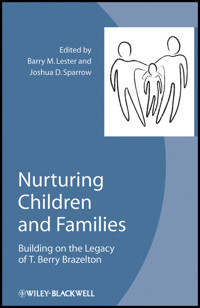
Nurturing Children and Families E-Book
32,99 €
Mehr erfahren.
- Herausgeber: John Wiley & Sons
- Kategorie: Geisteswissenschaft
- Sprache: Englisch
This volume celebrates the work and influence of T. Berry Brazelton, one of the world's foremost pediatricians, by bringing together contributions from researchers and clinicians whose own pioneering work has been inspired by Brazelton's foundations in the field of child development.
- Includes contributions from experts influenced by the work of Brazelton from a wide range of fields, including pediatrics, psychology, nursing, early childhood education, occupational therapy, and public policy
- Provides an overview of the field of child development, from the explosion of infant research in the 1960s to contemporary studies
- Outlines the achievements and influence of T. Berry Brazelton, one of the world's foremost pediatricians, and his lasting influence in continuing research, practice, and public policy
Sie lesen das E-Book in den Legimi-Apps auf:
Seitenzahl: 671
Veröffentlichungsjahr: 2011
Ähnliche




















Contents
Notes on Contributors
Preface
Acknowledgments
About T. Berry Brazelton
A Tribute to T. Berry Brazelton
Part I A Scientific Revolution in Behavioral and Developmental Research
Section I Changing Paradigms
1. Transforming the Research LandscapeBarry M. Lester
The Zeitgeist
View of the Baby
View of Infant-Parent Relationship
Models of Development
The Conduct of Research
References and further reading
2 Aligning Systems of Care with the Relational Imperative of DevelopmentJoshua D. Sparrow
Building Community through Collaborative Consultation
Transformative Ideas
Collaborative Consultation
Future Challenges
References and further reading
Section II Advances in Understanding Fetal and Newborn Behavior
3 Before Infant AssessmentAmy L. Salisbury
Historical Influences of Fetal Neurobehavioral Assessment
Fetal Neurobehavioral Assessment
Methods
Research Applications
Clinical Research
Clinical Applications
Conclusions
References and further reading
4 The Development of the NBASJ. Kevin Nugent
Background and History
A New Model of Newborn and Infant Development
The First Iteration of the Neonatal Behavioral Assessment Scale (NBAS)
The NBAS – Contents and Scoring
Research Uses
Uses of the NBAS in Different Cultural Settings
Clinical Uses of the NBAS
Scales Inspired by the NBAS
Conclusion – Looking Toward the Future
References and further reading
5 Keys to Developing Early Parent-Child RelationshipsKathryn E. Barnard
The Knowledge Base for Infant Caregiving
Infant Behaviors
Parent-Child Interaction
References and further reading
6 Prenatal Depression EffectsTiffany Field
Birth Complications
Neonates of Depressed Mothers
Prenatal Depression Effects on the Neonate
Prenatal Cortisol Levels are the Strongest Predictor of Prematurity and Low Birth Weight
Comorbid Effects of Other Moods
Therapies for Reducing Prenatal Depression and Neonatal Problems
Conclusion
References and further reading
Section III Self-Regulatory and Relational Processes
7 A New Look at Parent-Infant InteractionDaniel N. Stern
A Developmental View of the Arousal System
References and further reading
8 Infants and MothersEd Tronick
Self- and Mutual Regulation and Meaning Making
Introduction
Expanding States of Consciousness
The Mutual Regulation Model (MRM)
Meaning Making
Using the Theory to Think about Practice
Conclusion
References and further reading
Section IV Regression and Reorganization in Relational Models of Development
9 Patterns of Instability and ChangeMikael Heimann
Observations from Spain
Observations from Great Britain
Observations from Sweden
Conclusions
Acknowledgment
References and further reading
10 The Four Whys of Age-Linked Regression Periods in InfancyFrans X. Plooij
Introduction
Evolution of Regression Periods
Regression Period Development
Regression Period Causation
Regression Period Function
Epilogue
Acknowledgment
References and further reading
Section V Relational and Contextual Developmental Models
11 An Ethical Framework for Educating Children with Special Needs and All ChildrenStanley I. Greenspan
Stage 1
Stage 2
Stage 3
Stage 4
Stage 5
Stage 6
Stage 7
Stage 8
Stage 9
Future Challenges
References and further reading
12 Protective Environments in Africa and ElsewhereRobert A. LeVine
References and further reading
Section VI Neuroscience Perspectives on Relational and Developmental Models
13 A Neurobiological Perspective on the Work of Berry BrazeltonAllan N. Schore
Central Role of Arousal Regulation in Maternal–Infant Interactions
Interpersonal Neurobiology of Mother–Infant Face-to-Face Communications
Experience-Dependent Maturation of Right Brain Control Systems
References and further reading
14 Hidden Regulators Within the Mother–infant InteractionMyron Hofer
From Relationship to Interaction
Separation, Loss, and the Regulation of Development
Synchrony and Reciprocity
Maternal Entrainment of Infant Sleep–Wake State Organization
Implications
References and further reading
15 Temperaments as Sets of PreparednessJerome Kagan
What is Temperament?
High- and Low-Reactive Infants
References and further reading
Part II From Theory to Practice: Innovations in Clinical Intervention
Section I Preventive Interventions: Home Visitation
16 Touchpoints in a Nurse Home Visiting ProgramKristie Brandt and J. Michael Murphy
Introduction
Methods
Results
Discussion
Conclusion
Acknowledgment
Primary reference
Secondary references and further reading
17 The Nurse–Family PartnershipDavid L. Olds
Theory-driven
Research Designs, Methods, and Findings
Elmira Results
Memphis Results
Denver Results
Denver Results for Paraprofessionals
Denver Results for Nurses
Cost Savings
Policy Implications and Program Replication
References
Section II Early Interventions: The Care of Infants Born Preterm
18 Advances in the Understanding and Care of the Preterm InfantHeidelise Als
Introduction
The Preterm Infant, a Displaced Fetus
References and further reading
19 Fueling Development by Enhancing Infant–Caregiver RelationshipsRosemarie Bigsby
Regression in Normal Development
The Power of Shared Observation
“Talk to Me!” – The Communicative Infant–Caregiver Dance
Parental Involvement in Infant Care
Honoring Individual Sensory Thresholds
References and further reading
Section III Infant Mental Health and the Treatment of Early Trauma
20 Infant Mental HealthCharles H. Zeanah and Paula Doyle Zeanah
What is Infant Mental Health?
Importance of Early Experiences
Core Features of Infant Mental Health
Relational Focus
Scope of Infant Mental Health
Conclusions
References and further reading
21 Ghosts and Angels in the NurseryAlicia F. Lieberman and William W. Harris
References and further reading
22 Understanding and Helping Traumatized Infants and FamiliesJoy D. Osofsky and Howard J. Osofsky
The Problem of Abuse and Neglect
An Example of Trauma, Intervention, and Recovery
Trauma Symptoms in Young Children
Conclusions and Lessons Learned
References and further reading
23 Child MaltreatmentDante Cicchetti and Sheree L. Toth
Translating Research on the Developmental Sequelae of Child Maltreatment into Preventive Interventions
Attachment Organization
Representations of Caregivers and of Self
Translating Maltreatment Research into Practice
Early Intervention for Maltreated Preschoolers
From Research to Practice
References
Part III Translational Science: Implications for Professional Development, Systems of Care, and Policy
Section I Changing Practice and Improving Care through Professional Development
24 Developing the Infant Mental Health WorkforceLibby Zimmerman
What Competencies are Needed? What Programs and Policies Will Ensure that These Are Acquired?
What Helps Practitioners Shift Their Perspective? What Convinces Practitioners that Relationships Are Key?
Future Challenges – Scaling Relationship-based Infant Mental Health Workforce Development
References and further reading
25 The Touchpoints Approach for Early Childhood Care and Education ProvidersJayne Singer and John Hornstein
ECCE and the Touchpoints Approach
Training and Reflective Practice for ECCE Providers
Future Steps
References and further reading
26 Early Innovations in Behavioral/Developmental Pediatric Fellowship TrainingConstance H. Keefer
Introduction
Organization of the Fellowship
Conclusion
References and further reading
Section II Innovating Change in Service Delivery, Systems of Care, and Policy
27 The Birth of Child LifeMyra D. Fox
References and further reading
28 Improving Healthcare Service Delivery Systems and Outcomes with Relationship-based Nursing PracticesAnn C. Stadtler, Julie C. Novak, and Joshua D. Sparrow
Challenges Addressed by Developmental, Relationship-based Nursing Practices
Professional Development Supporting Change in Practice and Systems of Care
Future Challenges
References and further reading
29 Translating the Science of Early Childhood Development into Policy and PracticeDaniel Pedersen and Jack P. Shonkoff
Translating the Science of Early Childhood Development into Policy and Practice
The Promising Emergence of Educare
Creating the Future of Early Childhood Policy and Practice
References and further reading
30 Placing Relationships at the Core of Early Care and Education ProgramsFrancine Jacobs, Mallary I. Swartz, Jessica Dym Bartlett, and M. Ann Easterbrooks
The Development of Brazelton’s Approach to Early Relationships
The Touchpoints Training Model
Relationship-based Training Models for Early Childhood Providers
Policies Crediting Early Relationships
References and further reading
Section III Changing Ways of Being
31 Respect and Healing*Sara Lawrence-Lightfoot
References and further reading
Index
Praise for Nurturing Children and Families
“In this marvelous collection of leading thinkers and practitioners, Lester and Sparrow have reflected the wisdom of T. Berry Brazelton in the words of the scholars he has inspired. Nurturing Children and Families is a timely volume which will undoubtedly enlighten both experts and students alike.”
Matthew E. Melmed, Executive Director, Zero to Three
“The chapters represented in this edited volume represent a fitting tribute to ‘America’s Pediatrician.’ Written by a cadre of distinguished scholars, this book eloquently captures the essence of Dr. Brazelton’s many contributions to our understanding of child development.”
Charles A. Nelson III, Children’s Hospital Boston/Harvard Medical School
“Anyone who has heard T. Berry Brazelton speak will know why he has inspired so many researchers and clinicians. This book captures the inspiration of many who have listened and learned, and it will inspire you.”
Trecia Wouldes, University of Auckland
“This very impressive collection of papers by outstanding scholars is a fitting tribute to our nation’s greatest living pediatrician. Like Brazelton himself has done, these papers move pediatrics from children’s illnesses to their behavioral development with an emphasis on the all-important parent–child relationship.”
Edward Zigler, Yale University
“These two prominent editors provide a wealth of great information for parents, professionals, and everyone interested in the development of our children.”
Judith S. Palfrey, Children’s Hospital Boston
“This outstanding volume brings together groundbreaking research and profound clinical knowledge and celebrates the pioneering work of T. Berry Brazelton.”
Karl Heinz Brisch, LMU – Klinikum der Universität München
“The distinguished contributors in this volume reflect the diversity of disciplines and perspectives that both mirror and honor the scientific, clinical, practice, and policy contributions of T. Berry Brazelton. Those who want to bask in and relive the exciting engagement with infants and families throughout the second half of the 20th century, can do so in these chapters. Those who want to engage in the transformations required in the 21st century, read, imagine, and take action, knowing that Brazelton’s footsteps, though wide and encompassing, move quickly.”
Hiram Fitzgerald, Michigan State University
“T. Berry Brazelton has taught parents and pediatricians to perceive and respect the sociable vitality of a newborn baby and how a growing child seeks health and self-confidence in life with affectionate companions. This book, inspired by his life’s work, is important for all concerned with the well-being of children, their families, and our society.”
Colwyn Trevarthen, University of Edinburgh
“What a perfect tribute to Berry Brazelton – a book that brings together many of the seminal leaders from child development, medicine, and education whom he has nurtured so that they can nurture us with their groundbreaking work!”
Ellen Galinsky, President, Families and Work Institute
“This book is a treasure. Filled with the discoveries of brilliant scientists, it honors Berry Brazelton by mirroring his respectful approach to children and parents and his conviction that by really watching children we can find out what they need.”
J. Ronald Lally, Co-Director, Center for Child & Family Studies, WestEd
This book is dedicated to Christina Brazelton
This edition first published 2010
© 2010 Blackwell Publishing Ltd
Blackwell Publishing was acquired by John Wiley & Sons in February 2007. Blackwell’s publishing program has been merged with Wiley’s global Scientific, Technical, and Medical business to form Wiley-Blackwell.
Registered Office
John Wiley & Sons Ltd, The Atrium, Southern Gate, Chichester, West Sussex, PO19 8SQ, United Kingdom
Editorial Offices
350 Main Street, Malden, MA 02148-5020, USA
9600 Garsington Road, Oxford, OX4 2DQ, UK
The Atrium, Southern Gate, Chichester, West Sussex, PO19 8SQ, UK
For details of our global editorial offices, for customer services, and for information about how to apply for permission to reuse the copyright material in this book please see our website at www.wiley.com/wiley-blackwell.
The right of Barry M. Lester and Joshua D. Sparrow to be identified as the authors of the editorial material in this work has been asserted in accordance with the UK Copyright, Designs and Patents Act 1988.
All rights reserved. No part of this publication may be reproduced, stored in a retrieval system, or transmitted, in any form or by any means, electronic, mechanical, photocopying, recording or otherwise, except as permitted by the UK Copyright, Designs and Patents Act 1988, without the prior permission of the publisher.
Wiley also publishes its books in a variety of electronic formats. Some content that appears in print may not be available in electronic books.
Designations used by companies to distinguish their products are often claimed as trademarks. All brand names and product names used in this book are trade names, service marks, trademarks or registered trademarks of their respective owners. The publisher is not associated with any product or vendor mentioned in this book. This publication is designed to provide accurate and authoritative information in regard to the subject matter covered. It is sold on the understanding that the publisher is not engaged in rendering professional services. If professional advice or other expert assistance is required, the services of a competent professional should be sought.
Library of Congress Cataloging-in-Publication Data
Nurturing children and families: building on the legacy of T. Berry Brazelton/editors, Barry Lester and Joshua Sparrow.
p. cm.
Includes bibliographical references and index.
ISBN 978-1-4051-9600-0 (hbk.: alk. paper) 1. Child development. 2. Infants–Development. 3. Child psychology. 4. Infant psychology. 5. Parent and child. 6. Parent and infant. 7. Brazelton, T. Berry, 1918– I. Lester, Barry M. II. Sparrow, Joshua D.
RJ131.N88 2010
618.92–dc22
2009053161
Notes on Contributors
Heidelise Als, PhD is Associate Professor in Psychiatry, Harvard Medical School and Director of Neurobehavioral Infant and Child Studies at Children’s Hospital Boston. Dr. Als has received numerous awards in recognition of her outstanding leadership in the developmental assessment and care of preterm and high-risk infants, and most recently was the recipient of the Stan and Mavis Graven Award for Leadership in Enhancing Physical and Developmental Environments for High-Risk Infants and their Families. She is the originator of the Newborn Individualized Developmental Care and Assessment Program (NIDCAP) approach for the care of preterm infants and their families, and the founder and President of the NIDCAP Federation International, a nonprofit organization which provides national and international training for advanced professionals in the field of NICU developmental care implementation.
Kathryn E. Barnard, RN, PhD is Professor Emeritus of Nursing and the founder and Director of the Center on Infant Mental Health and Development at the University of Washington. Her pioneering work to improve the physical and mental health outcomes of infants and young children has earned her numerous honors, including the Gustav O. Leinhard Award from the Institute of Medicine; the Lucille Petry Leone Award for Teaching; the M. Scott Award for Contributions to Nursing Science, Education and Service; the Martha May Eliot Award for Leadership in Maternal-Child Health; Nurse Scientist of the Year Award; and, from the American Academy of Nursing, both the Episteme Award, the highest honor in nursing, and the Living Legend Award.
Jessica Dym Bartlett, MA, MSW, LICSW is a psychotherapist who has worked with children and families, childcare programs, and school systems for over 15 years. She is an adjunct faculty member at the Boston University School of Social Work where she teaches courses on resilience through the life span, human behavior in the social environment, and clinical practice with children and adolescents. Bartlett’s research and publications focus on resilience, infant/early childhood mental health, and child maltreatment.
Rosemarie Bigsby, ScD, OTR/L, FAOTA is Clinical Associate Professor of Pediatrics and of Psychiatry and Human Behavior, and Coordinator of NICU Services at the Center for the Study of Children At Risk, Brown University, Alpert Medical School and Women & Infants’ Hospital. Dr. Bigsby was named a Fellow of the American Occupational Therapy Association for her contributions to the practice of occupational therapy with infants and children. She is the author of a number of journal articles and book chapters, and is co-author of a textbook on NICU practice: Developmental and TherapeuticInterventions in the NICU, and a motor assessment tool: The Posture and Fine Motor Assessment of Infants (Psychological Corporation).
Kristie Brandt, CNM, MSN, DNP a board certified nurse-midwife, is the Director of the Parent–Infant & Child Institute in Napa, CA and co-developer and Director of the University of Massachusetts Boston Infant-Parent Mental Health Post-Graduate Certificate Program in Napa, CA, a 15-month training program for professionals. While Napa County’s Chief Public Health Manager, she developed and researched the nation’s first Touchpoints Perinatal Home Visiting Project, and she created and oversaw Napa’s Therapeutic Child Care Center, serving highrisk children 0–5 in a full-day, full-year therapeutic program. Dr. Brandt is a v isiting faculty member of the Brazelton Touchpoints Center at Children’s Hospital Boston. She is author of the new book, Facilitating the Reflective Process: An Introductory Workbook for the Infant–Family and Early Childhood Field (2009).
Geoffrey Canada, MEd is the acclaimed author of Fist Stick Knife Gun: A Personal History of Violence in America and was the recipient of the first Heinz Award in 1994 for his work as President/CEO of Harlem Children’s Zone in New York City. Since 1990, Mr. Canada has been the President and Chief Executive Officer for the Harlem Children’s Zone. In a June 2004 cover story in the New York Times Magazine, the agency’s Zone Project was called “one of the most ambitious social experiments of our time.” The Project offers an interlocking network of social service, education and community-building programs to thousands of children and families in a 60-block area of Central Harlem.
Dante Cicchetti, PhD is McKnight Presidential Chair and Professor of Child Psychology and Psychiatry at the University of Minnesota. Dr. Cicchetti has received a number of awards, including the three highest honors of the Developmental Division of the American Psychological Association: the G. Stanley Hall Award for Distinguished Contribution to Developmental Psychology, the Urie Bronfenbrenner Award for Lifetime Contribution to Developmental Psychology in the Service of Science and Society, and the Mentor Award in Developmental Psychology. He has published over 400 articles, books, and journal Special Issues that have had far-reaching impact on developmental theory as well as science, policy, and practice related to child maltreatment, depression, mental retardation, and numerous other domains of development. Dr. Cicchetti is the founding and current editor of Development and Psychopathology.
M. Ann Easterbrooks, PhD is Professor in the Eliot-Pearson Department of Child Development at Tufts University. She is Co-Principal Investigator of the Massachusetts Healthy Families Evaluation, examining the efficacy of Healthy Families Massachusetts, a statewide child maltreatment prevention program. Dr. Easterbrooks’s publications include chapters, research articles, and edited volumes on a range of topics, including: healthy social and emotional development in the context of psychosocial risk factors such as depression and trauma; father–child relationships in infancy and early childhood; the developmental course of parent–child attachment relationships; and promoting positive relationships in early education and care. She chairs the Publications Committee of the Society for Research in Child Development.
Tiffany Field, PhD is Director of the Touch Research Institutes at the University of Miami School of Medicine and Fielding Graduate University. She is recipient of the American Psychological Association Boyd McAndless Distinguished Young Scientist Award and has had a Research Scientist Award from the NIH for her research career. She is the author of Infancy,The Amazing Infant, Touch, Advances in Touch, Touch Therapy, MassageTherapy Research, and Complementary and Alternative Therapies, the editor of a series of volumes on High-Risk Infants, and on Stress and Coping, and the author of over 450 journal papers.
Myra D. Fox, BS is the former Director of Child Life Services at Children’s Hospital Boston where she devoted her career to the special needs of hospitalized children and their families until her retirement in 2008. In later years her responsibilities included Director of Volunteer Services, with responsibilities for the Big Apple Clown Care Unit, music and art therapy. She also developed a comprehensive educational/tutoring program for hospitalized children that also included home teaching. Fox has been a consultant to pediatric hospitals and to children’s television programs and has helped establish a child life program in Sao Paulo, Brazil.
Stanley I. Greenspan, MD was, until his death in April 2010, Clinical Professor of Psychiatry and Pediatrics at George Washington University Medical School, Chair of the Interdisciplinary Council on Developmental and Learning Disorders, and Chair of the Psychodynamic Diagnostic Manual Task Force, which represented many major psychoanalytic organizations. He was the founding President of Zero to Three: The National Center for Infants, Toddlers, and Families, and past Director of the NIMH Mental Health Study Center and the Clinical Infant Development Program. Dr. Greenspan was the recipient of many national and international awards, including the American Psychiatric Association’s highest honor for child psychiatry research, author of over 100 scholarly articles and chapters and author or editor of over 40 books, translated into over a dozen languages, including The IrreducibleNeeds of Children co-authored with T. Berry Brazelton, MD.
William W. Harris, PhD is a senior fellow at the Jonathan M. Tisch College of Citizenship and Public Service at Tufts University. He founded KidsPac, a political action committee dedicated to sound public policies for poor children from birth to age six and their families. He has served on numerous advisory committees, including the American Psychiatric Association’s Presidential Task Force on the Biopsychosocial Consequences of Childhood Violence. Harris has received several awards for his work on behalf of children, including the Advocacy Award, Division of Child, Youth and Family Services, from the American Psychological Association, the Dale Richmond Award from the American Academy of Pediatrics, the Leadership Award for Public Service from Zero to Three, and the Public Advocacy Award from the International Society for Traumatic Stress Studies.
Mikael Heimann, PhD is a Professor of Psychology at the Department of Behavioral Science, Linköping University, Sweden, Co-Director of the Swedish Institute for Disability Research, Linköping, and a senior researcher at the Norwegian Network for Infant Mental Health, Oslo, Norway. He worked clinically at the Clinic for Child and Adolescent Psychiatry, Gothenburg, Sweden, and was Professor and Head of a Centre of Child and Adolescent Mental Health, University of Bergen, Norway. Dr. Heimann’s research focuses on developmental processes (change processes and regression periods), infant cognition (imitation, memory, and attention), early social skills (neonatal imitation and mother–infant interaction), and early communicative development and developmental psychopathology (children with autism and sustained withdrawal in infancy). His interests also include intervention studies aimed at increasing social interaction skills as well as literacy (e.g., in children with autism and children with suspected dyslexia, “slow readers”).
Myron Hofer, MD is Sackler Professor and Director of the Sackler Institute of Developmental Psychobiology in the Department of Psychiatry at Columbia University College of Physicians and Surgeons. Throughout his research career, Dr. Hofer has worked at the interface of biology and psychology, and helped to define the new field of Developmental Psychobiology as it emerged in the 1970s and 1980s. Through an experimental analysis of the psychobiological events that enmesh the infant rat and its mother, he discovered hidden regulatory processes that have become the basis for a new understanding of the early origins of attachment, the dynamics of the separation response, and the shaping of development by that first relationship. Dr. Hofer has served on the editorial boards of Behavioral Neuroscience, the Journal of Psychosomatic Research,Developmental Psychobiology and Psychosomatic Medicine. He is the author/co-author of five books – including The Roots of Human Behavior as well as numerous journal articles, book chapters, monographs, and theoretical papers.
John Hornstein, EdD has worked in the field of early child development for over 30 years. His research focuses on the emotional development in young children with additional interest in cross-cultural issues, parenting, and creativity. He participated in the development of the AIMS Indicators of Emotional Health, and conducted research on its psychometric properties. Dr. Hornstein was on the faculty of the Department of Education at the University of New Hampshire for 13 years, teaching in early childhood education, special education, and undergraduate honors programs. As a research associate at Children’s Hospital and Harvard Medical School in Boston, Dr. Hornstein serves as a faculty member of the Brazelton Touchpoints Center. Areas of focus at Touchpoints include work with Native American sites and the development of training in working with families of children with special needs.
Francine Jacobs, EdD is an Associate Professor in the Eliot-Pearson Department of Child Development and the Department of Urban and Environmental Policy and Planning at Tufts University. Her research focuses on programs and policies meant to improve the life circumstances for children and families, including those in early childhood education, child welfare and child protection, juvenile justice, and family support; she has evaluated a range of these interventions in the United States and elsewhere. She is the co-Principal Investigator of the Massachusetts Healthy Families Evaluation.
Jerome Kagan, PhD is Emeritus Professor of Psychology at Harvard University. His research has addressed infant cognitive development, morality, the role of culture, and the contribution of temperamental biases to personality development. Kagan is a fellow of the American Academy of Arts and Sciences, a member of the Institute of Medicine of the National Academy of Sciences, and recipient of distinguished scientist awards from the American Psychological Association and the Society for Research in Child Development. He is the author or co-author of several hundred articles and many books including: Galen’s Prophecy; The Nature of the Child; Three Seductive Ideas; The Long Shadow of Temperament; A Young Mind in aGrowing Brain; The Three Cultures; and a forthcoming book titled TheTemperamental Thread.
Constance H. Keefer, MD is Assistant Professor of Pediatrics at Harvard Medical School and on the faculties of Newborn Medicine at Brigham and Women’s Hospital and the Brazelton Institute and Brazelton Touchpoints Center at Children’s Hospital. Dr. Keefer has done research on newborn behavior and child development, culture and parenting, and communication in healthcare. She focuses her teaching on development and behavior in pediatric primary care and application of the Touchpoints Approach. She co-authored Understanding Newborn Behavior and Early Relationships:The Newborn Behavioral Observation (NBO) System Handbook, and has contributed chapters on child development, newborn behavior, cultural perspective on behavior and development, the shy child, and nursery care of the newborn.
Sara Lawrence-Lightfoot, EdD, a MacArthur-prize-winning sociologist, is the Emily Hargroves Fisher Professor of Education at Harvard University. Educator, researcher, author and public intellectual, Lawrence-Lightfoot has written nine books including The Good High School: Portraits of Character and Culture; Balm in Gilead: Journey of a Healer; Respect: AnExploration; The Essential Conversation: What Parents and Teachers Can Learn From Each Other; and her most recent, The Third Chapter: Passion,Risk, and Adventure in the 25 Years After 50. Her volume, The Art and Scienceof Portraiture, documents her pioneering approach to social science methodology which bridges the realms of aesthetics and empiricism. LawrenceLightfoot is the recipient of numerous honors including Harvard’s George Ledlie Prize for research that “makes the most valuable contribution to science” and is for “the benefit of mankind.” She is a Spencer Senior Scholar; and was named the Margaret Mead Fellow by the American Academy of Political and Social Sciences.
Barry M. Lester, PhD is Professor of Psychiatry and Human Behavior, Professor of Pediatrics and founding Director of the Center for the Study of Children at Risk, Brown University Alpert Medical School and Women and Infants Hospital. His research has addressed processes of development in children at risk due to biological and social factors. His research has been continuously funded by the NIH for over 25 years. Dr. Lester was a member of the Council at the NIH National Institute on Drug Abuse. He directs the Infant and Child Mental Health Post-Baccalaureate Certificate Program at Brown University and is past President of the International Association for Infant Mental Health. He is the author of several hundred peer-reviewed publications and 16 books, including Why is My Baby Crying?
Robert A. LeVine, PhD is Roy E. Larsen Professor of Education and Human Development, Emeritus, Harvard University. He worked with Dr. Brazelton in Kenya from 1974 to 1976; they are co-authors of Child Care and Culture:Lessons from Africa (1994). Dr. LeVine’s most recent book is Anthropologyand Child Development: A Cross-Cultural Reader, co-edited with Rebecca Staples (New Malden, MA: Blackwell Publishers).
Alicia F. Lieberman, PhD is Irving B. Harris Professor Endowed Chair, Professor and Vice Chair for Academic Affairs at the UCSF Department of Psychiatry and Director of the Child Trauma Research Program at San Francisco General Hospital. She is President of the board of directors of Zero to Three: The National Center for Infants, Toddlers and Families, and author of The Emotional Life of the Toddler and senior author of Psychotherapywith Infants and Young Children: Repairing the Effects of Stress and Traumaon Early Attachment; Losing a Parent to Death in the Early Years: TreatingTraumatic Bereavement in Infancy and Early Childhood; and Don’t Hit myMommy: A Manual for Child-Parent Psychotherapy with Young Witnesses of Family Violence; and of numerous articles and chapters.
J. Michael Murphy, EdD is a psychologist with the Child Psychiatry Service at the Massachusetts General Hospital where he has worked for more than 25 years, and Associate Professor of Psychology at the Harvard Medical School where he teaches research methodology to psychiatric residents. He has collaborated with the U.S. Government Department of Agriculture, Maternal and Child Health Bureau, the Center for Disease Control (CDC), and numerous states and cities and is currently working with the government of Chile to evaluate a large school-based mental health program there. He has published more than 50 papers in academic journals. For more than a decade Dr. Murphy has been a research consultant to Napa County Health and Human Services, helping to evaluate the implementation of the Touchpoints program there as well as the county’s nurse home visiting programs and a therapeutic childcare center.
Julie C. Novak, DNSc, RN, CPNP, FAANP is Associate Dean for Practice, University of Texas Health Science Center San Antonio School of Nursing and Crow Endowed Professor. She continues to support special projects in the Center for Instructional Excellence at Purdue University where she served as School of Nursing Head and Director, DNP program and nursemanaged clinics and has grant support for two rural nurse- managed clinics. Her research addresses global child and family health promotion, public health safety and quality improvement, rural healthcare, and nursing education and practice. Dr. Novak is a Fellow of the American Academy of Nurse Practitioners and the National Association of Pediatric Nurse Practitioners. The recipient of numerous awards, Dr. Novak has authored or co-authored over 70 articles, book chapters, and a textbook.
J. Kevin Nugent, PhD is Founder and Director of the Brazelton Institute at the Division of Developmental Medicine, Children’s Hospital Boston. He is Professor of Child and Family Studies at the University of Massachusetts at Amherst and a Lecturer in Psychology at Harvard Medical School. He is co-author with Dr. Brazelton of the Neonatal Behavioral Assessment Scale(NBAS), 3rd edition. Recently, Dr. Nugent and his colleagues developed the Newborn Behavioral Observations (NBO) system, an adaptation of the NBAS as a clinical tool for clinicians in pediatric and intervention settings. Dr. Nugent is author or co-author of many articles and books including The Newborn as Person: Enabling Healthy Infant Development Worldwide; Understanding Newborn Behavior and Early Relationships: The Handbook ofthe Newborn Behavioral Observations (NBO) System; The Infant and Familyin the 21st Century; The Cultural Context of Infancy; Using the NBAS withInfants and Families: Guidelines for Intervention.
David L. Olds, PhD is Professor of Pediatrics, Psychiatry, Preventive Medicine, and Nursing at the University of Colorado, Denver, where he directs the Prevention Research Center for Family and Child Health. He has devoted his career to investigating methods of preventing health and developmental problems in children and parents from low-income families. The primary focus of his work has been on developing and testing in a series of randomized controlled trials a program of prenatal and infancy home visiting by nurses for socially disadvantaged mothers bearing first children, known today as the Nurse-Family Partnership. A member of the American Pediatrics Society, the Society for Prevention Research, and the Academy of Experimental Criminology, Professor Olds has received numerous awards for his work, including the Lela Rowland Prevention Award from the National Mental Health Association, a Senior Research Scientist Award from the National Institute of Mental Health, the Brooke Visiting Professorship in Epidemiology from the Royal Society of Medicine, and the Stockholm Prize in Criminology.
Howard J. Osofsky, MD, PhD is Kathleen and John Bricker Chair, Department of Psychiatry at Louisiana State University Health Sciences Center. He has served as Co-Director of the Louisiana Rural Trauma Services Center, part of the National Child Traumatic Stress Network. In the aftermath of Hurricane Katrina, he was asked to be Clinical Director for Louisiana Spirit. Dr. Osofsky received the award as “Best Department Chair” from the American Academy of Child and Adolescent Psychiatry in recognition of his efforts for children and adolescents. He has received the Sarah Haley Award for Clinical Excellence from the International Society for Traumatic Stress Studies, the Public Citizen of the Year Award by the Louisiana Chapter of the National Association of Social Workers and the Department of Psychiatry, and the Distinguished Partners in Education Award by the Board of Elementary and Secondary Education of the State Department of Education for their work in schools following Hurricane Katrina.
Joy D. Osofsky, PhD is a psychologist and psychoanalyst and Professor of Pediatrics and Psychiatry at Louisiana State University Health Sciences Center (LSUHSC) in New Orleans. She is Head of the Division of Pediatric Mental Health. Dr. Osofsky is Co-Director of the Louisiana Rural Trauma Services Center, a center in the National Child Traumatic Stress Network and Director of the Harris Center for Infant Mental Health at LSUHSC. She is editor of Children in a Violent Society and Young Children and Trauma: Intervention and Treatment. Dr. Osofsky is past President of Zero to Three: National Center for Infants, Toddlers, and Families and past President of the World Association for Infant Mental Health. She has received the Sarah Haley Award for Clinical Excellence for work with trauma from the International Society for Traumatic Stress Studies. The LSUHSC team from the Department of Psychiatry was awarded the Distinguished Partners in Education Award by the Board of Elementary and Secondary Education of the State Department of Education for their work in schools following Hurricane Katrina.
Daniel Pedersen, MA is founding President of the Buffett Early Childhood Fund, which invests in education where America is most underinvested: the first five years of life. Under Pedersen’s leadership, the foundation also is helping to build a coast-to-coast network of independently evaluated, highly effective Educare schools. Each school serves nearly 200 infants, toddlers and preschoolers in families facing the most difficult odds. Each school also functions as a catalyst for broader policy change within its community and state. In addition, Pedersen chairs the Birth to Five Policy Alliance and the executive policy council of the First Five Years Fund. The Alliance galvanizes state-based advocacy groups and more than a dozen national organizations committed to improving state early childhood policies. The First Five Years Fund forges change in federal policy making and national communications about early childhood. Pedersen was instrumental in creating the Educare network and both policy entities. Today, all three enterprises are backed by several nationally significant charitable foundations which are intent on finding new ways to work together on behalf of children at risk of school failure.
Frans X. Plooij, PhD is Director of the International Research-Institute on Infant Studies. He studied animal psychology with Adriaan Kortlandt, University of Amsterdam, the Netherlands, and biology of behavior with Gerard Baerends, University of Groningen, the Netherlands. He worked with Jane Goodall in the Gombe National Park on infant development in free-living chimpanzees; with Robert Hinde in the MRC-unit on the Development and Integration of Behaviour, University Sub-Department of Animal Behaviour in Madingley, Cambridge, England; at the department of Developmental Psychology, University of Nijmegen, the Netherlands, where he studied and filmed babies in the home environment. He has served as Vice-President for Information of the International Society for Human Ethology, Vice-President of the Institut Européen pour le Développement des Potentialités de tous les Enfants (IEDPE), and on the editorial board of the international journal Ethology and Sociobiology, and he is a member of the panel of assessors of the Journal of Clinical ChildPsychology and Psychiatry.
Amy L. Salisbury, PhD, APRN, BC trained as a clinical nurse specialist in child and family psychiatry and holds a PhD in developmental psychobiology. Her research examines prenatal and postnatal neurobehavioral development within a larger biopsychosocial framework. Dr. Salisbury heads the Fetal Behavior Studies Program at the Center for the Study of Children At Risk, Brown University, Alpert Medical School and Women and Infants’ Hospital examining fetal and infant neurobehavioral development. Dr. Salisbury and her colleagues have developed an organized a method of assessing fetal neurobehavior, called the Fetal Neurobehavior Coding System (FENS), which is currently being used to study the effects of fetal exposure to maternal depression, anxiety, antidepressant medications, opiates, and maternal smoking.
Allan N. Schore, PhD is on the clinical faculty of the UCLA David Geffen School of Medicine. He is author of three seminal volumes, Affect Regulationand the Origin of the Self, Affect Dysregulation and Disorders of the Self, and AffectRegulation and the Repair of the Self, as well as numerous articles and chapters. He is editor of the acclaimed Norton Series on Interpersonal Neurobiology, and a reviewer on the editorial staff of 35 journals across a number of scientific and clinical disciplines. He is a member of the Society of Neuroscience, and of the American Psychological Association Divisions of Neuropsychol ogy and of Psychoanalysis, from which he received its Scientific Award.
Jack P. Shonkoff, MD is the Julius B. Richmond FAMRI Professor of Child Health and Development at the Harvard School of Public Health and the Harvard Graduate School of Education; Professor of Pediatrics at Harvard Medical School and Children’s Hospital Boston; and Director of the universitywide Center on the Developing Child at Harvard University. He also chairs the National Scientific Council on the Developing Child, a multi-university collaboration comprising leading scholars in neuroscience, psychology, pediatrics, and economics, whose mission is to bring credible science to bear on policy affecting young children. Under the auspices of the National Academy of Sciences, Dr. Shonkoff chaired a blue-ribbon committee that produced a landmark report entitled, From Neurons to Neighborhoods: The Science of Early Childhood Development. He has received multiple honors, including elected membership to the Institute of Medicine of the National Academy of Sciences, designated National Associate of the National Academies, the C. Anderson Aldrich Award in Child Development from the American Academy of Pediatrics, and the Award for Distinguished Contributions to Public Policy for Children from the Society for Research in Child Development. He has authored more than 150 publications.
Jayne Singer, PhD, a clinical psychologist, is Clinical Director of the Child and Parent Program in the Developmental Medicine Center at Children’s Hospital Boston. She is an Assistant Professor of Pediatrics and Psychiatry at the Harvard Medical School, and serves as President of the Massachusetts Association for Infant Mental Health. Dr. Singer serves as a faculty member of the Brazelton Touchpoints Center where she provides leadership for the Early Care and Education (ECE) Initiative and is the primary contributor to the ECE Training Materials.
Joshua D. Sparrow, MD is Director of Special Initiatives at the Brazelton Touchpoints Center, Children’s Hospital, Boston, and Assistant Professor in Psychiatry at the Harvard Medical School. He has co-authored eight books with Dr. T. Berry Brazelton, and revised with him the second edition of Touchpoints Birth to Three: Your Child’s Emotional and BehavioralDevelopment. His work focuses on the social determinants of development and health, and culturally informed adaptations of interventions that catalyze community healing and self-strengthening processes.
Ann C. Stadtler, MSN, CPNP, one of the original faculty members and curriculum developers at the Brazelton Touchpoints Center (BTC), Children’s Hospital Boston, is Director of Site Development and Training. She has received numerous awards including the Touchpoints Distinguished Leader Award. She co-designed “Toilet School,” a group treatment approach to failure to toilet train. Stadtler’s work at the Brazelton Touchpoints Center includes the integration of parent voices into a systems theory-based approach for infants and families.
Daniel N. Stern, MD is Professeur Honoraire in the Faculté de Psychologie, University of Geneva, Switzerland, Adjunct Professor in the Department of Psychiatry, Cornell University Medical School, and New York Hospital Lecturer at the Columbia University Center for Psychoanalysis. Professor Stern is the author of several hundred journal articles and chapters, as well as six books, including The First Relationship: Infant and Mother – his first book – and The Motherhood Constellation: A Unifying View of Parent–InfantPsychotherapies. Professor Stern has been awarded an Honorary Doctorate at the University of Copenhagen, Denmark, the University of Mons Hinault, Belgium, and the University of Palermo, Italy.
Mallary I. Swartz, PhD is Director of Research and Evaluation at Connected Beginnings Training Institute in Boston, Massachusetts. Dr. Swartz has worked on multiple research and evaluation studies related to early care and education at Frank Porter Graham Child Development Center at the University of North Carolina at Chapel Hill, at the University of Pittsburgh, at the Children’s Museum of Pittsburgh, and at Tufts University, where she worked as a research analyst on the Evaluation of the Touchpoints Early Care and Education Initiative. Dr. Swartz also worked with organizations in New Orleans to rebuild and enhance the quality of childcare and to develop a family childcare curriculum for the state of Louisiana.
Sheree L. Toth is an Associate Professor of Clinical and Social Psychology at the University of Rochester and the Director of Mt. Hope Family Center. She has published in the areas of the developmental consequences of child maltreatment and the impact that Major Depressive Disorders exert on offspring and has completed a randomized clinical trial of Interpersonal Psychotherapy with low-income depressed mothers. Dr. Toth is an Associate Editor for the journal Development and Psychopathology and a past Associate Editor of The Journal of Child and Family Studies. She has contributed chapters to numerous books, including The Handbook of Child Psychology andDevelopmental Psychopathology, and she has co-edited The Rochester Symposium on Developmental Psychopathology. She received the 2006 award from the American Professional Society on the Abuse of Children for the publication of an outstanding research article in the area of child maltreatment.
Ed Tronick, PhD is a University Distinguished Professor of Psychology at the University of Massachusetts, Boston, Director of the Child Development Unit at Children’s Hospital, a Lecturer in Pediatrics, Harvard Medical School and an Associate Professor at both the Graduate School of Education and the School of Public Health at Harvard. He is a faculty member at the Fielding Graduate Institute and a member of the Boston Psychoanalytic Society and Institute. With Dr. Kristie Brandt, he is Co-Director of the Napa Parent-Infant Mental Health Fellowship Program and he is a faculty member of the Brazelton Touchpoints Center. He has published more than 200 scientific articles and four books. His research has been funded by the National Institute on Drug Abuse, the National Institute of Child Health and Development, the National Institute of Mental Health (NIMH), the National Science Foundation, and the McArthur Foundation. He has also served as permanent member of an NIMH review panel, and reviews for the National Science Foundations of Canada, the USA and Switzerland.
Charles H. Zeanah, MD is the Mary K. Sellars-Polchow Chair in Psy chiatry, Professor of Clinical Pediatrics, and Vice Chair for Child and Adolescent Psychiatry in the Department of Psychiatry and Neurology at Tulane University School of Medicine in New Orleans. He is also Executive Director of the Institute for Infant and Early Childhood Mental Health at Tulane. He is the recipient of the Rieger Award for Service Excellence and the Irving Phillips Award for Prevention from the American Academy of Child and Adolescent Psychiatry (AACAP), the Presidential Citation for Distinguished Research and Leadership in Infant Mental Health from the American Orthopsychiatric Association, the Sarah Haley Memorial Award for Clinical Excellence from the International Society for Traumatic Stress Studies, and the Blanche F. Ittelson Award for Research in Child Psychiatry from the American Psychiatric Association. Dr. Zeanah is a Fellow of AACAP, a Distinguished Fellow of the American Psychiatric Association, and a Board Member of Zero to Three. He is the editor of the Handbook of Infant MentalHealth.
Paula Doyle Zeanah, PhD, MSN, RN is Professor of Clinical Psychiatry and Pediatrics at the Tulane University School of Medicine, and adjunct faculty, School of Public Health and Tropical Medicine at Tulane. Dr. Zeanah serves as Chief of the Psychology Division in the Department of Psychiatry at Tulane, and Co-Director of the Pediatric Psychiatry Consultation-Liaison service at Tulane Hospital. She has served for more than a decade as a mental health consultant for the Louisiana Office of Public Health, Maternal Child Health section, and has conducted numerous large-scale research projects.
Libby Zimmerman, PhD, LICSW was, until her death in August 2009, founding Executive Director of Connected Beginnings Training Institute in Boston, Massachusetts. She held a PhD from the Heller School for Social Policy and Management, Brandeis University and an MSW from the University of Michigan. Dr. Zimmerman’s published research explores the development of relationships between infants and their significant caregivers. With Early Intervention program leaders in Massachusetts, she created IN-TIME, a widely used 36-hour course in infant mental health. Before founding Connected Beginnings, Dr. Zimmerman served as a Senior Early Childhood Associate with the Early Head Start Resource Center at Zero to Three. In that position she was the lead writer for Pathways to Prevention, a guide for integrating infant mental health principles into Early Head Start agency practices.
Preface
This book is the fruit of over half a century of labor, not by a single individual only, nor even a single field of inquiry and practice, but by a multitude of individuals in a wide range of fields working to nurture infants, children, and their families with T. Berry Brazelton’s seminal ideas, and those he helped to crystallize and communicate. Intended to bring together some of the most pioneering and exhilarating work in the fields of developmental psychology, pediatric healthcare, public health, education, and policy for students of development, the idea for this textbook first emerged as the occasion of T. Berry Brazelton’s ninetieth birthday on May 10, 2008 approached.
Lesen Sie weiter in der vollständigen Ausgabe!
Lesen Sie weiter in der vollständigen Ausgabe!
Lesen Sie weiter in der vollständigen Ausgabe!
Lesen Sie weiter in der vollständigen Ausgabe!
Lesen Sie weiter in der vollständigen Ausgabe!
Lesen Sie weiter in der vollständigen Ausgabe!
Lesen Sie weiter in der vollständigen Ausgabe!
Lesen Sie weiter in der vollständigen Ausgabe!
Lesen Sie weiter in der vollständigen Ausgabe!
Lesen Sie weiter in der vollständigen Ausgabe!
Lesen Sie weiter in der vollständigen Ausgabe!
Lesen Sie weiter in der vollständigen Ausgabe!
Lesen Sie weiter in der vollständigen Ausgabe!
Lesen Sie weiter in der vollständigen Ausgabe!
Lesen Sie weiter in der vollständigen Ausgabe!
Lesen Sie weiter in der vollständigen Ausgabe!
Lesen Sie weiter in der vollständigen Ausgabe!
Lesen Sie weiter in der vollständigen Ausgabe!
Lesen Sie weiter in der vollständigen Ausgabe!
Lesen Sie weiter in der vollständigen Ausgabe!
Lesen Sie weiter in der vollständigen Ausgabe!
Lesen Sie weiter in der vollständigen Ausgabe!
Lesen Sie weiter in der vollständigen Ausgabe!
Lesen Sie weiter in der vollständigen Ausgabe!
Lesen Sie weiter in der vollständigen Ausgabe!
Lesen Sie weiter in der vollständigen Ausgabe!
Lesen Sie weiter in der vollständigen Ausgabe!
Lesen Sie weiter in der vollständigen Ausgabe!
Lesen Sie weiter in der vollständigen Ausgabe!
Lesen Sie weiter in der vollständigen Ausgabe!
Lesen Sie weiter in der vollständigen Ausgabe!
Lesen Sie weiter in der vollständigen Ausgabe!
Lesen Sie weiter in der vollständigen Ausgabe!
Lesen Sie weiter in der vollständigen Ausgabe!
Lesen Sie weiter in der vollständigen Ausgabe!
Lesen Sie weiter in der vollständigen Ausgabe!
Lesen Sie weiter in der vollständigen Ausgabe!
Lesen Sie weiter in der vollständigen Ausgabe!
Lesen Sie weiter in der vollständigen Ausgabe!
Lesen Sie weiter in der vollständigen Ausgabe!
Lesen Sie weiter in der vollständigen Ausgabe!
Lesen Sie weiter in der vollständigen Ausgabe!
Lesen Sie weiter in der vollständigen Ausgabe!
Lesen Sie weiter in der vollständigen Ausgabe!
Lesen Sie weiter in der vollständigen Ausgabe!
Lesen Sie weiter in der vollständigen Ausgabe!
Lesen Sie weiter in der vollständigen Ausgabe!
Lesen Sie weiter in der vollständigen Ausgabe!
Lesen Sie weiter in der vollständigen Ausgabe!
Lesen Sie weiter in der vollständigen Ausgabe!




