


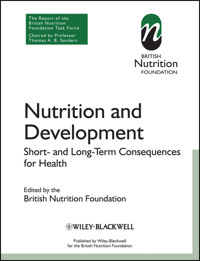
Nutrition and Development E-Book
71,99 €
Mehr erfahren.
- Herausgeber: John Wiley & Sons
- Kategorie: Fachliteratur
- Serie: British Nutrition Foundation
- Sprache: Englisch
This Task Force report reviews the evidence that the seeds of many adult diseases are sown in utero and in infancy. The report, written by experts in the field, summarises current knowledge in this area. It illustrates how early life nutrition can bring about changes in organ development and function, thus programming risk of disease in adult life. It also considers what might be done in early life to reduce the burden of future ill health.
Nutrition and Development: Short- and Long-Term Consequences for Health includes chapters on the history of this topic area, normal growth and development, and current recommendations and practice in relation to nutrition and diet in early life. Chapters exploring the possible mechanisms and pathways of critical windows for development cover the effects of diet and nutrition in early life on organ and skeletal development, the role of sex hormones in programming disease susceptibility, the establishment of gastrointestinal microbiota, and the impact of early life nutrition on cognitive and neurological development.
This new report:
• describes how development occurs and explores how changes in the fetal and postnatal environment, such as over- or under-nutrition, can result in permanent alterations in function;
• explains how diet and nutrition in early life can affect risk of adult disease, with specific chapters on allergic disease and asthma, bone health, cancer, cardiovascular disease, cognitive function, diabetes and obesity;
• includes a summary of the key points, as well as recommendations in each chapter to help fill the gaps in our knowledge;
• provides an overview of the main messages in a practical question and answer format suitable for lay readers.
Nutrition and Development is an important information resource for those involved in research and teaching in the health sciences sector and is also of value to those involved in making decisions about health policy. It will be of interest to a broad range of health professionals, the food industry and those who write and broadcast about the effects of food on health.
Sie lesen das E-Book in den Legimi-Apps auf:
Seitenzahl: 1084
Veröffentlichungsjahr: 2013
Ähnliche




















Table of Contents
Title page
Copyright page
Foreword
Terms of Reference
Task Force Membership
Chair
Members
Observer
Contributors
Editors
Secretariat
1: Introduction to Early Life and Later Disease
1.1 Environmental influences on development
1.2 Links between early life and adult disease
1.3 Biological mechanisms
1.4 Nutrition of mothers and children
1.5 Nutrition of young women today
2: Normal Growth and Development
2.1 Introduction
2.2 Prenatal development
2.3 Embryo development
2.4 Fetal development
2.5 Fetal development overview
2.6 Birthweight
2.7 Postnatal growth and development
2.8 Growth monitoring (growth charts)
2.9 Secular growth trends
2.10 Canalisation, catch-up and catch-down growth
3: Maternal Nutrition and Infant Feeding: Current Practice and Recommendations
3.1 Introduction
3.2 Characteristics of pregnant women in the UK
3.3 Current practice and recommendations: pre-pregnancy
3.4 Current practice and recommendations: during pregnancy
3.5 Current practice and recommendations: lactation
3.6 Infant feeding: issues relating to evidence base
3.7 Current practice and recommendations: breastfeeding
3.8 Current practice and recommendations: formula feeding
3.9 Current practice and recommendations: weaning/complementary feeding
3.10 Allergy
3.11 Conclusions
Appendix 3.1: Historical perspective on breastfeeding and artificial feeding
4: Mechanisms and Pathways of Critical Windows of Development
4.1 Introduction
4.2 Embryo stages
4.3 Development of placenta
4.4 Nutritional programming: the effect of nutrition on fetal development
4.5 Potential mechanisms of nutritional programming
4.6 Conclusions
5: Perinatal Effects of Sex Hormones in Programming of Susceptibility to Disease
5.1 Introduction
5.2 Timing of masculinisation and its body-wide effects
5.3 Disorders of masculinisation
5.4 Male–female differences in disease risk: the potential role of perinatal androgens
5.5 Fetal growth, susceptibility to intrauterine growth restriction and its long-term consequences, including timing of puberty
5.6 Growth hormone–insulin-like growth factor-I axis
5.7 Brain and behavioural effects
5.8 Sex differences in eating disorders, neuronal mechanisms and adipose tissue distribution
5.9 Cardiovascular disease/hypertension
5.10 Kidney disease/hypertension
5.11 The immune system
5.12 Lung development and disease risk
5.13 Effects of maternal diet/obesity and infant feeding choices
5.14 ‘Fetal programming’ and epigenetic mechanisms
5.15 Conclusions
6: Neurological Development
6.1 Introduction
6.2 The developing brain
6.3 Brain energy balance circuits and peripheral feedback signals
6.4 Nutritional influences on the developing brain
6.5 Programming mechanisms
6.6 Nutritional interventions
6.7 Conclusions
7: Establishing of Gut Microbiota and Bacterial Colonisation of the Gut in Early Life
7.1 Introduction
7.2 Acquisition of the gut microbiota
7.3 Factors affecting the infant gut microbiota (acquisition and development)
7.4 The gut microbiota of exclusively milk-fed infants
7.5 The effects of weaning on the infant gut microbiota
7.6 Potential long-term effects: implications for obesity
7.7 Conclusions
8: Nutrition and Development: Obesity
8.1 Introduction
8.2 Inadequate in utero nutrition: a risk factor for obesity in later life?
8.3 Breastfeeding and risk of obesity in later life
8.4 Maternal diabetes and obesity: early life determinants of offspring obesity?
8.5 Interventions to reduce offspring obesity?
8.6 Interventions in pregnant diabetic women
8.7 Interventions in obese pregnant women
8.8 Mechanisms underlying the early life origins of obesity; role of animal studies
8.9 A central role for disturbance in pathways of appetite regulation
8.10 Conclusions
9: Nutrition and Development: Type 2 Diabetes
9.1 Introduction
9.2 Relationships between birthweight and type 2 diabetes
9.3 Postnatal growth
9.4 Evidence for the role of early nutrition in humans influencing type 2 diabetes risk
9.5 Evidence for the role of early nutrition in animal models influencing type 2 diabetes risk
9.6 Conclusions
10: Nutrition and Development: Cardiovascular Disease
10.1 Introduction
10.2 Evidence-based on clinical endpoints
10.3 Postnatal growth
10.4 Programming of atherosclerosis
10.5 Programming of blood pressure
10.6 Animal models of nutritional manipulation in early life
10.7 Conclusions
11: Nutrition and Development: Cancer
11.1 Cancer incidence and trends
11.2 Cancer biology
11.3 Evidence linking early nutrition to cancer
11.4 Possible mechanisms linking early nutrition to cancer risk
11.5 Conclusions
12: Nutrition and Development: Bone Health
12.1 Early life origins of osteoporosis
12.2 Maternal nutrition in pregnancy
12.3 Postnatal calcium and vitamin D nutrition
12.4 Calcium and vitamin D nutrition in older children
12.5 Vitamin D: problems with defining normality
12.6 Physical activity and bone health in childhood
12.7 Conclusions
13: Nutrition and Development: Asthma and Allergic Disease
13.1 Introduction
13.2 Pathogenesis
13.3 Increasing prevalence of asthma and allergic disease
13.4 Impact of asthma and allergic disease
13.5 Importance of antenatal and early life influences on asthma and allergic disease
13.6 Maternal dietary food allergen intake during pregnancy and breastfeeding
13.7 Breastfeeding and childhood atopic dermatitis and asthma
13.8 Infant dietary food allergen intake
13.9 Early life nutrient intake
13.10 Obesity and childhood asthma and allergic disease
13.11 Conclusions
14: Nutrition and Development: Early Nutrition, Mental Development and Mental Ageing
14.1 The importance of mental development and ageing
14.2 Maternal diet during pregnancy
14.3 Breastfeeding
14.4 Post-weaning diet
14.5 Conclusions
15: Putting the Science into Practice: Public Health Implications
15.1 Introduction
15.2 Summary of the Task Force’s findings for various chronic conditions
15.3 Diet and lifestyle themes relevant to pregnancy and early life
15.4 Diet and lifestyle themes relevant to early feeding and weaning
15.5 Vulnerable groups
15.6 Diet and lifestyle recommendations
15.7 Role of health professionals
15.8 Recommendations
16: Conclusions of the Task Force
16.1 Chapter 1
16.2 Chapter 2
16.3 Chapter 3
16.4 Chapter 4
16.5 Chapter 5
16.6 Chapter 6
16.7 Chapter 7
16.8 Chapter 8
16.9 Chapter 9
16.10 Chapter 10
16.11 Chapter 11
16.12 Chapter 12
16.13 Chapter 13
16.14 Chapter 14
16.15 Chapter 15
17: Recommendations of the Task Force
17.1 Priorities for future research on current practice in relation to early life development
17.2 Priorities for future research on mechanisms and pathways of early life development
17.3 Priorities for future research: specific diseases
17.4 Recommendations to key stakeholders
18: Nutrition and Development: Answers to Common Questions
18.1 Nutrition and development
18.2 Developmental programming hypotheses
18.3 Normal growth
18.4 How development occurs and factors that can affect it
18.5 Influences of perinatal sex hormone exposure on programming of disease susceptibility
18.6 Cognitive and neurological development
18.7 Influences of gut microbiota on programming of disease susceptibility
18.8 Obesity
18.9 Diabetes
18.10 Cardiovascular disease
18.11 Cancer
18.12 Bone health
18.13 Allergic diseases and asthma
18.14 Mental health and cognitive behaviour
18.15 Dietary and lifestyle advice for early life
18.16 Policies relating to early life nutrition and development
Glossary
References
Index
This edition first published 2013 © 2013 by the British Nutrition Foundation
Blackwell Publishing was acquired by John Wiley & Sons in February 2007. Blackwell’s publishing program has been merged with Wiley’s global Scientific, Technical and Medical business to form Wiley-Blackwell.
Registered office: John Wiley & Sons, Ltd, The Atrium, Southern Gate, Chichester, West Sussex, PO19 8SQ, UK
Editorial offices: 9600 Garsington Road, Oxford, OX4 2DQ, UK
The Atrium, Southern Gate, Chichester, West Sussex, PO19 8SQ, UK
2121 State Avenue, Ames, Iowa 50014-8300, USA
For details of our global editorial offices, for customer services and for information about how to apply for permission to reuse the copyright material in this book please see our website at www.wiley.com/wiley-blackwell.
The right of the author to be identified as the author of this work has been asserted in accordance with the UK Copyright, Designs and Patents Act 1988.
All rights reserved. No part of this publication may be reproduced, stored in a retrieval system, or transmitted, in any form or by any means, electronic, mechanical, photocopying, recording or otherwise, except as permitted by the UK Copyright, Designs and Patents Act 1988, without the prior permission of the publisher.
Designations used by companies to distinguish their products are often claimed as trademarks. All brand names and product names used in this book are trade names, service marks, trademarks or registered trademarks of their respective owners. The publisher is not associated with any product or vendor mentioned in this book.
Limit of Liability/Disclaimer of Warranty: While the publisher and author(s) have used their best efforts in preparing this book, they make no representations or warranties with respect to the accuracy or completeness of the contents of this book and specifically disclaim any implied warranties of merchantability or fitness for a particular purpose. It is sold on the understanding that the publisher is not engaged in rendering professional services and neither the publisher nor the author shall be liable for damages arising herefrom. If professional advice or other expert assistance is required, the services of a competent professional should be sought.
Library of Congress Cataloging-in-Publication Data
Nutrition and development : short- and long-term consequences for health / report of a British Nutrition Foundation Task Force chaired by Thomas A. B. Sanders ; edited by Laura Wyness, Sara Stanner, Judith Buttriss.
p. ; cm.
Includes bibliographical references and index.
ISBN 978-1-4443-3678-8 (softback : alk. paper) – ISBN 978-1-118-54111-1 (ePub) – ISBN 978-1-118-54122-7 (eMobi) – ISBN 978-1-118-54123-4 (ePDF)
I. Wyness, Laura. II. Stanner, Sara. III. Buttriss, Judith. IV. British Nutrition Foundation. [DNLM: 1. Nutritional Physiological Phenomena. 2. Human Development. 3. Nutrigenomics–methods. QU 145]
613.2–dc23
2013001801
A catalogue record for this book is available from the British Library.
Wiley also publishes its books in a variety of electronic formats. Some content that appears in print may not be available in electronic books.
Cover design by Workhaus
The British Nutrition Foundation would like to thank the copyright holders acknowledged in the text for permission to reproduce data and fi gures in this book. Every effort has been made to contact all copyright holders and to acknowledge the sources of copyright material. Any inadvertent omissions will be rectifi ed in any future reprinting or edition of this work. We are also grateful to Hilary Bamforth for her help with proofreading.
Foreword
The concept, that early growth and development determines health in animals, has been known to nutritional scientists for more than 70 years. However, the realisation that this concept has major implications for human health is much more recent. The importance of considering the effect of diet on the whole life-cycle, rather than focusing on middle-aged and older adults, is increasingly recognised, particularly when the seeds of adult disease may be sown in utero and in infancy.
There is now a considerable body of evidence to link risk of developing type 2 diabetes and raised blood pressure to patterns of fetal and infant growth, alongside emerging evidence that obesity, bone health, gut microbiota, immunity, lung function, mental health and risk of cancer may be influenced by events in early life. British researchers have played a leading role in these discoveries.
The pioneering work by Sir John Hammond at Cambridge showed how piglets fed different diets during early life could determine their relative size and proportions of fat to lean tissue. Professor RA McCance and Dame Elsie Widdowson took this work further and with Professor John Dobbing coined the term ‘vulnerable phases of development’. The vulnerability of the human brain in early pregnancy explains why iodine deficiency in pregnancy, a major global problem, causes endemic deaf mutism and cretinism.
In the late 1950s the vulnerability of the fetus to ‘toxic insults’ in early pregnancy was highlighted, following the use of the drug thalidomide. More recent studies show that excessive intakes of a form of vitamin A (retinoic acid) also causes birth defects. Exposure to heavy metals, such as mercury and lead, in pregnancy may have long-term effects on intellectual capacity. On the positive side, Professor Richard Smithells was the first to show that high intakes of folic acid could prevent neural tube defects.
The ground-breaking work of Professor David Barker deserves special mention because it took research on the developmental origins of human disease onto another level. Professor Barker had been unable to find any relationship with current diet and risk of cardiovascular disease in his studies in the UK. However, he was able to show that low birthweight and the pattern of infant growth strongly predicted risk of type 2 diabetes and cardiovascular disease, in adult life. He introduced the concept of ‘developmental programming’ of adult disease. His work sparked off enormous interest and spawned many other studies, which we have attempted to summarise.
Recent advances in molecular biology have also provided insights into how cells in the body can be programmed. It would seem that this is to prepare us for the environment into which we are born and that problems arise if that environment is different to that expected.
This Task Force set out to summarise current knowledge on early life and later disease for a broader non-specialist audience and tried to identify gaps in knowledge where further research is needed. We have also attempted to try to translate the implications of these findings with regard to practical dietary advice for the population.
I am extremely grateful to the members of the Task Force for all their hard work and contributions and to Professor Judy Buttriss and her team at the British Nutrition Foundation for their patience and help putting the report together.
Professor Thomas A. B. Sanders
Chair of the Task Force
Terms of Reference
British Nutrition Foundation Nutrition and Development: Short- and Long-Term Consequences for Health Task Force Membership
Chair
Professor Thomas A. B. Sanders, Professor of Nutrition & Dietetics
Diabetes and Nutritional Sciences Division, School of Medicine, King’s College London, Franklin-Wilkins Building, 150 Stamford Street, London SE1 9NH
Members
Professor Judith L. Buttriss
Director General
British Nutrition Foundation
Imperial House
15–19 Kingsway
London
WC2B 6UN
Professor Graham S. Devereux
Professor of Respiratory Medicine
Child Health
University of Aberdeen
Royal Aberdeen Children’s Hospital
Aberdeen
AB25 2ZG
Professor Paul Haggarty
Head of Lifelong Health
University of Aberdeen
Rowett Institute of Nutrition and Health
Greenburn Road
Bucksburn
Aberdeen
AB21 9SB
Dr Nicholas C. Harvey
Senior Lecturer and Honorary Consultant Rheumatologist
MRC Lifecourse Epidemiology Unit
University of Southampton
Southampton General Hospital
Southampton
SO16 6YD
Dr Alison M. Lennox
Principal Investigator Scientist
MRC Human Nutrition Research
Elsie Widdowson Laboratory
120 Fulbourn Road
Cambridge
CB1 9NL
Professor Harry J. McArdle
Deputy Director of Science
University of Aberdeen
Rowett Institute of Nutrition and Health
Greenburn Road
Bucksburn
Aberdeen
AB21 9SB
Dr Anne L. McCartney
Senior Research Fellow
Microbial Ecology & Health Group
Department of Food and Nutritional Sciences
University of Reading
Reading
RG6 6AP
Professor Julian G. Mercer
Theme Leader, Obesity and Metabolic Health
University of Aberdeen
Rowett Institute of Nutrition and Health
Greenburn Road
Bucksburn
Aberdeen
AB21 9SB
Dr Susan E. Ozanne
Reader in Developmental Endocrinology
Institute of Metabolic Science
Metabolic Research Laboratories
University of Cambridge
Box 289, Level 4
Addenbrooke’s Hospital
Cambridge
CB2 0QQ
Professor Lucilla Poston
Head of Division of Women’s Health
Women’s Health Academic Centre
King’s College London
10th Floor, North Wing
St Thomas’ Hospital
Westminster Bridge Road
London
SE1 7EH
Professor Marcus Richards
Programme Leader, Medical Research Council and Professor of Psychology in Epidemiology
Institute of Epidemiology and Health Care
University College London
MRC Unit for Lifelong Health and Ageing
33 Bedford Place
London
WC1B 5JU
Dr Siân Robinson
Principal Research Fellow
MRC Lifecourse Epidemiology Unit
University of Southampton
Southampton General Hospital
Southampton
SO16 6YD
Professor Richard M. Sharpe
Principal Investigator
MRC Centre for Reproductive Health
The Queen’s Medical Research Institute
University of Edinburgh
47 Little France Crescent
Edinburgh
EH16 4TJ
Dr Paul D. Taylor
Senior Lecturer in Developmental Programming
Division of Women’s Health
King’s College London
Women’s Health Academic Centre
10th Floor, North Wing
St Thomas’ Hospital
1 Westminster Bridge
SE1 7EH
Observer
Rachel Marklew
Department of Health
133-155 Wellington House
Waterloo Road
London
SE1 8UG
Contributors
Professor Cyrus Cooper
Director and Professor of Rheumatology
MRC Lifecourse Epidemiology Unit
University of Southampton
Southampton General Hospital
Southampton
SO16 6YD
Dr Alan Dangour
Registered Public Health Nutritionist
London School of Hygiene and Tropical Medicine
Room 137
Keppel Street
London
WC1E 7HT
Professor Elaine Dennison
Professor of Musculoskeletal Epidemiology and Honorary Consultant in Rheumatology
MRC Lifecourse Epidemiology Unit
University of Southampton
Southampton General Hospital
Southampton
SO16 6YD
Dr Lorraine Gambling
Research Fellow
University of Aberdeen
Rowett Institute of Nutrition and Health
Greenburn Road
Bucksburn
Aberdeen
AB21 9SB
Professor Steven Darryll Heys
Head of Division of Applied Medicine and Co-Director of the Institute of Medical Sciences
Institute of Medical Sciences
Polwarth Building
Foresterhill
Aberdeen
AB25 2ZD
Dr Nanda Prabhu
Research Fellow
Child Health
University of Aberdeen
Royal Aberdeen Children’s Hospital
Aberdeen
AB25 2ZG
Dr Vicki Quincey
Registrar in Rheumatology
MRC Lifecourse Epidemiology Unit
University of Southampton
Southampton General Hospital
Southampton
SO16 6YD
Professor Ricardo Uauy
Professor of Public Health Nutrition
London School of Hygiene & Tropical Medicine
Room 182
Keppel St
London
WC1E 7HT
Editors
Professor Judith L. Buttriss
Director General
British Nutrition Foundation
Imperial House
15–19 Kingsway
London
WC2B 6UN
Sara A. Stanner
Science Programme Manager
British Nutrition Foundation
Imperial House
15–19 Kingsway
London
WC2B 6UN
Dr Laura A. Wyness
Senior Nutrition Scientist
British Nutrition Foundation
Imperial House
15–19 Kingsway
London
WC2B 6UN
Secretariat
Helena J. Gibson-Moore
Research Assistant
British Nutrition Foundation
Imperial House
Lesen Sie weiter in der vollständigen Ausgabe!
Lesen Sie weiter in der vollständigen Ausgabe!
Lesen Sie weiter in der vollständigen Ausgabe!
Lesen Sie weiter in der vollständigen Ausgabe!
Lesen Sie weiter in der vollständigen Ausgabe!
Lesen Sie weiter in der vollständigen Ausgabe!
Lesen Sie weiter in der vollständigen Ausgabe!
Lesen Sie weiter in der vollständigen Ausgabe!
Lesen Sie weiter in der vollständigen Ausgabe!
Lesen Sie weiter in der vollständigen Ausgabe!
Lesen Sie weiter in der vollständigen Ausgabe!
Lesen Sie weiter in der vollständigen Ausgabe!
Lesen Sie weiter in der vollständigen Ausgabe!
Lesen Sie weiter in der vollständigen Ausgabe!
Lesen Sie weiter in der vollständigen Ausgabe!
Lesen Sie weiter in der vollständigen Ausgabe!
Lesen Sie weiter in der vollständigen Ausgabe!
Lesen Sie weiter in der vollständigen Ausgabe!
Lesen Sie weiter in der vollständigen Ausgabe!
Lesen Sie weiter in der vollständigen Ausgabe!




