


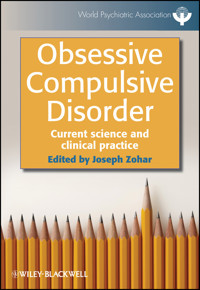
Obsessive Compulsive Disorder E-Book
80,99 €
Mehr erfahren.
- Herausgeber: John Wiley & Sons
- Kategorie: Fachliteratur
- Serie: World Psychiatric Association
- Sprache: Englisch
Obsessive compulsive disorder (OCD) remains one of the most challenging disorders of the brain.
Contemporary conceptualization and therapeutic strategies are undergoing a revolution as a result of new insights derived from modern technological advances. This book was conceived in order to present this revolution to the reader. It covers current theories regarding the etiology of OCD, what is known about the genetics of this disorder, evidence from neuroimaging and a discussion of potential endophenotypes. There is an evaluation of current treatment approaches for the disorder, encompassing psychological, psychopharmacological and physical interventions, as well as a discussion of treatment resistance. The book considers methodological issues, plus reviews of OCD in pediatric populations. A summary chapter highlights some potential research avenues, in a discussion of the future directions in OCD.
Rather than provide comprehensive coverage, repeating material from standard psychiatry textbooks, this book focuses on recent information and its application, distinguishing it from other titles.
- If you work in children with OCD,
- If you are interested in genetics, neurocognition or brain imaging,
- If you work with patients and would like to improve your assessment in OCD and OCD Spectrum disorders, to update your therapeutic strategies and to get a handle on cutting edge developments in this intriguing field,
- If you are planning a research project in OCD and would like to get some hints from people who are research leaders in this field and also learn about methodological issues specific to OCD research,
then this book will be a valuable resource.
- A concise overview of the current state of the art in OCD assessment and treatment, including physical interventions and treatment resistance
- Focuses on scientific advances (including specific methodological issues) and how they can inform and benefit clinical practice
- Looks critically and broadly at the diagnostic classification, including the ongoing revision of the two major international systems
- Written by an A-list team of experts in the field who have a track record of being engaging authors
Sie lesen das E-Book in den Legimi-Apps auf:
Seitenzahl: 597
Veröffentlichungsjahr: 2012
Ähnliche




















Contents
Cover
Series
Title Page
Copyright
List of Contributors
Introduction
Section 1: Assessment and Treatment
Chapter 1: Assessment
INTRODUCTION
DETECTING OCD
CLINICAL ASSESSMENT OF OBSESSIVE-COMPULSIVE SYMPTOMS
INSIGHT
ASSESSMENT OF THE RISK OF SUICIDE
DIFFERENTIAL DIAGNOSIS, COMORBIDITIES AND RELATED DISORDERS
CONCLUSIONS
Chapter 2: Pharmacotherapy of Obsessive-Compulsive Disorder
INTRODUCTION
PLACEBO-CONTROLLED STUDIES OF CLOMIPRAMINE
PLACEBO-CONTROLLED STUDIES OF FLUVOXAMINE
PLACEBO-CONTROLLED STUDIES OF FLUOXETINE
PLACEBO-CONTROLLED STUDIES OF PAROXETINE
PLACEBO-CONTROLLED STUDIES OF SERTRALINE
PLACEBO-CONTROLLED STUDIES OF CITALOPRAM/ESCITALOPRAM
PLACEBO-CONTROLLED STUDIES OF VENLAFAXINE
IMPROVING EARLY RESPONSE IN OCD
SPECIAL POPULATIONS: CHILDREN
CLOMIPRAMINE
META-ANALYSES
TOLERABILITY OF CLOMIPRAMINE AND SEROTONIN REUPTAKE INHIBITORS
OPTIMAL DOSE OF TREATMENT
DURATION OF TREATMENT
REFRACTORY OCD
FUTURE THERAPEUTIC OPTIONS
CONCLUSION
Chapter 3: Cognitive Behavioural Therapy in Obsessive-Compulsive Disorder: State of the Art
THEORETICAL MODELS
TREATMENT
OCD PROTOCOLS
DISSEMINATION
FUTURE RESEARCH
SUMMARY
Chapter 4: Electroconvulsive Therapy, Transcranial Magnetic Stimulation and Deep Brain Stimulation in OCD
INTRODUCTION
ELECTROCONVULSIVE THERAPY
TRANSCRANIAL MAGNETIC STIMULATION
LESIONING
DEEP BRAIN STIMULATION
CONCLUSION
ACKNOWLEDGEMENTS
Chapter 5: Approaches to Treatment Resistance
TERMINOLOGICAL PROBLEMS AND OPERATIONAL DEFINITIONS
PHARMACOLOGICAL STRATEGIES IN RESISTANT OCD
PHYSICAL THERAPIES
FAMILY INTERVENTION
CONCLUSIONS AND FUTURE PERSPECTIVES
Section 2: Clinical Spotlights
Chapter 6: Subtypes and Spectrum Issues
THE OBSESSIVE-COMPULSIVE SPECTRUM
OCD SUBTYPES: UNDERSTANDING THE HETEROGENEITY OF OCD
CONCLUSION
Chapter 7: Paediatric OCD: Developmental Aspects and Treatment Considerations
INTRODUCTION
EPIDEMIOLOGY
AETIOLOGICAL CONSIDERATIONS
CLINICAL FEATURES
CLINICAL ASSESSMENT
DIFFERENTIAL DIAGNOSIS
TREATMENT
COURSE AND PROGNOSIS
CONCLUSIONS AND FUTURE RESEARCH
ACKNOWLEDGEMENTS
Section 3: Research Spotlights
Chapter 8: Methodological Issues for Clinical Treatment Trials in Obsessive-Compulsive Disorder
INTRODUCTION
RANDOMIZED CONTROLLED TRIALS
THE RATIONALE OF PLACEBO
RECRUITMENT CRITERIA
DIAGNOSIS
OCD DIMENSIONS AND SUBTYPES
THE PROBLEM OF COMORBIDITY
RATING SCALES FOR OCD TRIALS
EVALUATING ANXIETY AND DEPRESSION IN OCD
MEASURING RESPONSE AND REMISSION
RELAPSE PREVENTION
TREATMENT-RESISTANT OCD
PSYCHOLOGICAL TREATMENT TRIALS
INTEGRATED PHARMACOLOGICAL AND PSYCHOLOGICAL TREATMENTS IN OCD
HEALTH-RELATED QUALITY OF LIFE
SUMMARY
Chapter 9: Serotonin and Beyond: A Neurotransmitter Perspective of OCD
SEROTONIN
DOPAMINE
GLUTAMATE
SEROTONIN: IS IT THE ONE TO BLAME?
THE PUZZLE OF ANTIPSYCHOTICS AND OCD: IS DOPAMINE THE ANSWER?
SO, IS IT A QUESTION OF LOCATION? (OR … LOCATION, LOCATION, LOCATION?)
Chapter 10: Brain Imaging
NEUROIMAGING MODALITIES
STRUCTURAL ASSESSMENT OF OCD
FUNCTIONAL NEUROIMAGING STUDIES OF OCD
NEUROCHEMISTRY
CONCLUSION
ACKNOWLEDGEMENTS
Chapter 11: The Genetics of Obsessive-Compulsive Disorder: Current Status
INTRODUCTION
TWIN STUDIES
FAMILY STUDIES
SEGREGATION ANALYSES
CANDIDATE GENE STUDIES
GENETIC LINKAGE STUDIES
FUTURE WORK
ACKNOWLEDGEMENTS
Chapter 12: Neurocognitive Angle: The Search for Endophenotypes
INTRODUCTION
HERITABILITY OF OCD
THE CONCEPT OF AN ENDOPHENOTYPE
APPLYING THE ENDOPHENOTYPE CONSTRUCT TO OCD
DOMAINS OF INTEREST IN HIERARCHICAL MODELLING OF OCD
SEARCHING FOR ENDOPHENOTYPES OF OCD
SUMMARY
ACKNOWLEDGEMENTS AND DISCLOSURES
Chapter 13: Conclusion and Future Directions
Index
World Psychiatric Association Evidence and Experience in Psychiatry Series
Series Editor: Michelle Riba, WPA Secretary for Publications, Department of Psychiatry, University of Michigan
Post-Traumatic Stress Disorders
Edited by Dan Stein, Matthew Friedman and Carlos Blanco
ISBN: 9780470688977
Substance Abuse Disorders
Edited by Hamid Ghodse, Helen Herrman, Mario Maj and Norman Sartorius
ISBN: 9780470745106
Depressive Disorders, 3e
Edited by Helen Herrman, Mario Maj and Norman Sartorius
ISBN: 9780470987209
Schizophrenia 2e
Edited by Mario Maj, Norman Sartorius
ISBN: 9780470849644
Dementia 2e
Edited by Mario Maj, Norman Sartorius
ISBN: 9780470849637
Obsessive-Compulsive Disorders 2e
Edited by Mario Maj, Norman Sartorius, Ahmed Okasha, Joseph Zohar
ISBN: 9780470849668
Bipolar Disorders
Edited by Mario Maj, Hagop S Akiskal, Juan José López-Ibor, Norman Sartorius
ISBN: 9780471560371
Eating Disorders
Edited by Mario Maj, Kathrine Halmi, Juan José López-Ibor, Norman Sartorius
ISBN: 9780470848654
Phobias
Edited by Mario Maj, Hagop S Akiskal, Juan José López-Ibor, Ahmed Okasha
ISBN: 9780470858332
Personality Disorders
Edited by Mario Maj, Hagop S Akiskal, Juan E Mezzich
ISBN: 9780470090367
Somatoform Disorders
Edited by Mario Maj, Hagop S Akiskal, Juan E Mezzich, Ahmed Okasha
ISBN: 9780470016121
Current Science and Clinical Practice Series
Series Editor: Michelle Riba, WPA Secretary for Publications, Department of Psychiatry, University of Michigan
Obsessive-Compulsive Disorder
Edited by Joseph Zohar
ISBN: 9780470711255
Schizophrenia
Edited by Wolfgang Gaebel
ISBN: 9780470710548
This edition first published 2012 © 2012 by John Wiley & Sons, Ltd.
Wiley-Blackwell is an imprint of John Wiley & Sons, formed by the merger of Wiley's global Scientific, Technical and Medical business with Blackwell Publishing.
Registered Office:John Wiley & Sons, Ltd, The Atrium, Southern Gate, Chichester, West Sussex, PO19 8SQ, UK
Editorial Offices:9600 Garsington Road, Oxford, OX4 2DQ, UK The Atrium, Southern Gate, Chichester, West Sussex, PO19 8SQ, UK 111 River Street, Hoboken, NJ 07030-5774, USA
For details of our global editorial offices, for customer services and for information about how to apply for permission to reuse the copyright material in this book please see our website at www.wiley.com/wiley-blackwell
The right of the author to be identified as the author of this work has been asserted in accordance with the UK Copyright, Designs and Patents Act 1988.
All rights reserved. No part of this publication may be reproduced, stored in a retrieval system, or transmitted, in any form or by any means, electronic, mechanical, photocopying, recording or otherwise, except as permitted by the UK Copyright, Designs and Patents Act 1988, without the prior permission of the publisher.
Designations used by companies to distinguish their products are often claimed as trademarks. All brand names and product names used in this book are trade names, service marks, trademarks or registered trademarks of their respective owners. The publisher is not associated with any product or vendor mentioned in this book. This publication is designed to provide accurate and authoritative information in regard to the subject matter covered. It is sold on the understanding that the publisher is not engaged in rendering professional services. If professional advice or other expert assistance is required, the services of a competent professional should be sought.
The contents of this work are intended to further general scientific research, understanding, and discussion only and are not intended and should not be relied upon as recommending or promoting a specific method, diagnosis, or treatment by physicians for any particular patient. The publisher and the author make no representations or warranties with respect to the accuracy or completeness of the contents of this work and specifically disclaim all warranties, including without limitation any implied warranties of fitness for a particular purpose. In view of ongoing research, equipment modifications, changes in governmental regulations, and the constant flow of information relating to the use of medicines, equipment, and devices, the reader is urged to review and evaluate the information provided in the package insert or instructions for each medicine, equipment, or device for, among other things, any changes in the instructions or indication of usage and for added warnings and precautions. Readers should consult with a specialist where appropriate. The fact that an organization or Website is referred to in this work as a citation and/or a potential source of further information does not mean that the author or the publisher endorses the information the organization or Website may provide or recommendations it may make. Further, readers should be aware that Internet Websites listed in this work may have changed or disappeared between when this work was written and when it is read. No warranty may be created or extended by any promotional statements for this work. Neither the publisher nor the author shall be liable for any damages arising herefrom.
Library of Congress Cataloging-in-Publication Data
Obsessive-compulsive disorder : current science and clinical practice / editor, Joseph Zohar. p. ; cm. Includes bibliographical references and index. Summary: “A clear summary of what is known about a highly prevalent and debilitating disorder that affects nearly as many people as does asthma. Expert authors review the biological basis for the disorder and describe both pharmacological and psychological approaches to treatment”–Provided by publisher. ISBN 978-0-470-71125-5 (cloth) I. Zohar, Joseph. [DNLM: 1. Obsessive-Compulsive Disorder–diagnosis. 2. Obsessive-Compulsive Disorder–drug therapy. 3. Obsessive-Compulsive Disorder–therapy. WM 176] 616.85′227–dc23 2012009775
A catalogue record for this book is available from the British Library.
Wiley also publishes its books in a variety of electronic formats. Some content that appears in print may not be available in electronic books.
List of Contributors
Anat AbudyPsychiatry Department A, Division of Psychiatry Chaim Sheba Medical Center Tel Hashomer, Israel
Rianne M. BlomDepartment of Psychiatry Academic Medical Center University of Amsterdam Amsterdam, The Netherlands
Ashley R. BrownClinical and Research Program in Pediatric Psychopharmacology Department of Psychiatry Massachusetts General Hospital Boston, MA, USA
Andrea CantisaniDepartment of Psychiatry University of Florence Florence, Italy
Samuel R. ChamberlainDepartment of Psychiatry University of Cambridge Addenbrooke’s Hospital Cambridge, UK
Eric H. DecloedtDepartment of Medicine Division of Clinical Pharmacology University of Cape Town Cape Town, South Africa
Damiaan DenysDepartment of Psychiatry Academic Medical Center University of Amsterdam Amsterdam, The Netherlands;
The Netherlands Institute for Neuroscience Amsterdam, The Netherlands
Phillip C. EasterDepartment of Psychiatry and Behavioral Neurosciences Wayne State University School of Medicine University Health Center Detroit, MI, USA
Alyssa L. FaroClinical and Research Program in Pediatric Psychopharmacology Department of Psychiatry Massachusetts General Hospital Boston, MA, USA
Martijn FigeeDepartment of Psychiatry Academic Medical Center University of Amsterdam Amsterdam, The Netherlands
Naomi A. FinebergNational OCD Treatment Service Hertfordshire Partnership NHS Foundation Trust Queen Elizabeth II Hospital Welwyn Garden City, UK and University of Hertfordshire, College Lane Hatfield UK
Martin E. FranklinUniversity of Pennsylvania School of Medicine Philadelphia, PA, USA
Daniel A. GellerClinical and Research Program in Pediatric Psychopharmacology Department of Psychiatry Massachusetts General Hospital Boston, MA, USA; Harvard Medical School Boston, MA, USA
Adriel GerardMontefiore Medical Center University Hospital of Albert Einstein College of Medicine Bronx, NY, USA
Addie GossBryn Mawr College Bryn Mawr, PA, USA
Giacomo GrassiDepartment of Psychiatry University of Florence Florence, Italy
Eric HollanderMontefiore Medical Center University Hospital of Albert Einstein College of Medicine Bronx, NY, USA
Alzbeta Juven-WetzlerPsychiatry Department A, Division of Psychiatry Chaim Sheba Medical Center Tel Hashomer, Israel
Hannah C. LevyDepartment of Psychology Concordia University Montreal, QC, Canada
John S. MarchDepartment of Psychiatry and Behavioral Sciences Duke University Medical Center Durham, NC, USA
Jose M. MenchonDepartment of Psychiatry Hospital Universitari de Bellvitge-IDIBELL Hospitalet de Llobregat Barcelona; Department of Clinical Sciences School of Medicine Universitat de Barcelona; Centro de Investigación Biomédica en Red de Salud Mental (CIBERSAM) Instituto de Salud Carlos III Ministry of Science and Innovation Barcelona, Spain
Lara MenziesDepartment of Psychiatry University of Cambridge Addenbrooke’s Hospital Cambridge, UK
Georgia MichalopoulouWayne State University School of Medicine; Children’s Hospital of Michigan Department of Psychiatry and Psychology Detroit, MI, USA
Stefano PallantiDepartment of Psychiatry Mount Sinai School of Medicine New York, NY, USA; Department of Psychiatry University of Florence Florence, Italy; Institute of Neuroscience Florence, Italy
David L. PaulsPsychiatric and Neurodevelopmental Genetics Unit Center for Human Genetic Research Massachusetts General Hospital Harvard Medical School Boston, MA, USA
Steven PoskarMontefiore Medical Center University Hospital of Albert Einstein College of Medicine Bronx, NY, USA
Samar ReghunandananNational OCD Treatment Service Hertfordshire Partnership NHS Foundation Trust Queen Elizabeth II Hospital Welwyn Garden City UK
David R. RosenbergChildren’s Hospital of Michigan; Wayne State University School of Medicine Department of Psychiatry University Health Center Detroit, MI, USA
Rachel SonninoPsychiatry Department A, Division of Psychiatry Chaim Sheba Medical Center Tel Hashomer, Israel
Dan J. SteinDepartment of Psychiatry University of Cape Town Cape Town, South Africa
Nienke VulinkDepartment of Psychiatry Academic Medical Center University of Amsterdam Amsterdam, The Netherlands
Joseph ZoharPsychiatry Department A, Division of Psychiatry Chaim Sheba Medical Center Tel Hashomer, Israel
Introduction
During my career, I have witnessed two revolutions in obsessive-compulsive disorder (OCD).
As a resident in psychiatry (in the late 1970s), I asked my supervisor for advice, having examined a patient with OCD; his response was that there was very little that could be done for these rare cases. He was right; at that time, OCD was considered a rare disorder of psychological origin, and refractory to treatment. The first revolution in OCD overturned all three of these conceptions. The seminal work of M.M. Weissman reported a lifetime prevalence of about 2%. Pioneering double-blind, placebo-controlled work at the National Institute of Mental Health (NIMH) raised the curtain on the specific response to serotonergic medication, highlighted the serotonergic basis and gave initial hints for the relevant brain regions involved in OCD.
The second revolution in OCD is taking place right now. It is composed of building blocks such as neurocognitive endophenotypes (see Chapter 12), genetics (Chapter 11), sophisticated brain imaging (Chapter 10), daring conceptual challenges (Chapter 6), and venturing beyond the conventional serotonin hypothesis (Chapter 9).
To help us build these new, improved, contemporary understandings of OCD and OC spectrum disorders, we use better assessment tools (Chapter 1), and utilize much more sophisticated methodological techniques (Chapter 8). All of this provides us with sharper pharmacological tools (Chapter 2) and psychological interventions (Chapter 3), for adult patients as well as for children (Chapter 7). Moreover, it enables us to embark on new therapeutic approaches (Chapter 5), including new physical interventions (Chapter 4).
This book is a sort of celebration of the emergence of the second revolution in OCD, and I hope that the reader will feel the enthusiasm shared by all the contributors about the promising present and the bright future of OCD.
Joseph Zohar 2012
SECTION 1
Assessment and Treatment
CHAPTER 1
Assessment
Jose M. Menchon
Department of Psychiatry, Hospital Universitari de Bellvitge-IDIBELL, Hospitalet de Llobregat (Barcelona), Universitat de Barcelona, CIBERSAM, Spain
INTRODUCTION
Many people have some obsessions during their lives: it is estimated that more than one-quarter of people experience obsessions or compulsions at some time [1], and a substantial proportion of them will meet the criteria for obsessive-compulsive disorder (OCD). The lifetime prevalence of OCD is about 2–2.5%, and the annual prevalence is 1–2% among the general population [1,2]. The male to female ratio is approximately unity, with some studies finding a slightly higher prevalence in women, while in the child and adolescent populations males show a higher prevalence.
The hallmark of OCD is the presence of either obsessions or compulsions. According to the Diagnostic and Statistical Manual of Mental Disorders, 4th Edition, Text Revision (DSM-IV-TR) [3] diagnostic criteria, the obsessions are defined by the following four criteria:
Compulsions are defined as: ‘1) repetitive behaviors (e.g., hand washing, ordering, checking) or mental acts (e.g., praying, counting, repeating words silently) that the person feels driven to perform in response to an obsession, or according to rules that must be applied rigidly, and 2) the behaviors or mental acts are aimed at preventing or reducing distress or preventing some dreaded event or situation; however, these behaviors or mental acts either are not connected in a realistic way with what they are designed to neutralize or prevent or are clearly excessive.’ Hence, obsessions and compulsions are repetitive, unpleasant and intrusive (although recognized as own thoughts), and usually the individual considers that the obsessions or compulsions are excessive or irrational, demonstrated by the subject’s attempts to resist them. While obsessions are considered phenomena that increase anxiety or discomfort, compulsions are behaviours that are aimed at reducing it.
Obsessions and compulsions are very diverse and have been grouped into various types. Table 1.1 shows the percentage of obsessions and compulsions in adult OCD samples reported in several studies. Such diversity in the clinical manifestations of OCD has led researchers to examine whether the different obsessions and compulsions seen in patients could be related and grouped into a few subtypes or dimensions; for instance, a recent meta-analysis [10] has derived four main factors: symmetry, forbidden thoughts, cleaning and hoarding. Apart from its descriptive utility, this kind of approach has heuristic value since it allows examination of the possible heterogeneity of OCD in terms of neurobiology, genetics or treatment response, among other aspects [11]. This issue is reviewed in detail in Chapter 6 of this book.
Table 1.1 Percentage of obsessions and compulsions in OCD adult samples reported in various studies.
The assessment of OCD includes the usual elements involved in the psychiatric assessment of mental disorders, although there are also specific issues related to this condition. Relevant issues in the OCD assessment are (Table 1.2):
Table 1.2 Components in the assessment of OCD.
Lesen Sie weiter in der vollständigen Ausgabe!
Lesen Sie weiter in der vollständigen Ausgabe!
Lesen Sie weiter in der vollständigen Ausgabe!
Lesen Sie weiter in der vollständigen Ausgabe!
Lesen Sie weiter in der vollständigen Ausgabe!
Lesen Sie weiter in der vollständigen Ausgabe!
Lesen Sie weiter in der vollständigen Ausgabe!
Lesen Sie weiter in der vollständigen Ausgabe!
Lesen Sie weiter in der vollständigen Ausgabe!
Lesen Sie weiter in der vollständigen Ausgabe!
Lesen Sie weiter in der vollständigen Ausgabe!
Lesen Sie weiter in der vollständigen Ausgabe!
Lesen Sie weiter in der vollständigen Ausgabe!
Lesen Sie weiter in der vollständigen Ausgabe!
Lesen Sie weiter in der vollständigen Ausgabe!




