


Oil and Gas Exploration E-Book
114,99 €
Mehr erfahren.
- Herausgeber: John Wiley & Sons
- Kategorie: Wissenschaft und neue Technologien
- Serie: Special Publications
- Sprache: Englisch
Oil and Gas Exploration: Methods and Application presents a summary of new results related to oil and gas prospecting that are useful for theoreticians and practical professionals. The study of oil and gas complexes and intrusions occurring in sedimentary basins is crucial for identifying the location of oil and gas fields and for making accurate predictions on oil findings.
Volume highlights include:
- Advanced geophysical techniques for achieving hydrocarbon exploration efficiency from beneath the Earth
- Discussion of theoretical and practical approaches in solving problems related to exploring and mining new oil and gas deposits
- New geological concepts for predicting potential hydrocarbon targets
- Novel methods of control of the outworking of these deposits using different geophysical methods, significant for optimization of mining hydrocarbon and carbonate deposits
- Estimation of the degree of outworking of oil and gas deposits, to facilitate the use of space-time monitoring of different kinds of fields
- Analysis of exploration data by an efficient processing system, based on strong methods proven mathematically
Oil and Gas Exploration is a valuable resource for exploration geophysicists, petroleum engineers, geoengineers, petrologists, mining engineers, and economic geologists, who will gain insights into exploring new methods involved in finding natural resources from our Earth.
Read an interview with the editors to find out more:
https://eos.org/editors-vox/where-and-how-can-we-find-new-sources-of-oil-and-gas
Sie lesen das E-Book in den Legimi-Apps auf:
Seitenzahl: 437
Veröffentlichungsjahr: 2017
Ähnliche




















Special Publications 72
OIL AND GAS EXPLORATION
Methods and Application
Edited by
Said GaciOlga Hachay
This Work is a co‐publication between the American Geophysical Union and John Wiley & Sons, Inc.
This Work is a co‐publication between the American Geophysical Union and John Wiley & Sons, Inc.
Published under the aegis of the AGU Publications Committee
Brooks Hanson, Director of PublicationsRobert van der Hilst, Chair, Publications Committee
© 2017 by the American Geophysical Union, 2000 Florida Avenue, N.W., Washington, D.C. 20009For details about the American Geophysical Union, see www.agu.org.
Published by John Wiley & Sons, Inc., Hoboken, New JerseyPublished simultaneously in Canada
No part of this publication may be reproduced, stored in a retrieval system, or transmitted in any form or by any means, electronic, mechanical, photocopying, recording, scanning, or otherwise, except as permitted under Section 107 or 108 of the 1976 United States Copyright Act, without either the prior written permission of the Publisher, or authorization through payment of the appropriate per‐copy fee to the Copyright Clearance Center, Inc., 222 Rosewood Drive, Danvers, MA 01923, (978) 750‐8400, fax (978) 750‐4470, or on the web at www.copyright.com. Requests to the Publisher for permission should be addressed to the Permissions Department, John Wiley & Sons, Inc., 111 River Street, Hoboken, NJ 07030, (201) 748‐6011, fax (201) 748‐6008, or online at http://www.wiley.com/go/permissions.
Limit of Liability/Disclaimer of Warranty: While the publisher and author have used their best efforts in preparing this book, they make no representations or warranties with respect to the accuracy or completeness of the contents of this book and specifically disclaim any implied warranties of merchantability or fitness for a particular purpose. No warranty may be created or extended by sales representatives or written sales materials. The advice and strategies contained herein may not be suitable for your situation. You should consult with a professional where appropriate. Neither the publisher nor author shall be liable for any loss of profit or any other commercial damages, including but not limited to special, incidental, consequential, or other damages.
For general information on our other products and services or for technical support, please contact our Customer Care Department within the United States at (800) 762‐2974, outside the United States at (317) 572‐3993 or fax (317) 572‐4002.
Wiley also publishes its books in a variety of electronic formats. Some content that appears in print may not be available in electronic formats. For more information about Wiley products, visit our web site at www.wiley.com.
Library of Congress Cataloging‐in‐Publication Data is available.
ISBN: 978‐1‐119‐22742‐7
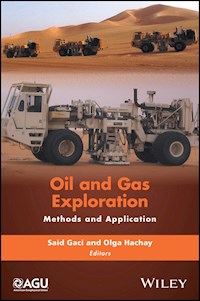
Cover image: A set of Vibroseis trucks used to generate seismic signals in a seismic land acquisition. A Vibroseis truck used to provide a seismic source. The source signal is provided by a servo‐controlled hydraulic vibrator or shaker unit mounted on a mobile base unit.
CONTRIBUTOR LIST
Mohand Amokrane Aitouch
Physics of Earth LaboratoryUniversity of M'hamed BougaraBoumerdès, Algeria
Yury G. Astrakhantsev
Head of the Laboratory of Borehole GeophysicsInstitute of Geophysics Ural Branch of Russian Academy of Sciences (UB RAS)Ekaterinburg, Russia
Eugenia Bazhenova
Junior Scientific ResearcherLaboratory of Borehole GeophysicsInstitute of Geophysics Ural Branch of Russian Academy of Sciences (UB RAS)Ekaterinburg, Russia
Nadezhda A. Beloglazova
Senior Scientific ResearcherLaboratory of Borehole GeophysicsInstitute of Geophysics Ural Branch of Russian Academy of Sciences (UB RAS) Ekaterinburg, Russia
Noureddine Djarfour
Faculty of Sciences and TechnologiesUniversity of Ahmed DraiaAdrar, Algeria
Vladimir S. Druzhinin
Lead ScientistLaboratory of Seismic ResearchInstitute of Geophysics Ural Branch of Russian Academy of Sciences (UB RAS)Ekaterinburg, Russia
Mohammed Farfour
Assistant ProfessorEarth Science DepartmentSultan Qaboos UniversityMuscat, Oman
Jalal Ferahtia
Physics of Earth LaboratoryUniversity of M'hamed BougaraBoumerdès, Algeria
Said Gaci
Sonatrach–IAPBoumerdès, Algeria
Olga Hachay
Professor, Lead ScientistLaboratory of Borehole GeophysicsInstitute of Geophysics Ural Branch of Russian Academy of Sciences (UB RAS)Ekaterinburg, Russia
Galina V. Igolkina
Head of Laboratory of Exploration GeophysicsInstitute of Geophysics Ural Branch of Russian Academy of Sciences (UB RAS)Ekaterinburg, Russia
Andrey Khachay
Associated ProfessorInstitute of Mathematics and Computer SciencesUral Federal UniversityEkaterinburg, Russia
Oleg Khachay
Associated ProfessorInstitute of Mathematics and Computer SciencesUral Federal UniversityEkaterinburg, Russia
Ignat Korchagin
Leading ResearcherInstitute of GeophysicsUkraine National Academy of ScienceKiev, Ukraine
Valery Korchin
ProfessorInstitute of Geophysics of Ukraine National Academy of ScienceKiev, Ukraine
Sergey Levashov
Leading ResearcherInstitute of Applied Problems of Ecology, Geophysics and GeochemistryKiev, Ukraine
Nikolay Nachapkin
Head of the Laboratory of Regional ResearchInstitute of Geophysics Ural Branch of Russian Academy of Sciences (UB RAS)Ekaterinburg, Russia
Orietta Nicolis
Institute of StatisticsFaculty of ScienceUniversity of ValparaísoValparaíso, Chile
Vjacheslav Osipov
Senior Scientific ResearcherLaboratory of Regional ResearchInstitute of Geophysics Ural Branch of Russian Academy of Sciences (UB RAS)Ekaterinburg, Russia
Daniyar Tazhibaev
Institute of Geomechanics and Mineral Development of National Academy of Sciences of the Kirghiz RepublicBishkek, Kyrgyzstan
Kushbakali Tazhibaev
ProfessorInstitute of Geomechanics and Mineral Development of National Academy of Sciences of the Kirghiz RepublicBishkek, Kyrgyzstan
Steven A. Tedesco
President, ConsultantAtoka, Inc.Englewood, Colorado, USA
Nikolay Yakymchuk
Corresponding Member of the National Academy of Sciences of Ukraine, ProfessorManagement and Marketing Center of Institute of Geological ScienceNAS UkraineKiev, Ukraine
Wang Jung Yoon
Geophysical Prospecting LabEnergy & Resources Engineering DepartmentChonnam National UniversityGwangju, South Korea
PREFACE
The goal of oil and gas exploration is to discover hydrocarbon accumulations that can be exploited in economic conditions. The geoscientists bring together information from various sources in order to evaluate the different petroleum system elements of a sedimentary basin. The book attempts to present different methods of oil and gas exploration, illustrated with worldwide case studies.
The book covers 16 chapters. Chapter 1 suggests a new technology of seismic geomapping based on new model conceptions of the upper part of lithosphere, and new depth criteria of forecasting deposits in new regions have been developed. Case studies from Russia illustrate the potential of the proposed approach.
Chapter 2 investigates a new statistical method based on fractal and multifractal analysis of Landsat 8 images for appraising the presence of mineral deposits and shale gas reservoirs. The potential of this method is shown through applications on different areas of study: northern Chile, the United States, and Argentina.
Chapter 3 aims at suggesting a denoising method using empirical mode decomposition. Applications on Algerian seismic traces demonstrate that the proposed method can serve as a good tool for denoising signals.
Chapter 4 is devoted to developing a lithological segmentation technique from well logs using the Hilbert‐Huang transform, based on estimating a local scaling coefficient. This parameter measures the degree of heterogeneity of the layers crossed by the borehole. The proposed technique has been tested on synthetic well logs data and then applied on seismic velocity logs recorded at the KTB main borehole (Germany).
Chapter 5 introduces two free software packages used for VSP (vertical seismic profiling) data processing. The data processed using the suggested software are compared with those obtained from commercial software. The comparison demonstrates that free software packages can be utilized to process VSP data and produce results with quality that is comparable to that produced using commercial software.
Chapter 6 reviews the theory and the application of the time‐frequency analysis or spectral decomposition on seismic data. The results obtained from southern Texas (USA) reveal features of the reservoir that are hidden in the seismic broadband.
Chapter 7 discusses the electromagnetic induction frequency geometrical method with controlled sources, a method that shows sufficient resolution and is constructed based on more complicated geological models. It is proved that this technique can successfully be used by oil production in mines.
Chapter 8 studies the reflection of processes of nonequilibrium two‐phase filtration in oil‐saturated hierarchic medium by active wave geophysical monitoring data. Using developed algorithms, it is possible to define the physical and structural features of a hierarchic oil layer structure and to estimate the water saturation from crack inclusions.
Chapter 9 deals with the definition of the surface of the fluid‐saturated porous inclusion in the hierarchic‐layered‐block medium according to electromagnetic monitoring data. A three‐stage approach, which is widely used for 3‐D interpretation of mapping in the frame of the frequency‐distance active electromagnetic method, is suggested for interpreting electromagnetic data.
Chapter 10 suggests a new technique based on three‐component measurements of geoacoustic signals on oil and gas deposits to control the hydrocarbon deposit exploitation. The performance of the method is demonstrated on a case study taken from Russia.
Chapter 11 presents an application of borehole magnetometry for exploring oil and gas deposits in western Siberia. The use of such a method helps to understand the geological model and to perform an accurate deep structural forecast.
Chapter 12 introduces an original model to predict S‐wave velocity integrating Hölderian regularity, empirical mode decomposition, and a multiple‐layer perceptron artificial neural network (MLP ANN), from P‐wave velocity logs. The obtained results demonstrate the effectiveness of the suggested model.
Chapter 13 examines a geophysical method, based on the law of variation of transverse waves velocity, for defining and checking the variation of stress in rocks at mining minerals. Examples of operating and residual stress definition of rocks are presented.
Chapter 14 discusses the possibility of using the mobile and direct‐prospecting geophysical technologies to assess the prospects of oil‐gas content in deep horizons. This technique has been implemented to evaluate the prospects of a number of oil‐bearing areas and structures in the Dnieper‐Donets basin and the Caspian basin.
Chapter 15 attempts to identify anomalies of low density in the crystalline crust of thermobaric origin based on laboratory study of the relationship between density and the longitudinal velocity of mineral material at high pressures and temperatures. It is shown that zones anomalies behavior of porosity and fractures parameters exist at different depths in the crystalline crust, and can play the role of canals for the migration and localization of hydrocarbons of deep origin.
Chapter 16




