


136,99 €
Mehr erfahren.
- Herausgeber: John Wiley & Sons
- Kategorie: Wissenschaft und neue Technologien
- Sprache: Englisch
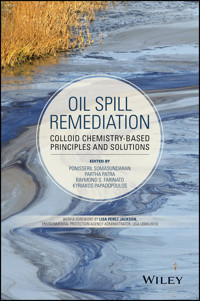
This book provides a comprehensive overview of oil spill remediation from the perspectives of policy makers, scientists, and engineers, generally focusing on colloid chemistry phenomena and solutions involved in oil spills and their cleanup.
• First book to address oil spill remediation from the perspective of physicochemical and colloidal science
• Discusses current and emerging detergents used in clean-ups
• Includes chapters from leading scientists, researchers, engineers, and policy makers
• Presents new insights into the possible impact of oil spills on ecosystems as well as preventive measures
Sie lesen das E-Book in den Legimi-Apps auf:
Seitenzahl: 708
Veröffentlichungsjahr: 2014
Ähnliche



















CONTENTS
Cover
Title page
Copyright page
Foreword
Preface
Contributors
1 Science-Based Decision Making on the Use of Dispersants in the Deepwater Horizon Oil Spill
1.1 Introduction
1.2 Brief History and Evolution of Dispersants for Oil
1.3 Dispersant Efficacy and Dispersion Effectiveness
1.4 Toxicity of Dispersants
1.5 Monitoring of Dispersants on the Surface and in the Deep Sea
1.6 Fate and Transport of Dispersants and Dispersed Oil
1.7 Future Oil Spill Research as a Result of Lessons Learned
1.8 Summary
References
2 Understanding and Properly Interpreting the 2010 Deepwater Horizon Blowout
2.1 Introduction
2.2 Background
2.3 Brief Summary of Gulf of Mexico Marine Ecosystems
2.4 Brief Deepwater Horizon Oil Spill Overview
2.5 Existing Marine Oil Spill Paradigm
2.6 A New Conceptual Model for Deepwater Marine Oil Spills
2.7 New Spill Scenario: Oil Is Released at Significant Depth from a Hot, Pressurized Reservoir
2.8 The Need for an Integrative, Interdisciplinary Marine Oil Spill Oceanography
2.9 Conclusions
2.10 Future Research
References
3 Remediation and Restoration of Northern Gulf of Mexico Coastal Ecosystems Following the Deepwater Horizon Event
3.1 Introduction
3.2 Shoreline Protection during and Following the Spill
3.3 Advancement through Failure and Innovation
3.4 Conclusions
References
4 Challenges in and Approaches to Modeling the Complexities of Deepwater Oil and Gas Release
4.1 Introduction
4.2 Survey of Available Data
4.3 Descriptions of Physical Mechanisms
4.4 Generic Approaches for Multiphase Flow Models
4.5 Sample Model Results
4.6 Concluding Remarks
Acronyms
Notation
Greek Letters
ACKNOWLEDGMENTS
References
5 Oil Films
5.1 Introduction
5.2 Crude Oil Composition
5.3 Oil Films
AcknowledgmentS
References
6 Remediating Oilfield Waste and Spills
6.1 Introduction
6.2 Particle-Stabilized Interfaces
6.3 Chemical Treatment to Enhance Solid-Stabilized Oil–Water Separation
6.4 Summary and Conclusions
References
7 Multipronged Approach for Oil Spill Remediation
7.1 Introduction
7.2 Microfibrous Sorbents for Oil Removal and Recovery
7.3 Oil Removal Using Froth Flotation Technique
7.4 Use of Greener Bio dispersants
7.5 Lipopeptide: Bacillus subtilis Biosurfactants and Lipopeptides
7.6 Structure–Property Relationships of Biosurfactants
7.7 Summary and Conclusions
Acknowledgments
References
8 Packed-Bed Capillary Microscopy on BP-Oil-Spill Oil in Porous Media
8.1 Introduction
8.2 Water–Oil Two-Phase Transport in Porous Media
8.3 How Bacteria May Access Porous-Entrapped Oil
8.4 Summary
Acknowledgments
References
9 Jameson Cell Technology for Organics Recovery
9.1 Introduction
9.2 Flotation and Water Treatment
9.3 The Jameson Cell for Oil Flotation
9.4 Jameson Cells in Solvent Extraction Treatment
9.5 Oil Sand Flotation
9.6 Summary
Acknowledgments
Reference
10 Development of Gelling Agent for Spilled Oils
10.1 Introduction
10.2 Discovery of Chiral Self-Assembly of Amphiphiles Derived from Optically Active Amino Acid
10.3 Development of Oil Gelling Agent to Treat Spilled Oil
10.4 Conclusions
Acknowledgments
References
11 Microstructures of Capped Ethylene Oxide Oligomers in Water and N-Hexane
11.1 Introduction
11.2 Results and Discussion
11.3 Conclusions
Appendix: Simulation Specifics
References
12 Some Colloidal Fundamentals in Oil Spill Remediation
12.1 Introduction
12.2 Size and Hydrocarbon–Water Dispersions
12.3 Emulsions
12.4 Association Structures and Emulsions
12.5 Spontaneous Emulsification
12.6 Phase Diagrams and Spontaneous Emulsification
12.7 Solid Particles and Oil Film on Water
12.8 Microemulsions
12.9 Potential Future Research Areas
12.10 Conclusions
Acknowledgments
References
13 Physicochemical Properties of Heavy Oil–Water Interface in the Context of Oil Removal from Seawater by Froth Flotation
13.1 Introduction
13.2 Materials and Methods
13.3 Results and Discussion
13.4 Conclusions
Acknowledgments
References
14 Measurement of Interfacial Tension in Hydrocarbon/Water/Dispersant Systems at Deepwater Conditions
14.1 Introduction
14.2 Experimental Methodology
14.3 Results and Discussion
14.4 Summary
14.5 Practical Implications
Acknowledgments
References
15 Surfactant Technologies for Remediation of Oil Spills
15.1 Introduction
15.2 Phase Behavior of Surfactant–Oil–Water (SOW) Systems
15.3 Surfactant Remediation Technologies for Spills in Open Waters
15.4 Surfactant Remediation Technologies for Spills on Land
15.5 Summary and Outlook
Acknowledgments
References
16 Role of Structural Forces in Cleaning Soiled Surfaces
16.1 Introduction
16.2 Organic Pollutant Removal from a Solid Surface
16.3 Oil Removal from a Solid Surface
16.4 Outlook
References
Index
Eula
List of Tables
Chapter 01
Table 1.1 Decision context, key science questions, and anticipated outcomes from EPA’s research strategy
Chapter 02
Table 2.1 Significant marine oil spills
a
Chapter 04
Table 4.1 BP spill-related data from various sources
Table 4.2 Simulation details of oil–gas plume separation in a laboratory-scale experiment
Table 4.3 Large-scale oil/gas simulation details
Chapter 08
Table 8.1 Historical oil spill with oil persisting for 5 years or longer
a
Table 8.2 System parameters for displacement experiments conducted by Cottin et al. (2010)
Chapter 10
Table 10.1 Synthesis of N-acyl-l-amino acids by Schotten–Baumann method
a
Table 10.2 Gel properties with l-LGDB and types of oils versus gel hardness and pour point
a
Table 10.3 Solubility of l-LGDB to organic oils
a
Chapter 13
Table 13.1 Properties and composition of crude oil and water used in this study
Chapter 14
Table 14.1 Salinities of the aqueous fluids used in this study
Table 14.2 Physical properties of MC252 crude oil
Table 14.3 Conditions of pressure and temperature specific to various water depths
Chapter 15
Table 15.1 HLD parameters for selected surfactants
Table 15.2 Equivalent alkane number for selected oils
Chapter 16
Table 16.1 Surfactants used in the study
Table 16.2 Summary of light scattering experiments
Table 16.3 Efficiency of pyrene removal for different surfactant formulations
List of Illustrations
Chapter 01
Figure 1.1 Conceptual diagram of monitoring efforts on the surface and in the deep sea.
Figure 1.2 Dispersed Alaska North Slope crude oil droplet size subjected to (a) physical dispersion, (b) dispersion by Corexit 9500, and (c) dispersion by Dispersit SPC 1000. Open circles are for droplets dispersed under regular nonbreaking waves, and solid circles are under breaking wave conditions (from Li et al., 2009).
Chapter 02
Figure 2.1 DWH Macondo blowout daily hydrocarbon release and applied aerial and subsurface dispersant application rates from April to July 2010. This data was used to parameterize the much-discussed Oil Budget Calculator (Oil Budget Calculator Science and Engineering Team, 2010). Daily dispersant application data were compiled from the National Incident Command by USGS and kindly provided by the S. Bristol and the USGS. Records do not clearly distinguish between Corexit 9,500A and 9,527A, and so dispersant data here are combined. Oil release rates decline overtime in responses to lessening pressures inside the Macondo formation. Changes in oil flow correspond to the following: day 1 riser falling to the seabed, day 43 riser cut to facilitate recovery efforts boosting flow by approximately 4%, and day 82 stacking cap installed. All hydrocarbon flow into the Gulf ceased on day 84, but a static condition was not declared until day 87. Subsurface dispersant application near the wellhead began on day 9 and then was stopped until day 14 but still not continuously applied until day 25.
Chapter 03
Figure 3.1 Conventional oil spill cleanup technology. Top left to right: manual cleanup, polypropylene-filled sorbent boom, and oil skimmer. Bottom left to right: containment boom, in situ burning, and chemical dispersant.
Figure 3.2 The distribution and intensity of oiling in northeastern Barataria Bay, Louisiana. Shoreline was categorized and identified for remediation according to the extent of oiling. Shoreline “K” in Bay Jimmy is host to ongoing studies of shoreline remediation and recovery.
Figure 3.3 Aggressive remediation of oiled shoreline in Bay Jimmy (Barataria Bay, Louisiana). Left: cleanup crews manually cutting oiled vegetation (Zengel and Michel, 2013). Right: mechanical removal of oiled material.
Figure 3.4 Two BPWS Integrated Systems installed on the D&L Salvage spud barge The Splash (left) and four BPWS Integrated Systems installed on Edison Chouest platform supply vessel ELLA G (right).
Lesen Sie weiter in der vollständigen Ausgabe!
Lesen Sie weiter in der vollständigen Ausgabe!
Lesen Sie weiter in der vollständigen Ausgabe!
Lesen Sie weiter in der vollständigen Ausgabe!
Lesen Sie weiter in der vollständigen Ausgabe!
Lesen Sie weiter in der vollständigen Ausgabe!
Lesen Sie weiter in der vollständigen Ausgabe!
Lesen Sie weiter in der vollständigen Ausgabe!
Lesen Sie weiter in der vollständigen Ausgabe!
Lesen Sie weiter in der vollständigen Ausgabe!
Lesen Sie weiter in der vollständigen Ausgabe!
Lesen Sie weiter in der vollständigen Ausgabe!
Lesen Sie weiter in der vollständigen Ausgabe!
Lesen Sie weiter in der vollständigen Ausgabe!
Lesen Sie weiter in der vollständigen Ausgabe!
Lesen Sie weiter in der vollständigen Ausgabe!
Lesen Sie weiter in der vollständigen Ausgabe!
Lesen Sie weiter in der vollständigen Ausgabe!
Lesen Sie weiter in der vollständigen Ausgabe!
Lesen Sie weiter in der vollständigen Ausgabe!
Lesen Sie weiter in der vollständigen Ausgabe!
Lesen Sie weiter in der vollständigen Ausgabe!
Lesen Sie weiter in der vollständigen Ausgabe!




