


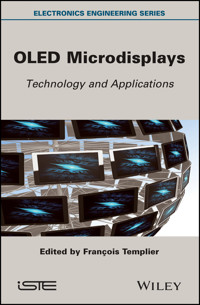
OLED Microdisplays E-Book
139,99 €
Mehr erfahren.
- Herausgeber: John Wiley & Sons
- Kategorie: Wissenschaft und neue Technologien
- Sprache: Englisch
Microdisplays are displays requiring optical magnification and OLEDs (Organic Light-Emitting Diode) are self-emitting displays where each pixel includes a LED made of organic material, in general composed of small-molecule organic material. This title reviews in detail how OLED microdisplays are made as well as how they are used. All aspects from theory to application will be addressed: basic principles, display design, display fabrication, operation and performances, present and future applications. The book will be useful to anyone interested in this rapidly developing field, such as students or researchers, industry professionals (engineers, project leaders) in the field of display development/fabrication and display end-users.
Sie lesen das E-Book in den Legimi-Apps auf:
Seitenzahl: 341
Veröffentlichungsjahr: 2014
Ähnliche




















Contents
Introduction
I.1. Revolution(s)
I.2. Definition of microdisplays
I.3. A brief history and overview of microdisplays
I.4. New requirements for new applications: near-to-eye
I.5. Then came OLED microdisplays
I.6. Interactive glasses: the next big thing?
I.7. Outline of the book
I.8. Bibliography
1 OLED: Theory and Principles
1.1. Organic light-emitting device: a brief history
1.2. Principles of OLED operation
1.3. Organic semiconductor material categories
1.4. Organic semiconductors: theory
1.5. OLEDs electrical characteristics
1.6. OLED: different structure types
1.7. OLED stability and lifetime: encapsulation issue
1.8. Specificities of OLED for microdisplays
1.9. Bibliography
2 Overview of OLED Displays
2.1. Passive-matrix OLED displays
2.2. Active-matrix AMOLED displays
2.3. Trends in OLED displays: flexible and transparent
2.4. OLED lighting
2.5. Microdisplays
2.6. Bibliography
3 OLED Characterization
3.1. Electronic properties of organic semiconductors
3.2. Optical properties of organic semiconductors
3.3. Device characterization
3.4. OLED microdisplay characterization
3.5. Bibliography
4 5-Tools and Methods for Electro-Optic Simulation
4.1. Electro-optic simulation presentation
4.2. Optical simulation
4.3. Electrical simulation
4.4. Microdisplay simulation limitations
4.5. Bibliography
5 Addressing OLED Microdisplays
5.1. Passive matrix OLED display
5.2. Active matrix OLED displays
5.3. Addressing OLED microdisplays
5.4. Bibliography
6 OLED Microdisplay Fabrication
6.1. Fabrication of CMOS active matrix
6.2. OLED process on CMOS circuit
6.3. Encapsulation process
6.4. Color: different approaches and associated processes
6.5. Packaging
6.6. Display testing and performances
6.7. Electronics
6.8. Process and performance evolutions
6.9. Bibliography
7 Applications of OLED Microdisplays
7.1. Introduction
7.2. Head-mounted displays and informative glasses for consumer and professional applications
7.3. Electronic viewfinder embedded into a camera/camcorder
7.4. Other display systems with OLED microdisplays
7.5. Bibliography
8 OLED Microdisplays Present and Future
8.1. Present actors of OLED microdisplays
8.2. Evolution and future developments for OLED microdisplays
8.3. Disruptive emissive microdisplays
8.4. Bibliography
Conclusion
List of Authors
Index
First published 2014 in Great Britain and the United States by ISTE Ltd and John Wiley & Sons, Inc.
Apart from any fair dealing for the purposes of research or private study, or criticism or review, as permitted under the Copyright, Designs and Patents Act 1988, this publication may only be reproduced, stored or transmitted, in any form or by any means, with the prior permission in writing of the publishers, or in the case of reprographic reproduction in accordance with the terms and licenses issued by the CLA. Enquiries concerning reproduction outside these terms should be sent to the publishers at the undermentioned address:
ISTE Ltd
27-37 St George’s Road
London SW19 4EU
UK
www.iste.co.uk
John Wiley & Sons, Inc.
111 River Street
Hoboken, NJ 07030
USA
www.wiley.com
© ISTE Ltd 2014
The rights of François Templier to be identified as the author of this work have been asserted by him in accordance with the Copyright, Designs and Patents Act 1988.
Library of Congress Control Number: 2014941990
British Library Cataloguing-in-Publication Data
A CIP record for this book is available from the British Library
ISBN 978-1-84821-575-7
Introduction
I.1. Revolution(s)
During the last decade, a revolution has happened in the display industry (Figure I.1). In fact, not only one, but two revolutions. The first revolution is the fade-out of the cathode ray tube (CRT). Like the giant meteor hitting planet earth 65 million years ago led to eradication of dinosaurs, the giant wave of flat-panel displays pushed out irremediably the 100-year old CRT.
Figure I.1.Display market 1990–2012 [NTA 14].
The other revolution is that in the meantime, the total display market rose from a cushy ~30-billion to a tremendous 100-billion dollar market. This is illustrated by the explosion of display application we have seen around us, at home (how many TV screens in the house in addition to the former single big TV in the living room?), in the car, or simply with all our digital wearable companions. During this second revolution; a very particular type of display has discreetly emerged and took a piece of the cake: microdisplays. A small piece of the market (so far), a small size, but definitely present.
I.2. Definition of microdisplays
Microdisplays can be defined as having a diagonal of around 1 inch or less. As a consequence, this means that they require an additional optical magnification system to be seen by the human eye. The system would depend on the use. In the case of near-to-eye application, such as head-mounted display (HMD) and head-up display (HUD), the system projects a virtual image, by collimating the light from the microdisplay and projecting the image near infinity. For projector applications, the collimated optics role is to make an enlarged, real image of the microdisplay on a physical diffusing screen.
One objective of microdisplays is to deliver the same image quality as conventional, larger-size displays. One of the main attributes to image quality is the definition, namely the total number of pixels constituting the image. If we consider the 1,080 p high-definition standard (1,080 lines and 1,920 columns), the color pixel-pitch will be around 460 µm in the case of a 40 in diagonal TV, and around 58 µm in the case of 5 in display from a high-end smartphone. In the latter case, considering a quad color arrangement, this corresponds to an elemental pixel pitch of around 29 µm. This pixel pitch is today the smallest that can be obtained with the conventional active-matrix techniques using thin-film transistor (TFT) technology on large-area glasses, where the minimum feature size provided by the patterning process is generally around 2 µm.
To achieve the same 1,080 p resolution on a microdisplay of say 0.5 in, the pixel pitch needs to be an order of less magnitude, namely much less than 10 µm. The main consequence of such small pixel-size is that they cannot be fabricated with conventional TFT active-matrix technologies. Actually, active matrix for microdisplays requires complementary metal-oxide-semiconductor (CMOS) integrated circuit (IC) technologies built on monocrystalline silicon, which provides the smallest feature size, now down to a few nanometer for advanced circuits). Only with such technologies, pixel pitches of a few microns can be obtained. Besides the difference in active matrix technology, there is therefore also a strong difference in the manufacturing model (and cost model) between microdisplays and conventional, medium/large-size displays. Conventional displays are fabricated on large area glass (up to 3 × 3 m) and feature pixel size of typically 30–300 µm (: (a) 2.2 × 2.5 m glass substrate with six TFT active matrices 52 in. TVs. Inset is a magnified view of a pixel. (b) (Courtesy of Ghent University) 200 mm silicon wafer with CMOS circuit consisting of active matrices for LCOS microdisplays. Inset is a magnified view of a pixel.). Microdisplays are fabricated on silicon wafers (200 or 300 mm in diameter) and have pixel size of typically 5–10 µm ().
Lesen Sie weiter in der vollständigen Ausgabe!
Lesen Sie weiter in der vollständigen Ausgabe!
Lesen Sie weiter in der vollständigen Ausgabe!
Lesen Sie weiter in der vollständigen Ausgabe!
Lesen Sie weiter in der vollständigen Ausgabe!
Lesen Sie weiter in der vollständigen Ausgabe!
Lesen Sie weiter in der vollständigen Ausgabe!
Lesen Sie weiter in der vollständigen Ausgabe!
Lesen Sie weiter in der vollständigen Ausgabe!
Lesen Sie weiter in der vollständigen Ausgabe!
Lesen Sie weiter in der vollständigen Ausgabe!




