


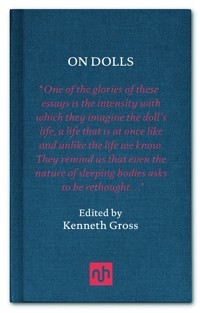
ON DOLLS E-Book
Erhalten Sie Zugang zu diesem und mehr als 300000 Büchern ab EUR 5,99 monatlich.
- Herausgeber: Notting Hill Editions
- Kategorie: Poesie und Drama
- Sprache: Englisch
Some of the greatest thinkers and writers of our age meditate on play and the mysteries of inanimate life. The essays and reflections in this collection explore the seriousness of play and the mysteries of inanimate life – 'the unknown spaces, noises, dust, lost objects, and small animals that fill any house' – which have provoked many writers to take the side of these dead or non-human things, resulting in some of the most profound passages in literature. With contributions from: Kleist, Baudelaire, Freud, Rilke, Kafka, Bruno Schulz, Walter Benjamin, Elizabeth Bishop, Dennis Silk and Marina Warner.
Sie lesen das E-Book in den Legimi-Apps auf:
Seitenzahl: 177
Veröffentlichungsjahr: 2023
Das E-Book (TTS) können Sie hören im Abo „Legimi Premium” in Legimi-Apps auf:
Ähnliche




















‘Dolls, those emissaries between dead and living …’
– Andrei Sinyavsky
Praise for Puppet: An Essay on Uncanny Life:
“Kenneth Gross is particularly illuminating about the passionate intensity or violent hunger for being that seems to be the particular characteristic of puppets; it is as though, as the fossilised form of human longing, the puppet longs in turn, vividly and vivaciously, for the life that can never be its own. The most telling insight is about the puppet’s intrinsic poverty. For Gross, the puppet is so poor, so close to the condition of deprivation and fragility, that it seems perversely, unnervingly, and triumphantly unkillable. The puppet cackles in the face of death, because it has been killed and revived so many times over … A canny and alert examination of the mechanics of animistic and magical thinking.’
– Steven Connor, Literary Review
‘“How are we devoured by the things we make?” it asks. “And when might that devouring save us?” My copy burns brightly on my favorite shelf, beside The Poetics of Space, Eccentric Spaces, and In Praise of Shadows … a treasure!’
– Rikki Ducornet
ON DOLLS
—
Heinrich von Kleist, Charles Baudelaire, Sigmund Freud, Rainer Maria Rilke, Franz Kafka, Bruno Schulz, Walter Benjamin, Elizabeth Bishop, Dennis Silk, Marina Warner
—
edited by Kenneth Gross
Contents
Joseph Cornell (1903–1972), Untitled (Bébé Marie), early 1940s, papered and painted wood box, with painted corrugated cardboard floor, containing doll in cloth dress and straw hat with cloth flowers, dried flowers, and twigs, flecked with paint, 59.7 x 31.5 x 13.3 cm. Photo © The Museum of Modern Art, New York/Scala, Florence.
Kenneth Gross
– Introduction –
Among the lost manuscripts of Franz Kafka are some letters from a doll, written to an unknown girl. Kafka had encountered the girl while walking in a park in Berlin in 1923, in the company of Dora Diamant, his last companion. The child was weeping in despair at the loss of her doll. He talked with her. Unhesitating, he told her that the doll was not lost, but travelling. She had sent him a letter. Consoled but still suspicious, the girl insisted on seeing the letter. Kafka went home and composed it, bringing the page next day to the park, and continuing over a few weeks to frame further letters. The doll, though loving the child, had grown tired of living with the same family for so long. The letters carried the doll’s story forward (within the compressed time of doll reality) to an engagement, wedding preparations, marriage, even finding a house, developments such as prevented her returning home to her former mistress.
Diamant told this story to Kafka’s biographer, Max Brod, and to other scholars (as her own biographer Kathi Diamant reports); she stressed the pains he took in writing the letters, working with as much intensity as on his own stories. What would he have written in these messages for the child (he whose own letters to his family and lovers could be so relentlessly unconsoling, anxious, accusatory, and self-wounding, also wildly funny)? I try to imagine Kafka at his writing table, a year from his death, working to frame a true voice for the doll, to honour the child’s need and innocence, shaping a story that would answer her mourning and also her appetite for truth. He might have reflected on the bafflement, the sense of isolation, that he himself could feel in the face of ordinary objects as well as persons. He might have thought of the actual lost doll lying beneath a hedge, exposed to the weather, wearing away with its glass eyes open, or seized on by a dog, or by another child. The letters would have been kind. They could not have helped being strange.
These letters would offer a curious pendant to Kafka’s ‘The Cares of a Family Man’. The story describes a creature-object named Odradek, not quite a doll, rather a thing framed of wooden sticks, a spool, broken bits of thread, able to stand and speak, yet lacking a face or hands. This miniature object looks like something improvised, or like a remnant of some larger construction, and yet, the narrator insists, it is obviously whole, with no part of it unfinished. Kafka makes us feel vividly its crude and careful making, its fitted oddness, even as he keeps it hard to visualize. Odradek is elusive, an artifact and yet alive, if also purposeless, and indifferent to human interest. Questioned by the narrator, it speaks like a child, giving short answers – ‘“Well, what’s your name?” you ask him. “Odradek,” he says. “And where do you live?” “No fixed abode,” he says and laughs.’ Its laughter is inhuman, ‘like the rustling of fallen leaves’, a sound ‘that has no lungs behind it’. The sorrows of the narrator – a parent, a householder – come partly from the fact that this doll-like thing cannot be lost, that its travels remain within the space of his house. Odradek writes no letters. Often as it seems to disappear, it keeps on turning up again, not to be laid hold of, rolling up and down the stairs of his house – and will keep doing so, ‘before the feet of my children, and my children’s children’. ‘He does no harm to anyone that one can see; but the idea that he is likely to survive me I find almost painful.’ Odradek might be an image of our memories, our disowned thoughts and histories; or of a child escaping human care, yet challenging it; or simply an evocation of the unknown spaces, noises, dust, lost objects, and small animals that fill any house, marking the fragility and strange power of these things. Odradek becomes one of a population of other such domestic visitants in Kafka’s stories, his lamb-kitten and donkey-greyhound, the shy beast that haunts the synagogue, or the anxious animal who narrates ‘The Burrow’.
Many of the essays in this collection evoke the mysterious roots of the child’s relation to its toys, the nature of the impulse to play, what it means for the child to enter into always changing relation to such objects (things often made and given to children by adults). These essays implicitly probe the seriousness of play, its inventiveness, which endlessly makes over the most ordinary objects. They evoke the truth and need of the child’s imagining of life in the doll she or he takes up, its importance in negotiating the child’s passage into a world of adult affections and demands and losses. They also carry the domain of play into a world of adult reverie, suggesting how it remains a part of our experience and consciousness. The thought of the doll becomes a test of memory, a means of taking stock of the writer’s present world, including the part which remains hidden. One glory of these writings is the intensity with which they imagine the doll’s life, a life that is at once like and unlike a life we know. All are in their own way letters from unknown dolls.
The child’s doll – an object that is itself the scale of a child – becomes an object full of equivocal consolations. The violence as much as the care which the child lavishes on the doll is part of the story. Charles Baudelaire imagines a child hungry for its toy, also provoked by it to undertake his first metaphysical researches, player with dolls but also inchoate scholar: he shakes, assaults, knocks, and tears the thing apart in the vain attempt to answer the question, ‘Where is its soul?’ The doll has no answer, and it is a question that remains, for the adult poet, unanswered. (What kinds of souls, what en-souling stories, do we supply to dolls, looking at them in museums, mysterious and often creepy as they appear? It was a soul at once old and young, resolute and wounded, that I sensed in a doll I saw in 2010, in an Edinburgh collection, a doll made from a ruined shoe, its eyes and mouth indicated by bent nails in the heel.) Rainer Maria Rilke writes movingly that, as children, ‘we took our bearings from the doll’, making it a lodestone or compass, a sign-post on a journey, a place-marker. The kindly doll, held tightly, might comfort the child in the face of those other objects that his imagination invests with dangerous being – Rilke’s fictive alter-ego, Malte Laurids Brigge, recalls from his childhood ‘the fear that a small woollen thread sticking out of the hem of my blanket may be hard, hard and sharp as a steel needle; the fear that this little button on my night-shirt may be bigger than my head, bigger and heavier; the fear that the breadcrumb which just dropped off my bed may turn into glass, and shatter when it hits the floor’ (Stephen Mitchell’s translation). The doll was something that we as children ‘fed with false food like the “Ka”’ (the word refers to a person’s soul or double in Egyptian religion, surviving bodily death and fed even in the tomb). Dolls, Rilke writes, absorbed our love and care, consoling us in turn, ‘allowing themselves to be dreamed’, despite the fact that they might, at another moment, be ruthlessly abandoned or thrown away. Yet in all their openness, dolls for Rilke also become our guides in entering into a universe where things turn away from us, conceal their origins and desires, speak to us of death and absence. Impenetrable, the dolls refuse the food we offer, which only succeeds in staining them, ‘like spoiled children’. These things, ordinary and strange at once, come to baffle our very relation to them, and thus our relation to ourselves
Interrogating the doll’s life and voice, its ambiguous animations, becomes a way of exploring the life of our own thoughts and instincts, the life of our words and ideas, the fate of our bodies and forms of making. Fictions of the living doll may even be a way of tracking the fate of our gods, of our exiled or suppressed human gift for god-making, as Victoria Nelson suggests starkly in her study, The Secret Life of Puppets. Dolls become dangerous figures. Sigmund Freud’s argument in ‘The Uncanny’ is to suggest how narratives of the animated doll or automaton – joined with other unsettling images, such as the severed but moving limb, the plucked-out yet still seductive eye – grip our imaginations because they covertly bind us back to infantile fantasies, to modes of thought we supposed long-ago abandoned, but that survive intact within our unconscious, at home there, in all their violence, all their wild ambition. Along with archaic fears and vulnerabilities, and the child’s hungry imagination, its childish faith in the omnipotence of thought, the alien-homely instincts animated by the ‘living doll’ include a vital instinct within ourselves that yet runs against life, that aims toward the cancelling rather than the perpetuation of erotic energy, toward repetition rather than change or growth. Freud hints that the impulse which winds up the clockwork automaton is also what winds it down.
The intense poetry, the unsettling thought, of these writings about the doll lies in how their imaginings of its life try to keep faith with something of the doll’s innocence, its belonging to the world of childhood, even as they pitch us toward something not at all childish. Dolls and their cousins, puppets, mannequins, and automatons, become entities that seek to reorient our ideas of innocence, and thus our ideas of childhood. Their innocence becomes more uncanny, and increasingly paradoxical, often haunted by its apparent opposite. In Heinrich von Kleist’s crucial essay-in-dialogue, ‘On the Marionette Theatre’, the chief interlocutor, a master dancer, asks that we honour the mysterious ‘grace’ of what are too often thought of as clumsy, childish, theatrical toys. The marionette’s power, he says, lies in the manipulator’s ability to join himself to a centre of gravity in the wooden figure that belongs to it as a form of soul-less matter, an object that moves on strings like a pendulum – this motion along the strings is the puppet’s soul, its form of knowledge. The puppet’s alien, even mechanical grace becomes an image of our own lost, unfallen knowledge of ourselves and our bodies. It is the human actor who turns clumsy, graceless, wooden, affected, embarrassed, and even violent in his self-consciousness, in his anxious wish for grace, his uncertainty about where to locate his soul. Kleist’s dancer in turn invites us – with what seriousness it is hard to tell – to imagine a theatre that would return us to our lost, original grace through the actor’s acquisition of ‘an infinite consciousness’. While inspiring a line of theatrical and filmic experimenters who find in puppets a means to challenge moribund forms of realism, the essay makes the puppet’s life into a broader parable about the conflicts internal to human forms of making, subjectivity, and language.
Writers following after Kleist dwell with similar complexity on the thought of the doll’s or puppet’s innocence. While the doll turns away from us at times, chills us with its baffling of our love, it may also look back at us with a sharper eye, assert a stranger solidarity. The apparently innocent plaything may say ‘we’ in chorus with a guilty human being, as does the mechanical toy horse in Elizabeth Bishop’s ‘Cirque d’Hiver’ –
Facing each other rather desperately –
his eye is like a star –
we stare and say, ‘Well, we have come this far.’
– the toy’s alien eye being linked to ours through that echo of ‘star’ and ‘stare’. We feel this toy’s survival, its (painful? ecstatic?) knowledge, a knowledge which is a reciprocal if still mysterious gift of human to doll and doll to human. There is also Rilke’s moving attempt to call out to a soul that belongs to dolls alone, a ‘doll-soul’ or ‘thing-soul’. This fiction helps him to catch at the doll’s own peculiar grief and longing, at its knowledge that its fragile self-hood was in fact destroyed by the sentimental affections of children, ‘the larvae who were eating you from within’. Crying out their fears in a domain beyond our knowledge, as Rilke imagines them, these thing-souls manifest themselves only as ‘they swarm and fade at the uttermost limit of our vision’, driven by a will to self-sacrifice like that of moths throwing themselves at candles, ‘and then the momentary reek of their burning would fill us with limitless unfamiliar sensations’. The fumes of that burning are the doll’s suicide notes and their letters of consolation.
Ironic as they can seem, such intuitions of innocence take the form of a more than child-like care directed to dolls, an often arcane form of sympathy and courtesy, habits of delicacy in speaking about their lives. The essays invite us to take the side of these dead or inhuman things, to attend to them, cherish them (as Francis Ponge – whose first book was titled Le parti pris des choses, taking the side of things – asks our solidarity with ordinary objects, a pebble, candle, or sponge). They invite this care, even in the face of the objects’ continuing strangeness and our own disenchantment, and a sense of how much such sympathy may cost us. Something of this uncanny charity harrows and haunts the narrator of ‘Cares of a Family Man’. It also shapes the way that the father in Bruno Schulz’s story ‘Tailors’ Dummies’, vulnerable heretic-mesmerist that he is, dilates upon these incomplete doubles of human life, silently surrounded by busy human use and human making, then often abandoned. He evokes the ‘terrible howling of these wax figures’, left alone in empty rooms or ‘shut in fair-booths’. ‘Who knows … how many suffering, crippled, fragmentary forms of life there are, such as the artificially created life of chests and tables quickly nailed together, crucified timbers, silent martyrs to cruel human inventiveness.’ If these forms of life are mirrors of the father’s own suffering, they are also something harder to classify, as much a gift as a curse, in that they test our doubt and expand our sympathies.
Dennis Silk’s ‘The Marionette Theatre’ also speaks out of ferocious, and ferociously comic, charity directed to objects in the world – a need to mind the domain of things. He refers us to the most common objects, remnants of human making, pieces of human work and tools of further making, plain enough, yet possessed of a strange life that we are in danger of overlooking. These visitants – which may come in the form of a child’s toy, spinning top, or yo-yo, but also a fork, a nutcracker, a corkscrew, the opening and shutting umbrella and the double-minded pendulum – are things whose distinct lives the poet evokes with curious sympathy. Silk’s text reminds us of the charged life that ordinary objects acquire in fairy tales and even novels, also of thing-like characters in Dickens, men who are corkscrews and umbrellas. But these objects are also alive to just how readily human beings neglect them, or take them for granted. Silk at one point suggests that we should hold an ‘All Souls’ Night for dead objects, and confer on them some hours of the life we deny them’.
We say animism. Then we put it back on the shelf with the other relegated religions. Maybe our flight from animism is our flight from madness. We’re afraid of the life we’re meager enough to term inanimate. Meager because we can’t cope with those witnesses. Rainer Maria Rilke hesitates whether to abandon a bar of a soap in a hotel room. During Gilles de Rais’ confession, the Bishop of Nantes covers the Cross … If a cross is a witness, why not a loaf of bread, or a shoe-tree, or a sugar-tongs, or a piece of string?
These lines evoke a species of animism that might defeat the narrower, more violent forms of idolatry and god-making which humans fall into – Silk, an English-born poet who died in 1998, and who lived most of his adult life in a kind of no man’s land in Jerusalem, on the pre-1967 border with Jordan, knew something about idolatry. Such concerns led him to imagine a form of puppet theatre, at once ecstatic and surreal, that might draw on this devoted life in things. He described the puppet, ‘a poet from Peru’, as an ambassador from the world of things, a thing that that has gotten an education, a ‘thing thing’ at home among objects, and that instructs us in the shapes of their life, even among what seems dead.
Silk at one point imagines the puppet itself falling asleep in the hands of a sentimental or reticent puppeteer, someone who fails to recognize the puppet’s explosive power. Such a performer is ‘like a sapper defusing the mines he plants’. Marina Warner, looking at the ‘sleeping beauties’ displayed in Madame Tussaud’s wax museum – registering their dead-alive charm, knowing the history of violence and longing they conceal, their diverse affiliations with royalists and revolutionaries – might ironically point to something similar in these figures. These essays remind us that even the nature of sleeping bodies asks to be rethought.
With white face and wide dark eyes, clad in a pale ruffled dress and a straw hat with ribbons on it, hands and feet invisible, the doll in Joseph Cornell’s ‘Bébé Marie’ looks out through a break of leafless, white-paint-spattered twigs. The twigs fill up the space of the box, looking silvery and strangely flame-like; they might be protection or mask, home or prison. The frame cuts her off from a larger world and history, which are left for our imaginations to supply. The eyes suggest variously wonder, hunger, and fear. You might take the box for a sacred image, a portable shrine for a saint, something suggested by the title as well. But this is also something profane, and lent a disturbingly erotic charge. Looking at it, you feel as if you have come upon a lost doll or a lost child, either by accident or at the end of a long search, as if in a dream. The upright, imperturbable doll stares from her bare house of sticks as if she has been waiting for us.
FURTHER READING
For more on the poetics of the doll (as well as the poetics of mannequins, puppets, automata, robots, and related creatures), the reader might look at the above-mentioned book by Victoria Nelson, The Secret Life of Puppets (Cambridge, MA: Harvard University Press, 2001); Susan Stewart’s On Longing: Narratives of the Gigantic, the Miniature, the Souvenir, and the Collection (Durham: Duke University Press, 1993); Barbara Johnson’s Persons and Things (Cambridge, MA: Harvard University Press, 2008); and my own Puppet: An Essay on Uncanny Life (Chicago: The University of Chicago Press, 2011) and The Dream of the Moving Statue (Ithaca: Cornell University Press, 1992). Lois Rostow Kuznets’s When Toys Come Alive: Narratives of Animation, Metamorphosis, and Development




