


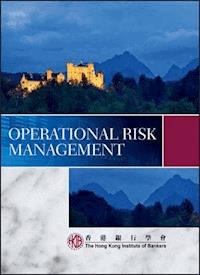
Operational Risk Management E-Book
36,99 €
Mehr erfahren.
- Herausgeber: John Wiley & Sons
- Kategorie: Fachliteratur
- Serie: Wiley Finance Series
- Sprache: Englisch
A practical guide to identifying, analyzing and tackling operational risk in banks and financial institutions
Created for banking and finance professionals with a desire to expand their management skill set, this book focuses on operational risk and operational risk events, as distinct from other types of functional risks. It was written by the experts at the world-renowned Hong Kong Institute of Bankers, an organization dedicated to providing the international banking community with education and training.
- Schools you in techniques for analyzing the operational risk exposure of banking institutions and assessing how operational risk impacts on other types of risk
- Provides expert guidance on how to design, plan and implement systems for operational risk management and quality control
- Describes a comprehensive approach to operational risk management that includes data collection, modeling and an overall risk management structure
- Shows you how to develop operational risk management solutions to help your company minimize losses without negatively impacting its ability to generate gains
- Offers expert guidance on various regulatory frameworks and how the latest Basel II and Basel III requirements impact a bank's operational risk management strategy and framework
Sie lesen das E-Book in den Legimi-Apps auf:
Seitenzahl: 385
Veröffentlichungsjahr: 2013
Ähnliche




















Contents
Preface
Part 1: Operational Risk in The Banking Industry
Chapter 1: Overview and Definition
Introduction
What is Operational Risk?
Important Operational Risk Events
Distinguished From Other Risks
Distinguished From Operations Risk
Boundaries of Operational Risk
Drivers of Operational Risk Management
Integrating Related Disciplines
Summary
Key Terms
Study Guide
Further Reading
Chapter 2: Operational Risk Management Frameworks
Introduction
Operational Risk Management Frameworks
ORM Frameworks and Goals
Summary
Key Terms
Study Guide
Further Reading
Chapter 3: Case Studies
Introduction
Categories of Operational Risk
Lessons in ORM
Summary
Key Terms
Study Guide
Further Reading
Part 2: Operational Risk Planning
Chapter 4: Methods and Tools
Introduction
The ORM Process
Managing Operational Risk
Summary
Key Terms
Study Guide
Further Reading
Chapter 5: Risk Identification
Introduction
Assessing Risk
Categorising Risk
Summary
Key Terms
Study Guide
Further Reading
Chapter 6: Risk Measurement and Assessment
Introduction
Impact and Probability
Value-at-Risk
Loss and Capital Charge
Summary
Key Terms
Study Guide
Further Reading
Part 3: Operational Risk Management
Chapter 7: Risk Control and Mitigation
Introduction
Incident Management
Assumptions, Avoidance, and Transference
Insurance
Internal Controls
Contingency Planning
Summary
Key Terms
Study Guide
Further Reading
Chapter 8: Risk Reporting
Introduction
Risk Profile
Reporting
Incidents and Data Reporting
Summary
Key Terms
Study Guide
Further Reading
Chapter 9: Related Techniques
Introduction
Scenario Analysis
Stress Testing
Operational Risk Models
Summary
Key Terms
Study Guide
Further Reading
Part 4: Regulatory Approaches to Operational Risk
Chapter 10: Regulatory Requirements
Introduction
Basel II
Basel III
HKMA Risk-Based Supervisory Approach
Approaches to Assessment
Basel III Risk Exposures
Summary
Key Terms
Study Guide
Further Reading
Chapter 11: Risk Governance
Introduction
Risk Governance Structure
Other Considerations
RCSA, KRIs, and Risk Events
Summary
Key Terms
Study Guide
Further Reading
Index
Copyright © 2013 John Wiley & Sons Singapore Pte. Ltd.
Published in 2013 by John Wiley & Sons Singapore Pte. Ltd.
1 Fusionopolis Walk, #07-01, Solaris South
Tower, Singapore 138628
All rights reserved.
No part of this publication may be reproduced, stored in a retrieval system, or transmitted in any form or by any means, electronic, mechanical, photocopying, recording, scanning, or otherwise, except as expressly permitted by law, without either the prior written permission of the Publisher, or authorization through payment of the appropriate photocopy fee to the Copyright Clearance Center. Requests for permission should be addressed to the Publisher, John Wiley & Sons Singapore Pte. Ltd., 1 Fusionopolis Walk, #07-01, Solaris South Tower, Singapore 138628, tel: 65–6643–8000, fax: 65–6643–8008, e-mail: [email protected].
This publication is designed to provide accurate and authoritative information in regard to the subject matter covered. It is sold with the understanding that the Publisher is not engaged in rendering professional services. If professional advice or other expert assistance is required, the services of a competent professional person should be sought. Neither the author nor the Publisher is liable for any actions prompted or caused by the information presented in this book. Any views expressed herein are those of the author and do not represent the views of the organizations he works for.
Other Wiley Editorial Offices
John Wiley & Sons, 111 River Street, Hoboken, NJ 07030, USA
John Wiley & Sons, The Atrium, Southern Gate, Chichester, West Sussex, P019 8SQ, United Kingdom
John Wiley & Sons (Canada) Ltd., 5353 Dundas Street West, Suite 400, Toronto, Ontario, M9B 6HB, Canada
John Wiley & Sons Australia Ltd., 42 McDougall Street, Milton, Queensland 4064, Australia
Wiley-VCH, Boschstrasse 12, D-69469 Weinheim, Germany
ISBN 978-0-470-82765-9 (Paperback)
ISBN 978-0-470-82767-3 (ePDF)
ISBN 978-0-470-82766-6 (Mobi)
ISBN 978-0-470-82768-0 (ePub)
Preface
The management of operational risk is one of the broadest functions of any bank or financial institution and one of the hardest to compartmentalise. Over the past two decades, understanding of operational risk has grown rapidly. Alongside this understanding, however, the realisation has emerged that only limited data is available. As a whole, the banking industry often has to deal with operational risk by trial and error. This book continues the discussion of bank operations. It examines how banks deal with operational risk, considers some case studies and lessons from the past and discusses how regulators approach operational risk.
This book is divided into four parts and eleven chapters that delve deeply into the subject matter. Despite the depth, the discussion here is unlikely to be enough to fully grasp the challenges of operational risk that have been high up on the list of considerations for the Basel Committee on Banking Supervision (BCBS) since the late 1990s. Further reading is encouraged and suggestions are provided at the end of each chapter.
Every effort has been made to ensure that policies and regulations discussed in this book are up to date and current. Most regulations on operational risk in use around the world are based on Basel II, which this book discusses at length.
The first part of this book starts with a background discussion of what operational risk is in the banking industry as differentiated from other types of risk commonly addressed such as credit risk, market risk, and operations risk. It also discusses how operational risk considerations in the banking industry may differ from other industries. With a broad definition at hand, this part goes on to discuss operational risk frameworks and best practice principles. The part ends with a series of real life cases that give a practical relief to theoretical discussions of operational risk management.
The second part of this book, which starts in Chapter 4, looks at how banks can and should undertake operational risk planning. The first chapter in this part considers the various methods and tools available to banks and other financial institutions. The second goes on to discuss how best to identify risk, and carry out risk and control self-assessment (RCSA). The final chapter in this part looks at how to measure and assess risk to determine the probable potential loss.
The third part of this book launches in Chapter 7 with an in-depth look of operational risk management. It starts out with considerations of risk control and mitigation followed by Chapter 8, which considers issues of escalation, key risk indicators (KRIs), and risk reporting at some length. This part ends in Chapter 9 with a discussion of associated techniques such as scenario analysis and how various operational risk models work and fit in within the greater framework of operational risk management. Some top-down and bottom-up models are considered.
The last part of this book encompasses the last two chapters, both of which consider how regulators look at operational risk and how regulatory approaches affect banks. The first considers regulatory requirements, particularly those set out by the Hong Kong Monetary Authority and its relationship to Basel II. The final chapter in this book looks at risk governance, outlines and discusses the principles for sound risk management developed by the BCBS and brings the book to an end with a brief discussion of how the various techniques help identify and manage potential events, thus, minimise losses.
This book includes detailed explanations, summaries, tables and charts to help industry professionals develop a sound theoretical framework for their work in the field. Both students and working professionals can benefit from this detailed work produced in collaboration with some of Hong Kong’s most prominent professionals. Aimed at banking practitioners and designed as an essential tool to achieve learning outcomes, this book includes recommendations for additional readings. A list of further readings at the end of each chapter will help readers expand their knowledge of each subject while supplementary readings can help readers dig deeper into specific areas. Essential readings will occasionally be highlighted and these are important for students preparing for the examinations leading to the Associate of the Hong Kong Institute of Bankers designation (AHKIB).
A number of people were integral to the development of this work. Among them it is important to highlight Frederick Au. There are many others whose contributions have been of particular significance in the preparation of this essential reference for banking professionals. Among them are Dr. David Yiu Chau Lam and Amos Chan. The information provided in the collection of Hong Kong Monetary Authority publications were instrumental in developing the chapters on risk control and risk governance, we are grateful for the insightful comments from representatives of the Hong Kong Monetary Authority.
The preparation would not have been possible without the help, advice, support, and encouragement of all these people and dozens more. We would like to extend our sincere thanks to them all.
The Hong Kong Institute of Bankers
PART 1
OPERATIONAL RISK IN THE BANKING INDUSTRY
Chapter 1
Overview and Definition
Learning objectives
After studying this chapter, you should be able to:
1 Understand how operational risk is defined by banking regulators, including the Hong Kong Monetary Authority (HKMA), and under Basel II
2 Distinguish operational risk from other types of risk, including market risk and credit risk, and from operations risk
3 Describe how Basel I and II approached operational risk and its inclusion as a factor in determining capital adequacy
4 Define operational risk management and discuss its drivers, activities, and related disciplines
5 Understand the HKMA approach to operational risk
Introduction
Risk is an inherent part of the business of banking. It comes in various forms, each of which presents its own challenges to the proper functioning of a bank. One of the most all-encompassing of these risks is operational risk.
Operational risk in banks and other financial institutions did not become a focal point until the late 1990s and the work by the Bank for International Settlements’ Basel Committee on Banking Supervision (BCBS) to define it, as well as develop frameworks to manage it and provide regulatory options. Through Basel I and the subsequent Basel II, operational risk moved from a position well behind the curtain to a role on the center stage of banking operations. Over the past decade, operational risk has taken on even greater importance. The BCBS principles on operational risk management were honed and streamlined.
This book seeks to define and explain operational risk, explore approaches to measure it, control it, and mitigate losses—in short, to explore operational risk management. It explores the sources of operational risk and the evolution of operational risk events. It seeks to offer readers and students the tools to determine bank exposures and develop strategies to mitigate it.
This first chapter lays the foundations for the rest of the book. It seeks to define operational risk, categorise it, and examine where it comes from. It outlines the approaches used in Basel II and by the Hong Kong Monetary Authority (HKMA). The broad outlines of important operational risk events will also be considered before trying to differentiate operational risk from other types of risk, including operations risk, which is an entirely different category.
Lastly, this chapter considers the interplay between the risk management practices of various functions of a bank and operational risk, including financial risk management, audit and internal controls, and reliability engineering.
Lesen Sie weiter in der vollständigen Ausgabe!
Lesen Sie weiter in der vollständigen Ausgabe!
Lesen Sie weiter in der vollständigen Ausgabe!
Lesen Sie weiter in der vollständigen Ausgabe!
Lesen Sie weiter in der vollständigen Ausgabe!
Lesen Sie weiter in der vollständigen Ausgabe!
Lesen Sie weiter in der vollständigen Ausgabe!
Lesen Sie weiter in der vollständigen Ausgabe!
Lesen Sie weiter in der vollständigen Ausgabe!
Lesen Sie weiter in der vollständigen Ausgabe!
Lesen Sie weiter in der vollständigen Ausgabe!
Lesen Sie weiter in der vollständigen Ausgabe!
Lesen Sie weiter in der vollständigen Ausgabe!
Lesen Sie weiter in der vollständigen Ausgabe!




