


112,99 €
Mehr erfahren.
- Herausgeber: John Wiley & Sons
- Kategorie: Wissenschaft und neue Technologien
- Serie: IEEE Series on Systems Science and Engineering
- Sprache: Englisch
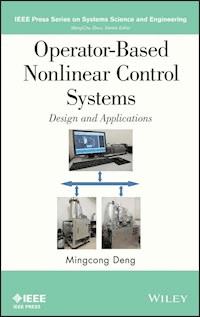
Enables readers to master and apply the operator-theoretic approach Control of nonlinear systems is a multidisciplinary field involving electrical engineering, computer science, and control engineering. Specifically, this book addresses uncertain nonlinearity. Beginning with how real plants are modeled as operator-based plants, the author develops a systematic methodology that enables readers to understand a quantitative stability result, a critical factor in any nonlinear control system's stability and performance. Operator-Based Nonlinear Control Systems: Design and Applications focuses on the operator-theoretic approach, offering detailed examples on how to apply it to network controlled systems. In addition to current research results, the author explores future research directions and applications of the operator-theoretic approach. The book begins with an introduction that defines nonlinear systems. Next, it covers: * Robust right coprime factorization for nonlinear plants with uncertainties * Robust stability of operator-based nonlinear control systems * Tracking issues and fault detection issues in nonlinear control systems * Operator-based nonlinear control systems with smart actuators * Nonlinear feedback control for large-scale systems using a distributed control system device Throughout the book, discussions of actual applications help readers understand how the operator-theoretic approach works in practice. Operator-Based Nonlinear Control Systems is recommended for students and professionals in control theory engineering and applied mathematics. Working with this expertly written and organized book, they will learn how to obtain robust right coprime factorization for modeled plants. Moreover, they will discover state-of-the-technology research results on robust stability conditions as well as the latest system output tracking and fault detection issues that are challenging today's researchers.
Sie lesen das E-Book in den Legimi-Apps auf:
Seitenzahl: 358
Veröffentlichungsjahr: 2014
Ähnliche




















Contents
Cover
IEEE Press
Title Page
Copyright
Chapter 1: Introduction
1.1 DEFINITION OF NONLINEAR SYSTEMS
1.2 NONLINEAR SYSTEM DYNAMICS ANALYSIS AND CONTROL
1.3 WHY OPERATOR-BASED NONLINEAR CONTROL SYSTEM?
1.4 OVERVIEW OF THE BOOK
ACKNOWLEDGMENTS
Chapter 2: Robust Right Coprime Factorization for Nonlinear Plants with Uncertainties
2.1 PRELIMINARIES
2.2 OPERATOR THEORY
Chapter 3: Robust Stability of Operator-Based Nonlinear Control Systems
3.1 CONCEPT OF OPERATOR-BASED ROBUST STABILITY
3.2 DESIGN METHODS OF NONLINEAR SYSTEMS WITH UNCERTAINTIES
3.3 OPERATOR-BASED ROBUST ANTI-WINDUP NONLINEAR FEEDBACK CONTROL SYSTEMS DESIGN
3.4 OPERATOR-BASED MULTI-INPUT–MULTI-OUTPUT NONLINEAR FEEDBACK CONTROL SYSTEMS DESIGN
3.5 OPERATOR-BASED TIME-VARYING DELAYED NONLINEAR FEEDBACK CONTROL SYSTEMS DESIGN
Chapter 4: Tracking and Fault Detection Issues in Nonlinear Control Systems
4.1 OPERATOR-BASED TRACKING COMPENSATOR IN NONLINEAR FEEDBACK CONTROL SYSTEMS DESIGN
4.2 ROBUST CONTROL FOR NONLINEAR SYSTEMS WITH UNKNOWN PERTURBATIONS USING SIMPLIFIED ROBUST RIGHT COPRIME FACTORIZATION
4.3 OPERATOR-BASED ACTUATOR FAULT DETECTION METHODS
4.4 OPERATOR-BASED INPUT COMMAND FAULT DETECTION METHOD IN NONLINEAR FEEDBACK CONTROL SYSTEMS
Chapter 5: Operator-Based Nonlinear Control Systems with Smart Actuators
5.1 OPERATOR-BASED ROBUST NONLINEAR FEEDBACK CONTROL SYSTEMS DESIGN FOR NONSYMMETRIC BACKLASH
5.2 OPERATOR-BASED ROBUST NONLINEAR FEEDBACK CONTROL SYSTEMS DESIGN FOR SYMMETRIC AND NONSYMMETRIC HYSTERESIS
5.3 OPERATOR-BASED NONLINEAR FEEDBACK SYSTEMS APPLICATION FOR SMART ACTUATORS
Chapter 6: Application of Operator-Based Nonlinear Feedback Control to Large-Scale Systems Using Distributed Control System Device
6.1 INTRODUCTION
6.2 MULTITANK PROCESS MODELING
6.3 ROBUST RIGHT COPRIME FACTORIZATION DESIGN AND CONTROLLER REALIZATION
6.4 EXPERIMENTAL RESULTS
6.5 SUMMARY
References
Index
Series
IEEE Press 445 Hoes Lane Piscataway, NJ 08854
IEEE Press Editorial Board Tariq Samad, Editor in Chief
Linda Shafer MengChu Zhou George Zobrist
George W. Arnold Ray Perez Dmitry Goldgof
Ekram Hossain Mary Lanzerotti Pui-In Mak
Kenneth Moore, Director of IEEE Book and Information Services (BIS)
Technical Reviewers
Prof. Xinkai Chen, Department of Electronic Information Systems, Shibaura Institute of Technology
Prof. Hong Wang, Control Systems Centre, The University of Manchester
Copyright © 2014 by The Institute of Electrical and Electronics Engineers, Inc.
Published by John Wiley & Sons, Inc., Hoboken, New Jersey. Published simultaneously in Canada.
No part of this publication may be reproduced, stored in a retrieval system, or transmitted in any form or by any means, electronic, mechanical, photocopying, recording, scanning, or otherwise, except as permitted under Section 107 or 108 of the 1976 United States Copyright Act, without either the prior written permission of the Publisher, or authorization through payment of the appropriate per-copy fee to the Copyright Clearance Center, Inc., 222 Rosewood Drive, Danvers, MA 01923, (978) 750-8400, fax (978) 646-8600, or on the web at www.copyright.com. Requests to the Publisher for permission should be addressed to the Permissions Department, John Wiley & Sons, Inc., 111 River Street, Hoboken, NJ 07030, (201) 748-6011, fax (201) 748-6008.
Limit of Liability/Disclaimer of Warranty: While the publisher and author have used their best efforts in preparing this book, they make no representations or warranties with respect to the accuracy or completeness of the contents of this book and specifically disclaim any implied warranties of merchantability or fitness for a particular purpose. No warranty may be created or extended by sales representatives or written sales materials. The advice and strategies contained herin may not be suitable for your situation. You should consult with a professional where appropriate. Neither the publisher nor author shall be liable for any loss of profit or any other commercial damages, including but not limited to special, incidental, consequential, or other damages.
For general information on our other products and services please contact our Customer Care Department with the U.S. at 877-762-2974, outside the U.S. at 317-572-3993 or fax 317-572-4002.
Wiley also publishes its books in a variety of electronic formats. Some content that appears in print, however, may not be available in electronic format.
Library of Congress Cataloging-in-Publication Data:
Deng, Mingcong. Operator-based nonlinear control systems design and applications / Mingcong Deng. – First edition. pages cm. – (IEEE Press series on systems science and engineering) ISBN 978-1-118-13122-0 (hardback) 1. Automatic control. 2. Nonlinear control theory. I. Title. TJ213.D435 2013 629.8′36–dc23
2013026695
CHAPTER 1
Introduction
1.1 DEFINITION OF NONLINEAR SYSTEMS
In general, a nonlinear system is one that does not satisfy the superposition principle or whose output is not directly proportional to its input. That is, a nonlinear system is any problem where the variable(s) to be solved for cannot be written as a linear combination of independent components. Since most economic, social, and many industrial systems are inherently nonlinear in nature, where mathematical analysis is unable to provide general solutions, nonlinear system problems, especially nonlinear systems dynamics analysis and control problems for industrial systems, are of interest to mathematicians, physicists, and engineers.
1.2 NONLINEAR SYSTEM DYNAMICS ANALYSIS AND CONTROL
Nonlinear systems control is the discipline that applies control theory to design systems with desired behaviors. It can be broadly defined or classified as nonlinear control theory and application. It seeks to understand nonlinear systems dynamics, using mathematical modeling, in terms of inputs, outputs, and various components with different behaviors and to use nonlinear control systems design schemes to develop controllers for those systems in one or many time, frequency, and complex domains, depending on the nature of the design problem. As a result, control of nonlinear systems is a multidisciplinary research field involving the synergistic integration of mechanical and electrical engineering, computer science, and even biological engineering. Control of nonlinear systems will become mainstream consumer products within the next decade, providing a significant growth opportunity for the above-mentioned engineering systems. So far, there are several significant techniques for analyzing nonlinear systems, for example, describing the function method, the phase plane method, Lyapunov-based analysis, the singular perturbation method, the Popov criterion, the center manifold theorem, the small-gain theorem, and passivity analysis. Based on the above techniques, significant results were introduced extending to nonlinear feedback systems design and control. Some cornerstone control methods, for example, Lyapunov function method, sliding-mode control method, and nonlinear damping method, are proposed. In view of the input–output nature of the nonlinear system concept itself, it seems useful to establish computer-oriented approaches to nonlinear control systems analysis and design. Addressing this problem, the robust right coprime factorization technique of nonlinear operators, in addition to the above significant techniques, which is based on real and complex variable theory, has been a promising technique, where the operators can be either linear or nonlinear, continuous time or discrete time, finite dimensional or infinite dimensional, and in the frequency domain or time domain [1].
1.3 WHY OPERATOR-BASED NONLINEAR CONTROL SYSTEM?
As a basis for the possible next generation of control of nonlinear systems, the theoretical concept of operator-based nonlinear control has been introduced in recent years. In the operator-based nonlinear control system research approach, since the 1990s, some researchers started with the operator-theoretic nonlinear control approach, and mathematical background was provided. As for the development of the design principle, it is forecasted that the operator-theoretic nonlinear control approach will be applied significantly. As a result, research on operator-based nonlinear system control has great potential to the application for industry and daily life. However, the nonlinear control system analysis design might be difficult and impossible because of the complex uncertain nonlinearities. There was lack of a quantitative stability result, which may guarantee stability and performance of the control system with the uncertain nonlinearities. Addressing the above problem, this book aims to develop a systematic methodology using operator-based design of nonlinear control systems.
1.4 OVERVIEW OF THE BOOK
This book concerns uncertain nonlinearity in this important research field. Starting with major goals and reviews, the book gives a perspective as to how plants can be modeled as operator-based plants. The primary objectives of this book are to guide modeled plants to obtain robust right coprime factorization, provide state-of-the art research on robust stability conditions, and discuss system output tracking and fault detection issues for researchers working in this field. Considering the broad set of the readers whom I would like to reach, I some applications are included for a good understanding. The intent is to help beginning graduate students learn several developments of operator-based nonlinear control system design. This book also summarizes our understanding of the current trend and the likely future of the operator-theoretic approach reported in latest research results on several frontier problems. Motivated by the above consideration, a detailed analysis of nonlinear feedback control systems based on an operator-theoretic approach is considered in this book. Based on the operator theory, nonlinear feedback control systems can be designed and applied, that is, operator-based nonlinear feedback control using robust right coprime factorization [1–2, 8]. For instance, application of the proposed designs to networked control processes is considered and vibration control using piezoelectric actuators, ionic polymer metal composite actuators, and shape memory alloy actuators has been successfully conducted. Meanwhile, a fault detection technique based on an operator-theoretic approach is also developed. In describing these aspects of the operator-based nonlinear control system, it is assumed that the reader is familiar with Banach spaces, linear operator theory, and right coprime factorization and has some elementary knowledge of nonlinear control, found in the excellent text by de Figueiredo and Chen [1]. Some of the work described in this book is based upon a series of recent publications by the author.
ACKNOWLEDGMENTS
The author would like to acknowledge his colleagues in Japan, especially Emeritus Professor Akira Inoue for valuable comments, suggestions, and criticisms during this research. In particular, the author would like to thank his former Ph.D. students, Dr. Changan Jiang, Dr. Lihua Jiang, Dr. Shuhui Bi, Dr. Osunleke A. Saheeb, Dr. Ni Bu, Dr. Shengjun Wen, Dr. Seiji Saito, and Dr. Aihui Wang, for their work in completing his idea on operator-based nonlinear control system design and experimental work, and the author appreciates the many valuable discussions concerning the research approach with the above Ph.D. students. Also, thanks to Dr. Akira Yanou and Dr. Tomohiro Henmi for their support of some of this research. Compilation of this book involved the assistance of my graduate student, Mr. Toshihiro Kawashima. Finally, a special thanks to my wife, Yan Yu, and my children, Mengyan and Huili, for their constant encouragement and patience and my friends in China, the United Kingdom, the United States, and Canada for many interesting discussions during the writing of this book.
Lesen Sie weiter in der vollständigen Ausgabe!
Lesen Sie weiter in der vollständigen Ausgabe!
Lesen Sie weiter in der vollständigen Ausgabe!
Lesen Sie weiter in der vollständigen Ausgabe!
Lesen Sie weiter in der vollständigen Ausgabe!
Lesen Sie weiter in der vollständigen Ausgabe!
Lesen Sie weiter in der vollständigen Ausgabe!
Lesen Sie weiter in der vollständigen Ausgabe!




