


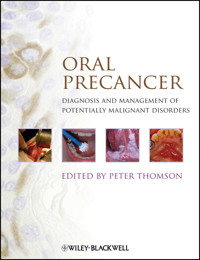
Oral Precancer E-Book
109,99 €
Mehr erfahren.
- Herausgeber: John Wiley & Sons
- Kategorie: Fachliteratur
- Sprache: Englisch
Without early detection, oral cancer is deadly. Protect your patients by applying the latest clinical interventions.
Rates of new oral cancer cases continue to increase and mortality rates remain alarmingly high. Oral
cancer may be preceded by clinically identifiable precancerous changes in the oral mucosa, which offer a therapeutic window of opportunity to intervene and halt disease progression to carcinoma development.
Written and edited by prominent researchers in the field, Oral Precancer:
- Reviews current scientific research on precancer conditions of the oral cavity providing evidence-based analysis of the nature and behavior of potentially malignant and deforming oral diseases
- Explains the principles of prevention, diagnosis and management of potentially malignant disorders of the oral cavity
- Details a practical and reliable interventional treatment strategy to facilitate early diagnosis and effective treatment of both precancer and early invasive carcinoma
- Contains a chapter devoted to illustrative case histories, high-quality, color, clinical photos, reference sections in each chapter listing relevant review articles, and more
From start to finish, Oral Precancer offers undergraduate students, clinicians, and professors an invaluable resource to minimise the morbidity and mortality of this most significant and life threatening of oral conditions.
Sie lesen das E-Book in den Legimi-Apps auf:
Seitenzahl: 365
Veröffentlichungsjahr: 2012
Ähnliche




















Contents
Cover
Title Page
Copyright
List of Contributors
Preface
Acknowledgements
Chapter 1: Introduction
General Introduction
Epidemiology
Prevalence of Oral Leukoplakia
Prevalence of Oral Erythroplakia
Prevention
Treatment Strategies
Terminology
Summary
References
Chapter 2: Form and Function of the Oral Mucosa
Introduction
Applied Anatomy of the Oral Cavity
Function of the Oral Mucosa
Microanatomy of the Oral Mucosa
Regional Variation of the Oral Mucosa
Oral Epithelial Cell Kinetics
Oral Epithelial Cell Proliferative Activity
Anatomical Site Predilection for Oral Carcinogenesis
Summary
References
Chapter 3: Oral Carcinogenesis
Introduction
Oral Cancer and Precancer
The ‘Progression Model’ for Oral Cancer
Aetiology and Risk Factors
Patient and Risk Factor Profiling
Summary
References
Chapter 4: Clinical Presentation of Oral Precancer
Introduction
Clinical Terminology
Precancerous (Premalignant) Lesions
Precancerous (Premalignant) Conditions
Syphilis
Multiple Lesion Disease
Summary
References
Chapter 5: Diagnostic Methods
Introduction
Screening
Clinical Examination Techniques
Diagnostic Aids in Precancer Diagnosis
Brush Biopsy and Exfoliative Cytology
Clinical Diagnosis in Practice
Summary
References
Chapter 6: Pathological Aspects of Oral Precancer
Introduction
Biopsy Techniques
Role of the Pathologist
Histopathological Features of Oral Potentially Malignant Disorders
Grading of Dysplasia
Limitations in Conventional Pathological Techniques
Summary
References
Chapter 7: Management of Oral Precancer
Introduction
Risk Factor Modification
Observation Versus Intervention
Medical Treatment
Surgical Treatment
Combined Treatment Modalities
Patient Follow up and Surveillance
Summary
References
Chapter 8: Clinical Outcome
Introduction
Clinical Outcome Studies
Patient Cohort Studies
Definitions of Clinical Outcome
Newcastle Patient Cohort Studies
Patient Follow Up
Prediction of clinical outcome
Summary
References
Chapter 9: Malignant Transformation and Oral Cancer Development
Introduction
Risk of Progression to Oral Carcinoma
Malignant Transformation Versus oral Cancer Development
Interventional Laser Surgery and Oral Cancer Prevention
Newcastle 10-year Follow-up Study
High- and Low-Risk Patients
Clinical Signs of Oral Squamous Cell Carcinoma
Diagnosis and Management of ‘Unexpected Malignancy’
Prognosis for the ‘Transformed’ Patient
Summary
References
Chapter 10: The Future
Introduction
Prevention of Oral Precancer
Early Diagnosis of Potentially Malignant Disease
Interventional Management Strategies in the Future
Individualised Patient Treatments: Biomarkers and Targeted Chemoprevention
Future Research Directions
Summary
References
Chapter 11: Case Histories
Introduction
Case 1: Diagnosis of Unexpected Malignancy
Case 2: Multiple Lesion Disease Responding to Conservative Management
Case 3: Multiple Lesion Disease Requiring Repeated Laser Treatments
Case 4: Proliferative Verrucous Leukoplakia
Case 5: Localised Oral Lichenoid Reaction
Case 6: Multiple Oral Lichenoid Reactions
Case 7: Widespread Dysplastic Oral Lichenoid Lesions
Case 8: An Immunosuppressed Patient
Case 9: Chronic Hyperplastic Candidosis
Case 10: Tobacco-Associated Hyperkeratosis
Case 11: Malignant Transformation in Longstanding Non-Erosive Lichen Planus
Summary
Chapter 12: Conclusions
Oral Cancer
Potentially Malignant Disorders
Clinical Management
Patient Care Pathways
Public Health Strategies
Future Directions
Index
This edition first published 2012 © 2012 by John Wiley & Sons, Ltd.
Blackwell Publishing was acquired by John Wiley & Sons in February 2007.
Blackwell's publishing program has been merged with Wiley's global Scientific, Technical and Medical business to form Wiley-Blackwell.
Registered office: John Wiley & Sons, Ltd, The Atrium, Southern Gate, Chichester, West Sussex, PO19 8SQ, UK
Editorial offices: 9600 Garsington Road, Oxford, OX4 2DQ, UK
The Atrium, Southern Gate, Chichester, West Sussex, PO19 8SQ, UK
111 River Street, Hoboken, NJ 07030-5774, USA
For details of our global editorial offices, for customer services and for information about how to apply for permission to reuse the copyright material in this book please see our website at www.wiley.com/wiley-blackwell.
The right of the author to be identified as the author of this work has been asserted in accordance with the UK Copyright, Designs and Patents Act 1988.
All rights reserved. No part of this publication may be reproduced, stored in a retrieval system, or transmitted, in any form or by any means, electronic, mechanical, photocopying, recording or otherwise, except as permitted by the UK Copyright, Designs and Patents Act 1988, without the prior permission of the publisher.
Designations used by companies to distinguish their products are often claimed as trademarks. All brand names and product names used in this book are trade names, service marks, trademarks or registered trademarks of their respective owners. The publisher is not associated with any product or vendor mentioned in this book. This publication is designed to provide accurate and authoritative information in regard to the subject matter covered. It is sold on the understanding that the publisher is not engaged in rendering professional services. If professional advice or other expert assistance is required, the services of a competent professional should be sought.
Library of Congress Cataloging-in-Publication Data
List of Contributors
Dr Michaela L. Goodson BMedSci BDS MBBS MFDSRCS MRCS
Specialist Registrar in Oral and Maxillofacial Surgery, Northern Deanery
Honorary Clinical Lecturer, Newcastle University, Newcastle upon Tyne, UK
Dr C. Max Robinson BDS MSc PhD FDSRCS FRCPath
Senior Lecturer in Oral Pathology, Newcastle University
Honorary Consultant Pathologist, Newcastle upon Tyne Hospitals NHS Foundation Trust, Newcastle upon Tyne, UK
Professor Philip Sloan BDS PhD FDSRCS FRCPath
Consultant Pathologist, Newcastle upon Tyne Hospitals NHS Foundation Trust
Honorary Professor, Newcastle University, Newcastle upon Tyne, UK
Professor Peter Thomson BDS MBBS MSc PhD FDSRCS(Eng) FFDRCS(Irel) FRCS(Ed)
Professor of Oral and Maxillofacial Surgery, Newcastle University
Honorary Consultant Oral and Maxillofacial Surgeon, Newcastle upon Tyne Hospitals NHS Foundation Trust, Newcastle upon Tyne, UK
Preface
This book has its origins some 30 years ago during my experiences as a dental undergraduate student attending specialist oral surgery and oral medicine clinics at a prestigious dental teaching hospital in northwest England in the early 1980s. I was fascinated to observe the number and variety of patients who presented with white and/or red oral mucosal lesions and to learn of their varied aetiologies, histopathological diagnoses and, perhaps most significantly of all, to discover their potential high risk for transformation to mouth cancer.
My early interest and enthusiasm to study this beguiling spectrum of oral precancer disease, however, quickly became tempered by the realisation that my clinical teachers, many of whom were senior clinicians and professors of international repute, were unable to determine the individual risk of patients undergoing carcinogenesis. Nor could they offer a reliable prognosis for disease progression or apparently any appropriate treatment intervention. Perhaps worst of all was to actually encounter those unfortunate patients who, despite regular clinic attendance for examination and reassurance, subsequently went on to develop oral cancer.
During my professional career, I have been extremely fortunate to have had the opportunity to continue this personal interest in oral oncology and to have been able to pursue a number of studies into the scientific basis of oral cancer and precancer diagnosis and management. As I commenced my clinical training, firstly within hospital dentistry, then medical undergraduate studies, followed by a period of research work in the field of oral epithelial biology before ultimately specialising as an oral and maxillofacial surgeon, I learned a great deal more about the devastating consequences, both in terms of morbidity and mortality, of invasive squamous cell carcinoma of the oral cavity.
Today oral cancer remains a lethal disease, with a near 50% mortality at 5 years. The consequences of that disease process and the application of the primary treatment modalities of tumour resection and/or chemoradiotherapy produce significant and distressing morbidities, in terms of a loss of form and function, to both the mouth and the face for those patients who survive their cancer treatment. Unfortunately, these problems are growing rather than lessening in significance. Worldwide, the annual mortality rates from mouth and oropharyngeal cancers are expected to rise from 370 000 to nearly 600 000 a year by 2030. This emphasises the seriousness of the disease as a truly global health problem. Some authors have even predicted that we will, in effect, actually experience a worldwide epidemic of oral cancer during the latter part of the 21st century.
It is important to stress, however, that it is not my intention to write a book about oral cancer. Indeed, there are many excellent textbooks available that encompass all the aetiology, diagnosis and management of mouth cancer that the interested reader may require. Rather, this book focuses upon oral precancer – that clinically recognisable state composed of a variety of distinct oral lesions or sometimes more widespread conditions, which is now more commonly referred to collectively as potentially malignant disorders, that may precede the development of invasive squamous cell carcinoma of the oral cavity. Potentially malignant disorders therefore offer clinicians a potential therapeutic window of opportunity to intervene and to attempt to halt the progress of oral mucosal disease before the onset of irreversible carcinogenesis.
Unfortunately, there remains significant controversy over the efficacy of interventional therapies in preventing cancer and there are thus no universally agreed treatment protocols for oral precancer lesions. Whilst a vast literature of published papers on potentially malignant disease has accrued through the years, quite literally numbering many thousands, there remains substantial confusion in their overall purpose, their use of terminology and the conclusions that they draw. Perhaps most frustratingly of all, this body of literature provides virtually no consensus on how to coordinate treatment or provide clinical care for precancer patients.
The principal aim in writing this book, therefore, is to propose a rational basis for an interventional clinical management protocol. This is based upon several years of observational clinical research and patient cohort treatment studies, all of which have been designed with the specific intent of trying to prevent potentially malignant disorders progressing to oral cancer.
I have not attempted in this book to construct a comprehensive worldwide literature review and critique. This is because, quite frankly, no consensus view could be extrapolated from such an exercise but also because such a work would be highly unreadable and it would fail in my attempt to deliver a concise summary of our current understanding of the nature and behaviour of oral potentially malignant disorders. I have, however, listed many contemporaneous review articles in the reference sections that accompany each chapter, to allow the researcher who wishes to pursue aspects of this work in more detail to be able to do so.
Like most clinicians, I owe an enormous personal debt to my many clinical teachers and surgical trainers through the years, but I particularly wish to acknowledge and thank all my patients for their stoicism and loyalty and especially the trust they have bestowed on me as both their advisor and surgeon. It is for them, and future patients like them, that I have written this book.
Peter ThomsonNewcastle upon Tyne, UK2012
Acknowledgements
I would like to acknowledge the important contributions of my expert co-authors Michaela Goodson, Max Robinson and Philip Sloan for their help and active involvement in producing this book. Without them, this manuscript would undoubtedly have been much poorer and only a pale shadow of its current form. I also wish to thank my postgraduate students who, with their boundless intelligence and ceaseless enthusiasm have, over the years, encouraged and stimulated my research into the scientific basis of oral carcinogenesis. Ultimately this has helped develop the approach to the diagnosis and management of oral potentially malignant disorders presented in this book. I especially wish to mention in this regard Omar Hamadah, Ameena Diajil, Rachel Green and Michaela Goodson. Much of their individual contributions to the scientific development of oral precancer research is presented and acknowledged in this work.
I would also like to express my thanks to many of my clinical colleagues in Newcastle upon Tyne without whom I would have been unable to offer my patients the wide and comprehensive range of services that are so important in an active oral precancer treatment programme. Of especial importance are those colleagues working in the Departments of Anaesthesia, Medical Physics, Pathology and Medical Photography. Out of these many people, Dr Remani Wariyar in Anaesthetics and Mr Steven Burnett from Medical Physics deserve special mention for their day to day support in the operating theatre.
A manuscript such as this, of course, requires help and cooperation from very many colleagues but, nonetheless, any errors or omissions remain my sole responsibility.
Chapter 1
Introduction
Peter Thomson
General Introduction
This book deals with the diagnosis and management of oral precancer, a relatively rare but important and fascinating range of potentially malignant disorders. Oral precancer comprises both discrete, readily identifiable, oral mucosal lesions such as leukoplakia or erythroplakia and also more widespread or systemic conditions that may affect the lining of the oral cavity, and whose clinical presence may precede the development of invasive oral cancer.
The concept of a recognisable precancer state has arisen following a number of salient clinicopathological observations that include the observed transformation of pre-existing clinical lesions into invasive cancers during patient follow up, the recognition that leukoplakic or erythroplakic lesions are often found to coexist with oral squamous cell carcinoma, and the realisation that numerous histopathological and biomolecular tissue changes are actually common to both cancers and their potentially malignant counterparts [1].
The identification of a potentially malignant disorder in an individual patient, however, does not mean that an inevitable malignant transformation will take place because many of these oral lesions do not progress over time and some may even resolve or regress spontaneously. Nonetheless, statistically, such patients are known to remain at an increased risk of developing mouth cancer.
Cancer of the mouth, which is primarily a squamous cell carcinoma arising from the oral mucosa lining, is the sixth most common cancer worldwide and is traditionally seen most frequently in older people [2]. It is a lethal and deforming disease due not only to local tumour invasion, oro-facial tissue destruction and cervical lymph node metastasis, but also because of widespread blood-borne tumour dissemination affecting particularly the lungs and the liver. Worldwide, 5-year survival rates for oral cancers are around 50%, with prognosis worsening with advanced disease and late presentation [2].
Lesen Sie weiter in der vollständigen Ausgabe!
Lesen Sie weiter in der vollständigen Ausgabe!
Lesen Sie weiter in der vollständigen Ausgabe!
Lesen Sie weiter in der vollständigen Ausgabe!
Lesen Sie weiter in der vollständigen Ausgabe!
Lesen Sie weiter in der vollständigen Ausgabe!
Lesen Sie weiter in der vollständigen Ausgabe!
Lesen Sie weiter in der vollständigen Ausgabe!
Lesen Sie weiter in der vollständigen Ausgabe!
Lesen Sie weiter in der vollständigen Ausgabe!
Lesen Sie weiter in der vollständigen Ausgabe!
Lesen Sie weiter in der vollständigen Ausgabe!




