


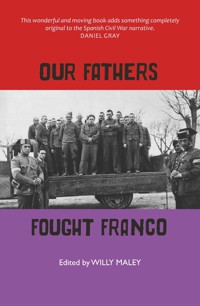
Our Fathers Fought Franco E-Book
11,99 €
Mehr erfahren.
- Herausgeber: Luath Press
- Kategorie: Geisteswissenschaft
- Sprache: Englisch
James Maley, George Watters, Donald Renton and Archibald Williams were members of Machine Gun Company No. 2 of the XV International Brigade. This is the first book to focus on a small group of men from different starting-points, ended up in the same battleground at Jarama, and then in the same prisons after capture by Franco's forces. Their remarkable story is told both in their own words and in the recollections of their sons and daughters, through a prison notebook, newspaper reports, stills cut from newsreels, interviews, anecdotes and memories, with a foreword by Daniel Gray. Our Fathers Fought Franco is a collective biography that promises to add significantly to the understanding of the motives of those who 'went because their open eyes could see no other way'.
Das E-Book können Sie in Legimi-Apps oder einer beliebigen App lesen, die das folgende Format unterstützen:
Seitenzahl: 310
Veröffentlichungsjahr: 2023
Ähnliche




















LISA CROFT lives in Lancashire and was a library assistant for over 20 years. She writes this account on behalf of her mother, Rosemary Nina Williams, who was born when her father was imprisoned in Spain, and for her aunt, Jennifer Talavera Williams, who is named after that Spanish jail’s location.
WILLY MALEY teaches at the University of Glasgow and is co-author, with his brother John, of From the Calton to Catalonia, a play based around their father’s experiences in Spain in 1937.
JENNIE RENTON is a secondhand bookseller and publishing freelancer in her home city of Edinburgh. As founder-editor of Scottish Book Collector she produced over 80 issues of the magazine; she also edited Folio for the National Library of Scotland.
TAM WATTERS worked as a coal miner for 25 years until Bilston Glen Colliery closed. A keen amateur photographer, he went on to work as a camera sales adviser for the next 23 years and is now retired. In his younger days he was a Scottish weightlifting champion.
All royalties generated from the sale of this book will be donated to the International Brigade Memorial Trust (IBMT) which ‘keeps alive the memory and spirit of the men and women who fought fascism in Spain from 1936 to 1939’. www.international-brigades.org.uk
First published 2023
ISBN 978-1-80425-078-5
The authors’ right to be identified as author of this book under the Copyright, Designs and Patents Act 1988 has been asserted.
Typeset in 11 point Sabon LT Pro by
Main Point Books, Edinburgh
Images © the contributors unless otherwise stated
Text © the contributors, 2023
Contents
Foreword by Daniel Gray
Introduction by Willy Maley
Timeline
1 JAMES MALEY
’Neath the Red Flag would fight
Willy Maley
2 DONALD RENTON
Not made with rosewater
Jennie Renton
3 GEORDIE WATTERS
‘I’m away to Spain to fight the fascists. Who will join me?’
Tam Watters
4 ARCHIBALD CAMPBELL MCASKILL WILLIAMS
‘Rosemary for remembrance: Is he still alive?’
Lisa Croft
Appendix
Members of No. 2 Machine Gun Company
Further Reading
Acknowledgements
To the International Brigaders and their families
Foreword
THE TENEMENT DOORWAYS of Scottish cities whisper ghosts’ names as you pass. Here lived the Robertsons, declare letters engraved on wizened green buzzer plaques, the Patersons and the Crollas too. If you are lucky, their pulling handles are still in place, bulbous and resembling the tops of old police truncheons. Most have disappeared – smelted in the war effort? stolen? – and there is only a small surprised mouth hole.
Whatever their state, it is an enjoyable, diverting pastime to glance at them and speculate as you walk on by – was FRASER a friend of THOMSON? Did NOWAK and DI ROLLO swap stories of immigrant life?
Not so many streets from mine is one such square plaque. J RUSSELL, it reads, and it belonged to an International Brigader. Strolling by this one, at 18 Edina Place in Leith, I do not have so many gaps to fill or flights of fancy to board. I know that one day in 1937, RUSSELL stepped down from this communal entrance, turned left and then left again onto Easter Road, and went to fight in Spain.
My possession of a list that contained the addresses of Scots at the time they volunteered to join the war in Spain domesticated them. They were still remote heroes brimming with courage alien to our times, and yet now I could picture them whistling ‘The Internationale’ while walking to the grocer’s shop or sitting on a park bench reading the Daily Worker. It humanised these hitherto otherworldly titans. Another local, Andrew Foley, listed his address as ‘Hibs Supporters Club, 72 Easter Road’. I began to think more about their lives before 1936 and after 1939, and most of all about those they left behind or would later bring into the world. To go to Spain you had to have a big heart. You probably knew, then, what it was to love and be loved.
I thought first of the women left here. Strictly speaking, there was a long stage when married men were not supposed to volunteer for the British Battalion of the International Brigade. That edict did not stop some and besides, even in the mid-to-late 1930s, romance blossomed way before it carried couples down the aisle. Occasionally in letters sent home from the Spanish frontline, talk would turn tender and absent hearts come to the fore. Having read these lines, I left them among the pages they were written on, keeping sweet nothings private as they should be, but never forgot them.
Sometimes, if rarely, there would be words from beyond those tenement buzzers – women writing to or about their Brigader loves. My own heart thudded densely when I encountered the words of Mrs C Fry, relaying the story of her recently killed Brigader husband, Harold, a shoemaker from Craigmillar in Edinburgh:
My husband went to Spain because he realised the danger of fascism and believed that his military experience could best be used in fighting it. He joined the International Brigades because he thought it was the job he could do best. His experience of fascist methods of warfare and their brutal treatment of prisoners behind the lines only helped to strengthen his determination to carry on the fight until Franco, Hitler and Mussolini were beaten. This is why he went back to Spain again after a short period of leave, his wound hardly healed, and without ever seeing his baby boy which was born the day after he left. I would not have stopped him even if I could, because I believe he was right, and I’m sure his last thoughts must have been of regret that he could not live to see the final triumph of the forces he fought for.
‘Without ever seeing his baby boy which was born the day after he left’ – it is hard to think of a sadder short story. Thoughts of women, then, unravelled into thoughts of children too.
Then I thought of other relatives – brothers and sisters in a familial rather than comradely way, and mums and dads and grandparents. All of them must have worried themselves nauseous. The men’s actions bred both pride and resistance, sometimes within the same household.
Three members of the Murray family – Annie, George and Tom – went to Spain; she to nurse and they to fight. Five further sisters were left at home, all campaigning for the Spanish cause and in most cases attempting to serve themselves. The words of one of them, Margaret, summarised the anguish of many remaining here when she spread news of a letter from Annie: ‘Annie was in very good spirits and not a bit worried about going out to the fighting zone. Of course, it is much worse for the people left at home, isn’t it?’
Less enthused were the uncles of Glaswegian volunteer John Dunlop. Learning that John was about to flee his accountancy apprenticeship and travel by rail to Spain, they raced to Central Station to prevent him from taking the early train to Euston. Unfortunately for them, he had already boarded the sleeper service.
In the mid-2000s, I found myself in front of another door and another buzzer. The location now was Riddrie, north-east Glasgow, and the home a neat and clearly cherished semi-detached house. This doorbell worked, a figure emerged behind the frosted panels and I swear her smile permeated through the opaque glass. ‘Come away in, son,’ said the figure, Nan Park. ‘The kettle’s on and there’s cakes and pieces.’ Here was the opposite of Morningside’s ‘You’ll have had your tea.’
Nan was a lifelong socialist as was her husband, George. His father, Alec, had fought in Spain. George sat in his chair – and don’t all men of a certain age need their chair? – and looked over while wearing the kind of grin which makes you feel as safe as a sleeping cat. He beckoned me to the sofa next to him. ‘Has Nan offered you a tea, son?’
Soon, George was a boy again. It was August 1938. He, his brother Eric and their mum, Annie, were in Glasgow City Hall talking to a giant named Paul Robeson. The great American singer had just given a typically invigorating performance during a benefit concert for the Spanish cause. Robeson had, earlier that year, travelled to Spain and met with members of the British Battalion. He distinctly remembered encountering Alec Park. This was why he appeared so upset when informed that Alec had recently been killed in battle. Robeson had a tear in his eye. So too, right now, did George. The Battalion had lost a member; he and Eric had lost much more.
There would be more sons and daughters of Brigaders as I continued to research what became Homage to Caledonia. They helped endlessly with details and narratives, of course, but much more importantly, they told me what these men were really like and how they laughed and moved. They made black and white photos colourful and gave accents to letters written three-quarters of a century earlier. They illuminated those years of their fathers’ lives prior to the Spanish Civil War and after it – if their dads had come home. And they talked about the legacy of Spain in their own lives and family relationships, good and bad.
Now, when I think of Scottish International Brigaders, I think of their families too. I see the pain of Allan Craig, unable to rest easily until he could find the remains of his father, slain at the Battle of Jarama. I see Tommy Bloomfield’s daughter, telling me how hunger behind the lines in Spain bred in her dad a lifelong habit of eating onions as if they were apples. I see the pride in the eyes of the sons and daughters of George Drever, Donald Renton and Tom Murray. I see George Murray’s daughter, Sheila, impossibly generous with stories and photographs, and William Jackson’s girl, Liz, eyes glinting as she recalled her dad drinking with Errol Flynn in Spain.
Their fathers, and those of this book’s authors, possessed the kind of foresight and intense convictions typical of those who volunteered to fight in Spain. In the summer of 1936, General Francisco Franco and his reactionary cohort had attempted a military coup that aimed to overthrow Spain’s socialistic, democratically elected republican government. The dictatorships of Europe – Hitler’s Germany and Mussolini’s Italy – sent troops, planes and arms to Franco’s Fascist side. Much of Europe turned the other cheek and the Republicans were left to look to the Soviet Union for assistance, and to the tens of thousands of anti-fascist volunteers who travelled from across the world to serve. Most joined the various battalions of the International Brigade, including the British Battalion, those dads among them.
The British Battalion would fight most notably – and often with brutal, heartbreaking consequences – at Jarama, Brunete, Aragon and around the banks of the River Ebro, until the removal of the International Brigades from combat in the autumn of 1938. The following spring, Franco and his allies emerged victorious. Soon, the world was at war, a fate so many Brigaders had foreseen and been engaged in attempting to prevent from happening.
Back home came the living to their streets and their buzzers. Once these ‘dirty reds’ had overcome the blacklisting and slander of the authorities, most served again and helped bring about fascism’s eventual defeat in 1945. And, they returned to their fatherly duties or began new family adventures. None of them were short of stories to tell.
In being told by those who listened to and were affected by those stories, this wonderful and moving book adds something completely original to the Spanish Civil War narrative. It represents, too, the handing on of these vital yarns.
These are individual accounts, full of nuance and difference. Yet they are also representative of fathers (and mothers) from across the world who went to Spain with one shared aim: to smash fascism.
Daniel GrayOctober 2022
Introduction
UNTOLD STORIES CONTINUE to emerge about the Scots volunteers who fought in the Spanish Civil War. Compiled in the tradition of collective biography, Our Fathers Fought Franco traces the extraordinary journeys of four members of Machine Gun Company No.2 of the British Battalion of the International Brigades. James Maley, Donald Renton, George (Geordie) Watters and Archibald Campbell McAskill (AC) Williams were captured together at the Battle of Jarama in February 1937 and ended up being held together as Prisoners of War in Franco’s jails. All too often the characters in accounts of the International Brigades are frozen in time, their lives beyond Spain reduced to a blank page. Instead, this book tells of the hard road these men took to Spain, from their political education and engagement in the 1920s and early 1930s to the risks they faced as volunteers for liberty, and follows these four lives before and after Jarama.
Their story is told in their own words, in the words of family and friends, through newspaper reports, stills cut from newsreels, interviews, letters, diaries, historical accounts, anecdotes and memories. It is illustrated throughout with images and documents, including a unique piece of testimony – the secret notebook kept by AC Williams during his imprisonment.
The poet Pablo Neruda called those who came from all over the world to fight Franco ‘the bright ones […] the victorious fighters […] that lean, hard, tested rock of a brigade’.1 On 21 August 1938, a month before he was killed in action at the Ebro, George Green, a member of the International Brigades, wrote home:
Mother dear, we’re not militarists, nor adventurers nor professional soldiers: but a few days ago on the hills the other side of the Ebro, I’ve seen a few unemployed lads from the Clyde, and frightened clerks from Willesden stand up (without fortified positions) against an artillery barrage that professional soldiers could not stand up to. And they did it because to hold the line here and now means that we can prevent this battle being fought again on Hampstead Heath or the hills of Derbyshire.2
Green’s description of the ordinary men who made up the extraordinary battalions of the International Brigades is almost as poignant as his wife’s account of her husband’s last moments. According to Nan Green, who was also in Spain nursing the wounded, George, ‘killed almost in the last hour of the last day, [...] died flying as it were, you know, like a bird dies’.
In !Comrades!: Portraits from the Spanish Civil War (2000), leading historian Paul Preston reminds his readers of the greys between the reds and blacks and blues:
The conflict was not a tidy split between right and left, between the forces of evil and the forces of good. It was a messy and appallingly painful amalgam of intertwined hostilities and hatreds.3
In Doves of War: Four Women of Spain (2002), Preston homes in on four ‘relatively unknown’ female figures from diverse political backgrounds – including Nan Green – to provide a portrait of the war through the eyes of women who experienced it directly. Our Fathers Fought Franco also tells the story of relatively unknown participants. All were members of the Communist Party at the time of volunteering, committed antifascists prepared to lay down their lives for the fledgling Spanish Republic. They travelled to Spain at the end of December 1936 – just before the British Government reaffirmed that under the Foreign Enlistment Act it was illegal to recruit or volunteer for service in Spain on either side – and were thrown into battle six weeks later. Their lifelong bond was forged in the crucible of the Battle of Jarama, one of only three episodes in the war where Franco’s forces were held at bay, the other two being Madrid from 1936 onwards and Guadalajara in March 1937. But Jarama was a costly defence of the Republic, with half the battalion lost. Many died on the first day.
Before and after Spain, the lives of Maley, Renton, Watters and Williams took different turns, but for a few dark and bloody hours in the Jarama Valley their fates intersected, and for the next few months they spent their days and nights in close proximity as prisoners of Franco. There can of course be no happy ending here; these men fought Franco and Franco won. But in no way did it deflect them from their lifelong commitment to the cause of the Left. Their activism had its roots in the trade union movement, the National Unemployed Workers’ Movement (NUWM) and in resistance to the British Union of Fascists (BUF). They were veterans of street fights and strikes, of rallies and speeches. Their hatred of fascism and willingness to take direct action against it was instilled long before they went to Spain. Their lives are emblematic of the grassroots activism and internationalist antifascist action of the times. They were the advance guard in the struggle against fascism.
Spain proved to be a defining moment for the Left, a struggle marked by heroism and sacrifice, but also scarred by sentiment and sectarianism. The communists, anarchists, socialists and republicans from different countries who fought Franco held very different views and at times political differences spilled over into bloodshed. Unlike Germany and Italy, in Spain the fascists won, and Franco stayed in power for nearly 40 years. Why? Partly because the anti-communism that was so central to fascism was shared by many former colonial powers. Churchill hated communism as much as Hitler. But empire is a dimension that is often overlooked. According to Paul Preston, the Spanish Civil War was a colonial war in which
the right coped with the loss of a ‘real’ overseas empire by internalising the empire… by regarding metropolitan Spain as the empire and the proletariat as the subject colonial race.4
Documenting the experience of these four young working-class men from Glasgow, Portobello, Prestonpans and Portsmouth seems ever more important today, in a world where fascism remains a threat rather than a distant memory.
Willy MaleyOctober 2022
Notes
1. Pablo Neruda, ‘The Arrival in Madrid of the International Brigades’, trans. Jodey Bateman, https://motherbird.com/arrival_brigades.html, accessed 18 September 2022. See also Marilyn Rosenthal (ed.), Poetry of the Spanish Civil War (New York: New York University Press, 1975), 297.
2. Cited in Paul Preston, Doves of War: Four Women of Spain (London: HarperCollins, 2002), 170–71.
3. Paul Preston, !Comrades!: Portraits from the Spanish Civil War (Glasgow: Fontana Press, 2000), 8.
4. Paul Preston, ‘The Answer Lies in the Sewers: Captain Aguilera and the Mentality of the Francoist Officer Corps’, Science & Society 68, 3 (2004): 277–312, at 281.
Timeline
193114 AprilSecond Spanish Republic proclaimed.193616 FebruaryIn Spain the Popular Front wins elections.10 MayManuel Azaña becomes President.17 JulyA military uprising in Spanish Morocco is followed next day by a rising in Spain, signalling the start of Civil War, with Franco leading the Army of Africa.4 AugustAnglo-French Non-Intervention Treaty signed.4 SeptemberPopular Front government formed with Republicans, Socialists and Communists. Four anarchist ministers join the Popular Front government23October Rome–Berlin Axis signed.8 NovemberArrival of International Brigades in Madrid. The battle begins for control of Madrid, with Franco aiming to effect a siege.27 DecemberThe Saklatvala Battalion – later the British Battalion – comes into being.193711 JanuaryBritish Government confirms that under the Foreign Enlistment Act it is illegal to recruit or volunteer for service in Spain on either side.6 FebruaryBattle of Jarama begins.8 FebruaryMálaga falls to Franco’s forces.9 MarchFranco issues an order that all foreigners captured with arms will be executed.26 AprilThe Luftwaffe bomb Guernica, the heart of the Basque region.3–9 MayRepublicans and Communists suppress an anarchist and Trotskyist rising in Barcelona.19 JuneFranco takes Bilbao.6 JulyRepublican counter-offensive at Brunete.23 AugustRepublican counter-offensive at Belchite fails to stem fascist advance.13 OctoberBattle of Ebro begins.17 DecemberBritish Battalion in action as Republicans take Teruel.19388 JanuaryTeruel recaptured by Franco’s forces.25 JulyA Republican counter-offensive across the River Ebro proves unsuccessful.1 AugustThe 15th Brigade launch attack on Hill 481 near Gandesa.22 SeptemberLast action of British Battalion. Juan Negrín, leader of the Republican government, announces withdrawal of the International Brigades.30 SeptemberMunich Agreement signed by Britain, France, Germany and Italy.28 OctoberInternational Brigades honoured with a farewell parade through Barcelona and speech by Isadora Dolores Ibárruri Gómez, ‘La Pasionaria’.23 DecemberFranco attacks Catalonia.193926 JanuaryFall of Barcelona.27 FebruaryBritish Government recognises Franco as the legitimate authority in Spain.28 MarchFranco’s forces enter Madrid.1 AprilSpanish Civil War ends.1 SeptemberGermany invades Poland, triggering the outbreak of WW2.1
JAMES MALEY
’Neath the Red Flag I would fight
Willy Maley
MY FATHER, JAMES MALEY, died aged 99 on 9 April 2007. On seeing his obituary, a military historian contacted the family and asked if he could have access to his papers before they were deposited in a library. He was surprised to learn that the only physical records of his time in Spain were two photographs, frames taken from a 1937 newsreel. My father rarely wrote anything down and when he died his papers consisted only of a passport from January 1930 when he emigrated to the USA. But in a way he left something of more lasting value than documents: on 12 July 2004, three years before his death, he gave a filmed interview to Craig Curran. At 96 years of age, he was still as sharp as a tack. It wasn’t until 2015 that Craig converted the film to digital format and it was posted on YouTube. Dini Power transcribed the audio that same year, so there is now a written record. In 2019 another interview surfaced, audio only, one that my father had given to the Imperial War Museum (IWM) on Tuesday 9 April 1991, when he was a youthful 83 years old. This was part of an emerging archive. It was fascinating for his family to hear their father’s voice from this time talking animatedly about Spain to Conrad Wood who, like Craig Curran, was an excellent interviewer, and managed to catch him at a time when he had more anecdotes on the tip of his tongue than in Craig’s film.
Wood’s interview was part of a series. By the early 1980s the IWM had completed an initial project on Spain: ‘Thirty-five interviews with British volunteers who fought with the International Brigade and with informants who served in other capacities during the Spanish Civil War’. My father was a late addition. Most of the interview with Conrad Wood – two of the three reels, each running for half an hour, are about the Spanish Civil War; in the third reel, the shortest section at about 15 minutes, he talks about his time in India and Burma during the Second World War. The Spanish side of his wartime experiences had been quite well covered, his time in India and Burma less so.
In these interviews, with very few exceptions, my father never names his comrades. As he says himself, ‘I never bothered much about names.’ The fact that MI5 was keeping tabs on him – the Communist Party was vulnerable to infiltration and its members were subject to surveillance – would have been a factor. Something else that strikes you about his recollection of his time as a prisoner of Franco in 1937 is that he never complains about mistreatment. He recalls how he saw a man having his brains blown out right in front of him and being punched in the face himself. He was stuck in a cell with nine men, infested with lice. There was a dry toilet with no paper and very little to eat or drink, and they would see the ‘death van’ appear at the place where they were being held. Yet he says he was ‘never ill-treated once’. That’s just the way he was, the same James Maley who would drink from the Irrawaddy River a few years later while dead bodies floated past. Recalling his time as a POW in Spain, he talks of being pulled up for singing republican songs, laughs about the capitan with the green hair, and recounts an interrogation in which he had to prove his Catholic faith by reciting ‘one or two of the Hail Maleys’. That slip of the tongue stood out in the original audiotape.
My father always spoke quickly, like a machine gun, so the transcriptions took time. It was decided that the reel covering his years in India and Burma, would be transcribed first. Some words were impossible to make out, no matter how many times the reel was replayed, but most of what he said was captured. The IWM interview was conducted a few months after the first performance of the play From the Calton to Catalonia, written by my brother John and myself, based loosely on our father’s time in Spain and taking the two frames from the lost newsreel as a starting-point. The strange thing is, we never thought to interview our father. We’d heard some of his stories but knew very little about his time in Spain beyond the fact of his being there, his capture and the images cut from the newsreel. When writing the play, we drew on printed sources like David Corkill and Stuart Rawnsley’s The Road to Spain: Anti-fascists at War 1936–1939 (1981) and Iain MacDougall’s Voices from the Spanish Civil War: Personal Recollections of Scottish Volunteers in Republican Spain, 1936–39 (1986). James’s voice wasn’t among the International Brigade members interviewed for those collections of first-hand accounts by members of the International Brigades. In fact, it was the absence of his voice from oral histories like these that spurred us into writing the play. My father had shown a lifetime of commitment but was rarely recognised, except locally. He had a habit of falling out with people and maybe this is why he never seemed to be included in rolls of honour.
There was another reason why interviewing my father about the past was difficult: his mind was nearly always focused on the present and the future. It was not that he never looked back, just that he was always watching the news and reading the papers, including The Beijing Review and The Soviet Weekly. Journalists who wanted to speak to him about Spain had to persist in order to get past Iraq, Afghanistan, and in the end, Sudan. But by doggedly getting James to stick to the subject, Conrad Wood and Craig Curran teased out some great vignettes.
Oral history is a unique way to capture the memories of those who don’t leave behind a written record. It is a crucial means of preserving working-class history, so-called ‘history from below’. The Spanish Civil War has been discussed at length by writers and historians but the voices of volunteers are vital in painting a fuller picture of what happened. In what follows, the aim is to let my father’s voice tell as much of the story as possible. In the absence of letters and diaries these interviews are his testament.
James Maley was imprisoned twice in his life. In 1985 he spent two nights in the cells after being arrested under the Prevention of Terrorism Act for selling a paper called Ireland’s War. On Monday 26 August that year he appeared at Hamilton Sheriff Court accused of committing a breach of the peace in Carfin, Lanarkshire the previous Saturday by
repeatedly thrusting documents entitled Ireland’s War at the public and attempting to sell them to their alarm and annoyance, or alternatively a contravention of section 21B of the Prevention of Terrorism Act alleging he carried or displayed such documents to arouse reasonable suspicion that he was a member or supporter of the IRA.
Charged with an offence under the PTA, he was released on bail pending trial, set for 17 February 1986, but the absurdity of the accusation and the intervention of several MPs, across parties, including Labour’s Joan Maynard, led to all charges being dropped on 14 November 1985. Remember that this happened not in Franco’s Spain, where censorship was rife, but in a country where the title of a Linda and Paul McCartney song – ‘Give Ireland Back to the Irish’ (1972) – couldn’t even be read out on the BBC, yet managed to reach No.1 in Ireland and, ironically, in Spain. A few weeks after his arrest, on Saturday 5 October 1985, James Maley stood to attention at the unveiling of the memorial to the International Brigades at the Jubilee Gardens in London, arm-in-arm with his closest comrade-in-arms, his wife Anne. My father was known in his younger days and among his Communist Party comrades to the end as ‘Jimmy’. James is used here – his Sunday name – because that was what my mother called him, and she always had the last word.
Early Life
The fifth of nine children, James Maley was born at 9am on Wednesday 19 February 1908 at 47 Kirk Street in the Calton district of Glasgow, in the heart of the city’s East End. The street name later changed to Stevenson Street, where the family address was No. 136. His parents were a familiar mix of Irish and Scottish. ‘Scots steel tempered wi’ Irish fire / Is the weapon that I desire’, wrote Hugh MacDiarmid in ‘The Weapon’ (1930), and James certainly had that fusion. His father, Edward Maley, known as Ned, was born in Rossanrubble, Newport, Co. Mayo on Monday 10 July 1871, the same day as Marcel Proust, and just six weeks after the bloody suppression of the Paris Commune.
There is no surviving photograph of Ned, but James remembered his father as a short man with a 50-inch chest. Ned worked as a corporation navvy – or causewayers’ labourer – on the roads. James’s mother, Anne Sherlock, was born at 24 Adelphi Street in the Gorbals, Glasgow, on Saturday 24 May 1879. She was a hawker and James worked from an early age helping his mother wheel her barrow around Glasgow. Sometimes he’d take the empty barrow home with his wee brothers sitting in it. Anne and Ned married in Glasgow on Friday 8 July 1898, their trades stated respectively as ‘fabric spinner’ and ‘mason’s labourer’.
Of their nine children, only five survived into adulthood. Infant mortality was high among Glasgow’s East End poor and four of James’s brothers never made it past the age of ten – three never made it to a year. John, born on 24 January 1899, died of bronchitis aged two weeks. Michael, born on 24 November 1899 died of bronchopneumonia at four months. Perhaps the saddest story is that of the two Edwards. The first Edward, born on 12 January 1901, died on 20 March 1911. This is an older brother that James remembered well, always running, a choirboy, who developed breathing problems. The death certificate says ‘Valvular disease of the Heart 3 months Pneumonia 8 days’. His parents tried again, giving their next son the same name. Born on 28 April 1912, he died of bronchopneumonia on 2 December 1912. James remembered the keening and the cuddles. Between times, three other children were born: Annie (31.7.1903), William (2.2.1910), and Timothy (24.11.1913). The last of Anne Sherlock’s children, Mary, was born on 5 February 1917. Interestingly, the birth certificate for Mary has under Surname ‘Sherlock or Maley’ and notes that her mother is ‘Annie Sherlock, Hawker, wife of Edward Maley, Labourer, who she declares is not the father of the child’.
James’s parents separated at the time of Mary’s birth, and he recalled going round to his mother’s house to see his wee sister, Mary. His father was away from home for a time too, and James recalls turning a woman away from the door who came with a pot of soup, which he took as nosiness disguised as charity. He’d have been about nine years old at the time. Educated at St Alphonsus in Greendyke Street, he remembered the Calton as a particularly unruly and unlawful neighbourhood:
Oh, aye, it was a hard area. It was a rowdy area, so far as the police were concerned. They hated – I must say this – they hated the police. The police were the enemy [...] Oh there were fights every Saturday night, last for hours.
James was radicalised from an early age. Politics was in the air he breathed. He recalls when he was five seeing a short film entitled The Yellow Peril. This film, made in 1908, is notorious for its anti-Chinese and anti-Irish stereotypes. He knew which side he should take – always the underdog. The following year, James watched the soldiers marching to the railway station in Glasgow, and soon heard about battleships, including the Clyde-built HMSInflexible, being involved in the Battle of the Falklands on 8 December 1914.
In the 1991 IWM interview with Conrad Wood, James reflected on his early schooling and mentions hearing about Jack London, even before he knew who that author was:
I got to realise that religion was the opium of the people, and that the Labour Party were also the enemy of the people. And when the young men came home from the First World War I heard them talking at the street corners about The Iron Heel. Although I didn’t know too much about what The Iron Heel was about I was interested in listening to them. And there was also a paper called John Bull that was fighting on behalf of the ex-soldiers after the First World War, and times were bad then. There were no jobs for the ones who came home from the First World War. Some of these men who came home in 1918 never worked except for two jobs from the dole, from the labour exchange.
As a boy, James Maley heard ‘street corner’ talk of Jack London’s novel about a fascist takeover of the United States.
One of the jobs the returning soldiers got was working at Palacerigg Labour Colony in South Cumbernauld, run by the Glasgow Distress Committee, producing peat. A fire-lighter factory opened there in 1923. This was no land fit for heroes. James recalled street corner conversations about the causes of the war and the false promises given to soldiers and their families. This was Red Clydeside, the Calton a seedbed of socialism. Out on an errand on 31 January 1919, James took a detour to George Square, where he witnessed the events of ‘Bloody Friday’, when 20,000 protesters were attacked by police and the Red Flag was raised.
James left school at 14 and started work selling rolls and cakes round the doors. He used to go to political meetings and report back on who was worth listening to. At Glasgow Green he heard James Maxton, leader of the Independent Labour Party (ILP), among others. In 1926, during the General Strike, James contracted pneumonia and was hospitalised. Considered to be at death’s door, he was given the last rites by a priest summoned to his bedside. James remembered hearing the sound of a band in the distance.
Whether it was the priest or the rousing sound of the pipes that did it, James was soon back on his feet. But the harsh times for the family continued. The following year James’s Uncle Michael, Ned’s younger brother, was hit by a tram and died of his injuries. Then three years after his near-death experience, James had to bury his own father: Edward ‘Ned’ Maley died of pulmonary tuberculosis in Stobhill Hospital on Sunday 17 November 1929. All the Irish relatives came over for Ned’s funeral and were taken aback by the poverty of the Glasgow branch.
James emigrated to the United States in January 1930. This process was set in motion by the death of his father, and also that of his uncle, triggering a series of letters from his Irish aunts, Anne and Mary, in Cleveland, Ohio. They considered James as the vanguard of a fresh wave of emigration, 30 or 40 years after they themselves had settled in America, married, and had children there. James’s Uncle John also wrote from Rossanrubble on 7 January 1930 encouraging emigration for James’s cousins, Uncle Michael’s orphaned children. James sailed to New York aboard the President Harding on New Year’s Day 1930, arriving at Ellis Island on 9 January. Under ‘Employment’ his passenger record says ‘cabinet maker’. For those of us who remember his handiwork, that raises an eyebrow and a smile but you probably had to say you had a skill. One of James’s Irish relatives in Cleveland, his Aunt Anne, had written on his father’s death: ‘I was glad to hear your Father had the Priest. Poor Michael he had no chance to have a Priest.’ Both aunts, though welcoming, cautioned against misconceptions of easy opportunities in America. These were hard times for new immigrants.




