


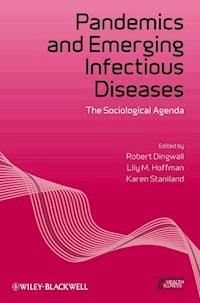
Pandemics and Emerging Infectious Diseases E-Book
21,99 €
Mehr erfahren.
- Herausgeber: John Wiley & Sons
- Kategorie: Geisteswissenschaft
- Serie: Sociology of Health and Illness Monographs
- Sprache: Englisch
Infectious disease pandemics are a rising threat in our globalizing world. This agenda-setting collection provides international analysis of the pressing sociological concerns they confront us with, from cross-border coordination of public health governance to geopolitical issues of development and social equity.
- Focuses on vital sociological issues raised by resurgent disease pandemics
- Detailed analysis of case studies as well as broader, systemic factors
- Contributions from North America, Europe and Asia provide international perspective
- Bold, agenda-setting treatment of a high-profile topic
Sie lesen das E-Book in den Legimi-Apps auf:
Seitenzahl: 450
Veröffentlichungsjahr: 2013
Ähnliche




















Table of Contents
Series page
Title page
Copyright page
Notes on contributors
1: Introduction: why a sociology of pandemics?
Acknowledgements
2: Public health intelligence and the detection of potential pandemics
Introduction
The sociology of public health (SPH)
Conceptualisation and actualisation of pandemics
PHI: sites for future research
Conclusion
Acknowledgements
3: West Nile virus: The production of a public health pandemic
Foucauldian theories of power
Methodology
PHAC's production of the WNV
Conclusion
Acknowledgements
4: Who's worried about turkeys? How ‘organisational silos’ impede zoonotic disease surveillance
Introduction
Methods
Institutional interaction and organisational culture
Priorities, jurisdictions and silos
Forging systemic connections
Conclusion
Acknowledgements
5: How did international agencies perceive the avian influenza problem? The adoption and manufacture of the ‘One World, One Health’ framework
The emergence of ‘One World One Health’
Theoretical backgrounds and methods
Competition between the fragmented frames: 2003–2008
The convergence on the OWOH policy framework: 2008 to the present
Functional consensus despite diverse interpretations
A double-edged policy framework
Acknowledgements
6: Global health risks and cosmopolitisation: from emergence to interference
Introduction
Materials and method
Global risks and cosmopolitisation
Avian flu: a classic and a modern risk
Asia, Vietnam and cosmopolitan modernities
Relations of definitions, relations of domination: the framing of avian flu
Global risk instrumentalisation: from local to international issues
A transformative cooperation for Vietnam?
Conclusion
Acknowledgements
7: The politics of securing borders and the identities of disease
The cases
The problematic
The European Union
Protecting borders
Explaining variations in screening across diseases
Disease identities
Disease identities and the making of policy
Europe and the collective imaginary
Conclusion
Acknowledgements
8: The return of the city-state: Urban governance and the New York City H1N1 pandemic
Introduction
The organisational and ideological context for pandemic planning
The event: H1N1 in NYC – spring and fall 2009
All-hazards emergency preparedness and pandemic response
Implications for health governance
Acknowledgements
9: The making of public health emergencies: West Nile virus in New York City
Introduction
Methods
Conclusion
Acknowledgements
10: Using model-based evidence in the governance of pandemics
Introduction
Modelling pandemics: How do models tell their stories?
Accommodating uncertainties in modelled narratives of pandemics
Towards narratives of governance
Acknowledgements
11: Exploring the ambiguous consensus on public–private partnerships in collective risk preparation
Introduction
Companies: from ‘risk-generator’ to ‘partner’ in dealing with risks
Pessimistic literature on the potential of a public–private partnership (PPP)
Methods and data
French preparation for the pandemic
Discussion and conclusion
Acknowledgements
12: ‘If you have a soul, you will volunteer at once’: gendered expectations of duty to care during pandemics
Acknowledgements
13: Flu frames
Introduction
A brief history of a contested term
Framing the flu
Flu frames
Audiences and flu frames
Conclusion: Frames, moral panics, and epidemic psychologies
Acknowledgements
14: Attention to the media and worry over becoming infected: the case of the Swine Flu (H1N1) Epidemic of 2009
Introduction
Theory, hypothesis and methods
Findings
Concluding remarks
15: Why the French did not choose to panic: a dynamic analysis of the public response to the influenza pandemic
Introduction
Sequence analysis of health behaviour during the influenza pandemic
Effects of perceptions on health behaviour during the pandemic: state or change?
The 1918 Spanish flu: an anchor for the future influenza pandemic?
Conclusion
Index
Sociology of Health and Illness Monograph Series
Edited by Professor Ian Rees Jones
Cardiff School of Social Sciences
WISERD
46 Park Place
Cardiff
CF10 3BB
Wales, UK
Current titles
This edition first published 2013
Originally published as Volume 35, Issue 2 of The Sociology of Health & Illness
Chapters © 2013The Authors.
Book Compilation © 2013 Foundation for the Sociology of Health & Illness/John Wiley & Sons Ltd.
Registered Office
John Wiley & Sons Ltd, The Atrium, Southern Gate, Chichester, West Sussex, PO19 8SQ, United Kingdom
Editorial Offices
350 Main Street, Malden, MA 02148-5020, USA
9600 Garsington Road, Oxford, OX4 2DQ, UK
The Atrium, Southern Gate, Chichester, West Sussex, PO19 8SQ, UK
For details of our global editorial offices, for customer services, and for information about how to apply for permission to reuse the copyright material in this book please see our website at www.wiley.com/wiley-blackwell.
The rights of Robert Dingwall, Lily M. Hoffman and Karen Staniland to be identified as the authors of the editorial material in this work has been asserted in accordance with the UK Copyright, Designs and Patents Act 1988.
All rights reserved. No part of this publication may be reproduced, stored in a retrieval system, or transmitted, in any form or by any means, electronic, mechanical, photocopying, recording or otherwise, except as permitted by the UK Copyright, Designs and Patents Act 1988, without the prior permission of the publisher.
Wiley also publishes its books in a variety of electronic formats. Some content that appears in print may not be available in electronic books.
Designations used by companies to distinguish their products are often claimed as trademarks. All brand names and product names used in this book are trade names, service marks, trademarks or registered trademarks of their respective owners. The publisher is not associated with any product or vendor mentioned in this book. This publication is designed to provide accurate and authoritative information in regard to the subject matter covered. It is sold on the understanding that the publisher is not engaged in rendering professional services. If professional advice or other expert assistance is required, the services of a competent professional should be sought.
Library of Congress Cataloging-in-Publication Data
Pandemics and emerging infectious diseases : the sociological agenda / edited by Robert Dingwall, Lily M. Hoffman and Karen Staniland.
pages cm
“Originally published as Volume 35, Issue 2 of The Sociology of Health & Illness”
Includes bibliographical references and index.
ISBN 978-1-118-55371-8 (pbk.)
1. Emerging infectious diseases–Social aspects. 2. World health. 3. Epidemiology. I. Dingwall, Robert, editor of compilation. II. Hoffman, Lily M., editor of compilation. III. Staniland, Karen, editor of compilation. IV. Sociology of Health & Illness.
RA643.P26 2013
362.1969–dc23
2013017044
A catalogue record for this book is available from the British Library.
Cover design by Design Deluxe.
Notes on contributors
Yu-Ju Chien Department of Sociology, University of Minnesota, Minneapolis MN, United States
Robert Dingwall Dingwall Enterprises and School of Social Sciences, Nottingham Trent University, UK
Muriel Figuié Centre de coopération internationale en recherche agronomique pour le développement, Montpellier, France
Martin French Department of Media, Culture and Communication, New York University, United States
Claude Gilbert CNRS (UMR PACTE), Politique et Organisations, Grenoble, France
Maya K. Gislason Centre for Global Health Policy, University of Sussex, Brighton
Rebecca Godderis Health Studies, Wilfrid Laurier University, Brantford, Ontario, Canada
Lily M. Hoffman Department of Sociology, The City College and Graduate Center, City University of New York, United States.
Colin Jerolmack Department of Sociology, New York University, United States
Tanya Kolobov Department of Sociology, University of Haifa, Israel
Erika Mansnerus LSE Health, London School of Economics and Political Science; and Department of Social Science, Health and Medicine, King's College, London
Sabrina McCormick Department of Environmental and Occupational Health, George Washington University, Washington DC, United States
Gustavo S. Mesch Department of Sociology, University of Haifa, Israel
Eric Mykhalovskiy Department of Sociology, York University, Toronto, ON, Canada
Jocelyn Raude Department of Social and Behavioural Sciences, EHESP School of Public Health, Rennes, France
Kate Rossiter Health Studies, Wilfrid Laurier University, Brantford, Ontario, Canada
Kent P. Schwirian Department of Sociology, The Ohio State University, Columbus, Ohio, United States
William Sherlaw Department of International Relations, EHESP School of Public Health, Rennes, France
Greg Smith School of Humanities, Languages and Social Sciences, University of Salford
Karen Staniland College of Health and Social Care, University of Salford, UK
Véronique Steyer ISG Paris, GrIIsG, and ESCP Europe, Stratégie, Hommes et Organisations, Paris, France
Rosemary C.R. Taylor Department of Sociology/Community Health Program, Tufts University, Medford, MA, United States
Kristoffer Whitney Holtz Center for Science and Technology Studies, University of Wisconsin-Madison, Madison WI, United States
1
Introduction: why a sociology of pandemics?
Robert Dingwall, Lily M. Hoffman and Karen Staniland
This collection explores what sociology has to say about pandemics and emerging infectious diseases at a time when some would claim this topic to be the increasingly exclusive terrain of microbiologists, virologists and practitioners in public health.
Such assertions, we argue, betray a basic lack of understanding of how medicine and biomedical science relate to the world in which they exist. Both are social institutions. This means that they are carried out in social organisations by people who are socially recognised as competent practitioners within a division of labour; that they are delivered through other organisations and through social interactions with innumerable partners. Furthermore, problems come to medicine and biomedical science along socially constructed pathways and are delivered into the world by other pathways: knowledge or technology transfer is a social process. A focus of attention and resources on medicine and biomedical science, then, tells less than half the story of how societies identify new diseases, how they respond, and what the consequences might be. In bringing together current work on different aspects of emerging diseases, this monograph also alerts sociological readers to the rich scholarly potential of this area. Emerging diseases are sources of instability, uncertainty and even crises that can make visible features of the social order ordinarily opaque to investigation. As societies respond to these challenges, features that we have taken for granted suddenly become transparent. For a moment, our own world can become anthropologically strange. This is at the core of the contribution made by the sociological imagination to policy and practice, of understanding how social arrangements can, and must, change when biological environments change.
The sociological relevance of new diseases was identified for readers of Sociology of Health and Illness by P.M. Strong's (1990) paper on ‘Epidemic Psychology’. This title is rather ironic since the paper concerns neither epidemics nor psychology. With the brio for which he was justly celebrated, Strong explored the parallels between what would now be defined as pandemics caused by two emerging infectious diseases: HIV in the 1980s and the Black Death of fourteenth century Europe. Although subsequent research has established that HIV originated in transmission from simian to human populations in West Africa during the early twentieth century (Sharp and Hahn 2011), its emergence and rapid spread across the developing world during the 1980s generated a profound sense of public alarm, particularly in the absence of any effective therapy. This response, Strong argued, resembled that of European populations to the virulent form of bubonic plague that raged across their continent around 1350 (Haensch et al. 2010). As institutional memory of an earlier outbreak, Justinian's Plague (541–542 CE), had long been lost, this disease also appeared as a new affliction, with no history, no explanation and no remedy. Both pandemics seemed to threaten the very survival of the societies in which they emerged.
How did these societies react? Although Strong refers to ‘social’ or ‘collective’ psychology, his intended audience is sociological: psychology here is used in the sense of Tarde (1901), Park (Elsner, Jr. 1972) or Blumer (1971, McPhail 1989) in their studies of collective behaviour. Strong proposes a sociological study of societal responses to an existential threat. In his own words:
This essay is a first attempt at a general sociological statement on the striking problems that large, fatal epidemics seem to present to social order; on the waves of fear, panic, stigma, moralising and calls to action that seem to characterise the immediate reaction … Societies are caught up in an extraordinary emotional maelstrom which seems, at least for a time, to be beyond anyone's immediate control. Moreover, since this strange state presents such an immediate threat, actual or potential, to public order, it can also powerfully influence the size, timing and shape of the social and political response in many other areas affected by the epidemic
(Strong 1990: 249).
Unlike atavistic psychologies which assume that disorder results from primitive emotions unleashed by such threats, Strong argues that apparently bizarre behaviour may be entirely intelligible once it is understood how the world is routinely stabilised by language and social institutions. Emerging diseases disturb our assumptions of a known universe of risk. A new hazard disrupts our established strategies for managing our everyday lives. What appears as irrational may be a locally rational response to uncertainty, or at least an attempt to use locally available resources to re-establish sufficient certainty for practical action.
Underlying Strong's approach is his use of interactionist traditions in US and European sociology – he explicitly pairs Mead and Schutz as his sources of inspiration. These stress the inherent formlessness of the world: it acquires order as the outcome of human actions that assign meaning to events through the socially shared medium of language and the institutions that have evolved to manage and stabilise sources of uncertainty. New diseases are not self-evident and do not direct the societal response. They must be defined by those agents and institutions that are socially licensed to distinguish disease from other kinds of deviance. This definition, in turn, provides a basis for societal mobilisation. Strong focusses on two particularly dramatic cases. At the time he was writing, HIV had only just become stabilised as a result of rapid scientific work that had produced agreement on the identification and nature of the virus in 1986. In the absence of closure by those institutions licensed to declare a matter settled under the impersonal authority of science, rival narratives had competed for authority in much the same way as occurred in the fourteenth century. Was HIV some kind of divine punishment for sin or possibly an evolutionary response to the abuse of human bodies by the consumption of unnatural chemicals or the intensification of non-reproductive sexual practices? The Black Death seemed similarly incomprehensible, particularly as the religious authorities, who were then the main source of closure, were even less well placed than twentieth century scientists to establish a definitive naming and control strategy. In the end, it simply burned out, although outbreaks recurred until the 1750s, and, as Strong remarked in seminar presentations, were accepted as periodic inconveniences that would kill a lot of people but had proved unlikely to bring about the end of humanity.
Thirty years later, however, it has become clear that the shadow cast by HIV, along with subsequent outbreaks of infectious diseases, threats of biological terrorism, and the new vulnerabilities invoked by intense globalisation, prompted a concerted effort to constrain the possibilities for future disorder by what we might call ‘stabilisation in advance’. By this we mean the creation of actor-networks that are primed for rapid mobilisation to manage ‘known unknowns’. Considerable investments have been made in surveillance, at supra-national, national and subnational levels, to give ‘early warnings’ of new diseases, to plan for the consequences, and to enhance the resilience of institutions faced with an outbreak. The threat of disorder is never far from the thoughts of those involved – but it is seen as potentially manageable with the resources of a modern society. ‘Waves of fear, panic, stigma, moralising and calls to action’ are thought to be containable with the application of science, although they may still be invoked in arguments between interested parties.
The collection opens with a group of chapters focussing on the social production of new diseases. By this we mean the processes that turn a disruption of the social ordering of relations between humans and their biological environment into a phenomenon that has been named, classified and assigned a causal account from microbiology or virology. French and Mykhalovskiy discuss the attempts by public health agencies to identify such events as they occur, if not beforehand. Their approach is strongly influenced by Actor-Network Theory (ANT), which also draws inspiration from Tarde's collective psychology (Latour 2002). They characterise public health as an actor-network that creates disease events as the outcome of a joint enterprise that mobilises both human and non-human actants. Emerging diseases are co-constituted by the social and the medical. An emerging infectious disease must marshal and enrol a complex assemblage of scientists, doctors, planners, laws, patients, vectors and the like in order to be recognised: influenza could not fully accomplish this until the 1930s when viruses succeeded in getting themselves distinguished from bacteria, which explains many of the problems encountered in managing both the 1889–90 and 1918–19 influenza pandemics.1 Gislason approaches the same issues within a Foucauldian framework, which has been widely adopted by the sociology of public health. ANT and Foucauldian analyses take very different positions on the nature of power in society: Latour (1987: 223) declared, ‘We need to get rid of all categories like those of power, knowledge, profit or capital, because they divide up a cloth that we want seamless in order to study it as we choose’. In contrast, Gislason sees the constitution of West Nile Virus as an exercise of power by the Public Health Agency of Canada, which articulated a particular reading of the disease, selected a preferred authoritative determination of its nature, and of appropriate interventions, and ultimately normalised it as a routine event in the Canadian biosphere. West Nile Virus is also the focus of Jerolmack's contribution, which examines the problems of establishing ownership of a disease. One characteristic of recent emerging diseases has been their movement from animal to human populations. Animals, or in this case birds, have, however, traditionally been the focus of surveillance systems that work quite independently from those directed at humans, and which tend to concentrate on a limited range of species determined by reference to their economic value. Jerolmack also draws on ANT, to describe the difficult process by which West Nile Virus came to be distinguished within the animal disease reference system and then passed into the human public health system, as a hybrid struggling to reconstitute well-established but segregated organisational networks.
A second group of chapters examine these organisational networks. Chien pursues issues identified by Jerolmack to discuss how international agencies concerned with human health (World Health Organization), agriculture (Food and Agriculture Organization) and animals (World Organization for Animal Health) tried to establish a shared framing of the potential threats from viruses in poultry. These were seen as a likely source for a new influenza pandemic but represented an immediate threat to economically valuable birds. The result was the ‘One World, One Health’ framework, which was able to serve as a ‘boundary object’ (Gieryn 1983) that could, at some level, unify the different agencies' efforts, at the cost of a high degree of abstraction and uncertainty in what would constitute implementation. Implementation issues are central to Figuie's case study of Vietnam. The country was seen as a potential epicentre for the emergence of a form of H5N1 influenza capable of easy transmission between humans and, hence, a global pandemic threat. Indeed, virtually the entire international surveillance effort prior to 2009 focussed on South East Asia and South China, assuming that the interactions between human and bird populations in that region were the most likely source of the next pandemic influenza strain. Figuie shows how actions on the ground within Vietnam became entangled with internal political tensions between localism and centralism in government and with an external agenda to complete the country's international rehabilitation following the defeat of the USA in 1975.
Interactions between global and local politics in the management of infectious diseases are further explored by Taylor in comparing responses to HIV by different European states. She notes how Germany, France and the UK manage health threats associated with international migration. All three have a legacy of nineteenth century legislation that empowers them to screen migrants for tuberculosis and to use the results as grounds for quarantine or refusal of entry. However, all three declined to adapt these powers to regulate the movement of people with HIV/AIDS. This, she suggests, reflects the emergence of HIV/AIDS within a context where transnational human rights was a potent discourse, particularly when allied to the project of creating a common European citizenship. This created a collective imaginary within which HIV acquired a different kind of identity from tuberculosis. Such ‘disease identities’ characterise sufferers in particular ways that endure over time and inform public policies. Hoffman pursues the national/local interplay in a study of New York City's response to H1N1 influenza. Referencing debates within urban sociology about the relative importance of supra-national organisations, nation-states, and global cities, and drawing upon Weber's classic definition of the city as unit of defence, she looks at NYC's response to the 2009 H1N1 outbreak. After 9/11 the reframing of infectious disease as a national security threat under a standardised ‘all-hazards’ emergency preparedness strategy, contributed to the renewed importance of the city as key actor. When the ‘one-size-fits-all’ model based on a worst-case scenario failed to provide guidance, the New York Department of Health and Mental Health seized the initiative and imposed its own response strategy. While there may have been important local factors that contributed to the Department's success, Hoffman nevertheless demonstrates that the enactment of public health interventions cannot be simply read off from a national disaster management template: the return of epidemics and the need for defence requires a degree of local autonomy. Also looking at New York City but through the earlier case of West Nile Virus, Whitney and McCormick echo issues identified by French and Mykhalovskiy and by Gislason. Their approach, however, is organisational and institutional, emphasising the impact of emergency powers and the conflict generated by their use, in this case to impose a pesticide spraying regime intended to control the virus's insect vectors. The resulting controversy challenged the legitimacy of the governance regime, with its incentives to adopt this aggressive strategy in preference to more targeted interventions. They note how this questioning led the federal government to respond with intensive investments in attempts to generate legitimacy.
Three chapters look at more detailed aspects of policy implementation. Mansnerus draws on the growing body of sociological work on the rise of quantification as a feature of the contemporary world. She focuses on modelling as a technology for legitimating particular versions of the future as the foundation of current policies and investments. For all their apparent precision, models are essentially a way to black-box a range of issues and uncertainties and produce an authoritative narrative that temporarily stabilises the future. They are a latter-day version of oracles, divination or clairvoyance, deriving their societal licence from science rather than from religion. Steyer and Gilbert investigate the implications of the contemporary movement to frame governance as a collaboration between public authorities and private interests. Their chapter explores the implications of the well-recognised institutional and cultural problems in achieving effective partnerships. Companies struggle with legal and reputational issues, while governments find that they cannot fully delegate responsibilities for public protection. The result is a weak form of co-production that is likely to fail in the crisis it is intended to manage. Godderis and Rossiter take a historical turn to highlight the role of gender in societal responses to pandemic disease. In their short note, they document appeals to women to volunteer as nurses during the 1918 influenza pandemic: their gender placed them under a moral duty to care, regardless of the personal risks or the implications for their families. The nature and limits of the duty to care were particularly exposed during the SARS outbreak in 2002–03, much as they had been during the early years of HIV/AIDS, and became a concern for pandemic response planning (Ruderman et al. 2006). Although not fully tested by the relatively mild nature of the 2009 H1N1 influenza pandemic, there was considerable uncertainty about whether social and organisational change might have weakened the force of appeals to this supposed moral duty. How would the conflicting claims of family and profession be resolved by healthcare workers asked to care simultaneously for both and to manage the risks of transmitting infection in either direction?
Finally, three chapters examine public reactions to the 2009 H1N1 pandemic. Staniland and Smith review an international range of studies of media reporting on this pandemic. Although their findings are consistent with Strong's arguments about the initial inflammation of societal anxieties, they show that the difficulty in identifying an unequivocal ‘folk devil’ quickly diffused these fears. Unlike HIV/AIDS' early identification as a ‘gay plague’, H1N1 was not easily associated with a consistent cast of villains: it was introduced to the UK via people who had been on expensive package holidays in Mexico. They were not an already stigmatised group who could be further accused of propagating disease. The speed of the issue cycle in news media also meant that representatives of order – scientists, doctors, policymakers – could address and dampen anxieties before panic could set in. Of course, it should be acknowledged that H1N1 proved to be a relatively mild infection and that it was represented as the return of something that science knew about rather than something wholly unfamiliar like HIV. Authority won this framing contest but a similar result may not be guaranteed in the future. This analysis is extended in the short note by Mesch et al., which examines US survey evidence on public responses to media reports. While methodological limitations circumscribe their conclusions, the analysis shows a positive relationship between media consumption and worry, which is accentuated by social status: women, older people and those with larger families became increasingly concerned between May and August 2009. The rise among older people seems particularly worthy of further investigation, given that it emerged over the same period that they were less at risk than children, probably because of some residual cross-immunity from previous influenza pandemics. Sherlaw and Raude show the value of asking counterfactual questions in social science with their inquiry into the absence of panic among the French population. They argue that this was, at least in part, the result of media and policy framing that had anchored future influenza pandemics in the context of the 1918 pandemic. Since 2009 fell so far short of this dramatic possibility, its potential for engendering panic was correspondingly limited. In the absence of popular mobilisation, however, French people showed themselves unwilling to take up vaccination or engage in behavioural measures intended to interrupt the transmission of the virus. There is, Sherlaw and Raude conclude, a fine line between preparedness and alarmism, of generating enough public concern to engage in self-protection and provoking panic. Could the legacy of the perceived exaggeration in invoking the 1918 experience as a template for the 2009 pandemic be a loss of trust in future calls for action by public health agencies? Do they risk the fate of the boy who cried ‘wolf’ too often?
The chapters in this collection cover a diverse range of countries and diseases. From a sociological perspective, what is striking is the extent to which different emerging diseases provoke common reactions, which are only slightly modified by national environments. Figuie's discussion of central/local tensions in Vietnam is replicated by the studies of New York. Jerolmack's account of the difficulties between the surveillance systems targeted at human and animal diseases is replicated in an as yet unpublished study of Ghana and Malawi.2 These are not, however, the panicked reactions discussed by Strong or still expected by so many policymakers. Several contributors suggest explanations: the news cycle has accelerated so much that this initial phase of societal reaction flashes past. Public health systems have established better systems of surveillance, early warning and crisis management so that the orderliness of society can be more rapidly re-established. Moreover, the diseases themselves have proved to be containable, susceptible to conventional bioscientific means of analysis and control.
This collection moves beyond the classic sociological focus on societal reactions and the social construction of disease. The reappearance of infectious disease in an intensely globalised arena, marked by supra-national as well as national and local actors, has raised many other issues, including the impact of scientific modalities on uncertainty and risk, the interplay of public health and national security, the dynamics of health governance, and the gendered division of caring labour. It goes without saying that each of these, in turn, raises provocative questions for policy and implementation. In the 21st century, a focus on pandemics and emerging infectious disease gives new insight into evolving social structures and processes. This collection challenges sociologists to contribute further to the public and policy agenda – and questions the narrow thinking that would seek to ‘leave it all to biomedical science’.
Acknowledgements
Robert Dingwall has benefitted from numerous discussions with fellow-members of the UK Department of Health Committee on Ethical Aspects of Pandemic Influenza and Roche Pharmaceuticals Pandemic Advisory Council.
Notes
1 This approach was suggested by Gearóid Ó'Cuinn.
2 This draws on discussions with Evanson Sambala.
References
Blumer, H. (1971) Social problems as collective behavior, Social Problems, 18, 3, 298–306.
Elsner, Jr., H. (1972) Robert E Park: The Crowd and the Public and Other Essays. Chicago: University of Chicago Press.
Gieryn, T.F. (1983) Boundary-work and the demarcation of science from non-science: strains and interests in professional ideologies of scientists, American Sociological Review, 48, 6, 781–95.
Haensch, S. et al. (2010) Distinct clones of yersinia pestis caused the black death, PLoS Pathogens, 6, 10, e1001134. doi:10.1371/journal.ppat.1001134 (accessed 14 October 2012).
Latour, B. (2002) Gabriel Tarde and the end of the social. In Joyce, P. (ed.) The Social in Question. New Bearings in History and the Social Sciences. London: Routledge.
Latour, B. (1987) Science in Action, Cambridge: Harvard University Press.
McPhail, C. (1989) Blumer's theory of collective behavior: The Development of a Non-Symbolic Interaction Explanation, The Sociological Quarterly, 30, 3, 401–23.
Ruderman, C. et al. (2006) On pandemics and the duty to care: whose duty? Who cares? BMC Medical Ethics, 7:5 doi:10.1186/1472-6939-7-5 (accessed 14 October 2012).
Sharp, P.M. and Hahn, B.H. (2011) Origins of HIV and the AIDS pandemic, Cold Spring Harbor Perspectives in Medicine, 1, 1. Available at: http://www.ncbi.nlm.nih.gov/pmc/articles/PMC32-34451/(accessed 10 September 2012).
Strong, P.M. (1990) Epidemic psychology: a model, Sociology of Health and Illness, 12, 3, 249–59.
Tarde, G. (1901) L'opinion et la foule (1901). Paris: Alcan. Available at: http://classiques.uqac.ca/classiques/tarde_gabriel/opinion_et_la_foule/opinion_et_foule.html (accessed 10 September 2012).
2
Public health intelligence and the detection of potential pandemics
Martin French and Eric Mykhalovskiy
Introduction
Lesen Sie weiter in der vollständigen Ausgabe!
Lesen Sie weiter in der vollständigen Ausgabe!
Lesen Sie weiter in der vollständigen Ausgabe!
Lesen Sie weiter in der vollständigen Ausgabe!
Lesen Sie weiter in der vollständigen Ausgabe!
Lesen Sie weiter in der vollständigen Ausgabe!
Lesen Sie weiter in der vollständigen Ausgabe!
Lesen Sie weiter in der vollständigen Ausgabe!
Lesen Sie weiter in der vollständigen Ausgabe!
Lesen Sie weiter in der vollständigen Ausgabe!
Lesen Sie weiter in der vollständigen Ausgabe!
Lesen Sie weiter in der vollständigen Ausgabe!
Lesen Sie weiter in der vollständigen Ausgabe!
Lesen Sie weiter in der vollständigen Ausgabe!




