


3,49 €
Mehr erfahren.
- Herausgeber: Shadowpaw Press
- Kategorie: Fantasy und Science-Fiction
- Sprache: Englisch
From Edward Willett, Aurora Award-winning author of Marseguro, The Cityborn, and the Worldshaper series (DAW Books), among many others, comes twenty-two tales of fantasy, science fiction, and horror, drawn from a long career of telling fantastic tales.
A young musician dreams of playing his songs among the stars...A Broadway performer on the lam is forced to direct aliens in The Sound of Music...Strange vegetables with dangerous properties crop up in small-town Saskatchewan...A man with a dark secret gets his comeuppance on a windy night on the prairie...An elderly caretaker on the Moon preserves the memory of the millions who died on Earth's darkest day...A woman and a bat-like alien must overcome their own prejudices to prevent an interstellar war...
From the far future and the farthest reaches of space to the Canadian prairie, from our world to worlds that have never existed to world's that might some day, rich realms of imagination and the fascinating characters and creatures that populate them await within these stories, some previously published, some seeing print for the first time.
Time to go exploring...
Das E-Book können Sie in Legimi-Apps oder einer beliebigen App lesen, die das folgende Format unterstützen:
Seitenzahl: 463
Veröffentlichungsjahr: 2020
Ähnliche














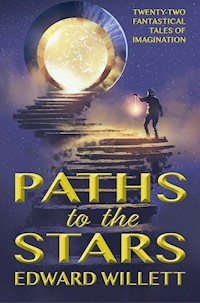
Paths to the Stars
Twenty-Two Fantastical Tales of Imagination
Edward Willett
© Copyright 2018
by Edward Willett
All rights reserved.
ISBN 978-1-9993827-0-4
Cover art by Tithi Luadthong
Order From:
SHADOWPAW PRESS
303 - 2333 Scarth Street
Regina, Saskatchewan, Canada
www.shadowpawpress.com
This book is dedicated to all the writers whose books I loved as a child, who inspired me to tell my own stories, in the hope I could move and entertain readers as much as I have been moved and entertained.
Contents
Introduction
1. The Minstrel
2. A Little Space Music
3. Strange Harvest
4. Waterlilies
5. Sins of the Father
6. The Path of Souls
7. Follow A Song
8. Memory Jam
9. The Rescue
10. Devil’s Architect
11. Moon Baby
12. The Daydark
13. The Wind
14. Lost in Translation
15. Texente Tela Veneris
16. Landscape With Alien
17. Janitor Work
18. The Strange One
19. I Count the Lights
20. The Mother’s Keepers
21. Fairy Tale
22. Je me Souviens
About the Author
Introduction
IT'S HARD TO SAY when I first began reading science fiction. My two older brothers, Jim and Dwight, both read the stuff, and thus I was exposed to it at an early age.
What I do know is that for many years I probably read more science fiction short stories than novels: short stories by Asimov and Heinlein, collections of short stories, anthologies of the year’s best, single-author collections—I loved short stories, and so it wasn’t too surprising that when I first started writing science fiction, I began with the short form.
(Besides, I thought that was the generally agreed-upon path to science-fiction writerdom: you wrote short stories, you got them published in magazines, you got noticed for your brilliance, and only then did you move on to novels.)
My very first fiction sale, in 1982, was a short story (although, not being science fiction, it’s not in this book). “The Storm,” about two kids caught in a prairie blizzard, sold to Western People, the magazine supplement of The Western Producer (an agricultural newspaper), which would later also publish my short story “Strange Harvest” (which is in this book, and is quite possibly the only science fiction story Western People ever published). I was in Zurich, Switzerland, of all places, touring with the Harding University A Cappella Chorus (I’d graduated three years earlier but did two European tours with the chorus as an alumnus), when I received an aerogram from my mother: a letter from the magazine had arrived in the mail, and, with my previously granted permission, she’d opened it, discovering the good news.
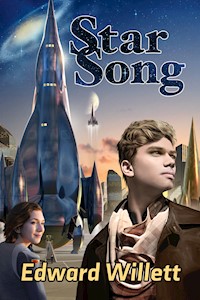
And yet…over the years, I really haven’t written that much short fiction. See, despite my love of short stories, I soon found that I personally had trouble with the “short.” Inside many of my short stories were novels trying to get out. “The Minstrel,” which starts this collection, expanded into Star Song, the first novel I tried seriously to sell. (There were three high-school novels before that, The Golden Sword, Ship from the Unknown, and Slavers of Thok, my Grade 12 magnum opus.) “Lost in Translation,” a longish short story published in TransVersions, became Lost in Translation, my first adult SF novel, first published in hardcover by FiveStar, and then brought out in mass-market paperback by DAW Books. “Sins of the Father” was never published as a short story, but became Marseguro, my second novel from DAW, and winner of the 2009 Aurora Award for best Canadian science fiction novel (well, technically, Best Long-Form Work in English).
But despite my predilection for novels, every once in a while, I do write and (Lord willing) sell a short story. And I’ve also kept tucked away on my hard drive a few unpublished stories that I think deserve to see the light of day, even if I’ve never found a home for them. (At the very least, you may find it interesting to compare some of these very early efforts to my latest ones. Be kind.) As a result, I’ve often thought of publishing a collection. Trouble is, a short-story collection by an author who isn’t exactly known as a short-story writer seemed like it would be a hard sell for any traditional publisher…so I never acted on that thought.
Until now. I like my stories (obviously), and am egotistical enough (hey, I'm a writer) to think that perhaps other people might like them, too. And so, at last, I have collected my short stories—almost all the published ones, plus a few unpublished ones—into the book you now hold in your hands, whether in ink-on-paper or pixels-on-screen format.
I hope you enjoy them.
Edward Willett
Regina, Saskatchewan
February 2018
The Minstrel
I chose this as the first story to present because its central image, of a youngster gazing longingly at the silver spires of starships, aching to ride them into space, is a metaphor for the way I reacted to science fiction as a young reader. The stories of Heinlein and Asimov and Clarke and Norton and Silverberg and Simak and many, many others were, in a very real sense, my shining starships—my paths to the stars. Kriss’s longing in “The Minstrel” was, and is, my longing. It’s no wonder this was one of the first science fiction stories I wrote, and one of the first I sold. It appeared in the long-defunct teen magazine JAM, sometime in the early 1980s.
THE MUSIC SANG OF THE INFINITE DARK and the suns that burn within it. It shimmered like starlight on alien seas, and whispered with the voices of strange winds.
Kriss stopped playing, and as the last chord died slowly away, sat quietly with his head bowed, cradling his touchlyre in his arms. The orange glow of the oil lamps gleamed on the instrument’s polished black wood and burnished copper.
One by one those in the smoky bar, mostly offworlders, rose from their tables and came to the low platform where Kriss sat, to drop coins into the wooden bowl at his feet. The murmur of their conversation was slow to resume.
When the last had come and gone Kriss stood, bowed, and left the stage. He divided the money with the innkeeper, then slipped the touchlyre into its soft leather case and went out into the chill night air.
In the cobblestoned street he stopped and looked up at the stars blazing in the night sky, as he did every evening when he finished playing, burning into his mind’s eye the goal for which he had striven, it seemed, forever.
Two local men staggered by. One poked the other with his elbow and nodded toward Kriss. “Uppity offworlder,” he whispered loudly. His companion made an obscene gesture, then, laughing, they weaved on down the street.
Kriss clenched his fists, then spun and strode in the opposite direction.
Where the cobblestones ended and concrete began, artificial lights banished the night. At the sight of them, Kriss forgot the drunks’ insults and broke into a run. In a moment he reached the tall wire fence that surrounded the spaceport, and pressed his face against the cold mesh, peering through it at the starships, silver spires that seemed to soar skyward even though standing still. The lights glittered on their mirrored sides.
There lay his path to the stars, away from this hated planet where he didn’t belong, couldn’t belong, though he had been raised on it. The drunks had known; they had seen his height and his blonde hair and had known he came from the stars.
Somewhere out there must be his true home; somewhere out there he had to have a family. His parents were dead, but they had to have had parents of their own, brothers, sisters…
He blinked away tears, and, disgusted with his own self-pity, turned away from the fence and set out along a dark, garbage-strewn alley for his barren lodging, a tiny attic room above a seamstress’s shop. He was fooling himself if he thought he would ever leave Farr’s World, he thought bitterly. The spacecrews called him “worldhugger”; neither Union nor Family, and without contacts in either of those spacefaring groups, he could never gain a berth as a crewmember, and he could entertain in spaceport bars for the rest of his life without raising enough money to buy passage into orbit, much less to another world.
Lost in dark thoughts, he didn’t realize he was being followed until a hand touched his shoulder.
He instinctively spun away from that touch and pressed his back against a rough stone wall, his heart pounding, his arms wrapped protectively around the touchlyre.
“I mean you no harm,” said the man who faced him. Shadows hid his features. “I only want to talk.”
Kriss did not relax. “Then talk.”
“What is your name?”
Kriss said nothing.
“Perhaps if you knew mine…? I am Carl Vorlick, a dealer in alien curiosities.” He waited.
“My name’s Kriss Lemarc,” Kriss said finally. “Why?”
Vorlick ignored the question. “And how old are you?”
“Fifteen, standard.”
“That would be just about right.” Vorlick’s eyes glinted faintly in the starlight. “I heard you play in Andru’s—remarkable. Almost as though you projected emotion, not just sound.”
Pleased despite himself, Kriss shrugged. “My instrument is…special.”
“Indeed it is. And very beautiful. May I…?” Vorlick held out his hand.
Kriss looked up and down the alley, but saw no hope of rescue. Slowly he unfolded the leather covering and took out the touchlyre. The copper fingerplates and strings shone even in that dark corner.
Vorlick took a handlight from his pocket and played the beam over the instrument. Kriss caught a quick glimpse of a lean face with thin lips and ice-blue eyes before the light switched off. “Lovely,” the man murmured. “How does it work?”
Kriss hesitated. “I hear music in my mind, and the touchlyre plays it,” he said finally. “I can’t explain any better than that.”
“Touchlyre?”
“That’s what I call it. I don’t know what its real name is.”
“Where did it come from?”
“It belonged to my parents. But I don’t even remember them.”
“Your parents, yes.” Vorlick paused for a long moment, then said, “You desire to leave this world, don’t you?”
Kriss said nothing. This stranger knew too much. Once again he glanced up and down the alley. He would have welcomed even the two drunks who had insulted him earlier—but there was no one.
But Vorlick took his silence as consent. “I own a ship.”
Kriss stiffened. “What do you want from me?” he demanded; but inside he already knew.
“The price is small: your instrument. Give the touchlyre to me, and I will take you into space.”
Kriss looked down at the touchlyre. “It’s that valuable?”
“To the right person, everything is valuable. Your music spoke of your longing for the stars—some of those hardened spacefarers in Andru’s were near tears. You value the stars, I value your instrument. A fair exchange.”
“A musician once told me there isn’t another instrument like this one in the galaxy.”
“But there are other instruments. You could choose from those of a thousand worlds. Surely one construction of wood and metal is not so different from another?”
To go to the stars, Kriss thought. To cross the great Dark, to breathe the air of alien worlds, to perhaps touch Mother Earth herself…
…to find a family…
Almost unconsciously, his arms loosened from the touchlyre. He looked up again at the stars, drank in their light with his eyes—and made up his mind. “Agreed.”
Vorlick rubbed his hands together. “Excellent! Come to the spaceport gate at dawn. Bring the instrument.” He turned and vanished into the darkness.
Kriss listened to his footsteps fade, then turned and walked slowly on toward his room. He climbed the familiar, rickety wooden stairs on the outside of the old brick building, past the dingy window through which shone a faint yellow light from the seamstress’s lantern, unlocked his door, and went in. Lighting his single candle, he looked around the tiny chamber. The ceiling, with its small square skylight, was simply the underside of the roof, and so low on one side he had to stoop to get to his bed, the only furniture aside from a rough-hewn table and rusty metal chair. I won’t miss this, he thought. I won’t miss anything on this planet.
But he didn’t feel euphoric, as he had always expected to feel when he finally found a way to fulfill his dream. Instead he felt—numb? No, not numb—depressed.
Why? he asked himself. I’m going to the stars—all my dreams are coming true! But the feeling persisted.
As always when his spirits needed lifting, Kriss took out the touchlyre. Playing it was cathartic; he could lose himself in music as so many others on this impoverished planet did in wine. He held the instrument in his lap for a moment, running his fingers over the sinuous curves of its velvety, unvarnished wood. Then he raised it and placed his hands on the copper plates.
The strings screamed: discordant, angry, ear-shattering. Kriss snatched his hands away. The touchlyre had never made a sound like that before! Had he broken it? He touched the plates again, cautiously, and again the instrument howled.
Disgusted, he tossed it on the table. If it was broken, he was well rid of it. He’d find himself another instrument, from one of those thousand worlds of which Vorlick had spoken. He undressed, blew out the candle, and crawled into bed.
Just before sleep claimed him, he thought he heard the instrument’s strings softly humming; but of course that was impossible, with no one touching the plates.
He dreamed.
He was performing in Andru’s, as he had done so many times, playing of his longing for the stars. That longing filled him with almost physical pain, but pain he could bear as long as he kept playing.
But suddenly the touchlyre disappeared, and he stood on an alien planet, strange and beautiful. Then another new world surrounded him, and another, and another, flashing past faster and faster, but no matter how exotic, how wonderful, they did not satisfy his longing, and the ache grew ever more acute.
And then he came to a world where dwelt a man who, he somehow knew, was his father’s brother. His uncle rose to greet him, laughing, and hugged him, welcoming him to his family…
…but still the longing burned within Kriss, stronger than ever, so strong he suddenly knew it could never be quenched, and he broke away and screamed and screamed and—
—woke, gasping, bathed in sweat, his blanket a tangled heap on the floor, the scream echoing in his ears.
His scream? Or...?
He glanced sharply at the touchlyre, barely visible in the faint illumination from the skylight. It seemed to him he could hear the strings vibrating down to stillness, as though a mighty chord had just been wrung from them.
Nonsense, he told himself. He retrieved his blanket. No dreams troubled him the rest of the night.
In the morning he rose very early, put the touchlyre and the few clothes he owned into a backpack, and headed down the stairs and through a thin morning mist to the spaceport. The mountains towering above the city still hid the sun, but light filled the sky.
Vorlick waited at the spaceport gate. “Did you bring it?” he asked at once.
“Yes,” Kriss said, startled by the blunt question.
“Take it out. I want to see it in the daylight.”
Nonplused, Kriss did as he was told. But as he took the touchlyre from its case it hummed to life in his hands, and from it crashed a single explosive chord that echoed through the silent streets. Vorlick stumbled back as though slapped. “What—”
Kriss didn’t hear him. The chord had sent the whole dream of the night before flashing through his mind, and it suddenly made perfect sense to him. His longing wasn’t so much to see the stars, or even to find his family, but to find himself. He was doing that, bit by bit, through the touchlyre, journeying into his own soul to find out what kind of person he was, healing the wound made when he was orphaned on Farr’s World.
Without the touchlyre, he could never finish that healing process. Wandering around the stars with the touchlyre lost to him forever would only hurt him worse; and even if he found a family, he would have lost something just as important.
Kriss’s eyes suddenly focused on Vorlick. “No.”
“No?”
“I’ve changed my mind. I’ll keep the touchlyre. I’ll find my own way into space.” He started to turn away.
Vorlick reached into his pocket with his right hand, and pulled out something metallic. “Stand still,” he said, his voice as cold as space. “That’s not one of your options." He pointed the object at Kriss, who froze as he recognized the deadly form of a hyperneedler. “You don’t even know what you have, but I do. It’s a working artifact from an ancient, alien civilization, uncovered by two archaeologists on a planet we may never find again. They fled here with it when they realized someone knew they had it and was out to get it.” He smiled humourlessly. “Me, of course. It was almost fifteen standard years ago. I tracked them here, only to find they had died in an aircar crash. I assumed the artifact was destroyed with them.
“But then, just a few months ago, a spy on this world told me of a strange instrument in the hands of a boy—an instrument unlike any other.
“I did some checking. I found that the archaeologists had an infant son shortly after they arrived here, a son who was not in the aircar when it crashed—a baby who has become a young man—the minstrel with the unique instrument.
“So now, Kriss Lemarc, though I must withdraw my offer of placing you in a ship’s crew, I give you your parents: Jon and Memory Lemarc, archaeologists. And I also give you knowledge of what your ‘touchlyre’ is: the only relic of an ancient alien culture, and worth a fortune you cannot imagine.
“In exchange for that information, you will now give me this instrument.” Vorlick put his left hand on it. “Or I will kill you.”
Kriss tore the touchlyre away from him. “No!”
His cry of defiance woke a matching cry from the strings of the touchlyre, a crashing chord that exploded outward with a force that surpassed sound. Kriss felt all his violent emotions, fear, awe, defiance, hatred, pouring through his hands into the touchlyre, adding to the force it hurled at Vorlick like a weapon. The power coursed through Kriss like a cleansing tide—and he knew he couldn’t stop it if he wanted to.
Vorlick’s face paled and slackened, and his eyes glazed, then closed. The gun dropped from his nerveless hand as his legs buckled, and he fell to his knees, and then to the ground.
Finally it ended. Kriss felt, not empty of emotion, but as if he now had room to truly experience and understand his emotions for the first time, as though a gritty residue clogging his mind had been washed away.
He looked down at Vorlick and pitied him. The man lay unconscious, and Kriss knew he had nothing more to fear from him.
Then he raised the touchlyre, silent again, and held it at arm’s length, studying it in the first rays of the sun, streaming like searchlights through a cleft in the mountains behind him. The orange beams made the wood and copper glow, reflecting the power hidden inside the ancient artifact. Just what that power was, and where it came from, he might never know: but he knew it was on his side.
He let his gaze travel to the tall starships beyond the gate, stark against the brightening sky. Above the tallest a single star still outshone the dawn light.
Someday, Kriss thought. Someday I’ll make that journey.
That dream was still his: but now he knew the real journey lay within him. He turned his back on the spaceport and walked back to his attic room.
In a bar called Andru’s, near the only spaceport of an obscure planet, starship crewmembers come to sit quietly and listen to a boy play a strange instrument of space-black wood and burnished copper.
His music sings of the infinite Dark and the suns that burn within it. It shimmers like starlight on alien seas, and whispers with the voices of strange winds.
A Little Space Music
This story, which was published in the Spring 2012 issue of On Spec, you have to blame on my friend Robert Ursan, brilliant composer, amazing accompanist, musical-theatre director par excellence, and very funny man. He occasionally refers to The Sound of Music as The Sound of Mucus. And for some reason I thought, “The Squill are alive with the sound of mucus”...and this story was born. (Did I mention I’m an actor and singer with a long history of appearing in musical theatre? Though never any productions quite like these...)
DRIPPING VISCOUS GREEN SLIME onto the brushed-steel plates of the recreation room floor, the pulsating blue slug reared until it towered a full meter above my head. Three eyes the colour of old blood reared up on black stalks, somehow remaining focused on me even as they weaved like demented cobras in thrall to acid jazz played by a drunken snake charmer. Its mouth peeled open like a gaping wound.
Then came the ultimate horror.
It began to sing.
“Midnight...”
Oh, no. No!
“Touch me...”
That which does not kill me makes me stronger, I reminded myself. I felt very strong indeed by the time Lloyd Webber’s oft-abused “classic” ground to its inevitable conclusion.
“Thank you, Mr...Urkh(cough)lisssss(choke). That was very...interesting. We’ll be letting...people...know in about a shipday.”
The slug grunted something that might have been “Thank you,” or might have just been a correction of my pronunciation of his—I checked the information sheet—oops, its—name, and slithered out, leaving a trail of green goop a meter wide in its wake. A cleaning robot scurried after it on clicking insectile legs, its elephant-like nose-hose swinging back and forth, slurping up the surplus mucus for recycling in the galley.
Groaning, I rested my aching head in my hands, twitched my jaw sideways three times to activate my implanted commbug, and croaked, “Next!”
This nightmare had begun the moment I boarded the LSS Mendel, rushing down the loading ramp as though the hounds of hell were after me—not far from the truth, considering Governor Fexeldub’s minions sported long black fur, long blue teeth, and bioluminescent eyes that radiated heavily in the longer wavelengths of visible light.
One thing neither of the two possessed, however, was a boarding pass for the Mendel. The security tanglefield stopped them in their tracks at the top of the ramp. My elation evaporated two seconds later when, at the bottom of the ramp, the tanglefield likewise wrapped me in molasses, and hardened to amber. Immobilized, I watched the ship’s security hatch open, revealing a stocky, auburn-haired-and-bearded man wearing a bright-red uniform liberally adorned with gold buttons and braid. He looked like he’d just stepped offstage from playing the Major General in The Pirates of Penzance. “Professor Peak, I presume?” he said.
I found myself rather breathless, though probably due more to the tanglefield’s compression of my lungs than the sudden outbreak of alliteration. “You have...the advantage...of me...sir.”
“Forgive me. Robert Robespierre Robinson, Captain of the multi-species-capable luxury liner LSS Mendel, pride of the Blue Nebula Line, at your service.” The Captain inclined his head slightly. “My friends call me Redbeard. You can call me Captain. Or ‘sir.’” He looked back at the security hatch and made a cutting-his-own-throat gesture, which alarmed me until the tanglefield suddenly shut off and I realized it hadn’t been a signal for summary execution. I staggered. The Captain caught me and straightened me up, then released me.
I took a couple of deep breaths. “I’m honoured you felt it necessary to greet me in person...sir.”
“I’m sure.” The Captain looked up the ramp. Fexeldub’s hellhounds snarled at him. He turned on his heel. “Come with me, ‘Professor.’ We have matters to discuss.”
Relieved but alarmed, I followed the Captain, through corridors panelled with pearl and carpeted in pink, to his spacious stateroom. From the platinum-floored foyer he led me into an office, and pointed me to a grey blob of pseudoleather facing a desk of black metal, topped with glass. He eased himself down on the identical grey blob on the other side of the desk; it swelled and puffed into a comfortable-looking armchair. I sat down on my blob, and it instantly sprang into a rigid, straight-backed shape with all the give of a block of steel. Okay, then, I thought. At least I know where I stand...er, sit.
The Captain steepled his fingers under his chin and looked at me. “You’re a wanted man, Professor. And not just by your friends on the loading dock.” He tapped the desktop, and the faint glow of a holodisplay, indecipherable from where I sat, sprang into existence above the desk. “There are outstanding warrants for your apprehension on half a dozen different planets.”
I cleared my throat. “Cultural misunderstandings. I’m a businessman trying to make an honest living, that’s all.”
Captain Robinson barked a laugh. “You’re a con man. ‘Professor Peter Peak’ is not your real name. Too alliterative, for one thing.”
I felt my left eyebrow lift. The Captain noticed. “I never said Robert Robespierre ‘Redbeard’ Robinson was my real name either, did I? But we’re discussing your past, not mine.”
“With all due respect, I’d rather talk about my future.”
“In good time.” The Captain tapped the desktop again. “Before you became Professor Peter Peak, purveyor of programmable paramours, you went by the name Aristotle Atkinson, and sold life-long subscriptions to Encyclopedia Galactica...until someone realized there’s no such thing. Before that, you were Dr. Schroeder Petering, sole authorized human sales agent for life-extension nanomachines from Tofuni Secundus...quite a feat, since Tofuni has no planets.”
“An unfortunate accident involving a planet-eating nanoswarm,” I said. “Hardly my fault. As I explained.”
“And yet, your customers tried to lynch you just the same. People can be so unreasonable.” He shook his head. “But never mind. The version of you I’m interested in is the original.”
I stiffened.
“Jerry Smith,” he said (and the sound of my birth name made my heart skip a beat), “this is your life.” He tapped, and the holodisplay suddenly became visible to me, revealing all the sordid details of my past, including birthplace (Moose Jaw, Saskatchewan), birthdate (much longer ago than I liked to admit), parents, and education. But what terrified me was something I had thought long-since lost in the mists of decaying data storage: a head-and-shoulders shot of a much-younger me. The Captain pointed at it, and the computer began reading the text of a press release: “Persephone Theatre is pleased to announce that Saskatchewan’s own Jerry Smith will be playing the leading role of Bobby in this fall’s production of Stephen Sondheim’s Company. Smith, originally from Moose Jaw—”
Captain Robinson pointed again, and the computer’s voice cut off. “You’re not just a con man,” the Captain said. “You’re an actor, singer, and dancer—in short, a musical theatre performer. A triple threat, in fact.” He made it sound like a sentence of execution...and I knew it very well could be.
But I couldn’t argue with the evidence. “Was. For about eight years. You know the difference between a stage actor and a pizza?”
“A pizza can feed a family of four. Yes, I’ve heard the joke.” He leaned forward, like a cat tensing to leap at a mouse. “But that was on Earth, ‘Professor.’ You’re not in Kansas anymore.”
“Actually, I’ve never been to—”
“Here on the LSS Mendel, you can make enough money to feed a family of four. Not as an actor, perhaps, but certainly as...a director.”
Uh-oh. “Contrary to cliché, all I’ve ever really wanted to do is avoid directing.”
The Captain pointed at the holodisplay. “You’ve directed at least five shows.”
“That résumé is twenty years out of date.”
“It’s like riding a bicycle.”
“I can’t ride a bike.”
The Captain sighed. “Professor Peak, I really don’t have time for this. You’ve been in space a long time. You know as well as I do that of all the culture Earth has produced, all the artwork, all the novels, all the symphonies, only one thing holds the slightest interest for any of our alien neighbours.”
I decided to try playing dumb. “You tell me.”
“Musical theatre, Professor.” The Captain tapped the desktop, and on every wall, previously opaque screens suddenly displayed...theatre posters. Oklahoma. Oliver!The Sound of Music. Sweeney Todd. My Fair Lady. The Most Happy Fella. Candide. West Side Story. Chicago. Cats. Starlight Express, for God’s sake. Wicked. The Light in the Piazza. Avenue Q. Passion. Hamilton. Dear Evan Hansen. Thunder in the Night. What the Cat Dragged In. Jimi!Apollo 13: The Musical. The posters kept changing; by the time I’d looked through them once, there was a new batch on display.
“I collect them,” said the Captain. “I have a poster from every musical that ran on Broadway from Show Boat in 1927 to The Singularity in 2024, the last new Broadway musical produced...”
Suddenly furious, I forgot about playing dumb. “Yeah, because a Squill spaceship the size of Yankee Stadium appeared over Times Square one Saturday night and mysteriously vanished the casts of every show,” I snarled. “And because over the next week, any actor who dared to step out on stage and burst into song vanished, too. Which is why Jerry Smith disappeared, too—into a different line of work.”
“A criminal line of work.”
“I was an actor. I wasn’t suited for honest work.”
“My Squill passengers are hungry for musical theatre, Professor Peak.” He gestured at the walls. “As am I.”
“Squill!” My voice actually squeaked. “You have Squill on board?”
He had the nerve to smile. “Didn’t you know? Most of the vessel is currently occupied by Squill on a...pilgrimage, I suppose you’d call it...to their homeworld.”
Worse and worse. “We’re going to Squill Primus?” I hadn’t had time, what with hellhounds after me, to check exactly where the only ship in port would take me. “And you want me to direct musical theatre?”
“I told you, my passengers are hungry for it.”
“Maybe literally! We still don’t know where all those actors went. Maybe the Squill are serving up ham sandwiches—with bits of real ham!—on their homeworld right now.”
“They don’t eat people, they eat algae and the occasional sulphurous rock,” the Captain said. “And anyway, they said they were sorry. And they gave us the spacetime drive by way of reparation. If not for Broadway, we’d still be stuck puttering around the Earth and Moon, Professor. We owe musical theatre a huge debt of gratitude.”
“You’re welcome.” I stood up. “Now, if that’s all you wanted—”
“I want you to direct a musical, Professor,” the Captain said. “The first live musical to hit the boards since the sad but profitable demise of Broadway. And I want you to cast my passengers.”
My knees buckled and I hit the pseudoleather hard. “Oh, God. You want me to direct Squill.” No, it was worse than that. “Amateur Squill!”
“Squill this time. But next time...” He spread his hands. “Who knows? It could be Hellhounds. Skitterings. Even humans. And as for being amateurs...well, Professor, remember that amateurs are those who do something because they love it. Presumably you first went into theatre because you loved it, Professor. Reach down deep into your heart, if you still have one, and...” His grin widened. “Feel the love.”
“Scripts...orchestra...stagehands...” Like a drowning man, I grasped at straws.
“Scripts are in the ship’s database. The computer will provide the accompaniment. And I’m sure, in time-honoured community theatre tradition, that those not cast for roles will be happy to serve as stagehands.”
“I’m not the only performer in hiding,” I said. “There must be others with more directing experience. Why me?”
“You’re here. And you…” He waved at the holodisplay. “...have an incentive they do not.”
“This is blackmail.”
“Of course it is! Feel free to complain to the local constabulary.” He flicked a finger, and the holodisplay showed a sudden close-up of the red-eyed, slavering visage of one of Fexeldub’s hellhounds. “Oh, look! There’s a peace officer now.”
I knew when I was beaten. “How long do I have?”
“It’s four weeks, ship-time, to Squill Primus. I’m looking forward to seeing your production on the penultimate evening of our voyage. It will be a wonderful treat for our passengers on the eve of their big festival.”
“Festival?” I couldn’t imagine Squill partying. “What kind of Festival do giant slugs gather for?”
“It’s a religious festival, Professor. I told you they were on pilgrimage.”
I groaned. Not just Squill, but religious Squill. “We apologize for the action of our religionists,” had been the message from the second giant spaceship, which had entered Earth orbit shortly after the performer-eating one had departed. “We offer reparations.”
For a moment I seriously considered taking my chances with the hellhounds...but only for a moment. I doubted I’d still be in one piece two minutes after they dragged me out of sight.
I glared at the Captain. “I hope, when I’m spirited away by Squill fanatics, you’ll at least have the grace to feel guilty.”
“Should that happen, I’ll do my best.”
I sighed. “When do we start auditions?”
Captain Robinson had been very sure of himself, I thought sourly, as I read the in-ship newsfeed, The Mendelian Factor, in my cabin an hour later. Before I’d even run down the ramp into the tanglefield, early arrivals on the ship had been reading, “Auditions for The Sound of Music, the premiere production of the Mendel Amateur Musical Entertainment Society (MAMES), will be held in Multipurpose Recreation Space 7 tonight beginning at 1900. MAMES is pleased to announce that Professor Peter Peak, a musical theatre professional from Earth itself, will direct. Bring a song that shows off your voice; computer accompaniment will be provided.”
Auditions were every bit as horrifying as I’d anticipated. The “Memory”-warbler was perhaps the worst...but perhaps not. “I’m Just A Girl Who Cain’t Say No” sung by an elderly female Squill with bladder—or something—control problems sticks in my mind as well. And the less said about “On the Good Ship Lollipop,” the better.
Unable to cast by appearance, I could only go by vocal skills. Fortunately, some of the Squill actually had some. I chose the best as my leads, relegated most of the rest to chorus, and suggested that a few hopeless cases join the stage crew—which they seemed thrilled to do.
In fact, all the Squill seemed permanently thrilled about everything. As the Mendel left orbit on its four-week-subjective journey to Squill Primus, I felt pretty good about the show’s prospects—assuming the cast didn’t eat the director.
Staging was simplified by the complete absence of dancing ability—or legs—among the cast, and by the fact that humans can’t read the emotional content of a Squill’s “face.” (Indeed, the computer informed me, “some scientists believe the colour of a Squill’s mucus is a better indicator of emotional state. When asked, the Squill change the subject.”) With choreography impossible, I only had to come up with simple blocking. And my being unable to read my actors’ expressions meant that if they were acting badly, I couldn’t tell—so I just pretended they were acting well.
Memorization was no problem; all of them had their music and dialogue note- and word-perfect at the first rehearsal. The movement, limited though it was, posed more of a challenge. I had to modify the set after the first on-stage rehearsal of “So Long, Farewell,” when my entire group of “children” ended up in sickbay with nasty fluorescent bruises. Squill don’t do stairs, apparently. Who knew?
Squill don’t wear clothes, either, so our only costumes were hats—wimples, Nazi caps, sailor hats—and a couple of wigs. Maria looked terrifying in a long brown one; Gretl looked cute, in a nightmarish sort of way, in blonde pigtails.
After the first few days, my fear of sudden disintegration began to fade. No Squill ever threatened me or was anything but friendly...which was more than I could say of all the human actors I’d worked with.
And I began to learn more about my cast—and just how badly I had miscast some of them. The Squill playing the Mother Superior turned out to be an elderly “it” (the Squill have three sexes that we know of). The “children” were mostly twice as old as me (three times as old, in the case of Gretl).
They were all very curious about my acting past, and we took to meeting in the main lounge after rehearsal for drinks. (The Squill drink a lot; their prodigious mucus production requires constant replenishment of fluids. Their staterooms looked more like indoor swamps, with thick black mud on the floor and a constant spray of fine mist in the air.) There I would regale them with the traditional actor-stories of forgotten lines, collapsing sets, drunks, hecklers, and wardrobe malfunctions.
It was at one of those get-togethers, four days from our opening (and closing) performance, that the matter I’d been very careful not to mention suddenly came up.
I was sitting with “Captain Von Trapp,” “Maria,” “Liesl,” and “Rolf,” and had just told a joke about a producer, a director, a writer, and an actor walking into a bar, when Rolf, the youngest member of the cast at 65 Earth years (he’d only recently been released from his mandatory adolescent confinement), put down his third glass of what I privately called Smoking Green Goo, burped, and slurred, “Prophet Matthew Broderick tellsh that shtory better, Professhor.”
Sudden, absolute silence as the babble of Squill and human voices from all around us abruptly ceased...even though I could still see mouths moving. I glanced down. Von Trapp had hurriedly slapped down on the table a little golden egg (exactly where he had had it hidden, in the absence of clothes, I preferred not to think about). A sound-dampener, presumably.
My heart jumped, then raced. Rolf blundered on. “Hash lecture at the sheminary lasht year was the besht thing I ever...” his voice trailed off at last. All three of his eyes widened, and his mouth slapped shut so suddenly gobs of mucus spattered the table. The slime oozing from his flanks took on a pinkish hue.
I looked around at the others. They were all staring at Rolf; but then, one by one, they looked at me.
My blood ran cold. But I couldn’t pretend I hadn’t heard. And we knew Squill “religionists” had stolen musical theatre. It wasn’t really a secret...
What had happened to all the actors, though, had been.
Until now?
Heart still pounding, I said, as casually as I could, “Matthew Broderick? Wasn’t he playing Henry in Old Fool, that awful musical version of On Golden Pond, back when...um...” My voice failed.
I winced as high-pitched squealing erupted around me. Squills talking their own language sound like seagulls on helium being tortured in an echo chamber.
The sound cut off as suddenly as it had begun. “We would like to tell you something,” Von Trapp said. “We had discussed doing so earlier, but had not made up our minds. Now, however…,” two of his eyes swivelled toward Rolf, whose eyestalks drooped in response, “...the matter has been settled for us.”
“Don’t tell me anything I shouldn’t know!” I said. (Squeaked, if we’re being perfectly honest.) “Much as I’d like to meet some of the great old Broadway performers in the flesh, I’m not that keen...”
“Only a Rapturer—a priest of the Order of Religious Insight Collection—would or could transport you,” Maria said. “It is unlikely any of them are aboard.”
“How unlikely?”
“Reasonably,” Liesl said. “They do sometimes travel incognito.”
“Knowing the truth does not make it any more likely you will be raptured,” said Von Trapp. “If a Rapturer is on board, you are already marked simply because you are a prophet.”
“A prophet?”
“Of musical theatre.”
A prophet of musical theatre? Musical-theatre actors had been called many things over the decades, but prophets? I didn’t like the sound of it.
I drained my beer and called for another...to no effect. Damn sound-dampener. For a moment I eyed the remnants of Rolf’s Smoking Green Goo, but I wasn’t that desperate...yet. I sighed, and met Von Trapp’s disconcerting gaze. “I’m all ears.”
Two hours later I staggered back to my cabin (having made up for the initial lack of drink several times over once the Squill departed). I fell into bed, looked up at the slowly spinning ceiling, and didn’t know whether to laugh or cry or throw up.
The decision was suddenly made for me. I staggered into the bathroom and vomited up everything I had eaten for the last twenty-four hours or so—but not, alas, everything I had drunk.
Discretion being the better part of valour, I decided to spend the next hour or so on the bathroom floor. I had little else to do in that position but reflect on what I had heard.
The Squill religionists, it seemed, had “raptured” Broadway in order to get closer to God.
In view of how far from God, in my experience, most people in the acting profession considered themselves (an opinion shared by most of those in the God-bothering business), the irony was rich. But if you could wrap your head around the Squill point of view, it almost made sense.
The Squill Church, unlike its human counterparts, did not pretend to know the Truth about God and/or the gods, or how to best please/serve/placate/worship He/She/It/Them. Instead, the Church’s purpose was to seek the Truth. It did so by conducting a cosmic opinion poll: it gathered various “Truths” from all over the galaxy to see what could be gleaned from them.
Along the way, the Church had spawned innumerable sub-cults, as various factions decided that the latest “Truth” was THE TRUTH, and stopped searching. But the Great Church Fluorescent and Iridescent (really, that’s how Von Trapp translated it) carried on, collecting bits of alien cultures from all over the galaxy.
The secular government of Squill Primus, while condemning the practice, made no move to stop it. Instead, its ships trailed the Church’s Rapture ships at a respectable distance, apologizing to and reimbursing the affected planets...and, in the process, opening up lucrative trade routes. It seemed a recipe for disaster if the Squill ever met their technological match. But so far they hadn’t, and probably even the Great Church Fluorescent and Iridescent had enough sense of self-preservation not to rapture members of a technologically superior race.
The Rapturers, being essentially pollsters, sought a random sample of religious insights—and used a very broad definition of religious that boiled down to “activities that draw crowds.” On Earth, the “winner” had been musical theatre (with professional hockey a close second).
But something had happened with musical theatre that had never happened before: the Great Church Fluorescent and Iridescent had declared, after watching the actors perform their shows, that there would be no further collecting of religious insight—musical theatre provided THE TRUTH.
The musical theatre performers raptured from Earth, Von Trapp had told me, though prohibited from leaving Squill or contacting their human counterparts, now formed a thriving, pampered human colony, a kind of Vatican City, on Squill. Not only did they produce incredible musicals—the special effects alone, thanks to Squill technology, were literally out of this world—but they sent “missionaries” around the planet, instructing everyone in the newly discovered Great White Way.
Which meant that The Sound of Music—my Sound of Music—was, for the Squill, a worship service.
It made a strange sort of sense, I thought as the bathroom’s spinning finally slowed. Like religions, most musicals present neat little packages of supposed insight, wrapped up in pleasing tunes and eye-candy. To coin a phrase, they’re the “spoonful of sugar to help the medicine go down.”
Nothing had come up for a while. I crawled back to my bed and climbed into it. But as darkness descended, I felt a faint frisson of fear as I recalled being told it was “unlikely” I would be raptured.
“How unlikely?” I asked the dark, but got no answer.
I was not at my best for dress rehearsal the next day. But the Squill were, and if you closed your eyes and ignored the multicoloured trails of slime all over the stage (the cleaner ’bots just couldn’t keep up), you could imagine you were hearing, if not a Broadway show, at least a good-quality regional production.
The next day we entered orbit around Squill Primus. After a one-Squill-day (29-hour) quarantine, the pilgrims would disembark to worship at the feet of the Broadway Prophets, Original Cast.
And that meant it was show time.
I gave the traditional Pre-Opening Pep Talk. “You’re ready,” I informed the cast. “You’re good. I admit I had my doubts going in, especially with such a short rehearsal time, but you’ve all done a terrific job. I’m proud of you all. And if Rogers and Hammerstein were here—” And not busy spinning in their graves... “they’d be proud of you, too. Break a...” I hesitated, looking at the sea of slugs before me. “Um, good luck.”
The stage manager’s voice squealed over the monitor. I still couldn’t understand Squill, but I knew what he had just said: “Places.”
I made my way out front. The audience of humans, non-performing Squill, and one or two non-Squill aliens quieted as the lights went down. “Dixit Dominus Domino meo, sede a dextris meis,” sang eight Squill in wimples as they slithered up the aisle onto the stage, and we were off. Scene followed scene, and if “I Am Sixteen Going on Seventeen” looked more like a nature documentary about the mating of garden slugs than a touching musical tribute to young love in troubled times, no one seemed to care. The audience watched raptly, completely caught up in a tale whose historical elements must have been incomprehensible to most of them. By the time the family slithered off, leaving a rainbow of slime behind them, to “Climb Every Mountain,” there wasn’t a dry...well, much of anything, considering the preponderance of Squill...in the house.
Squill don’t applaud; if they see something they like, they pay it the honour of being silent, while their slime turns bright blue. Our audience paid us the greatest compliment of all: a Silent Blue Departure.
Like they’re leaving church, I thought.
The ear-splitting cast party more than made up for the audience’s silence. Enormous quantities of Smoking Green Goo disappeared down gaping maws, and even larger quantities of squirming blobs of shapeless protoplasm, the Squill equivalent of potato chips.
Still a little alcohol-shy, I confined myself to a glass of the champagne sent to my dressing room by Captain Robinson. I was just finishing it when “Redbeard” himself appeared. He seized my free hand and pumped it. “Fabulous! Bravo! Bravissimo! I admit I had my doubts about you when you first came aboard, but you’ve proven them groundless.”
I looked around. The Squill had congregated in the furthest corner of the large banquet room, watching a holorecording of “The Lonely Goatherd.” For some reason, puppets fascinated them.
“Thank you for the champagne, Captain,” I said. “Can I pour you a glass?”
“I’d be honoured.”
I filled one for him, and decided to risk a second one for myself. “Tell me, Captain,” I said casually as I handed him his drink, “have you ever heard of the Rapturers?”
Did his glass hesitate, ever-so-slightly, on its way to his lips? He took a sip, lowered the glass, and said, “What an...odd question. Why do you ask?”
The Squill were still engrossed, but I lowered my voice anyway. “Someone in the cast let it slip. Captain, I know what happened to Broadway!”
“Really? What?” He took another sip of champagne, sharp blue eyes focused on me over the rim of the flute.
I recounted what Von Trapp and the others had told me. He said nothing until I was finished, then set down his now-empty glass. “Interesting. Well, Professor, I must prepare for disembarkation...”
“Interesting!” I grabbed his arm. “Didn’t you hear what I said, Captain? There are humans being held prisoner on Squill! Shouldn’t you...tell someone? Shouldn’t there be government protests? A rescue, even?”
The Captain removed my hand from his arm as though lifting damp garbage from a pristine floor. “Professor, I run a liner, not a battleship. I suggest you make a report to the human authorities at our next port of call after Squill Primus.” He gave me a cold smile. “For now, enjoy your success.”
I poured a third glass of champagne. I seemed to have regained my taste for alcohol.
In the morning, not quite hung over, I went to the shuttle bay to say goodbye to my cast. Captain Robinson was already there; he nodded to me, then stood at ease, watching the line of departing slugs.
Von Trapp was the last of my performers to board the shuttle. “Farewell, Professor,” he said. “We are most grateful for the insights you have shared with us. The cast has asked me to give you a token of our appreciation.”
He extruded a manipulator tentacle from...somewhere. It held an egg-shaped, multifaceted crystal, fiery as a diamond, but with a pulsing spark of blue fire deep within. The bits of green slime clinging to it couldn’t dim its beauty...well, not much.
“Thank you,” I said...
...and Captain Robinson’s hand snaked out and seized Von Trapp’s manipulator. I stared at him; I’d never seen a human willingly touch a Squill before. All three of Von Trapp’s eyes whipped around: they focused first on Robinson’s hand, then on his face. “Explain yourself!” he barked.
“You explain yourself,” Robinson said. “On what authority do you do this?”
Authority? I looked back and forth from Von Trapp to Robinson like a spectator at a tennis match—except I had the distinct feeling I was the ball.
Von Trapp hissed, spattering mucus. “The Director commanded—”
“The Director?” Robinson let go of Von Trapp’s tentacle and straightened. “Don’t speak to me of the Director. I am the Producer!”
Von Trapp goggled at him, his eyes forming the points of an equilateral triangle, every stalk stiff. “The Producer? Himself?”
“The same.”
Von Trapp’s slime went grey. “There are theological disagreements over the role of the Producer. The Director claims—”
Robinson pointed at me. “He is also a Director. A Director. One of several possible Directors. But I am the Producer. I choose Directors. I hire and fire Directors. Would you challenge my authority?”
Von Trapp’s maw opened and shut a couple of time slowly, strings of mucus looping from it. “The Director must decide this,” he said finally. “It is beyond me. But for the moment—for the moment—we will leave matters as they are.” His mouth snapped shut, the crystal egg went back into whatever orifice he had taken it from, and he slithered aboard the shuttle, his slime trail now an inky black. Captain Robinson made a chopping motion at a crewman standing by the door controls, and the door slid shut, clunking and hissing as it sealed. A moment later the ship shuddered as the shuttle disconnected and began its descent to the planet, and cleaner ’bots moved in to hoover up the accumulated Squill mucus.
Captain Robinson turned to me. “I think perhaps we should have a talk, Professor.”
I licked dry lips, and nodded.
“Let’s adjourn to my office.”
Once there, Robinson tapped his desktop to light up his collection of Broadway posters, then tapped it again; a panel slid open beneath a poster from the original production of Follies, revealing a wet bar. “Drink?”
“Scotch.” Beer just didn’t seem up to the task of preparing me to face whatever might be coming...though I already had my suspicions.
“I have some information related to the...concerns...you voiced last night,” Robinson said, pouring me a double of...I squinted. Oban? Nice! “Ice?”
“No thanks.”
Robinson handed me the drink, then sat down at his desk. “I believe the time has come to tell you the truth,” he said.
“You were a Broadway producer,” I said.
He inclined his head. “Myron Summerfeld, at your service.”
I gaped at him. “You produced The Singularity. I almost auditioned for that show...”
“I made the mistake of hanging around backstage during that...final performance. When the rapture came, right in the middle of the big ‘Exponential Existentialism’ dance number at the top of Act 2, there was a flash of light. We thought someone had sneaked a flash photograph. It wasn’t until the holographic theatre they had transported us to vanished that we discovered we—and the cast of every other show then on Broadway—were actually on an alien spaceship populated by giant slugs.
“Some people reacted badly, but I’ve always prided myself on being a quick thinker. Somebody needed to take charge, and who better than a producer? The actors were happy to let me do the talking to the Squill priests. So...”
“...so when the Church Fluorescent and Iridescent decided it had finally found Ultimate Truth in musical theatre, you were the Pope.”
“Something like that.” Robinson shrugged. “The Church is led by a three-Squill supreme council. They’re now calling themselves the Production Manager, the Stage Manager—and the Director. But for the moment at least, I’m still the only Producer. Lucky for you, or I never would have gotten around Von Trapp like that.”
“What would they have done with me?” I asked.
“Oh, nothing bad. The Squill have been very good to everyone. First-class digs. Fabulous food. And Squill Prime is heaven for actors and directors: no budget or technical constraints, freedom to perform any musical ever written, and audiences that literally worship you. Matthew Broderick is head of the new seminary, you know. And if the insights on offer seem banal to us—‘Always leave them wanting more,’ ‘Never act with children or animals,’ ‘Dying is easy, comedy is hard,’—they seem to be new to the Squill.”
“So why aren’t you down there right now?” I demanded.
“I’m a producer,” Robinson said. “Once the Church signed on to the whole Musical Theatre is the Ultimate Truth thing, there wasn’t much for me to do. The Church’s hierarchy does all the stuff I’d normally be responsible for. And there’s no chance of producing anything new: the Musical Canon has hardened into dogma, and woe betide he who shall alter a jot or a tittle of it.” Captain Robinson sipped his Scotch, then set it down on the desk. “So I made a proposal. I pointed out that now that the Church has discovered Ultimate Truth, it needed to share that truth with other races.”
I took a largish gulp of Scotch, and had to overcome a fit of coughing before I could choke out, “You made them evangelical!”
He shrugged. “Proselytizing had never occurred to them before, but they quite liked the idea. So...they gave me this ship, and sent me out into the galaxy. I told them the first thing I needed to find was a director.” He pointed at me. “They already knew about you, Professor. If I hadn’t made sure Governor Fexeldub herded you—”
“Herded me!”
“—to my ship, the Rapturers would have taken you. But the deal was, if I succeeded in getting you on my ship—Von Trapp had no business—” Robinson bit off what he was going to say. “Never mind. I’ll take that up with the Director itself, when I see it.
“Now you have to make a decision, Professor. Will you stay here and continue directing for the Mendel Amateur Musical Entertainment Society, or…” He reached out of my sight behind the desk, and pulled out an egg-shaped, blue-pulsing crystal identical to the one Von Trapp had offered me. “…will you join your counterparts on Squill Primus?”
“You want me to be a missionary!”
“Why not? You’ve been everything else. What better way to make your living than spreading the joy of musical theatre around the galaxy? And remember, Professor, I don’t just transport Squill. You’ll get to work with all kinds of aliens...maybe even humans.”
I looked deep into my Scotch glass, thinking. A life spent directing musicals featuring amateur casts with uncertain vocal abilities and a varying array of body parts...or a life spent surrounded by aging Broadway actors whose egos were constantly fed by seas of worshipping slugs.
Put that way, it was no decision at all.
I looked up at Robinson. “What’s our next show, Mr. Producer?”
So here I am, halfway between Squill Primus and Arbus Tertius, trying to teach six-legged felinoids to dance.
The show? Cats, of course.
We’re saving a fortune on makeup.




