


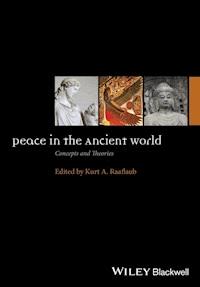
Peace in the Ancient World E-Book
79,99 €
Mehr erfahren.
- Herausgeber: John Wiley & Sons
- Kategorie: Geisteswissenschaft
- Serie: Ancient World: Comparative Histories
- Sprache: Englisch
Peace in the Ancient World: Concepts and Theories conducts a comparative investigation of why certain ancient societies produced explicit concepts and theories of peace and others did not. * Explores the idea that concepts of peace in antiquity occurred only in periods that experienced exceptional rates of warfare * Utilizes case studies of civilizations in China, India, Egypt, and Greece * Complements the 2007 volume War and Peace in the Ancient World, drawing on ideas from that work and providing a more comprehensive examination
Sie lesen das E-Book in den Legimi-Apps auf:
Seitenzahl: 414
Veröffentlichungsjahr: 2016
Ähnliche




















Table of Contents
Cover
Title Page
Notes on Contributors
Series Editor’s Preface
The Ancient World: Comparative Histories
Introduction
Chapter 1: Abhorring War, Yearning for Peace: The Quest for Peace in the Ancient World
Chapter 2: Concepts of Peace in Ancient Egypt
Chapter 3: Thinking about Peace in Ancient India
Chapter 4: Searching for Peace in the Warring States: Philosophical Debates and the Management of Violence in Early China
Chapter 5: Greek Concepts and Theories of Peace
Chapter 6: Broadening the Scope: Thinking about Peace in the Pre-Modern World
Chapter 1: Abhorring War, Yearning for Peace
Prologue
Five Cases and a Thesis
The Prevalence and Brutality of War in the Ancient World
Visions of Peace
Peace Cults
War Cults
Intellectual Concerns with Peace
Conclusion
Abbreviations
References
Chapter 2: Concepts of Peace in Ancient Egypt
The Egyptian World View: Conflict and Equilibrium
Peacefulness as Moral Value
Cultural Valuation of War and Peace
Terminology
Internal Strife and its Conceptual Treatment
Political Behavior and Foreign Policy
The peace treaty between Egypt and the Hittites
Conclusion
Abbreviations
References
Chapter 3: Thinking about Peace in Ancient India
Aśoka
Brahmanism
Buddhism
Conclusion
Abbreviations
References
Chapter 4: Searching for Peace in the Warring States
Introduction
Political Conditions in Early China
The Warring States
Peace in the Warring States
Conclusion
References
Chapter 5: Greek Concepts and Theories of Peace
Introduction: Homer, Thucydides, Peace, and Just War
Containing External War and Ending Civil War: Three Examples
Background: Peace in Political Thought, Discourse, and Conceptualization
Theories of Peace
Explanations and Conclusion
Abbreviations
References
Chapter 6: Broadening the Scope
“Universal Peace” in Ancient Empires
“Inner Peace” and Non-violence in the Axial Age
“Common Peace” Inside and Outside Sovereign States
Conclusion: Explaining Ideas about Peace
Abbreviation
References
Index
End User License Agreement
Guide
Cover
Table of Contents
Begin Reading
Pages
i
ii
iii
iv
vii
viii
ix
x
1
2
3
4
5
6
7
8
9
10
11
12
13
14
15
16
17
18
19
20
21
22
23
24
25
26
27
28
29
30
31
32
33
34
35
36
37
38
39
40
41
42
43
44
45
46
47
48
49
50
51
52
53
54
55
56
57
58
59
60
61
62
63
64
65
66
67
68
69
70
71
72
73
74
75
76
77
78
79
80
81
82
83
84
85
86
87
88
89
90
91
92
93
94
95
96
97
98
99
100
101
102
103
104
105
106
107
108
109
110
111
112
113
114
115
116
117
118
119
120
121
122
123
124
125
126
127
128
129
130
131
132
133
134
135
136
137
138
139
140
141
142
143
144
145
146
147
148
149
150
151
152
153
154
155
156
157
158
159
160
161
162
163
164
165
166
167
168
169
170
171
172
173
174
175
176
177
178
179
180
181
182
183
184
185
186
The Ancient World: Comparative Histories
Series Editor: Kurt A. Raaflaub
Published
War and Peace in the Ancient WorldEdited by Kurt A. Raaflaub
Household and Family Religion in AntiquityEdited by John Bodel and Saul Olyan
Epic and HistoryEdited by David Konstan and Kurt A. Raaflaub
Geography and Ethnography: Perceptions of the World in Pre-Modern SocietiesEdited by Kurt A. Raaflaub and Richard J. A. Talbert
The Roman Empire in Context: Historical and Comparative PerspectivesEdited by Johann P. Arnason and Kurt A. Raaflaub
Highways, Byways, and Road Systems in the Pre-Modern WorldEdited by Susan E. Alcock, John Bodel, and Richard J. A. Talbert
The Gift in AntiquityEdited by Michael L. Satlow
The Greek Polis and the Invention of DemocracyEdited by Johann P. Arnason, Kurt A. Raaflaub, and Peter Wagner
Thinking, Recording, and Writing History in the Ancient WorldEdited by Kurt A. Raaflaub
Peace in the Ancient World: Concepts and TheoriesEdited by Kurt A. Raaflaub
Peace in the Ancient World
Concepts and Theories
Edited by
Kurt A. Raaflaub
This edition first published 2016© 2016 John Wiley & Sons, Inc
Registered OfficeJohn Wiley & Sons, Ltd, The Atrium, Southern Gate, Chichester, West Sussex, PO19 8SQ, UK
Editorial Offices350 Main Street, Malden, MA 02148-5020, USA9600 Garsington Road, Oxford, OX4 2DQ, UKThe Atrium, Southern Gate, Chichester, West Sussex, PO19 8SQ, UK
For details of our global editorial offices, for customer services, and for information about how to apply for permission to reuse the copyright material in this book please see our website at www.wiley.com/wiley-blackwell.
The right of Kurt A. Raaflaub to be identified as the author of the editorial material in this work has been asserted in accordance with the UK Copyright, Designs and Patents Act 1988.
All rights reserved. No part of this publication may be reproduced, stored in a retrieval system, or transmitted, in any form or by any means, electronic, mechanical, photocopying, recording or otherwise, except as permitted by the UK Copyright, Designs and Patents Act 1988, without the prior permission of the publisher.
Wiley also publishes its books in a variety of electronic formats. Some content that appears in print may not be available in electronic books.
Designations used by companies to distinguish their products are often claimed as trademarks. All brand names and product names used in this book are trade names, service marks, trademarks or registered trademarks of their respective owners. The publisher is not associated with any product or vendor mentioned in this book.
Limit of Liability/Disclaimer of Warranty: While the publisher and authors have used their best efforts in preparing this book, they make no representations or warranties with respect to the accuracy or completeness of the contents of this book and specifically disclaim any implied warranties of merchantability or fitness for a particular purpose. It is sold on the understanding that the publisher is not engaged in rendering professional services and neither the publisher nor the author shall be liable for damages arising herefrom. If professional advice or other expert assistance is required, the services of a competent professional should be sought.
Library of Congress Cataloging-in-Publication data applied for
Hardback ISBN: 9781118645123
A catalogue record for this book is available from the British Library.
Cover image: 1st Image: Eirene image: © age fotostock / Alamy Stock Photo2nd Image: The Maat image: © age fotostock / Alamy Stock Photo3rd Image: Buddha image: © Creative Commons / Mario Biondi CC BY-SA 3.0
Notes on Contributors
Susanne Bickel is Professor of Egyptology at the University of Basel, Switzerland, and director of the University’s King’s Valley Project. Her research focuses on Egyptian religion and culture (especially the funerary texts of the 3rd and 2nd millennium), temple iconography and epigraphy, and archaeology. Her book publications include La cosmogonie égyptienne avant le Nouvel Empire (1994); D’un monde à l’autre, Textes des Pyramides et Textes des Sarcophages (co-ed., 2004); Images as Sources (co-ed., 2007); Vergangenheit und Zukunft. Studien zum historischen Bewusstsein in der Thutmosidenzeit (ed., 2013).
Johannes Bronkhorst is Emeritus Professor of Sanskrit and Indian studies at the University of Lausanne, Switzerland. His main area of interest is the history of Indian thought in the broadest sense: religious, philosophical, and scientific. Among his most recent books are Aux origines de la philosophie indienne (2008); Buddhist Teaching in India (2009); Buddhism in the Shadow of Brahmanism (2011); Absorption: Human Nature and Buddhist Liberation (2012).
Kurt A. Raaflaub is David Herlihy University Professor and Professor of Classics and History Emeritus at Brown University in Providence, R.I. His research focuses on the social, political, and intellectual history of archaic and classical Greece and of the Roman republic, on the social dimension of ancient warfare, and on the comparative history of the ancient world. Publications that are relevant in the present context include War and Society in the Ancient World (co-ed., 1999); The Discovery of Freedom in Ancient Greece (2004); Origins of Democracy in Ancient Greece (co-author, 2007); War and Peace in the Ancient World (ed., 2007).
Hans Van Wees is Grote Professor of Ancient History at University College London. His main areas of interest are the social and economic history of early Greece, archaic and classical Greek warfare, and the use of iconographical and comparative evidence in the study of the ancient Greek world. Book publications relevant in the present context include Status Warriors: War, Violence, and Society in Homer and History (1992); War and Violence in Ancient Greece (ed., 2000); Greek Warfare: Myths and Realities (2004); A Companion to Archaic Greece (co-ed., 2009).
Robin D. S. Yates is James McGill Professor of East Asian Studies and History and Classical Studies at McGill University in Montréal, Canada. His research interests include early and traditional Chinese history, historical theory, archaeology of culture, Chinese science and technology, and all aspects of Chinese warfare. His book publications include Five Lost Classics: Tao, Huang-Lao, and Yin-Yang in Han China (1997); Women in China from Earliest Times to the Present: A Bibliography of Studies in Western Languages (2009); Birth of an Empire: The State of Qin Revisited (co-ed., 2013).
Series Editor’s Preface
The Ancient World: Comparative Histories
The purpose of this series is to pursue important social, political, religious, economic, and intellectual issues through a wide range of ancient or early societies, while occasionally covering an even broader diachronic scope. By engaging in comparative studies of the ancient world on a truly global scale, this series hopes not only to throw light on common patterns and marked differences, but also to illustrate the remarkable variety of responses humankind developed to meet common challenges. Focusing as it does on periods that are far removed from our own time, and in which modern identities are less immediately engaged, the series contributes to enhancing our understanding and appreciation of differences among cultures of various traditions and backgrounds. Not least, it thus illuminates the continuing relevance of the study of the ancient world in helping us to cope with problems of our own multicultural world.
In the present case, the problem of peace, an issue of crucial importance for all human societies (discussed in a comprehensive survey in an earlier volume of this series), is reexamined selectively and from a specific angle: what concepts and theories of peace ancient or early societies developed, what role these played and what impact they had, and why certain societies developed such concepts and theories and others did not. The comparative approach helps us understand successes and failures in humankind’s path toward peace, and sharpens our awareness of the problems our own troubled time has with this issue.
Earlier volumes in the series are listed at the very beginning of this volume. Volumes in preparation include The Adventure of the Human Intellect: Self, Society, and the Divine in Ancient World Cultures (ed. Kurt A. Raaflaub); After Slavery and Social Death (eds. John Bodel and Walter Scheidel).
Introduction
Kurt A. Raaflaub
For the first time ever, our age has developed a discipline of “peace studies” (even if much that runs under this label should more properly be called “war studies”). Think tanks and academic, as well as political, organizations try to find ways and draw up blueprints to secure peace, and in international relations and political science the issue of “peace” has become highly prominent. All too often, though, even highly competent specialists pronounce as a simple fact that “peace” is a modern invention, that only the recent past has produced practical and viable proposals to establish a solid foundation for peace, and that all earlier civilizations advanced but naive ideals and impractical dreams on the subject. This volume refutes such assumptions, offers an opportunity to track the ancient origins of at least some modern ideas on peace, and looks specifically at ancient efforts to identify, explain, and resolve the relevant problems on a conceptual and theoretical level.
In 2007, I published in the same series a volume on War and Peace in the Ancient World. That volume’s contributions covered many ancient or early societies around the globe, and examined the question of how these societies dealt with one of the central and most urgent challenges posed to all of humankind: war and peace. The variety of responses to these challenges, which were revealed in those chapters, was illuminating.
As is often the case in endeavors of this kind, the collection of the evidence and assemblage of broad surveys is only the first step. Having gone this far, those involved consider it desirable and promising to add a second step (or more), to dig deeper, and to use the insights gained on this first step to explore specific issues and questions either across the board or in individual case studies. Usually, such follow-ups remain unfulfilled plans. In the case of war and peace, one particular question kept haunting us: why was it that among many highly accomplished ancient civilizations with a rich cultural, intellectual, and written record only a very small group—in fact, only two (China and Greece)—seemed to have developed an explicit discourse on peace and even specific concepts and theories of peace? What was it that kept others from doing so, even though at first sight they would have seemed perfectly capable of taking this step as well? This is the single question the present volume tries to answer.
In 2008, I convened a panel at the European Social Science and History Conference (ESSHC) in Lisbon. The contributors to the present volume joined me there to search for answers to these and related questions. Susanne Bickel (Basel) and Johannes Bronkhorst (Lausanne) explored the reasons of why Egypt and India did not develop a substantive and theoretical peace discourse, while Robin Yates (McGill) and I tried to explain why and how early China and Greece did. Hans Van Wees (UC London) served as a respondent. Our discussions were productive and we decided to aim at publication.
Given the success of the War and Peace volume, the Classics Editor of Blackwell Publishing (later Wiley-Blackwell and now Wiley), Haze Humbert, reacted very positively to the suggestion but worried about publishing a follow-up too soon. We decided to wait a few years. When we revived the project about three years ago, health problems, professional overextension, and urgent prior commitments on the part of various contributors caused a series of further long delays. All authors, though, had an opportunity to revise and update their chapters before submission. I am most grateful to them for their commitment, patience, and excellent contributions. I also thank Haze Humbert and her staff most sincerely for their trust and support.
I add here somewhat detailed summaries of the chapters’ contents.
Chapter 1: Abhorring War, Yearning for Peace: The Quest for Peace in the Ancient World
This chapter establishes a framework for the more detailed investigations of the subsequent chapters by offering a broad survey over the quest for peace in ancient or early societies. It begins with five brief case studies that range from the “Iroquois League” with its “Great Law of Peace” and early China to classical Athens, the late Roman republic, and the single extant discussion of peace in Greco-Roman literature preserved in Augustine’s City of God. These case studies support the thesis that it took war experiences of extraordinary intensity to prompt ancient or early societies to think more consistently and intensely about peace than they normally did, to challenge traditional concepts and norms, and to formulate new ones. Even such experiences, though, may not have been sufficient to trigger the development of concepts and theories of peace. It is the purpose of this volume to find out what concepts and theories did emerge in this area, what factors made them possible and why such factors seem to have had an impact only in some societies and not in others, despite the ubiquity of intense war.
For in all parts of the ancient world wars were frequent and brutal, firmly supported by ideology and, often, religion. Those in power depended on wars to legitimate their position and demonstrate their superiority. Constant warfare molded and conditioned entire societies. Victories were celebrated in poetry, historical records, and art. In contrast, concern for peace is less pervasive in the extant record: in some form, most religions advocated it, and imperial ideologies celebrated it. Although critics did not fail to point out the price to be paid for it, the benefits of long-lasting imperial peace were real enough.
Cults and monuments offer valuable insights. Overall, cults of peace were rare. In both Greece (especially Athens) and Rome, peace (eirēnē, pax), although widely desired, was recognized and celebrated by cult and monuments only late and primarily for political and ideological reasons, even in hegemonic and imperial contexts. The concept of concord (homonoia, concordia) emerged in reaction to severe civil strife and was soon supported by a cult, but it was eventually instrumentalized to emphasize unity in the context of the Macedonian kings’ and Augustus’s consolidation of imperial power. Moreover, all this pales in comparison to the ubiquity of war and victory cults in these same cities. Shrines and statues of war deities, vowed in wars, and monuments celebrating victories made of the center of Rome a vast “memorial space” that continually reinforced Roman identity and conditioned every new generation to emulate its ancestors. The same was true for Athens where public spaces were crowded with monuments celebrating martial exploits and with statues and temples of Victory (Nikē) and Athena as the ultimate warrior goddess. In democratic Athens and oligarchic Rome, collective governments fostered the celebration of martial values through communal cults and monuments. In imperial monarchies, by contrast, the commemoration of victories was integrated into monuments that focused on the person of the monarch and his tutelary deities. Overall, imperial reassertion and aspirations left little space for monumental expressions of peace.
The chapter’s final section deals with intellectual concerns with peace. The greatly interesting Indian and Chinese evidence will be discussed in separate chapters. In Rome, poets called for peace and praised Augustus for having achieved it. Historians were much more reluctant to do so, and politically engaged intellectuals had little to say on peace. Explanations include the charged topic of civil war—on which not even the victors liked to dwell—and the perspective of the leading class, to which peace was but a consequence of a well-functioning state; especially in the crisis of the late republic, debate therefore focused on the latter. Greek thinkers found it easier to deal with stasis that played out in a sphere over which the citizen communities had control; external war proved much more intractable. Still, in both areas the Greeks came up with remarkable, even theoretical, solutions that will be the subject of a separate chapter as well.
In sum, in most societies numerous obstacles prevented the emergence of a substantive discourse on peace, let alone of concepts and theories of peace. The chapter ends by formulating, as a thesis, three conditions that enabled societies to develop such concepts and theories: exceptionally harsh war experiences, which made peace an urgent need; a capacity for abstract and philosophical thinking; and the political and critical independence of the thinkers.
Chapter 2: Concepts of Peace in Ancient Egypt
“Peace,” Susanne Bickel emphasizes, is not naturally given but a cultural product and, as such, varies greatly in the understanding of societies and periods. It needs to be examined in a conceptual context—considering world view, cosmology, theology, and moral values—and in a social-political context, looking at specific constellations, outside stimuli, and necessities to which society reacts. The Egyptian world view is dominated by a concept of antagonism that drives the universe and society: disruptive forces and deities oppose the forces and gods representing order, justice, and harmony. The equilibrium in the universe and society needs to be maintained by constantly overcoming (even violently) the tensions created by an intrinsic antagonism of opposing forces.
In the social and moral value system, the ideals of non-violence, self-control, and respect for social status are described with terms related to the semantic field of peace. “Peace” here designates both a personal attitude (non-aggressiveness) and condition (safety from attack). Such emphasis on “peacefulness,” however, has no place in the sphere of politics and foreign relations. The Pharaoh’s obligation is to fight to keep the universe in balance and his country safe. Accordingly, in foreign relations “peace” means subjection and a condition imposed by the victorious pharaoh on others. Bravery and victory are his prime qualities. The need to fight wars is never questioned, world view and economics foster domination and imperialism, and no discourse on peace can develop in these conditions. Nor is there space for concepts such as internal opposition or civil war.
The Egyptians aimed at controlling (directly or indirectly) neighboring regions to the south and east. In their ideological construct, supported by economic needs, the peaceful and orderly Egyptian interior was opposed to a wicked and criminal outside world that constantly aimed at attacking the Egyptian order. For the longest time, ideology, not real threats, thus justified wars that kept reaffirming the pharaoh’s divinely sanctioned mission. Hence, there was no need to develop a concept of peace in opposition to warfare. Eventually, new powers arose in West Asia and forced the Egyptians to maintain a large army and to engage in frequent warfare to defend their dominant position. Even so, the pharaohs “imposed peace” from a position of superiority upon those who surrendered. The conquered and crushed enemy symbolized peace. War was fought outside of Egypt’s borders and only marginally affected the country’s population itself. Even when this, too, changed and Egypt lost its independence, conditions never favored the development of a concept of peace as an alternative value.
A unique exception is the peace treaty concluded between Ramesses II and the Hittite king Hattusili III in the aftermath of the battle of Kadesh (c. 1275 BCE). The well-documented treaty establishes peace as an equitable agreement on the basis of parity between the partners and defines peace as a state of non-violence, non-aggression, and mutual respect and aid. Yet, in a spectacular clash between ideology and the reality of politics, Egyptian self-presentation still embeds this treaty in the traditional framework depicting the pharaoh as the universal victor and Egypt’s total control over the outside world.
Overall, then, both conceptual and ideological dispositions and the reality of Egyptian politics and history failed to offer an opportunity to reflect about peace as a political value. As Bickel concludes, “there was no necessity to create such a concept, nor even an interest in doing so, because (during the third and second millennium) Egypt was much more powerful than its neighbors and potential opponents, and later (in the first millennium) there was no possibility because the opposing forces overpowered Egypt and integrated the country into their political entities.”
Chapter 3: Thinking about Peace in Ancient India
Johannes Bronkhorst begins with the famous rock inscriptions of the Mauryan emperor Aśoka. Turned Buddhist, he regretted the violence caused by his conquests and promoted righteous rule (dharma). Yet Aśoka himself did not renounce violence, and his successors did not follow his precepts. His empire turned out to be one of many attempts to unite “the world” (the Indian subcontinent) in a single state and thus to create peace through universal rule. Paradoxically, the “ultimate aim of permanent and universal peace led in practice to ceaseless and relentless war.”
Two major and very different intellectual currents (the Brahmins and Buddhists) dealt with the Mauryan legacy. The Brahmins used a pragmatic approach, exemplified by the oldest extant treatise on statecraft (Arthaśāstra) that explicitly claims to advise rulers. The goal of any ruler is to conquer the world, and the treatise discusses ways to achieve this goal and, as a basic condition, to establish and secure the ruler’s power. Permanent and universal peace is only achievable in this way, even if it is a distant goal or dream. More limited peace between or within kingdoms is not to be despised but a means to an end, to be abandoned when an opportunity emerges to gain power over others. Brahmanism was no religion but an ideology, a vision of a highly stratified society, with Brahmins occupying the highest positions and kings creating and expanding kingdoms. Other texts, too, confirm that Brahmanical teaching promoted the use of force and war to expand one’s realm whenever the gains were likely to be larger than the risks. Hence, overall, Bronkhorst emphasizes, the “Brahmanical political tradition… was not actively in search of peace.” Rather, the “victory of Brahmanism in the realm of religious, social, and political ideas expressed itself in what might be called a celebration of war, both in reality and in rhetorical contexts.” Brahmins certainly wanted to live in peace but only in conditions that were favorable to them, and this concretely meant, under rulers who were powerful and successful, and whose aspirations were supported by the Brahmins’ acceptance of war.
In sharp contrast, Buddhism was not pragmatic but idealistic, teaching a path, open to all (high and low), to avoid rebirth, which required followers to abandon society, refrain from violence, and survive by begging. The Buddhist theoreticians’ main problem eventually was how to reconcile their nonviolent ways with the needs of the world. Their ideal was a righteous ruler who conquered the world in an unobjectionable manner. The solutions they proposed were initially impractical and unrealistic, and in the early centuries Buddhism was not able to produce constructive thoughts concerning political peace—although in the real world in which they lived peace was greatly important to them. Apparently, they had early on yielded certain areas of intellectual activity, including matters of statecraft, to the Brahmins as specialists with useful advice to offer and impressive manuals to back it up. This changed only with the emergence of a tradition that the most recent Buddha had in his earlier lives led a normal life, and even been a competent king. The stories told about this showed that one could be a committed Buddhist, even aspire to become a future Buddha, and still occupy a role in society. Logically, then, a Buddhist could also be involved in killing and war—if he did so for righteous reasons. This in turn opened the way for Buddhists to serve as royal advisors, profiting from the expertise of the Brahmins, even adapting some of their manuals, and borrowing the use of magic and spells to protect their kings. However successful the Buddhists were, though, “their competition with the Brahmins offered no opportunity to develop ideas about political peace. Quite on the contrary, where Indian Buddhism had originally looked with disapproval upon all forms of violence, including political violence, in the course of time they found ways to justify and contribute to it.”
“Indian antiquity,” Bronkhorst concludes, “has produced no credible ideas about political peace,” despite the importance of mental peace in its culture. As a result, “war was endemic in India for all but the few periods in which one kingdom succeeded in uniting a major part of the subcontinent under a single ruler. Thinking about political peace did not play a credible role in ancient India and never exerted a noticeable influence.”
Chapter 4: Searching for Peace in the Warring States: Philosophical Debates and the Management of Violence in Early China
Robin Yates takes issue with the long-dominant opinion that, beginning with Confucius, all thinkers in China’s “Warring State” period (476–221 BCE: a period tormented by ceaseless war) agreed that peace could be established only by a unitary empire, and that this opinion prevailed throughout Chinese history virtually into the present. In fact, there were wide-ranging debates with many competing opinions about political and philosophical issues that were relevant in this context. Nor is the search for a system to overcome war and establish lasting peace to be confused with a “pacifist” attitude. In its early history, Yates emphasizes, China “was among the most inventive cultures in the arts of war;” it was “never a pacifist culture and Confucianism was never a pacifist ideology.”
In the “Spring and Autumn” period (770–476), the state system disintegrated and competition among numerous polities increased. Such competition made administrative reorganization and centralization necessary, which was not possible without new types of experts who were able to offer advice and leadership, apply innovative solutions to the practical challenges of government, execute the rulers’ policies, and integrate increasing numbers of commoners into the state structure. Members of lesser lineages embarked on such careers, supported by an education that was provided by professional teachers. Confucius was the first teacher of such experts, and soon many more schools were founded that specialized in such teaching. They all were confronted with the challenge of solving the anarchy of incessant warfare and social dislocation, of finding a way to establish lasting order and peace, and of defining the qualities and methods by which a ruler might achieve this.
Although it is difficult to determine to what extent the experience of intense and incessant war directly prompted a discourse on war and peace, philosophical debates about crucial political issues (including war and peace) thus began in the sixth century and intensified with the increase of competition among states. Apparently, though, the ideas of the philosophers had little immediate impact. Rather, the administrators of the various states sought their own solutions. Investing great resources into coercing the population to serve their rulers’ needs, both economically and militarily, the states were increasingly able to establish order within their boundaries. This made it possible for philosophers and theoreticians to think about peace abstractly and to engage in a debate about the nature and realization of an ideal peace. Conceptually, many early Chinese thinkers saw “peace” not as the absence of war but as a condition with positive connotations. Yet of more immediate concern were the notions of order and disorder. Other political developments prompted a vigorous debate about the value of hereditary succession vs. merit-based rulership and of the qualities of a “true ruler.” In some of these debates, the issue of war and peace was confronted head on, including discussion of detailed policies and institutions that a ruler could enact to achieve “perfect peace.”
Against the majority’s view that war could be ended only through the methods of peace (though what these methods were to be was vigorously contested), a group of “militarists” argued that unity could be created only by force; hence they focused on developing military, legal, and economic methods to strengthen their states and overcome the others by military might alone. Those who prevailed in the end (thinkers at the court of Qin) promoted a simple and pragmatic solution: peace “was to be created by the subordination of the weaker to the stronger, by military means if necessary, with only a thin veneer of morality or justification.” Under the Qin and Han dynasties, internal unity and peace were indeed established, even if at great cost in lives and property.
Still, Chinese philosophers “endorsed the importance of the ruler ensuring peace and harmony with the cosmos.” They as much as the rulers and statesmen themselves realized, however, that the maintenance of peace required the maintenance of a strong army and readiness to go to war. War and peace alternated with the rhythms of the cosmos. Perpetual peace was impossible and even unnatural.
Chapter 5: Greek Concepts and Theories of Peace
A strong concern for peace and just war connects Homer and Thucydides. The Iliad stands at the beginning of a long, intense, and public discourse on war and peace that can be traced through archaic poetry and philosophy to the dramatists and historians of the fifth century. The pervasiveness and public nature of this discourse seems to distinguish the Greeks from other ancient societies. Moreover, from early on, it included conceptualizations of war and peace as central communal issues, and attempts at theoretical categorization and analysis. Thucydides marks both a rapid intensification and increasing theorization of this discourse.
Three examples in and after the time of Thucydides illustrate innovative Greek efforts to establish peace by containing endemic inter-communal war and overcoming destructive intra-communal conflict (stasis): large-scale organizations to secure “international peace,” a blueprint for peace requiring profound changes in thinking and attitudes, and the use of amnesty and geographical separation to eliminate stasis from the community.
Such efforts profited from the emergence of politically oriented philosophers (sophists) who enhanced the ongoing discourse on war and peace by adding theoretical sophistication. Thucydides’ “pathology of civil war” thus incorporates a theoretical analysis of the causes and characteristics of stasis. Among various proposals offered to resolve this problem, those applying constitutional theory and aiming at a “mixed constitution” seemed especially promising. Containing endemic war proved more difficult, but new initiatives were built on theoretical foundations as well: thus, attempts were made to improve inter-polis collaboration in “common peace” treaties and create an improved alliance system by limiting hegemonic power and strengthening the allies’ influence. Other debates focused on mentalities by changing deeply ingrained attitudes toward war and empire, and on economic and social conditions by supporting trade to enhance interdependence among poleis and by supporting the lower classes to make them less dependent on and eager for war. By focusing on possibilities to overcome war and conflict, all these initiatives contributed to theoretical debates about peace, and hints survive in the evidence that peace was thematized directly in such debates as well.
In conclusion, it cannot be accidental that precisely in the period when warfare became much more pervasive and brutal, and when philosophy and political theory focused increasingly on political issues, the Greeks began to think in new ways about war and peace and to seek innovative and at least partly theoretical solutions to create peace by overcoming war and stasis.
Chapter 6: Broadening the Scope: Thinking about Peace in the Pre-Modern World
Prominent modern views consider peace a recent invention and dismiss earlier discussions of peace as idealistic or pious dreams, failing to yield practical results. On the contrary, Hans Van Wees points out, the chapters in the present volume demonstrate that the ancient world was not only deeply concerned with the issue of peace but produced, on the conceptual and theoretical levels, complex and sophisticated ideas about causes of war and possibilities to attain political peace. In some cases, these ideas were pragmatic enough to yield practical results.
In the ancient Near East, we find a concept that seems common in Bronze and Iron Age empires throughout the ancient world: a ruler is charged by the gods to maintain order (and in this sense peace) within his realm and harmonious relations between the human and divine worlds. By contrast, the Romans believed, like the builders of the ancient Chinese empires and modern imperialists, that peace could be established only by imperial conquest. Both these views assumed that maintaining peace necessitated force and that coercive power was legitimated by the desire for peace.
In stark contrast, in pre-imperial China, India, and Greece a range of ideas emerged that essentially rejected the use of force and cultivated inner balance and virtue as conditions for peace on the individual, state, and international levels. These ideas were often impractical and politically unsuccessful, but they were important because they assumed that endemic war and violence were the result of problems internal to human society and not due to external forces or a cosmic order: if people, officials, and kings pursued selfish goals and used violent means to achieve them, these attitudes needed to be changed to overcome war and violence. Methods to achieve peace thus relied on self-control and consent rather than coercion. Even small changes along those lines could reduce the likelihood of violence and war.
Another approach thought of peace as being the result of negotiations between individuals or collectives with competing self-interests. This approach underlies modern thinking about peace, concepts such as “balance of power,” or the expectation that institutionally supported international trade will reduce threats of war. Far from being modern inventions, Van Wees argues, such ideas developed in ancient Greece on very similar lines. He traces this development from early Greece to Thucydides’ analysis of the causes of wars that is based on a rational calculation of expected gains, costs, and risks.
Such ideas, known today as “Realism,” broke fully through in the fourth century. They underlie “Common Peace” treaties, in which responsibility for maintaining peace was imposed on both the hegemonic power and the collective of signees, and are expressed powerfully by Plato, Isocrates, and Xenophon, who considered lasting peace desirable not least because peace was more profitable than war. The theories and practical solutions offered by Greek intellectuals anticipated nineteenth-century Liberal peace theories. Since, moreover, in Greece commoners economically often depended on war, some thinkers recognized that peace required the elimination of structural social and economic problems plaguing Greek communities. Their solutions included nonviolent ways to increase public revenues that could be spent on a welfare program supporting the lower-class citizens.
In conclusion, Van Wees proposes to add two structural factors to the list of conditions for the development of a substantive and even theoretical peace discourse in antiquity: the need to legitimate and consolidate certain forms of power (most obviously, empire) and the need for an intellectual response to the development of increasingly centralized and competitive states. Fourth-century Greeks went furthest in their intellectual and political efforts to create remarkably “modern” ideas about peace; this fact may be due to a strong sense of common ethnic and cultural identity and economic interdependence. All this requires further research and corroboration, especially on the levels of a broad “intellectual history” that “places ideas in their contemporary context,” and of a broadly comparative approach as it is offered in this volume.
Chapter 1Abhorring War, Yearning for Peace: The Quest for Peace in the Ancient World1
Kurt A. Raaflaub
Prologue
The dramatic date of the Chinese film Hero (Ying xiong) is the end of the Warring State Period (403–221 BCE), in which seven kingdoms fought ruthlessly for supremacy, causing massive slaughter and suffering for the population.2 In the film, the king of Qin, determined to conquer all of China, has defeated most of his enemies. Over the years, however, he has been the target of many assassins. Three of these are still alive, Broken Sword, Flying Snow, and Sky. To anyone who defeats these three, the king promises great rewards: power, riches, and a private audience with himself. For ten years no one comes close to claiming the prize. Then an enigmatic person, Nameless, appears in the palace, bearing the legendary weapons of the slain assassins. His story is extraordinary: for ten years he has studied the arts of the sword, before defeating the mighty Sky in a furious fight and destroying the famed duo of Snow and Broken Sword, using a weapon far more devastating than his sword—their love for each other.
The king, however, replies with a different story: of a conspiracy between the four, in which Nameless’ victories were faked to enable him to come close to the king and kill him. Nameless indeed has a chance to achieve his goal. The king, exposed to his sword, tells him of his true aspiration: to conquer the warring states in order to overcome war and violence once and for all, to create a unified empire, and to establish lasting peace. Overcome by this vision, Nameless draws back his sword and walks out of the great hall—to die willingly under the arrows of the king’s bowmen.
This is a powerful and beautiful film. Its message is exciting. It raises both hope and doubts: was there really an ancient ruler who pursued a true vision of peace—even if it could be realized only at the price of war and violence? Not unexpectedly, hopes prove illusionary. The film is based on a historical episode: the attempt of Jing Ke to assassinate the king of Qin in 227 BCE. But the film clearly does not intend merely to reconstruct history. The question of how to interpret it has raised intense debates; one interpretation sees it as an allegory for Mao Zedong and communism’s unification of the world through global conquest, another, fueled by the Chinese government’s approval, as advocating stability and security over human rights and liberty—although the film’s director, Zhang Yimou, insisted that he did not pursue any political purpose. An any rate, the first emperor—he who displayed his army in a now world-famous terracotta replica near his necropolis—was no visionary of peace. Later Chinese historians did not even celebrate him as one of the greatest conquerors of all time, but rather castigated him as a cruel, arbitrary, impetuous, suspicious, and superstitious megalomaniac.3
Experts on war in the ancient world are numerous, those on peace harder to find; the bibliographies differ accordingly.4 The topic this chapter addresses is huge. My purpose is twofold: on the one hand, to offer a broad survey over the quest for peace in the ancient world and to stimulate discussion;5 on the other hand, to argue, at least in a preliminary way, for a thesis that will be tested in the subsequent chapters of this volume. To lay the ground for this thesis, I begin by presenting five brief case studies.
Five Cases and a Thesis
The first case is perhaps unexpected in this volume. It concerns a society that is not usually considered “ancient,” although it is certainly “early” and has roots that go back to ancient times. What I have in mind is the “Iroquois League,” founded by five (later six) Native American Nations in the north-east of today’s United States. It is usually dated to around 1450 CE but strong arguments have been presented for the early twelfth century. The foundation of this League was marked by the acceptance of the “Great Law of Peace.”6 Its purpose, achieved to a remarkable degree, was to restore and maintain general peace, unity, and order among its member nations and beyond.7 Depending on what founding date we accept, it lasted for three hundred or even six hundred years. Nothing like this ever came about in the ancient world, despite numerous attempts.
What interests here is the reason for the League’s foundation. According to oral traditions preserved among the nations involved, it emerged in reaction to strife and warfare that had become excessive, uncontrollable, and fratricidal:
Everywhere there was peril and everywhere mourning. Men were ragged with sacrifice and the women scarred with flints, so everywhere there was misery. Feuds with outer nations, feuds with brother nations, feuds of sister towns and feuds of families and of clans made every warrior a stealthy man who liked to kill… A man’s life was valued as nothing. For any slight offence a man or woman was killed by his enemy and in this manner feuds started between families and clans. At night none dared leave their doorways lest they be struck down by an enemy’s war club. Such was the condition when there was no Great Law.8
Dekanawidah, “the Great Peacemaker,” a figure raised to superhuman status in some legends, was able to convince the warriors and their chiefs to “bury the hatchet,” conclude peace, accept a “code of law” (the Great Law of Peace), and set up an organization that would guarantee its maintenance. Symbolically, a large tree (the “Tree of the Great Peace”) was uprooted, weapons were buried in the hole, and the tree planted again.9 The politicial system adopted by the League, involving representation and equal vote (and thus elements characteristic of democracy), as well as a reassessment of the Law and the League’s rationale in regular intervals, was known to the American Founders; whether and to what extent it influenced the constitution of the United States remains debated.10
The second case leads us to China in the Warring State Period (475–221 BCE, mentioned above). It received its name because of the endless wars for power and primacy that were based on two interrelated developments, among others: advances in technology made it much cheaper to produce individual weapons and equip large armies, thus encouraging the transition from aristocracy-dominated contests to mass fighting. States with larger resources were thus at an advantage, and this was crucial in propelling the ongoing consolidation of power among a shrinking number of an initial multitude of rivaling petty states, down to only seven among which the kingdom of Qin emerged victorious, creating the First Empire. Wars in this period were brutal and relentless, causing profound and widespread misery that was increasingly resented and could not easily be overlooked. Not least for this reason, this was also a period of great intellectual ferment and social as well as political innovation, one of the most productive in Chinese history: it laid the foundations of thought patterns, structures, and developments for centuries to come. Among other intellectual advances, political thought and philosophy, represented most conspicuously by Confucius and his disciples and successors reached unprecedented heights, and their thoughts focused, typically, on two major issues, among others: how to help their patrons among the kings of the contending states to gain and secure victory and power, and how to overcome the chaos and misery caused by constant war and establish lasting peace. Substantive thinking about peace thus grew at least indirectly out of intolerable experiences of war.11
The third case takes us to Athens. Its history in the first half of the fifth century BCE was marked by its decisive contributions to victories over invading Persian armies in 490 and 480/79, its swift rise to power at the head of a widespread alliance system that was soon turned into a centralized naval empire, and, in close interaction with war and empire, its development of the most advanced democracy that was imaginable under the conditions of the ancient world. Although for different reasons than Sparta, Athens too became a somewhat militarized society. Between the Persian and Peloponnesian Wars (431–404 BCE between Athens and Sparta) Athens was involved in some kind of war in two out of three years, and its collective or “national” character was defined by “aggressive activism,” a propensity for expansionist and interventionist policies. This tendency got Athens involved twice in serious conflicts with Sparta; the long and bitter Peloponnesian War ended with total defeat, the loss of empire, fleet, and fortifications, and almost with the city’s annihilation.
The emergence of naval warfare and imperialism completely changed the face of war in the Greek world: it became permanent, ubiquitous, destructive, and total, involving most of Greece and affecting every sphere of life. In particular, as Thucydides demonstrates in memorable chapters, external war often went hand in hand with civil strife or even war (stasis) that prompted unprecedented excesses of cruelty and moral depravation.12 Yet, at the same time, and again not accidentally, Athens in the fifth century was the center of an unparalleled cultural upswing in all spheres of intellectual and artistic achievement.13 And it was especially in the last third of the century, under the experience of excessive war and stasis, that a long-standing discourse on war and peace was massively intensified: leading thinkers (especially philosophers, historians, and dramatic poets) turned their attention to analyzing issues of war and peace; they focused, in theory and practice, on finding ways to control war and civil strife and to secure peace. Moreover, as we shall see, the experience of stasis prompted the creation of a new term and concept denoting concord (homonoia).14
The fourth case concerns Rome in the period of transition from Republic to monarchy. Unlike the meteoric rise and fall of the Athenian empire, the Roman Empire was the result of a long development, stretching over many centuries, and of the efforts of many generations of leaders and citizens.15 For centuries, the Romans were at war almost every year; in important ways, both elite and commoners were conditioned by war. By the middle of the second century BCE, Rome directly or indirectly controlled the entire Mediterranean, and its political system under the leadership of the senate and a powerful aristocracy had proved supremely successful.16




