


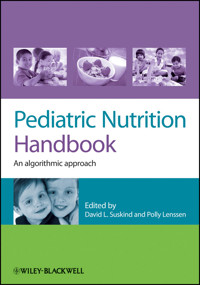
Pediatric Nutrition Handbook E-Book
48,99 €
Mehr erfahren.
- Herausgeber: John Wiley & Sons
- Kategorie: Fachliteratur
- Sprache: Englisch
The last decade has seen an explosion of medical information in regards to the nutrition care and management of children. While nutritional therapies have expanded, the treatment choices have become increasingly complex. This exciting title addresses the extensive amount of information available to practitioners in a concise, accessible fashion via a series of algorithms. It focuses on the normal growing healthy child from birth through adolescence, covering common pediatric diseases and disorders through a series of flows charts which outline step-by-step nutritional processes for pediatric patients. The highly visual format of the book allows the practitioner to make rapid, evidence based choices. Features: * Unique algorithm approach to the largest dietetic specialism * Highly visual approach allows quick decision making * All algorithms and text built on evidence-based research * Covers the pediatric phase from birth to adolescence * Includes common childhood diseases and disorders
Sie lesen das E-Book in den Legimi-Apps auf:
Seitenzahl: 166
Veröffentlichungsjahr: 2013
Ähnliche




















Contents
Preface
Foreword
Acknowledgments
Contributors
Chapter 1 General Nutrition
1.1 General Pediatric Nutrition Assessment — Cheryl Davis and the Clinical Nutrition Department
1.2 Focused Assessment: Infants — Cheryl Davis and the Clinical Nutrition Department
1.3 Focused Assessment: Toddlers — Cheryl Davis and the Clinical Nutrition Department
1.4 Focused Assessment: School-Age Children — Cheryl Davis and the Clinical Nutrition Department
1.5 Focused Assessment: Adolescents — Alicia Dixon Docter
Appendix A: Expected Gain in Weight: Birth to 24 Months (Guo et al., 1991)
Appendix B: Expected Gain in Length: Birth to 24 Months (Guo et al., 1991)
Chapter 2 General Pediatrics
2.1 Failure to Thrive — Crystal Knight, David L. Suskind
2.2 Failure to Gain Weight Breast-Feeding — Lee Bossung Sweeney
2.3 Swallowing Disorder and Aspiration — Susan Casey
2.4 Gastroesophageal Reflux Disease — David L. Suskind
2.5 Acute Gastroenteritis — David L. Suskind
2.6 Cow’s Milk Protein Allergy — David L. Suskind
2.7 Eosinophilic Esophagitis — David L. Suskind
2.8 Food Allergies — Susan Casey
2.9 Toddler’s Diarrhea or Chronic, Nonspecific Diarrhea of Childhood — David L. Suskind
2.10 Vitamins and Minerals — Matt Giefer, David L. Suskind
Chapter 3 Endocrine
3.1 Type 1 and Type 2 Diabetes Mellitus — Tran Hang
Chapter 4 Gastroenterology
4.1 Crohn’s Disease — Crystal Knight, David L. Suskind
4.2 Ulcerative Colitis — Crystal Knight, David L. Suskind
4.3 Short Bowel Syndrome — Cheryl Davis, Simon Horslen
4.4 Ascites and Portal Hypertension — Crystal Knight, Simon Horslen
4.5 Acute Pancreatitis — Matt Giefer, Crystal Knight, David L. Suskind
Chapter 5 Biochemical Genetics
5.1 Urea Cycle Defects — Kelly McKean, Melissa Edwards
5.2 Maple Syrup Urine Disease — Kelly McKean, Melissa Edwards
5.3 Galactosemia — Kelly McKean, Melissa Edwards
5.4 Glycogen Storage Disease Types 1a and 1b — Kelly McKean, Melissa Edwards
5.5 Hereditary Fructose Intolerance — Kelly McKean, Melissa Edwards
5.6 Mitochondrial Disorders — Kelly McKean, Melissa Edwards
5.7 Fatty Acid Oxidation Disorders — Kelly McKean, Melissa Edwards
5.8 Organic Acidemia — Kelly McKean, Melissa Edwards
Chapter 6 Nephrology
6.1 Nephrotic Syndrome — Peggy Solan, Kirsten Thompson
6.2 Chronic Kidney Disease — Peggy Solan, Kirsten Thompson
6.3 Kidney Transplant — Peggy Solan, Kirsten Thompson
6.4 Hypertension — Peggy Solan, Kirsten Thompson
Chapter 7 Neurology
7.1 Antiepileptic Drug–Nutrient Interactions — Elaine Cumbie, Marta Mazzanti
7.2 Ketogenic Diet Therapy Plan — Elaine Cumbie, Marta Mazzanti
Chapter 8 Obesity
8.1 Obesity — Heather Paves
Chapter 9 Pulmonary
9.1 Bronchopulmonary Dysplasia/Chronic Lung Disease — Susan Casey
9.2 Cystic Fibrosis — Susan Casey
9.3 Asthma — Susan Casey
Chapter 10 Oncology
10.1 Cancer — Kathy Hunt
Chapter 11 Neurodevelopment
11.1 Neurodevelopmental Delay — Kim Cooperman
Chapter 12 Neonatology
12.1 Feeding Infants in the Neonatal Intensive Care Unit — Maura Sandrock
Chapter 13 Nutrition Support
13.1 Enteral Nutrition — Polly Lenssen
13.2 Indications for Total Parenteral Nutrition — Polly Lenssen
Chapter 14 Surgery
14.1 Post-operative Nutritional Care — Jenny Stevens
Chapter 15 Intensive Care: Cardiac/Pediatric
15.1 Chylothorax — Claudia Sassano-Miguel
15.2 Extracorporeal Membrane Oxygenation — Claudia Sassano-Miguel
Chapter 16 Cardiology
16.1 Congenital Heart Disease — Christine Avgeris
Chapter 17 Rheumatology
17.1 Rheumatic Disease — Kim Kellogg
Glossary of Acronyms
Index
To the inspirations in my life, Rebecca, Elias, and Sadie and the foundation from which I grew, Mom and Dad.
– David L. Suskind
A special acknowledgment to my children Natalie and Charles, who taught me to “relax” about childhood feeding and appreciate every day of life!
– Polly Lenssen
This edition first published 2011 © 2011 John Wiley and Sons.
Wiley-Blackwell is an imprint of John Wiley & Sons, formed by the merger of Wiley’s global Scientific, Technical and Medical business with Blackwell Publishing.
Registered office:
John Wiley & Sons, Ltd, The Atrium, Southern Gate, Chichester, West Sussex, PO19 8SQ, UK
Editorial offices:
9600 Garsington Road, Oxford, OX4 2DQ, UKThe Atrium, Southern Gate, Chichester, West Sussex, PO19 8SQ, UK111 River Street, Hoboken, NJ 07030-5774, USA
For details of our global editorial offices, for customer services and for information about how to apply for permission to reuse the copyright material in this book please see our website at www.wiley.com/wiley-blackwell.
The right of the author to be identified as the author of this work has been asserted in accordance with the UK Copyright, Designs and Patents Act 1988.
All rights reserved. No part of this publication may be reproduced, stored in a retrieval system, or transmitted, in any form or by any means, electronic, mechanical, photocopying, recording or otherwise, except as permitted by the UK Copyright, Designs and Patents Act 1988, without the prior permission of the publisher.
Designations used by companies to distinguish their products are often claimed as trademarks. All brand names and product names used in this book are trade names, service marks, trademarks or registered trademarks of their respective owners. The publisher is not associated with any product or vendor mentioned in this book. This publication is designed to provide accurate and authoritative information in regard to the subject matter covered. It is sold on the understanding that the publisher is not engaged in rendering professional services. If professional advice or other expert assistance is required, the services of a competent professional should be sought.
Library of Congress Cataloging-in-Publication Data
Pediatric nutrition handbook : an algorithmic approach / edited by David L. Suskind and Polly Lenssen.p. ; cm.Includes bibliographical references and index.ISBN-13: 978-0-470-65995-3 (pbk. : alk. paper)ISBN-10: 0-470-65995-5 (pbk. : alk. paper) 1. Children–Nutrition–Handbooks, manuals, etc.2. Nutrition disorders in children–Handbooks, manuals, etc. I. Suskind, David L. II. Lenssen, Polly. [DNLM: 1. Child Nutrition Disorders–Handbooks. 2. Adolescent. 3. Child.4. Gastrointestinal Diseases–Handbooks. 5. Infant Nutrition Disorders–Handbooks. 6. Infant.7. Metabolism, Inborn Errors–Handbooks. WS 39]RJ206.P3625 2011618.92–dc23
2011020646
A catalogue record for this book is available from the British Library.
1 2011
Preface
Each year, millions of children throughout the world are subjected to the life-threatening ravages of malnutrition. The nutritional issues that children face today have radically changed as knowledge on disease processes as well as their treatments have improved.
We know the effect of nutrition is profound. Good nutrition not only assures proper growth and development, but it also enables each organ system to do its job properly. In ill children, nutrition is paramount, affecting both morbidity and mortality. As medicine has specialized, the nutritional care of children has also become increasingly specialized. This handbook serves as a broad guide to the nutritional care for the developing infant and child as well as for children with specialized medical needs.
This handbook is the fruition of a long-held dream by many at Seattle Children’s Hospital to standardize the nutritional care of our patients. Collectively, it represents years of experience and specialized knowledge in the nutritional assessment and care of infants, children, and teens.
We would like to recognize our contributors for their time and effort. Additional thanks to the many reviewers who both recommended content and analyzed all the chapters. Our hope is that all health care providers – residents, nurses, dietitians, and other clinicians – find the handbook helpful. We welcome feedback to improve future publications.
David L. SuskindPolly Lenssen
This handbook is designed to assist healthcare practitioners deal with the large number of nutritional issues which present during childhood. It is intended to be a quick reference only and not an in-depth review of either nutritional or medical issues that occur in childhood. This book is an educational resource only and none of its content is meant to be standard of care. The authors would like to acknowledge Seattle Children’s Hospital for its commitment to nutrition and the importance it plays in a child’s health.
Foreword
The idea that good nutrition is essential for the optimal development of a child and to the child’s evolvement to a healthy adulthood seems simple. But translating that simple idea to effective truth is a challenge. It’s for that reason that this book is so important. David L. Suskind, M.D,. and Ms. Polly Lenssen have created, with Seattle’s most expert nutritionists, a book which is essential for every physician and health worker dealing with children. They have, for the first time in medical history, provided the pediatric health worker with a systematic algorithmic approach to the nutritional support of all children and, most importantly, children with primary and secondary nutritional deficiencies.
With rare comprehensiveness, this volume provides the mechanism for the nutritional assessment of infants and adolescents as well as a comprehensive list of the pediatric diseases that impact on the nutritional status of children including the cardiac, gastrointestinal, metabolic, neurologic, pulmonary, renal, and rheumatologic systems.
Dr. Suskind and Ms. Lenssen have described the important role played by nutrition in maintaining the cellular integrity of the body, demonstrating that, without this integrity, organs and systems fail and the nutritional complications of disease processes contribute to the morbidity and mortality associated with the underlying disease. By developing an inductive algorithmic approach to the handling of these nutritional problems they provide those responsible for pediatric care a systematic, logical, effective approach to dealing with the nutritional impact of disease.
Pediatric Nutrition Handbook: An Algorithmic Approach is an outstanding textbook, critical to good pediatric care. I personally want to congratulate the editors and all of the contributors. Their contribution to this book is invaluable.
Robert Suskind, M.D.Former Founding/Regional DeanProfessor of Pediatrics/Director of International HealthPaul L. Foster School of MedicineTexas Tech Health Science University at El PasoEl Paso, Texas
Acknowledgments
Much appreciation to Melissa Redding, for her astounding abilities, diligence, and dedication to this project, and Mi Ae Lipe, for her commitment, enthusiasm, and attention to detail. For the nutrition assessment chapters, we would like to acknowledge the contributions of the clinical nutrition staff over many years in developing our standard guidelines.
We would also like to thank the many reviewers whose help was essential:
Tyler Burpee, MD
David Loren, MD
Dennis Christie, MD
Lawrence Merritt, MD
Ronald Dick, MD
Melissa Mortensen, MS, RD, CD, CSP
Allison Eddy, MD
Kathryn Ness, MD, MS
Patricia Fechner, MD
Edward Novotny, MD
Joseph Flynn, MD
Aaron Owens, MS, RD, CD, CSP
Ian Glass, MD, MB, ChB
Cate Pihoker, MD
Sidney Gospe, MD, PhD
Gregory Redding, MD
Sihoun Hahn, MD, PhD
Russell Saneto, DO, PhD
Coral Hanevold, MD
Jordan Symons, MD
Doug Hawkins, MD
Joel S. Tieder, MD, MPH
Simon Horslen, MB, ChB
Ghassan Wahbeh, MD
Craig Jackson, MD, MHA
John Waldhausen, MD
Mark Lewin, MD
Linda Wallen, MD
Lenna Liu, MD, MPH
Jerry Zimmerman, MD
Contributors
Note: All the contributors are based at the Seattle Hospital for Children, Seattle, Washington.
Christine Avgeris, MS, RD, CD, CDE
Lee Bossung Sweeney, MN, RN, IBCLC
Susan Casey, RD, CD
Kim Cooperman, MS, RD, CD
Elaine Cumbie, MS, RD, CD, CDE
Cheryl Davis, RD, CD, CNSC
Alicia Dixon Docter, MS, RD, CD
Melissa Edwards, RD, CD
Matt Giefer, MD
Tran Hang, MS, RD, CD, CDE
Simon Horslen, MB, ChB
Kathy Hunt, RD, CD
Kim Kellogg, MS, RD, CD
Crystal Knight, MD
Polly Lenssen, MS, RD, CD, FADA
Marta Mazzanti, MS, RD, CD
Kelly McKean, MS, RD, CD
Heather Paves, MS, RD, CD
Maura Sandrock, MS, RD, CD
Claudia Sassano-Miguel
Peggy Solan, RD, CD
Jenny Stevens, RD, CD, CNSC
David L. Suskind, MD
Kirsten Thompson, RD, CD, MPH
Chapter 1
General Nutrition
1.1 General Pediatric Nutrition Assessment
Lesen Sie weiter in der vollständigen Ausgabe!
Lesen Sie weiter in der vollständigen Ausgabe!
Lesen Sie weiter in der vollständigen Ausgabe!
Lesen Sie weiter in der vollständigen Ausgabe!
Lesen Sie weiter in der vollständigen Ausgabe!
Lesen Sie weiter in der vollständigen Ausgabe!
Lesen Sie weiter in der vollständigen Ausgabe!
Lesen Sie weiter in der vollständigen Ausgabe!
Lesen Sie weiter in der vollständigen Ausgabe!
Lesen Sie weiter in der vollständigen Ausgabe!
Lesen Sie weiter in der vollständigen Ausgabe!
Lesen Sie weiter in der vollständigen Ausgabe!
Lesen Sie weiter in der vollständigen Ausgabe!
Lesen Sie weiter in der vollständigen Ausgabe!
Lesen Sie weiter in der vollständigen Ausgabe!
Lesen Sie weiter in der vollständigen Ausgabe!
Lesen Sie weiter in der vollständigen Ausgabe!
Lesen Sie weiter in der vollständigen Ausgabe!
Lesen Sie weiter in der vollständigen Ausgabe!




