


15,59 €
Mehr erfahren.
- Herausgeber: Independent Thinking Press
- Kategorie: Bildung
- Sprache: Englisch
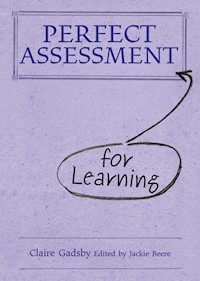
Too much valuable teacher time is devoted to the kind of marking and feedback which does little to improve pupils' learning. This easy to read guide introduces a range of innovative and practical strategies to ensure that assessment genuinely is for learning
Das E-Book können Sie in Legimi-Apps oder einer beliebigen App lesen, die das folgende Format unterstützen:
Veröffentlichungsjahr: 2013
Ähnliche


















For my beautiful daughter, Poppy Matilda, who gives meaning to everything.
Contents
Title Page
Dedication
Acknowledgements
Foreword by Jackie Beere
1. Beware the AfL ‘Buffet’
2. Sharing Learning Intentions
3. Success Criteria: The ‘Cinderella’ Aspect of AfL
4. Engineering Effective Classroom Discussions
5. Formative Feedback
6. Activating Learners as Resources for Each Other
7. Activating Learners as Owners of their Own Learning
8. Demonstrating Effective AfL Progress to Ofsted and Other Stakeholders
9. How to Work Effectively with Parents
10. Winning Hearts and Minds: How to Successfully Embed AfL across the Whole School
11. Key Messages: Moving Forward
Checklist for Perfect Assessment for Learning
Bibliography
Copyright
Acknowledgements
Since 2003 I have had the enormous privilege of working as a teaching and learning consultant supporting hundreds of schools. Many of the ideas in this book have been inspired by my work with the committed and talented teachers I have met along the way and who have made me so welcome in their classrooms. I hope this book will be useful to you all. I have tried to give credit where it is due but apologies to anyone who I have failed to acknowledge properly.
Particular thanks are due to the marvellous consultant Janet Evans, Assessment for Learning guru and all-round wonder woman, who has taught me so much about AfL. Also, to my fabulous editor and mentor Jackie Beere who has helped me far more than she should have needed to and who continues to inspire me.
Last, but by no means least, thanks to Kevin, my incredible family and my friends for putting up with me whilst writing this book and for keeping me going in so many ways: I couldn’t have done it without you all.
Foreword
Once upon a time there was a land where teachers went into school on a Monday with a couple of bullet points written in their diary with ideas of what they may teach that week. As the week progressed a few annotations may have been added to note what work had been completed and where the learning would go next. The names of children who needed to work a bit harder or could take the lead next lesson may even have been added. Occasionally, an interesting idea about homework tasks may have found its way in. And this, my friends, was my planning diary in 1979.
My results were good and getting better each year I taught. However, I look back in amazement at how random and anecdotal teaching was in those early days. ‘Teach one of these texts and let the work grow from there’ my Head of Department told me. How different teaching is now – and how much more rigorous is our planning and assessing to ensure our pupils learn effectively. Much of that essential rigour is now delivered through using Assessment for Learning.
If Assessment for Learning is the answer, what is the question?
How can every teacher ensure that every pupil makes progress?
Every child making optimum progress in every classroom in the land is the hope and dream of all those involved in education from Ofsted and the Minister for Education, to the teacher slogging away planning their lessons on a Sunday afternoon. Consequently, teachers ensure that lessons have clear objectives, build in self and peer assessment and include a plenary which measures progress. They also plan their next lesson to ensure progression for all abilities. So what’s not to like?
Well, like all prescriptive models of great practice, this can become just a ticklist of ideas to be included in lesson plans. But teachers rarely engage effectively with formative assessmentas a learning process in the lesson. To really engage with formative assessment you have to be a teacher who has your metaphoric antennae tuned in to what is reallyhappening in your classroom. Are those kids really engaged with that objective or just writing it down out of habit? Do they actuallyknow what progress is in your subject? Or do they just have the customary target sheets stuck in the front of their books with little or no understanding of what they need to do to improve? Do the pupils find that peer assessment really gives them feedback that helps them move on – or does it just give the class know-all an opportunity to remind them how inadequate their handwriting is? Does the plenary really tell the teacher whether every individual child has ‘got it’? How can it if the quiet child at the back holds up their whiteboard with the answer on so that the teacher can’t properly see it? Is your ‘marking’ really making a difference to the progress being made over time for every child? Or do they glance briefly at the grade you give them and move on to the next thing?
Just planning to use assessment for learning strategies will not give you an assurance that your lesson is outstanding. You need to really care and get curious about what is happening in your classroom and relentlessly go on a quest to find out – by getting feedback from the pupils and noticing what they are doing. The great strength of this book is that it suggests a huge range of ideas and methods to measure progress and empower pupils to take ownership of their own progress. If you use the myriad of strategies in this book you will grow your instincts about the learning happening inside your classroom. As Claire says, progress happens in their heads – if you can tune in using her techniques you will be helping every child make the most of their ability and using assessment as learning.
And that is what I call a happy ending.
Jackie Beere, Tiffield 2012
Chapter 1
Beware the AfL ‘Buffet’
Although I am not a gambling woman, I would wager that, if we were to question 100 randomly selected teachers, all of them would at least have heard of Assessment for Learning or AfL. Furthermore, I would bet that the vast majority would be happily using several of the more common AfL strategies such as traffic lighting or peer assessment.
Whilst this is encouraging to those of us passionate about how Assessment for Learning can genuinely transform outcomes for young people, it also alludes to what is one of the great paradoxes: that many well-intentioned teachers are engaging with the letter of AfL rather than the spirit of it. Or, to put it another way, many teachers are grazing at the buffet of AfL without necessarily perceiving how the various morsels come together to form a well-balanced and satisfying educational philosophy.
What is AfL and why does it matter?
Assessment for Learning should not be confused with assessment in its traditional sense; that is, the objective gathering and measuring of progress evidence. Assessment for Learning is much broader and is defined as:
… the process of seeking and interpreting evidence for use by learners and their teachers to decide where the learners are in their learning, where they need to go and how best to get there.1
Further exemplification was added in this definition proposed in 2009:
Assessment for Learning is part of everyday practice by students, teachers and peers that seeks, reflects upon and responds to information from dialogue, demonstration and observation in ways that enhance ongoing learning.2
Finally, Dylan Wiliam identifies the key elements of AfL as a set of activities which can empower learners to become independent through:
Sharing learning intentions and success criteria.
Engineering effective classroom discussions.
Formative feedback.
Activating learners as resources for each other.
Activating learners as owners of their own learning.3
Assessment for Learning involves asking questions about the quality of learning and being prepared to adapt and enrich the curriculum in response to what we learn. It is important to remember that AfL embodies effective assessment practice which is applicable to all ages, groups and key stages. It has the unique potential not just to measure learning but to promote and further improve learning.
As teachers begin to implement the various practical strategies commonly associated with AfL, such as ‘think, pair, share’, traffic lighting and peer and self assessment, it is important that they also understand the general principles underpinning AfL. Even busy teachers need to spend time exploring the philosophy behind AfL and constantly ask the question: What does this mean for me and my practice?
AfL is based on constructivism – a view of teaching and learning predicated upon the simple but profound principle that learning is something which can only happen inside the heads of learners. This is why monitoring the ‘progress’ much sought after by Ofsted can be a challenge – it is often invisible! Also, despite our best efforts as teachers, we cannot make learning happen for our learners – there is a gulf between the teaching and the learning that only the learners themselves can bridge in order to develop new skills and knowledge.
Genuine AfL occurs at the point of learning – that moment when a learner engages in personal reflection or interacts with you or another pupil in order to make sense of what is being learned. The most effective AfL practitioners ensure that all of their planning and interactions with learners aim to facilitate exactly this.
In essence, AfL is about empowering pupils to be owners of their own learning. That is to say, learners who can understand where they currently are, what they need to do to improve and exactly how to do this. Clearly, this goes way beyond learners merely knowing their current grade or target or even knowing something about the grade criteria for a particular subject. As Gordon Stobart amongst others observes, real AfL is about learning to learn – a skill for life and not just for examination success.4
Is AfL having a ‘mid-life crisis’?
Assessment expert Janet Evans recently used the phrase ‘mid-life crisis’ to describe the current state of AfL.5 This provocative phrase alludes to the fact that although Assessment for Learning has been around for more than 14 years, and is now supported by a huge wealth of evidence attesting to its positive impact, it is not yet fully or properly embedded in all schools. Reflecting on the table below, why are more schools not yet at the ‘enhancing’ stage? What are the challenges preventing them from getting there?
Assessment for Learning progression table – where are you?




