


Petronius E-Book
33,99 €
Mehr erfahren.
- Herausgeber: John Wiley & Sons
- Kategorie: Geisteswissenschaft
- Sprache: Englisch
Petronius: A Handbook unravels the mysteries of the Satyrica, one of the greatest literary works that antiquity has bequeathed to the modern world.
- Includes a dozen original essays by a team of leading Petronius and Roman history scholars
- Features the first multi-dimensional approach to Satyricon studies by exploring the novel's literary structure, social and historic contexts, and modern reception
- Supplemented by illustrations, plot outline, glossary, map, bibliography, and suggestions for further reading
Sie lesen das E-Book in den Legimi-Apps auf:
Seitenzahl: 481
Veröffentlichungsjahr: 2012
Ähnliche




















Contents
Illustrations
Contributors
Preface and Acknowledgments
Abbreviations
Introduction
About this Book
Who Was Petronius?
Episodic Outline of the Extant Satyrica
Glossary of Important Names
Introductory Reading
1 Reading the Satyrica
Reading Fragments and Fragmented Readings
Genre, Narrator, Narrative
Reading a Poet and his Poetry
The Wrath of Priapus?
(Without) a Sense of an Ending
Further Reading
2 Petronius and Greek Literature
Homer
Plato
The Greek Novel
Conclusion
Further Reading
3 Petronius and the Roman Literary Tradition
Petronius and Horace
Petronius and Virgil
Petronius and Ovid
Encolpius’s Penis and Dido
Petronius and Greek Novels, Roman Rhetoric, and Low Drama
Petronius and Publilius (No, I meant Seneca)
Petronius and Petronius
Conclusion
Further Reading
4 Letting the Page Run On
Talking, Eating, and Characterization
Pump Up the Volume: Music and Metaphor
Language Breakdowns and Civil War
Conclusion
Further Reading
5 Sex in the Satyrica
Sex Norms
The Satyrica as Document
Outlaw Sex
Further Reading
6 The Satyrica and Neronian Culture
Close Reading
Beyond the Cena
Putting Nero in Context
Further Reading
7 Freedmen in the Satyrica
Further Reading
8 A Funny Thing Happened on My Way to the Market
A Rogues’ Market and Commodity Culture
Go to School and Get a Good Job
Big Business
Money Makes the World Go Round
To Live Off the Land
Conclusion
Further Reading
9 At Home with the Dead
Introduction
Death, Dying, and the Dead
A Fictional Tomb
Real Tombs and Real People
Conclusion
Further Reading
10 Freedmen’s Cribs
Vulgarity and Villas
Importance of the Domus
Insularity of Trimalchio’s Domus
Layout of the Domus
Memory and Autobiography
Myth and Education
Hunting
Theatricality
Reality and Fantasy, Deception and Naturalism
Conclusion
Further Reading
11 Petronius’s Satyrica and the Novel in English
Introduction
Dormice and Honey: The Cena Trimalchionis through the Novelistic Ages
The Man and the Book: Petronius and the Satyrica as Fictional Subjects
Conclusion
Further Reading
12 Fellini-Satyricon
Fellini and the Birth of Fellini-Satyricon
The Narrative of Fellini-Satyricon
The Sights and Sounds of Fellini-Satyricon
“The Meaning should Become Apparent Only at the End” (Fellini)
Further Reading
Bibliography
Index locorum
General Index
This paperback edition first published 2013© 2013 Blackwell Publishing Ltd
Edition history: Blackwell Publishing Ltd (hardback, 2009)
Blackwell Publishing was acquired by John Wiley & Sons in February 2007. Blackwell’s publishing program has been merged with Wiley’s global Scientific, Technical, and Medical business to form Wiley-Blackwell.
Registered OfficeJohn Wiley & Sons Ltd, The Atrium, Southern Gate, Chichester, West Sussex, PO19 8SQ, UK
Editorial Offices350 Main Street, Malden, MA 02148-5020, USA9600 Garsington Road, Oxford, OX4 2DQ, UKThe Atrium, Southern Gate, Chichester, West Sussex, PO19 8SQ, UK
For details of our global editorial offices, for customer services, and for information about how to apply for permission to reuse the copyright material in this book please see our website at www.wiley.com/wiley-blackwell.
The right of Jonathan Prag and Ian Repath to be identified as the authors of the editorial material in this work has been asserted in accordance with the UK Copyright, Designs and Patents Act 1988.
All rights reserved. No part of this publication may be reproduced, stored in a retrieval system, or transmitted, in any form or by any means, electronic, mechanical, photocopying, recording or otherwise, except as permitted by the UK Copyright, Designs and Patents Act 1988, without the prior permission of the publisher.
Wiley also publishes its books in a variety of electronic formats. Some content that appears in print may not be available in electronic books.
Designations used by companies to distinguish their products are often claimed as trademarks. All brand names and product names used in this book are trade names, service marks, trademarks or registered trademarks of their respective owners. The publisher is not associated with any product or vendor mentioned in this book. This publication is designed to provide accurate and authoritative information in regard to the subject matter covered. It is sold on the understanding that the publisher is not engaged in rendering professional services. If professional advice or other expert assistance is required, the services of a competent professional should be sought.
Library of Congress Cataloging-in-Publication Data
Petronius : a handbook / edited by Jonathan Prag and Ian Repath. p. cm. Includes bibliographical references and indexes.
ISBN 978-1-4051-5687-5 (hardcover : alk. paper) ISBN 978-1-118-45137-3 (pbk.: alk. paper)
1. Petronius Arbiter–Criticism and interpretation. 2. Satire, Latin–History and criticism.I. Prag, J. R. W. II. Repath, Ian.PA6561.P37 2009873′.01–dc22
2008028318
A catalogue record for this book is available from the British Library.
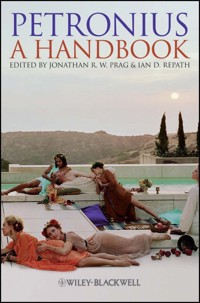
Cover image: Eleanor Antin, The Death of Petronius from The Last Days of Pompeii, 2001, chromogenic print, 469/16 × 941/2 × 13/4 inches (framed). Copyright © Eleanor Antin. Courtesy Ronald Feldman Fine Arts, New YorkCover design by Richard Boxall Design Associates
For Ewen Bowiemagistro optimo et ingenti flumine litterarum inundato
Illustrations
Map of Italy showing locations mentioned in the text, with an inset of the Campanian coastline.
5.1
Title page from The Satyrical Works of Titus Petronius Arbiter in Prose and Verse (London 1708).
5.2
Frontispiece from The Satyrical Works of Titus Petronius Arbiter in Prose and Verse (London 1708).
9.1
Tombs fronting the road at the Nocera Gate necropolis, Pompeii.
9.2
Tomb 43, the Isola Sacra necropolis, Portus.
9.3
The tombstone of Publius Longidienus, a ship-builder, Ravenna.
9.4
The funerary altar of Caius Calventius Quietus, an augustalis, the Herculaneum Gate necropolis, Pompeii.
9.5
The tomb of Marcus Vergilius Eurysaces, Porta Maggiore, Rome.
10.1
The Priapus in the vestibule of the House of the Vettii, Pompeii.
10.2
Cave canem (“beware of the dog”) mosaic in the vestibule of the House of the Tragic Poet, Pompeii.
10.3
The view from the entrance through the House of the Vettii, Pompeii.
10.4
A wall of the “Corinthian oecus” in the House of the Labyrinth, Pompeii.
12.1
Federico Fellini and Donyale Luna (Enotea) on the set of Fellini-Satyricon.
12.2
Dining at the “feast of Trimalchio,” Fellini-Satyricon.
12.3
Guests at the “feast of Trimalchio,” Fellini-Satyricon.
12.4
Martin Potter (Encolpio) and Fanfulla (Vernacchio), Fellini-Satyricon.
Contributors
Jean Andreau is Directeur d’Études at the École des Hautes Études en Sciences Sociales in Paris. He specializes in the economic and social history of the Roman world. In 1999 he published Banking and Business in the Roman World (Cambridge). His most recent book is J. Andreau and V. Chankowski (eds), Vocabulaire et expression de l’économie dans le monde antique (Bordeaux 2007). He is currently working on a history of the Roman economy and collaborates, along with Jonathan Prag, in a group directed by Sylvie Pittia which is preparing a new edition and commentary of Cicero’s third speech against Verres (the De frumento).Shelley Hales is Senior Lecturer in Art and Visual Culture at the University of Bristol and specializes in the roles and meanings of Roman domestic art and architecture. She is the author of Roman Houses and Social Identity (Cambridge 2003). She is currently working on the reception of Pompeii in nineteenth-century culture.Stephen Harrison is Fellow and Tutor in Classics at Corpus Christi College, Oxford, and Professor of Classical Languages and Literature in the University of Oxford. He has written widely on the Roman novels and was a co-founder of the journal Ancient Narrative (www.ancientnarrative.com). He is editor of Oxford Readings in the Roman Novel (Oxford 1999) and author of Apuleius: A Latin Sophist (Oxford 2000).Valerie Hope is Senior lecturer in the Department of Classical Studies at the Open University. Her main research interest is Roman funerary monuments and funeral customs. Publications include Death and Disease in the Ancient City (London and New York 2000, co-edited with E. Marshall); Constructing Identity: The Funerary Monuments of Aquileia, Mainz and Nimes (Oxford 2001); and Death in Ancient Rome: A Sourcebook (London 2007).J. R. Morgan is Professor of Greek at Swansea University. He has published widely on ancient fiction, particularly the Greek novel. His commentary on Longus’s Daphnis and Chloe was published in 2004 (Warminster). He is co-editor, with Meriel Jones, of Philosophical Presences in the Ancient Novel (Ancient Narrative Supplementum 10, Groningen 2007), and, with Ian Repath, of another forthcoming Ancient Narrative Supplementum on lies and metafiction. Other projects include an edition of Heliodorus for the Loeb Classical Library, and a monograph on Longus for the Duckworth Classical Literature and Society series. He is Leader of the KYKNOS Research Centre, which brings together colleagues working on the narrative literatures of the ancient world at Swansea and Lampeter (www.kyknos.org.uk).Costas Panayotakis is Reader in Classics at the University of Glasgow. He researches on the Roman novel and Roman drama, and he is the review editor of the journal Ancient Narrative. His books include Theatrum Arbitri: Theatrical Elements in the Satyrica of Petronius (Leiden 1995) and annotated book-length translations into Modern Greek of one play of Plautus and two of Terence. His new book, Decimus Laberius: The Fragments, is forthcoming in the series Cambridge Classical Texts and Commentaries. He is now collating manuscripts to establish a new critical text of the sententiae attributed to the mimographer Publilius, and he has recently undertaken to write a new commentary on Petronius’s “Dinner at Trimalchio’s.”Joanna Paul is Lecturer in Classical Studies at the Open University. Her research specialism is modern receptions of the ancient world, especially in the cinematic medium. She has a particular interest in adaptations of ancient literature for the cinema, and is working on a book entitled Film and the Classical Epic Tradition for Oxford University Press.Jonathan Prag is a university lecturer in Ancient History at the University of Oxford, and a tutorial fellow of Merton College. He has published briefly on Petronius (in CQ 2006), but his main areas of research are Hellenistic and Republican Sicily and the Roman Republic. He is the editor of Sicilia nutrix plebis Romanae: Rhetoric, Law, and Taxation in Cicero’s Verrines (London 2007) and collaborates, along with Jean Andreau, in a group directed by Sylvie Pittia which is preparing a new edition and commentary of Cicero’s second and third speeches against Verres. He is currently co-editing (with J. C. Quinn) a series of papers on The Hellenistic West (forthcoming, Cambridge) and working on a book on the non-Italian auxiliaries of the Roman Republican army.Ian Repath is Lecturer in Classics at Swansea University. His principal research interests are Greek and Latin prose fiction, and literary aspects of Plato. He is author of “Plato in Petronius: Petronius in platanona,” and co-editor, with John Morgan, of Where the Truth Lies: Fiction and Metafiction in Ancient Narrative (forthcoming). He is a founding member of KYKNOS, the Swansea and Lampeter Centre for Research in Ancient Narrative Literatures.Amy Richlin is Professor of Classics at the University of California, Los Angeles. She works on the history of sexuality, Roman humor, women’s history, and feminist theory. Her most recent books are Rome and the Mysterious Orient (Berkeley 2005) and Marcus Aurelius in Love (Chicago 2007).Victoria Rimell is Associate Professor of Latin Literature in the Department of Greek and Latin Philology at La Sapienza, University of Rome. She has published books on Petronius (Petronius and the Anatomy of Fiction, Cambridge 2002) and on Ovid, and edited Seeing Tongues, Hearing Scripts: Orality and Representation in the Ancient Novel (Ancient Narrative Supplementum 7, Groningen 2007). Martial’s Rome: Empire and the Ideology of Epigram is forthcoming with Cambridge University Press.Niall W. Slater is Samuel Candler Dobbs Professor of Latin and Greek at Emory University. His research interests focus on the prose fiction and drama of the ancient world, as well as the conditions of their production and reception. His books include Plautus in Performance: The Theatre of the Mind (Princeton 1985; second, revised edition 2000), Reading Petronius (Baltimore 1990) and Spectator Politics: Metatheatre and Performance in Aristophanes (Philadelphia 2002). His current project is a study of Euripides’ Alcestis.Koen Verboven is Lecturer in Ancient History at Ghent University. He specializes in ancient social and economic history, Roman friendship, and voluntary associations (collegia). He is the author of The Economy of Friends (Latomus, Brussels 2002), and co-editor (with K. Vandorpe and V. Chankowski) of Pistoi dia tèn technèn: Bankers, Loans and Archives in the Ancient World. Studies in Honour of Raymond Bogaert (Leuven 2007).Caroline Vout is a University Senior Lecturer in Classics at Cambridge and a Fellow of Christ’s College. She is a cultural historian and art historian with a particular interest in the Roman imperial period and has published widely on topics related to Rome and its reception. Recent publications include Power and Eroticism in Imperial Rome (Cambridge 2007) and “Sizing up Rome or Theorising the Overview,” in D. Larmour and D. Spencer (eds), The Sites of Rome (Oxford 2007). Her interest in the Satyrica stems from several years of teaching it at the University of Nottingham.
Preface and Acknowledgments
The idea for this book was born over a couple of pints of beer in a pub in Nottingham. While chatting about teaching and related matters we came to realize that one of us, Jonathan, was using the Satyrica as part of a course on ancient society and economy at the University of Leicester while the other, Ian, was teaching a literary course on the ancient novel at the University of Nottingham. It seemed a good thing that a text could be used in such different ways, but also a shame that such different approaches are often segregated. We decided, therefore, to propose a volume in which we would invite leading scholars to write chapters on a range of topics, a range both broad and mutually complementary, all focusing on the one text: Petronius’s Satyrica. That our contributors were so eager to help seemed to suggest we had struck a chord, and we hope that this book will be valuable for all those with an interest in this novel and its influence.
We gratefully acknowledge the generosity of Eleanor Antin and of Ronald Feldman Fine Arts, New York, for their willingness to let us use the image reproduced on the cover; Merton College, Oxford, for financial assistance with other illustrations; and Paul Dilley for translating the chapter by Jean Andreau.
We are indebted to Al Bertrand and his colleagues at Wiley-Blackwell for being so receptive to the idea in the first place and so helpful throughout the editorial process. We are no less grateful to the contributors, who have been both prompt and patient – editing a volume by multiple academics can, in the unforgettable words of one of our contributors, be rather like herding cats – but happily not on this occasion!
Abbreviations
All references to chapters of the Satyrica are prefaced with a §. Although the division into chapters is almost certainly later than Petronius himself (and the numbering sequence in use today certainly is), they have been universally adopted, are now printed in all texts and most translations, and are the standard form of reference.
References to all other ancient authors and their works follow the standard abbreviations listed in The Oxford Classical Dictionary (third, revised edition 2003, edited by S. Hornblower and A. Spawforth, Oxford University Press), at pp. xxix–liv.
Other abbreviations used in this volume are:
Introduction
Jonathan Prag and Ian Repath
About this Book
Petronius’s fragmentary novel, the Satyrica, is a text as amazing as it is puzzling. It combines startling originality, outrageous and raunchy humor, literary genius, and brilliant characterization. It provides an insight into the seedier side of life in the ancient world and an unusual perspective on first-century municipal Roman Italy and beyond. It has a unique place in the history of literature as the first substantial novelistic text and has been enormously influential on writers of fiction and on those trying to understand ancient Rome. Its attractiveness as a text to be read, studied, and researched, whatever one’s interest, has long been clear, and, as is evident from the bibliography to this volume, there is no shortage of material written on it. What, then, does this book aim to achieve?
In this volume there are a dozen especially commissioned, original essays by leading scholars in the fields of the ancient novel and of the culture and history of the early Roman Empire. These essays have Petronius’s Satyrica as their sole focus and students as their primary audience, although we are confident that anyone interested in this text will find much that is useful and illuminating. The essays each present a survey of one aspect of the Satyrica taking into account the vast amount of scholarship, both specialized and general, and, in a “Further Reading” section, point the reader towards other works on the particular topic. (Works are referred to by author and date, and full details can be found in the comprehensive bibliography towards the back of this book.) The aim is not a synthesis of material so that you do not have to read anything else; rather, the essays act as introductory pieces to provoke thought and guide you on your way. They enable you to gain a valuable insight by themselves, but they can also form the basis of in-depth research. However, they will be much more valuable if you read the text of the first. This book cannot be, and is certainly not intended to be, a substitute for reading the text itself: it is a handbook to it, a help in interpreting it and making sense of it. In addition, we hope that this volume will prove invaluable for not only students, but also those who are lucky enough to teach this text, whether exclusively or as part of a broader course.
Lesen Sie weiter in der vollständigen Ausgabe!
Lesen Sie weiter in der vollständigen Ausgabe!
Lesen Sie weiter in der vollständigen Ausgabe!
Lesen Sie weiter in der vollständigen Ausgabe!
Lesen Sie weiter in der vollständigen Ausgabe!
Lesen Sie weiter in der vollständigen Ausgabe!
Lesen Sie weiter in der vollständigen Ausgabe!
Lesen Sie weiter in der vollständigen Ausgabe!
Lesen Sie weiter in der vollständigen Ausgabe!
Lesen Sie weiter in der vollständigen Ausgabe!
Lesen Sie weiter in der vollständigen Ausgabe!
Lesen Sie weiter in der vollständigen Ausgabe!
Lesen Sie weiter in der vollständigen Ausgabe!
Lesen Sie weiter in der vollständigen Ausgabe!
Lesen Sie weiter in der vollständigen Ausgabe!
Lesen Sie weiter in der vollständigen Ausgabe!




