


19,99 €
Mehr erfahren.
- Herausgeber: John Wiley & Sons
- Kategorie: Wissenschaft und neue Technologien
- Sprache: Englisch
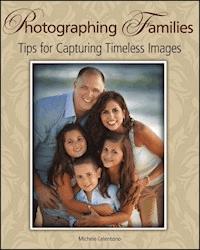
Create family portraits to cherish for a lifetime
Family photographs are a staple of both amateur and professional photography. While always in demand, they also pose a unique set of challenges. In this book, Canon Explorer of Light Michele Celentano guides beginning- to intermediate-level photographers around the common pitfalls and helps them learn how to get top-quality shots every time. From getting families organized and directing the posing to managing large groups and impatient kids, this book reveals the secrets and helps you capture the shot without relying on post-production to achieve perfection.
Whether you're a professional seeking to advance your knowledge or the family's designated picture-taker, you'll benefit from these professional tips. You'll learn camera techniques that can take pounds and years off your subjects and create images that stand the test of time.
- Family pictures are a photographic staple with their own set of challenges; this book offers tried-and-true advice for both hobbyists and professionals
- Veteran photographer and Canon Explorer of Light Michele Celentano guides you through getting families prepared for a photo session, directing the poses, handling challenging personalities, and creating memorable settings
- Helps you capture the perfect shot in the camera without relying on post-production to make it right
- Reveals secrets that can help your subjects shed pounds and years
- Packed with advice to help you keep your photos from showing up on awkwardfamilyphotos.com
Photographing Families: Tips for Capturing Timeless Images is loaded with insider tips to help you make family portraits the treasure they should be.
Das E-Book können Sie in Legimi-Apps oder einer beliebigen App lesen, die das folgende Format unterstützen:
Seitenzahl: 223
Veröffentlichungsjahr: 2013
Ähnliche



















Photographing
Families
Michele Celentano
Photographing Families: Tips for Capturing Timeless Images
Published by
John Wiley & Sons, Inc.
10475 Crosspoint Boulevard
Indianapolis, IN 46256
www.wiley.com
Copyright © 2013by John Wiley & Sons, Inc., Indianapolis, Indiana
Published simultaneously in Canada
ISBN: 978-1-118-39170-9
Manufactured in the United States of America
10 9 8 7 6 5 4 3 2 1
No part of this publication may be reproduced, stored in a retrieval system or transmitted in any form or by any means, electronic, mechanical, photocopying, recording, scanning or otherwise, except as permitted under Sections 107 or 108 of the 1976 United States Copyright Act, without either the prior written permission of the Publisher, or authorization through payment of the appropriate per-copy fee to the Copyright Clearance Center, 222 Rosewood Drive, Danvers, MA 01923, (978) 750-8400, fax (978) 646-8600. Requests to the Publisher for permission should be addressed to the Permissions Department, John Wiley & Sons, Inc., 111 River Street, Hoboken, NJ 07030, 201-748-6011, fax 201-748-6008, or online at www.wiley.com/go/permissions.
Limit of Liability/Disclaimer of Warranty: The publisher and the author make no representations or warranties with respect to the accuracy or completeness of the contents of this work and specifically disclaim all warranties, including without limitation warranties of fitness for a particular purpose. No warranty may be created or extended by sales or promotional materials. The advice and strategies contained herein may not be suitable for every situation. This work is sold with the understanding that the publisher is not engaged in rendering legal, accounting, or other professional services. If professional assistance is required, the services of a competent professional person should be sought. Neither the publisher nor the author shall be liable for damages arising herefrom. The fact that an organization or Web site is referred to in this work as a citation and/or a potential source of further information does not mean that the author or the publisher endorses the information the organization or Web site may provide or recommendations it may make. Further, readers should be aware that Internet Web sites listed in this work may have changed or disappeared between when this work was written and when it is read.
For general information on our other products and services or to obtain technical support, please contact our Customer Care Department within the U.S. at (877) 762-2974, outside the U.S. at (317) 572-3993 or fax (317) 572-4002.
Wiley publishes in a variety of print and electronic formats and by print-on-demand. Some material included with standard print versions of this book may not be included in e-books or in print-on-demand. If this book refers to media such as a CD or DVD that is not included in the version you purchased, you may download this material at http://booksupport.wiley.com. For more information about Wiley products, visit www.wiley.com.
Trademarks:Wiley and the Wiley logo are trademarks or registered trademarks of John Wiley and Sons, Inc. and/or its affiliates. All other trademarks are the property of their respective owners. John Wiley & Sons, Inc. is not associated with any product or vendor mentioned in this book.
About the Author
Michele Celentanois an accomplished wedding and family portrait photographer with more than 25 years of experience. Michele is one of an elite group of fifty photographers contracted by Canon USA to be a spokesperson for the company’s Explorers of Light program. She also was awarded a Photographic Craftsmen degree from the Professional Photographers of America and the Accolade of Photographic Mastery from Wedding and Portrait Photographers International. Her artwork has been published in photography magazines such as Rangefinder, American Photo, Shutterbug, and Studio Photography. In addition to running her portrait business full time, Michele conducts seminars, workshops, and lectures on professional photography in the United States and abroad. Visit her web site at www.michelecelentano.com to learn more about her seminars and workshops as well as to view her beautiful images.
Michele a native New Yorker and currently resides in Arizona with her husband Paul and between them three daughters.
Photo courtesy of David Guy Maynard.
Credits
Acquisitions Editor
Carol Kessel
Project Editor
Katharine Dvorak
Technical Editor
George Maginnis
Copy Editor
Lauren Kennedy
Editorial Director
Robyn Siesky
Business Manager
Amy Knies
Senior Marketing Manager
Sandy Smith
Vice President and Executive Group Publisher
Richard Swadley
Vice President and Executive Publisher
Barry Pruett
Book Designer
Traci Powers
Acknowledgments
“To attain you must aspire.” Those are the words my grandfather wrote in my grade school yearbook. I remember asking him at the age of 12 what that meant. He smiled and told me to look the words up in the dictionary. “If you are going to be a gravedigger you be the best gravedigger there is.” Those were my mother’s words. I skipped the grave-digging job and picked up a camera with a will to aspire. Anything is possible! I know this because I have made a 25-year career from what some thought would turn out to be an expensive hobby.
Paul, you made me a believer when I did not believe. You are my true north, my heart, my soul, and the safest place to fall. You have brought a joy to my spirit that I could not have known without you. Thank you for your incredible and endless support during this process. I know it was not easy but you never let on. There were days I doubted this book was possible. You knew better and never let me get off course. I love you more than you could ever know.
Mom, thank you for believing in my talent and supporting my education and passion for starting my own business. I know there were days you worried that this would be an expensive hobby rather than a career but you always supported me. Your words, “Well, it’s not neurosurgery, but at least she is trying something!” helped to get me where I am today. Your words only pushed me to prove I could achieve my dreams. I know you were horrified to find out that I smuggled expensive crystal and Tiffany china out of the house for photography school assignments; however, those first works of art from 1990 still hang in your house today. I hope I have made you proud.
Dan, you helped me spread my wings and fly. Heading out to sea and working as a cruise ship photographer are some of my greatest memories of my youth and I gained experience out at sea I could have never dreamed of. (That was your idea.) You are always there for me as a friend and as a father. Thank you.
Gary, thank you for being my first model and putting up with more than your share of crazy photo shoots. You were the first person to say, “You should be a professional photographer.” You were there the first time I presented a program. You were my biggest fan, greatest supporter, best friend, and now the greatest dad to our amazing daughter. You will always be a part of my personal and professional history. Thank you for giving Anna the best “other mother” and one of the truest friends I could have ever hoped for. Louise, you are a true gift in my life.
Susan Cameron, there are no words for what you have added to my life. You are the kindest spirit with the coolest head and the warmest heart. You are the wisest woman I know and have the greatest understanding of what is truly important in life: to love and to be loved; to spend quality time with those you love; and to not worry about the little things because in the end it will all be okay. You are a fighter with a strong heart and I love you.
The list of photographers who have been influential in my life is too long for this paragraph; however, there are two who deserve special mention. Monte Zucker, you will always have a special place in my heart. The gifts you gave to me — I continuously work to pay them forward. I can still hear your laugh and smell the cologne that would linger long after your hugs. I know you watch over me from that perfect high key studio in heaven. Hanson Fong, I simply adore you and I am so proud to call you my friend. The greatest compliment you gave me was, “This is the fifth time you are taking my class. Why? You don’t need me anymore.” You are the King and you will always be the King!
To my “A” team: Alli, Ashley, and Anna. I am truly blessed to have each of you in my life. You have all taught me lessons about life that have become part of who I am. Learning to be a mother and a stepmother is a process that is far from perfect. Thank you for allowing me to grow into my role in your lives. I will always love you.
Being honored by Canon USA as an Explorer of Light has been a highlight of my career and I am beyond grateful to Canon, David Sparer, and Steve Inglima for believing in what I do and giving me an incredible platform from which to share it.
There are so many talented people who helped me through the process of writing this book. Ted Baird, thank you for your brilliant coaching. With your help, writing this book became a gift to myself, and one of my greatest personal growth periods. Dawn Irons, you have been a trusted friend and studio assistant for almost seven years. Without your groundwork with clients, sessions, model releases, being a sounding board and my organizer none of this would have been possible. Thank you so much.
To my team at Wiley, thank you, thank you, and thank you again for asking me to take on this project and supporting me all the way through it. Carol Kessel, Katharine Dvorak, Traci Powers, George Maginnis, Lauren Kennedy, Barry Pruett, Robin Siesky, Amy Knies, and Richard Swadley, thank you for all the work you put into this book. Without you this would not have been possible. I am incredibly grateful for this opportunity.
To every family who has given me the honor of creating their portraits, thank you so much for allowing me to be a small part of your family.
And last but certainly not least, to my “chosen” family of amazing supportive friends, thank you for every word of encouragement. I heard every word and your love and good wishes were felt.
Growth is only possible when positive people who help you reach your true potential surround you. Such people have more than blessed me throughout my life.
This book is dedicated to my daughter Anna. You are the most beautiful gift I have ever received. Thank you for being incredibly supportive during this process. Every time you put your hand on my shoulder and said, “Mom you can do this,” you reminded me that anything is possible. I will forever be grateful for your love and support.
Foreword
When I first met Michele Celentano some 20 years ago, I was instantly impressed by her bubbly personality and her “I can do this” attitude. Over the years, I have had the wonderful opportunity to observe her evolvement as a professional photographer. When I saw her at the Professional Photographers of America National Convention as the keynote speaker, she wowed the audience with her exceptional photographic techniques. She did not speak at her audience, but most important, she spoke to the level of her audience on the principles of making her subjects look photographically timeless.
This book shows Michele’s techniques on why and how her techniques work and it also shows and explains specific techniques that cannot justify acceptable photographic moments.
I personally enjoy her key phrases when posing her subjects. Why I like these phrases is because you are interacting with the subjects. You are creating a mutual working relationship by putting the subjects at ease, thereby capturing their natural expressions.
The key phrases also assist the subjects to pose naturally rather than appear looking “posed” in the photographs. The purpose to these key phrases is that the photographer is the director, i.e., a director directing the movie. The director, aka, photographer, leads the subject(s) into the proper pose, etc. Subjects always want to be led by a leader; Michele is the ideal photographic leader! A toast to you, Michele!
Hanson FongMaster Photographer Photographic Craftsman
Introduction
family |’fam(ə)lē|
noun ( pluralfamilies)
1. a group consisting of two parents and their children living together as a unit.
• a group of people related to one another by blood or marriage: friends and family can provide support.
• the children of a person or couple being discussed: she has the sole responsibility for a large family.
• a person or people related to one and so to be treated with a special loyalty or intimacy: I could not turn him away, for he was family.
portrait |’pôrtrət, -'trāt|
noun
1. a painting, drawing, photograph, or engraving of a person, especially one depicting only the face or head and shoulders.
• a representation or impression of someone or something in language or on film or television.
* Definitions from Oxford University Press online (http://oxforddictionaries.com).
Blending these definitions, a family portrait is a representation or impression of people related to one another who are to be treated with a special loyalty or intimacy. They are a historical view of our families — a representation of a time in the history of our parents, grandparents, and even great-grandparents. They are the visual aid we use to help us tell our children stories about their family. Family portraits are important — maybe not as much for today than for the future, for the generations that will outlast us; the family portraits that help tell our story are really just the beginning of their story.
I was only 17 when my interest in photography began. To be honest, I failed photography in high school because I spent a fair amount of time cutting class to hang out with my boyfriend. You can imagine my mother’s shock when I asked to attend photography school at the Center for Media Arts in New York City. My mother’s exact words were, “How is she going to make a living taking pictures?”
My personal journey into family portraits started a long time ago, while I was aspiring to be a wedding photographer. It never dawned on me that being a wedding photographer meant that I was also a family photographer. I suppose this is where I began to learn about family dynamics and how to navigate family relationships.
I was born and raised in Brooklyn, New York, by my grandparents and my mother. I was an only child and spent most of my time with my grandparents because my mom worked full time. Nanny and Pop were old-school Italians and my grandmother was the oldest of nine children. In my house, family was everything. Sunday dinner was not negotiable, and blood was always thicker than water. There is no doubt in my mind that my upbringing has given me a strong appreciation for the meaning of family and family portraits. I truly believe with every fiber of my being that the portraits of those we love are the treasured, tangible items we hold closest to our hearts when they are gone.
The portrait of my grandfather and his family shown in Figure 1 is 99 years old. I love it because it represents my grandfather’s generation, and it is a small window that allows me to see him as a child. A 99-year-old photograph is still important, relevant, and timeless. This is what I hope I am creating with my work. Someday when I am gone and the children in the portraits I created have grandchildren of their own, they too will hold a piece of history — their own personal histories.
I started my photography career in New York. High-end weddings were my specialty and I loved photographing them. Italian and ethic weddings were my favorite. The energy, the families yelling, the traffic, the huge churches, the ridiculously long limos, the over-the-top food, the women in the bathroom taking cash out of envelops if they thought the wedding did not live up to expectations, the brides and grooms counting cash at the end of the night so they could pay the band that played an hour of overtime because the party just wouldn’t end. I loved it all! I loved it right up until my daughter was born and then suddenly the idea of being gone for 14 hours on the weekend wasn’t appealing to me anymore.
When my daughter Anna was 16 months old we relocated to Arizona. Our new neighborhood was brand new and master planned for young family living. My plan was to rebuild my wedding business on a smaller scale and enjoy being a mom. Before long, neighbors and friends were suggesting that I photograph children and families. At first I was not all that thrilled with the idea. Patience with young children was a bit beyond my natural talents. I liked working with adults who could pay attention and stay where I put them. Sure enough, however, it happened — I began to photograph children and families and I enjoyed it. My years of wedding experience and speed was a great asset to photographing families with young children.
As my daughter grew older, I began to realize the importance of documenting family portraits. As a child we had lots of candid photos taken with a 110mm camera but we really didn’t have professional family portraits. It was something I began to see great value in. It dawned on me that I had no real pictures with the grandparents who raised me, and that by being a portrait photographer, I am able to provide these important photographs for others. To this day when I photograph grandparents with their grandchildren I still get teary eyed. I always say to those children, “I know this isn’t what you want to do today, but some day you will be so grateful you have these portraits. They will mean more than you can imagine.” The kids usually look at me like I am nuts but I say it anyway.
Figure 1
This is a portrait of my grandfather when he was three years old.
Today, I live in Anthem, Arizona, and am married to amazing man who “gets” me and all of my quirkiness. Figure 2 is a portrait of our family. I’m a wife, a mother, a stepmother, a runner, a yogi, and a bit of a gym rat. I continue to photograph families and children but mostly I love to teach photography to upcoming photographers. It really is an honor and a blessing to be able to give back to an industry that has given so much to me. Over the years I have been fortunate to earn my living by photographing people. (See, Mom — I told you it was possible!) Now more than ever photographers need education so that they can continue to produce quality work that will last for generations. I hope this book in some way will inspire and help educate photographers young and old on the beauty of creating timeless family portraits.
Figure 2
This is a portrait of my family. From left to right: Anna, Michele, Paul, Alli, and Ashley. (Portrait by Angela Carson)
The 80/20 Rule
In my mind, to be a successful portrait photographer, it takes 80% personality and 20% technical knowledge. The technical stuff — cameras, settings, lenses, lighting — can all be learned. The personality part is where pros really shine. And you really have to like people — all kinds of people — from newborns to the elderly. If you are not a big fan of working with people, then you might be better suited for still life or product photography.
But being a great photographer is more than liking people; the people have to like you, too. You need to be able to instantly connect with people who you may have just met. You need to be able to direct people, take command of a crowd, and be assertive when needed. Confidence is a must. You need to be engaging and interested in your subjects. Asking a lot of questions is a great way for people to feel like you want to know more about them. The more you know your subjects and engage them in conversation, the more comfortable and relaxed they become.
If clients really like you and have a great experience, in most cases they will love the portraits you create for them. (That is, as long as they are not substandard quality, which is why you are reading this book.) On the flip side, I have seen wedding albums and family portraits that are done well but the client doesn’t like them because in the client’s words, “The photographer was a jerk.” If clients do not have a great experience, it will be reflected in how they feel about their final portraits.
Knowing the names of all your subjects is a sure way to gain instant respect. I always make it a priority to know the name of each person I am photographing no matter how big a group is. In the initial conversations with parents who are interested in family portraits, I spend a lot of time asking about the children: what are their hobbies, which movies do they like, who are their favorite characters, what sports do they play, what is their favorite subject. The more I can talk to children about what they are interested in, the greater the likelihood I will get natural expressions from them. That is my ultimate goal — natural expressions! The last thing I want to see in a portrait is a “cheesy” smile.
As photographers, we love cameras and all the cool gadgets that go along with them; however, most people do not like to be in front of a camera. The camera and being photographed can be intimidating. Our first job as photographers is to get our clients to relax and feel comfortable. We have to establish a relationship with our subjects. It may be a short-lived 1-to-2 hour relationship but it is the key to creating fun, believable portraits that your client will love.
As you can see, connecting with your clients has absolutely nothing to do with technical knowledge. This is the 80% of what we do. Having a pleasant, confident personality and being able to connect with everyone in the family, from the 2-year-old to the 80-year-old, is critical to becoming a great family portrait photographer. Engaging your subjects in a way that brings natural, beautiful expressions has nothing to do with how to work a camera, which lens you use, postproduction work, or fancy filters. Great expressions from your subjects are simply a reflection of you. A smile without an expression is just a smile. Expression is what brings portraits to life; it’s what tells the story of the subject. Have fun, enjoy your subjects, and make them laugh. If you can do that, you are 80% there!
What to Expect From This Book
Cameras, lenses, postproduction work, locations, and white balance are really only a small part of what goes into the images passionate photographers create. You can read this book and many more to learn about f-stops and shutter speeds, but my goal is to teach you how to make everyone in your images feel and look beautiful and enjoy the experience so much that they love the images you create for them and remember how much fun it was doing them, too.
Having portraits created should be fun for the whole family as well as the photographer, but, of course, the portraits also need to be done well. Be a perfectionist in your work and always strive to grow and learn as a professional, but remember as much as you love the camera, most people do not. It’s your responsibility to make every person you photograph look her best. It’s not enough to find a great location with beautiful light and then stick a subject there and hope for a “pretty picture.”
Throughout the chapters in this book, you will learn about posing subjects, camera settings, cropping images, postproduction workflow, how to find the best locations, and techniques to make people look younger and thinner in the camera. My hope is that in these chapters you find inspiration and information mixed with some technical details, a touch of humor, and a lesson on the one thing that will make your photography incredibly special: you. You might just learn about yourself — what makes you special and why clients will come to you for their next family portrait.
People and the connections we have with those we love are what matter most in this world. I hope you find the joy and importance of capturing the essence of what family means throughout the chapters of this book. There is a great responsibility knowing the portraits you take will outlast you, outlast the people in them, and give generations down the line an idea of who their great-grandparents were.
1: Getting Started with Family Portraits
For a large majority of portrait photographers, the idea of creating a photography business stems from a passion for taking pictures of people. But how do you get started photographing families? How do you turn a hobby into a business? Or if establishing a business doesn’t appeal to you, how do you take the passion you have for taking pictures and create beautiful, timeless memories for future generations of your family?
In this chapter, I discuss how to get started taking family portraits. First you need to determine what style of portrait photography appeals to you most, and then you need to look at the type of equipment you will need to get started.




