


44,99 €
Mehr erfahren.
- Herausgeber: John Wiley & Sons
- Kategorie: Wissenschaft und neue Technologien
- Sprache: Englisch
"Marine photosynthesis provides for at least half of the primary production worldwide..."
Photosynthesis in the Marine Environment constitutes a comprehensive explanation of photosynthetic processes as related to the special environment in which marine plants live. The first part of the book introduces the different photosynthesising organisms of the various marine habitats: the phytoplankton (both cyanobacteria and eukaryotes) in open waters, and macroalgae, marine angiosperms and photosymbiont-containing invertebrates in those benthic environments where there is enough light for photosynthesis to support growth, and describes how these organisms evolved. The special properties of seawater for sustaining primary production are then considered, and the two main differences between terrestrial and marine environments in supporting photosynthesis and plant growth are examined, namely irradiance and inorganic carbon. The second part of the book outlines the general mechanisms of photosynthesis, and then points towards the differences in light-capturing and carbon acquisition between terrestrial and marine plants. This is followed by discussing the need for a CO2 concentrating mechanism in most of the latter, and a description of how such mechanisms function in different marine plants. Part three deals with the various ways in which photosynthesis can be measured for marine plants, with an emphasis on novel in situ measurements, including discussions of the extent to which such measurements can serve as a proxy for plant growth and productivity. The final chapters of the book are devoted to ecological aspects of marine plant photosynthesis and growth, including predictions for the future.
Sie lesen das E-Book in den Legimi-Apps auf:
Seitenzahl: 509
Veröffentlichungsjahr: 2014
Ähnliche



















Photosynthesis in the Marine Environment
Sven Beer, Mats Björk and John Beardall
This edition first published 2014 © 2014 by John Wiley & Sons, Ltd.
Editorial offices: 2121 State Avenue, Ames, Iowa 50014-8300, USA The Atrium, Southern Gate, Chichester, West Sussex, PO19 8SQ, UK 9600 Garsington Road, Oxford, OX4 2DQ, UK
For details of our global editorial offices, for customer services and for information about how to apply for permission to reuse the copyright material in this book please see our website at www.wiley.com/wiley-blackwell.
Authorization to photocopy items for internal or personal use, or the internal or personal use of specific clients, is granted by Blackwell Publishing, provided that the base fee is paid directly to the Copyright Clearance Center, 222 Rosewood Drive, Danvers, MA 01923. For those organizations that have been granted a photocopy license by CCC, a separate system of payments has been arranged. The fee codes for users of the Transactional Reporting Service are ISBN-13: 978-0-4709-6290-9/2013.
Designations used by companies to distinguish their products are often claimed as trademarks. All brand names and product names used in this book are trade names, service marks, trademarks or registered trademarks of their respective owners. The publisher is not associated with any product or vendor mentioned in this book.
Limit of Liability/Disclaimer of Warranty: While the publisher and author(s) have used their best efforts in preparing this book, they make no representations or warranties with respect to the accuracy or completeness of the contents of this book and specifically disclaim any implied warranties of merchantability or fitness for a particular purpose. It is sold on the understanding that the publisher is not engaged in rendering professional services and neither the publisher nor the author shall be liable for damages arising herefrom. If professional advice or other expert assistance is required, the services of a competent professional should be sought.
Library of Congress Cataloging-in-Publication Data
Beer, Sven, 1949–
Photosynthesis in the marine environment / Sven Beer, Mats Björk, and John Beardall. – Second edition.
pages cm
Includes bibliographical references and index.
ISBN 978-1-119-97958-6 (cloth) – ISBN 978-1-119-97957-9 (pbk.) 1. Photosynthesis. 2. Plants–Effect of underwater light on. 3. Aquatic plants–Ecophysiology. 4. Underwater light. I. Björk, Mats. II. Beardall, John. III. Title.
QK882.B35 2014
581.7′6–dc23
2014002673
A catalogue record for this book is available from the British Library.
Wiley also publishes its books in a variety of electronic formats. Some content that appears in print may not be available in electronic books.
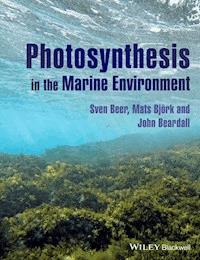
Front cover - A thick turf of red and brown algae growing in the high-energy surf zone, Malta. Photo by Mats Björk
Back cover (from left to right) - Colonies of the marine cyanobacteria Trichodesmium (see Figure 2.1b). Photo by Birgitta Bergman - Quantum yield measurement of zooxanthellae in a coral by PAM fluorometry (see Figure 9.7). Photo by Katrin Österlund - Various macroalgae in the Mediterranean, with the brown alga Padina sp. on top. Photo by Katrin Österlund - The seagrass Cymodocea serrulata, Zanzibar. Photo by Mats Björk.
Cover design by Steve Thompson
CONTENTS
About the authors
Contributing authors
Preface
About the companion website
Part I Plants and the Oceans
Introduction
Notes
Chapter 1 The evolution of photosynthetic organisms in the oceans
Notes
Chapter 2 The different groups of marine plants
2.1 Cyanobacteria
2.2 Eukaryotic microalgae
2.3 Photosymbionts
2.4 Macroalgae
2.5 Seagrasses
Notes
Chapter 3 Seawater as a medium for photosynthesis and plant growth
3.1 Light
3.2 Inorganic carbon
3.3 Other abiotic factors
Summary notes of Part I
Notes
Part II Mechanisms of Photosynthesis, and Carbon Acquisition in Marine Plants
Introduction to Part II
Note
Chapter 4 Harvesting of light in marine plants: The photosynthetic pigments
4.1 Chlorophylls
4.2 Carotenoids
4.3 Phycobilins
Notes
Chapter 5 Light reactions
5.1 Photochemistry: excitation, de-excitation, energy transfer and primary electron transfer
5.2 Electron transport
5.3 ATP formation
5.4 Alternative pathways of electron flow
Notes
Chapter 6 Photosynthetic CO
2
-fixation and -reduction
6.1 The Calvin Cycle
6.2 CO
2
-concentrating mechanisms
Notes
Chapter 7 Acquisition of carbon in marine plants
7.1 Cyanobacteria and microalgae
7.2 Photosymbionts
7.3 Macroalgae
7.4 Seagrasses
7.5 Calcification and photosynthesis
Summary notes of Part II
Notes
Part III Quantitative Measurements, and Ecological Aspects, of Marine Photosynthesis
Introduction to Part III
Note
Chapter 8 Quantitative measurements
8.1 Gas exchange
8.2 How to measure gas exchange
8.3 Pulse amplitude modulated (PAM) fluorometry
8.4 How to measure PAM fluorescence
8.5 What method to use: Strengths and limitations
Notes
Chapter 9 Photosynthetic responses, acclimations and adaptations to light
9.1 Responses of high- and low-light plants to irradiance
9.2 Light responses of cyanobacteria and microalgae
9.3 Light effects on photosymbionts
9.4 Adaptations of Carbon acquisition mechanisms to light
9.5 Acclimations of seagrasses to high and low irradiances
Notes
Chapter 10 Photosynthetic acclimations and adaptations to stress in the intertidal
10.1 Adaptations of macrophytes to desiccation
10.2 Other stresses in the intertidal
Notes
Chapter 11 How some marine plants modify the environment for other organisms
11.1 Epiphytes and other ‘thieves’
11.2
Ulva
can generate its own empires
11.3 Seagrasses can alter environments for macroalgae and
vice versa
11.4 Cyanobacteria and eukaryotic microalgae
Chapter 12 Future perspectives on marine photosynthesis
12.1 ‘Harvesting’ marine plant photosynthesis
12.2 Predictions for the future
12.3 Scaling of photosynthesis towards community and ecosystem production
Summary notes of Part III
References
Index
List of Tables
Chapter 2
Table 2.1
Table 2.2
Chapter 3
Table 3.1
Table 4.1
Table 4.2
Chapter 7
Table 7.1
Chapter 8
Table 8.1
Guide
Cover
Table of Contents
Preface
Part
Chapter
Pages
iii
iv
ix
x
xi
xii
xiii
xiv
1
2
3
4
5
6
7
8
9
10
11
12
13
14
15
16
17
18
19
20
21
22
23
24
25
26
27
28
29
30
31
32
33
34
35
36
37




