


Phycotoxins E-Book
174,99 €
Mehr erfahren.
- Herausgeber: John Wiley & Sons
- Kategorie: Fachliteratur
- Sprache: Englisch
Phycotoxins are a diverse group of poisonous substances produced by certain seaweed and algae in marine and fresh waters and are important to the scientific community for many reasons, the most obvious being that they pose food safety issues which requires a large investment to regularly monitor the presence of these compounds in foods. Phycotoxins: Chemistry and Biochemistry, second edition presents the most updated information available on phycotoxins. Major emphases are given to chemistry and biochemistry, while origins, mechanism of action, toxicology, and analytical methodology are also covered. Since the publication of the first edition, there have been major advances in the science of marine and aquatic toxins, as well as advances in toxicology, analytical chemistry and pharmacology. This fully revised and updated edition includes several new chapters, including those on ciguatoxins, pinnatoxin, ichthyotoxins, as well as new chapters on food safety control of marine toxins, climate change and water toxins, and microalgae as a source of nutraceuticals. The book will be of interest to toxicologists, marine, food, and plant scientists, as well as researchers and academics in the areas of food science, medicine, public health, toxicology, pharmacology and marine biology.
Sie lesen das E-Book in den Legimi-Apps auf:
Seitenzahl: 1217
Veröffentlichungsjahr: 2015
Ähnliche




















Table of Contents
Cover
Title Page
Copyright
List of contributors
Preface
Chapter 1: Analysis of marine toxins: gaps on food safety control of marine toxins
Analysis of marine toxins and gaps on food safety control
Gaps on food safety control for marine toxins by chemical methods
Use of standards
New risks in the EU
References
Chapter 2: Pharmacology of ciguatoxins
Chemical structure of ciguatoxins
Voltage-gated sodium channels
Neurological symptoms of ciguatera
Physiological effects of ciguatoxin
Ciguatoxin neurotoxicity
Ciguatoxins, neurological perspectives
References
Chapter 3: Chemistry of pinnatoxins
Introduction
Isolation
Bioactivity
Detection
Total chemical synthesis
Chemical stability
Conclusions
References
Chapter 4: Chemistry and analysis of PSP toxins
Introduction
Methods of analysis
Chemical methods
References
Chapter 5: Chemistry of palytoxin and its analogues
Introduction
Palytoxin
Palytoxin's analogues from
Ostreopsis
spp
Ostreocins from
O. siamensis
References
Chapter 6: Pharmacology of palytoxins and ostreocins
Introduction
Origin and producing organisms
Toxin distribution and ecological aspects
Pharmacological target of PLTXs
Palytoxin toxicology
Detection methods
Future perspectives
References
Chapter 7: Recent insights into anatoxin-a chemical synthesis, biomolecular targets, mechanisms of action and LC-MS detection
Anatoxin-
a
and analogues
Anatoxins' biomolecular targets and mechanisms of action
LC-MS detection
Conclusions and perspectives
Acknowledgements
References
Chapter 8: Therapeutics of marine toxins
Introduction
Marine toxins as a source of therapeutic compounds
Present marine toxins and derived compound uses
Future of marine toxins and derived compounds uses
Problems and advancements in drug discovery from the seas
Conclusions
References
Chapter 9: Marine toxins as modulators of apoptosis
Introduction
Phycotoxins involved in apoptotic processes
Non-apoptotic cytotoxicity of phycotoxins
References
Chapter 10: Cyanobacterial toxins
Introduction
Chemistry of cyanotoxins
Distribution of cyanotoxins
Acknowledgments
References
Chapter 11: Marine toxins and climate change: the case of PSP from cyanobacteria in coastal lagoons
Introduction
Definition of coastal lagoons and main ecosystem characteristics
Ecosystem goods and services and human exploitation of coastal lagoons
Eutrophication and climate change in coastal lagoons
Cyanobacteria in coastal lagoons
Paralytic shellfish poisoning and cyanobacteria in coastal lagoons
Conclusions
References
Chapter 12: Microalgae as a source of nutraceuticals
Introduction
Microalgal taxa
World biodiversity of microalgae
Microalgae in culture collections and under commercial cultivation
Commercial use of microalgae as nutraceuticals
Categories of nutraceuticals from microalgae
Cholesterol-lowering activity
Potential upcoming microalgae or their alternate use
Genetically modified (GM) microalgae
Concluding remarks
Acknowledgments
References
Chapter 13: The marine origin of drugs
Introduction
Marine chemical ecology and the origin of marine drugs
Marine or marine-derived drugs sources
From marine origin to therapeutics use: the success stories of Cytarabine, Ziconotide and Eribulin Mesilate
Marine phycotoxin as a tool for signal transduction pathways analysis: the success story of okadaic acid
Conclusions
References
Chapter 14: Pharmacology of cylindrospermopsin
Introduction
Chemical and physical properties
Producing genera/species
Cylindrospermopsin biosynthesis
Distribution and bioaccumulation
Human and animal intoxications
Cylindrospermopsin toxicity
Mechanism of action
Detection methods
Cylindrospermopsin elimination
Legislation
References
Chapter 15: Pharmacology of the cyclic imines
Introduction
Overview of cyclic imine chemical structure
In vivo
effects of cyclic imines
Pharmacodynamics:
in vitro
evidence of spirolides, pinnatoxins and gymnodimines targeting nicotinic acetylcholine receptors
Structure-activity relationship of cyclic imines
Involvement of nAChR antagonism in
in vivo
and
in vitro
effects of cyclic imines
Pharmacokinetics of cyclic imines
Conclusions
References
Chapter 16: Diversity of organic structures of marine microbial origin with drug potential
Introduction
Marine bacterial natural products
Marine bacterial natural products with anticancer drug potential
Marine actinomycete natural products with antimicrobial drug potential
Marine fungal natural products
Modifying marine microbial natural products
Conclusions
References
Chapter 17: Polyketides as a source of chemical diversity
Introduction
Biosynthesis of polyketides
Structural diversity of polyketides among phycotoxins produced by dinoflagellates and cyanobacteria
Conclusions
References
Chapter 18: Ichthyotoxins
Introduction
Anatoxins and homoanatoxin
Brevetoxins
Ciguatoxins
Karlotoxins
Microcystins
Prymnesins
Saxitoxins
The special case of
Pfiesteria
Ichthyotoxins of less widespread significance
Reactive oxygen species and physical/mechanical damage
The unknown nature of ichthyotoxicity
References
Chapter 19: Pathological clues of phycotoxin ingestion
Introduction
Paralytic shellfish poisoning
Diarrhetic shellfish poisoning
Amnesic shellfish poisoning
Neurotoxic shellfish poisoning
Azaspiracid shellfish poisoning
Ciguatera shellfish poisoning
References
Index
End User License Agreement
Pages
iv
vii
viii
ix
x
xi
xiii
1
2
3
4
5
6
7
8
9
10
11
12
13
14
15
16
17
18
19
20
21
23
24
25
26
27
28
29
30
31
32
33
34
35
36
37
38
39
40
41
42
43
44
45
46
47
48
49
50
51
52
53
54
55
56
57
58
59
60
61
62
63
64
65
66
67
68
69
70
71
72
73
74
75
76
77
78
79
80
81
82
83
84
85
86
87
88
89
90
91
92
93
94
95
96
97
98
99
100
101
102
103
104
105
106
107
108
109
110
111
113
114
115
116
117
118
119
120
121
122
123
124
125
126
127
128
129
130
131
132
133
134
135
137
138
139
140
141
142
143
144
145
146
147
148
149
150
151
152
153
154
155
156
157
158
159
160
161
162
163
164
165
166
167
168
169
170
171
172
173
174
175
176
177
178
179
180
181
182
183
184
185
186
187
188
189
190
191
192
193
194
195
196
197
198
199
200
201
203
204
205
206
207
208
209
210
211
212
213
214
215
216
217
218
219
220
221
222
223
224
225
226
227
228
229
230
231
232
233
234
235
236
237
238
239
240
241
242
243
244
245
246
247
248
249
250
251
252
253
255
256
257
258
259
260
261
262
263
264
265
266
267
268
269
270
271
272
273
274
275
276
277
278
279
280
281
282
283
284
285
286
287
288
289
290
291
293
294
295
296
297
298
299
300
301
302
303
304
305
306
307
308
309
310
311
312
313
314
315
316
317
318
319
320
321
322
323
324
325
326
327
328
329
330
331
332
333
334
335
336
337
338
339
340
341
343
344
345
346
347
348
349
350
351
352
353
354
355
356
357
358
359
360
361
362
363
364
365
366
367
368
369
370
371
372
373
374
375
376
377
378
379
380
381
382
383
384
385
386
387
388
389
390
391
392
393
394
395
396
397
398
399
400
401
402
403
404
405
407
408
409
410
411
412
413
414
415
416
417
418
419
420
421
422
423
424
425
426
427
428
429
430
431
432
433
434
435
436
437
438
439
440
441
442
443
444
445
446
447
448
449
450
451
452
453
454
455
456
457
458
459
460
461
463
464
465
466
467
468
469
470
471
472
473
474
475
476
477
478
479
480
481
482
483
484
485
486
487
488
489
490
491
492
493
494
495
496
497
498
499
500
501
502
503
504
505
506
507
508
509
510
511
512
513
514
515
516
517
518
519
520
521
522
523
Guide
cover
Table of Contents
Preface
Begin Reading
List of Illustrations
Figure 1.1
Figure 1.2
Figure 1.3
Figure 2.1
Figure 2.2
Figure 2.3
Figure 2.4
Figure 2.5
Figure 2.6
Figure 3.1
Scheme 3.1
Scheme 3.2
Scheme 3.3
Scheme 3.4
Scheme 3.5
Scheme 3.6
Scheme 3.7
Scheme 3.8
Scheme 3.9
Scheme 3.10
Scheme 3.11
Scheme 3.12
Scheme 3.13
Scheme 3.14
Scheme 3.15
Figure 4.1
Figure 4.2
Figure 4.3
Figure 5.1
Figure 5.2
Figure 5.3
Figure 5.4
Figure 6.1
Figure 6.2
Figure 7.1
Figure 7.2
Figure 7.3
Figure 7.4
Figure 7.5
Figure 7.6
Figure 7.7
Figure 7.8
Figure 7.9
Figure 7.10
Figure 7.11
Figure 7.12
Figure 7.13
Figure 7.14
Figure 7.15
Figure 7.16
Figure 7.17
Figure 7.18
Figure 7.19
Figure 7.20
Figure 7.21
Figure 7.22
Figure 7.23
Figure 7.24
Figure 7.25
Figure 7.26
Figure 7.27
Figure 7.28
Figure 7.29
Figure 8.1
Figure 8.2
Schemes 9.1
Figure 9.2
Figure 9.1
Scheme 9.3
Figure 10.1
Figure 10.2
Figure 10.3
Figure 10.4
Figure 10.5
Figure 10.6
Figure 10.7
Figure 10.8
Figure 10.9
Figure 10.10
Figure 11.1
Figure 11.2
Figure 12.1
Figure 13.1
Figure 13.2
Figure 14.1
Figure 14.2
Figure 15.1
Figure 15.2
Figure 15.3
Figure 16.1
Figure 17.1
Figure 17.2
Figure 17.3
Figure 17.4
Figure 17.5
Figure 17.6
Figure 17.7
Figure 17.8
Figure 17.9
Figure 17.10
Figure 17.11
Figure 17.12
Figure 17.13
Figure 17.14
Figure 17.15
Figure 19.1
Figure 19.2
Figure 19.3
Figure 19.4
Figure 19.5
Figure 19.6
Figure 19.7
Figure 19.8
Figure 19.9
List of Tables
Table 1.1
Table 1.2
Table 1.3
Table 2.1
Table 2.2
Table 4.1
Table 4.2
Table 5.1
Table 5.2
Table 5.3
Table 5.4
Table 6.1
Table 7.1
Table 7.2
Table 7.3
Table 8.1
Table 10.1
Table 11.1
Table 11.2
Table 12.1
Table 12.2
Table 12.3
Table 12.4
Table 12.5
Table 13.1
Table 15.1
Table 15.2
Table 15.3
Table 18.1
Table 18.2
Table 18.3
Table 18.4
Table 18.5
Table 18.6
Table 18.7
Table 18.8
Table 18.9
Table 18.10
Table 18.11
Table 18.12
Table 18.13
Table 18.14
Phycotoxins
Chemistry and Biochemistry
EDITED BY
Luis M. Botana and Amparo Alfonso
University of Santiago de Compostela, Department of Pharmacology, Veterinary Faculty, Lugo-Spain
SECOND EDITION
This edition first published 2015 ©2015 by John Wiley & Sons, Ltd.
Registered office: John Wiley & Sons, Ltd, The Atrium, Southern Gate, Chichester, West Sussex, PO19 8SQ, UK
Editorial offices: 9600 Garsington Road, Oxford, OX4 2DQ, UK
The Atrium, Southern Gate, Chichester, West Sussex, PO19 8SQ, UK
111 River Street, Hoboken, NJ 07030-5774, USA
For details of our global editorial offices, for customer services and for information about how to apply for permission to reuse the copyright material in this book please see our website at www.wiley.com/wiley-blackwell.
The right of the author to be identified as the author of this work has been asserted in accordance with the UK Copyright, Designs and Patents Act 1988.
All rights reserved. No part of this publication may be reproduced, stored in a retrieval system, or transmitted, in any form or by any means, electronic, mechanical, photocopying, recording or otherwise, except as permitted by the UK Copyright, Designs and Patents Act 1988, without the prior permission of the publisher.
Designations used by companies to distinguish their products are often claimed as trademarks. All brand names and product names used in this book are trade names, service marks, trademarks or registered trademarks of their respective owners. The publisher is not associated with any product or vendor mentioned in this book.
Limit of Liability/Disclaimer of Warranty: While the publisher and author(s) have used their best efforts in preparing this book, they make no representations or warranties with respect to the accuracy or completeness of the contents of this book and specifically disclaim any implied warranties of merchantability or fitness for a particular purpose. It is sold on the understanding that the publisher is not engaged in rendering professional services and neither the publisher nor the author shall be liable for damages arising herefrom. If professional advice or other expert assistance is required, the services of a competent professional should be sought.
Library of Congress Cataloging-in-Publication Data
Phycotoxins: chemistry and biochemistry. – 2nd edition / Luis M Botana and Amparo Alfonso [editors].
pages cm
Includes bibliographical references and index.
ISBN 978-1-118-50036-1 (cloth)
1. Algal toxins. I. Botana, Luis M. II. Alfonso, Amparo, 1965-
RA1242.A36P48 2015
615.9′45–dc23
2014037287
A catalogue record for this book is available from the British Library.
Wiley also publishes its books in a variety of electronic formats. Some content that appears in print may not be available in electronic books.
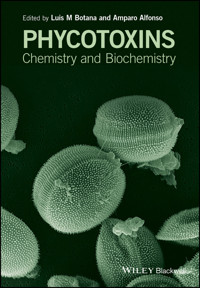
Cover image: Prorocentrum minimum image (Scanning Electron Microscope (SEM) Leica, S440, ×7500). Picture from Editors.
List of contributors
Feras Abbas
Mass Spectrometry Research Centre (MSRC) and PRTOEOBIO Research groups, Department of Chemistry, Cork Institute of Technology (CIT), Bishopstown, Cork, Ireland.
Amparo Alfonso
Department Pharmacology, Veterinary School, Campus de Lugo, University of Santiago de Compostela, 27002 Lugo, Spain.
Carmen Alfonso
Cifga Laboratory, Campus Universitario, Pl. Santo Domingo, 20, 5a, 27001 Lugo, Spain.
Eva Alonso
Department of Pharmacology, Veterinary School, Campus de Lugo, University of Santiago de Compostela, 27002 Lugo, Spain.
Celso Alves
Grupo de Investigação em Recursos Marinhos, Escola Superior de Turismo e Tecnologia do Mar, Instituto Politécnico de Leiria, Campus 4 – Santuário N.a Sra. dos Remédios, 2520–641 Peniche, Portugal.
Álvaro Antenlo
Cifga Laboratory, Campus Universitario, Pl. Santo Domingo, 20, 5a, 27001 Lugo, Spain.
Manuel Aureliano
Department of Biological Sciences and Bioengineering, Marine Science Center, Faculty of Science and Technology, Algarve University, Faro 8005–139 Portugal.
Tanya Beletskaya
Shannon Applied Biotechnology Centre, Limerick Institute of Technology, Moylish Park, Limerick, Ireland.
Roberto Bermúdez
Department of Anatomy and Animal Production, University of Santiago de Compostela, Lugo 27002, Spain.
Ana M. Botana López
Department of Analytical Chemistry, Faculty of Sciences, University of Santiago de Compostela. C/ Alfonso X s/n, 27002 Lugo, Spain.
Milena Bruno
Istituto Superiore di Sanità, Department of Environment and Primary Prevention, V.le Regina Elena 299, 00161 Rome, Italy.
Alexandre Campos
Interdisciplinary Center of Marine and Environmental Research, CIIMAR, and Faculty of Sciences, University of Porto, Porto, Portugal.
Manuel Cifuentes
Department of Anatomy and Animal Production, University of Santiago de Compostela, Lugo 27002, Spain.
Patrizia Ciminiello
Department of Pharmacy, University of Napoli Federico II, Via Domenico Montesano 49, Napoli 80131, Italy.
John W. La Claire II
University of Texas at Austin, Department of Molecular Biosciences, 205 W. 24th St., Austin, TX 78712-1240, USA.
Catherine Collins
Shannon Applied Biotechnology Centre, Limerick Institute of Technology, Moylish Park, Limerick, Ireland.
Andrés Crespo Vieira
Department of Pharmacology, Veterinary School, University of Santiago de Compostela, 27002 Lugo, Spain.
Sara F. Ferreiro
Department of Pharmacology, Veterinary School, University of Santiago de Compostela, 27002 Lugo, Spain.
Rainer Ebel
Marine Biodiscovery Centre, Department of Chemistry, University of Aberdeen, Old Aberdeen, AB24 3UE, Scotland, UK.
Hai Deng
Marine Biodiscovery Centre, Department of Chemistry, University of Aberdeen, Old Aberdeen, AB24 3UE, Scotland, UK.
Carmela Dell'Aversano
Department of Pharmacy, University of Napoli Federico II, Via Domenico Montesano 49, Napoli 80131, Italy.
Diego Alberto Fernández
Department of Pharmacology, Veterinary School, Campus de Lugo, University of Santiago de Compostela 27002 Lugo, Spain.
Andrea Fernández-Araujo
Department of Pharmacology, Veterinary School, Campus de Lugo, University of Santiago de Compostela, 27002 Lugo, Spain.
Custódia Fonseca
Department of Chemistry and Pharmacy, Marine Science Center, Faculty of Science and Technology, Algarve University, Faro 8005–139 Portugal.
Martino Forino
Department of Pharmacy, University of Napoli Federico II, Via Domenico Montesano 49, Napoli 80131, Italy.
María Fraga
Department of Pharmacology, University of Santiago de Compostela, Spain.
Ambrose Furey
Mass Spectrometry Research Centre (MSRC) and PRTOEOBIO Research groups, Department of Chemistry, Cork Institute of Technology (CIT), Bishopstown, Cork, Ireland.
José Gil
Department of Pharmacology, School of Pharmacy, University of Santiago de Compostela, Campus Sur, Praza Seminario de Estudos Galegos, s/n., 1782 Santiago de Compostela, Spain.
André Horta
Grupo de Investigação em Recursos Marinhos, Escola Superior de Turismo e Tecnologia do Mar, Instituto Politécnico de Leiria, Campus 4 - Santuário N.a Sra. dos Remédios, 2520 – 641 Peniche, Portugal.
Marcel Jaspars
Marine Biodiscovery Centre, Department of Chemistry, University of Aberdeen, Old Aberdeen, AB24 3UE, Scotland, UK.
Sushanta Kumar Saha
Shannon Applied Biotechnology Centre, Limerick Institute of Technology, Moylish Park, Limerick, Ireland (ROI).
Pedro Leão
Interdisciplinary Center of Marine and Environmental Research, CIIMAR, University of Porto, Porto, Portugal.
Henar López Alonso
Department of Pharmacology, Veterinary School, Campus de Lugo, University of Santiago de Compostela, 27002 Lugo, Spain.
M Carmen Louzao
Department of Pharmacology, Veterinary School, Campus de Lugo, University of Santiago de Compostela, 27002 Lugo, Spain.
Antonella Lugliè
University of Sassari, Department of Sciences for Nature and Environmental Resources, Via Piandanna 4, 07100 Sassari, Italy.
Phillip Mabe
Department of Chemistry and Biochemistry, University of California, Santa Barbara, CA 93106, USA.
Schonna R. Manning
University of Texas at Austin, Department of Molecular Biosciences, 205 W. 24th St., Austin, TX 78712-1240, USA.
Víctor Martín
Department of Pharmacology, Veterinary School, University of Santiago de Compostela, Campus Universitario, 27002 Lugo, Spain.
Edward McHugh
Algae Health Ltd., Rooaunmore Lodge, Rooaunmore, Claregalway, Galway, Ireland (ROI).
Patrick Murray
Shannon Applied Biotechnology Centre, Limerick Institute of Technology, Moylish Park, Limerick, Ireland (ROI).
Alexei Novikov
Department of Chemistry, University of North Dakota, Grand Forks, ND 58201.
Paz Otero
Department of Pharmacology, Veterinary School, University of Santiago de Compostela, 27002 Lugo, Spain.
Susete Pinteus
Grupo de Investigação em Recursos Marinhos, Escola Superior de Turismo e Tecnologia do Mar, Instituto Politécnico de Leiria, Campus 4 - Santuário N.a Sra. dos Remédios, 2520 – 641 Peniche, Portugal.
Bachisio Mario Padedda
University of Sassari, Department of Sciences for Nature and Environmental Resources, Via Piandanna 4, 07100 Sassari, Italy.
Rui Pedrosa
Grupo de Investigação em Recursos Marinhos, Escola Superior de Turismo e Tecnologia do Mar, Instituto Politécnico de Leiria, Campus 4 - Santuário N.a Sra. dos Remédios, 2520 – 641 Peniche, Portugal.
Silvia Pulina
University of Sassari, Department of Sciences for Nature and Environmental Resources, Via Piandanna 4, 07100 Sassari, Italy.
Cecilia Teodora Satta
University of Sassari, Department of Sciences for Nature and Environmental Resources, Via Piandanna 4, 07100 Sassari, Italy.
Verónica Rey López
Department of Analytical Chemistry, Faculty of Sciences, University of Santiago de Compostela. C/ Alfonso X s/n, 27002 Lugo, Spain.
Juan A. Rubiolo
Department of Pharmacology, Veterinary School, Campus de Lugo, University of Santiago de Compostela, 27002 Lugo, Spain.
Nicola Sechi
University of Sassari, Department of Sciences for Nature and Environmental Resources, Via Piandanna 4, 07100 Sassari, Italy.
Carmen Vale
Department of Pharmacology, Veterinary School, University of Santiago de Compostela, Campus Universitario, 27002, Lugo, Spain.
Vitor Vasconcelos
Interdisciplinary Center of Marine and Environmental Research, CIIMAR, and Faculty of Sciences, University of Porto, Porto, Portugal.
Mercedes R. Vieytes
Department of Physiology, Veterinary School, Campus de Lugo, University of Santiago de Compostela, 27002 Lugo, Spain.
Natalia Vilariño
Department of Pharmacology, Veterinary School, University of Santiago de Compostela, 27002 Lugo, Spain.
Daniel J. Walsh
Shannon Applied Biotechnology Centre, Limerick Institute of Technology, Moylish Park, Limerick, Ireland (ROI).
Armen Zakarian
Department of Chemistry and Biochemistry, University of California, Santa Barbara, CA 93106, USA.
Preface
The reason for this second edition of Phycotoxins: Chemistry and Biochemistry is to update the information that relates to the field of marine toxins and marine compounds. Although marine toxins are usually associated with risks in food safety, there is much more to the subject than this. On the one hand, marine toxins are an excellent source of drug leads, since their structures are very diverse, ranging from very simple (domoic acid) to extremely complex (maitotoxin), and they are also a growing indicator of ecological changes caused by a changing climate. A third aspect of marine compounds and marine toxins is the vast number of physiological targets they have, which makes their study extremely interesting for research purposes once their mechanism of action is understood.
With the intention of offering a wide view of all these aspects, this book covers several topics which are of growing concern in several fields of research. Chapter 1 describes the current technical situation of the analysis of marine toxins for their control and monitoring as a food risk. Chapters 2 to 6, 14 and 15 describe mechanistic and chemical aspects of toxins of particular interest, as their presence and chemical profile may not be not well understood, or is changing in certain geographical areas. Chapters 7, 10 and 11 describe interesting aspects of toxins from freshwater, in some cases with equivalencies to marine toxins, and possible influence of climate.
The chemical diversity of marine compounds, and their mechanism of action, as well as their diversity as possible drug leads, is covered in chapters 8, 12, 13, 16 and 17. Specifically, chapter 17 describes how the elaboration of these toxins (and their stereochemistry) is so complex. Finally, chapters 18 and 19 describe special toxins in fish, and how to identify the damage caused by the marine toxins.
This book could not have been written without the generosity, talent and dedication of specialists in each field who contributed enthusiastically, giving up a large number of days to prepare each of the chapters. As editors, we wish to acknowledge their efforts and give thanks for the support they have given to this book. Without their generosity, this type of book would not be possible. So we offer a sincere ‘thank you’ to them all.
Finally, we wish to thank Wiley-Blackwell for believing in this project.
Amparo Alfonso and Luis M Botana
Chapter 1Analysis of marine toxins: gaps on food safety control of marine toxins
Paz Otero1 & Carmen Alfonso2
1Department of Pharmacology, University of Santiago de Compostela, Spain
2Cifga Laboratory, Pl. Santo Domingo, Spain
Analysis of marine toxins and gaps on food safety control
The field of marine toxins has been deeply studied in recent decades, but there are a lot of variables that need to be understood. These relate to the occurrence of harmful algal blooms, the production of different analogues of the same group of toxins, their accumulation and biotransformation in shellfish or in fish, and the associated hazards for human consumers, both from acute and long-term exposure.
Different factors are related to the proliferation of a determined alga in a zone: physical considerations, such as temperature or light, chemical parameters like nutrients, oxygen or pollutants, and biological relationships between kinds of algae and shellfish. These proliferations can develop suddenly, due to the germination of cysts from ocean sediments under appropriate environmental conditions, (Camacho ., 2007) and are referred to as harmful algal blooms (HABs) if marine toxins are detected during them.
Lesen Sie weiter in der vollständigen Ausgabe!
Lesen Sie weiter in der vollständigen Ausgabe!
Lesen Sie weiter in der vollständigen Ausgabe!
Lesen Sie weiter in der vollständigen Ausgabe!
Lesen Sie weiter in der vollständigen Ausgabe!
Lesen Sie weiter in der vollständigen Ausgabe!
Lesen Sie weiter in der vollständigen Ausgabe!
Lesen Sie weiter in der vollständigen Ausgabe!
Lesen Sie weiter in der vollständigen Ausgabe!
Lesen Sie weiter in der vollständigen Ausgabe!
Lesen Sie weiter in der vollständigen Ausgabe!
Lesen Sie weiter in der vollständigen Ausgabe!
Lesen Sie weiter in der vollständigen Ausgabe!
Lesen Sie weiter in der vollständigen Ausgabe!
Lesen Sie weiter in der vollständigen Ausgabe!
Lesen Sie weiter in der vollständigen Ausgabe!
Lesen Sie weiter in der vollständigen Ausgabe!
Lesen Sie weiter in der vollständigen Ausgabe!
Lesen Sie weiter in der vollständigen Ausgabe!
Lesen Sie weiter in der vollständigen Ausgabe!
Lesen Sie weiter in der vollständigen Ausgabe!




