


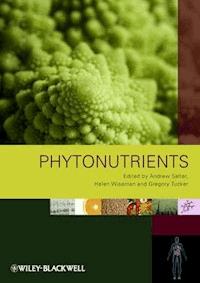
Phytonutrients E-Book
161,99 €
Mehr erfahren.
- Herausgeber: John Wiley & Sons
- Kategorie: Fachliteratur
- Sprache: Englisch
In many Western diets, the role of plants has been reduced in favour of more animal-based products and this is now being cited more widely as being the cause of increases in the incidence of diseases such as cancer and cardiovascular disease. This important book covers the biochemistry and nutritional importance of a wide range of phytonutrients, including all the major macronutrients as well as the micronutrients and 'non-essential' nutrients.
Phytonutrients is divided into three parts. The first deals with the role of plants in the human diet. Part II, representing the major part of the book covers in turn each of the major phytonutrient groups. Chapters include: non-lipid micronutrients, lipids and steroids, carotenoids, phenolics, vitamins C, E, folate/vitamin B12, phytoestrogens, other phytonutrients and minerals, and anti-nutritional factors. The final part of the book covers the methods used to manipulate levels of phytonutrients in the diet, such as fortification, supplementation and the use of genetically modified plants.
Phytonutrients is an essential purchase for nutritionists, food scientists and plant biochemists, particularly those dealing with nutrients from plants, and their use in the human diet.
Sie lesen das E-Book in den Legimi-Apps auf:
Seitenzahl: 666
Veröffentlichungsjahr: 2012
Ähnliche




















Contents
Preface
Contributors
Abbreviations
Chapter 1 Plant foods and health
Introduction
Historical changes in the plant content of the human diet
Changing composition of dietary constituents in the past 50 years
Plants – nutrients and other constituents
A summary of the evidence linking plant food intake and health
Plant foods and health: overall conclusions
Recommendations and current policy on plant food intake
Current consumption patterns
Conclusions
Acknowledgement
Chapter 2 Carbohydrates and lipids
Introduction
Major carbohydrates
Nutritional benefits of plant carbohydrates
Lipids
Dietary lipids and human health
Phytosterols
Chapter 3 Carotenoids
Introduction
Structure, biosynthesis and function of plant carotenoids
Dietary sources and health benefits
Absorption and bioavailability of dietary carotenoids
Carotenoid metabolism in humans
Meeting the dietary demand and consequences for imbalance
Acknowledgements
Chapter 4 Polyphenols
Introduction
Polyphenol structure
Biosynthetic routes within the plant
Major sources within the diet
Metabolic fate of dietary polyphenols
Role in human health
Conclusion
Summary
Acknowledgements
Chapter 5 Vitamins C and E
Introduction
Vitamin C: structure and chemistry
Vitamin E: structure and chemistry
Chapter 6 Folate
Introduction
One-carbon metabolism
Folate synthesis and distribution in plants
Physiology of folate in human health and disease
Folate bioavailability, requirements and food fortification
Chapter 7 Phytoestrogens
Introduction
Biosynthesis of phytoestrogens
Isoflavonoids
Lignans
Prenylflavonoids
Stilbenes
Miroestrol
Deoxybenzoins
Coumestans
Phytoestrogens and human health: conclusions
Chapter 8 Plant minerals
Introduction
Genetic variation in plant mineral concentration
Has the mineral concentration of crops declined due to breeding for increased yield?
Plates
Index
This edition first published 2012 © 2012 by Blackwell Publishing Ltd
Wiley-Blackwell is an imprint of John Wiley & Sons, formed by the merger of Wiley’s global Scientific, Technical and Medical business with Blackwell Publishing.
Registered OfficeJohn Wiley & Sons, Ltd, The Atrium, Southern Gate, Chichester, West Sussex, PO19 8SQ, UK
Editorial Offices9600 Garsington Road, Oxford, OX4 2DQ, UKThe Atrium, Southern Gate, Chichester, West Sussex, PO19 8SQ, UK2121 State Avenue, Ames, Iowa 50014-8300, USA
For details of our global editorial offices, for customer services and for information about how to apply for permission to reuse the copyright material in this book please see our website at www.wiley.com/wiley-blackwell.
The right of the author to be identified as the author of this work has been asserted in accordance with the UK Copyright, Designs and Patents Act 1988.
All rights reserved. No part of this publication may be reproduced, stored in a retrieval system, or transmitted, in any form or by any means, electronic, mechanical, photocopying, recording or otherwise, except as permitted by the UK Copyright, Designs and Patents Act 1988, without the prior permission of the publisher.
Designations used by companies to distinguish their products are often claimed as trademarks. All brand names and product names used in this book are trade names, service marks, trademarks or registered trademarks of their respective owners. The publisher is not associated with any product or vendor mentioned in this book. This publication is designed to provide accurate and authoritative information in regard to the subject matter covered. It is sold on the understanding that the publisher is not engaged in rendering professional services. If professional advice or other expert assistance is required, the services of a competent professional should be sought.
Library of Congress Cataloging-in-Publication Data
Phytonutrients / edited by Andrew Salter, Helen Wiseman, Gregory Tucker.p. cm. Includes bibliographical references and index.
ISBN 978-1-4051-3151-3 (hardcover : alk. paper)1. Phytonutrients. 2. Phytochemicals. 3. Food–Composition. I. Salter, Andrew M. II. Wiseman, Helen. III. Tucker, G. A. (Gregory A.) QK861.P49 2012 572′.2–dc23
2011045493
A catalogue record for this book is available from the British Library.
Wiley also publishes its books in a variety of electronic formats. Some content that appears in print may not be available in electronic books.
Preface
Plants have been a major source of nutrition for humans ever since the start of our evolution, although more recently we have become more reliant on animal-based foods. This has led to some challenging situations in terms of diet and health and we are encouraged, through schemes such as the 5-A-Day campaign, to consume more plant-based foods. Plants can provide us with almost all of our dietary requirements and this includes macronutrients such as carbohydrates and lipids as well as the wide range of essential micronutrients such as vitamins and minerals. It is also becoming increasingly evident that many other phytochemicals, whilst perhaps not essential, are nonetheless beneficial to our health. These would include the carotenoids, polyphenols and phytoestrogens.
There has long been an interest amongst plant scientists in the enhancement of nutrients within crops. Traditionally this has been brought about by breeding or modifications to agronomic or horticultural practice. More recently this has also been achieved through the application of genetic engineering, for example to enhance levels of vitamins such as vitamin A and folate, or through manipulation of biosynthetic pathways to introduce novel nutrients into plants such as the production of long chain polyunsaturated fatty acids. Such modifications to the plants metabolism often require an intricate knowledge of the metabolic pathways and more specifically their control. Acquisition of this knowledge is greatly facilitated by the rapid progress being made in the areas of transcriptomics, proteomics and systems biology.
These phytonutrients are normally presented in the diet in the form of a complex food matrix. Understanding the interactions between this matrix and the digestive system is a key part of modelling the fate of nutrients in the diet. The plant cell wall for instance can represent a barrier to the release of nutrients and its ‘digestibility’ in the gastrointestinal tract is a significant factor in determining the bioaccessibility of nutrients. Similarly, the fate of nutrients in terms of how they are able to cross the gut lumen and their subsequent metabolism within the body are also key factors in determining bioavailability and functionality, respectively.
This book contains contributions from both plant scientists and nutritionists. The plant science perspective is primarily about how nutrients are made within the plant and how this may be manipulated to enhance their levels or availability. The nutrition perspective is more on how these food matrices behave during digestion and, more specifically, the functionality of nutrients within the body. It is hoped therefore that this book will be of interest to researchers and students in both of these disciplines. Indeed one of its aims is to encourage understanding, dialogue and collaboration between these two often disparate fields of expertise.
Contributors
John Brameld
Nutritional Sciences Division, University of Nottingham, Sutton Bonington Campus, Loughborough, Leicestershire, LE12 5RD, UK.
John Brameld is currently Associate Professor of Nutritional Biochemistry at the University of Nottingham. His main interests relate to the regulatory effects of nutrients on gene expression in relation to cell/tissue development, metabolism and function.
Martin R. Broadley
Plant and Crop Sciences Division, University of Nottingham, Sutton Bonington Campus, Loughborough, Leicestershire, LE12 5RD, UK.
Dr Martin Broadley is a Reader in Plant Nutrition at the University of Nottingham. Martin’s research focus is on mineral dynamics in soil-plant systems, including the use of agronomic and genetics-based understanding of mineral improvement of crops (biofortification).
Judith Buttriss
British Nutrition Foundation. High Holborn House, 52-54 High Holborn, London WC1V 6RQ.
Professor Judith Buttriss is the Director General at the British Nutrition Foundation, a post she has held since 2007; prior to this she was the Foundation’s Science Director since 1998. She is a public health nutritionist with an interest in a broad range of nutrition topics.
David Gray
Food Sciences Division, University of Nottingham, Sutton Bonington Campus, Loughborough, Leicestershire, LE12 5RD, UK.
Dr David Gray gained his PhD in the field of plant lipid biochemistry and is now an Associate Professor in Food Chemistry. His research includes an exploration of novel ways of delivering healthy oils to foods, with minimum loss to oil quality and minimum impact on the environment.
Úrsula Flores-Perez
Centre for Research in Agricultural Genomics (CRAG) CSIC-IRTA-UAB, Campus UAB Bellaterra, 08193 Barcelona, Spain.
Dr. Flores-Perez obtained her PhD degree at CRAG, where she developed her interest in the regulation of plant carotenoid biosynthesis and biotechnology. She is currently a postdoctoral fellow working on plastid import mechanisms at the Department of Biology, University of Leicester, University Road, Leicester LE1 7RH, UK.
Manuel Rodriguez-Concepcion
Centre for Research in Agricultural Genomics (CRAG) CSIC-IRTA-UAB, Campus UAB Bellaterra, 08193 Barcelona, Spain.
Dr. Rodriguez-Concepcion is a Research Professor at CRAG, where he leads a group working on the regulation of isoprenoid and carotenoid biosynthesis. His research has unveiled a number of molecular mechanisms used by plant cells to control the supply of carotenoid precursors and their channelling to the carotenoid pathway at transcriptional and post-transcriptional levels.
Stéphane Ravanel
Laboratoire de Physiologie Cellulaire Végétale, UMR5168 CNRS- UMR1200 INRA – CEA-Université Joseph Fourier Grenoble I, Institut de Recherches en Technologies et Sciences pour le Vivant – CEA-Grenoble, 17 rue des Martyrs, 38054 Grenoble Cedex 9, France.
Dr Stéphane Ravanel is a plant biochemist and molecular biologist with a long-standing interest in the metabolism of amino acids and folates.
Fabrice Rébeillé
Laboratoire de Physiologie Cellulaire Végétale, UMR5168 CNRS- UMR1200 INRA – CEA-Université Joseph Fourier Grenoble I, Institut de Recherches en Technologies et Sciences pour le Vivant – CEA-Grenoble, 17 rue des Martyrs, 38054 Grenoble Cedex 9, France.
Dr Fabrice Rébeillé is a plant biochemist and physiologist who has been conducting research on photorespiration before studying folate metabolism.
Andrew Salter
Nutritional Sciences Division, University of Nottingham, Sutton Bonington Campus, Loughborough, Leicestershire, LE12 5RD, UK.
Andy Salter is Professor of Nutritional Biochemistry. His major interests lie in the mechanisms whereby dietary fatty acids regulate lipid and lipoprotein metabolism and development of atherosclerosis.
Jeremy P E Spencer
Molecular Nutrition Group, School of Chemistry, Food and Pharmacy, University of Reading, Reading, RG2 6AP, UK.
Professor Spencer is Leader of the Food Chain and Health sub-theme “Plant Bioactives and Health” within Food and Nutritional Sciences at Reading University. His interests are focused on investigating the molecular mechanisms that underlie the accumulating body of epidemiological, and medical anthropological evidence, on a positive correlation between the consumption of diets rich in fruits and vegetables and a decreased risk of neurodegenerative disorders.
Gregory Tucker
Nutritional Sciences Division, University of Nottingham, Sutton Bonington Campus, Loughborough, Leicestershire, LE12 5RD, UK.
Greg Tucker is Professor of Plant Biochemistry at Nottingham University. A major area of interest is the molecular basis of quality in fruit and vegetables. This includes methods to extend the shelf life of these commodities and the impact that this may have on nutritional composition.
Katerina Vafeiadou
Molecular Nutrition Group, School of Chemistry, Food and Pharmacy, University of Reading, Reading, RG2 6AP, UK.
Dr Katerina Vafeiadou is a research fellow at the Hugh Sinclair Unit of Human Nutrition, University of Reading. Dr Vafeiadou has previously carried out research on the effects of dietary flavonoids on both cardiovascular and neurodegenerative diseases, with main focus on flavonoids role in the prevention of inflammation and endothelial dysfunction. Dr Vafeiadou is currently working for a Food Standards Agency project which investigates the impact of replacing dietary saturated fats with either monounsaturated fats or polyunsaturated fats on cardiovascular risk.
David Vauzour
Norwich Medical School, Faculty of Medicine and Health Sciences, University of East Anglia, Norwich, NR4 7TJ, UK.
Dr David Vauzour is a Senior Research Associate at Norwich Medical School, University of East Anglia. Dr Vauzour has carried out many investigations on the influence of phytochemicals on brain health through their interactions with specific cellular signalling pathways pivotal in protection against neurotoxins, in preventing neuroinflammation and in controlling memory, learning and neuro-cognitive performances.
Philip J. White
The Scottish Crop Research Institute, Invergowrie, Dundee, DD2 5DA, UK.
Professor Philip J. White is a Senior Research Scientist at Scottish Crop Research Institute (which became The James Hutton Institute w.e.f. April 2011). Philip’s research comprises a wide range of subjects within the field of plant mineral nutrition, ranging from molecular genetic through to agronomic scales. He has previously held positions at the Universities of Edinburgh and Cambridge, and Horticulture Research International. He is a Special Professor in Plant Ion Transport at the University of Nottingham, and a Visiting Associate Professor at the Comenius University, Bratislava.
Helen Wiseman
Nutritional Sciences, Diabetes and Nutritional Sciences Division, King’s College London, Franklin-Wilkins Building, 150 Stamford Street, London, SE1 9NH.
Dr Helen Wiseman leads the Phytochemical Research Group at King’s College London. Dr Wiseman has carried out numerous investigations of the potential health effects of dietary phytochemicals, such as flavonoids, including possible protection against cardiovascular disease, cancer and loss of cognitive function, which may be exerted via a wide range of mechanisms including effects on gene expression, regulatory microRNA and post-translational modification and modulation of cell signalling pathways.
Abbreviations
AAascorbic acidACPacyl carrier proteinADC4-amino-4-deoxychorismateAdoMetS-adenosylmethionineAICARaminoimidazole carboxamide ribonucleotideAICARTaminoimidazole carboximide ribonucleotide transformylaseALAalpha linolenic acidANRanthocyanidin reductaseANSanthocyanidin synthaseBCOβ-carotene-15,15′-oxygenasecAMPcyclic AMPCHDcoronary heart diseaseCHIchalcone flavanone isomeraseCHSchalcone synthaseCHYBcarotenoid β-ring hydroxylaseCHYEcarotenoid ε-ring hydroxylaseCIconfidence intervalCOMTcatechol-O-methyltransferasesCRTISOcarotenoid isomeraseCYPcytochrome P450CVDcardiovascular diseaseDAGdiacylglycerolDAHPD-arabino-heptulosonic acid 7-phosphateDFEdietary folate equivalentsDFRdihydroflavonol reductaseDHAdocosahexaenoic acidDHAdehydroascorbate (Chapter 5)DHAAdehydroascorbic acidDHFdihydrofolateDHFRdihydrofolate reductaseDHPSdihydropteroate synthaseDHQ3-dehydroquinic acidDMAPPdimethylallyl diphosphateDMPBQdimethylphytylbenoquinolE-4-PD-erythrose-4-phosphateEGCGepigallocatechin gallateEPSP3-enolpyruvylshikimic acid 3-phosphateERendoplasmic reticulumERKextracellular signal-related kinaseEPAeicosapentoenoic acidF3H Flavanone 3-hydroxylaseFASfatty acid synthase complexFCL5-formyl-THF cycloligaseFGGHfolylpolyglutamate γ-glutamyl hydrolaseFPGSfolylpolyglutamate synthetaseFS flavone synthaseFTCDglutamate formiminotransferase/formimino-THF cyclodeaminaseFTHFS10-formyl-THF synthetaseGARglycinamide ribonucleotideGARTglycinamide ribonucleotide transformylaseGBSSgranule bound starch synthaseGDCglycine decarboxylaseGIgastrointestinal tractGGPPgeranylgeranyl pyrophosphateGGRgeranylgeranyl reductaseGHglycosyl hydrolaseGLAgamma linolenic acidGLUTglucose transporterGSHglutathioneGSHPxglutathione peroxidiseGTglycosyl transferaseGTPCHIGTP-cyclohydrolase I 7,8-dihydroneopterin (DHN) triphosphateHBAhydroxybenzoic acidsHCAhydroxycinnamic acidsHDLhigh density lipoproteinsHO-1haem oxygenase 1HPPKhydroxymethyldihydropterin pyrophosphokinaseIFSisoflavone synthaseIMPinosine monophosphateIPPisopentenyl diphosphateJNKc-jun amino-terminal kinaseKPHMTketopantoate hydroxymethyl transferaseLAlinoleic acidLARleucoanthocyanidin reductaseLCYBlycopene cyclase BLCYElycopene cyclase ELDLlow density lipoproteinMAPKMAP kinase signalling pathwayMATEmultidrug and toxin extrusion transporterMDHAmonodehydroascorbateMEPmethylerythritol 4-phosphate pathwayMGGBQ2-methy-6-phytylbenzoquinolMPBQ2-methy-6-phytylbenzoquinolMRPmultidrug resistance-associated proteinsMSmethionine synthaseMTFmethionyl-tRNA transformylaseMTHFC5,10-methenyl-THF cyclohydrolaseMTHFD5,10-methylene-THF dehydrogenaseMUFAmonounsaturated fatty acidNSPnon starch polysaccharideNTDneural tube defectsODAoctadecatetraenoic acidpABApara-aminobenzoic acidpABAGlunp-aminobenzoyl(poly)glutamatePALphenylalanine ammonia lyasePCphosphatidylcholinePDPphytyl pyrophosphatePDSphytoene desaturasePEphosphatydyl ethanolaminePEPphosphoenolpyruvatePMPphytol monophosphatePPARperoxisome proliferator activated receptorPS1photosystem 1PSYphytoene synthasePUFApolyunsaturated fatty acidQTLquantitative trait lociRALDHNAD+-dependent retinal dehydrogenaseRDArecommended dietary allowanceRDHretinol dehydrogenaseROSreactive oxygen speciesRRrelative riskSBEstarch branching enzymeSDEstarch debranching enzymeSFAsaturated fatty acidSHMTserine hydroxymethyl transferaseSVCTsodium vitamin C co-transportersTAGtriacyl glycerolTALtyrosine ammonia lyaseTGtriglyceridesTHFtetrahydrofolatesTSthymidylate synthaseUFGTUDP glucose-flavonoid 3-O-glucosyl transferaseUGTUDP-glucuronosyltransferasesVADvitamin A deficiencyVDEviolaxanthin de-epoxidaseVLDLvery low density lipoproteinsXETxyloglucan endo transglycosylaseZDSζ-carotene desaturaseZEPzeaxanthin eopxidaseChapter 1
Plant foods and health
Judith Buttriss
Introduction
The purpose of this introductory chapter is to pave the way for subsequent chapters by looking at the historical context of plant food consumption, reviewing the contribution plant foods make to intakes of essential nutrients (e.g. fibre, vitamins, minerals, protein and essential fatty acids), examining the evidence linking plant food intake to health, summarising current recommendations and policy regarding plant food intake, and comparing these recommendations with current intakes.
Historical changes in the plant content of the human diet
Throughout human history, communities and societies have developed a diversity of dietary patterns and habits that have taken advantage of the food plants and animals available to them as a result of personal skills, climate, geography, trade and economic status. It is a basic premise the diets that persisted were capable of providing sufficient energy and essential nutrients to support growth and reproduction. They may not, however, have been conducive to optimal health.
Archaeological investigations have been used to predict what the diet of early man was like. Nestle (1999) cites Eaton and Konner (1985) who proposed that by the time of the emergence of modern Homo sapiens 45 000 years ago (Table 1.1), meat intake was high, but lean, and plant foods provided levels of vitamin C that exceed current recommendations. The diets of those modern day communities who survive primarily through hunting and gathering have also been used as a source of information, although the extent to which the diets of such communities simulate those of early man can only be speculated. Estimates suggest that most of the modern day hunter-gatherer communities lived in areas where plant foods grew readily, one exception being the indigenous people living in the Arctic whose traditional diets were dominated by meat and who relied almost completely on hunting for much of the year (Eaton and Konner 1985). Also, anthropologists have examined the diets of closely related primates for clues about the possible diets of our distant ancestors. In general, primates seem to eat whatever is convenient, mainly plants but also insects, eggs, crustaceans and carrion (Nestle 1999). Recent documentary evidence has captured film of chimpanzees and other primates hunting and killing animals as prey, which has subsequently been shown on wildlife television programmes in the UK.
Table 1.1 Stages of evolution of human diets
Adapted from Eaton and Konner (1985).
Time period elapsed (years)Pleistocene: Stone Age1.6 millionHomo sapiens: Archaic400 000Neanderthal80 000Modern45 000Holocene: Agriculture10 000Industrial revolution200Global food economy50Archaeology has provided considerable evidence for meat consumption by early man, including characteristic marks on fossilised animal bones and stone artefacts consistent with meat eating. However, this information must be considered in context: bones are better preserved than vegetable matter and hence reliance on such evidence is likely to underestimate plant food consumption (Nestle 1999).
Plant foods can be categorised in many ways but the method used here can be seen in Table 1.2. It has been suggested that the plant foods gathered by our early ancestors were those that did not require digging with hands or sticks, such as fruits, leaves and stems, and seeds in pod-like structures (e.g. peas, beans) that would have provided protein. There is also early evidence of the cultivation and storage of legumes such as broad beans in the Middle East, where ‘farming’ is said to have begun, and among cave dwellers living as far apart as Mexico and Peru, and north-east Thailand (Toussaint-Samat 1992). Similar evidence exists for collection of wild chick peas, lentils and peas, followed by their cultivation.
Lesen Sie weiter in der vollständigen Ausgabe!
Lesen Sie weiter in der vollständigen Ausgabe!
Lesen Sie weiter in der vollständigen Ausgabe!
Lesen Sie weiter in der vollständigen Ausgabe!
Lesen Sie weiter in der vollständigen Ausgabe!
Lesen Sie weiter in der vollständigen Ausgabe!
Lesen Sie weiter in der vollständigen Ausgabe!
Lesen Sie weiter in der vollständigen Ausgabe!
Lesen Sie weiter in der vollständigen Ausgabe!




