


136,99 €
Mehr erfahren.
- Herausgeber: John Wiley & Sons
- Kategorie: Wissenschaft und neue Technologien
- Sprache: Englisch
The increase in global population, urbanization and industrialization is resulting in the conversion of cultivated land into wasteland. Providing food from these limited resources to an ever-increasing population is one of the biggest challenges that present agriculturalists and plant scientists are facing. Environmental stresses make this situation even graver. Plants on which mankind is directly or indirectly dependent exhibit various mechanisms for their survival. Adaptability of the plants to changing environment is a matter of concern for plant biologists trying to reach the goal of food security. Despite the induction of several tolerance mechanisms, sensitive plants often fail to withstand these environmental extremes. Using new technological approaches has become essential and imperative.
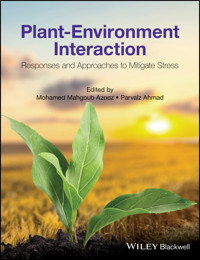
Plant-Environment Interaction: Responses and Approaches to Mitigate Stress throws light on the changing environment and the sustainability of plants under these conditions. It contains the most up-to-date research and comprehensive detailed discussions in plant physiology, climate change, agronomy and forestry, sometimes from a molecular point of view, to convey in-depth understanding of the effects of environmental stress in plants, their responses to the environment, how to mitigate the negative effects and improve yield under stress.
This edited volume is written by expert plant biologists from around the world, providing invaluable knowledge to graduate and undergraduate students in plant biochemistry, food chemistry, plant physiology, molecular biology, plant biotechnology, and environmental sciences. This book updates scientists and researchers with the very latest information and sustainable methods used for stress tolerance, which will also be of considerable interest to plant based companies and institutions concerned with the campaign of food security.
Sie lesen das E-Book in den Legimi-Apps auf:
Seitenzahl: 1244
Veröffentlichungsjahr: 2015
Ähnliche



















Table of Contents
Cover
Title Page
List of contributors
Preface
About the editors
CHAPTER 1: Biotechnological applications to improve salinity stress in wheat
1.1 Introduction
1.2 Salinity stress is a striking environmental threat to plants
1.3 Effects of salinity stress on wheat
1.4 Wheat natural tolerance and defence against salinity
1.5 Biotechnological applications to improve salinity stress in wheat
1.6 Conclusion and future perspectives
References
CHAPTER 2: Soybean under abiotic stress: Proteomic approach
2.1 Introduction
2.2 Proteomic approach
2.3 Proteomics for soybean
2.4 Proteomics of soybean under abiotic stresses
2.5 Conclusion and future perspectives
Acknowledgement
References
CHAPTER 3: Proteomic analysis of food crops under abiotic stresses in the context of climate change
3.1 Introduction
3.2 Atmospheric greenhouse gas composition
3.3 Temperature
3.4 Conclusions and future perspectives
References
CHAPTER 4: Transcriptome modulation in rice under abiotic stress
4.1 Introduction
4.2 Drought stress
4.3 Salt stress
4.4 Temperature stress
4.5 Heavy metals
4.6 Common stress-responsive genes
4.7 Conclusions and future prospects
Acknowledgements
References
CHAPTER 5: Sulphur: Role in alleviation of environmental stress in crop plants
5.1 Introduction
5.2 Sulphur assimilation and the most important S compounds in plants
5.3 Heavy metals
5.4 Salinity
5.5 Drought
5.6 Hydrogen sulphide
5.7 Conclusions and future prospects
References
CHAPTER 6: Proline and glycine betaine modulate cadmium-induced oxidative stress tolerance in plants: Possible biochemical and molecular mechanisms
6.1 Introduction
6.2 Cadmium toxicity symptoms in plant cells and physiological and cellular responses
6.3 Possible mechanisms of cadmium tolerance in plants
6.4 Cadmium-induced ROS generation in plant cells
6.5 Detoxification of ROS under Cd stress
6.6 Modulation of antioxidant enzyme activities in response to cadmium stress
6.7 Methylglyoxal and glyoxalase enzyme activities under cadmium stress
6.8 Co-ordinated induction of MG and ROS detoxification systems in inducing heavy metal stress tolerance, including Cd stress
6.9 Exogenous proline and betaine pretreatment and Cd stress tolerance in relation to ROS and MG detoxification
6.10 Conclusions and future perspectives
References
CHAPTER 7: Enhancement of vegetables and fruits growth and yield by application of brassinosteroids under abiotic stresses: A review
7.1 Introduction
7.2 Environmental stresses
7.3 Brassinosteroids
7.4 Role of BRs on the growth and yield of vegetables and fruits under various environmental stresses
7.5 Conclusion and future prospects
Acknowledgements
References
CHAPTER 8: Physiological mechanisms of salt stress tolerance in plants: An overview
8.1 Introduction
8.2 Adverse impact of salinity on plants
8.3 Plant performance under saline conditions
8.4 Mechanism of salinity tolerance
8.5 Salt and water stress
8.6 Seed priming for higher salinity tolerance
8.7 Foliar application of salicylic acid (SA)
8.8 Conclusions and future prospects
References
CHAPTER 9: Heat stress in wheat and interdisciplinary approaches for yield maximization
9.1 Introduction
9.2 Mineral activity during heat stress
9.3 Effect of temperature on growth of wheat
9.4 Approaches to improving heat tolerance in wheat
9.5 Conclusion and future prospects
References
CHAPTER 10: Effect of elevated CO
2
and temperature stress on cereal crops
10.1 Introduction
10.2 Physiological and biochemical effects of elevated CO
2
and temperature on cereal crops
10.3 Stress response, tolerance and molecular approaches for yield safety
10.4 Understanding gene expression: use of molecular markers
10.5 Concluding remarks: thinking of cereals, thinking of food security
References
CHAPTER 11: Lipid metabolism and oxidation in plants subjected to abiotic stresses
11.1 Introduction
11.2 Lipid vulnerability to reactive oxygen species and mechanism of lipid oxidation
11.3 Methodologies for lipid oxidation estimation
11.4 Lipid oxidation in abiotic-stressed plants
Lesen Sie weiter in der vollständigen Ausgabe!
Lesen Sie weiter in der vollständigen Ausgabe!
Lesen Sie weiter in der vollständigen Ausgabe!
Lesen Sie weiter in der vollständigen Ausgabe!
Lesen Sie weiter in der vollständigen Ausgabe!
Lesen Sie weiter in der vollständigen Ausgabe!
Lesen Sie weiter in der vollständigen Ausgabe!
Lesen Sie weiter in der vollständigen Ausgabe!
Lesen Sie weiter in der vollständigen Ausgabe!
Lesen Sie weiter in der vollständigen Ausgabe!
Lesen Sie weiter in der vollständigen Ausgabe!
Lesen Sie weiter in der vollständigen Ausgabe!
Lesen Sie weiter in der vollständigen Ausgabe!
Lesen Sie weiter in der vollständigen Ausgabe!
Lesen Sie weiter in der vollständigen Ausgabe!
Lesen Sie weiter in der vollständigen Ausgabe!
Lesen Sie weiter in der vollständigen Ausgabe!
Lesen Sie weiter in der vollständigen Ausgabe!
Lesen Sie weiter in der vollständigen Ausgabe!
Lesen Sie weiter in der vollständigen Ausgabe!
Lesen Sie weiter in der vollständigen Ausgabe!
Lesen Sie weiter in der vollständigen Ausgabe!
Lesen Sie weiter in der vollständigen Ausgabe!
Lesen Sie weiter in der vollständigen Ausgabe!
Lesen Sie weiter in der vollständigen Ausgabe!




