


Plastic Techniques in Neurosurgery E-Book
99,99 €
Mehr erfahren.
- Herausgeber: Thieme Medical Publishers
- Kategorie: Fachliteratur
- Sprache: Englisch
Step-by-step descriptions of surgical techniques
This book highlights the successful collaboration of plastic surgeons, neurosurgeons, and, in some cases, ENT, maxillofacial, oral, and oculoplastic surgeons, in treating some of the most complex craniofacial, skull-based, intracranial, and spinal problems. Beginning with the basic principles of wound healing and flap rotation, you will find full discussions of craniofacial anomalies, skull base tumors, scalp closures, skull defects, management techniques for spinal dysraphism, and much more.
Key features:
- Nearly 300 beautiful illustrations, most in full-color, effectively map out each procedure
- Updated with a thorough review of potential complications and how to avoid them
- Valuable procedural guidelines on the newest techniques for full calvarial and facial reconstructions, especially around the eyes, orbit, and midface region -Demonstrates MR and 3D imaging in surgical management of congenital malformations of the spine
- Discusses the role of ENT, maxillofacial, and oculoplastic procedures for optimal outcomes
With a balanced combination of concepts followed by illustrated, step-by-step surgical techniques, here is the book that all neurosurgeons and plastic and reconstructive surgeons will use as both an everyday reference and a key addition to their surgical armamentariums. Residents preparing for boards will also find its succinct, straightforward coverage ideal for reviewing fundamental principles and surgical applications.
Das E-Book können Sie in Legimi-Apps oder einer beliebigen App lesen, die das folgende Format unterstützen:
Veröffentlichungsjahr: 2004
Ähnliche




















Plastic Techniquesin Neurosurgery
Second Edition
James Tait Goodrich
Professor of Clinical Neurosurgery,Pediatrics, Plastic and Reconstructive SurgeryDirector, Division of Pediatric NeurosurgeryAlbert Einstein College of MedicineMontefiore Medical CenterBronx, NY
David A. Staffenberg
Assistant Professor ofPlastic and Reconstructive Surgery and PediatricsDepartment of Plastic and Reconstructive SurgeryAlbert Einstein College of MedicineMontefiore Medical CenterBronx, NY
Foreword by Daniel Marchac
ThiemeNew York · Stuttgart
Thieme Medical Publishers, Inc.
333 Seventh Ave.
New York, NY 10001
Editor: Sharon Liu
Director, Production and Manufacturing: Anne Vinnicombe
Production Editor: Print Matters, Inc.
Marketing Director: Phyllis Gold
Sales Manager: Ross Lumpkin
Chief Financial Officer: Peter van Woerden
President: Brian D. Scanlan
Compositor: Compset, Inc.
Printer: Four Colour Imports, Inc.
Cover Image: Courtesty of Montefiore Medical Center. Photograph by Alice Attie.
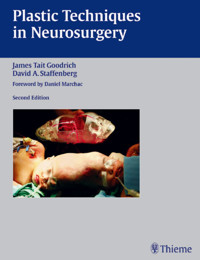
Cover Legend: Intraoperative view of a set of craniopagus twins; over the field is a medical acrylic model showing a 3-D model of the anatomy of each twin. This type of surgery clearly reveals the extensive cooperative efforts needed between plastic surgery and neurosurgery.
Library of Congress Cataloging-in-Publication Data
Plastic techniques in neurosurgery.—2nd ed. / [edited by] James Tait
Goodrich, David A. Staffenberg ; foreword by Daniel Marchac.
p. ; cm.
Includes bibliographical references and index.
ISBN 1-58890-271-4 (hc)
1. Brain—Surgery—Complications. 2. Surgery, Plastic. 3. Skull—Surgery. 4. Facial bones—Surgery.
[DNLM: 1. Neurosurgical Procedures—methods. 2. Craniofacial Abnormalities—surgery. 3. Face—surgery. 4. Reconstructive Surgical Procedures—methods. 5. Skull—surgery. 6. Spine—surgery. WL 368 P715 2004] I. Goodrich, James T. II. Staffenberg, David A.
RD594.P53 2004
617.5’10592—dc22
2004042210
Copyright © 2004 by Thieme Medical Publishers, Inc. This book, including all parts thereof, is legally protected by copyright. Any use, exploitation, or commercialization outside the narrow limits set by copyright legislation, without the publisher’s consent, is illegal and liable to prosecution. This applies in particular to photostat reproduction, copying, mimeographing or duplication of any kind, translating, preparation of microfilms, and electronic data processing and storage.
Important note: Medical knowledge is ever changing. As new research and clinical experience broaden our knowledge, changes in treatment and drug therapy may be required. The authors and editors of the material herein have consulted sources believed to be reliable in their efforts to provide information that is complete and in accord with the standards accepted at the time of publication; however, in view of the possibility of human error by the authors, editors, or publisher, of the work herein, or changes in medical knowledge, neither the authors, editors, or publisher, nor any other party who has been involved in the preparation of this work, warrants that the information contained herein is in every respect accurate or complete, and they are not responsible for any errors or omissions or for the results obtained from use of such information. Readers are encouraged to confirm the information contained herein with other sources. For example, readers are advised to check the product information sheet included in the package of each drug they plan to administer to be certain that the information contained in this publication is accurate and that changes have not been made in the recommended dose or in the contraindications for administration. This recommendation is of particular importance in connection with new or infrequently used drugs.
Some of the product names, patents, and registered designs referred to in this book are in fact registered trademarks or proprietary names even though specific reference to this fact is not always made in the text. Therefore, the appearance of a name without designation as proprietary is not to be construed as a representation by the publisher that it is in the public domain.
Printed in China
5 4 3 2 1
TMP ISBN 1-58890-271-4
GTV ISBN 3 13 758802 2
Dedication
Pigmei gigantum humeris impositi plusquam ipsi gigantes vident
Bernard of Chartres—Twelfth Century
Don Collins
Frank Visco
Tom Wert
John Lenanton
Robert Hoeppner
And the group at Orange Coast College, Costa Mesa, California
In June 1968, a young, very tired, burnt-out former Marine, just back from Vietnam, entered Orange Coast College to begin a career in premed. An extraordinary group of very talented and bright educational minds took an uneducated one and provided a never-forgotten stimulus to become educated. To my giants at Orange Coast College, it is on your shoulders that I have stood. I have never forgotten your efforts and would like to thank you all now and dedicate my part of this work to you.
I placed this above dedication in the first edition of this work in 1991. Nothing has changed over the years and I continue to remain grateful to the faculty and staff of Orange Coast College—on their shoulders I have continued to stand, and, in addition, remain in total admiration all of their wonderful work as educators.
James Tait Goodrich, M.D., Ph.D., FRCM (London)
Dedication
Accepting my new position at the Children’s Hospital at Montefiore was fueled by my interest in working with Dr. James Goodrich. His work in craniofacial surgery as a pediatric neurosurgeon was well known to me. He told me early on, “If it (a craniofacial problem) exists anywhere in the world, it’s here in the Bronx. If it’s not already here, it’s on its way.” He was right. My work with him both in and out of the operating room has been as wonderful as any professional relationship could ever be. His skills in the operating room continue to impress me. He has been a great mentor, partner, and friend. This book is his special child. I am confident that, like the first edition, it will be supremely useful for neurosurgeons and plastic surgeons. The diagrams have been excellent illustrations for our patient consultations.
The Children’s Hospital at Montefiore is an extraordinary place. As the pediatric plastic surgeon, I have been working with one of the oldest and finest craniofacial centers in the world. Finding myself in such a position is no accident. I have had a long history of making good choices, beginning with my parents. I have chosen my teachers especially well. While a resident in plastic surgery at Emory University, Josh Jurkiewicz, John Bostwick, III, Glyn Jones, and Jack Culbertson tried to teach me the science, but also showed me the art, of plastic surgery. Henry Kawamoto taught me the nuts and bolts of craniofacial surgery. My year as his craniofacial fellow was extraordinary and I still miss seeing patients with him and operating with him.
At Montefiore, my plastic surgical colleagues have embraced my work, and their standards have been a model for me. My partners, Berish Strauch and Teresa Benacquista, have supported me in every way possible.
Choosing to do my fellowship with Henry Kawamoto was an especially good choice because this was where I met my wife, Nadine. She endured countless flights from Los Angeles to New York before we got married. She is amazing and beautiful, and I appreciate this more and more every day. While standing on so many shoulders and being blessed in so many ways, I could not do any of this without Nadine’s love and support.
David A. Staffenberg, M.D.
Contents
Foreword
Preface
Contributors
1. Plastic Surgery Wound Coverage for the Neurosurgery Patient
David A. Staffenberg and Berish Strauch
2. Repair of Calvarial Bone Defects: Cranioplasty and Bone-Harvesting Techniques
James Tait Goodrich and David A. Staffenberg
3. Congenital Malformations of the Brain and Spine: Repair Techniques
James Tait Goodrich and Robert F. Keating
4. Craniofacial Reconstruction for Craniosynostosis
James Tait Goodrich
5. Congenital Facial Disorders
Mark Urata, David A. Staffenberg, and Henry K. Kawamoto, Jr.
6. Craniofacial and Transfacial Approaches to the Midface and Skull Base Region
James Tait Goodrich, Sidney Eisig, Joseph G. Feghali, and David A. Staffenberg
Index
Foreword
Today, the necessity of a multidisciplinary approach to complex lesions of the face and cranium seems obvious. But not so long ago—thirty years back—such was not the case, and each speciality worked in its own separate area. There was a wall, the cranial base, between neurosurgeons and plastic surgeons. That wall was knocked down, thanks to Paul Tessier, who really invented craniofacial surgery as such, with free circulation of specialists, instruments, and sometimes bacteria!
I started my own career in craniofacial surgery in 1970, after having had the chance to observe Tessier from 1962 to 1967, before he became famous. With difficulty, I found a few cases to operate on in North Africa. The first case was a fronto-orbital osseous tumor, in conjunction with a superficial angioma, that required radical resection and reconstruction. Then my plastic surgery chief, Claude Dufourmentel, sent me to one of his neurosurgical colleagues, where I was able to operate with a young neurosurgeon, Jean Cophignon.
The only tool available was a drill. They had no bone saws, no wires. The chisels were huge, and there was nothing to hold the bone pieces or to bend them. I had to bring many instruments with me, which I had collected after observing Tessier–in particular, a Stryker oscillating saw. The neurosurgeons were not at all familiar with bone grafts. They used to remove bone with powerful “rongeurs” to get access to the brain but usually did not repair the bone loss. After observing a few temporal flaps, I suggested splitting the calvaria to use the inner table as a graft to reconstruct, for example, an orbital roof.
I only mention this to help younger surgeons realize how things have changed, thanks to the cooperation between plastic surgeons and neurosurgeons. Craniosynostosis was previously treated only by neurosurgeons. More-or-less extensive craniectomies led too often to recurrence and deformities. Plastic surgeons, using Tessier’s concepts of remodeling–“mobilize, correct, replace”–have completely revolutionized the approach and have greatly improved the quality of the results.
For non-syndromic craniosynostosis, pediatric neurosurgeons working in tandem with craniofacial plastic surgeons were soon able—like my colleague, Dominique Renier—to perform all the procedures on their own, and to teach them in turn to other young neurosurgeons. This is perfectly normal, but I would like to warn against the risk of going back to a monospeciality approach.
Craniofacial malformations in particular are often complex. An orbital or facial involvement can exist and is not always obvious at first sight. The craniofacial team should examine the patients to properly diagnose the anomaly and to set up the optimal treatment plan.
Growth is a fundamental factor in malformation correction. An initially excellent result can deteriorate with time: temporal depressions can appear, as well as frontal sinus bulges. The development of the midface is always insufficient in faciocraniosynostosis. These patients should be followed by the multidisciplinary team: the neurosurgeon will focus on brain development and cranial shape; the plastic surgeon on the general appearance and orbital and facial development; the orthodontist on occlusion; the opthalmologist on ocular problems; and finally, the psychologist will evaluate behavior and intellectual development.
Techniques have evolved and changed. At first, we fixed our bone pieces with wires, like Tessier; then we started to use miniplate fixation, when they became available in France in the late 1970’s. Miniplates were excellent for adults, especially at the facial level, but we soon realized they had to be avoided in young children because they tended to migrate inside the cranium or into the orbit with the bone apposition-reabsorption process. When reabsorbable plates became available, we adopted them, but now we use them only occasionally because of their high cost and the long time it takes for their reabsorption. We use them only when we cannot obtain a stable fixation with wires and reabsorbable monofilament stitches, which is rare.
So, not so long ago, we were saying ironically that our major improvement in craniofacial surgery in the past twenty years has been to modify the scalp incision from a straight vertical line to a zig-zag incision, thus avoiding the vertical temporal scar which was often the only visible sequela of an early operation.
Skin expansion has allowed closure of scalp defects, especially after cutis aplasia of the vertex and to get rid of bad scars, but the most important new development is distraction.
Jean-François Hirsch, head of the Pediatric Neurosurgery Unit at Necker Hospital for Sick Children who called me there in 1976 to organize a craniofacial team, would say to me: “Your reconstructions are fine, but you are operating on a growing child—you must have a dynamic system that will accompany the growth!” I thought about embedded springs and mechanical devices, but nothing was suitable until the distraction principle appeared.
Distraction was first utilized for the mandible by Joseph McCarthy in New York in 1989, and we devised our system for the maxilla in 1995. Then, with Eric Arnaud, we worked on the idea of a monoblock advancement and devised a four-point mobilization, two frontal and two maxillary, apparatus. This was a real breakthrough since in faciocraniosynostosis there is simultaneous retrusion of the forehead and the midface, and the proposition of advancing it “en bloc,” made by Fernando Ortiz-Monasterio in 1978, was very tempting. Like most craniofacial teams, however, we stopped doing it because of the high risk of frontal infection due to the communication of the cranial base with the nasal cavities. We preferred a two-stage approach: forehead first, face later. Distraction, with its slow and controlled advancement, has considerably reduced operative risk, and produces remarkable correction, because it permits simultaneous and gradual stretching of the soft tissues as well. Monoblocks in young children are feasible, and when there is a breathing problem, which is often the case in faciocraniosynostosis, improvement is spectacular.
The utilization of distraction for cranial synostosis is less obvious. Several teams are exploring it, though, as well as the use of springs advocated by Claes Lauritzen.
So new ideas are emerging all the time. Since plastic surgery has no anatomically defined territory, its domain is innovation, introducing new techniques to the other specialities!
The endoscopic approach has endocranial applications, and some time in the future, short incisions associated with endoscopic procedures will allow osteotomies and placement of distraction devices with minimally invasive techniques.
Plastic surgeons and neurosurgeons must continue their close cooperation—they must examine difficult cases together to evaluate all aspects of the situation. They must follow together the young children they operate on, throughout their growth period. And they should share all their technical progress and problems.
Plastic and neurosurgeons should also present their work and exchange ideas in scientific forums, and in particular, at the “International Society of Craniofacial Surgery” meetings.
One must congratulate James Tait Goodrich and David A. Staffenberg for having edited this second edition of Plastic Surgery Techniques in Neurosurgery that will be so useful to specialists in both fields.
Daniel Marchac, M.D.
Ex-Chirurgien, Att.
Consultant de l’Hôpital Necker
Professeur Associé au Collège
de Médecine Hôpitaux de Paris
Preface
O! Author, with what words will describewith such perfection the whole configuration,such as the sketch does here?
Leonardo da Vinci, Quaderni d’anatomiaChristiania, Dybwad, 1911–16.Volume II, fol. 2r.
O! reader, the same feeling that inspired Leonardo to restate the Vitruvian man and provide the perfect proportion inspired the editors to provide this palimpsestic atlas, now in the second edition, pages now re-etched and redone. Surgical techniques have continued to evolve and multiple surgical collaborations now routinely occur in operating rooms. One of the most useful collaborations has been the joint cooperation of plastic surgeons with neurosurgeons in the treatment of some of the more complex skull-based and craniofacial cases. That team has grown to include our colleagues in ENT, maxillofacial and oral surgery, and oculoplastics, among others. This atlas originally came about when the editors realized the amount of useful collaboration occurring as a result of the crossover between plastic surgery and neurosurgery. It was formulated in an effort to disseminate these new surgical techniques. The design and presentation are straightforward and very practical. The atlas-style format was selected in the belief that, like Leonardo da Vinci, surgeons are more comfortable with the “visual” picture than with the written word—although both are provided!
This atlas starts with a discussion of wound management and flap closures. No surgeon, in any field, can hope to design a good wound closure without an understanding of the principles of wound healing and potential flap rotations. The failure or lack of understanding of certain fundamental principles and design has led to much angst among surgeons. Understanding the principles behind closures and the availability of various flaps and their rotations will additionally enhance anyone’s surgical armamentarium.
There have been numerous new materials and techniques offered to neurosurgeons for correction of skull and craniotomy defects. Drs. Staffenberg and Goodrich have reviewed some of the classic techniques of skull closure, with both the benefits and pitfalls discussed. In addition, the authors have reviewed some of the newer techniques using autologous graft materials. This chapter is a very practical one that all neurosurgeons and plastic surgeons will find useful.
No field of neurosurgery and plastic surgery has undergone as much change as has recently been seen in the surgical management of congenital malformations, particularly those of the spine. The introduction of magnetic resonancy and three-dimensional imaging have offered enormous details for surgical management of these disorders. The authors review the techniques available for treating various congenital problems, along with helpful advice in closing the more complex anomalies.
There have been dramatic changes in the management of craniofacial disorders. From the days of doing just strip craniectomies to providing full calvarial and facial reconstructions now are reviewed in the chapter on craniofacial reconstruction. The principles behind the reconstructions plus the various surgical techniques available are detailed. The contributions of our plastic surgery colleagues have made a significant difference in how the neurosurgeon now deals with craniosynostosis and craniofacial anomalies in the new millennium and beyond.
Plastic surgeons have made a number of important advances in the treatment of facial deformities. The work of Paul Tessier and others has provided many useful techniques for the correction of what used to be inoperable facial deformities. Many of the facial approaches require the complementary skills of the neurosurgeon and the plastic surgeon. In particular in the area of facial trauma, the combined approach of neurosurgeons and plastic surgeons is now standard in many hospitals. Dr. Urata and colleagues have outlined the techniques available in working around the eyes, orbits, and midface region. Many of these techniques are now available to the neurosurgeon for facial reconstruction when working in collaboration with the plastic surgeon.
The multiteam approach to surgical disorders is nowhere more evident than in the management of facial and skull base disorders. The treatment of these disorders has benefited greatly from the collaboration of neurosurgeons, plastic surgeons, ENT surgeons, maxillofacial surgeons, and others. It can now be safely said that there are very few, if any, skull base and intracranial regions that cannot be approached, as long as a surgical team concept is used. The surgical team that deals with these disorders at the Montefiore Medical Center has clearly outlined the preferred approaches along with many of the nuances involved.
A careful review of this book will provide for both the neurosurgeon and the plastic surgeon, and other surgical colleagues, many useful joint surgical ideas and techniques. The format is designed so that, while the concept is provided and discussed, the surgical technique is detailed step by step in an atlas format. Standards, techniques, and styles are changing so rapidly that we hope that this second edition of a palimpsistic manuscript will continue to add to the new techniques available and continue to do so in the future.
The knowledge which a man can use is the only real knowledge, the only knowledge which has life and growth in it and converts itself into practical power. The rest hangs like dust about the brain and dries like raindrops off the stones.
Harvey Cushing Laboratories. Then and Now, 1922, p. 9
Acknowledgments
In infinito vacuo, ex fortuitâ atomorum collisione! The editors would like to thank a number of people, for through their fortuitous collisions, this atlas came about. When one realizes the efforts that are generated by so many people, in so many parts of the world, to make a book—yes, there needs to be many collisions of minds, and many did occur here!
We would like to start by thanking our team at Thieme Medical Publishers, New York—as we came down to press time the squeeze was on, and what an outstanding result! Many people made this happen through gentle prodding and superb guidance. At the top of the list of people are Brian Scanlan, Richard Rothschild, Sharon Liu, and Anne Vinnicombe—a special thanks to you all for the wonderful editing, production, and final product.
To Helen Lopez a sincere thanks for handling all the calls, mailing the bulky manuscripts, and reminding us to be nice and to be on time—thanks!
Thanks to our operating room nurses, such an essential part of any surgical team—for their watchful vigilance, their helpful advice and insight in preparing this manuscript. We hope that this volume will also be helpful to operating room nurses elsewhere. Thanks to Mary, Esther, Katie, Charles, Loretta, Sandy, and Noel—a wonderful team to work with!
Finally, to all the authors for doing such a wonderful job in presenting some very complex subjects.
Contributors
Sidney Eisig, D.D.S.
William Carr Professor
Oral and Maxillofacial Surgery
Columbia University School of Dental and Oral Surgery
New York Presbyterian Hospital
New York, NY
Joseph G. Feghali, M.D., F.A.C.S.
Clinical Professor of
Otolaryngology and Neurological Surgery
Albert Einstein College of Medicine
Montefiore Medical Center
Bronx, NY
James Tait Goodrich, M.D., Ph.D., F.R.C.M.
Professor of Clinical Neurosurgery,
Pediatrics, Plastic and Reconstructive Surgery
Director, Division of Pediatric Neurosurgery
Department of Neurosurgery
Albert Einstein College of Medicine
Montefiore Medical Center
Bronx, NY
Henry K. Kawamoto, Jr., M.D., D.D.S.
Clinical Professor of Plastic Surgery
Director of Craniofacial Program
Department of Surgery, Division of Plastic Surgery
University of California Los Angeles
UCLA Medical Center
Mattel Children’s Hospital
Santa Monica, CA
Robert F. Keating, M.D.
Associate Professor of Neurosurgery and Pediatrics
The George Washington University School of Medicine
Children’s National Medical Center
Washington, DC
David A. Staffenberg, M.D.
Assistant Professor of
Plastic and Reconstructive Surgery and Pediatrics
Department of Plastic and Reconstructive Surgery
Albert Einstein College of Medicine
Montefiore Medical Center
Bronx, NY
Berish Strauch, M.D.
Professor and Chairman
Department of Plastic and Reconstructive Surgery
Albert Einstein College of Medicine
Montefiore Medical Center
Bronx, NY
Mark Urata, M.D., D.D.S.
Director of Craniofacial Surgery
Division of Plastic Surgery
Department of Surgery
Keck School of Medicine
University of Southern California
Children’s Hospital Los Angeles
Los Angeles, CA
Plastic Techniquesin Neurosurgery
Second Edition
1
Plastic Surgery Wound Coverage for the Neurosurgery Patient
DAVID A. STAFFENBERG AND BERISH STRAUCH
Soft tissue loss is the most frequent problem that requires plastic surgery techniques. Tissue loss may be evident upon presentation, such as in trauma, or a deficiency of tissue may be present at birth. It may also become a problem postoperatively because excess tension combined with poor blood supply of the involved soft tissue invariably leads to soft tissue infection and soft tissue necrosis. Prompt attention is required to protect the underlying structures (e.g., brain, dura, and bone) from exposure, desiccation, infection, and potential loss of vital structures. The skin serves as a principal barrier to external bacteria. It is no surprise that loss of skin or a compromise in its integrity may jeopardize a craniotomy flap and the remainder of the neurosurgical site. Stable coverage of the wound with vascularized tissue is the goal to protect the underlying vital structures.
When the resulting soft tissue defect is small, exposure of vital structures is minimal, and there may be enough laxity of the surrounding soft tissue so that simple or layered closure may be possible. Such an approach may be less prudent if the wound is larger, the quality of the surrounding soft tissue is questionable, or the exposure of vital structures is more dramatic. Several factors must be considered to ensure successful wound closure and healing: available blood supply, previous scars, the presence of infected tissue or contaminated material (i.e., plates, screws, wires), and prior or subsequent. When a small dehiscence is seen postoperatively, attempts at wound closure are commonly made with larger sutures in an effort to overcome tension. As these larger sutures are tied under greater tension, blood supply to the wound edges is further compromised. The result is usually additional devascularization of the wound edges, which ultimately leads to further necrosis and a larger wound. Any dehiscence should instigate a reevaluation of wound closure in terms of blood supply, tension, and infection. To achieve reliable coverage of wounds, a better understanding of scalp anatomy is required. This chapter will review the anatomy and discusse some of the plastic surgery principles for closure.
Surgical Anatomy of the Scalp
The layers of the scalp are quite straightforward, but variable terminology and differences due to location on the scalp can lead to confusion. From superficial to deep, there are five layers: (1) skin, (2) subcutaneous fat, (3) galea, (4) subaponeurotic plane or loose areolar plane, and (5) pericranium (periosteum). As it does in the face, the third layer contains the muscles, which are innervated from their deep surface (Fig. 1–1).
Superficial Temporal Fascia/Galea Aponeurotica
The superficial temporal fascia (STF) is the middle layer of the scalp; superficial temporal fascia, temporoparietal fascia, and galeal extension are all terms for the same layer. It exists lateral to the frontalis, occipitalis, galea, and above the superficial musculoaponeurotic system (SMAS) of the face. It is a highly vascular layer deep to the hair follicles. The blood supply is the superficial temporal artery (STA) and vein. The STA lies within the fascia. The vein lies slightly more superficial to this. The STA divides into an anterior and a posterior division about 2 cm above the zygoma. The frontal branch of the facial nerve (cranial nerve VII) courses along the undersurface of the STF. The galea aponeurotica is contiguous with the occipitalis muscle and the frontalis muscle. The galea and the STF are adjacent areas of the same tissue layer; the terminology differs based on their location with reference to the temporal crest. STF refers to this layer in the temporal region, or below the temporal crest.
FIGURE 1–1. Surgical anatomy of the scalp. Galea exists in the same plane as the scalp muscles (frontalis and occiptalis). Lateral to the temporal crests it is synonymous with the superficial temporal fascia (i.e., temporoparietal fascia). Deep temporal fascia fuses with the pericranium (periosteum) at the temporal crest.
Subaponeurotic Plane/Loose Areolar Plane
The STF is separated from the deep temporal fascia and periosteum by the subaponeurotic plane. This is a loose areolar or avascular plane. The natural mobility of the scalp is attributed to this plane.
Deep Temporal Fascia
The deep temporal fascia (DTF) is a dense layer enveloping the temporalis muscle. It fuses with the periosteum of the cranium at the temporal crest. Dissection directly on the surface of the DTF is a technique used to allow the surgeon to avoid injury to the frontal branch of the facial nerve.
FREE SKIN GRAFTS
A wound with a healthy vascularized bed, free of infection and free of foreign material, alloplastic implants, or hardware, can be expected to support a skin graft. Potential exceptions to this are irradiated tissue, bone without periosteum, cartilage without perichondrium, tendon without peritenon, and nerve without perineurium. It will not take on new bone flaps or grafts (which have not yet become vascularized) unless they are covered with vascularized soft tissue flaps. It must be remembered that skin grafts make subsequent bone grafting difficult. Skin grafts may be applied for either permanent or temporary coverage.
Skin grafts are classified as either split-thickness (STSG) or full-thickness (FTSG). An FTSG is composed of epidermis and the entire thickness of dermis. When epidermis and a partial thickness of dermis are taken, it is called an STSG. The STSG tends to be more useful than the FTSG because it is more likely to survive on its recipient site. An STSG can be harvested with ease with modern dermatomes. The dermatome allows the thickness to set. An STSG does not include sebaceous glands or hair follicles. The amount of contracture of the skin graft is inversely proportional to the amount of dermis in the graft; therefore, the STSG undergoes a greater amount of contracture than does the FTSG (Fig. 1–2).
FIGURE 1–2. Cross–sectional diagram of the layers of the skin and their relationship to the thickness of skin grafts.
Split-thickness skin grafts can be harvested from any convenient area, but they are usually taken from the anterolateral thigh or lateral buttock. The graft can be meshed in an effort to minimize the amount of skin that needs to be harvested for a particular defect. Meshing the graft also allows blood and serum to escape from the undersurface of the graft where it might otherwise interfere with adherence and healing, which is also referred to as “take.”
In general, FTSGs are usually harvested from the retroauricular or supraclavicular areas, the upper eyelid, groin, or abdomen. These donor sites can then be closed primarily. The choice of donor site is made with regard to skin color, thickness, and texture. FTSGs require optimal recipient beds to take, but they undergo less contracture than STSGs; therefore, FTSGs yield superior cosmetic results and remain softer. The FTSGs are favored for coverage on the face and hands.
Skin grafts should be avoided (1) for covering areas of functional stress, (2) for covering gliding tendons, (3) for covering nerves where contracture of the skin graft may cause pain, and (4) in areas where secondary surgery is necessary. Areas where surgery on bone, tendon, ligament, or a joint is needed should be covered with a skin flap.
FLAPS (LOCAL and DISTANT)
When managing wounds, consideration should always begin with the simplest and most direct approach and progress in a stepwise fashion to more complex methods. The simplest technique is direct closure, followed by skin grafts. When these are not appropriate, a flap must be designed and utilized. A flap is a unit of tissue that is transferred from its donor site to the wound while keeping its blood supply through a vascular pedicle. Either the donor tissue or blood supply defines a flap (Figs. 1–3 and 1–4). Flaps defined by their donor tissue include cutaneous flaps, muscle flaps, myocutaneous (muscle and skin) flaps, osteocutaneous (bone and skin flaps), fasciocutaneous (fascia and skin) flaps, and omental flaps. When blood supply is used to describe a flap, the applied terminology is random (local skin flaps), axial pattern flaps, myocutaneous flaps, muscle flaps, and free flaps. Free flaps are flaps whose vascular pedicle is completely divided at the donor site and anastomosed to vessels at the recipient site using microsurgical technique.
FIGURE 1–3. Flaps illustrated as defined by their donor tissue. (A) Cutaneous flap consisting of vascular pedicle supplying the skin and subcutaneous tissue. (B) Myocutaneous flap; the vascular pedicle supplies the muscle, whereas musculocutaneous perforators supply the overlying skin. (C) Omental flap. (D) Osteocutaneous flap; the vascular pedicle supplies adjacent bone and overlying skin.
FIGURE 1–4. Flaps defined by their blood supply. (A) Random pattern flap; the blood supply is delivered through the subdermal plexus. (B) Axial pattern flap; a direct cutaneous vessel supplies the skin and subcutaneous tissue in this flap. (C) Fasciocutaneous flap; an arterial trunk that is superficial to the deep fascia supplies the overlying skin. By including the vessel and deep fascia, a much longer flap can be created.
RANDOM PATTERN SKIN FLAPS
Skin flaps can be “random,” meaning that their blood flow is supplied through a subdermal plexus, or “axial,” meaning that they have a specific arterial supply. Random-pattern skin flaps are quite useful for covering relatively small defects where direct closure is not possible. Random-pattern flaps may be classified as rotation flaps, transposition flaps, interpolation flaps, and advancement flaps.
A rotation flap is a semicircular flap of skin that is rotated around a pivot point to close a defect. A secondary defect is then created at the opposite end of the flap and can be closed with either direct suturing or a skin graft. The line of maximum tension is the longest line through the flap from the pivot point (Figs. 1–5 and 1–6).
Although a rotation flap is semicircular in shape, a transposition flap is a square or rectangular flap of skin that is rotated into an immediately adjacent defect. A key point in the design of this flap is that the end of the flap immediately adjacent to the defect is extended beyond the defect. The line between this point and the rotation point is the line of maximum tension and it needs to reach across the defect. The flap is designed by measuring from the planned rotation point to the point of the defect furthest away from that point. The donor site, or the secondary defect created by the transposition, can be closed by skin grafting or direct closure (Fig. 1–7).
FIGURE 1–5. Rotation flap to cover defect.




