


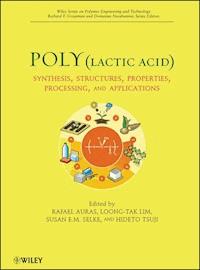
Poly(lactic acid) E-Book
145,99 €
Mehr erfahren.
- Herausgeber: John Wiley & Sons
- Kategorie: Fachliteratur
- Serie: Wiley Series on Plastics Engineering and Technology
- Sprache: Englisch
This book describes the synthesis, properties, and processing methods of poly(lactic acid) (PLA), an important family of degradable plastics. As the need for environmentally-friendly packaging materials increases, consumers and companies are in search for new materials that are largely produced from renewable resources, and are recyclable. To that end, an overall theme of the book is the biodegradability, recycling, and sustainability benefits of PLA. The chapters, from a base of international expert contributors, describe specific processing methods, spectroscopy techniques for PLA analysis, and and applications in medical items, packaging, and environmental use.
Sie lesen das E-Book in den Legimi-Apps auf:
Seitenzahl: 1425
Veröffentlichungsjahr: 2011
Ähnliche




















Contents
Cover
Wiley Series on Polymer Engineering and Technology
Title Page
Copyright
Preface
References
Contributors
Part I: Chemistry and Production of Lactic Acid, Lactide, and Poly(Lactic Acid)
Chapter 1: Production and Purification of Lactic Acid and Lactide
1.1 Introduction
1.2 Lactic Acid
1.3 Lactide
References
Chapter 2: Chemistry and Thermodynamic Properties of Lactic Acid and Lactide and Solvent Miscibility
2.1 General Properties
2.2 Thermodynamic Properties
2.3 Miscibility Properties of Lactic Acid and Lactide
References
Chapter 3: Industrial Production of High Molecular Weight Poly(Lactic Acid)
3.1 Introduction
3.2 Lactic Acid Based Polymers by Polycondensation
3.3 Lactic Acid Based Polymers by Chain Extension
3.4 Lactic Acid Based Polymers by Ring-Opening Polymerization
References
Chapter 4: Design and Synthesis of Different Types of Poly(Lactic Acid)
4.1 Introduction
4.2 Copolymerization
4.3 Properties of Copolymers
References
Chapter 5: Structure and Properties of Stereocomplex-Type Poly(lactic acid)
5.1 Introduction
5.2 Formation of Stereocomplex Crystals
5.3 Thermal Properties of sc-PLA
5.4 Crystal Structure of sc-PLA
5.5 Formation of sb-PLA
5.6 Applications of sc-PLA
References
Part II: Properties of Poly(Lactic Acid)
Chapter 6: Chemical Structure of Poly(lactic acid)
6.1 Introduction
6.2 Chain Structure and Configuration
6.3 Syndiotactic Polymerization and Syndiotacticity
6.4 Conformation
6.5 Amorphous Structure and Thermal Properties
6.6 Orientation Structure of PLA
6.7 Semicrystalline Structure
6.8 Frustrated Structure
6.9 Molecular Weight
6.10 Summary
References
Chapter 7: Chemical Compatibility of Poly(lactic acid): A Practical Framework Using Hansen Solubility Parameters
7.1 A Practical Framework
7.2 Solvent Compatibility
7.3 Plasticizers
7.4 Polymer Compatibility
7.5 Environmental Stress Cracking
7.6 Rational Composite Design
7.7 Diffusion and Barrier Properties
7.8 Pharmacological Transport
7.9 Summary
References
Chapter 8: Optical Properties
8.1 Introduction
8.2 Absorption and Transmission of UV–Vis Radiation
8.3 Refractive Index
8.4 Specific Optical Rotation
8.5 Infrared and Raman Spectroscopy
8.6 1H and 13C NMR Spectroscopy
References
Chapter 9: Crystallization and Thermal Properties
9.1 Introduction
9.2 Crystallinity and Crystallization
9.3 Crystallization Regime
9.4 Fibers
9.5 Hydrolytic Degradation
References
Chapter 10: Rheology of Poly(lactic acid)
10.1 Introduction
10.2 Fundamental Chain Properties from Dilute Solution Viscometry
10.3 Processing of PLA: General Considerations
10.4 Melt Rheology: An Overview
10.5 Processing of PLA: Rheological Properties
10.6 Conclusions
Appendix 10.A Description of the Software
References
Chapter 11: Mechanical Properties
11.1 Introduction
11.2 General Mechanical Properties and Molecular Weight Effect
11.3 Temperature Effect
11.4 Annealing
11.5 Orientation
11.6 Stereoregularity
11.7 Plasticization
11.8 Relaxation and Aging
11.9 Conclusions
References
Chapter 12: Permeation, Sorption, and Diffusion in Poly(lactic acid)
12.1 Introduction
12.2 Factors Affecting Permeability, Sorption, and Diffusion in PLA
12.3 Permeability, Sorption, and Diffusion of Pure PLA
12.4 Copolymers
12.5 PLA Blends
12.6 PLA Laminations
12.7 Coated PLA
12.8 PLA Composites and Fibers
12.9 PLA Nanocomposites
12.10 Future of PLA Membranes
References
Chapter 13: Migration
13.1 Migration Principles
13.2 Legislation
13.3 Migration and Toxicological Data of Lactic Acid, Lactide, Dimers, and Oligomers
13.4 EDI of Lactic Acid
13.5 Other Potential Migrants from PLA
13.6 Conclusions
References
Part III: Processing and Conversion of Poly(Lactic Acid)
Chapter 14: Processing of Poly(lactic acid)
14.1 Introduction
14.2 Properties of PLA Relevant to Processing
14.3 Modification of PLA Properties by Process Aids and Other Additives
14.4 Drying
14.5 Extrusion
14.6 Injection Molding
14.7 Film and Sheet Casting
14.8 Stretch Blow Molding
14.9 Extrusion Blown Film
14.10 Thermoforming
14.11 Electrospinning
14.12 Conclusion: Prospects of PLA Polymers
References
Chapter 15: Poly(lactic acid)/Starch Blends
15.1 Introduction
15.2 Blending Hydrophobic PLA with Hydrophilic Starch
15.3 Compatibilizers Used for Starch/PLA Blends
15.4 Enhancing Function of Compatibilizer by Controlling Compatibilizer Distribution
15.5 Reactive Blending
15.6 Summary
References
Chapter 16: Poly(lactic acid) Blends
16.1 Introduction
16.2 PLA/Nonbiodegradable Polymer Blends
16.3 PLA/Biodegradable Polymer Blends
16.4 Plasticization of PLA
16.5 Conclusion
References
Chapter 17: Foaming
17.1 Introduction
17.2 Plastic Foams
17.3 Foaming Agents
17.4 Formation of Cellular Plastics
17.5 Plastic Foams Expanded with Physical Foaming Agents
17.6 PLA Foamed with Chemical Foaming Agents
17.7 Mechanical Properties of PLA Foams
17.8 Foaming of PLA/Starch Blends
References
Chapter 18: Composites
18.1 Introduction
18.2 PLA Matrix
18.3 Reinforcements
18.4 Fiber/Matrix Adhesion
18.5 PLA Nanocomposites
18.6 Processing
18.7 Properties
18.8 Applications
18.9 Future Developments and Concluding Remarks
References
Chapter 19: Nanocomposites
19.1 Introduction
19.2 PLA Nanocomposites Based on Clay
19.3 PLA Nanocomposites Based on Carbon Nanotubes
19.4 PLA Nanocomposites Based on Various Other Nanoparticles
19.5 Properties of PLA-Based Nanocomposites
19.6 Biodegradability
19.7 Melt Rheology
19.8 Foam Processing
19.9 Possible Applications and Future Prospects
Acknowledgments
References
Chapter 20: Spinning of Poly(lactic acid) Fibers
20.1 Defining Fiber and Fiber Spinning
20.2 Melt Spinning Line
20.3 Fluid Dynamics During Spinning
20.4 Structure Development During Melt Spinning
20.5 Post-Spinning Operation
20.6 Structure Development During Drawing
20.7 Solution Spinning of PLLA
20.8 Mechanical Properties
References
Part IV: Degradation and Environmental Issues
Chapter 21: Hydrolytic Degradation
21.1 Introduction
21.2 Degradation Mechanism
21.3 Parameters for Hydrolytic Degradation
21.4 Structural and Property Changes During Hydrolytic Degradation
21.5 Applications of Hydrolytic Degradation
21.6 Conclusions
References
Chapter 22: Enzymatic Degradation
22.1 Introduction
22.2 Enzymatic Degradation of PLA Films
22.3 Enzymatic Degradation of Thin Films
22.4 Enzymatic Degradation of Lamellar Crystals
22.5 Future Perspectives
References
Chapter 23: Thermal Degradation
23.1 Introduction
23.2 Kinetic Analysis of Thermal Degradation
23.3 Thermal Degradation Behavior of PLA Based on Molecular Weight Change
23.4 Thermal Degradation Behavior of PLA Based on Weight Loss
23.5 Conclusions
References
Chapter 24: Photodegradation and Radiation Degradation
24.1 Introduction
24.2 Mechanisms of Photodegradation
24.3 Mechanism of Radiation Degradation
24.4 Photodegradation of PLA
24.5 Photosensitized Degradation of PLA
24.6 Radiation Effects on PLA
24.7 Modification of PLA by Irradiation
References
Chapter 25: Biodegradation
25.1 Introduction
25.2 Microbial Degradation
25.3 Poly(L-lactide) Degrading Enzymes
25.4 Conclusion and Future Prospects
References
Chapter 26: Cradle to Gate Environmental Footprint and Life Cycle Assessment of Poly(lactic acid)
26.1 Introduction to LCA and Environmental Footprints
26.2 Life Cycle Considerations for PLA
26.3 Review of Biopolymer LCA Studies
26.4 Improving PLA's Environmental Footprint
26.5 Further Reading on LCA
References
Part V: Applications
Chapter 27: Medical Applications
27.1 Introduction
27.2 Minimal Requirements for Medical Devices
27.3 Preclinical and Clinical Applications of PLA Devices
27.4 Conclusions
References
Chapter 28: Packaging and Other Commercial Applications
28.1 Introduction
28.2 Applications in Packaging and Containers
28.3 Other Commercial Applications
28.4 Conclusions
References
Chapter 29: Textile Applications
29.1 Introduction
29.2 Manufacturing, Properties, and Structure of PLA Fibers
29.3 Key Performance Features of PLA Fibers
29.4 Potential Applications
29.5 Conclusions
References
Chapter 30: Environmental Applications
30.1 Introduction
30.2 Application to Water and Wastewater Treatment
30.3 Application to Bioremediation
30.4 Concluding Remarks and Prospects
Acknowledgments
References
Index
Wiley Series on Polymer Engineering and Technology
Richard F. Grossman and Domasius Nwabunma, Series Editors
Polyolefin Blends
Edited by Domasius Nwabunma and Thein Kyu
Polyolefin Composites
Edited by Domasius Nwabunma and Thein Kyu
Handbook of Vinyl Formulating, Second Edition
Edited by Richard F. Grossman
Total Quality Process Control for Injection Molding, Second Edition
M. Joseph Gordon, Jr.
Microcellular Injection Molding
Jingyi Xu
Poly(lactic acid): Synthesis, Structures, Properties, Processing, and Applications
Edited by Rafael Auras, Loong-Tak Lim, Susan E.M. Selke, and Hideto Tsuji
Copyright © 2010 John Wiley & Sons, Inc. All rights reserved.
Published by John Wiley & Sons, Inc., Hoboken, New Jersey
Published simultaneously in Canada
No part of this publication may be reproduced, stored in a retrieval system, or transmitted in any form or by any means, electronic, mechanical, photocopying, recording, scanning, or otherwise, except as permitted under Section 107 or 108 of the 1976 United States Copyright Act, without either the prior written permission of the Publisher, or authorization through payment of the appropriate per-copy fee to the Copyright Clearance Center, Inc., 222 Rosewood Drive, Danvers, MA 01923, (978) 750-8400, fax (978) 750-4470, or on the web at www.copyright.com. Requests to the Publisher for permission should be addressed to the Permissions Department, John Wiley & Sons, Inc., 111 River Street, Hoboken, NJ 07030, (201) 748-6011, fax (201) 748-6008, or online at http://www.wiley.com/go/permission.
Limit of Liability/Disclaimer of Warranty: While the publisher and author have used their best efforts in preparing this book, they make no representations or warranties with respect to the accuracy or completeness of the contents of this book and specifically disclaim any implied warranties of merchantability or fitness for a particular purpose. No warranty may be created or extended by sales representatives or written sales materials. The advice and strategies contained herein may not be suitable for your situation. You should consult with a professional where appropriate. Neither the publisher nor author shall be liable for any loss of profit or any other commercial damages, including but not limited to special, incidental, consequential, or other damages.
For general information on our other products and services or for technical support, please contact our Customer Care Department within the United States at (800) 762-2974, outside the United States at (317) 572-3993 or fax (317) 572-4002.
Wiley also publishes its books in a variety of electronic formats. Some content that appears in print may not be available in electronic formats. For more information about Wiley products, visit our web site at www.wiley.com.
Library of Congress Cataloging-in-Publication Data:
Poly(lactic acid): synthesis, structures, properties, processing, and applications/ edited by Rafael Auras . . . [et al.].
p. cm.
Includes index.
ISBN 978-0-470-29366-9 (cloth)
1. Biodegradable plastics. 2. Lactic acid. 3. Polymers. I. Auras, Rafael.
TP1180.B55P65 2010
620.1'92323–dc22
2010006494
Preface
Poly(lactic acid) (PLA) cannot be considered as a new polymer. As early as 1845, PLA was synthesized by Théophile-Jules Pelouze by the condensation of lactic acid [1]. In 1932, Wallace Hume Carothers et al. developed a method to polymerize lactide to produce PLA that was later patented by DuPont in 1954 [2]. Although PLA existed for several decades, its use was limited to biomedical applications (e.g., biocompatible sutures, implants, biologically active controlled release devices) due to its high cost. The low molecular weight PLA polymers obtained also hampered their wide-ranging applications. The breakthrough occurred in the early 1990s when Cargill Inc. succeeded in polymerizing high molecular weight PLA using a commercially viable lactide ring opening reaction [3, 4]. In 1997, Cargill Dow LLC, a joint venture between Cargill Inc. and The Dow Chemical Company, was formed to begin truly commercially significant production of PLA resins under the trade name NatureWorks™. This is a major landmark in PLA's history because it signifies the beginning of a large-scale use of this bio-based polymer, transforming PLA from a specialty material to a commodity thermoplastic.
The increased availability of PLA stimulated an increased in its research and development activities. A survey of the literature revealed that the number of published articles related to PLA increased exponentially over the past decade, which can be also partly attributed to the escalating “green” movement that is stimulating the use of bio-based polymers. To date, the major PLA resin suppliers have been Cargill (in the United States known as Ingeo™), Mitsui Chemicals, Inc. (in Japan known as LACEA™), Purac (The Netherlands), and Teijin Limited (in Japan known as Biofront®). Other important events that took place pertaining to PLA are summarized in Figure P.1 and Table P.1.
Figure P.1 Number of works published since 1960 based on Scholars Portal Search (accessed on 28 Dec 09) using keywords “polylactide”, “poly(lactic acid)”, and “polylactic acid”.
Table P.1 Significant Events Related to PLA Production that Occurred over the Past Few Decades.
2010Jung et al. employed recombinant Escherichia coli to produce PLA [5]2009PURAC, Sulzer, and Synbra announced production of PLA from solid lactide for foamed products2009Galactic and Total Petrochemicals from Belgium created a joint venture, Futerro, to begin PLA production2009Cargill Inc. acquired full NatureWorks ownership from Teijin Limited2008Uhde Inventa Fischer and Pyramide Bioplastics announced large-scale production of PLA in Guben, Germany2008PURAC started to commercialize solid lactide monomers under PURALACT™2007Teijin launched heat-resistant stereocomplex PLA under Biofront™2007NatureWorks LLC and Teijin Limited formed 50–50 joint venture to market Ingeo™ bio-based thermoplastic resins2005Cargill Inc. acquired The Dow Chemical Company's share in Cargill Dow LLC 50–50 joint venture2003Toyota produced and developed PLA for automotive applications1997Formation of Cargill Dow LLC, a 50–50 joint venture of Cargill Inc. and The Dow Chemical Company, to commercialize PLA under the trade name NatureWorks™1997Fiberweb (now BBA, France) introduced melt-blown and spun-laid PLA fabrics under Deposa™ brand name1996Mitsui Chemicals, Inc. commercialized PLA produced by polycondensation route1994Kanebo Ltd. introduced Lactron® PLLA fiber and spun-laid nonwovensWhile the information available in the literature is massive, at the inception of this volume, no reference book could be found that coherently assembled the scientific and technological knowledge about PLA. Our main motive for editing this book was to consolidate the most relevant information on PLA into a volume that serves as a one-source reference for readers who are keen on this unique biodegradable polymer.
Organized in five parts, Part I of this book covers several important topics, including chemistry and production of lactic acid (Chapter 1) and lactide (Chapter 2), which are the essential building blocks of PLA. Different polymerization reactions for the production of PLA are covered in Chapter 3. In view of certain shortcomings of PLA, copolymerization of PLA with other monomers and stereocomplexation with optimal enantiomer lactide ratios are gaining increased popularity as ways to enhance the material properties of the resulting polymer. These topics are covered in detail in Chapters 4 and 5, respectively. These chapters set the stage for discussions in Part II of this book, in which different material properties of PLA are covered in eight separate chapters. Chain configuration, tacticity, and crystal structure are discussed in Chapter 6 to illuminate how chain structure affects the material properties of PLA and its copolymers. Chapter 7 investigates the compatibility of PLA with solvents and other polymers, an important aspect that should be considered during end-use applications. The interaction of PLA with electromagnetic radiation for probing the molecular structure and interactions are discussed in Chapter 8. The essence of spectroscopy techniques for PLA analysis, including UV–VIS, FTIR, Raman, and NMR, is reviewed in this chapter. Crystallization, thermal, and rheological properties of PLA are discussed in Chapters 9 and 10, and these are important to elucidate the melt processing phenomena of PLA. In the remainder of Part II, Chapters 11, 12, and 13 deal with the mechanical, permeability, and migration behaviors of PLA, respectively, and will serve as handy references for designing and engineering PLA products for various end-use applications. In Part III, seven chapters are devoted to summarizing the state of the art of processing and conversion technologies for PLA, covering topics such as extrusion and molding (Chapter 14), polymer blending (Chapters 15 and 16), foaming (Chapter 17), preparation of micro- and nanocomposites (Chapters 18 and 19), and fiber spinning (Chapter 20). One of the hallmarks of PLA polymers is that they are degradable, which has been viewed as an attractive feature for certain applications. In Part IV, six chapters are included to discuss in great detail the various degradation modes of PLA, including hydrolytic degradation (Chapter 21), enzymatic degradation (Chapter 22), thermal degradation (Chapter 23), photodegradation (Chapter 25), and biodegradation (Chapter 25). This part ends with Chapter 26 in which the life cycle assessment and the environmental footprint of PLA are objectively discussed. Finally, in Part V, various applications for PLA are discussed, including medical items (Chapter 27), packaging (Chapter 28), textiles (Chapter 29), and environment-related applications (Chapter 30). Rather than eliminating all duplicate materials between chapters, we deliberately allowed some overlap in discussions to enable the chapters to stand alone to some extent.
This volume skillfully brings together the work of many contributors who are experts in their respective research areas. This volume would not have been possible without their help and contributions. We are indebted to them for their participation and patience during the preparation of this book and are grateful that they have entrusted us to edit their contributions as per the requirements of each chapter. We hope that readers will find this book useful. We are looking forward to receiving comments and constructive feedback regarding the content of this book [5]. Finally, we are indebted to our three academic institutions, Michigan State University, University of Guelph, and Toyohashi University of Technology, for allowing us to dedicate our effort and time to the completion of this edited book. Our most grateful thanks are to our colleagues for providing a sounding board to discuss ideas and explore new concepts about biodegradable polymers and materials in general; to our editor at John Wiley & Sons, Inc., Jonathan T. Rose, for supporting this proposal, and walking us through its completion; to Lisa Van Horn for coordinating the production of the book; and to Sanchari Sil, our project manager at Thomson Digital, for her invaluable patience to in answering our endless questions about the final proofing of the book. Overall, we could not put our effort into this task without the unconditional support of our families, so that our most special thanks go to all of them.
References
1. H. Benninga, A History of Lactic Acid Making, Springer, New York, 1990.
2. W. H. Carothers, G. L. Dorough, F. J. van Natta. J. Am. Chem. Soc. 1932, 54, 761–772.
3. P. R. Gruber, E. S. Hall, J. J. Kolstad, M. L. Iwen, R. D. Benson, R. L. Borchardt, U.S. Patent 6,326,458, 2001.
4. P. R. Gruber, E. S. Hall, J. J. Kolstad, M. L. Iwen, R. D. Benson, R. L. Borchardt, U.S. Patent 5,357,035, 1994.
5. Y. K. Jung, T. Y. Kim, S. J. Park, S. Y. Lee, Biotechnol. Bioeng. 2010, 105, 161–171.
RAFAEL AURAS
East Lansing, Michigan
LOONG-TAK LIM
Guelph, Ontario, Canada
SUSAN E. M. SELKE
East Lansing, Michigan
HIDETO TSUJI
Toyohashi, Aichi, JapanMay 2010
Contributors
Steven Abbott, Steven Abbott TCNF Ltd., Ipswich, England
Hideki Abe, Chemical Analysis Team, RIKEN Institute, Saitama, Japan
Seiichi Aiba, National Institute of Advanced Industrial Science and Technology (AIST), Tsukuba, Ibaraki, Japan
Ashwini K. Agrawal, SMITA Labs, Department of Textile Technology, Indian Institute of Technology, New Delhi, India
Ann-Christine Albertsson, Department of Fiber and Polymer Technology, Royal Institute of Technology, Stockholm, Sweden
Eva Almenar, School of Packaging, Michigan State University, East Lansing, Michigan
Rafael Auras, School of Packaging, Michigan State University, East Lansing, Michigan
Sanchita Bandyopadhyay-Ghosh, Center for Biocomposites and Biomaterials Processing, Faculty of Forestry, University of Toronto, Toronto, Ontario, Canada
Buenaventurada P. Calabia, National Institute of Advanced Industrial Science and Technology (AIST), Tsukuba, Ibaraki, Japan
Gian Domenico Cella, Novamont SpA, Novara, Italy
Kevin Cink, NatureWorks LLC, Minnetonka, Minnesota
João A. P. Coutinho, CICECO, Chemistry Department, University of Aveiro, Aveiro, Portugal
Katherine Dean, CSIRO, Materials Science and Engineering, Melbourne, Australia
Sukeewan Detyothin, School of Packaging, Michigan State University, East Lansing, Michigan; Department of Agroindustry, Faculty of Agriculture, Natural Resources and Environment, Naresuan University, Phitsanulok, Thailand
John R. Dorgan, Colorado School of Mines, Golden, Colorado
Luca Fambri, Department of Materials Engineering and Industrial Technologies and BIOtech Research Center, University of Trento, Trento, Italy
Anna Finne-Wistrand, Department of Fiber and Polymer Technology, Royal Institute of Technology, Stockholm, Sweden
Subrata Bandhu Ghosh, Center for Biocomposites and Biomaterials Processing, Faculty of Forestry, University of Toronto, Toronto, Ontario, Canada
Carla M. B. Gonçalves, CICECO, Chemistry Department, University of Aveiro, Aveiro, Portugal
Wim Groot, PURAC, Gorinchem, The Netherlands
Akira Hiraishi, Department of Environmental and Life Sciences, Graduate School of Engineering, Toyohashi University of Technology, Toyohashi, Aichi, Japan
Masayuki Hirata, Department of Biomolecular Engineering, Center for Fiber and Textile Science, Kyoto Institute of Technology, Kyoto, Japan
Dan Huang, Key Laboratory of Eco-textiles of Ministry of Education, College of Textile and Clothing, Jiangnan University, Wuxi, China
Yoshito Ikada, Faculty of Medicine, Nara Medical University, Nara, Japan
Tadahisa Iwata, Department of Biomaterial Sciences, Graduate School of Agricultural and Life Sciences, The University of Tokyo, Tokyo, Japan
Waree Jaruwattanayon, School of Packaging, Michigan State University, East Lansing, Michigan; Thai Packaging Center, Thailand Institute of Scientific and Technological Research, Bangkok, Thailand
Xue Jiang, Key Laboratory of Eco-textiles of Ministry of Education, College of Textile and Clothing, Jiangnan University, Wuxi, China
Zhengyu Jin, School of Food Science and Technology, Jiangnan University, Wuxi, China
Ajay Kathuria, School of Packaging, Michigan State University, East Lansing, Michigan
Yoshihiro Kikkawa, Photonics Research Institute, National Institute of Advanced Industrial Science and Technology (AIST), Tsukuba, Ibaraki, Japan
Yoshiharu Kimura, Department of Biobased Materials Science, Center for Fiber and Textile Science, Kyoto Institute of Technology, Kyoto, Japan
Kamlesh Kumar, Center for Polymer Science and Engineering, Indian Institute of Technology, New Delhi, India
Amy E. Landis, Department of Civil and Environmental Engineering, Swanson School of Engineering, University of Pittsburgh, Pittsburgh, Pennsylvania
Loong-Tak Lim, Department of Food Science, University of Guelph, Guelph, Ontario, Canada
Hongshen Liu, CSIRO, Materials Science and Engineering, Melbourne, Australia; Center for Polymer from Renewable Resources, SCUT, Guangzhou, China
Bimlesh Lochab, Center for Polymer Science and Engineering, Indian Institute of Technology, New Delhi, India
Yan Luo, Department of Applied Chemistry, College of Chemistry, Chemical Engineering and Biotechnology, Donghua University, Shanghai, China
Isabel M. Marrucho, CICECO, Chemistry Department, University of Aveiro, Aveiro, Portugal; Instituto de Tecnologia Química e Biológica, ITQB2, Universidade Nova de Lisboa, Oeiras, Portugal
Laurent M. Matuana, School of Packaging, Michigan State University, East Lansing, Michigan
Claudio Migliaresi, Department of Materials Engineering and Industrial Technologies and BIOtech Research Center, University of Trento, Trento, Italy
Masatsugu Mochizuki, Center for Fiber and Textile Science, Kyoto Institute of Technology, Kyoto, Japan
Haruo Nishida, Eco-Town Collaborative R&D Center for the Environment and Recycling, Kyushu Institute of Technology, Fukuoka, Japan
Shoji Obuchi, Materials Laboratory, Mitsui Chemicals, Inc., Chiba, Japan
Shinji Ogawa, Process Technology Center, Mitsui Chemicals, Inc., Chiba, Japan
Gabriele Perego, Vanadis Srl, Colleretto Giacosa, Italy
Eustathios Petinakis, CSIRO, Materials Science and Engineering, Melbourne, Australia
Narendra Reddy, Department of Textiles, Clothing and Design, University of Nebraska-Lincoln, Lincoln, Nebraska
Mohini Sain, Center for Biocomposites and Biomaterials Processing, Faculty of Forestry, University of Toronto, Toronto, Ontario, Canada
Wataru Sakai, Macromolecular Science and Engineering, Kyoto Institute of Technology, Kyoto, Japan
Susan E. M. Selke, School of Packaging, Michigan State University, East Lansing, Michigan
Suprakas Sinha Ray, DST/CSIR Nanotechnology Innovation Center, National Center for Nano-Structured Materials, Council for Scientific and Industrial Research, Pretoria, Gauteng, Republic of South Africa
Olav Sliekers, PURAC, Gorinchem, The Netherlands
Herlinda Soto-Valdez, Centro de Investigación en Alimentació y Desarrollo A.C., Hermosillo, Sonora, México
Anders Södergaå rd, Laboratory of Polymer Technology, Åbo Akademi University, Turku, Finland
Mikael Stolt, Laboratory of Polymer Technology, Åbo Akademi University, Turku, Finland
Shuko Suzuki, Faculty of Medicine, Nara Medical University, Nara, Japan
Yaoqi Tian, School of Food Science and Technology, Jiangnan University, Wuxi, China
Xiuzhi Tian, Key Laboratory of Eco-textiles of Ministry of Education, College of Textile and Clothing, Jiangnan University, Wuxi, China
Yutaka Tokiwa, Okinawa Industrial Technology Center, Uruma, Okinawa, Japan
Hideto Tsuji, Department of Environmental and Life Sciences, Graduate School of Engineering, Toyohashi University of Technology, Toyohashi, Aichi, Japan
Naoto Tsutsumi, Macromolecular Science and Engineering, Kyoto Institute of Technology, Kyoto, Japan
Charles U. Ugwu, Okinawa Industrial Technology Center, Uruma, Okinawa, Japan
Jan van Krieken, PURAC, Gorinchem, The Netherlands
Tim Vanyo, NatureWorks LLC, Minnetonka, Minnesota
Indra Kumari Varma, Center for Polymer Science and Engineering, Indian Institute of Technology, New Delhi, India
Sicco de Vos, PURAC, Gorinchem, The Netherlands
Jinpeng Wang, School of Food Science and Technology, Jiangnan University, Wuxi, China
Yiqi Yang, Department of Textiles, Clothing and Design and Department of Biological Systems Engineering, University of Nebraska-Lincoln, Lincoln, Nebraska
Long Yu, CSIRO, Materials Science and Engineering, Melbourne, Australia; Center for Polymer from Renewable Resources, SCUT, Guangzhou, China
Part I
Chemistry and Production of Lactic Acid, Lactide, and Poly(Lactic Acid)
Chapter 1
Production and Purification of Lactic Acid and Lactide
Wim Groot, Jan van Krieken, Olav Sliekersl, and Sicco de Vos
1.1 Introduction
Natural polymers, biopolymers, and synthetic polymers based on annually renewable resources are the basis for the twenty-first-century portfolio of sustainable, eco-efficient plastics [1]. These biosourced materials will gradually replace the currently existing family of oil-based polymers as they become cost- and performance-wise competitive. Polylactide or poly(lactic acid) (PLA) is the front runner in the emerging bioplastics market with the best availability and the most attractive cost structure. The production of the aliphatic polyester from lactic acid, a naturally occurring acid and bulk produced food additive, is relatively straightforward. PLA is a thermoplastic material with rigidity and clarity similar to polystyrene (PS) or poly(ethylene terephthalate) (PET). End uses of PLA are in rigid packaging, flexible film packaging, cold drink cups, cutlery, apparel and staple fiber, bottles, injection molded products, extrusion coating, and so on [2]. PLA is bio-based, resorbable, and biodegradable under industrial composting conditions [1, 3, 4].
PLA can be produced by condensation polymerization directly from its basic building block lactic acid, which is derived by fermentation of sugars from carbohydrate sources such as corn, sugarcane, or tapioca, as will be discussed later in this chapter. Most commercial routes, however, utilize the more efficient conversion of lactide—the cyclic dimer of lactic acid—to PLA via ring-opening polymerization (ROP) catalyzed by a Sn(II)-based catalyst rather than polycondensation [2–6]. Both polymerization concepts rely on highly concentrated polymer-grade lactic acid of excellent quality for the production of high molecular weight polymers in high yield [2–4, 7].
Purification of lactic acid produced by industrial bacterial fermentation is therefore of decisive importance because crude lactic acid contains many impurities such as acids, alcohols, esters, metals, and traces of sugars and nutrients [4].
The lactide monomer for PLA is obtained from catalytic depolymerization of short PLA chains under reduced pressure [4]. This prepolymer is produced by dehydration and polycondensation of lactic acid under vacuum at high temperature. After purification, lactide is used for the production of PLA and lactide copolymers by ROP, which is conducted in bulk at temperatures above the melting point of the lactides and below temperatures that cause degradation of the formed PLA [4].
Processing, crystallization, and degradation behavior of PLA all depend on the structure and composition of the polymer chains, in particular the ratio of the L- to the D-isomer of lactic acid [2, 4, 6, 8, 9]. This stereochemical structure of PLA can be modified by copolymerization of mixtures of L-lactide and -, D-, or -lactide resulting in high molecular weight amorphous or semicrystalline polymers with a melting point in the range from 130 to 185°C [3, 4, 6–10].
Lesen Sie weiter in der vollständigen Ausgabe!
Lesen Sie weiter in der vollständigen Ausgabe!
Lesen Sie weiter in der vollständigen Ausgabe!
Lesen Sie weiter in der vollständigen Ausgabe!
Lesen Sie weiter in der vollständigen Ausgabe!
Lesen Sie weiter in der vollständigen Ausgabe!
Lesen Sie weiter in der vollständigen Ausgabe!
Lesen Sie weiter in der vollständigen Ausgabe!
Lesen Sie weiter in der vollständigen Ausgabe!
Lesen Sie weiter in der vollständigen Ausgabe!
Lesen Sie weiter in der vollständigen Ausgabe!
Lesen Sie weiter in der vollständigen Ausgabe!
Lesen Sie weiter in der vollständigen Ausgabe!
Lesen Sie weiter in der vollständigen Ausgabe!
Lesen Sie weiter in der vollständigen Ausgabe!
Lesen Sie weiter in der vollständigen Ausgabe!
Lesen Sie weiter in der vollständigen Ausgabe!
Lesen Sie weiter in der vollständigen Ausgabe!
Lesen Sie weiter in der vollständigen Ausgabe!
Lesen Sie weiter in der vollständigen Ausgabe!
Lesen Sie weiter in der vollständigen Ausgabe!
Lesen Sie weiter in der vollständigen Ausgabe!
Lesen Sie weiter in der vollständigen Ausgabe!
Lesen Sie weiter in der vollständigen Ausgabe!
Lesen Sie weiter in der vollständigen Ausgabe!
Lesen Sie weiter in der vollständigen Ausgabe!
Lesen Sie weiter in der vollständigen Ausgabe!
Lesen Sie weiter in der vollständigen Ausgabe!
Lesen Sie weiter in der vollständigen Ausgabe!
Lesen Sie weiter in der vollständigen Ausgabe!
Lesen Sie weiter in der vollständigen Ausgabe!
Lesen Sie weiter in der vollständigen Ausgabe!
Lesen Sie weiter in der vollständigen Ausgabe!
Lesen Sie weiter in der vollständigen Ausgabe!




