


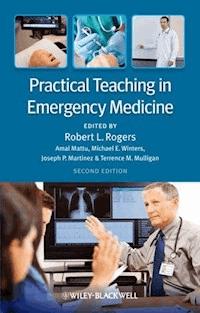
Practical Teaching in Emergency Medicine E-Book
62,99 €
Mehr erfahren.
- Herausgeber: John Wiley & Sons
- Kategorie: Fachliteratur
- Sprache: Englisch
Emergency medicine attendings who wish to hone their teaching skills can find a number of books on educational strategies written by physicians from other disciplines. However, until the publication of the first edition of this book, they did not have access to a text written by emergency medicine physicians on methods of teaching that are directly applicable to teaching EM. This book was compiled to meet that need.
Following the introductory section, which provides important background information, the book’s contents are organized into 4 sections that correspond to the core needs and interests of EM educators: Section 2 focuses on practical and ethical considerations of teaching in the ED; Section 3 provides strategies for teaching specific groups of learners; Section 4 looks at the skills that are characteristic of the best EM educators; and Section 5 looks indepthly at specific teaching techniques and strategies.
Now more than ever this book addresses the needs of physician educators from all over the world. New chapters discuss lecturing to an international audience; using simulation as a teaching tool; how to make journal club work for you, and other topics that are of broad interest to medical educators in this field. In general, each chapter has been updated and reviewed to make sure the content was something that emergency physician educators could use in any country.
The chapter contributors are widely regarded as leaders in the field of emergency medicine education and faculty development. Authors were given free rein to develop their chapters and write in their own style. They were asked to present their personal views on how to successfully teach the art of emergency medicine, rather than review evidence-based guidelines regarding medical education. As a result, most of the chapters have few references. This first-person approach to a multi-authored textbook yields a compilation that varies in style from chapter to chapter and exposes the reader to a variety of communication techniques.
Sie lesen das E-Book in den Legimi-Apps auf:
Seitenzahl: 649
Veröffentlichungsjahr: 2012
Ähnliche




















Table of Contents
Title Page
Copyright
Dedication
Editors and Contributors
Preface
Section 1: Background/Introduction
Chapter 1: Adult Learners in The Emergency Department
Learning Theories
Learning as a Child
Learning as an Adult
Learning as an Adult—Malcolm Knowles' Theories and the Arguments Against Them
Educating Adults
Adult Learning in the Emergency Department
Conclusion
References
Chapter 2: Obstacles to Teaching in The Emergency Department
Obstacles Inherent in The Emergency Department
Conclusion
References
Chapter 3: Teaching and Patient Care in Emergency Medicine
Introduction
Motivation for Teaching Emergency Medicine
The Beginning Educator
The Seasoned Veteran
The Master Educator
The Benefits of Teaching in Emergency Medicine
Improving Patient Care and Safety
Conclusion
References
Chapter 4: Mentoring in Emergency Medicine
Mentor and Mentoring Defined
Why Mentoring is Important
Benefits of Mentorship
The Mentoring Process
Successful Mentors and Pitfalls of Mentoring
Role of Mentoring in Medical Education
Goals of Mentoring
Career Guidance
Summary
References
Section 2: Teaching in the Emergency Department and Beyond
Chapter 5: Bedside Teaching in The Emergency Department
What is Holding us Back: Barriers to Bedside Teaching
The Basics: Characteristics of Effective Bedside Teachers
The Framework: The Experience versus Explanation Cycle
Implementation: The Art of Bedside Questioning
Closure: Effective Feedback as It Relates to Bedside Teaching
Summary
References
Chapter 6: Teaching Invasive Medical Procedures
Prepare to Teach and Learn
The Process of Learning
Putting Theory Into Practice
Creating a Procedural Education Elective for Preclinical Medical Students
Assessing Competence
References
Chapter 7: Providing Feedback in The Emergency Department
Guidelines for Providing Effective Feedback
Additional Feedback Methods and Tools
Feedback and the Accreditation Process
Faculty/Trainee Development
Conclusion
References
Chapter 8: The Computer as a Teaching Tool
Improving Patient Care by Locating and Implementing Evidence-Based Clinical Guidelines
Performing an Effective and Efficient Evidence-Based Medicine Literature Search for Clinically Meaningful Answers During a Busy Shift
Improving Use and Interpretation of Diagnostic Imaging
Enhancing Systematic Interpretation of Electrocardiograms
Enhancing Understanding of Drug Toxicity, Interactions, and Treatment
Introducing a Systematic Approach to Describing Skin Lesions
Enhancing the Neurologic Examination, Understanding The NIH Stroke Scale, and Knowing The Indications/Contraindications for Tissue Plasminogen Activator for Stroke
Enhancing The Student's Use of Scoring Systems, Calculators, and Decision Rules to Provide the Basis for and Documentation of Care
Preventing Medical Error
Improving the Student's Understanding of Normal Changes in Pregnancy, Pregnancy Complications, Radiation Risks in Pregnancy, and Contraindications to Medications in Pregnancy
Reinforcing the Importance of Clear Communication and Use of Fluent Translators for Non-English-Speaking Patients
Understanding Uncertainty in Medicine
Using Online Video in Emergency Medicine
Online Spaced Education
Summary
References
Chapter 9: Educational Technology: Web 2.0
Introduction
“Really Simple Syndication” or “Rich Site Summary”
Wikis
Blogs
Microblogging
Podcasts
Social Networking
Learning Management Systems
Web-Based Applications
Social Media Risks
Conclusions
Recommended Reading
References
Chapter 10: Teaching the Intangibles: Professionalism and Interpersonal Skills/Communication
Communication and Professionalism
Recommendation 1: Establish and Evaluate Explicit Standards, Beginning with The Selection Process
Recommendation 2: Discuss The Benefits of Professionalism
Recommendation 3: Promote Openness to Continual Growth Through Feedback
Recommendation 4: Observe and Discuss Negative Encounters
Recommendation 5: Outline Key Components of a Patient Encounter, Including the Initial Introduction, Patient-Centered Interview, and Concluding the Visit
Recommendation 6: Promote Effective Leadership Through Positive Communication with All Members of the Health Care Team
Recommendation 7: Communicating Clearly, Respectfully, and Confidently with Consultants
Recommendation 12: Be the Role Model of Professionalism
Remediation of Learners having Difficulty with Professionalism and Communication
Conclusion
References
Chapter 11: Teaching Lifelong Learning Skills: Journal Club and Beyond
Incorporation of Research-Enhanced Practice Into Graduate Medical Education
Worldwide Access to Biomedical Information via The Internet
Characteristics of Poor Evidence-Based Medicine/Journal Club Curricula
Attributes of the Successful Evidence-Based Medicine Curriculum and Journal Club
Conclusions
References
Chapter 12: Medical Podcasting 101
Summary
Further Reading
Chapter 13: Use of Simulation in Emergency Department Education
History of Simulation in Education
Why Use Simulation?
Basic Simulation Tools
How to Set Up a Simulation Program
Debriefing
Assessment
Challenges to Simulation
Conclusion
Section 3: Teaching Specific Groups
Chapter 14: Teaching Medical Students
Reasons to Teach Medical Students
Unique Educational Experiences During an Emergency Medicine Rotation
Qualities of an Effective Teacher
Adult Learner Themes
Educational Curricular Components
Clinical Teaching
Techniques for Overwhelmed Students
References
Chapter 15: Teaching Residents from Other Services in The Emergency Department
Introduction
Advantages of having Off-Service Residents in the Emergency Department
Suggested Educational Goals
Models for Teaching Off-Service Residents
Practical Tips to Improve Models of Teaching
Conclusion
References
Chapter 16: The Education of Resident Physicians in Emergency Medicine
Emergency Medicine Residency Infrastructure and Support
The Core Competencies
Paradigms for Teaching Residents
Tailoring the Individual Resident Experience
International Considerations
Conclusion
References
Chapter 17: Teaching Residents How to Teach
Starting The Shift: Expectations and Enthusiasm
Assessment
Capturing Observations and Organizing Patient Care as A Teacher
Conclusion
References
Chapter 18: Teaching to An International Audience
Background
Technical Considerations for Teaching International Audience
Style Considerations
Thematic Considerations
Context and Content Considerations
References
Chapter 19: The Emergency Department Consultation: Teaching Physician–Physician Communication to Improve Patient Outcomes
Introduction
Importance of Consultations
Taxonomy of Consultation
Barriers to Successful Consultations and Communication
Improving Communication in the Emergency Department
Approaches to Consultations in the Emergency Department
Future of Consultations
References
Section 4: Improving as an Educator in Emergency Medicine
Chapter 20: Characteristics of Great Teachers
What Do Learners Want From Their Teachers?
What Do Medical Educators Believe are the Characteristics of Great Teachers?
What Styles and Strategies Do Great Teachers Use?
What Are The Barriers To (And The Solutions For) Successful Teaching?
Conclusion
References
Chapter 21: Effective Presentation Skills
Introduction
10 Principles for Becoming a Memorable Speaker
Now That You Have Got It All Together: Practice, Practice, Practice
Conclusion
References
Chapter 22: Small-Group Discussion Skills
Opportunities for Use of Small Groups
Types of Small Groups
Characteristics and Techniques of A Good Facilitator
Starting A Small-Group Discussion
Challenges of Small-Group Discussions and Their Solutions
Assessing the Discussion
Conclusion
References
Chapter 23: Faculty Development As A Guide To Becoming A Better Teacher
Definitions of Faculty Development
Practicing in An Academic Setting
Necessary Knowledge and Skills
Clinicians as Teachers
Process for Faculty Development
Developing a Customized Program
Finding Resources
Promotion
Conclusions
References
Section 5: Teaching Techniques and Strategies
Chapter 24: Strategies for Effective Clinical Emergency Department Teaching
Introduction
Strategies Versus Traits
Models to Guide Emergency Department Teaching
Diagnosing The Learner
Summary
References
Chapter 25: Pearls and Pitfalls in Teaching: What Works, What Does Not?
Introduction
Teach for the Right Reasons
Keep it Simple
Clarify Expectations
Learn What They Need To Learn
Teach, Do Not Taunt
Practice Safe Learning
Engage Your Learners
A Little Autonomy Goes A Long Way
What Are You Thinking?
Food For Thought
Conclusion
Index
This edition first published 2013 © 2013 by John Wiley & Sons, Ltd.
Wiley-Blackwell is an imprint of John Wiley & Sons, formed by the merger of Wiley's global Scientific, Technical and Medical business with Blackwell Publishing.
Registered office: John Wiley & Sons, Ltd, The Atrium, Southern Gate, Chichester, West Sussex, PO19 8SQ, UK
Editorial offices: 9600 Garsington Road, Oxford, OX4 2DQ, UK
The Atrium, Southern Gate, Chichester, West Sussex, PO19 8SQ, UK
111 River Street, Hoboken, NJ 07030-5774, USA
For details of our global editorial offices, for customer services and for information about how to apply for permission to reuse the copyright material in this book please see our website at www.wiley.com/wiley-blackwell.
The right of the author to be identified as the author of this work has been asserted in accordance with the UK Copyright, Designs and Patents Act 1988.
All rights reserved. No part of this publication may be reproduced, stored in a retrieval system, or transmitted, in any form or by any means, electronic, mechanical, photocopying, recording or otherwise, except as permitted by the UK Copyright, Designs and Patents Act 1988, without the prior permission of the publisher.
Designations used by companies to distinguish their products are often claimed as trademarks. All brand names and product names used in this book are trade names, service marks, trademarks or registered trademarks of their respective owners. The publisher is not associated with any product or vendor mentioned in this book. This publication is designed to provide accurate and authoritative information in regard to the subject matter covered. It is sold on the understanding that the publisher is not engaged in rendering professional services. If professional advice or other expert assistance is required, the services of a competent professional should be sought.
Library of Congress Cataloging-in-Publication Data
Practical teaching in emergency medicine / chief editor, Robert L. Rogers ; associate editors, Amal Mattu … [et al.].— 2nd ed.
p. ; cm.
Includes bibliographical references and index.
ISBN 978-0-470-67111-5 (pbk.)
I. Rogers, Robert L. II. Mattu, Amal.
[DNLM: 1. Emergency Medicine— education. 2. Emergency Service, Hospital.
3. Teaching— methods. WX 18]
616.02′5— dc23
2012023221
A catalogue record for this book is available from the British Library.
Wiley also publishes its books in a variety of electronic formats. Some content that appears in print may not be available in electronic books.
First and foremost, this book is dedicated to my beautiful wife, Tricia, and my two wonderful children, Harrison and Gabriella. Without their love, guidance, and constant support, this book would not have been possible. Family comes first.
I dedicate this book to all of the educators of emergency medicine in USA and around the world: may this book inspire you to educate how to teach our craft and deliver the best patient care possible.
To the emergency medicine residents and students at the University of Maryland: you are the reason I drive to work with energy and enthusiasm for teaching.
I would like to thank my mom and dad for their encouragement and love throughout life. I am where I am today because of them.
To Linda Kesselring, who edited the book and transformed its contents into an amazing work. The success of this book is due in large part to her tireless efforts.
Rob L. Rogers
My thanks to my family for their constant support; my colleagues, residents, and students for their inspiration to teach and to learn; and to all those who spend their time teaching emergency medicine around the world … may your efforts continue to help our specialty flourish.
Amal Mattu
To the medical students and emergency medicine residents at the University of Maryland for making me look forward to my shifts and to Lisa, Nicholas, Dylan, and Luke for making me happy to go home.
Joseph P. Martinez
To Erika, Hayden, Emma, Taylor, and Olivia, for your endless love and support; you are my world and my inspiration for everything. To the emergency medicine residents and faculty at the University of Maryland, it is a privilege to be your colleague.
Michael E. Winters
I am very excited to be involved as coeditor for the second edition of Practical Teaching in Emergency Medicine. My involvement stems from the enormous interest and growth of emergency medicine education, practice and development in the international setting, and from the demand to share the contents of this book with the international emergency medicine community. I would like to offer my deepest thanks to my coeditors, especially Rob Rogers, without whom this material would most likely still reside in the collective minds of our teachers instead of in a book form. I would also like to thank my beautiful wife Kristina without whom I would not be able to do most anything.
Terrence M. Mulligan
Editors and Contributors
Chief Editor
Preface
Considering the success of the first edition of this book, I wondered what important elements could or should be added to the second edition to make it even better. The first edition is already very comprehensive and useful for the physician who wants to become a better educator and learn the skills necessary to teach emergency medicine. So, what could be added to make the book even better? Well, to make sure the book addresses the needs of physician–educators from all over the world, chapters on lecturing to an international audience, using simulation as a teaching tool, how to make journal club work for you, and many other topics were added to the book. Each chapter was updated and reviewed to make sure the content was something that emergency physician–educators could use in any country. This edition is even better than the first, and we sincerely hope that it helps you in your mission as an educator in one of the best specialties in the house of medicine.
The emergency department (ED) is one of the most interesting and rewarding teaching venues in the house of medicine. No other environment offers such a rich blend of undifferentiated patient presentations and diseases. However, because of this diversity, the ED is also one of the most difficult places to teach. Many of our patients are desperately ill, and we must often reset our priorities quickly to meet their clinical demands. In this environment, emergency medicine educators are challenged to provide quality education for medical students and physicians-in-training.
Emergency medicine attendings who wish to hone their teaching skills can find a number of textbooks on educational strategies written by physicians from other disciplines. However, until now, they have not had access to a text written by emergency medicine physicians on methods of teaching that are directly applicable to our specialty. This book was compiled to meet that need. Its purpose is to provide educators in emergency medicine with a resource on best practices in teaching the art of emergency medicine. The contents are organized around the topics of teaching specific groups of learners, teaching in the ED, improving as an educator in emergency medicine, and appreciating various teaching techniques and strategies.
The chapter contributors are widely regarded as leaders in the field of emergency medicine education and faculty development. Authors were given free rein to develop their chapters and write in their own style. They were asked to present their personal views on how to successfully teach the art of emergency medicine rather than review evidence-based guidelines regarding medical education. As a result, most of the chapters have few references. This first-person approach to a multiauthored textbook yields a compilation that varies in style from chapter to chapter and exposes the reader to a variety of communication techniques. The editors hope that readers find useful models within these pages as they refine their own methods for teaching in the spectrum of venues where emergency medicine is taught.
Inherent in the teaching and the practice of emergency medicine are specific challenges not found in other specialties—the unknowns of the ED, the need to identify life- and limb-threatening conditions, the pressure to solve problems and find solutions quickly, and the orchestration of clinical specialists and ancillary services. Because of these unique demands of our practice, books written by clinicians from other disciplines may be helpful but not complete for us. Practical Teaching in Emergency Medicine was written by emergency medicine physicians for emergency medicine physicians. We hope you find the second edition to be a valuable resource toward teaching the art of practicing our beloved specialty.
Section 1
Background/Introduction
Chapter 1
Adult Learners in The Emergency Department
Ellen J. O'Connell and Kurt C. Kleinschmidt
Division of Emergency Medicine, University of Texas Southwestern Medical Center, Dallas, TX, USA
Medical Toxicology, University of Texas Southwestern Medical Center, Dallas, TX, USA
Learning begins before birth and continues to death. Notably, the process of learning changes throughout life. Children study topics because an authority figure dictates that they must. The child may argue the applicability of the topic to the “real world,” but ultimately the child must learn the material.
Adults seek to learn because of a motivation to do so. Adults seek experiences that have an identifiable impact on life. However, the motivation for adult learning is not always from within; external forces also affect motivation. Adults sometimes seek education, not because they are excited about the subject but because they know it is in their best interest. Adults seek learning so as to better interact with the real world. This is the difference between adult and childhood learning.
The purpose of this chapter is to explore the principles of adult education as they apply to teaching in the emergency department (ED). Examples of the principles will be applied to the ED setting. The terms learner and physician-in-training refer to anyone in the position of learning. A “teacher,” an “instructor,” or an “educator” is the person at any level of training who is in the teaching role.
Learning Theories
There are three recognized classic learning theories: behaviorism, cognitive learning, and constructivism [1]. Each of these theories influences curriculum design, teaching, and evaluation. Most educators use elements from each theory in any given situation rather than strictly adhering to one style.
Lesen Sie weiter in der vollständigen Ausgabe!
Lesen Sie weiter in der vollständigen Ausgabe!
Lesen Sie weiter in der vollständigen Ausgabe!
Lesen Sie weiter in der vollständigen Ausgabe!
Lesen Sie weiter in der vollständigen Ausgabe!
Lesen Sie weiter in der vollständigen Ausgabe!
Lesen Sie weiter in der vollständigen Ausgabe!
Lesen Sie weiter in der vollständigen Ausgabe!
Lesen Sie weiter in der vollständigen Ausgabe!
Lesen Sie weiter in der vollständigen Ausgabe!
Lesen Sie weiter in der vollständigen Ausgabe!
Lesen Sie weiter in der vollständigen Ausgabe!
Lesen Sie weiter in der vollständigen Ausgabe!
Lesen Sie weiter in der vollständigen Ausgabe!
Lesen Sie weiter in der vollständigen Ausgabe!
Lesen Sie weiter in der vollständigen Ausgabe!
Lesen Sie weiter in der vollständigen Ausgabe!
Lesen Sie weiter in der vollständigen Ausgabe!
Lesen Sie weiter in der vollständigen Ausgabe!
Lesen Sie weiter in der vollständigen Ausgabe!
Lesen Sie weiter in der vollständigen Ausgabe!
Lesen Sie weiter in der vollständigen Ausgabe!
Lesen Sie weiter in der vollständigen Ausgabe!
Lesen Sie weiter in der vollständigen Ausgabe!
Lesen Sie weiter in der vollständigen Ausgabe!
Lesen Sie weiter in der vollständigen Ausgabe!
Lesen Sie weiter in der vollständigen Ausgabe!
Lesen Sie weiter in der vollständigen Ausgabe!
Lesen Sie weiter in der vollständigen Ausgabe!




