


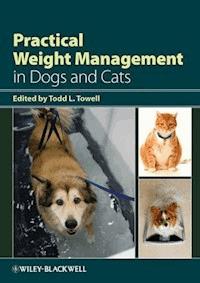
Practical Weight Management in Dogs and Cats E-Book
56,99 €
Mehr erfahren.
- Herausgeber: John Wiley & Sons
- Kategorie: Fachliteratur
- Sprache: Englisch
Practical Weight Management in Dogs and Cats is a comprehensive, clinical reference for the veterinary health team, providing the necessary tools to successfully manage pet obesity. Bringing together specialists in nutrition, internal medicine, critical care, and surgery and rehabilitation, the book provides an overview of prevention techniques, clinical management, and practical tips for implementing successful programs and educating owners. Covering topics ranging from taking a nutritional history and body condition scoring to calculating food dosage and client communication tips, this book is a resource for both veterinarians and veterinary technicians to address the growing problem of pet obesity. The book begins by explaining the clinical importance of obesity, then moves on to diagnosing and preventing obesity. The heart of the book is devoted to managing body weight, with chapters on nutritional, pharmacotherapeutic, and exercise strategies, and two unique chapters cover owner compliance and wellness programs. Practical Weight Management in Dogs and Cats offers a collaborative approach to managing weight in pet dogs and cats.
Sie lesen das E-Book in den Legimi-Apps auf:
Seitenzahl: 374
Veröffentlichungsjahr: 2011
Ähnliche




















Table of Contents
Cover
Title page
Copyright page
List of Contributors
1 Clinical Importance of Canine and Feline Obesity
Introduction
Defining Obesity
Prevalence of Obesity
Health Risks of Obesity
Fat as an Endocrine Organ
Appetite Regulation
In Practice
2 Diagnosing Obesity
Recognizing a Problem: The First Step to Solving It
Defining Obesity
Clinical Tools
Why Ideal Body Weight Matters
Gain Commitment
Summary
In Practice
3 Preventing Obesity
Basic Advice for Owners
Nutritional Plan
Nutritional Assessment
Step One: Assess the Current Situation
Step Two: Specific Nutritional Recommendation
Feeding Amounts
How Should I Feed My Pet?
Life Stage and Lifestyle Considerations
Conclusion
In Practice: The Case of the Automatic Feeder
4 Nutritional Management of Obesity
Evidence-based Veterinary Medicine
Nutraceuticals
Nutrigenomics: The Future of Functional Foods
Nutrigenomics and Obesity
Therapeutic Weight Loss Foods
Determining How Much to Feed
Food Dose
Summary
In Practice
5 Pharmacotherapy for Management of Canine Obesity
Mechanism of Action
Dosing
Clinical Response
Safety Profile
Effects on Fat-soluble Vitamins
Contraindications, Warnings, Precautions
Implementing a Successful Weight Loss Program Using MTP-Inhibitors
6 Therapeutic Exercises
The Principles of Therapeutic Exercises for Dogs and Cats
Exercise Options
Planning an Exercise Program
Assessing and Adjusting Exercise Programs
Resources for Ambulation Assistance Devices
7 Owner Education and Adherence
The Human-Animal Bond: What Goes Wrong?
Weight Reduction Programs
Monitoring and Adjusting the Program
Summary
8 Implementing a Weight Management Program
Getting Started
Staff Training
Implementing the Program
Regular Check-ins
Cat Specifics
Weight Maintenance Program Examples
Keys to Success
Online Tools
Benefits of Weight Loss Programs to Practices
Summary
In Practice
Index
This edition first published 2011 © 2011 by John Wiley and Sons, Inc.
Wiley-Blackwell is an imprint of John Wiley & Sons, formed by the merger of Wiley’s global Scientific, Technical and Medical business with Blackwell Publishing.
Registered office: John Wiley & Sons Ltd, The Atrium, Southern Gate, Chichester,
West Sussex, PO19 8SQ, UK
Editorial offices: 2121 State Avenue, Ames, Iowa 50014-8300, USA
The Atrium, Southern Gate, Chichester, West Sussex, PO19 8SQ, UK
9600 Garsington Road, Oxford, OX4 2DQ, UK
For details of our global editorial offices, for customer services and for information about how to apply for permission to reuse the copyright material in this book please see our website at www.wiley.com/wiley-blackwell.
Authorization to photocopy items for internal or personal use, or the internal or personal use of specific clients, is granted by Blackwell Publishing, provided that the base fee is paid directly to the Copyright Clearance Center, 222 Rosewood Drive, Danvers, MA 01923. For those organizations that have been granted a photocopy license by CCC, a separate system of payments has been arranged. The fee codes for users of the Transactional Reporting Service are ISBN-13: 978-0-8138-0956-4/2011.
Designations used by companies to distinguish their products are often claimed as trademarks. All brand names and product names used in this book are trade names, service marks, trademarks or registered trademarks of their respective owners. The publisher is not associated with any product or vendor mentioned in this book. This publication is designed to provide accurate and authoritative information in regard to the subject matter covered. It is sold on the understanding that the publisher is not engaged in rendering professional services. If professional advice or other expert assistance is required, the services of a competent professional should be sought.
Library of Congress Cataloging-in-Publication Data
Practical weight management in dogs and cats / edited by Todd L. Towell.
p. ; cm.
Includes bibliographical references and index.
ISBN 978-0-8138-0956-4 (pbk. : alk. paper)
1. Cats–Diseases–Diet therapy. 2. Dogs–Diseases–Diet therapy. 3. Cats–Exercise.
4. Dogs–Exercise. 5. Obesity in animals. I. Towell, Todd L.
[DNLM: 1. Obesity–therapy. 2. Obesity–veterinary. 3. Cats. 4. Dogs.
SF 992.N88]
SF985.P65 2011
636.8'083–dc22
2011007211
A catalogue record for this book is available from the British Library.
This book is published in the following electronic formats: ePDF 9780470960974; ePub 9780470960981; Mobi 9780470960998
Disclaimer
The publisher and the author make no representations or warranties with respect to the accuracy or completeness of the contents of this work and specifically disclaim all warranties, including without limitation warranties of fitness for a particular purpose. No warranty may be created or extended by sales or promotional materials. The advice and strategies contained herein may not be suitable for every situation. This work is sold with the understanding that the publisher is not engaged in rendering legal, accounting, or other professional services. If professional assistance is required, the services of a competent professional person should be sought. Neither the publisher nor the author shall be liable for damages arising herefrom. The fact that an organization or website is referred to in this work as a citation and/or a potential source of further information does not mean that the author or the publisher endorses the information the organization or website may provide or recommendations it may make. Further, readers should be aware that Internet websites listed in this work may have changed or disappeared between when this work was written and when it is read.
List of Contributors
P. Jane Armstrong, DVM, MS, MBA, DACVIM
Professor, Veterinary Internal Medicine
University of Minnesota College of Veterinary Medicine
Mark A. Brady, DVM, DACVECC
Veterinary Consultation Service
Hill’s Pet Nutrition Inc.
Kara Burns, MS, MEd, LVT
Veterinary Technician Specialist
Hill’s Pet Nutrition Inc.
Sharon Campbell, DVM, MS, DACVIM
Specialty Hospital Liaison
Pfizer Animal Health
S. Dru Forrester, DVM, MS, DACVIM
Associate Director, Scientific Communications
Hill’s Pet Nutrition Inc.
Angela L. Lusby, DVM, PhD, DACVN
Clinical Instructor
University of Tennessee College of Veterinary Medicine
Denis J. Marcellin-Little, DEDV, DACVS, DECVS, DACVSMR
Professor, Orthopedics
North Carolina State University College of Veterinary Medicine
Rebecca L. Remillard, PhD, DVM, DACVN
Nutritionist
MSPCA Angell Animal Medical Center
Todd L. Towell, DVM, MS, DACVIM
Senior Manager, Scientific Communications
Hill’s Pet Nutrition Inc.
1
Clinical Importance of Canine and Feline Obesity
P. Jane Armstrong, DVM, MS, MBA, DACVIM, and Angela L. Lusby, DVM, PhD, DACVN
Introduction
The last decade has seen a fundamental shift in our understanding of obesity. The discovery of hormones and cytokines generated by adipose tissue (termed adipokines) has expanded fat’s traditional roles as an energy storage depot, insulator, and support for abdominal organs. Fat is now recognized as the most abundant source of hormones in the body, making it the largest endocrine organ. Additionally, macrophages in adipose tissue contribute to the release of numerous inflammatory cytokines and other adipokines into the blood. As a result, overweight and obese individuals reside in a state of chronic inflammation (Figure 1.1).
Figure 1.1. Relationship of obesity to chronic inflammation. In obese states, adipose tissue expands rapidly and adipocytes enlarge. This induces a state of local hypoxia and stress responses that recruit macrophages to adipose tissue. In the obese state, adipocytes also release cytokines, adipokines, and free fatty acids. These work locally and systemically to increase the inflammatory state within adipose tissue, liver, and muscle, and cause insulin resistance.
Images from Fotolia.com.
This knowledge has come on the heels of an epidemic of obesity in companion animals that parallels the global obesity epidemic in human patients. The combination of serious metabolic and health consequences of obesity and sheer number of obese pets should make canine and feline obesity a priority for veterinarians. Just as veterinarians have long provided routine infectious disease and dental prophylaxis, preventive health care also must focus on nutrition counseling. Informing pet owners about disease risk factors associated with obesity and recommending appropriate dietary intake for obesity prevention and weight loss should be integrated into most preventive care examinations.
Defining Obesity
Obesity is a disease in which excess body fat has accumulated such that health may be adversely affected. In human medicine, application of this definition is based on epidemiologic data that demonstrate increased morbidity and mortality risks with increasing body fat mass. Based on such data, criteria have been established for what constitutes “overweight” and “obese.” To date, such objective criteria are not available for dogs and cats. Fat mass comprises about 15% to 20% of the body weight in dogs and cats in ideal body condition.1–5 Pets are typically considered overweight at 10% to 20% above their ideal body weight and obese if their weight exceeds 20% to 30% more than ideal.6,7
One of the most difficult challenges in diagnosing obesity is determining ideal body weight and present fat mass. A patient’s fat mass can be measured using a variety of methods. However, most involve some procedure or parameter that makes them unsuitable at present for routine clinical use. Because of its precision and relative ease of use, dual energy X-ray absorptiometry (DEXA) has become the standard tool for measuring body composition when performing clinical research in pet obesity. Unfortunately, access to DEXA equipment is generally limited to academic and corporate research facilities.
Lesen Sie weiter in der vollständigen Ausgabe!
Lesen Sie weiter in der vollständigen Ausgabe!
Lesen Sie weiter in der vollständigen Ausgabe!
Lesen Sie weiter in der vollständigen Ausgabe!
Lesen Sie weiter in der vollständigen Ausgabe!
Lesen Sie weiter in der vollständigen Ausgabe!
Lesen Sie weiter in der vollständigen Ausgabe!
Lesen Sie weiter in der vollständigen Ausgabe!




