


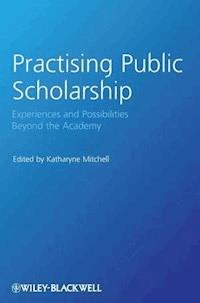
Practising Public Scholarship E-Book
20,99 €
Mehr erfahren.
- Herausgeber: John Wiley & Sons
- Kategorie: Wissenschaft und neue Technologien
- Serie: Antipode Book Series
- Sprache: Englisch
A cross-disciplinary collection of 20 essays describing the journey to public scholarship, exploring the pleasures and perils associated with breaching the town-gown divide. * Includes contributions from departments of geography, comparative literature, sociology, communications, history, English, public health, and biology * Discusses their efforts to reach beyond the academy and to make their ideas and research broadly accessible to a wider audience * Opens the way for a new kind of democratic politics--one based on grounded concepts and meaningful social participation * Includes deeply personal accounts about the journey to becoming a public scholar and to intervening politically in the world, while remaining within a university system * Provides a broad prescription for social change, both within and outside the university
Sie lesen das E-Book in den Legimi-Apps auf:
Seitenzahl: 325
Veröffentlichungsjahr: 2011
Ähnliche




















Contents
Introduction: Becoming PoliticalKatharyne Mitchell
References
Chapter 1 Comrades and ColonsTerry Eagleton
Chapter 2 Tales of Western AdventurePatricia Limerick
Endnotes
Reference
Chapter 3 Open Letter to C. Wright MillsMichael Burawoy
References
Chapter 4 Craven Emotional WarriorsMelissa W. Wright
Plan B
Plan A
A, B…
Endnotes
References
Chapter 5 Population, Environment, War, and Racism: Adventures of a Public ScholarPaul R. Ehrlich
Suggestions and Advice
Suggested Reading
Chapter 6 The Something We Can DoDavid Domke
Growing Pains
People and Hope
Endnotes
Suggested Reading
Chapter 7 Philadelphia Dreaming: Discovering Citizenship between the University and the SchoolsJulia Reinhard Lupton
Endnotes
References
Chapter 8 Beyond Positivism: Public Scholarship in Support of HealthDennis Raphael
Introduction
Beginnings
Academics and the Parallel Universe of Political Activity
Enter the 1990s: Exposure to the Critical Sociology of Health and the Common Sense Revolution
Becoming a Public Scholar
Safe Landing and Going On the Road
Tides of Change?
Lessons Learned
References
Suggested Reading
Chapter 9 Weaving Solidarity from Oneonta to OxchucKatherine O’Donnell
Friends of Jolom Mayaetik Transnational Solidarity Network
Participatory Democracy
Suggested Reading
Chapter 10 Demand the Possible: Journeys in Changing our World as a Public Activist-ScholarPaul Chatterton
Take One: Disarm Dsei: Arm your Writing
Take Two: Radicalise Learning
Take Three: Make the Leap
Be Realistic, Demand the Impossible…
Online Resources
Chapter 11 Becoming a Scholar-Advocate: Participatory Research with ChildrenMeghan Cope
Passionate Trajectories
The Children’s Urban Geographies Project
Risks and Strategies
Concluding Thoughts
Endnote
Suggested Reading
Chapter 12 Why Am I Engaged?Walden Bello
Suggested Reading
Chapter 13 Drugs, Data, Race and Reaction: A Field ReportKatherine Beckett
Endnotes
Suggested Reading
Chapter 14 Confessions of a Desk-Bound RadicalDon Mitchell
The Activism-Academics Divide
The People’s Geography Project: An Intellectual as much as an Activist Endeavor
Conclusion
Suggested Reading
Chapter 15 Becoming a Public Scholar to Improve the Health of the US PopulationStephen Bezruchka
Endnote
Suggested Reading
Chapter 16 The Humanities and the Public Soul1Julie Ellison
Endnote
References
Chapter 17 This Fist Called My Heart: Public Pedagogy in the Belly of the BeastPeter McLaren
References
Suggested Reading
Chapter 18 The Surprising Sense of HopeJenny Pickerill
Deeds Not Words
“Good Work”
The Importance of Methodology
Writing and Teaching for Most People
Walking Your Talk and Creating Space for Passion and Hope
Suggested Reading
Chapter 19 The Making of a Public IntellectualHoward Zinn
Suggested Reading
Chapter 20 When Theory Meets PoliticsDoreen Massey
Reference
Index
Antipode Book Series
General Editor: Noel Castree, Professor of Geography, University of Manchester, UK
Like its parent journal, the Antipode Book Series reflects distinctive new developments in radical geography. It publishes books in a variety of formats – from reference books to works of broad explication to titles that develop and extend the scholarly research base – but the commitment is always the same: to contribute to the praxis of a new and more just society.
Published
Practising Public Scholarship: Experiences and Possibilities Beyond the Academy
Edited by Katharyne Mitchell
Grounding Globalization: Labour in the Age of Insecurity
Edward Webster, Rob Lambert and Andries Bezuidenhout
Privatization: Property and the Remaking of Nature-Society Relations
Edited by Becky Mansfield
Decolonizing Development: Colonial Power and the Maya
Joel Wainwright
Cities of Whiteness
Wendy S. Shaw
Neoliberalization: States, Networks, Peoples
Edited by Kim England and Kevin Ward
The Dirty Work of Neoliberalism: Cleaners in the Global Economy
Edited by Luis L. M. Aguiar and Andrew Herod
David Harvey: A Critical Reader
Edited by Noel Castree and Derek Gregory
Working the Spaces of Neoliberalism: Activism, Professionalisation and Incorporation
Edited by Nina Laurie and Liz Bondi
Threads of Labour: Garment Industry Supply Chains from the Workers’ Perspective
Edited by Angela Hale and Jane Wills
Life’s Work: Geographies of Social Reproduction
Edited by Katharyne Mitchell, Sallie A. Marston and Cindi Katz
Redundant Masculinities? Employment Change and White Working Class Youth
Linda McDowell
Spaces of Neoliberalism
Edited by Neil Brenner and Nik Theodore
Space, Place and the New Labour Internationalism
Edited by Peter Waterman and Jane Wills
Forthcoming
Working Places: Property, Nature and the Political Possibilities of Community Land Ownership
Fiona D. Mackenzie
This edition first published 2008
Chapters © 2008 the Authors
Book Compilation © 2008 Editorial Board of Antipode and Blackwell Publishing Ltd
First published as volume 40, issue 3 of Antipode
Blackwell Publishing was acquired by John Wiley & Sons in February 2007. Blackwell’s publishing program has been merged with Wiley’s global Scientific, Technical, and Medical business to form Wiley-Blackwell.
Registered Office
John Wiley & Sons Ltd, The Atrium, Southern Gate, Chichester, West Sussex, PO19 8SQ, United Kingdom
Editorial Offices
350 Main Street, Malden, MA 02148–5020, USA
9600 Garsington Road, Oxford, OX4 2DQ, UK
The Atrium, Southern Gate, Chichester, West Sussex, PO19 8SQ, UK
For details of our global editorial offices, for customer services, and for information about how to apply for permission to reuse the copyright material in this book please see our website at www.wiley.com/wiley-blackwell.
The right of Katharyne Mitchell to be identified as the author of the editorial material in this work has been asserted in accordance with the Copyright, Designs and Patents Act 1988.
All rights reserved. No part of this publication may be reproduced, stored in a retrieval system, or transmitted, in any form or by any means, electronic, mechanical, photocopying, recording or otherwise, except as permitted by the UK Copyright, Designs and Patents Act 1988, without the prior permission of the publisher.
Wiley also publishes its books in a variety of electronic formats. Some content that appears in print may not be available in electronic books.
Designations used by companies to distinguish their products are often claimed as trademarks. All brand names and product names used in this book are trade names, service marks, trademarks or registered trademarks of their respective owners. The publisher is not associated with any product or vendor mentioned in this book. This publication is designed to provide accurate and authoritative information in regard to the subject matter covered. It is sold on the understanding that the publisher is not engaged in rendering professional services. If professional advice or other expert assistance is required, the services of a competent professional should be sought.
Library of Congress Cataloging-in-Publication Data
Practising public scholarship: experiences and possibilities beyond the academy/edited by Katharyne Mitchell.
p. cm. – (Antipode book series)
Includes bibliographical references and index.
ISBN 978-1-4051-8912-5 (pbk.: alk. paper)
1 Community and college.
2 Universities and colleges-Public services. 3. Learning and scholarship. I. Mitchell, Katharyne. LC237.P73 2008
378.1’03–dc22
2008027428
In memory of Allan Pred
Introduction: Becoming Political
Katharyne Mitchell
Soon after finishing graduate school I told an eminent person in our field that I would like our incipient scholarly collaboration to have some political relevance. He responded with a raised eyebrow, “I don’t know what you mean by ‘political’”. It was a crafty response and I recall being paralyzed by it. What does it mean to be political in academic life? Why was I so sure that I already knew? Did that assurance cast doubt on my potential as an intellectual? By desiring a project with political relevance was I showing myself to be both close-minded and theoretically naive, the equivalent of a somewhat dense academic bigot?
I have subsequently spent a fair number of hours pondering the meaning of “political” and in some ways I feel that I have returned to my starting point. Yet the journey itself has been instructive, and even if it began with a sly postmodern push in the small of the back, I’m glad I made it. For many people working in the academy, the last couple of decades have brought an intoxicating brew of fresh ideas across the social sciences and humanities, a brew that has—and I’m speaking very generally here—caused a widespread rethinking of the nature of knowledge and the representation of reality. The idea that certain claims and judgments accurately reflect a pre-given reality (existing prior to the researcher/interpreter’s arrival) was persuasively critiqued by those arguing for the contingency and social construction of all knowledge. Foundationalist thought of all stripes and hues was soon placed on the chopping block, leading to a veritable orgy of destruction and dismemberment. It was extremely satisfying at first, all of those functionalist limbs and structuralist torsos lying about, fragmented and nonlinear. But while liberating in many ways, this initial heady period led to a dispiriting state of paralysis for quite a few good souls, and I remember more than one graduate seminar in which I felt that the language of “transient articulations” and “emergent multiplicities” was going to drive me mad.
The problem was further entrenched by the perceived loss of the moral language of “rights”. As Cary Wolf has noted, “almost all progressive movements (and some not so progressive ones) find it effective to trade upon the rhetoric of’rights’“.1 What is a politically minded person to do, when it becomes clear that the idea of human rights carries unacceptable historical baggage, connected as it is with a violent and exclusionary liberal lineage, one with a cheery but ultimately false notion of equal rights under the law? This is not even to mention the hideous possibility of retaining a concept of “the human”.
Many students dropped the language of human rights as if it had turned around and bitten them on the hand. But they neglected to pick up anything else, and it often seemed to me that the more people read and understood, the less claims they felt able to make; the sharper and stronger their tools of analysis, the less there was to defend or construct. For those working in the sciences, critiques of claims to truth often seemed to encompass the entire scientific project, leaving scant room to negotiate a middle ground, and ultimately repelling many critical and sympathetic allies. In the rush to attack anything smacking of apre-given structure or even worse “metanarrative”, what often got lost was a broad and inclusive notion of the political, and with it a sense of voice and purpose.
What does it mean to be political? And why does this feel like an intuitive rather than an intellectual question? My sense is that what creates a public scholar is related to a profound urge to participate and intervene in the political practices of the world—to fight injustice or correct misinformation or provide a needed service—in short, to try to make the world a better place, corny as that sounds. But is this desire compatible with an academic project? Does it necessarily involve selling out, either intellectually, personally or politically?
Like many public scholars I have both spoken and written for audiences outside of a university setting. In just about every situation that I can recall, I have radically changed my language, including the vocabulary and even grammatical structure of my sentences. But I have retained most, if not all, of the content, and in a number of cases, I have felt that editorial suggestions made my writing crisper and stronger than the original draft. I’ve found it surprisingly easy to jettison words like neoliberalism without losing the thread of my argument, and I’ve also found audiences generally receptive to critiques of free-market capitalism, even though I rarely use words like capitalism, which has a different resonance inside and outside of the university.
But even so there are some boundaries I don’t cross and some self- censorship that I perform, partly out of the desire to hold onto my audience and partly from naked fear. It’s different speaking or writing to people who don’t necessarily share your intellectual or political positions or even ascribe much to your right to espouse them. And knowing that you will need to defend everything you claim clearly and forcefully is a lot scarier than resting secure in your knowledge that everything is “complicated” (all of those emergent multiplicities), and surely the questioner must understand that too? Is it selling out to perform these small censoring moves?
I find these compromises relatively minor in the larger scheme of things, and I do not agree with Wolf’s characterization of the public intellectual’s internal psyche as one of profound schizophrenia. (The result of a supposed discrepancy between theoretical belief, eg in opposition to foundationalist concepts, and the necessity to invoke those same concepts in order to be politically efficacious in the public arena.) The only time that I have felt somewhat queasy in this regard is when I have advocated for the “rights” of middle-class children to be spared the bruising and competitive scramble for that elusive place at Harvard or Yale and taught instead to be those gentle and cooperative citizens we’d much rather have in our classrooms and our world. But really my trepidation here is not so much related to an intellectual sell-out, ie my invocation of rights, or the idea that there is such a thing as a child, or even the liberal panacea to what is obviously a systemic problem. Rather, my sell-out here is profoundly political: why am I talking about middle-class American children’s problems to begin with, when their problems are relatively minor compared with those of most of the rest of the world?
I don’t suffer from intellectual schizophrenia, possibly because I hold some semi-foundational (if there is such a thing) beliefs about the contemporary workings of the world: for example, that there’s a widely entrenched and increasingly hegemonic socio-economic system that is making a few people exceedingly rich and a lot of people extremely poor; and that most societies are dominated by men and this has negative repercussions for both men and women. I don’t think these processes are natural or inevitable or irretrievable, and, pace Wolf, the main “rights” I need to invoke to counteract them long predate liberalism. So this gives me hope and intellectual cover. But if I’m truly honest, it also gives me a deep sense of personal inadequacy. Rome is burning, and I’m organizing workshops and writing about American children? Unequal education systems? Gentrification? The spatial banishment of prostitutes? What I do as an academic never seems important enough, or just enough. But I suppose, as David Domke says in this book, it’s the something I can do, at least for now.
Most of the authors in this book were pulled into public scholarship rather than seeking it out. But in all of the essays you sense a profound pleasure in what has come to pass, one that outweighs any initial feelings of trepidation. Each person has found his or her own way of waging scholarship in difficult times. Scholar-activists retain a passion for the political grassroots campaigns they joined in their youth; scholarly producers organize collaborative ventures, make plans, find money, start institutions, and generally just get things up and running; public intellectuals make their research and ideas accessible through media contacts, public outreach, writing for the newspapers, making videos, and endlessly soliciting all possible outlets for informing the wider community about their political and intellectual passions; critical scholar-pedagogues take their classrooms out of the university and bring the outer world in, make connections with K-12 schools, rewrite curricula, and conduct their research and their lives with the same democratic spirit in which they run their classes; scholar-politicos enter the political arena itself, running their campaigns with ideas and ideals rather than via sound bites.
These projects have not come without personal cost. The personal implications vary, but each contributor has experienced some negative moments along with the highlights. These include those whose work has been impugned as “non-objective”, whose careers have been threatened or derailed, whose academic papers have been withdrawn, and/or whose colleagues have scorned or demoted them.
Many important public voices in the world are not evident in this volume precisely because of these kinds of personal and political difficulties. The costs of remaining affiliated with university systems are often too great for many public intellectuals, who have chosen, or been forced, to opt out of academia altogether. There are many reasons for these types of difficulties, which vary greatly both within countries and regions, as well as more broadly between western and non-western settings. Faculty in university systems in the US, Canada, and the UK, for example, are under increasing pressure to produce more books and articles in shorter periods of time, thus decreasing the opportunities to engage in activities outside of the standardized, narrowly circumscribed ideals of their disciplines and departments. These pressures are part of the broad shift to an increasingly market- based logic that has infiltrated and affected most university systems over the past few decades.2 This logic makes university life increasingly incompatible with the social and political projects of many potential scholars, and has reduced the number of public intellectuals operating within academic settings. For many other public intellectuals, especially those working in politically unstable venues, political considerations are primary in their decisions to leave the university. Academic affiliations end up either impeding their work or becoming impossible to maintain in the face of political opposition both within and outside the university.
This book is not a general collection of works by prominent public intellectuals such as these. Neither is it an exegesis on the meaning of public scholarship, although there are a good number of insights that can be gleaned throughout the texts.3 Rather, the essays here are deeply personal accounts about the journey to becoming a public scholar and to intervening politically in the world, while remaining within a university system. All of the essayists consider themselves academics but also something more. That little bit more is integral to the person’s identity and core; it influences—whether consciously or not—the types of research questions asked, experiments or fieldwork pursued, clinics or centers established, and contacts made and maintained. It also gives these writers a sense of personal power, and a belief that their actions can and do make a difference.
When I invited contributions to this book I was delighted by the positive response. Although busy, tired, overworked, overcommitted, and then some, each of these essayists wanted to reach out and provide a manifesto and a road map so that others could follow in their footsteps. Within these pages are intellectual biographies and also calls to action from academics across the disciplinary spectrum. They are unique but also share any number of meditative thoughts among them. One recurring emotion that pervades the essays is a general sense of shock and dismay that so few people in academia use their professional authority to make their voices count. Hence as these authors narrate their lives and ideas, you might detect a seductive invitation that runs through every essay: join us.
Endnotes
1 Cary Wolf, “Getting the dirt on the public intellectual: a response to Michael Bérubé”, ebr2. See http://www.altx.com/ebr/ebr2/2wolfe.htm
2 On the theme of the increasing corporatization of the university, see Readings (1997).
3 For a more “intellectual” discussion of the meaning of the public intellectual, see Small (2002).
References
Readings B (1997) The University in Ruins. Cambridge, MA: Harvard University Press. Small H (2002) The Public Intellectual. Oxford: Wiley-Blackwell.
Chapter 1
Comrades and Colons
Terry Eagleton
Perhaps my finest contribution to the general welfare of humanity as a public intellectual involved the correct handling of the colon. I was a member at the time of a far-left political group in Oxford—a fact which seemed to occasion a number of rather strange clickings and whirrings whenever I picked up the phone, and involved an extraordinary number of visits to my local telegraph pole by workmen apparently repairing the line. One of the senior members of the group was a shop steward at what was then the largest automobile plant in the south of England, and had a long career of industrial militancy. The company would have dearly loved to dismiss him, and finally seized the chance to do so when he parked his car illegally for 30 seconds or so outside their gates. For some years he had been writing a history of the workers’ fight for better conditions at the plant, a piece of work which constituted a precious addition to the annals of the English labour and socialist movements. But he was handier with a megaphone than he was with the intricacies of English grammar, and finally handed the manuscript over to me to knock into syntactical shape. I spent a number of lonely evenings embroiled in the revolutionary struggle to turn commas into colons, introduce some elementary paragraphing into a seamless text, and find synonyms for “bosses” and “shameful betrayal”. We had to fight hard to find the book a publisher, but were finally successful.
Lesen Sie weiter in der vollständigen Ausgabe!
Lesen Sie weiter in der vollständigen Ausgabe!
Lesen Sie weiter in der vollständigen Ausgabe!
Lesen Sie weiter in der vollständigen Ausgabe!
Lesen Sie weiter in der vollständigen Ausgabe!
Lesen Sie weiter in der vollständigen Ausgabe!
Lesen Sie weiter in der vollständigen Ausgabe!
Lesen Sie weiter in der vollständigen Ausgabe!
Lesen Sie weiter in der vollständigen Ausgabe!
Lesen Sie weiter in der vollständigen Ausgabe!
Lesen Sie weiter in der vollständigen Ausgabe!
Lesen Sie weiter in der vollständigen Ausgabe!
Lesen Sie weiter in der vollständigen Ausgabe!
Lesen Sie weiter in der vollständigen Ausgabe!
Lesen Sie weiter in der vollständigen Ausgabe!
Lesen Sie weiter in der vollständigen Ausgabe!
Lesen Sie weiter in der vollständigen Ausgabe!
Lesen Sie weiter in der vollständigen Ausgabe!
Lesen Sie weiter in der vollständigen Ausgabe!
Lesen Sie weiter in der vollständigen Ausgabe!




