


111,99 €
Mehr erfahren.
- Herausgeber: John Wiley & Sons
- Kategorie: Wissenschaft und neue Technologien
- Sprache: Englisch
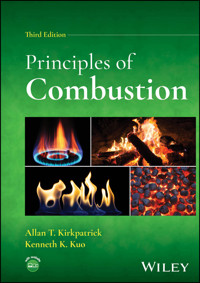
The new edition of a classic textbook on combustion principles and processes, covering the latest developments in fuels and applications in a student-friendly format
Principles of Combustion provides clear and authoritative coverage of chemically reacting flow systems. Detailed and accessible chapters cover key combustion topics such as chemical kinetics, reaction mechanisms, laminar flames, droplet evaporation and burning, and turbulent reacting flows. Numerous figures, end-of-chapter problems, extensive reference materials, and examples of specific combustion applications are integrated throughout the text.
Newly revised and expanded, Principles of Combustion makes it easier for students to absorb and master each concept covered by presenting content through smaller, bite-sized chapters. Two entirely new chapters on turbulent reacting flows and solid fuel combustion are accompanied by additional coverage of low carbon fuels such as hydrogen, natural gas, and renewable fuels. This new edition contains a wealth of new homework problems, new application examples, up-to-date references, and access to a new companion website with MATLAB files that students can use to run different combustion cases.
Fully updated to meet the needs of today’s students and instructors, Principles of Combustion:
- Provides problem-solving techniques that draw from thermodynamics, fluid mechanics, and chemistry
- Addresses contemporary topics such as zero carbon combustion, turbulent combustion, and sustainable fuels
- Discusses the role of combustion emissions in climate change and the need for reducing reliance on carbon-based fossil fuels
- Covers a wide range of combustion application areas, including internal combustion engines, industrial heating, and materials processing
Containing both introductory and advanced material on various combustion topics, Principles of Combustion, Third Edition, is an essential textbook for upper-level undergraduate and graduate courses on combustion, combustion theory, and combustion processes. It is also a valuable reference for combustion engineers and scientists wanting to better understand a particular combustion problem.
Sie lesen das E-Book in den Legimi-Apps auf:
Seitenzahl: 942
Veröffentlichungsjahr: 2024
Ähnliche

















Table of Contents
Cover
Table of Contents
Title Page
Copyright
About the Authors
Preface
Acknowledgments
About the Companion Website
1 Introduction to Combustion
1.1 Introduction
1.2 Combustion Applications
1.3 Organization of Text
1.4 Solution Methods for Combustion Problems
1.5 Fuels Background
1.6 Hydrocarbon Fuel Chemistry
1.7 Gaseous and Liquid Fuels for Combustion Engines
1.8 Fuels for Rocket Engines
1.9 Solid Fuels
1.10 Additional Reading
References
Homework Problems
2 Chemical Thermodynamics
2.1 Introduction
2.2 Properties of Gas Mixtures
2.3 Liquid–Vapor–Gas Mixtures
2.4 Standard Enthalpies of Formation
2.5 Relationship Between Bond Energy and Enthalpy of Formation
2.6 Fugacity and Real-Gas Equations of State
2.7 Conservation of Mass
2.8 The First Law of Thermodynamics
2.9 The Second Law of Thermodynamics
2.10 Stoichiometric Chemical Reactions
2.11 Mixture Fraction
2.12 First Law Analysis of Combustion
2.13 Second Law Analysis of Cyclic Engines
2.14 Equilibrium Constant
2.15 Chemical Equilibrium Using Lagrange Multipliers
2.16 Chemical Equilibrium Using Equilibrium Constants
2.17 Thermodynamic Properties of Combustion Products
References
Homework Problems
3 Chemical Kinetics
3.1 Introduction
3.2 Rates of Reaction and Their Functional Dependence
3.3 One-Step Chemical Reactions of Various Orders
3.4 Chain Reactions
3.5 Chain-Branching Reactions and Explosions
3.6 Pressure Dependence of Rate Coefficients
3.7 Surface Reactions
3.8 Surface Reaction Kinetics
3.9 Experimental Methods for Measurement of Gas-Phase Reaction Rates
3.10 Experimental Methods to Study Surface Reactions
References
Homework Problems
4 Reaction Mechanisms
4.1 Introduction
4.2 Multiple Reactions
4.3 Steady-State Approximation
4.4 Partial Equilibrium
4.5 Hydrogen Reaction Mechanisms
4.6 Ammonia Reaction Mechanisms
4.7 Hydrocarbon Reaction Mechanisms
4.8 Additional Hydrocarbon Reaction Mechanisms
4.9 Reduced Mechanism of Hydrocarbon Combustion
4.10 Chemical Mechanism Reduction
4.11 Sensitivity Analysis
4.12 Reaction Flow Analysis
4.13 Computational Singular Perturbation (CSP)
References
Homework Problems
5 Transport Processes
5.1 Introduction
5.2 Definitions of Concentrations, Velocities, and Mass Fluxes
5.3 Fick’s Law of Diffusion
5.4 Dimensionless Ratios of Transport Coefficients
5.5 Theory of Mass Diffusion in Gases at Low Density
5.6 Continuity Equation and Species Mass Conservation Equations
5.7 Conservation of Momentum
5.8 Conservation of Energy
5.9 Physical Derivation of the Multicomponent Diffusion Equation
5.10 Shvab–Zel’dovich Formulation
5.11 Boundary Conditions at an Interface
5.12 Turbulent Flow Fields
5.13 Turbulent Length, Velocity, and Time Scales
5.14 Reynolds and Favre Averaging
5.15 Turbulence Modeling
5.16 Probability Density Function (PDF) Models
5.17 Further Reading
References
Homework Problems
6 Premixed Flames
6.1 Introduction
6.2 Laminar Flame Speed Modeling
6.3 Zeldovich, Frank-Kamenetsky, and Semenov Flame Model
6.4 Diagnostic Methods for Flame Speed and Structure
6.5 Laminar Flame Speeds of Hydrocarbon/Air Mixtures
6.6 Numerical Analysis of Laminar-Flame Problems
6.7 Stretched Laminar Premixed Flames
6.8 Stabilization of Combustion Flames in Laminar Flows
6.9 Ignition
6.10 Flame Quenching
6.11 Flammability Limits of Premixed Laminar Flames
6.12 Turbulent Flame Propagation
6.13 Example: Turbulent Flame Propagation in a Spark Ignition Engine
6.14 Stabilization of Turbulent Combustion Flames
6.15 Turbulent Flame Models
Further Reading
References
Homework Problems
7 Detonation Waves
7.1 Introduction
7.2 Qualitative Differences Between Detonation and Deflagration Waves
7.3 The Hugoniot Curve
7.4 Burned Gas Properties and the C–J Detonation-Wave Velocity
7.5 Zel’dovich–von Neumann–Döring (ZND) One-Dimensional Wave Model
7.6 Multidimensional Detonation Wave Structure
7.7 Deflagration-to-Detonation Transition (DDT) in Gaseous Mixtures
7.8 Detonability Limits
7.9 Detonability Limits of Confined Fuel Mixtures
7.10 Engineering Applications of Detonation
7.11 Possible Measures for Reducing Potential of Detonation
References
Homework Problems
8 Non-premixed Flames
8.1 Introduction
8.2 Scale Analysis of Laminar and Turbulent Jet Flames
8.3 Laminar Jet Flames
8.4 Coaxial Jet Flames
8.5 Combustion Chemistry of Laminar Jet Flames
8.6 Turbulent Gaseous Fuel Jets
8.7 Measurements of Non-Premixed Turbulent Flames
8.8 Models of Non-Premixed Turbulent Flames
8.9 Buoyant Flames
References
Homework Problems
9 Droplet Combustion
9.1 Introduction
9.2 Droplet Evaporation in Quiescent Environments
9.3 Combustion of a Fuel Droplet in a Quiescent Environment
9.4 Droplet Formation in Convective Environments
9.5 Fuel Droplet Evaporation in a Convective Environment
9.6 Droplet Combustion in Supercritical Environments
9.7 Application: Compression Ignition Engine Combustion
References
Homework Problems
10 Emissions
10.1 Introduction
10.2 Nitrogen Oxides
10.3 Carbon Monoxide
10.4 Particulate Matter
10.5 Soot Radiation
10.6 Emissions Control in Internal Combustion Engines
References
Homework Problems
11 Solid Fuel Combustion
11.1 Introduction
11.2 Drying of Solid Fuels
11.3 Biomass Pyrolysis
11.4 Char Oxidation
11.5 Solid Fuel Ignition
11.6 Example: Biomass Cookstove
11.7 Gasification of Solid Fuels
References
Homework Problems
A Conversion Factors and Physical Constants
Reference
B Thermal and Transport Properties of Air
B.1 Introduction
References
C Thermodynamic Property Tables for Various Ideal Gases
Reference
D Curve-Fit Equations for Thermodynamic Properties of Gaseous Fuels and Combustion Products
References
E Transport Properties of Gases: Mass Diffusion, Viscosity, and Thermal Conductivity
E.1 Introduction
E.2 Binary Diffusion Coefficients
E.3 Dynamic Viscosity
E.4 Thermal Conductivity
E.5 Curve-Fits and Coefficients for Viscosity, Thermal Conductivity, and Specific Heat
References
F Equations of State
F.1 Introduction
F.2 Thermodynamic Derivatives
References
G Mathematical Relations
G.1 Numerical Solution of Equilibrium Combustion Equations
G.2 Gaussian Error Function
G.3 Bessel Functions of the First Kind
H Computer Programs
Index
End User License Agreement
List of Tables
Chapter 1
Table 1.1 Thermodynamic Properties of Common Gaseous Fuels.
Table 1.2 Critical Compression Ratio versus Methane Number.
Table 1.3 Thermodynamic Properties of Spark Ignition Liquid Fuels.
Table 1.4 Comparison of Thermodynamic Properties of Various Compression Igni...
Table 1.5 Comparison of Representative Wood and Coal Components and Heating ...
Chapter 2
Table 2.1 Ideal-Gas Enthalpy of Formation, Enthalpy of Vaporization, Saturat...
Table 2.2 Enthalpy of Vaporization, Saturation Vapor Pressure, and Specific ...
Table 2.3 Curve-Fit Coefficients for Antoine’s Equation for Saturation Vapor...
Table 2.4 Curve-Fit Coefficients for Enthalpy of Vaporization (kJ/mol)....
Table 2.5 Mean Bond Energies.
Table 2.6 Resonance Energies.
Table 2.7 Critical Temperatures and Pressures of Selected Gases.
Table 2.8 Molecular Mass, Stoichiometric Air–Fuel Ratios, and Product Mole F...
Table 2.9 Enthalpy of Formation, Entropy, Lower/Higher Heat of Combustion, a...
Table 2.10 Stoichiometric Adiabatic Flame Temperature in Air of Various Fuel...
Table 2.11 Equilibrium Constant Curve-Fit Coefficients.
Chapter 3
Table 3.1 Molecular Collision Diameters.
Table 3.2 Surface Reactions Performed with Metal Catalysts.
Table 3.3 Typical Half-Lives of Chemical Species for Different Techniques....
Chapter 4
Table 4.1 Reduced Mechanism with 12 Reactions.
Table 4.2 Pre-exponential Factors, Activation Energies, and Exponents of Som...
Table 4.3 Five-Step Reduced Kinetic Mechanism.
Table 4.4 Sample Output Percentage of a Reaction Flow Analysis.
Chapter 6
Table 6.1 Curve-Fit Parameters for Laminar Flame Speed Correlation.
Table 6.2 Kinetic Coefficients.
Table 6.3 Comparison of Flame Speeds.
Table 6.4 Summary of Markstein Number Correlations, Eq. 6.137, for Four Diff...
Table 6.5 Flammability Limits of Various Fuel–Air Mixtures.
Table 6.6 Global Activation Energy of / Mixtures at K.
Table 6.7 Turbulent Flame Regimes.
Chapter 7
Table 7.1 Qualitative Differences Between Detonation and Deflagration in Gas...
Table 7.2 Reactant and Product Property Table for Example 7.1
Table 7.3 Comparison of Experimental Detonation Velocity Data with C–J Theor...
Table 7.4 Comparison of Experimental Detonation Velocity Data with C–J Theor...
Table 7.5 Experimental Deflagration and Detonation Limits by Volume for Diff...
Table 7.6 Comparison of Theory and Experiment.
Chapter 8
Table 8.1 Transition Reynolds Number for Jet Diffusion Flames.
Chapter 9
Table 9.1 Transfer Number Values for Various Fuels.
Table 9.2 Critical Properties of Selected Fluid.
Chapter 11
Table 11.1 Thermophysical Properties of Wood.
Table 11.2 and Coefficients for Eq. 11.84.
Table 11.3 Critical Surface Temperature Required for Spontaneous (SI) and ...
Table 11.4 Effect of Moisture on Time to Ignition. (Horizontal Samples, Doug...
A
Table A.1 Unit Conversion Factors.
Table A.2 Physical Constants.
B
Table B.1 Properties of Air at Atmospheric Pressure.
Table B.2 Physical Properties of Air at Atmospheric Conditions...
C
Table C.1 Properties of Various Ideal Gases at 298 K (SI Units).
Table C.2 Ideal-Gas Properties of and N (SI Units), Entropies at 0.1-MPa (...
Table C.3 Ideal-Gas Properties of and O (SI Units), Entropies at 0.1-MPa (...
Table C.4 Ideal-Gas Properties of and CO (SI Units), Entropies at 0.1-MPa ...
Table C.5 Ideal-Gas Properties of O and OH (SI Units), Entropies at 0.1-MPa...
Table C.6 Ideal-Gas Properties of and H (SI Units), Entropies at 0.1-MPa (...
Table C.7 Ideal-Gas Properties of NO and (SI Units), Entropies at 0.1-MPa ...
D
Table D.1 Curve-Fit Coefficients for Ideal-Gas Properties of Selected Fuels ...
Table D.2 Curve-Fit Coefficients for Thermodynamic Properties of Combustion ...
Table D.3 Curve-Fit Coefficients for Thermodynamic Properties of Combustion ...
E
Table E.1 Binary Diffusion Coefficients at 1 atm.
Table E.2 Lennard–Jones Parameters.
Table E.3 Curve-Fit Coefficients for Fuel Vapor Thermal Conductivity (W/m-...
F
Table F.1 Summary of Four Common “Cubic” Equations of State and Their Consta...
Table F.2 Representative Acentric Factors.
Table F.3 Constants for Beattie–Bridgeman Equation of State (Pressure in kPa...
G
Table G.1 Gaussian Error Function.
Table G.2 Bessel Functions of the First Kind, Order 0 and 1.
List of Illustrations
Chapter 1
Figure 1.1 Predicted results for a diffusion flame using () DNS, () LES, a...
Figure 1.2 () Paraffins, () olefins, and () naphthenes.
Figure 1.3 Aromatics.
Figure 1.4 () Alcohols, () ethers, and () nitroparaffins.
Chapter 2
Figure 2.1 Enthalpy versus temperature curve-fits for and .
Figure 2.2 Potential energy between two molecular fragments as a function of...
Figure 2.3 Different molecular structures of the benzene () molecule.
Figure 2.4 Molecular structure of .
Figure 2.5 Molecular structure of iso-octane .
Figure 2.6 Generalized compressibility chart for selected gases.
Figure 2.7 Mixing and combustion of fuel and air streams in a combustion cha...
Figure 2.8 Mass fractions as functions of mixture fraction.
Figure 2.9 Adiabatic flame temperature of some fuels initially at atmospheri...
Figure 2.10 A control volume for analyzing the maximum work of a cyclic engi...
Figure 2.11 Comparison of the available energy and the equilibrium heat of...
Figure 2.12 Equilibrium composition of octane () – air mixtures for differe...
Figure 2.13 Equilibrium composition of octane () – air mixtures as a functi...
Figure 2.14 Specific heat of equilibrium combustion products versus temper...
Figure 2.15 Specific heat of equilibrium combustion products versus equiva...
Figure 2.16 Enthalpy of combustion products for a gasoline–air mixture versu...
Figure 2.17 Enthalpy of combustion products of a methanol–air mixture versus...
Chapter 3
Figure 3.1 Minimum distance between molecules for a collision. (a) Greater t...
Figure 3.2 Collisions of a moving molecule of radius with stationary point...
Figure 3.3 Change in the distance between two atoms in the molecule as a f...
Figure 3.4 Variation of potential energy along reaction coordinate: (
a
) exot...
Figure 3.5 Two possible orientations for the collision of two HI molecules....
Figure 3.6 Temperature dependence of the specific reaction rate coefficient
Figure 3.7 The specific reaction rate is dependent upon the temperature rang...
Figure 3.8 Time variation of the concentrations of reactant and product in t...
Figure 3.9 Time variation of reactant concentration for first-order reaction...
Figure 3.10 Time variation of reactant concentration for second-order reacti...
Figure 3.11 Illustration of a concentration peak of the intermediate product...
Figure 3.12 Formation of two free radicals from .
Figure 3.13 Pressure–temperature explosion diagram of a stoichiometric / m...
Figure 3.14 Fall-off curves for the unimolecular reaction .
Figure 3.15 Processes of catalytic surface reaction of hydrogen oxidation.
Figure 3.16 Illustration of (
a
) monolayer and (
b
) multilayer adsorption.
Figure 3.17 Langmuir adsorption schematic.
Figure 3.18 Adsorption with dissociation.
Figure 3.19 Langmuir–Hinshelwood mechanism.
Figure 3.20 Eley–Rideal mechanism.
Chapter 4
Figure 4.1 Reaction path diagram showing the major routes for the oxidation ...
Figure 4.2 Reaction structure of hydrocarbon combustion.
Figure 4.3 Mole fraction profiles of major species versus time for stoichiom...
Figure 4.4 Mole fraction profiles of intermediate and radical species versus...
Figure 4.5 Temperature and concentration profiles for K (iso-octane).
Figure 4.6 Temperature and concentration profiles for K (iso-octane).
Figure 4.7 Ignition delay as a function of initial temperature and octane ...
Figure 4.8 Green’s function coefficient, , versus and .
Figure 4.9 (
a
) Sensitivity analysis of the methane/air laminar flame velocit...
Figure 4.10 Sensitivity analysis of flame velocity to equivalence ratio fo...
Figure 4.11 Sensitivity of mass fractions
Y
of hydrogen, water vapor , and ...
Figure 4.12 Sensitivity analysis for the OH concentration in an igniting sto...
Figure 4.13 Integral reaction flow analysis in a premixed stoichiometric /a...
Figure 4.14 Integral reaction flow analysis in a premixed rich /air flame a...
Figure 4.15 Comparison of the flame structures of temperature and species pr...
Figure 4.16 Comparison of the dependence of flame speed on the equivalence r...
Chapter 5
Figure 5.1 Computation of a turbulent diffusion flame using () DNS, () LES...
Figure 5.2 Diagram of velocity vectors, where and .
Figure 5.3 Molecular transport of species from plane at to plane at .
Figure 5.4 Fluid flow through a fixed infinitesimal control volume .
Figure 5.5 An infinitesimal fluid particle moving in three-dimensional space...
Figure 5.6 Surface-stress components acting on the fluid particle in the -d...
Figure 5.7 (
a
) Fluid between two parallel plates with the lower one stationa...
Figure 5.8 Deformation of an infinitesimal fluid element in a two-dimensiona...
Figure 5.9 Angular deformation of an infinitesimal fluid element in a two-di...
Figure 5.10 Linear deformation of a fluid element.
Figure 5.11 Normal stresses acting on a two-dimensional fluid element.
Figure 5.12 Comparison of Dufour and Soret effects with heat conduction and ...
Figure 5.13 Terms in the energy balance equation for a two-dimensional flow....
Figure 5.14 Control volume and interface for the derivation of interface c...
Figure 5.15 Regressing surface of a burning solid material. () Control volu...
Figure 5.16 An infinitely thin control volume at the gas–solid interface of ...
Figure 5.17 Mass flux balance of th species at the gas–solid interface.
Figure 5.18 Energy-flux balance at a gas–liquid interface.
Figure 5.19 Generation of turbulence by grid at = 2000.
Figure 5.20 Visualization of turbulent wake of a cylinder at = 10,000.
Figure 5.21 Turbulence energy cascade.
Figure 5.22 Laser Doppler velocimetry (LDV) turbulent flow measurement.
Figure 5.23 Dimensionless turbulent kinetic energy spectrum as a function of...
Figure 5.24 Spectral schematic of large eddy simulation methodology.
Figure 5.25 PDF of a truncated Gaussian function with two Dirac -functions ...
Figure 5.26 PDF distribution of a turbulent fuel jet mixing with surrounding...
Figure 5.27 Diagram of solid fuel gasification for, Problem 5.3.
Figure 5.28 Turbulent fuel–air mixing layer schematic.
Chapter 6
Figure 6.1 Schematic diagram of the temperature variation across a laminar f...
Figure 6.2 Schematic of a premixed laminar flame shown above a Bunsen burner...
Figure 6.3 () Shadowgraph of conical premixed ethylene–air laminar flame. (
Figure 6.4 (
a
) Flow configuration near the mouth of a Bunsen burner. (
b
) Rel...
Figure 6.5 A flat-flame burner setup with () reactant gas supply line, () ...
Figure 6.6 Experimental setup of the soap-bubble method.
Figure 6.7 Dependence of laminar-flame speed on mixture composition for diff...
Figure 6.8 Dependence of laminar flame speed...
Figure 6.9 Dependence of laminar flame speed...
Figure 6.10 Premixed ozone/oxygen laminar flame.
Figure 6.11 Comparison of theoretical results of Heimerl and Coffee (1980) w...
Figure 6.12 Comparison of calculated temperature profiles by Warnatz (1977) ...
Figure 6.13 Computed mole fractions in a stoichiometric...
Figure 6.14 Velocity vectors associated with a propagating curved laminar fl...
Figure 6.15 Three perpendicular curvilinear coordinates for a curved laminar...
Figure 6.16 Displacement of laminar flame front with local flame velocity w ...
Figure 6.17 Burning velocity as a function of stoichiometry. Points: experim...
Figure 6.18 Markstein lengths for hydrogen/air as a function of stoichiometr...
Figure 6.19 Laminar burning velocity as a function of Karlovitz number and f...
Figure 6.20 Markstein number (Mn) as a function of equivalence ratio for pro...
Figure 6.21 Laminar premixed flames in the vicinity of stagnation-point flow...
Figure 6.22 Comparison of experimental and numerical ...
Figure 6.23 Characteristic stability diagram for a premixed open burner flam...
Figure 6.24 Four different radial distributions of velocity profiles in the ...
Figure 6.25 Burning velocity and gas velocity inside a Bunsen tube. (Adapted...
Figure 6.26 Effect of critical boundary velocity gradient and fuel percentag...
Figure 6.27 Correlation of the flashback velocity gradient with . (Adapte...
Figure 6.28 Flame kernel development during single-pulse laser ignition of p...
Figure 6.29 (a) Standard glass tube for testing flammability limits of premi...
Figure 6.30 Dependence of the flammability limits of a hydrocarbon–air mixtu...
Figure 6.31 Dependence of the width of flammable region on pressure and chem...
Figure 6.32 Superimposed contours of instantaneous flame boundaries in a wri...
Figure 6.33 Turbulent flame regimes.
Figure 6.34 Laser shadowgraph of combustion in a spark ignition engine. (a) ...
Figure 6.35 Stabilization of turbulent combustion flames. () Bluff body in ...
Figure 6.36 Intermittency between unburned and fully burned gases at locatio...
Figure 6.37 Direct numerical simulation (DNS) calculations of the probabilit...
Figure 6.38 Schematic of flame front where .
Figure 6.39 Parabolic flame front (Problem 6.1).
Chapter 7
Figure 7.1 Schematic diagram of a one-dimensional deflagration or detonation...
Figure 7.2 Hugoniot curve on -versus-1/ plane for given values of , and
Figure 7.3 Detonation wave in the laboratory coordinate system.
Figure 7.4 Solution regions on the Hugoniot curve.
Figure 7.5 Dependence of C–J detonation velocities on equivalence ratio fo...
Figure 7.6 Detonation wave velocity as a function of the percentage of propa...
Figure 7.7 Detonation wave velocity as a function of the percentage of acety...
Figure 7.8 Entropy distribution on the Hugoniot curve.
Figure 7.9 Variation of physical properties through a ZND detonation wave.
Figure 7.10 ZND detonation structure on (, ) diagram.
Figure 7.11 Reflection of a detonation from a soot-covered end wall. (
Figure 7.12 Smoked-foil record of equilibrium configuration detonation (re...
Figure 7.13 Smoked-foil record and schematic diagram of symmetric planar int...
Figure 7.14 Schematic diagram showing the shock wave pattern and triple poin...
Figure 7.15 Interferogram of a self-sustained detonation in a mixture init...
Figure 7.16 Pressure, temperature, density, and reaction variable contours s...
Figure 7.17 (a) Streak schlieren photograph of the development of detonation...
Figure 7.18 Streak schlieren photograph of the onset of
retonation
in a stoi...
Figure 7.19 Flash schlieren photograph of the onset of retonation in a stoic...
Figure 7.20 Flash schlieren photograph of the onset of retonation in a stoic...
Figure 7.21 Wall imprints of the transition process. (
Figure 7.22 Schlieren record of the transition to detonation with onset betw...
Figure 7.23 Various modes of transition to detonation observed in mixtures...
Figure 7.24 Critical Mach number as a function of , and .
Figure 7.25 and versus percentage of in mixture and the limits of deto...
Figure 7.26 Comparison of calculated detonation-wave velocity with experimen...
Figure 7.27 Path of a single-head detonation wave front in a straight cylind...
Figure 7.28 Effects of fuel concentration and cylinder diameter on the onset...
Figure 7.29 Schematic illustration of wave motion in a detonation cell.
Figure 7.30 Limiting cylinder diameter as a function of equivalence ratio....
Chapter 8
Figure 8.1 Variation of flame length and flow regime as a function of jet ve...
Figure 8.2 Laminar flame length .
Figure 8.3 Sketch of the mixture state as a function of mixture fraction a...
Figure 8.4 Self-similar profiles of velocity and concentration as a function...
Figure 8.5 Radial distribution of mass fractions.
Figure 8.6 Isovelocity or isocomposition contours of a laminar jet.
Figure 8.7 Contour of a laminar diffusion flame.
Figure 8.8 The shapes of a coaxial diffusion flame under over- and under-ven...
Figure 8.9 Radial profiles of species concentration through a coaxial diffus...
Figure 8.10 Bessel functions of the first kind of order 0 and 1.
Figure 8.11 Calculated diffusion flame contour by Burke and Schumann: curve ...
Figure 8.12 Comparison of measured and calculated temperature fields for an ...
Figure 8.13 Comparison of measured and calculated (solid line) radial temper...
Figure 8.14 Comparison between measured and computed reactant and product pr...
Figure 8.15 () Comparison of , , and at a height of 3.0 cm above the bu...
Figure 8.16 Comparison of calculated and measured radial profiles of tempera...
Figure 8.17 Temperature profiles at two different pressures, () MPa and (
Figure 8.18 NO concentration profiles at two different pressures. () MPa ...
Figure 8.19 Simple model of a turbulent gas jet.
Figure 8.20 Experimental diagnostics setup for simultaneous measurements of ...
Figure 8.21 PLIF intensity and temperature distributions. Scales are in mm. ...
Figure 8.22 Rayleigh intensity distributions for four different exit Reynold...
Figure 8.23 Diffusion flame jets () without and () with crosswind and buoy...
Chapter 9
Figure 9.1 Schematic of gasoline direct fuel injection.
Figure 9.2 Temperature distribution of an evaporating liquid droplet.
Figure 9.3 The -evaporation law for liquid fuel droplets.
Figure 9.4 Shapes of diffusion flames surrounding a burning spherical fuel d...
Figure 9.5 Radial variations of temperature and species partial pressures in...
Figure 9.6 Liquid jet breakup regimes: () Rayleigh, () first wind induced,...
Figure 9.7 Liquid droplet breakup regimes. (
Figure 9.8
Figure 9.9 Calculated droplet deformation when it is undergoing stripping-ty...
Figure 9.10 () Hill’s spherical vortex and orthogonal boundary-layer coordi...
Figure 9.11 Droplet size and vaporization rate versus time. (
Figure 9.12 Phase diagram of a liquid fuel.
Figure 9.13 Subcritical () and supercritical () droplet vaporization. (...
Figure 9.14 Pressure–temperature diagram for an / system in equilibrium. (...
Figure 9.15 Effect of pressure on enthalpy of vaporization of in an equili...
Figure 9.16 Droplet diameter versus time for a spherical oxygen droplet evap...
Figure 9.17 Dependency of oxygen droplet lifetime on critical mixing tempera...
Figure 9.18 Time variations of -pentane droplet surface temperature at vari...
Figure 9.19 Time variations of droplet surface temperature and temperature d...
Figure 9.20 Calculated LOX droplet vaporization in a supercritical hydrogen ...
Figure 9.21 LOX Droplet vaporization in supercritical hydrogen flow at atm...
Figure 9.22 Energy release profiles for short- and long-duration fuel inject...
Figure 9.23 High-speed photographic sequence of the luminosity of a diesel f...
Figure 9.24 Simple model of diesel combustion.
Figure 9.25 Detailed model of diesel combustion. (
Chapter 10
Figure 10.1 Chain reaction nature of the thermal NO formation mechanism.
Figure 10.2 Reaction path diagram showing major steps in prompt NO mechanism...
Figure 10.3 flame structure and profiles of H, NO, and .
Figure 10.4 Engine slider crank geometry.
Figure 10.5 Cumulative mass fraction burned versus crank angle.
Figure 10.6 Mass fraction burned versus crank angle.
Figure 10.7 Cylinder pressure versus crank angle.
Figure 10.8 Temperature of burned gas and unburned gas .
Figure 10.9 Computed equilibrium and rate-limited NO concentrations at .
Figure 10.10 Computed equilibrium and rate-limited NO concentrations at .
Figure 10.11 Computed exhaust NO concentration versus equivalence ratio an...
Figure 10.12 CO concentration in two elements of the charge the burned at di...
Figure 10.13 Soot formation process and oxidation pathways during combustion...
Figure 10.14 Two- and three-ring polycyclic aromatic hydrocarbon (PAH) struc...
Figure 10.15 Electron microscope photograph of soot particle structure.
Figure 10.16 Soot formation and oxidation versus temperature. (Example 10.2)...
Figure 10.17 Representative plot of soot and tradeoff versus injection tim...
Figure 10.18 Soot and formation on a plot.
Figure 10.19 Catalytic converter components. (Adapted from Kirkpatrick 2021....
Figure 10.20 Conversion efficiencies for three-way catalyst versus air–fuel ...
Figure 10.21 Illustration for Homework Problem 10.3.
Chapter 11
Figure 11.1 Burning charred wood with pyrolysis zone. (Courtesy of Dr. O. Ma...
Figure 11.2 Effect of moisture content for three values (dry, 15%, and 200%)...
Figure 11.3 Solid fuel pyrolysis reactions. (Adapted from Park et al. 2010)....
Figure 11.4 Temperature–penetration depth plot for pinewood irradiated with
Figure 11.5 Devolatilization rates as a function of temperature for beech wo...
Figure 11.6 Schematic diagram of rocket stove parameters. (Adapted from Agen...
Figure 11.7 Mass flow rate, temperature, and excess air as a function of fir...
Guide
Cover
Table of Contents
Title Page
Copyright
About the Authors
Preface
Acknowledgments
About the Companion Website
Begin Reading
A Conversion Factors and Physical Constants
B Thermal and Transport Properties of Air
C Thermodynamic Property Tables for Various Ideal Gases
D Curve-Fit Equations for Thermodynamic Properties of Gaseous Fuels and Combustion Products
E Transport Properties of Gases: Mass Diffusion, Viscosity, and Thermal Conductivity
F Equations of State
G Mathematical Relations
H Computer Programs
Index
End User License Agreement
Pages
iii
iv
xiii
xv
xvii
xix
1
2
3
4
5
6
7
8
9
10
11
12
13
14
15
16
17
18
19
20
21
22
23
24
25
27
28
29
30
31
32
33
34
35
36
37
38
39
40
41
42
43
44
45
46
47
48
49
50
51
52
53
54
55
56
57
58
59
60
61
62
63
64
65
66
67
68
69
70
71
72
73
74
75
76
77
78
79
80
81
82
83
84
85
86
87
88
89
90
91
92
93
94
95
96
97
98
99
100
101
102
103
104
105
106
107
108
109
110
111
112
113
114
115
116
117
118
119
120
121
122
123
124
125
126
127
128
129
130
131
132
133
134
135
136
137
138
139
140
141
143
144
145
146
147
148
149
150
151
152
153
154
155
156
157
158
159
160
161
162
163
164
165
166
167
168
169
170
171
172
173
174
175
176
177
178
179
180
181
182
183
184
185
186
187
189
190
191
192
193
194
195
196
197
198
199
200
201
202
203
204
205
206
207
208
209
210
211
212
213
214
215
216
217
218
219
220
221
222
223
224
225
226
227
228
229
230
231
232
233
234
235
236
237
238
239
240
241
242
243
244
245
246
247
248
249
251
252
253
254
255
256
257
258
259
260
261
262
263
264
265
266
267
268
269
270
271
272
273
274
275
276
277
278
279
280
281
282
283
284
285
286
287
288
289
290
291
292
293
294
295
296
297
298
299
300
301
302
303
304
305
306
307
308
309
310
311
312
313
314
315
316
317
319
320
321
322
323
324
325
326
327
328
329
330
331
332
333
334
335
336
337
338
339
340
341
342
343
344
345
346
347
348
349
350
351
352
353
354
355
356
357
358
359
360
361
362
363
364
365
366
367
369
370
371
372
373
374
375
376
377
378
379
380
381
382
383
384
385
386
387
388
389
390
391
392
393
394
395
396
397
398
399
400
401
402
403
404
405
406
407
409
410
411
412
413
414
415
416
417
418
419
420
421
422
423
424
425
426
427
428
429
430
431
432
433
434
435
436
437
438
439
440
441
442
443
444
445
446
447
448
449
450
451
452
453
454
455
457
458
459
460
461
462
463
464
465
466
467
468
469
470
471
472
473
474
475
476
477
478
479
480
481
482
483
484
485
486
487
488
489
490
491
492
493
495
496
497
498
499
500
501
502
503
504
505
506
507
508
509
510
511
512
513
514
515
516
517
518
519
520
521
522
523
524
525
526
527
528
529
531
532
533
534
535
536
537
538
539
540
541
542
543
545
546
547
548
549
550
551
553
554
555
556
557
558
559
560
561
562
563
564
565
567
569
570
571
572
573
Principles of Combustion
Third Edition
Allan T. Kirkpatrick
Department of Mechanical Engineering
Colorado State University
USA
Kenneth K. Kuo
Department of Mechanical Engineering
The Pennsylvania State University
USA
Copyright © 2025 by John Wiley & Sons, Inc. All rights reserved, including rights for text and data mining and training of artificial technologies or similar technologies.
Published by John Wiley & Sons, Inc., Hoboken, New Jersey.Published simultaneously in Canada.
No part of this publication may be reproduced, stored in a retrieval system, or transmitted in any form or by any means, electronic, mechanical, photocopying, recording, scanning, or otherwise, except as permitted under Section 107 or 108 of the 1976 United States Copyright Act, without either the prior written permission of the Publisher, or authorization through payment of the appropriate per-copy fee to the Copyright Clearance Center, Inc., 222 Rosewood Drive, Danvers, MA 01923, (978) 750-8400, fax (978) 750-4470, or on the web at www.copyright.com. Requests to the Publisher for permission should be addressed to the Permissions Department, John Wiley & Sons, Inc., 111 River Street, Hoboken, NJ 07030, (201) 748-6011, fax (201) 748-6008, or online at http://www.wiley.com/go/permission.
Trademarks: Wiley and the Wiley logo are trademarks or registered trademarks of John Wiley & Sons, Inc. and/or its affiliates in the United States and other countries and may not be used without written permission. All other trademarks are the property of their respective owners. John Wiley & Sons, Inc. is not associated with any product or vendor mentioned in this book.
Limit of Liability/Disclaimer of Warranty: While the publisher and author have used their best efforts in preparing this book, they make no representations or warranties with respect to the accuracy or completeness of the contents of this book and specifically disclaim any implied warranties of merchantability or fitness for a particular purpose. No warranty may be created or extended by sales representatives or written sales materials. The advice and strategies contained herein may not be suitable for your situation. You should consult with a professional where appropriate. Further, readers should be aware that websites listed in this work may have changed or disappeared between when this work was written and when it is read. Neither the publisher nor authors shall be liable for any loss of profit or any other commercial damages, including but not limited to special, incidental, consequential, or other damages.
For general information on our other products and services or for technical support, please contact our Customer Care Department within the United States at (800) 762-2974, outside the United States at (317) 572-3993 or fax (317) 572-4002.
Wiley also publishes its books in a variety of electronic formats. Some content that appears in print may not be available in electronic formats. For more information about Wiley products, visit our web site at www.wiley.com.
Library of Congress Cataloging-in-Publication Data
Names: Kirkpatrick, Allan T., author. | Kuo, Kenneth K., author.
Title: Principles of combustion / Allan T. Kirkpatrick, Kenneth K. Kuo.
Description: Third edition. | Hoboken, New Jersey : Wiley, [2025] | Includes index.
Identifiers: LCCN 2024014114 (print) | LCCN 2024014115 (ebook) | ISBN 9781394187065 (hardback) | ISBN 9781394187089 (adobe pdf) | ISBN 9781394187072 (epub)
Subjects: LCSH: Combustion engineering.
Classification: LCC TJ254.5 .K57 2025 (print) | LCC TJ254.5 (ebook) | DDC 621.402/3–dc23/eng/20240403
LC record available at https://lccn.loc.gov/2024014114
LC ebook record available at https://lccn.loc.gov/2024014115
Cover Design: Wiley
Cover Images: © Bikash Mallick/Getty Images, © Jose A. Bernat Bacete/Getty Images, © AVN Photo
Lab/Shutterstock, © Oleg Pankeev/Shutterstock, © Lianov/Shutterstock
About the Authors
Dr. Allan T. Kirkpatrick is Emeritus Professor at Colorado State University. He earned his bachelor’s and PhD degrees in mechanical engineering from the Massachusetts Institute of Technology. He taught for 42 years at Colorado State (1980–2022), where he was Professor of Mechanical Engineering and a former Department Head. Dr. Kirkpatrick is an internationally recognized authority in the applied thermal-fluid sciences. He has authored four books and numerous journal and conference publications on the internal combustion engine, combustion instability, fluid jets, and engineering education areas. He is a Fellow of the American Society of Mechanical Engineers (ASME) and is the recipient of numerous awards, including the Ben Sparks Medal by ASME.
Dr. Kenneth K. Kuo was awarded his bachelor’s degree by the National Taiwan University. He earned a master’s degree in mechanical engineering from the University of California, Berkeley, and earned a PhD in mechanical and aerospace engineering from Princeton University. Dr. Kuo taught for 39 years at Penn State (1972–2011), where he was Professor of Mechanical Engineering and Director of the High Pressure Combustion Laboratory. He was an internationally recognized authority in chemical propulsion and propellant combustion and authored four books and numerous publications on energetic material combustion and chemical propulsion. An elected fellow of the American Institute of Aeronautics and Astronautics (AIAA), the ASME and the International Ballistics Society, Kuo received numerous awards from various professional societies and from U.S. government agencies.
Preface
The third edition of this combustion textbook builds on the foundation established by the two previous editions (1986, 2004). For over 30 years, these editions have documented the continuing development of the field of combustion. The editions have demonstrated the application of the principles of thermodynamics, heat and mass transfer, and chemical kinetics to combustion processes and reflected the balance between engineering analysis and numerical computation in improving our understanding of combustion. The third edition continues to place emphasis on the development of idealized models to represent actual features of a combustion process.
Better understanding of the fundamental principles of combustion processes will provide engineers and scientists with the expertise needed to address a wide range of combustion issues. To reduce greenhouse gas emissions, there is a need to both increase the use of biofuels and carbon-free fuels such as hydrogen and ammonia and develop more efficient combustion technologies.
Since the publication of the second edition, major advancements have been made in theoretical, computational, and experimental aspects of combustion. Increased computational power has allowed engineers and scientists to simulate detailed reaction mechanisms and transport processes. Highly comprehensive model simulations can now be conducted with in-depth consideration of many complex thermochemical processes. At the same time, newly developed nonintrusive diagnostic techniques have allowed researchers to explore detailed phenomena associated with ignition and combustion processes. However, a note of caution should be sounded. As the capacity of computers increase, there can be a temptation to rely exclusively on numerical computation. Engineering insight is also required. It is a sense of a “feel for the answer,” which is developed through engineering analysis and modeling.
There are now 11 chapters in the third edition, each of which focuses on a particular area of combustion. Content from the second edition has been extensively reorganized and updated to reflect suggestions from instructors and students. The topics of chemical kinetics and reaction mechanisms are now in separate chapters. The chapters on transport processes, premixed combustion, and nonpremixed combustion now each include turbulence and turbulent combustion modeling. Three new chapters on fuels (including carbon-free fuels), emissions, and solid fuel combustion have been added. The number of examples and homework problems has been increased to illustrate solution techniques for various combustion problems.
This edition is aimed toward advanced undergraduate and graduate engineering students who have an interest in combustion. It is also designed for combustion engineers and scientists to be used as a reference book in their research, development, and design work.
August 24, 2024
Allan T. Kirkpatrick
Fort Collins, Colorado
Acknowledgments
It should be noted that Kenneth Kuo, the author of the first two editions of the combustion book, passed away in 2016. Dr. Kuo should be recognized for his contributions to combustion education and research. As noted below, Dr. Kuo was an internationally recognized authority in chemical propulsion and propellant combustion. This edition is dedicated to Professor Kuo, who sparked an interest in combustion for hundreds of students over the course of his academic career.
Discussions with Professors Anthony Marchese at the University of Rhode Island on combustion modeling have been very helpful. Thanks are due to Professor Peyman Givi at the University of Pittsburgh, and Dr. Ondrej Masek at the University of Edinburgh for supplying selected combustion figures. Former CSU graduate students Aron Dobos and Kevin Knappmiller deserve a heartfelt thanks for their contributions to the computational sections of the nonpremixed combustion chapters.
Many thanks are due to the editorial staff at John Wiley & Sons, Inc., for their work on the third edition. Ms. Lauren Poplawski, Mr. Ashik Melvin, and Mr. Sindhu Raj Kuttappan deserve special acknowledgment for their editorial assistance with this project. Allan T. Kirkpatrick thanks his wife Susan and his extended family, Anne, Matt, Maeve, Michael, Rob, Kristin, Thomson, Charlotte, and Theo, for their unflagging support while this third edition was being written.
About the Companion Website
This book is accompanied by a companion website:
www.wiley.com/go/kirkpatrick/principlesofcombustion3e
This website includes:
Combustion Matlab Files
Combustion Solutions
Lecture Notes
1Introduction to Combustion
1.1 Introduction
The goal of this book is to provide insight into the modeling and analysis of combustion processes. The term combustion encompasses many high‐temperature chemical reactions that involve oxygen. Combustion is a chemical reaction between a fuel and an oxidizer producing heat and light. It is a rapid energy conversion process that converts molecular energy stored in the fuel to thermal energy. The book covers the basic principles of combustion with a focus on the application of the chemical and thermal sciences to better understand combustion processes.
Our society relies heavily on the thermal energy released by combustion to meet a wide variety of needs, as most (85%) of the world’s energy use comes from combustion processes. This energy from combustion is primarily used for three purposes: to supply heat, to provide power, and to produce manufactured materials. We use petroleum in the form of gasoline, diesel, or kerosene for transportation, natural gas for heating our buildings and industrial processes, and coal and natural gas for electricity generation.
The mix of U.S. energy production and consumption has changed over time. Fossil fuels have dominated the U.S. energy mix for more than 100 years, but the mix has changed. Currently, in 2023, about a third of the U.S. energy production is petroleum based and another third is natural gas, with the remaining third a combination of renewables, coal, and nuclear energy (Smil 2017).
There are a number of private and governmental initiatives underway to decarbonize, i.e., reduce the amount of greenhouse gas emissions, primarily , from combustion devices. About three‐quarters of the worldwide greenhouse gas emissions are due to the combustion of fossil fuels. The goal of decarbonization is to limit global warming to no more than 2.0 °C by 2050. The initiatives include increased use of biofuels and carbon‐free fuels such as hydrogen and ammonia and improved combustion and process efficiency. Two technologies have dominated policy discussions about mitigating climate change: renewable energy generation and carbon capture and storage. Renewable technologies for electricity generation now being deployed widely are wind turbines and solar cells. Carbon capture and storage technologies include a process of converting carbon dioxide into fuel. In a two‐stage process, the gas is chemically captured and turned into a solid form as calcium carbonate, then heated to drive off the and convert it to carbon monoxide.
1.2 Combustion Applications
Electrical power generation:
Natural gas and coal are burned in the furnaces of electrical power stations to produce steam in order to generate electricity. For many years, most power plants used coal as a fuel, but due to health, economic, and climate change considerations, coal is being replaced by natural gas and also renewable energy sources.
Transportation:
Liquid and gaseous fuels are used as an energy source for transportation by automobiles, trucks, aircraft, and ships due to their high energy density. Gasoline and diesel fuels are the major fuels used in internal combustion engines, and kerosene and natural gas are the major fuels used in gas turbines. There have been significant developments since the late 1960s in internal combustion engine and gas turbine technology in order to reduce their emissions and increase thermal efficiency.
Process industry for materials manufacturing:
Manufacturers of primary metals (iron and steel), nonferrous materials (glass, ceramics, cement, and nanoparticles), chemicals, petroleum products, food, and paper produce these materials through heating and combustion processes. The combustion devices used in materials manufacturing include boilers, furnaces, ovens, and blast furnaces. For example, cement is produced by sintering ground limestone to 1450 °C in large kilns. In the Haber process, hydrogen and nitrogen are reacted together at high temperatures and pressures to produce ammonia, .
Domestic and industrial heating:
Heating of residential homes, commercial buildings, industrial factories, offices, and various types of buildings such as schools and hospitals is accomplished through combustion of natural gas. There is an extensive natural gas network in the United States and many countries which delivers natural gas directly to a domestic and industrial end user.
Cooking
More than 2.5 billion people, about 1/3 of the world’s population, rely on solid biomass, kerosene, or coal as their primary cooking fuel. The burning of solid fuels in households for cooking and heating can lead to very low indoor air quality and health issues.
1.3 Organization of Text
In Chapter 1, we introduce various applications of combustion processes, fuels, and emissions from various combustion applications. As discussed below, these applications include electrical power generation, transportation, industrial processes, and heating of domestic and commercial buildings. The major fuels for these combustion processes include natural gas, liquid hydrocarbons (gasoline and diesel fuels), and solids (wood and coal).
Chapter 2 covers chemical thermodynamics, including thermodynamic properties of fuel–air mixtures and equilibrium thermodynamics of multicomponent reacting systems. Chapter 3 reviews chemical kinetics, reaction rates, and the rate of production of combustion products. Chapter 4 introduces detailed reaction mechanisms of various fuels. In Chapter 5, the general conservation equations of mass, momentum, energy, and species for reacting systems are presented. Chapter 5 also introduces turbulence models and turbulent combustion.
In Chapter 6, premixed laminar flames are modeled to determine burning velocities and flammability limits. Chapter 7 examines subsonic deflagration waves and supersonic detonation waves of premixed gases. Chapter 8 covers non‐premixed or diffusion flames, including jet mixing and flame length. In Chapter 9, the evaporation and burning of fuel droplets are presented. Chapter 10 discusses the emissions, including nitrogen oxides, carbon monoxide, carbon dioxide, and particulates from combustion processes. The final chapter, Chapter 11, introduces the processes of solid fuel (biomass, i.e., wood and coal) combustion. A Homework Problem section is included at the end of each chapter.
1.4 Solution Methods for Combustion Problems
A combustion problem can be solved using various combinations of analytical, computational, and experimental approaches. The text introduces a number of solution techniques and gives background references for more information. Although the design of many modern combustion systems leans toward calculation and simulation rather than extensive hardware fabrication and testing, diagnostic techniques are still very important.
Indeed, the rise in computational fluid dynamics (CFD) is beginning to allow the evaluation of complex flow and combustion systems over a wide range of design parameters more quickly, inexpensively, and thoroughly than can be accomplished with actual hardware tests. Reactive flows including multistep kinetic considerations have become computationally tractable. For example, there are three major categories of numerical analysis, Reynolds average Navier–Stokes (RANS), large‐eddy simulation (LES), and direct numerical simulation (DNS). The predictions of these numerical solution techniques for a diffusion flame are shown in Figure 1.1. A discussion of these methods is provided in Chapter 5.
However, these computational models often require adequate input of kinetic information in the form of sub‐models, which are based on specific measurements or basic understanding of the chemical and physical mechanisms derived from experimental observations. In particular, experimental validation of computed results will be necessary to prove the predictive capability of theoretical models and computer codes before they are used for guiding actual designs.
There are a number of software packages available for numerical solution of combustion problems, from commercial, national laboratory, and academic sources. A popular open‐source program is Cantera, which is a suite of software tools for problems involving chemical kinetics, thermodynamics, and transport processes. Since Cantera is open source, users can incorporate detailed chemical kinetics and transport models into their calculations. Cantera can be used from Python and Matlab, or in applications written in C/C++ and Fortran 90.
A popular commercial combustion software tool is Chemkin‐Pro. Many researchers work with combustion mechanisms in Chemkin format, which has become a de facto standard in the combustion community. The Chemkin software was originally developed in the U.S. Sandia National Laboratories and has since become a standard computational program for combustion engineering as well as in other fields such as fluid dynamics and chemistry. The Chemkin‐Pro package is a set of programs which incorporate complex chemical kinetics into simulations of gas‐phase and gas‐surface reacting flow. The software includes application programs for stirred reactors, plug‐flow reactors, premixed and diffusion flames, and opposed‐flow diffusion flames. For specific applications such as combustion in internal combustion engines and gas turbines, commercial software packages such as Converge, WAVE, OpenFOAM, Fluent, STAR‐CD, and KIVA are also used by the combustion research community.
Figure 1.1 Predicted results for a diffusion flame using () DNS, () LES, and () RANS.
(Courtesy of Prof. P. Givi.)
1.5 Fuels Background
In this and the next few sections, we introduce a range of conventional and alternative fuels used in combustion devices. We discuss the chemical structure of fuels and oxidizers, their thermodynamic properties, and their use in various combustion devices, such as boilers, internal combustion engines, gas turbines, and rockets.
A typical hydrocarbon‐based liquid fuel may consist of 100 different hydrocarbons and another 100–200 trace species. Gasoline and diesel fuels are primarily obtained by distillation from petroleum oil. Petroleum oil has a relatively low cost and a high energy density. Since petroleum contains carbon, its combustion produces carbon dioxide, a greenhouse gas contributing to global warming and climate change.
Petroleum is a fossil fuel composed from ancient organic materials. Formation of petroleum and natural gas reservoirs occurs underground during the pyrolysis of hydrocarbons in a variety of endothermic reactions at high temperature and/or pressure. Wells are drilled into oil reservoirs to extract the crude oil. In 1858, Edwin Drake drilled the first U.S. oil well, a 21‐m deep well in Titusville, Pennsylvania. He is credited with inventing the technique of drilling inside a pipe casing to prevent water seepage. Innovations in the technology for oil recovery have allowed deeper and deeper wells to be drilled, both on land and in the oceans. In Europe, petroleum oil is currently extracted from reservoirs located about 3000 m below the North Sea seabed.
The identified worldwide crude oil reserves are estimated by the American Petroleum Institute to be about 1 trillion barrels, with 0.6 trillion barrels remaining to be identified. At present consumption rates, at about 100 million barrels per day, it is estimated that petroleum reserves will last for 60–95 years. Technological advances in extraction have created continual increases in the size of the worldwide petroleum reserves. In 1950, the identified worldwide petroleum reserves were estimated to be about 0.09 trillion barrels, so in the last 60 years, the identified petroleum reserves have increased 10‐fold. To put the consumption of petroleum into perspective, about 0.7 trillion barrels of petroleum have been consumed since the advent of the Industrial Revolution. The recent invention and commercialization of hydraulic fracturing, commonly known as “fracking,” have enabled greater production of petroleum and natural gas from shale and related geological formations.
Crude oil is classified by its geographical origin, its American Petroleum Institute (API) gravity (light, heavy), and its sulfur content (low sulfur is labeled as sweet, and high sulfur is labeled as sour). Light crude oil produces a higher gasoline fraction. Sweet crude oil is more valuable than sour crude oil because it requires less refining to meet sulfur standards. Crude oil contains a very large number of different hydrocarbons. For example, 25,000 different compounds have been found in one sample of petroleum‐derived crude oil. The compounds range from gases to viscous liquids and waxes.
Solid fuels like wood and coal are heterogenous hydrocarbon compounds that do not burn completely. Their combustion residue is in the form of inorganic ash particles. Gasification is a combustion technique that has been developed to convert a solid fuel into a clean gaseous fuel that can be used in combustion devices. Coal and woody biomass are broken down at high temperature (between 700 and 800 °C) and high pressure in a low‐oxygen environment, a process called pyrolysis. Coal and wood gasification has many applications, as it has been used for the generation of synthetic natural gas (“syngas”), hydrogen, ammonia, and specialty chemicals.
A gasifier differs from a typical combustor as it uses a controlled air or oxygen supply and steam. With coal or wood gasification, only drying, distillation, and pyrolysis processes occur. The pyrolysis reactions are controlled by the level of oxygen or air made available for the reactions. A volatile flame is not established. The products are low molecular mass hydrocarbons, CO, , , O, , and tar. The tar, char, and ash particles and any vaporized inorganic compounds are filtered from the pyrolysis products before use in an engine.
Coal gas was the primary source of gaseous fuel in the United States until replaced by natural gas in the 1940s. Coal gas is obtained by coking, i.e., partial pyrolysis of coal, similar to the process of producing charcoal from wood. The pyrolysis process drives off the volatile constituents in the coal. Coal gas is typically 50% hydrogen, 35% methane, 10% carbon monoxide, and other trace gases such as ethylene. The earliest internal combustion engines in the late 1800s were fueled with coal gas.
Biogas, a mixture of methane and carbon dioxide, is produced from the decay of organic matter. When organic matter, such as kitchen scraps and farm or livestock waste, decays anaerobically at low temperature with no oxygen present, either in nature or under controlled conditions in a sealed tank, it ferments, producing biogas. Feedstocks can include residues from the harvest of wheat, maize, rice, sugar beet, sugar cane, soybean, and other crops. The methane content of biogas typically ranges from 45% to 75% by volume, with most of the remainder being . The Assyrians may have used biogas to heat bath water, and Marco Polo reported that in the 13th century, the Chinese extracted energy from covered sewage pots. Biogas from sewage treatment powered English streetlights in the 1890s. In the United States, the primary pathway for biogas has been through landfill gas collection.
1.6 Hydrocarbon Fuel Chemistry
Hydrocarbon fuels are composed of blends of hydrocarbons, grouped into families of hydrocarbon molecules termed paraffins, olefins, naphthenes, and aromatics. The hydrocarbon families each have characteristic carbon–hydrogen bond structures and chemical formulae.
Paraffins (alkanes) are molecules in which carbon atoms are chained together by single bonds. The remaining bonds are with hydrogen. They are called saturated hydrocarbons because there are no double or triple bonds. The general formula for the paraffin family is . The number of carbon atoms is specified by a prefix:
1‐meth
2‐eth
3‐prop
4‐but
5‐pent
6‐hex
7‐hept
8‐oct
9‐non
10‐dec
11‐undec
12‐dodec
Paraffin is designated as an alkane by the suffix ‐ane. Examples of paraffins are methane, , and octane, , as shown schematically in Figure 1.2. Compounds with straight chains are also labeled as normal or ‐. Octane is sometimes called normal octane or ‐octane, and straight‐chain heptane, , is labeled ‐heptane.
Figure 1.2 () Paraffins, () olefins, and () naphthenes.
Iso‐octane, shown in Figure 1.2, is an example of a highly branched chain isomer of octane. That is, it has the same number of carbon atoms as octane but not in a straight chain. The group attached to the second and fourth carbons from the right is called a methyl radical, because it has one carbon atom, because it is of the alkyl radical family , and because it is a molecule that contains at least one unpaired valence electron, which makes it very reactive. Iso‐octane is more properly called 2,2,4‐trimethyl pentane, because methyl groups are attached to the second and fourth carbon atoms, because three methyl radicals are attached, and because the straight chain has five carbon atoms.
Olefins (alkenes) are molecules with one or more carbon=carbon double bonds. Mono‐olefins have one double bond, the general formula , and their names end with ‐. The molecule 1‐octene, is shown in Figure 1.2. Isomers are possible not only by branching the chain with the addition of a methyl radical but also by shifting the position of the double bond without changing the carbon skeleton. Olefins with more than one carbon=carbon double bond are undesirable components of fuel that lead to storage problems. Consequently, they are refined out and the only olefins of significance in diesel fuel or gasoline fuel are mono‐olefins.
Naphthenes (cycloalkanes) have the same general formula as olefins, , but there are no double bonds. They are called cyclo because the carbon atoms are in a ring structure. Two examples are cyclopropane and cyclobutane, shown in Figure 1.2. Cycloalkane rings having more than six carbon atoms are not as common.
Aromatics are hydrocarbons with carbon=carbon double bonds internal to a ring structure. The most common aromatic is benzene, shown schematically in Figure 1.3




