


100,99 €
Mehr erfahren.
- Herausgeber: John Wiley & Sons
- Kategorie: Fachliteratur
- Sprache: Englisch
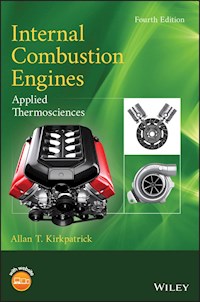
A comprehensive resource covering the foundational thermal-fluid sciences and engineering analysis techniques used to design and develop internal combustion engines
Internal Combustion Engines: Applied Thermosciences, Fourth Edition combines foundational thermal-fluid sciences with engineering analysis techniques for modeling and predicting the performance of internal combustion engines.
This new 4th edition includes brand new material on:
- New engine technologies and concepts
- Effects of engine speed on performance and emissions
- Fluid mechanics of intake and exhaust flow in engines
- Turbocharger and supercharger performance analysis
- Chemical kinetic modeling, reaction mechanisms, and emissions
- Advanced combustion processes including low temperature combustion
- Piston, ring and journal bearing friction analysis
The 4th Edition expands on the combined analytical and numerical approaches used successfully in previous editions. Students and engineers are provided with several new tools for applying the fundamental principles of thermodynamics, fluid mechanics, and heat transfer to internal combustion engines.
Each chapter includes MATLAB programs and examples showing how to perform detailed engineering computations. The chapters also have an increased number of homework problems with which the reader can gauge their progress and retention. All the software is ‘open source’ so that readers can see in detail how computational analysis and the design of engines is performed. A companion website is also provided, offering access to the MATLAB computer programs.
Sie lesen das E-Book in den Legimi-Apps auf:
Seitenzahl: 1046
Veröffentlichungsjahr: 2020
Ähnliche

















Internal Combustion Engines
Applied Thermosciences
Fourth Edition
Allan T. KirkpatrickDepartment of Mechanical Engineering Colorado State University CO, US
Copyright
This edition first published 2021
© 2021 John Wiley & Sons Ltd
Edition History
John Wiley & Sons, Ltd (3e, 2015)
All rights reserved. No part of this publication may be reproduced, stored in a retrieval system, or transmitted, in any form or by any means, electronic, mechanical, photocopying, recording or otherwise, except as permitted by law. Advice on how to obtain permission to reuse material from this title is available at http://www.wiley.com/go/permissions.
The right of Allan T. Kirkpatrick to be identified as the author of this work has been asserted in accordance with law.
Registered Offices
John Wiley & Sons, Inc., 111 River Street, Hoboken, NJ 07030, USA
John Wiley & Sons Ltd, The Atrium, Southern Gate, Chichester, West Sussex, PO19 8SQ, UK
Editorial Office
The Atrium, Southern Gate, Chichester, West Sussex, PO19 8SQ, UK
For details of our global editorial offices, customer services, and more information about Wiley products visit us at www.wiley.com.
Wiley also publishes its books in a variety of electronic formats and by print‐on‐demand. Some content that appears in standard print versions of this book may not be available in other formats.
Limit of Liability/Disclaimer of Warranty
MATLAB® is a trademark of The MathWorks, Inc. and is used with permission. The MathWorks does not warrant the accuracy of the text or exercises in this book. This work's use or discussion of MATLAB® software or related products does not constitute endorsement or sponsorship by The MathWorks of a particular pedagogical approach or particular use of the MATLAB® software.
In view of ongoing research, equipment modifications, changes in governmental regulations, and the constant flow of information relating to the use of experimental reagents, equipment, and devices, the reader is urged to review and evaluate the information provided in the package insert or instructions for each chemical, piece of equipment, reagent, or device for, among other things, any changes in the instructions or indication of usage and for added warnings and precautions. While the publisher and authors have used their best efforts in preparing this work, they make no representations or warranties with respect to the accuracy or completeness of the contents of this work and specifically disclaim all warranties, including without limitation any implied warranties of merchantability or fitness for a particular purpose. No warranty may be created or extended by sales representatives, written sales materials or promotional statements for this work. The fact that an organization, website, or product is referred to in this work as a citation and/or potential source of further information does not mean that the publisher and authors endorse the information or services the organization, website, or product may provide or recommendations it may make. This work is sold with the understanding that the publisher is not engaged in rendering professional services. The advice and strategies contained herein may not be suitable for your situation. You should consult with a specialist where appropriate. Further, readers should be aware that websites listed in this work may have changed or disappeared between when this work was written and when it is read. Neither the publisher nor authors shall be liable for any loss of profit or any other commercial damages, including but not limited to special, incidental, consequential, or other damages.
Library of Congress Cataloging‐in‐Publication Data
Names: Kirkpatrick, Allan, author.
Title: Internal combustion engines : applied thermosciences / Allan Thomson
Kirkpatrick.
Description: Fourth edition. | Hoboken, NJ, USA : Wiley, 2020. | Includes
index.
Identifiers: LCCN 2020020070 (print) | LCCN 2020020071 (ebook) | ISBN
9781119454502 (cloth) | ISBN 9781119454533 (adobe pdf) | ISBN
9781119454557 (epub)
Subjects: LCSH: Internal combustion engines–Thermodynamics. | BISAC:
SCIENCE / Mechanics / Dynamics / Thermodynamics.
Classification: LCC TJ756 .F47 2020 (print) | LCC TJ756 (ebook) | DDC
621.43–dc23
LC record available at https://lccn.loc.gov/2020020070
LC ebook record available at https://lccn.loc.gov/2020020071
Cover Design: Wiley
Cover Images: © Abstract background © Atropat/Getty Images, Internal combustion engine rendering © Alexey Lyubchikov/Shutterstock, Car clutch kit © Viktor Chursin/Shutterstock, Steel turbocharger © studiovin/Shutterstock
Preface
This fourth edition builds upon the foundation established by the three previous editions (1986, 1999, 2014) of this internal combustion engines textbook. For over thirty years, these editions have documented the continuing development of the internal combustion engine and the increased use of digital computation for analysis and design of engines. The editions have demonstrated the application of the principles of thermodynamics, fluid mechanics, and heat transfer to internal combustion engines, and reflected the changing balance between engineering analysis and numerical computation in improving our understanding of internal combustion engine performance. However, a note of caution should be sounded. As the capability of computers increase, there can be a temptation to rely exclusively on numerical computation. Engineering insight is also required. It is a sense of ‘a feel for the answer’, and is developed through engineering analysis and modeling.
The major focus of this fourth edition has been incorporating a time variable, i.e., engine rpm, into the engine analysis. The content additions include chemical equilibrium, chemical kinetics of reacting fuel‐air mixtures, incorporation of valve events into an energy release model, diesel spray penetration and evaporation, analysis of compressor and turbine fluid flow, expanded coverage of alternative fuels, piston ring and crankshaft bearing friction, heat transfer, gaseous emissions, soot, and exhaust gas analysis. The chapter organization remains the same as that of the third edition. The homework problems have increased in number and topics covered.
Since it is a standard in most engineering colleges and in industry, the programming software MATLAB® has been retained for the examples and homework problems, and listings of all computer codes are given in the Appendix. The computer codes have been expanded to allow comparison of valve timing and flow, friction and heat transfer models. There are now 26 programs included in the fourth edition, up from 17 programs in the third edition. Digital copies of the computer programs are also available from the author ([email protected]) and the John Wiley web site.
The text is designed for a one‐semester course in internal combustion engines at the senior undergraduate or beginning graduate level. At Colorado State University, this text is used for a single term course in internal combustion engines. The course meets for a lecture two times per week and a recitation/laboratory once a week, for a term of fifteen weeks.
Acknowledgements
It should be noted that Colin Ferguson, the author of the first edition of the engines book in 1986, has retired. Colin should be recognized for this significant contribution to engines education. Thanks are due to Professors Alex Taylor, Stelios Rigopoulos, Aaron Costall, and Yannis Hardalupas at Imperial College in London, England for providing a collegial and stimulating environment during my recent stay there. Professor Joshua Keena at West Point Military Academy suggested improvements in friction modeling.
Discussions with Colorado State Professors Daniel Olsen and Anthony Marchese on combustion modeling also have been very helpful. Former CSU graduate students Aron Dobos and Richard Wagner deserve a heartfelt thanks for their contributions to the computational elements of the combustion and friction chapters, respectively.
Many thanks to the editorial staff at John Wiley & Sons, Inc. for their work on the fourth edition. Ms. Anne Hunt and Mr. Steve Fassioms deserve special acknowledgement for their editorial assistance with this project. I would like to thank my wife Susan and my extended family: Anne, Matt, Maeve, Michael, Rob, Kristin, Thomson, Charlotte, and Theo for their unflagging support while this fourth edition was being written.
Finally, this edition is dedicated to my late father, Edward T. Kirkpatrick, who sparked my interest in engines and engineering years ago.
About the Companion Website
This book is accompanied by a companion website:
www.wiley.com/go/kirkpatrick/internal
The Website includes:
Solution manuals
Matlab programs
Scan this QR code to visit the companion website.
Chapter 1Introduction to Internal Combustion Engines
1.1 Introduction
The goals of this textbook are to describe how internal combustion engines work and provide insight into how engine performance can be modeled and analyzed. The main focus of the text is the application of the thermal sciences, including thermodynamics, combustion, fluid mechanics, and heat transfer, to internal combustion engines. An aspect upon which we will put considerable emphasis is the development of idealized models to represent the actual features of an operating engine.
Engineers use the methods and analyses introduced in the textbook to calculate the performance of proposed engine designs and to parameterize and correlate engines experiments. With the advent of high‐speed computers and advanced measurement techniques, today's internal combustion engine design process has evolved from being purely empirical to a rigorous semi‐empirical process in which computer based engineering software is used to evaluate the performance of a proposed engine design even before the engine is built and tested. In addition to detailed analysis, the textbook contains numerous computer routines for calculating the various thermal and mechanical parameters that describe internal combustion engine operation.
In this chapter we discuss the engineering parameters, such as thermal efficiency, mean effective pressure, and specific fuel consumption, that are used to characterize the overall performance of internal combustion engines. Major engine cycles, configurations, and geometries are also covered. The following chapters will apply the thermal science principles to determine an internal combustion engine's temperature and pressure profiles, work, volumetric efficiency, and exhaust emissions.
The internal combustion engine was invented and successfully developed in the late 1860s. It is considered one of the most significant inventions of the last century, and has had a significant impact on society, especially human mobility. The internal combustion engine has been the foundation for the successful development of many commercial technologies. Consider how the internal combustion engine has transformed the transportation industry, allowing the invention and improvement of automobiles, trucks, airplanes, and trains. The adoption and continued use of the internal combustion engine in different application areas has resulted from its relatively low cost, favorable power‐to‐weight ratio, high efficiency, and relatively simple and robust operating characteristics.
An internal combustion engine is an engine in which the chemical energy of the fuel is released inside the engine and used directly for mechanical work, as opposed to an external combustion engine in which a separate combustor is used to burn the fuel. The reciprocating piston‐cylinder geometry is the primary geometry that has been used in internal combustion engines, and is shown in Figure 1.1. As indicated in the figure, a piston oscillates back and forth in a cyclic pattern in a cylinder, transmitting power to a drive shaft through a connecting rod and crankshaft mechanism. Valves or ports are used to control the flow of gas into and out of the engine. This configuration of a reciprocating internal‐combustion engine, with an engine block, pistons, valves, crankshaft, and connecting rod, has remained basically unchanged since the late 1800s.
Figure 1.1 Piston and connecting rod. (Courtesy Mahle, Inc.)
The main differences between a modern‐day engine and one built 100 years ago can be seen by comparing their reliability, thermal efficiency, and emissions level. For many years, internal combustion engine research was aimed at improving thermal efficiency and reducing noise and vibration. As a consequence, the thermal efficiency has increased from about 10–20% at the beginning of the twentieth century to values as high as 50% today. Likewise, the power per unit volume has increased from about 0.5 kW/L to 50–100 kW/L.
Internal combustion engine efficiency continues to increase, driven both by legislation and the need to reduce operating costs. The primary US vehicle mileage standard is the Federal Corporate Average Fuel Economy (CAFE) standard. The CAFE standard for passenger vehicles and light‐duty trucks was 27.5 miles per gallon (mpg) for a 20‐year period from 1990 to 2010. The CAFE standards have risen in the last few years and are expected to double in the next decade. This increase in vehicle mileage requirements will require expanded use of techniques such as electronic control, engine downsizing, turbocharging, supercharging, variable valve timing, low‐temperature combustion, and electric motors and transmissions.
Figure 1.2 Automobile engine. (Courtesy Mercedes‐Benz Photo Library.)
Internal combustion engines have become the dominant prime mover technology in several areas. In 1900, most automobiles were steam or electrically powered, but by 1920 most automobiles were powered by gasoline engines. As of the year 2020, in the United States alone there are about 220 million motor vehicles powered by internal combustion engines, with about 12 million new vehicles built each year. In 1900, steam engines were used to power ships and railroad locomotives; today two‐ and four‐stroke diesel engines are used. Prior to 1950, aircraft relied almost exclusively on piston engines. Today gas turbines are the power plant used in large planes, and piston engines continue to dominate the market in small planes.
Internal combustion engines have been designed and built to deliver power in the range from 0.01 kW to kW, depending on their displacement. They compete in the marketplace with electric motors, gas turbines, and steam engines. The major applications are in the vehicular (see Figure 1.2), railroad, marine (see Figure 1.3), aircraft, stationary power, and home use areas. The vast majority of internal combustion engines are produced for vehicular applications, requiring a power output on the order of 100 kW.
Figure 1.3 Marine engine. (Courtesy Man B&W Diesel.)
Since 1970, with the recognition of the importance of environmental issues such as the impact of air quality on health, there has also been a great deal of work devoted to reducing the various emissions from engines. The emission levels of current internal combustion engines have decreased to about 5% of the emission levels 40 years ago. Currently, meeting emission requirements is one of the major factors in the design and operation of internal combustion engines. The major emissions from internal combustion engines include nitrogen oxides (), carbon monoxide (CO), hydrocarbons (HC), particulates (PM), and aldehydes. These combustion products are a significant source of air pollution, as the internal combustion engine is currently the source of about half of the , CO, and HC pollutants in the environment.
The emissions of carbon dioxide (CO2), a primary combustion product of hydrocarbon‐fueled internal combustion engines are now regulated, as CO2 is the dominant contributor to climate change. There is increasing interest in carbon‐free fuels for internal combustion engines, namely hydrogen and ammonia.
1.2 Historical Background
In this section we briefly discuss a few of the major figures in the invention and development of the internal combustion engine. The ingenuity and creativity demonstrated by these early engineers in producing these successful inventions is truly inspiring to today's engine designers. In 1858, J. Lenior (1822–1900), a Belgian engineer, developed a two‐stroke engine that developed 6 hp with an efficiency of about 5%. During the intake stroke, a gas–air mixture at atmospheric pressure was drawn into the engine and ignited by a spark, causing the cylinder pressure to increase during the latter half of the stroke, producing work. The return stroke was used to remove the combustion products through an exhaust valve. The Lenior engine was primarily used in stationary power applications.
In 1872, George Brayton (1830–1892), an American mechanical engineer, patented and commercialized a constant pressure internal combustion engine, Brayton's Ready Engine. The engine used two reciprocating piston‐driven cylinders, a compression cylinder and an expansion cylinder. This cycle was also called the flame cycle, as ignition of the gas–air mixture was by a pilot flame, and the mixture was ignited and burned at constant pressure as it was pumped from the compression cylinder to the expansion cylinder. The Brayton piston engine was used on the first automobile in 1878. The Brayton cycle is the thermodynamic cycle now used by gas turbines, which use rotating fan blades to compress and expand the gas flowing through the turbine.
Nikolaus Otto (1832–1891), a German engineer, developed the Otto Silent Engine, the first practical four‐stroke engine with in‐cylinder compression, in 1876. With a compression ratio of 2.5, the gas engine produced 2 hp at 160 rpm, and had a brake efficiency of 14%. Nikolaus Otto is considered the inventor of the modern internal combustion engine, and the founder of the internal combustion engine industry. The concept of a four‐stroke engine had been conceived and patented by A. de Rochas in 1861, however Otto is recognized as the first person to build and commercialize a working flame ignition engine. Otto had no formal engineering schooling; he was self‐taught. He devoted his entire career to the advancement of the internal combustion engine. In 1872, he founded the first internal combustion engine manufacturing company, N. A. Otto and Cie, and hired Gottlieb Daimler and Wilhelm Maybach, who would go on to start the first automobile company, the Daimler Motor Company, in 1890. Otto's son Gustav founded the automotive company now known as BMW.
The first practical two‐stroke engine was invented and built by Sir Dugald Clerk (1854–1932), a Scottish mechanical engineer, in 1878. Clerk graduated from Yorkshire College in 1876, and patented his two‐stroke engine in 1881. He is well known for his career‐long contributions to improvement of combustion processes in large‐bore two‐stroke engines. Clerk's engine was made of two cylinders – one a working cylinder to produce power and the other a pumping cylinder to compress and transfer the intake air and fuel mixture to the working cylinder. Poppet valves were used for intake flow, and a cylinder port uncovered by the piston on the expansion stroke was used to exhaust the combustion gases.
Many of these early internal combustion engines, such as the Lenior, Brayton, and Otto engines, were powered by coal gas, a mixture of methane, hydrogen, carbon monoxide, and other gases produced by the partial pyrolysis of coal. In the 1880s, crude oil refineries began producing gasoline and kerosene in quantities sufficient to create a market for liquid fueled internal combustion engines.
Gottlieb Daimler (1834–1900), a German engineer, is recognized as one of the founders of the automotive industry. He developed a high‐speed, water‐cooled four‐stroke engine in 1883. The engine had a 70 mm bore and 100 mm stroke, and produced about 1 hp at 650 rpm. The gasoline fuel was vaporized and mixed with the intake air in a carburetor. It then passed by a spring loaded intake valve activated by sub‐atmospheric cylinder pressure into the cylinder. The fuel–air mixture was ignited by a flame tube located just below the intake valve. The exhaust valve was operated by a cam lobe on the flywheel. In 1886, Daimler built the first four‐wheeled automobile, and founded the Daimler Motor Company in 1890.
Karl Benz (1844–1929), a German engineer, successfully developed a 3.5 hp liquid fueled four‐stroke engine with a carburetor and spark ignition in 1885. The ignition system consisted of an electrical induction coil with a rotary breaker driven by the engine and a removable spark plug fitted into the cylinder head, similar to what is found in today's engines. The engine was installed on a custom three wheeled vehicle in 1886, the first ”horseless carriage.” The transmission was a two‐chain arrangement that connected the engine to the rear axle.
In 1897 Rudolph Diesel (1858–1913), a German engineer, developed the first practical four‐stroke engine using direct injection of liquid fuel into the combustion chamber. The high compression ratio of the engine resulted in autoignition and combustion of the fuel–air mixture. Diesel graduated from Munich Polytechnic in 1880, and worked with his former professor, Carl von Linde, initially on ammonia Rankine cycle refrigeration, then worked with the MAN company to develop compression ignition engines. He designed his engines to follow Carnot's thermodynamic principles as closely as possible. Accordingly, his initial objective was to have constant temperature combustion; however, this was not realized in practice, and he adopted the strategy of constant pressure combustion.
Rudolph Diesel's single cylinder engine had a bore of 250 mm, stroke of 400 mm, for a 20‐liter displacement. The diesel fuel was atomized using air injection, a technique where compressed air entrained diesel fuel in the injector and carried it into the cylinder. The engine operated at a speed of of 170 rpm, and produced 18 hp, with a an efficiency of 27% at full load. This is a much greater efficiency than the steam engines and spark‐ignition engines in use at that time.
Sir Harry Ricardo (1885–1974), a mechanical engineering graduate of Cambridge and a prominent English engineer, patented the use of a spherical prechamber, the Ricardo “Comet” to greatly increase the fuel–air mixing rate, allowing diesel engines to be used in high speed, 2000 rpm and higher, engine vehicular applications. During his career, Ricardo also contributed to greater understanding of the role of turbulence, swirl, and squish in enhancing flame speed in both spark and diesel engines; commercialized sleeve valves for aircraft engines, developed an octane rating system for quantifying knock in spark engines; and founded what is now the Ricardo Consulting Engineers Company.
Early engines were air cooled, since they produced relatively low power. Natural convection water cooling using the thermosyphon principle, and forced convection cooling using water pumps was adopted after about 1910 for higher horsepower engines. Henry Ford's Model T engine of 1908, and the Wright Brother's Flyer engine of 1903 used natural convection water cooling.
The first multicylinder diesel engines for trucks were available by 1924. The first commercially available diesel powered automobile was the Mercedes 260D, initially introduced in 1936. It had a 2.6 L four‐cylinder prechamber diesel engine, which produced 45 hp at 3000 rpm.
Engine configurations for automobiles in the first half of the twentieth century were primarily four‐stroke, water‐cooled, with four or six in‐line cylinders, equipped with side valves. The valves were located at the side of the cylinder in a combustion pocket. The most common engine configuration used at the present time is the overhead valve configuration.
1.3 Engine Cycles
The two major cycles currently used in internal combustion engines are termed spark‐ignition and compression‐ignition cycles, also known as Otto and Diesel cycles, named after the two men credited with their invention. As we will see in Chapter 2, the Otto cycle is modeled as a constant volume combustion cycle and the Diesel cycle is modeled as a constant pressure combustion cycle. These cycles can configured as either a two‐stroke cycle in which the piston produces power on every downward stroke or a four‐stroke cycle in which the piston produces power every other downward stroke.
Spark‐Ignition Engine
As shown in Figure 1.4, the four‐stroke spark‐ignition engine has the following sequence of operations:
An intake stroke draws a combustible mixture of fuel and air past the throttle and the intake valve into the cylinder.
A compression stroke with the valves closed raises the temperature of the mixture. A spark ignites the mixture toward the end of the compression stroke.
An expansion or power stroke results from combustion of the fuel–air mixture.




