


78,99 €
Mehr erfahren.
- Herausgeber: John Wiley & Sons
- Kategorie: Wissenschaft und neue Technologien
- Sprache: Englisch
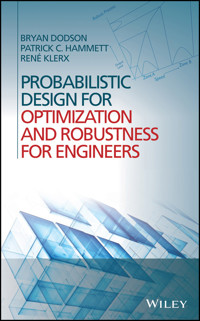
Probabilistic Design for Optimization and Robustness:
- Presents the theory of modeling with variation using physical models and methods for practical applications on designs more insensitive to variation.
- Provides a comprehensive guide to optimization and robustness for probabilistic design.
- Features examples, case studies and exercises throughout.
The methods presented can be applied to a wide range of disciplines such as mechanics, electrics, chemistry, aerospace, industry and engineering. This text is supported by an accompanying website featuring videos, interactive animations to aid the readers understanding.
Sie lesen das E-Book in den Legimi-Apps auf:
Seitenzahl: 346
Veröffentlichungsjahr: 2014
Ähnliche




















Probabilistic Design for Optimization and Robustness for Engineers
Bryan Dodson
Executive Engineer, SKF, USA
Patrick C. Hammett
Lead Faculty Six Sigma Program, Integrative Systems & Design, College of Engineering, University of Michigan, Ann Arbor, USA
René Klerx
Principal Statistician, SKF, The Netherlands
This edition first published 2014 © 2014 John Wiley & Sons, Ltd
Registered office
John Wiley & Sons Ltd, The Atrium, Southern Gate, Chichester, West Sussex, PO19 8SQ, United Kingdom
For details of our global editorial offices, for customer services and for information about how to apply for permission to reuse the copyright material in this book please see our website at www.wiley.com.
The right of the author to be identified as the author of this work has been asserted in accordance with the Copyright, Designs and Patents Act 1988.
All rights reserved. No part of this publication may be reproduced, stored in a retrieval system, or transmitted, in any form or by any means, electronic, mechanical, photocopying, recording or otherwise, except as permitted by the UK Copyright, Designs and Patents Act 1988, without the prior permission of the publisher.
Wiley also publishes its books in a variety of electronic formats. Some content that appears in print may not be available in electronic books.
Designations used by companies to distinguish their products are often claimed as trademarks. All brand names and product names used in this book are trade names, service marks, trademarks or registered trademarks of their respective owners. The publisher is not associated with any product or vendor mentioned in this book.
Limit of Liability/Disclaimer of Warranty: While the publisher and author have used their best efforts in preparing this book, they make no representations or warranties with respect to the accuracy or completeness of the contents of this book and specifically disclaim any implied warranties of merchantability or fitness for a particular purpose. It is sold on the understanding that the publisher is not engaged in rendering professional services and neither the publisher nor the author shall be liable for damages arising herefrom. If professional advice or other expert assistance is required, the services of a competent professional should be sought.
Library of Congress Cataloging-in-Publication Data
Dodson, Bryan, 1962– Probabilistic design for optimization and robustness for engineers / Bryan Dodson, Patrick C. Hammett, René Klerx. pages cm Includes bibliographical references and index. ISBN 978-1-118-79619-1 (cloth) 1. Industrial design–Statistical methods. 2. Reliability (Engineering) 3. Robust statistics. I. Hammett, Patrick C. II. Klerx, René. III. Title. TS171.9.D63 2014 620′.00452–dc23
2014013950
A catalogue record for this book is available from the British Library.
ISBN: 978-1-118-79619-1
Contents
Preface
Acknowledgments
1 New product development process
1.1 Introduction
1.2 Phases of new product development
1.3 Patterns of new product development
1.4 New product development and Design for Six Sigma
1.5 Summary
Exercises
2 Statistical background for engineering design
2.1 Expectation
2.2 Statistical distributions
2.3 Probability plotting
2.4 Summary
Exercises
Notes
3 Introduction to variation in engineering design
3.1 Variation in engineering design
3.2 Propagation of error
3.3 Protecting designs against variation
3.4 Estimates of means and variances of functions of several variables
3.5 Statistical bias
3.6 Robustness
3.7 Summary
Exercises
Notes
4 Monte Carlo simulation
4.1 Determining variation of the inputs
4.2 Random number generators
4.3 Validation
4.4 Stratified sampling
4.5 Summary
Exercises
Notes
5 Modeling variation of complex systems
5.1 Approximating the mean, bias, and variance
5.2 Estimating the parameters of non-normal distributions
5.3 Limitations of first-order Taylor series approximation for variance
5.4 Effect of non-normal input distributions
5.5 Nonconstant input standard deviation
5.6 Summary
Exercises
Notes
6 Desirability
6.1 Introduction
6.2 Requirements and scorecards
6.3 Desirability—single requirement
6.4 Desirability—multiple requirements
6.5 Desirability—accounting for variation
6.6 Summary
Exercises
Notes
7 Optimization and sensitivity
7.1 Optimization procedure
7.2 Statistical outliers
7.3 Process capability
7.4 Sensitivity and cost reduction
7.5 Summary
Exercises
Notes
8 Modeling system cost and multiple outputs
8.1 Optimizing for total system cost
8.2 Multiple outputs
8.3 Large-scale systems
8.4 Summary
Exercises
Notes
9 Tolerance analysis
9.1 Introduction
9.2 Tolerance analysis methods
9.3 Tolerance allocation
9.4 Drift, shift, and sorting
9.5 Non-normal inputs
9.6 Summary
Exercises
Notes
10 Empirical model development
10.1 Screening
10.2 Response surface
10.3 Taguchi
10.4 Summary
Exercises
Notes
11 Binary logistic regression
11.1 Introduction
11.2 Binary logistic regression
11.3 Logistic regression and customer loss functions
11.4 Loss function with maximum (or minimum) response
11.5 Summary
Exercises
Notes
12 Verification and validation
12.1 Introduction
12.2 Engineering model V&V
12.3 Design verification methods and tools
12.4 Process validation procedure
12.5 Summary
Notes
References
Bibliography
Answers to selected exercises
Index
End User License Agreement
List of Tables
Chapter 2
Table 2.1
Table 2.2
Table 2.3
Table 2.4
Table 2.5
Table 2.6
Table 2.7
Chapter 3
Table 3.1
Table 3.2
Table 3.3
Chapter 4
Table 4.1
Table 4.2
Table 4.3
Chapter 5
Table 5.1
Table 5.2
Table 5.3
Table 5.4
Table 5.5
Chapter 6
Table 6.1
Table 6.2
Table 6.3
Table 6.4
Table 6.5
Chapter 7
Table 7.1
Table 7.2
Table 7.3
Table 7.4
Table 7.5
Chapter 8
Table 8.1
Table 8.2
Chapter 9
Table 9.1
Table 9.2
Table 9.3
Chapter 10
Table 10.1
Table 10.2
Table 10.3
Table 10.4
Table 10.5
Table 10.6
Table 10.7
Table 10.8
Table 10.9
Table 10.10
Table 10.11
Table 10.12
Table 10.13
Table 10.14
Table 10.15
Table 10.16
Chapter 11
Table 11.1
Table 11.2
Table 11.3
Table 11.4
Table 11.5
Chapter 12
Table 12.1
Table 12.2
Guide
Cover
Table of Contents
Preface
Pages
ix
xi
1
2
3
4
5
6
7
8
9
10
11
12
13
14
15
16
17
18
19
20
21
22
23
24
25
26
27
28
29
30
31
32
33
34
35
36
37
38
39
40
41
42
43
44
45
46
47
48
49
50
51
52
53
54
55
56
57
58
59
60
61
62
63
64
65
66
67
68
69
70
71
72
73
74
75
76
77
78
79
80
81
82
83
84
85
86
87
88
89
90
91
92
93
94
95
96
97
98
99
100
101
102
103
104
105
106
107
108
109
110
111
112
113
114
115
116
117
118
119
120
121
122
123
124
125
126
127
128
129
130
131
132
133
134
135
136
137
138
139
140
141
142
143
144
145
146
147
148
149
150
151
152
153
154
155
156
157
158
159
160
161
162
163
164
165
166
167
168
169
170
171
172
173
174
175
176
177
178
179
180
181
182
183
184
185
186
187
188
189
190
191
192
193
194
195
196
197
198
199
200
201
202
203
204
205
206
207
208
209
210
211
212
213
214
215
216
217
218
219
220
221
222
223
224
225
226
227
228
229
230
231
232
233
234
235
236
237
238
239
240
241
242
243
244
245
246
247
248
249
250
251
252
253
254
255
Preface
Engineers spend years learning mathematical models to describe the behavior of systems. However, only a small portion of the engineering curriculum is dedicated to accounting for variation faced by product and process designers. Even here, the focus is usually limited to controlling manufacturing variation through tolerance analysis. Today, many engineering curricula offer elective courses in experimental design or robust design, but these courses focus more on system optimization and reducing variation in design through experimentation. This book presents the theory of modeling variation using physical models and presents methods for practical applications including making designs less sensitive to variation. This approach helps create designs that are easy to manufacture, with less design and manufacturing costs, and utilize more realistic tolerances. Methods are presented for determining nominal parameter settings that minimize output variation, determining the output variation caused by each input parameter, and minimizing total system costs, which includes the cost of non-conformance.
A challenge for this book is the lack of in-depth statistical training for many engineers. Many engineering curricula require a single course on probability or have no requirement at all. Stochastic modeling and optimization require some advanced statistical methods. Introductory chapters provide a logical roadmap to allow a complete understanding of the material without overwhelming the reader with excessive statistical rigor. Worked examples in the text are available on the Wiley website (www.wiley.com/go/robustness_for_engineers) along with animation software and computer-based exercises to aid understanding.
Acknowledgments
Paolo ReGroup Business ExcellenceSKF
Rajeev SundarrajGraduate Student, Class of 2013Industrial and Operations EngineeringUniversity of Michigan, Ann Arbor
Silvio VasconiRegional Manager Engineering Consultancy ServicesSKF
The authors wish to acknowledge the following individuals for their contribution in providing valuable input and industry examples.
Steven GeddesManufacturing Validation Solutions
Donald LynchSKF
Patrick WalshManufacturing Validation Solutions
1New product development process
1.1 Introduction
The development of new products is a major competitive issue as consumers continuously demand new and improved products. One outcome of this competitive landscape is the need for shorter product life cycles while still achieving ever increasing expectations for product quality and performance measures. This has required companies to significantly enhance their capabilities to better identify true customer wants, translate them into quantifiable product functional requirements, quickly develop, evaluate, and integrate new design concepts to meet them, and then effectively bring these concepts to market through new product offerings.
Several companies (e.g., Apple, General Electric (GE), Samsung, Toyota, General Motors (GM), Ford) have made great strides improving the effectiveness of new product development. For example, many companies have created processes to quickly gather voice of the customer information via surveys, customer clinics, or other sources. Samsung, for instance, has a well-designed system of scorecards and tool application checklists to manage risk and cycle time from the voice of the customer through the launch of products that meet customer and business process demands (Creveling et al., 2003). In addition, advances in computer simulation and modeling techniques permit manufacturers to evaluate many design concept alternatives, thereby resolving many potential problems at minimal costs. This also allows one to minimize assumptions and simplifications that reduce the accuracy of the answer (Tennant, 2002). Finally, even when there is a need to construct physical prototypes, the cost has been lowered through rapid prototyping processes.
Lesen Sie weiter in der vollständigen Ausgabe!
Lesen Sie weiter in der vollständigen Ausgabe!
Lesen Sie weiter in der vollständigen Ausgabe!
Lesen Sie weiter in der vollständigen Ausgabe!
Lesen Sie weiter in der vollständigen Ausgabe!
Lesen Sie weiter in der vollständigen Ausgabe!
Lesen Sie weiter in der vollständigen Ausgabe!
Lesen Sie weiter in der vollständigen Ausgabe!
Lesen Sie weiter in der vollständigen Ausgabe!
Lesen Sie weiter in der vollständigen Ausgabe!
Lesen Sie weiter in der vollständigen Ausgabe!
Lesen Sie weiter in der vollständigen Ausgabe!
Lesen Sie weiter in der vollständigen Ausgabe!
Lesen Sie weiter in der vollständigen Ausgabe!
Lesen Sie weiter in der vollständigen Ausgabe!
Lesen Sie weiter in der vollständigen Ausgabe!




