


91,99 €
Mehr erfahren.
- Herausgeber: John Wiley & Sons
- Kategorie: Wissenschaft und neue Technologien
- Sprache: Englisch
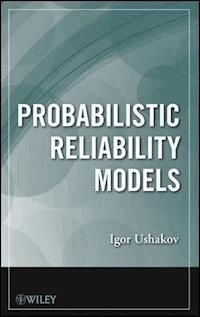
Practical Approaches to Reliability Theory in Cutting-Edge Applications Probabilistic Reliability Models helps readers understand and properly use statistical methods and optimal resource allocation to solve engineering problems. The author supplies engineers with a deeper understanding of mathematical models while also equipping mathematically oriented readers with a fundamental knowledge of the engineeringrelated applications at the center of model building. The book showcases the use of probability theory and mathematical statistics to solve common, real-world reliability problems. Following an introduction to the topic, subsequent chapters explore key systems and models including: * Unrecoverable objects and recoverable systems * Methods of direct enumeration * Markov models and heuristic models * Performance effectiveness * Time redundancy * System survivability * Aging units and their related systems * Multistate systems Detailed case studies illustrate the relevance of the discussed methods to real-world technical projects including software failure avalanches, gas pipelines with underground storage, and intercontinental ballistic missile (ICBM) control systems. Numerical examples and detailed explanations accompany each topic, and exercises throughout allow readers to test their comprehension of the presented material. Probabilistic Reliability Models is an excellent book for statistics, engineering, and operations research courses on applied probability at the upper-undergraduate and graduate levels. The book is also a valuable reference for professionals and researchers working in industry who would like a mathematical review of reliability models and the relevant applications.
Sie lesen das E-Book in den Legimi-Apps auf:
Seitenzahl: 201
Veröffentlichungsjahr: 2012
Ähnliche



















Contents
Cover
Title Page
Copyright
Dedication
Preface
Acronyms and Notation
Acronyms
Notation
Chapter 1: What Is Reliability?
1.1 Reliability as a Property of Technical Objects
1.2 Other “Ilities”
1.3 Hierarchical Levels of Analyzed Objects
1.4 How Can Reliability be Measured?
1.5 Software Reliability
Chapter 2: Unrecoverable Objects
2.1 Unit
2.2 Series Systems
2.3 Parallel System
2.4 Structure of Type “K-out-of-n”
2.5 Realistic Models of Loaded Redundancy
2.6 Reducible Structures
2.7 Standby Redundancy
2.8 Realistic Models of Unloaded Redundancy
Chapter 3: Recoverable Systems: Markov Models
3.1 Unit
3.2 Series System
3.3 Dubbed System
3.4 Parallel Systems
3.5 Structures of Type “M-out-of-n”
Chapter 4: Recoverable Systems: Heuristic Models
4.1 Preliminary Notes
4.2 Poisson Process
4.3 Procedures over Poisson Processes
4.4 Asymptotic Thinning Procedure over Stochastic Point Process
4.5 Asymptotic Superposition of Stochastic Point Processes
4.6 Intersection of Flows of Narrow Impulses
4.7 Heuristic Method for Reliability Analysis of Series Recoverable Systems
4.8 Heuristic Method for Reliability Analysis of Parallel Recoverable Systems
4.9 Brief Historical Overview and Related Sources
Bibliography
Chapter 5: Time Redundancy
5.1 System with Possibility of Restarting Operation
5.2 Systems with “Admissibly Short Failures”
5.3 Systems with Time Accumulation
5.4 Case Study: Gas Pipeline with an Underground Storage
5.5 Brief Historical Overview and Related Sources
Bibliography
Chapter 6: “Aging” Units and Systems of “Aging” Units
6.1 Chebyshev Bound
6.2 “Aging” Unit
6.3 Bounds for Probability of Failure-Free Operations
6.4 Series System Consisting of “Aging” Units
6.5 Series System
6.6 Parallel System
6.7 Bounds for the Coefficient of Operational Availability
6.8 Brief Historical Overview and Related Sources
Bibliography
Chapter 7: Two-Pole Networks
7.1 General Comments
7.2 Method of Boolean Function Decomposition
7.3 Method of Paths and Cuts
7.4 Brief Historical Overview and Related Sources
Bibliography
Chapter 8: Performance Effectiveness
8.1 Effectiveness Concepts
8.2 General Idea of Effectiveness Evaluation
8.3 Additive Type of System Units' Outcomes
8.4 Case Study: ICBM Control System
8.5 Systems with Intersecting Zones of Action
8.6 Practical Recommendation
8.7 Brief Historical Overview and Related Sources
Bibliography
Chapter 9: System Survivability
9.1 Illustrative Example
9.2 Brief Historical Overview and Related Sources
Bibliography
Chapter 10: Multistate Systems
10.1 Preliminary Notes
10.2 Generating Function
10.3 Universal Generating Function
10.4 Multistate Series System
10.5 Multistate Parallel System
10.6 Reducible Systems
10.7 Conclusion
10.8 Brief Historical Overview and Related Sources
Bibliography
Appendix A: Main Distributions Related to Reliability Theory
A.1 Discrete Distributions
A.2 Continuous Distributions
Appendix B: Laplace Transformation
Appendix C: Markov Processes
C.1 General Markov Process
C.2 Birth–Death Process
Appendix D: General Bibliography
Handbooks
Textbooks and Monographs
Index
Cover Image: © Victor Tongdee/iStockphoto
Copyright © 2012 by John Wiley & Sons, Inc. All rights reserved.
Published by John Wiley & Sons, Inc., Hoboken, New Jersey.
Published simultaneously in Canada.
No part of this publication may be reproduced, stored in a retrieval system, or transmitted in any form or by any means, electronic, mechanical, photocopying, recording, scanning, or otherwise, except as permitted under Section 107 or 108 of the 1976 United States Copyright Act, without either the prior written permission of the Publisher, or authorization through payment of the appropriate per-copy fee to the Copyright Clearance Center, Inc., 222 Rosewood Drive, Danvers, MA 01923, (978) 750-8400, fax (978) 750-4470, or on the web at www.copyright.com. Requests to the Publisher for permission should be addressed to the Permissions Department, John Wiley & Sons, Inc., 111 River Street, Hoboken, NJ 07030, (201) 748-6011, fax (201) 748-6008, or online at http://www.wiley.com/go/permission.
Limit of Liability/Disclaimer of Warranty: While the publisher and author have used their best efforts in preparing this book, they make no representations or warranties with respect to the accuracy or completeness of the contents of this book and specifically disclaim any implied warranties of merchantability or fitness for a particular purpose. No warranty may be created or extended by sales representatives or written sales materials. The advice and strategies contained herein may not be suitable for your situation. You should consult with a professional where appropriate. Neither the publisher nor author shall be liable for any loss of profit or any other commercial damages, including but not limited to special, incidental, consequential, or other damages.
For general information on our other products and services or for technical support, please contact our Customer Care Department within the United States at (800) 762-2974, outside the United States at (317) 572-3993 or fax (317) 572-4002.
Wiley also publishes its books in a variety of electronic formats. Some content that appears in print may not be available in electronic formats. For more information about Wiley products, visit our web site at www.wiley.com.
Library of Congress Cataloging-in-Publication Data:
Ushakov, I. A. (Igor Alekseevich)
Probabilistic reliability models / Igor A. Ushakov.
p. cm.
Includes bibliographical references and index.
ISBN 978-1-118-34183-4 (hardback)
1. Reliability (Engineering)–Mathematical models. 2. Probabilities. I. Title.
TA169.U84 2012
320'.00452015192—dc23
2012005946
To Boris Gnedenko, a mentor throughout my life
Preface
I dedicate this book to a great man who was more than my mentor. He took the place of my father who passed away relatively early. Boris Gnedenko was an outstanding mathematician and exceptional teacher. In addition, he was a magnetic personality who gathered around him tens of disciples and students. He was a founder of the famous Moscow Reliability School that produced a number of first-class mathematicians (among them Yuri Belyaev, Igor Kovalenko, Jacob Shor, and Alexander Solovyev) and talented reliability engineers (including Ernest Dzirkal, Vadim Gadasin, Boris Kozlov, Igor Pavlov, Allan Perrote, and Anatoly Raykin).
Why did I write this book?
Since the beginning of my career, I have been working at the junction of engineering and mathematics—I was a reliability engineer. As an engineer by education, I never had a proper mathematical background; however, life has forced me to submerge in depth into the area of probability theory and mathematical statistics. And I was lucky to meet at the start of my career the “three pillars on which rested the reliability theory” in Russia, namely, Boris Gnedenko, Alexander Solovyev, and Yuri Belyaev. They helped me understand the nuances and physical sense of many mathematical methods.
Thus, I have decided to share with the readers my experience, as well as many real mathematical insights, that happened when I submerged myself into reliability theory.
Boris Gnedenko once told me: “Mathematical reliability models are engendered by practice, so they have to be adequate to reality and should not be too complex by their nature.”
To get an understanding of “real reliability,” one goes through a series of painful mistakes in solving real problems. Engineering intuition arrives to mathematicians only after years of working in reliability engineering. At the same time, proper mathematical knowledge comes to reliability engineers after multiple practical uses of mathematical methods and having experienced “finger sensation” of formulas and numbers.
I remember my own thorny way in the course of my professional career. In writing this reliability textbook, I have tried to include as much as possible “physical” explanations of mathematical methods applied in solving reliability problems, as well as “physical” explanations of engineering objects laid on the basis of mathematical models.
At the end of the book, the reader can find a wide list of monographs on reliability. I must, however, note a few books that, in my opinion, are basic in this area. They are (in order of publication) the monographs by Igor Bazovsky (1961), David K. Lloyd and Myron Lipow (1962), Richard Barlow and Frank Proschan (1965), and Boris Gnedenko, Yuri Belyaev, and Alexander Solovyev (1965). These books cover the entire area of probabilistic reliability modeling and contain many important theoretical and practical concepts.
Igor Ushakov
San Diego, CaliforniaMarch 31, 2012
Acronyms and Notation
Acronyms
ACAvailability coefficientd.f.Distribution functionDFRDecreasing failure rateFRFailure rateGFGenerating functioni.i.d.Independent and identically distributed (about r.v.)IFRIncreasing failure rateLTLaplace transformMDTMean downtimeMTBFMean time between failuresMTTFMean time to failureOACOperational availability coefficientPEIPerformance effectiveness indexPFFOProbability of failure-free operationr.v.Random variableRBDReliability block diagramTTFRandom time to failureUGFUniversal generating functionNotation
F(t)Distribution functionKSystem stationary availability coefficientK(t)System nonstationary availability coefficientpk(t)Probability of failure-free operation of unit kP(t)Probability of system's failure-free operationqk(t)Probability of failure of unit kQ(t)Probability of system's failureTMean time to/between failuresXRandom variableλFailure rateτDowntimeξRandom time to/between failuresηRandom recovery timeψ(·)System's structural functionSum by k from 1 to nProduct by k from 1 to nLogic sum (“or”)Logic product (“and”)Logic sum by k from 1 to nLogic product by k from 1 to nSet of natural numbers from 1 to nChapter 1
What Is Reliability?
1.1 Reliability as a Property of Technical Objects
Reliability of a technical object is its ability to perform required operations successfully. Usually, it is assumed that an object is used in accordance with its technical requirements and is supported by appropriate maintenance.
One of the outstanding Russian specialists in cybernetics, academician Axel Berg, has said: “Reliability is quality expanded in time.”
Reliability is a broad concept. Of course, its main characterization is the failure-free operation while performing required tasks. However, it also includes such features as availability, longevity, recoverability, safety, survivability, and other important properties of technical objects.
Speaking of reliability, one has to introduce a concept of failure. What does it mean—“successful operation?” Where is the limit of “successfulness?”
Lesen Sie weiter in der vollständigen Ausgabe!
Lesen Sie weiter in der vollständigen Ausgabe!
Lesen Sie weiter in der vollständigen Ausgabe!
Lesen Sie weiter in der vollständigen Ausgabe!
Lesen Sie weiter in der vollständigen Ausgabe!
Lesen Sie weiter in der vollständigen Ausgabe!
Lesen Sie weiter in der vollständigen Ausgabe!
Lesen Sie weiter in der vollständigen Ausgabe!
Lesen Sie weiter in der vollständigen Ausgabe!
Lesen Sie weiter in der vollständigen Ausgabe!
Lesen Sie weiter in der vollständigen Ausgabe!
Lesen Sie weiter in der vollständigen Ausgabe!
Lesen Sie weiter in der vollständigen Ausgabe!
Lesen Sie weiter in der vollständigen Ausgabe!




