


39,99 €
Mehr erfahren.
- Herausgeber: John Wiley & Sons
- Kategorie: Wissenschaft und neue Technologien
- Sprache: Englisch
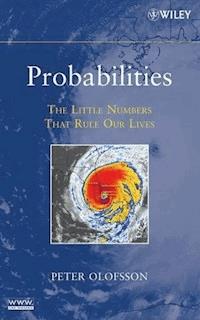
What are the chances?
Find out in this entertaining exploration ofprobabilities in our everyday lives
“If there is anything you want to know, or remind yourself, about probabilities, then look no further than this comprehensive, yet wittily written and enjoyable, compendium of how to apply probability calculations in real-world situations.”
— Keith Devlin, Stanford University, National Public Radio’s “Math Guy” and author of The Math Gene and The Math Instinct
“A delightful guide to the sometimes counterintuitive discipline of probability. Olofsson points out major ideas here, explains classic puzzles there, and everywhere makes free use of witty vignettes to instruct and amuse.”
— John Allen Paulos, Temple University, author of Innumeracy and A Mathematician Reads the Newspaper
“Beautifully written, with fascinating examples and tidbits of information. Olofsson gently and persuasively shows us how to think clearly about the uncertainty that governs our lives.”
— John Haigh, University of Sussex, author of Taking Chances: Winning with Probability
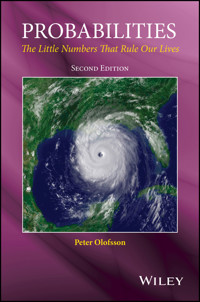
From probable improbabilities to regular irregularities, Probabilities: The Little Numbers That Rule Our Lives investigates the often-surprising effects of risk and chance in our everyday lives. With examples ranging from WWII espionage to the O. J. Simpson trial, from bridge to blackjack, from Julius Caesar to Jerry Seinfeld, the reader is taught how to think straight in a world of randomness and uncertainty.
Throughout the book, readers learn:
- Why it is not that surprising for someone to win the lottery twice
- How a faulty probability calculation forced an innocent woman to spend three years in prison
- How to place bets if you absolutely insist on gambling
- How a newspaper turned an opinion poll into one of the greatest election blunders in history
Educational, eloquent, and entertaining, Probabilities: The Little Numbers That Rule Our Lives is the ideal companion for anyone who wants to obtain a better understanding of the mathematics of chance.
Sie lesen das E-Book in den Legimi-Apps auf:
Seitenzahl: 547
Veröffentlichungsjahr: 2013
Ähnliche


















Contents
Preface
1 Computing Probabilities: Right Ways and Wrong Ways
THE PROBABILIST
THE PROBABILIST’S TOYS AND LANGUAGE
THE PROBABILIST’S RULE BOOK
INDEPENDENCE, AIRPLANES, AND RUSSIAN PEASANTS
CONDITIONAL PROBABILITY, SWEDISH TV, AND BRITISH COURTS
LIAR, LIAR
TOTAL PROBABILITY, USED CARS, AND TENNIS MATCHES
COMBINATORICS, PASTRAMI, AND POETRY
THE VON TRAPPS AND THE BINOMIAL DISTRIBUTION
FINAL WORD
2 Surprising Probabilities: When Intuition Struggles
BOYS, GIRLS, ACES, AND COLORED CARDS
GOATS AND GLOATS
HAPPY BIRTHDAY
TYPICAL ATYPICALITIES
STRATEGIES, SHOPPING, AND SPAGHETTI WESTERNS
THE BRITISH SNOB AND I
FINAL WORD
3 Tiny Probabilities: Why Are They So Hard to Escape?
PROBABLE IMPROBABILITIES
SADDAM AND I
TAKING TINY RISKS
A MILLION-TO-ONE SHOT, DOC, MILLION TO ONE!
MONSIEUR POISSON AND THE MYSTERIOUS NUMBER 37
CLUMPS IN SPACE
FINAL WORD
4 Backward Probabilities: The Reverend Bayes to Our Rescue
DRIVING MISS DAISY
BAYES, BALLS, AND BOYS (AND GIRLS)
BAYES AND MY GREEN CARD
OBJECTION YOUR HONOR
FINAL WORD
5 Beyond Probabilities: What to Expect
GREAT EXPECTATIONS
GOOD THINGS COME TO THOSE WHO WAIT
EXPECT THE UNEXPECTED
SIZE MATTERS (AND LENGTH, AND AGE)
DEVIANT BEHAVIOR
FINAL WORD
6 Inevitable Probabilities: Two Fascinating Mathematical Results
ALEA IACTA EST, OVER AND OVER
EVEN-STEVEN? THE LAW MISUNDERSTOOD
COIN TOSSES AND FREEWAY CONGESTION
LET’S GET SERIOUS
BELLS AND BREAD
HOW A TORONTO QUINCUNX CHANGED MY LIFE
FINAL WORD
7 Gambling Probabilities: Why Donald Trump Is Richer than You
FRENCH LETTERS
ROULETTE: A CLASSY WAY TO WASTE YOUR MONEY
CRAPS: NOT SO DICEY AFTER ALL
BLACKJACK: MONEY FOR MNEMONICS
MATH FOR LOSERS
WIN MONEY AND LOSE FRIENDS
FINAL WORD
8 Guessing Probabilities: Enter the Statisticians
LIES, DAMNED LIES, AND BEAUTIFUL LIES?
4 OUT OF 10 LIKE THE PRESIDENT 19 TIMES OUT OF 20
POLLS GONE WILD
THE LAWSUIT AND THE LURKER
FOOTBALL PLAYERS AND GEYSER ERUPTIONS
SNOOPING IN THE ABBOT’S GARDEN
FINAL WORD
9 Faking Probabilities: Computer Simulation
MAHOGANY DICE AND MODULAR ARITHMETIC
RANDOM AND NOT-SO-RANDOM DIGITS
NUMBER ONE IS NUMBER ONE
IS RANDOM REALLY RANDOM?
FINAL WORD
Index
THE WILEY BICENTENNIAL-KNOWLEDGE FOR GENERATIONS
ach generation has its unique needs and aspirations. When Charles Wiley first opened his small printing shop in lower Manhattan in 1807, it was a generation of boundless potential searching for an identity. And we were there, helping to define a new American literary tradition. Over half a century later, in the midst of the Second Industrial Revolution, it was a generation focused on building the future. Once again, we were there, supplying the critical scientific, technical, and engineering knowledge that helped frame the world. Throughout the 20th Century, and into the new millennium, nations began to reach out beyond their own borders and a new international community was born. Wiley was there, expanding its operations around the world to enable a global exchange of ideas, opinions, and know-how.
For 200 years, Wiley has been an integral part of each generation’s journey, enabling the flow of information and understanding necessary to meet their needs and fulfill their aspirations. Today, bold new technologies are changing the way we live and learn. Wiley will be there, providing you the must-have knowledge you need to imagine new worlds, new possibilities, and new opportunities.
Generations come and go, but you can always count on Wiley to provide you the knowledge you need, when and where you need it!
Copyright © 2007 by John Wiley & Sons, Inc. All rights reserved.
Published by John Wiley & Sons, Inc., Hoboken, New Jersey.
Published simultaneously in Canada.
No part of this publication may be reproduced, stored in a retrieval system, or transmitted in any form or by any means, electronic, mechanical, photocopying, recording, scanning, or otherwise, except as permitted under Section 107 or 108 of the 1976 United States Copyright Act, without either the prior written permission of the Publisher, or authorization through payment of the appropriate per-copy fee to the Copyright Clearance Center, Inc., 222 Rosewood Drive, Danvers, MA 01923, (978) 750-8400, fax (978) 750-4470, or on the web at www.copyright.com. Requests to the Publisher for permission should be addressed to the Permissions Department, John Wiley & Sons, Inc., 111 River Street, Hoboken, NJ 07030, (201) 748-6011, fax (201) 748-6008, or online athttp://www.wiley.com/go/permission.
Limit of Liability/Disclaimer of Warranty: While the publisher and author have used their best efforts in preparing this book, they make no representations or warranties with respect to the accuracy or completeness of the contents of this book and specifically disclaim any implied warranties of merchantability or fitness for a particular purpose. No warranty may be created or extended by sales representatives or written sales materials. The advice and strategies contained herein may not be suitable for your situation. You should consult with a professional where appropriate. Neither the publisher nor author shall be liable for any loss of profit or any other commercial damages, including but not limited to special, incidental, consequential, or other damages.
For general information on our other products and services or for technical support, please contact our Customer Care Department within the United States at (800) 762-2974, outside the United States at (317) 572-3993 or fax (317) 572-4002.
Wiley also publishes its books in a variety of electronic formats. Some content that appears in print may not be available in electronic format. For information about Wiley products, visit our web site at www.wiley.com.
Library of Congress Cataloging-in-Publication Data is available.
ISBN-13: 978-0-470-04001-0
ISBN-10: 0-470-04001-7
1 0 9 8 7 6 5 4 3 2 1
Preface
This book is about those little numbers that we just cannot escape. Try to remember the last day you didn’t hear at least something about probabilities, chance, odds, randomness, risk, or uncertainty. I bet it’s been a while. In this book, I will tell you about the mathematics of such things and how it can be used to better understand the world around you. It is not a textbook though. It does not have little colored boxes with definition or theorems, nor does it contain sections with exercises for you to solve. My main purpose is to entertain you, but it is inevitable that you will also learn a thing or two. There are even a few exercises for you, but they are so subtly presented that you might not even notice until you have actually solved them.
The spousal thanks is always more than a formality. I thank Aλμήvη for putting up with irregular work hours and everything else that comes with writing a book, but also for help with Greek words and for reminding me of some of my old travel stories that you will find in the book. I am deeply grateful to Professor Olle Häggström at Chalmers University of Technology in Göteborg, Sweden. He has read the entire manuscript, and his comments are always insightful, accurate, and clinically free from unnecessary politeness. If you find something in this book that strikes you as particularly silly, chances are that Mr. Häggström has already pointed it out to me but that I decided to keep it for spite. I have also received helpful comments from John Haigh at the University of Sussex, Steve Quigley at Wiley, and from an anonymous referee. Thanks also to Kris Parrish and Susanne Steitz at Wiley, to Sheree Van Vreede at Sheree Van Vreede Publications Services for excellent copyediting, and to Amy Hendrickson at Texnology Inc. for promptly and patiently answering my LaTeX questions.
A large portion of this book was written during the tumultuous Fall of 2005. Our move from Houston to New Orleans in early August turned out to be a masterpiece of bad timing as Hurricane Katrina hit three weeks later. We evacuated to Houston, and when Katrina’s sister Rita approached, we took refuge in the deserts of West Texas and New Mexico. Sandstorms are so much more pleasant than hurricanes! However, it was also nice to return to New Orleans in January 2006; the city is still beautiful, and its chargrilled oysters are unsurpassed. I am grateful to many people who housed us and helped us in various ways during the Fall and by doing so had direct or indirect impact on this book. Special thanks to Kathy Ensor & Co. at the Department of Statistics at Rice University in Houston and to Tom English & Co. at the College of the Mainland in Texas City for providing me with office space. Finally, thanks to Professor Peter Jagers at Chalmers University of Technology, who as my Ph.D. thesis advisor once in a distant past wisely guided me through my first serious encounters with probabilities, those little numbers that rule our lives.
PETER OLOFSSONwww.peterolofsson.com
New Orleans,2006
1
Computing Probabilities: Right Ways and Wrong Ways
THE PROBABILIST
Whether you like it or not, probabilities rule your life. If you have ever tried to make a living as a gambler, you are painfully aware of this, but even those of us with more mundane life stories are constantly affected by these little numbers. Some examples from daily life where probability calculations are involved are the determination of insurance premiums, the introduction of new medications on the market, opinion polls, weather forecasts, and DNA evidence in courts. Probabilities also rule who you are. Did daddy pass you the X or the Y chromosome? Did you inherit grandma’s big nose? And on a more profound level, quantum physicists teach us that everything is governed by the laws of probability. They toss around terms like the Schrödinger wave equation and Heisenberg’s uncertainy principle, which are much too difficult for most of us to understand, but one thing they do mean is that the fundamental laws of physics can only be stated in terms of probabilities. And the fact that Newton’s deterministic laws of physics are still useful can also be attributed to results from the theory of probabilities. Meanwhile, in everyday life, many of us use probabilities in our language and say things like “I’m 99% certain” or “There is a one-in-a-million chance” or, when something unusual happens, ask the rhetorical question “What are the odds?”
Some of us make a living from probabilities, by developing new theory and finding new applications, by teaching others how to use them, and occasionally by writing books about them. We call ourselves probabilists. In the universities, you find us in mathematics and statistics departments; there are no departments of probability. The terms “mathematician” and “statistician” are much more well known than “probabilist,” and we are a little bit of both but we don’t always like to admit it. If I introduce myself as a mathematician at a cocktail party, people wish they could walk away. If I introduce myself as a statistician, they do. If I introduce myself as a probabilist…well, most actually still walk away. They get upset that somebody who sounds like the Swedish Chef from the Muppet Show tries to impress them with difficult words. But some stay and give me the opportunity to tell them some of the things I will now tell you about.
Let us be etymologists for a while and start with the word itself, probability. The Latin roots are probare, which means to test, to prove, or to approve, and habilis, which means apt, skillful, able. The word “probable” was originally used in the sense “worthy of approval,” and its connection to randomness came later when it came to mean “likely” or “reasonable.” In my native Swedish, the word for probable is “sannolik,” which literally means “truthlike” as does the German word “wahrscheinlich.” The word “probability” still has room for nuances in the English language, and Merriam-Webster’s online dictionary lists four slightly different meanings. To us a probability is a number used to describe how likely something is to occur, and probability (without indefinite article) is the study of probabilities.
Probabilities are used in situations that involve randomness. Many clever people have thought about and debated what randomness really is, and we could get into a long philosophical discussion that could fill the rest of the book. Let’s not. The French mathematician Pierre-Simon Laplace (1749–1827) put it nicely: “Probability is composed partly of our ignorance, partly of our knowledge.” Inspired by Monsieur Laplace, let us agree that you can use probabilities whenever you are faced with uncertainty. You could:
Lesen Sie weiter in der vollständigen Ausgabe!
Lesen Sie weiter in der vollständigen Ausgabe!
Lesen Sie weiter in der vollständigen Ausgabe!
Lesen Sie weiter in der vollständigen Ausgabe!
Lesen Sie weiter in der vollständigen Ausgabe!
Lesen Sie weiter in der vollständigen Ausgabe!
Lesen Sie weiter in der vollständigen Ausgabe!
Lesen Sie weiter in der vollständigen Ausgabe!
Lesen Sie weiter in der vollständigen Ausgabe!




