


122,99 €
Mehr erfahren.
- Herausgeber: John Wiley & Sons
- Kategorie: Wissenschaft und neue Technologien
- Sprache: Englisch
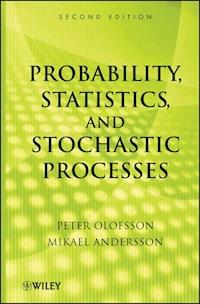
Praise for the First Edition ". . . an excellent textbook . . . well organized and neatly written." --Mathematical Reviews ". . . amazingly interesting . . ." --Technometrics Thoroughly updated to showcase the interrelationships between probability, statistics, and stochastic processes, Probability, Statistics, and Stochastic Processes, Second Edition prepares readers to collect, analyze, and characterize data in their chosen fields. Beginning with three chapters that develop probability theory and introduce the axioms of probability, random variables, and joint distributions, the book goes on to present limit theorems and simulation. The authors combine a rigorous, calculus-based development of theory with an intuitive approach that appeals to readers' sense of reason and logic. Including more than 400 examples that help illustrate concepts and theory, the Second Edition features new material on statistical inference and a wealth of newly added topics, including: * Consistency of point estimators * Large sample theory * Bootstrap simulation * Multiple hypothesis testing * Fisher's exact test and Kolmogorov-Smirnov test * Martingales, renewal processes, and Brownian motion * One-way analysis of variance and the general linear model Extensively class-tested to ensure an accessible presentation, Probability, Statistics, and Stochastic Processes, Second Edition is an excellent book for courses on probability and statistics at the upper-undergraduate level. The book is also an ideal resource for scientists and engineers in the fields of statistics, mathematics, industrial management, and engineering.
Sie lesen das E-Book in den Legimi-Apps auf:
Seitenzahl: 942
Veröffentlichungsjahr: 2012
Ähnliche

















Contents
Cover
Title Page
Copyright
Preface
Preface to the First Edition
The Book
The People
Chapter 1: Basic Probability Theory
1.1 Introduction
1.2 Sample Spaces and Events
1.3 The Axioms of Probability
1.4 Finite Sample Spaces and Combinatorics
1.5 Conditional Probability and Independence
1.6 The Law of Total Probability and Bayes' Formula
Problems
Chapter 2: Random Variables
2.1 Introduction
2.2 Discrete Random Variables
2.3 Continuous Random Variables
2.4 Expected Value and Variance
2.5 Special Discrete Distributions
2.6 The Exponential Distribution
2.7 The Normal Distribution
2.8 Other Distributions
2.9 Location Parameters
2.10 The Failure Rate Function
Problems
Chapter 3: Joint Distributions
3.1 Introduction
3.2 The Joint Distribution Function
3.3 Discrete Random Vectors
3.4 Jointly Continuous Random Vectors
3.5 Conditional Distributions and Independence
3.6 Functions of Random Vectors
3.7 Conditional Expectation
3.8 Covariance and Correlation
3.9 The Bivariate Normal Distribution
3.10 Multidimensional Random Vectors
3.11 Generating Functions
3.12 The Poisson Process
Problems
Chapter 4: Limit Theorems
4.1 Introduction
4.2 The Law of Large Numbers
4.3 The Central Limit Theorem
4.4 Convergence in Distribution
Problems
Chapter 5: Simulation
5.1 Introduction
5.2 Random Number Generation
5.3 Simulation of Discrete Distributions
5.4 Simulation of Continuous Distributions
5.5 Miscellaneous
Problems
Chapter 6: Statistical Inference
6.1 Introduction
6.2 Point Estimators
6.3 Confidence Intervals
6.4 Estimation Methods
6.5 Hypothesis Testing
6.6 Further Topics in Hypothesis Testing
6.7 Goodness of Fit
6.8 Bayesian Statistics
6.9 Nonparametric Methods
Problems
Chapter 7: Linear Models
7.1 Introduction
7.2 Sampling Distributions
7.3 Single Sample Inference
7.4 Comparing Two Samples
7.5 Analysis of Variance
7.6 Linear Regression
7.7 The General Linear Model
7.8 Problems
Chapter 8: Stochastic Processes
8.1 Introduction
8.2 Discrete -Time Markov Chains
8.3 Random Walks and Branching Processes
8.4 Continuous -Time Markov Chains
8.5 Martingales
8.6 Renewal Processes
8.7 Brownian Motion
Problems
Appendix A: Tables
Appendix B: Answers to Selected Problems
Chapter 1
Chapter 2
Chapter 3
Chapter 4
Chapter 5
Chapter 6
Chapter 7
Chapter 8
Further Reading
Index
Copyright 2012 by John Wiley & Sons, Inc. All rights reserved
Published by John Wiley & Sons, Inc., Hoboken, New Jersey
Published simultaneously in Canada
No part of this publication may be reproduced, stored in a retrieval system, or transmitted in any form or by any means, electronic, mechanical, photocopying, recording, scanning, or otherwise, except as permitted under Section 107 or 108 of the 1976 United States Copyright Act, without either the prior written permission of the Publisher, or authorization through payment of the appropriate per-copy fee to the Copyright Clearance Center, Inc., 222 Rosewood Drive, Danvers, MA 01923, (978) 750-8400, fax (978) 750-4470, or on the web at www.copyright.com. Requests to the Publisher for permission should be addressed to the Permissions Department, John Wiley & Sons, Inc., 111 River Street, Hoboken, NJ 07030, (201) 748-6011, fax (201) 748-6008, or online at http://www.wiley.com/go/permission.
Limit of Liability/Disclaimer of Warranty: While the publisher and author have used their best efforts in preparing this book, they make no representations or warranties with respect to the accuracy or completeness of the contents of this book and specifically disclaim any implied warranties of merchantability or fitness for a particular purpose. No warranty may be created or extended by sales representatives or written sales materials. The advice and strategies contained herein may not be suitable for your situation. You should consult with a professional where appropriate. Neither the publisher nor author shall be liable for any loss of profit or any other commercial damages, including but not limited to special, incidental, consequential, or other damages.
For general information on our other products and services or for technical support, please contact our Customer Care Department within the United States at (800) 762-2974, outside the United States at (317) 572-3993 or fax (317) 572-4002.
Wiley also publishes its books in a variety of electronic formats. Some content that appears in print may not be available in electronic formats. For more information about Wiley products, visit our web site at www.wiley.com.
Library of Congress Cataloging-in-Publication Data:
Olofsson, Peter, 1963–
Probability, statistics, and stochastic processes / Peter Olofsson, Mikael
Andersson. –2nd ed.
p. cm.
ISBN 978-0-470-88974-9 (hardback)
1. Stochastic processes–Textbooks. 2. Probabilities–Textbooks. 3. Mathematical statistics–Textbooks. I. Andersson, Mikael. II. Title.
QA274.O46 2012
519.2′3–dc23
2011040205
ISBN: 9780470889749
Preface
The second edition was motivated by comments from several users and readers that the chapters on statistical inference and stochastic processes would benefit from substantial extensions. To accomplish such extensions, I decided to bring in Mikael Andersson, an old friend and colleague from graduate school. Being five days my junior, he brought a vigorous and youthful perspective to the task and I am very pleased with the outcome. Below, Mikael will outline the major changes and additions introduced in the second edition.
Peter Olofsson
San Antonio, Texas, 2011
The chapter on statistical inference has been extended, reorganized, and split into two new chapters. Chapter 6 introduces the principles and concepts behind standard methods of statistical inference in general, while the important case of normally distributed samples is treated separately in Chapter 7. This is a somewhat different structure compared to most other textbooks in statistics since common methods such as t tests and linear regression come rather late in the text. According to my experience, if methods based on normal samples are presented too early in a course, they tend to overshadow other approaches such as nonparametric and Bayesian methods and students become less aware that these alternatives exist.
New additions in Chapter 6 include consistency of point estimators, large sample theory, bootstrap simulation, multiple hypothesis testing, Fisher's exact test, Kolmogorov–Smirnov test and nonparametric confidence intervals, as well as a discussion of informative versus noninformative priors and credibility intervals in Section 6.8.
Chapter 7 starts with a detailed treatment of sampling distributions, such as the t, chi-square, and F distributions, derived from the normal distribution. There are also new sections introducing one-way analysis of variance and the general linear model.
Chapter 8 has been expanded to include three new sections on martingales, renewal processes, and Brownian motion. These areas are of great importance in probability theory and statistics, but since they are based on quite extensive and advanced mathematical theory, we offer only a brief introduction here.
It has been a great privilege, responsibility, and pleasure to have had the opportunity to work with such an esteemed colleague and good friend. Finally, the joint project that we dreamed about during graduate school has come to fruition!
I also have a victim of preoccupation and absentmindedness, my beloved Eva whom I want to thank for her support and all the love and friendship we have shared and will continue to share for many days to come.
Mikael Andersson
Stockholm, Sweden, 2011
Preface to the First Edition
The Book
In November 2003, I was completing a review of an undergraduate textbook in probability and statistics. In the enclosed evaluation sheet was the question “Have you ever considered writing a textbook?” and I suddenly realized that the answer was “Yes,” and had been for quite some time. For several years I had been teaching a course on calculus-based probability and statistics mainly for mathematics, science, and engineering students. Other than the basic probability theory, my goal was to include topics from two areas: statistical inference and stochastic processes. For many students this was the only probability/statistics course they would ever take, and I found it desirable that they were familiar with confidence intervals and the maximum likelihood method, as well as Markov chains and queueing theory. While there were plenty of books covering one area or the other, it was surprisingly difficult to find one that covered both in a satisfying way and on the appropriate level of difficulty. My solution was to choose one textbook and supplement it with lecture notes in the area that was missing. As I changed texts often, plenty of lecture notes accumulated and it seemed like a good idea to organize them into a textbook. I was pleased to learn that the good people at Wiley agreed.
It is now more than a year later, and the book has been written. The first three chapters develop probability theory and introduce the axioms of probability, random variables, and joint distributions. The following two chapters are shorter and of an “introduction to” nature: Chapter 4 on limit theorems and Chapter 5 on simulation. Statistical inference is treated in Chapter 6, which includes a section on Bayesian statistics, too often a neglected topic in undergraduate texts. Finally, in Chapter 7, Markov chains in discrete and continuous time are introduced. The reference list at the end of the book is by no means intended to be comprehensive; rather, it is a subjective selection of the useful and the entertaining.
Throughout the text I have tried to convey an intuitive understanding of concepts and results, which is why a definition or a proposition is often preceded by a short discussion or a motivating example. I have also attempted to make the exposition entertaining by choosing examples from the rich source of fun and thought-provoking probability problems. The data sets used in the statistics chapter are of three different kinds: real, fake but realistic, and unrealistic but illustrative.
The People
Most textbook authors start by thanking their spouses. I know now that this is far more than a formality, and I would like to thank not only for patiently putting up with irregular work hours and an absentmindedness greater than usual but also for valuable comments on the aesthetics of the manuscript.
A number of people have commented on various parts and aspects of the book. First, I would like to thank Olle Häggström at Chalmers University of Technology, Göteborg, Sweden for valuable comments on all chapters. His remarks are always accurate and insightful, and never obscured by unnecessary politeness. Second, I would like to thank Kjell Doksum at the University of Wisconsin for a very helpful review of the statistics chapter. I have also enjoyed the Bayesian enthusiasm of Peter Müller at the University of Texas MD Anderson Cancer Center.
Other people who have commented on parts of the book or been otherwise helpful are my colleagues Dennis Cox, Kathy Ensor, Rudy Guerra, Marek Kimmel, Rolf Riedi, Javier Rojo, David W. Scott, and Jim Thompson at Rice University; Prof. Dr. R.W.J. Meester at Vrije Universiteit, Amsterdam, The Netherlands; Timo Seppäläinen at the University of Wisconsin; Tom English at Behrend College; Robert Lund at Clemson University; and Jared Martin at Shell Exploration and Production. For help with solutions to problems, I am grateful to several bright Rice graduate students: Blair Christian, Julie Cong, Talithia Daniel, Ginger Davis, Li Deng, Gretchen Fix, Hector Flores, Garrett Fox, Darrin Gershman, Jason Gershman, Shu Han, Shannon Neeley, Rick Ott, Galen Papkov, Bo Peng, Zhaoxia Yu, and Jenny Zhang. Thanks to Mikael Andersson at Stockholm University, Sweden for contributions to the problem sections, and to Patrick King at ODS–Petrodata, Inc. for providing data with a distinct Texas flavor: oil rig charter rates. At Wiley, I would like to thank Steve Quigley, Susanne Steitz, and Kellsee Chu for always promptly answering my questions. Finally, thanks to John Haigh, John Allen Paulos, Jeffrey E. Steif, and an anonymous Dutchman for agreeing to appear and be mildly mocked in footnotes.
Peter Olofsson
Houston, Texas, 2005
Lesen Sie weiter in der vollständigen Ausgabe!
Lesen Sie weiter in der vollständigen Ausgabe!
Lesen Sie weiter in der vollständigen Ausgabe!
Lesen Sie weiter in der vollständigen Ausgabe!
Lesen Sie weiter in der vollständigen Ausgabe!
Lesen Sie weiter in der vollständigen Ausgabe!
Lesen Sie weiter in der vollständigen Ausgabe!
Lesen Sie weiter in der vollständigen Ausgabe!
Lesen Sie weiter in der vollständigen Ausgabe!
Lesen Sie weiter in der vollständigen Ausgabe!
Lesen Sie weiter in der vollständigen Ausgabe!




