


87,99 €
Mehr erfahren.
- Herausgeber: John Wiley & Sons
- Kategorie: Wissenschaft und neue Technologien
- Serie: Wiley Series in Probability and Statistics
- Sprache: Englisch
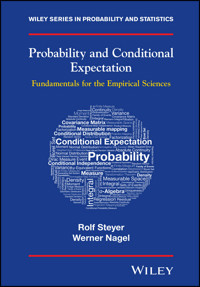
Probability and Conditional Expectations bridges the gap between books on probability theory and statistics by providing the probabilistic concepts estimated and tested in analysis of variance, regression analysis, factor analysis, structural equation modeling, hierarchical linear models and analysis of qualitative data. The authors emphasize the theory of conditional expectations that is also fundamental to conditional independence and conditional distributions.
Probability and Conditional Expectations
- Presents a rigorous and detailed mathematical treatment of probability theory focusing on concepts that are fundamental to understand what we are estimating in applied statistics.
- Explores the basics of random variables along with extensive coverage of measurable functions and integration.
- Extensively treats conditional expectations also with respect to a conditional probability measure and the concept of conditional effect functions, which are crucial in the analysis of causal effects.
- Is illustrated throughout with simple examples, numerous exercises and detailed solutions.
- Provides website links to further resources including videos of courses delivered by the authors as well as R code exercises to help illustrate the theory presented throughout the book.
Sie lesen das E-Book in den Legimi-Apps auf:
Seitenzahl: 650
Veröffentlichungsjahr: 2017
Ähnliche



















WILEY SERIES IN PROBABILITY AND STATISTICS
Established by Walter A. Shewhart and Samuel S. Wilks
Editors: David J. Balding, Noel A. C. Cressie, Garrett M. Fitzmaurice, Geof H. Givens, Harvey Goldstein, Geert Molenberghs, David W. Scott, Adrian F. M. Smith, Ruey S. Tsay
Editors Emeriti: J. Stuart Hunter, Iain M. Johnstone, Joseph B. Kadane, Jozef L. Teugels
The Wiley Series in Probability and Statistics is well established and authoritative. It covers many topics of current research interest in both pure and applied statistics and probability theory. Written by leading statisticians and institutions, the titles span both state-of-the-art developments in the field and classical methods.
Reflecting the wide range of current research in statistics, the series encompasses applied, methodological and theoretical statistics, ranging from applications and new techniques made possible by advances in computerized practice to rigorous treatment of theoretical approaches. This series provides essential and invaluable reading for all statisticians, whether in academia, industry, government, or research.
A complete list of titles in this series can be found at http://www.wiley.com/go/wsps
Probability andConditional Expectation
Fundamentals for the Empirical Sciences
Rolf Steyer
Institute of Psychology, University of Jena, Germany
Werner Nagel
Institute of Mathematics, University of Jena, Germany
This edition first published 2017 © 2017 by John Wiley & Sons Ltd
Registered officeJohn Wiley & Sons Ltd, The Atrium, Southern Gate, Chichester, West Sussex, PO19 8SQ, United Kingdom
For details of our global editorial offices, for customer services and for information about how to apply for permission to reuse the copyright material in this book please see our website at www.wiley.com.
The right of the authors to be identified as the authors of this work has been asserted in accordance with the Copyright, Designs and Patents Act 1988.
All rights reserved. No part of this publication may be reproduced, stored in a retrieval system, or transmitted, in any form or by any means, electronic, mechanical, photocopying, recording or otherwise, except as permitted by the UK Copyright, Designs and Patents Act 1988, without the prior permission of the publisher.
Wiley also publishes its books in a variety of electronic formats. Some content that appears in print may not be available in electronic books.
Designations used by companies to distinguish their products are often claimed as trademarks. All brand names and product names used in this book are trade names, service marks, trademarks or registered trademarks of their respective owners. The publisher is not associated with any product or vendor mentioned in this book.
Limit of Liability/Disclaimer of Warranty: While the publisher and authors have used their best efforts in preparing this book, they make no representations or warranties with respect to the accuracy or completeness of the contents of this book and specifically disclaim any implied warranties of merchantability or fitness for a particular purpose. It is sold on the understanding that the publisher is not engaged in rendering professional services and neither the publisher nor the authors shall be liable for damages arising herefrom. If professional advice or other expert assistance is required, the services of a competent professional should be sought.
Library of Congress Cataloging-in-Publication Data
Names: Steyer, Rolf, 1950– | Nagel, Werner, 1952–. Title: Probability and conditional expectation : fundamentals for the empirical sciences / Rolf Steyer, Werner Nagel. Description: Chichester, West Sussex : John Wiley & Sons, Inc., 2017. | Includes index. Identifiers: LCCN 2016025874 | ISBN 9781119243526 (cloth) | ISBN 9781119243489 (epub) | ISBN 9781119243502 (epdf) Subjects: LCSH: Conditional expectations (Mathematics) | Random variables. | Independence (Mathematics) | Dependence (Statistics) | Measure theory. | Probability and statistics. | Correlation (Statistics) | Multivariate analysis. | Regression analysis. | Logistic regression analysis. | Measure algebras. | Probabilities. Classification: LCC QA273 .S75325 2017 | DDC 519.2–dc23 LC record available at https://lccn.loc.gov/2016025874
A catalogue record for this book is available from the British Library.
For my wonderful wife and children.—RST
CONTENTS
Preface
Why another book on probability?
What is it about?
For whom is it?
Prerequisites
Acknowledgements
About the companion website
Part I: Measure-theoretical foundations of probability theory
1: Measure
1.1 Introductory examples
1.2 σ-Algebra and measurable space
1.3 Measure and measure space
1.4 Specific measures
1.5 Continuity of a measure
1.6 Specifying a measure via a generating system
1.7 σ-Algebra that is trivial with respect to a measure
1.8 Proofs
Exercises
Solutions
2: Measurable mapping
2.1 Image and inverse image
2.2 Introductory examples
2.3 Measurable mapping
2.4 Theorems on measurable mappings
2.5 Equivalence of two mappings with respect to a measure
2.6 Image measure
2.7 Proofs
Exercises
Solutions
3: Integral
3.1 Definition
3.2 Properties
3.3 Lebesgue and Riemann integral
3.4 Density
3.5 Absolute continuity and the Radon-Nikodym theorem
3.6 Integral with respect to a product measure
3.7 Proofs
Exercises
Solutions
Part II: Probability, random variable, and its distribution
4: Probability measure
4.1 Probability measure and probability space
4.2 Conditional probability
4.3 Independence
4.4 Conditional independence given an event
4.5 Proofs
Exercises
Solutions
5: Random variable, distribution, density, and distribution function
5.1 Random variable and its distribution
5.2 Equivalence of two random variables with respect to a probability measure
5.3 Multivariate random variable
5.4 Independence of random variables
5.5 Probability function of a discrete random variable
5.6 Probability density with respect to a measure
5.7 Uni- or multivariate real-valued random variable
5.8 Proofs
Exercises
Solutions
6: Expectation, variance, and other moments
6.1 Expectation
6.2 Moments, variance, and standard deviation
6.3 Proofs
Exercises
Solutions
7: Linear quasi-regression, covariance, and correlation
7.1 Linear quasi-regression
7.2 Covariance
7.3 Correlation
7.4 Expectation vector and covariance matrix
7.5 Multiple linear quasi-regression
7.6 Proofs
Exercises
Solutions
8: Some distributions
8.1 Some distributions of discrete random variables
8.2 Some distributions of continuous random variables
8.3 Proofs
Exercises
Solutions
Part III: Conditional expectation and regression
9: Conditional expectation value and discrete conditional expectation
9.1 Conditional expectation value
9.2 Transformation theorem
9.3 Other properties
9.4 Discrete conditional expectation
9.5 Discrete regression
9.6 Examples
9.7 Proofs
Exercises
Solutions
10: Conditional expectation
10.1 Assumptions and definitions
10.2 Existence and uniqueness
10.3 Rules of computation and other properties
10.4 Factorization, regression, and conditional expectation value
10.5 Characterizing a conditional expectation by the joint distribution
10.6 Conditional mean independence
10.7 Proofs
Exercises
Solutions
11: Residual, conditional variance, and conditional covariance
11.1 Residual with respect to a conditional expectation
11.2 Coefficient of determination and multiple correlation
11.3 Conditional variance and covariance given a σ-algebra
11.4 Conditional variance and covariance given a value of a random variable
11.5 Properties of conditional variances and covariances
11.6 Partial correlation
11.7 Proofs
Exercises
Solutions
12: Linear regression
12.1 Basic ideas
12.2 Assumptions and definitions
12.3 Examples
12.4 Linear quasi-regression
12.5 Uniqueness and identification of regression coefficients
12.6 Linear regression
12.7 Parameterizations of a discrete conditional expectation
12.8 Invariance of regression coefficients
12.9 Proofs
Exercises
Solutions
13: Linear logistic regression
13.1 Logit transformation of a conditional probability
13.2 Linear logistic parameterization
13.3 A parameterization of a discrete conditional probability
13.4 Identification of coefficients of a linear logistic parameterization
13.5 Linear logistic regression and linear logit regression
13.6 Proofs
Exercises
Solutions
14: Conditional expectation with respect to a conditional-probability measure
14.1 Introductory examples
14.2 Assumptions and definitions
14.3 Properties
14.4 Partial conditional expectation
14.5 Factorization
14.6 Uniqueness
14.7 Conditional mean independence with respect to
14.8 Proofs
Exercises
Solutions
15: Effect functions of a discrete regressor
15.1 Assumptions and definitions
15.2 Intercept function and effect functions
15.3 Implications of independence of
and
for regression coefficients
15.4 Adjusted effect functions
15.5 Logit effect functions
15.6 Implications of independence of
and
for the logit regression coefficients
15.7 Proofs
Exercises
Solutions
Part IV: Conditional independence and conditional distribution
16: Conditional independence
16.1 Assumptions and definitions
16.2 Properties
16.3 Conditional independence and conditional mean independence
16.4 Families of events
16.5 Families of set systems
16.6 Families of random variables
16.7 Proofs
Exercises
Solutions
17: Conditional distribution
17.1 Conditional distribution given a σ-algebra or a random variable
17.2 Conditional distribution given a value of a random variable
17.3 Existence and uniqueness
17.4 Conditional-probability measure given a value of a random variable
17.5 Decomposing the joint distribution of random variables
17.6 Conditional independence and conditional distributions
17.7 Expectations with respect to a conditional distribution
17.8 Conditional distribution function and probability density
17.9 Conditional distribution and Radon-Nikodym density
17.10 Proofs
Exercises
Solutions
References
List of Symbols
Author index
Subject index
EULA
List of Tables
Chapter 2
Table 2.1
Table 2.2
Chapter 4
Table 4.1
Chapter 5
Table 5.1
Table 5.2
Chapter 9
Table 9.1
Table 9.2
Chapter 10
Table 10.1
Chapter 11
Table 11.1
Table 11.2
Chapter 12
Table 12.1
Chapter 13
Table 13.1
Chapter 14
Table 14.1
Table 14.2
Table 14.3
Chapter 15
Table 15.1
Table 15.2
Chapter 16
Table 16.1
Table 16.2
Chapter 17
Table 17.1
Guide
Cover
Table of Contents
Preface
Pages
ii
xv
xvi
xvii
xviii
xix
xxi
1
3
4
5
6
7
8
9
10
11
12
13
14
15
16
17
18
19
20
21
22
23
24
25
26
27
28
29
30
31
32
33
34
35
36
37
38
39
40
41
42
43
44
45
46
47
48
49
50
51
52
53
54
55
56
57
58
59
60
61
62
63
64
65
66
67
68
69
70
71
72
73
74
75
76
77
78
79
80
81
82
83
84
85
86
87
88
89
90
91
92
93
94
95
96
97
98
99
100
101
102
103
104
105
106
107
108
109
110
111
112
113
114
115
116
117
118
119
120
121
122
123
124
125
126
127
128
129
131
133
134
135
136
137
138
139
140
141
142
143
144
145
146
147
148
149
150
151
152
153
154
155
156
157
158
159
160
161
162
163
164
165
166
167
168
169
170
171
172
173
174
175
176
177
178
179
180
181
182
183
184
185
186
187
188
189
190
191
192
193
194
195
196
197
198
199
200
201
202
203
204
205
206
207
208
209
210
211
212
213
214
215
216
217
218
219
220
221
222
223
224
225
226
227
228
229
230
231
232
233
234
235
236
237
238
239
240
241
242
243
244
245
246
247
248
249
250
251
252
253
254
255
256
257
258
259
260
261
262
263
264
265
266
267
268
269
270
271
272
273
274
275
276
277
278
279
280
281
282
283
285
287
288
289
290
291
292
293
294
295
296
297
298
299
300
301
302
304
305
306
307
308
309
310
311
312
313
314
315
316
317
318
319
320
321
322
323
324
325
326
327
328
329
330
331
332
333
334
335
336
337
338
339
340
341
342
343
344
345
346
347
348
349
350
351
352
353
354
355
356
357
358
359
360
361
362
363
364
365
366
367
368
369
370
371
372
373
374
375
376
377
378
379
380
381
382
383
384
385
386
387
388
389
390
391
392
393
394
395
396
397
398
399
400
401
402
403
404
406
407
408
409
410
411
412
413
414
415
416
417
418
419
420
421
422
423
424
425
426
427
428
429
430
431
432
433
434
435
436
437
438
439
440
441
442
443
444
445
446
447
448
449
450
451
452
453
454
455
456
457
458
459
460
461
462
463
464
465
466
467
468
469
470
471
473
474
475
476
477
478
479
480
481
482
483
484
485
486
487
488
489
490
491
492
493
494
495
496
497
498
499
500
501
502
503
504
505
506
507
508
509
510
511
512
513
514
515
516
517
518
519
520
521
522
523
524
525
526
527
528
529
530
531
532
533
534
535
536
537
538
539
540
541
542
543
544
545
546
547
548
549
550
551
552
553
554
555
556
557
558
559
560
561
562
563
564
565
566
567
569
570
571
572
573
574
575
576
e1
Acknowledgements
This book could not have been written without the help of many. First of all, we thank Ivailo Partchev, who prepared the LaTeX framework and many of the figures, tables, and boxes. Some of the figures have been produced by Désirée Thielemann and Julie Toussaint, who also cared for references, read some of the chapters, and hinted at errors. For supporting us with respect to LaTeX, finding errors, or suggesting other improvements, we also thank Karoline Bading, Marcel Bauer, Sonja Hahn, Gregor Kappler, Christoph Kiefer, Andreas Neudecker, Axel Mayer, Erik Sengewald, Jan Plötner, Carolin Rebekka Scheifele, and Tom Landes. Thanks are also due to Ernesto San Martin for suggesting section 1.7 and proposition (iv) of Theorem 16.37. The proof of Lemma 12.38 is due to Peter Vogel. Finally, we would like to thank our students who kept us thinking on how to improve the text.
About the companion website
This book is accompanied by a companion website:
http://www.probability-and-conditional-expectation.de
This website includes:
Errata
Videos
Slides
Teaching tools
Datasets.




