


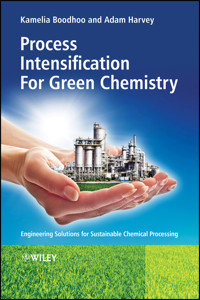
Process Intensification Technologies for Green Chemistry E-Book
116,99 €
Mehr erfahren.
- Herausgeber: John Wiley & Sons
- Kategorie: Fachliteratur
- Sprache: Englisch
The successful implementation of greener chemical processes relies not only on the development of more efficient catalysts for synthetic chemistry but also, and as importantly, on the development of reactor and separation technologies which can deliver enhanced processing performance in a safe, cost-effective and energy efficient manner. Process intensification has emerged as a promising field which can effectively tackle the challenges of significant process enhancement, whilst also offering the potential to diminish the environmental impact presented by the chemical industry.
Following an introduction to process intensification and the principles of green chemistry, this book presents a number of intensified technologies which have been researched and developed, including case studies to illustrate their application to green chemical processes.
Topics covered include:
• Intensified reactor technologies: spinning disc reactors, microreactors, monolith reactors, oscillatory flow reactors, cavitational reactors
• Combined reactor/separator systems: membrane reactors, reactive distillation, reactive extraction, reactive absorption
• Membrane separations for green chemistry
• Industry relevance of process intensification, including economics and environmental impact, opportunities for energy saving, and practical considerations for industrial implementation.
Process Intensification for Green Chemistry is a valuable resource for practising engineers and chemists alike who are interested in applying intensified reactor and/or separator systems in a range of industries to achieve green chemistry principles.
Sie lesen das E-Book in den Legimi-Apps auf:
Seitenzahl: 749
Veröffentlichungsjahr: 2013
Ähnliche




















Contents
Cover
Title Page
Copyright
List of Contributors
Preface
Chapter 1: Process Intensification: An Overview of Principles and Practice
1.1 Introduction
1.2 Process Intensification: Definition and Concept
1.3 Fundamentals of Chemical Engineering Operations
1.4 Intensification Techniques
1.5 Merits of PI Technologies
1.6 Challenges to Implementation of PI
1.7 Conclusion
Nomenclature
Greek Letters
References
Chapter 2: Green Chemistry Principles
2.1 Introduction
2.2 The Twelve Principles of Green Chemistry
2.3 Metrics for Chemistry
2.4 Catalysis and Green Chemistry
2.5 Renewable Feedstocks and Biocatalysis
2.6 An Overview of Green Chemical Processing Technologies
2.7 Conclusion
References
Chapter 3: Spinning Disc Reactor for Green Processing and Synthesis
3.1 Introduction
3.2 Design and Operating Features of SDRs
3.3 Characteristics of SDRs
3.4 Case Studies: SDR Application for Green Chemical Processing and Synthesis
3.5 Hurdles to Industry Implementation
3.6 Conclusion
Nomenclature
Greek Letters
Subscripts
References
Chapter 4: Micro Process Technology and Novel Process Windows – Three Intensification Fields
4.1 Introduction
4.2 Transport Intensification
4.3 Chemical Intensification
4.4 Process Design Intensification
4.5 Industrial Microreactor Process Development
4.6 Conclusion
Acknowledgement
References
Chapter 5: Green Chemistry in Oscillatory Baffled Reactors
5.1 Introduction
5.2 Case Studies: OBR Green Chemistry
5.3 Conclusion
References
Chapter 6: Monolith Reactors for Intensified Processing in Green Chemistry
6.1 Introduction
6.2 Design of Monolith Reactors
6.3 Hydrodynamics of Monolith Reactors
6.4 Advantages of Monolith Reactors
6.5 Applications in Green Chemistry
6.6 Conclusion
Acknowledgment
Nomenclature
Greek Letters
Subscripts and Superscripts
References
Chapter 7: Process Intensification and Green Processing Using Cavitational Reactors
7.1 Introduction
7.2 Mechanism of Cavitation-based PI of Chemical Processing
7.3 Reactor Configurations
7.4 Mathematical Modelling
7.5 Optimization of Operating Parameters in Cavitational Reactors
7.6 Intensification of Cavitational Activity
7.7 Case Studies: Intensification of Chemical Synthesis using Cavitation
7.8 Overview of Intensification and Green Processing Using Cavitational Reactors
7.9 The Future
7.10 Conclusion
References
Chapter 8: Membrane Bioreactors for Green Processing in a Sustainable Production System
8.1 Introduction
8.2 Membrane Bioreactors
8.3 Biocatalytic Membrane Reactors
8.4 Case Studies: Membrane Bioreactors
8.5 Green Processing Impact of Membrane Bioreactors
8.6 Conclusion
References
Chapter 9: Reactive Distillation Technology
9.1 Introduction
9.2 Principles of RD
9.3 Design, Control and Applications
9.4 Modelling RD
9.5 Feasibility and Technical Evaluation
9.6 Case Studies: RD
9.7 Green Processing Impact of RD
9.8 Conclusion
References
Chapter 10: Reactive Extraction Technology
10.1 Introduction
10.2 Case Studies: Reactive Extraction Technology
10.3 Impact on Green Processing and Process Intensification
10.4 Conclusion
Acknowledgement
References
Chapter 11: Reactive Absorption Technology
11.1 Introduction
11.2 Theory and Models
11.3 Equipment, Operation and Control
11.4 Applications in Gas Purification
11.5 Applications to the Production of Chemicals
11.6 Green Processing Impact of RA
11.7 Challenges and Future Prospects
References
Chapter 12: Membrane Separations for Green Chemistry
12.1 Introduction
12.2 Membranes and Membrane Processes
12.3 Case Studies: Membrane Operations in Green Processes
12.4 Integrated Membrane Processes
12.5 Green Processing Impact of Membrane Processes
12.6 Conclusion
References
Chapter 13: Process Intensification in a Business Context: General Considerations
13.1 Introduction
13.2 The Industrial Setting
13.3 Process Case Study
13.4 Business Risk and Ideas
13.5 Conclusion
References
Chapter 14: Process Economics and Environmental Impacts of Process Intensification in the Petrochemicals, Fine Chemicals and Pharmaceuticals Industries
14.1 Introduction
14.2 Petrochemicals Industry
14.3 Fine Chemicals and Pharmaceuticals Industries
References
Chapter 15: Opportunities for Energy Saving from Intensified Process Technologies in the Chemical and Processing Industries
15.1 Introduction
15.2 Energy-Intensive Processes in UK Chemical and Processing Industries
15.3 Case Study: Assessment of the Energy Saving Potential of SDR Technology
15.4 Conclusion
Nomenclature
Greek Letters
Subscripts
Appendix: Physical Properties of Styrene, Toluene and Cooling/Heating Fluids
References
Chapter 16: Implementation of Process Intensification in Industry
16.1 Introduction
16.2 Practical Considerations for Commercial Implementation
16.3 Scope for Implementation in Various Process Industries
16.4 Future Prospects
References
Index
This edition first published 2013
© 2013 John Wiley & Sons, Ltd.
Registered office
John Wiley & Sons Ltd., The Atrium, Southern Gate, Chichester, West Sussex, PO19 8SQ, United Kingdom
For details of our global editorial offices, for customer services and for information about how to apply for permission to reuse the copyright material in this book please see our website at www.wiley.com.
The right of the author to be identified as the author of this work has been asserted in accordance with the Copyright, Designs and Patents Act 1988.
All rights reserved. No part of this publication may be reproduced, stored in a retrieval system, or transmitted, in any form or by any means, electronic, mechanical, photocopying, recording or otherwise, except as permitted by the UK Copyright, Designs and Patents Act 1988, without the prior permission of the publisher.
Wiley also publishes its books in a variety of electronic formats. Some content that appears in print may not be available in electronic books.
Designations used by companies to distinguish their products are often claimed as trademarks. All brand names and product names used in this book are trade names, service marks, trademarks or registered trademarks of their respective owners. The publisher is not associated with any product or vendor mentioned in this book. This publication is designed to provide accurate and authoritative information in regard to the subject matter covered. It is sold on the understanding that the publisher is not engaged in rendering professional services. If professional advice or other expert assistance is required, the services of a competent professional should be sought.
The publisher and the author make no representations or warranties with respect to the accuracy or completeness of the contents of this work and specifically disclaim all warranties, including without limitation any implied warranties of fitness for a particular purpose. This work is sold with the understanding that the publisher is not engaged in rendering professional services. The advice and strategies contained herein may not be suitable for every situation. In view of ongoing research, equipment modifications, changes in governmental regulations, and the constant flow of information relating to the use of experimental reagents, equipment, and devices, the reader is urged to review and evaluate the information provided in the package insert or instructions for each chemical, piece of equipment, reagent, or device for, among other things, any changes in the instructions or indication of usage and for added warnings and precautions. The fact that an organization or Website is referred to in this work as a citation and/or a potential source of further information does not mean that the author or the publisher endorses the information the organization or Website may provide or recommendations it may make. Further, readers should be aware that Internet Websites listed in this work may have changed or disappeared between when this work was written and when it is read. No warranty may be created or extended by any promotional statements for this work. Neither the publisher nor the author shall be liable for any damages arising herefrom.
Library of Congress Cataloging-in-Publication Data applied for.
A catalogue record for this book is available from the British Library.
ISBN: 9780470972670
List of Contributors
Kamelia Boodhoo School of Chemical Engineering & Advanced Materials, Newcastle University, UK
Svetlana Borukhova Department of Chemical Engineering and Chemistry, Micro Flow Chemistry & Process Technology, Eindhoven University of Technology, Eindhoven, The Netherlands
Vitaly Budarin Green Chemistry Centre of Excellence, University of York, York, UK
James Clark Green Chemistry Centre of Excellence, University of York, York, UK
Enrico Drioli Institute on Membrane Technology, CNR-ITM, University of Calabria, Rende, Calabria, Italy
Dag Eimer D-IDE AS, Teknologisenteret, Porsgrunn, Norway
Niels Eldrup Sivilingenir Eldrup AS, Teknologisenteret, Porsgrunn, Norway
Dena Ghiasy School of Chemical Engineering & Advanced Materials, Newcastle University, UK
Lidietta Giorno Institute on Membrane Technology, CNR-ITM, University of Calabria, Rende, Calabria, Italy
Parag Gogate Chemical Engineering Department, Institute of Chemical Technology, Matunga, Mumbai, India
Mark Gronnow Green Chemistry Centre of Excellence, University of York, York, UK
Jan Harmsen Harmsen Consultancy BV, Nieuwerkerk aan den Ijssel, The Netherlands
Adam Harvey School of Chemical Engineering & Advanced Materials, Newcastle University, UK
Volker Hessel Department of Chemical Engineering and Chemistry, Micro Flow Chemistry & Process Technology, Eindhoven University of Technology, Eindhoven, The Netherlands
Anton A. Kiss Arnhem, The Netherlands
Keat T. Lee School of Chemical Engineering, Universiti Sains Malaysia, Engineering Campus, Pulau Pinang, Malaysia
Steven Lim School of Chemical Engineering, Universiti Sains Malaysia, Engineering Campus, Pulau Pinang, Malaysia
Duncan Macquarrie Green Chemistry Centre of Excellence, University of York, York, UK
Rosalinda Mazzei Institute on Membrane Technology, CNR-ITM, University of Calabria, Rende, Calabria, Italy
Vijayanand Moholkar Chemical Engineering Department, Indian Institute of Technology, Guwahati, Assam, India
Aniruddha Pandit Chemical Engineering Department, Institute of Chemical Technology, Matunga, Mumbai, India
Emma Piacentini Institute on Membrane Technology, CNR-ITM, University of Calabria, Rende, Calabria, Italy
Joseph Wood School of Chemical Engineering, University of Birmingham, Birmingham, UK
Preface
Of late, a tremendous effort has been made to implement more sustainable and environmentally friendly processes in the chemical industry. Increased legislation on emissions and waste disposal and the need for businesses to remain highly competitive and to demonstrate their social responsibility are just some of the reasons for this drive towards greener processing. The successful implementation of greener chemical processes relies not only on the development of more efficient catalysts for synthetic chemistry but also, and as importantly, on the development of reactor and separation technologies that can deliver enhanced processing performance in a safe, cost-effective and energy-efficient manner. In some sectors, particularly those related to pharmaceuticals and fine chemicals processing, separations is often the stage at which the most waste is generated, through large amounts of solvents for purification, and this must therefore be addressed at the outset when novel green reactions are explored. The ideal process is one in which byproducts are reduced or eliminated altogether at the reaction stage, rather than removed after they are formed – a concept referred to as waste minimization at source.
Process intensification (PI) has emerged as a promising field that can effectively tackle these process challenges while offering at the same time the potential for ‘clean’ or ‘green’ processing in order to diminish the environmental impact presented by the chemical industry. One of the ways this is made possible is by minimizing the scale of reactors operating ideally in continuous mode so that more rapid heat/mass-transfer/mixing rates and plug flow behaviour can be achieved for high selectivity in optimized reaction processes.
This book covers the latest developments in a number of intensified technologies, with particular emphasis on their application to green chemical processes. The focus is on intensified reactor technologies, such as spinning disc reactors, microreactors, monolith reactors, oscillatory flow reactors and so on, and a number of combined or hybrid reactor/separator systems, the most well known and widely used in industry being reactive distillation (RD). PI is about not only the implementation of novel designs of reaction/separation units but also the use of novel processing methods such as alternative forms of energy input to promote reactions. A notable example here is ultrasonic energy, applications for which are also highlighted in this book. Each chapter presents relevant case studies examining the green processing aspect of these technologies. Towards the end of the book, we have included four chapters to emphasize the industry relevance of PI, with particular focus on the general business context within which intensification technology development and application takes place; on process economics and environmental impact; on the energy-saving potential of intensification technologies; and on practical considerations for industrial implementation of PI.
The book is intended to be a useful resource for practising engineers and chemists alike who are interested in applying intensified reactor and/or separator systems in a range of industries, such as petrochemicals, fine/specialty chemicals, pharmaceuticals and so on. Not only will it provide a basic knowledge of chemical engineering principles and PI for chemists and engineers who may be unfamiliar with these concepts, but it will be a valuable tool for chemical engineers who wish to fully apply their background in reaction and separation engineering to the design and implementation of green processing technologies based on PI principles. Students on undergraduate and post-graduate degree programmes which cover topics on advanced reactor designs, PI, clean technology and green chemistry will also have at their disposal a vast array of material to help them gain a better understanding of the practical applications of these different areas.
We would like to thank all contributors to this book for their commitment in producing their high-quality manuscripts. Our heartfelt gratitude goes to Sarah Hall, Sarah Tilley and Rebecca Ralf at Wiley-Blackwell, whose support and encouragement throughout this project made it all possible.
Kamelia BoodhooAdam HarveyAugust 2012
1
Process Intensification: An Overview of Principles and Practice
Kamelia Boodhoo and Adam Harvey
School of Chemical Engineering & Advanced Materials, Newcastle University, UK
1.1 Introduction
The beginning of the 21st century has been markedly characterized by increased environmental awareness and pressure from legislators to curb emissions and improve energy efficiency by adopting ‘greener technologies’. In this context, the need for the chemical industry to develop processes which are more sustainable or eco-efficient has never been so vital. The successful delivery of green, sustainable chemical technologies at industrial scale will inevitably require the development of innovative processing and engineering technologies that can transform industrial processes in a fundamental and radical fashion. In bioprocessing, for example, genetic engineering of microorganisms will obviously play a major part in the efficient use of biomass, but development of novel reactor and separation technologies giving high reactor productivity and ultimately high-purity products will be equally important for commercial success. Process intensification (PI) can provide such sought-after innovation of equipment design and processing to enhance process efficiency.
1.2 Process Intensification: Definition and Concept
PI aims to make dramatic reductions in plant volume, ideally between 100- and 1000-fold, by replacing the traditional unit operations with novel, usually very compact designs, often by combining two or more traditional operations in one hybrid unit. The PI concept was first established at Imperial Chemical Industries (ICI) during the late 1970s, when the primary goal was to reduce the capital cost of a production system. Although cost reduction was the original target, it quickly became apparent that there were other important benefits to be gained from PI, particularly in respect of improved intrinsic safety and reduced environmental impact and energy consumption, as will be discussed later in this chapter.
Over the last 2 decades, the definition of PI has thus evolved from the simplistic statement of ‘the physical miniaturisation of process equipment while retaining throughput and performance’ [1] to the all-encompassing definition ‘the development of innovative apparatus and techniques that offer drastic improvements in chemical manufacturing and processing, substantially decreasing equipment volume, energy consumption, or waste formation, and ultimately leading to cheaper, safer, sustainable technologies’ [2]. Several other definitions with slight variations on the generic theme of innovative technologies for greater efficiency have since emerged [3].
The reduction in scale implied by intensification has many desirable consequences for chemical engineering operations. First, the lower mass- and heat-transfer resistances enabled by the reduced path lengths of the diffusion/conduction interfaces, coupled with more intense fluid dynamics in active enhancement equipment, allow reactions to proceed at their inherent rates. By the same token, the more rapid mixing environment afforded by the low reaction volumes should enable conversion and selectivity to be maximized. Residence times of the order of minutes and seconds may be substituted for the hour-scale processing times associated with large conventional batch operations, with beneficial consequences for energy consumption and process safety.
PI covers a wide range of processing equipment types and methodologies, as aptly illustrated in Figure 1.1 [2]. Many of the equipment types classed as ‘intensified technologies’ have long been implemented in the chemical industry, such as compact heat exchangers, structured packed columns and static mixers. More recent developments include the spinning disc reactor (SDR), oscillatory baffled reactor, loop reactor, spinning tube-in-tube reactor, heat-exchange reactor, microchannel reactor and so on. Lately, it has become increasingly important for the chemical processing industries not only to remain cost competitive but to do so in an environmentally friendly or ‘green’ manner. It is fitting, therefore, that many of the processes based on the PI philosophy also enable clean technology to be practised. For instance, high selectivity operations in intensified reactors will on their own reduce or ideally eliminate the formation of unwanted byproducts. Combining such intensified reactors with renewable energy sources such as solar energy would give even greater impetus to achieving these green processing targets.
Figure 1.1 Classification of PI equipment and methods. Reproduced from [ref 2] with permission of American Institute of Chemical Engineers copyright (2000).
1.3 Fundamentals of Chemical Engineering Operations
1.3.1 Reaction Engineering
Reactor engineering starts with the simple mass balance:
(1.1)
Where ‘Made’ is the rate at which a species is created or lost by reaction. The rate of this reaction in a well-mixed system is governed by the reaction kinetics, which depend only upon the concentrations of species and temperature. However, not all systems are well mixed, particularly at larger scales, and mixing can be rate-determining. The different degrees and types of mixing are introduced in Section 1.3.2. The ‘Accumulated’ term will be zero for continuous reactors running in steady state, but will be of interest during start-up or shut-down. Determining the rate at which species are created or destroyed in a reactor requires knowledge of mixing, reaction kinetics and heat transfer. Once these are known they can be input into a reactor model. An important part of this model for continuous reactors (as most intensified reactors are) is the residence time distribution (RTD), which is the probability distribution for the length of time elements of fluid will spend in a given reactor design. It can be envisaged as the response to the input of an infinitely narrow pulse of a tracer. All real reactors fall between two extreme cases: the plug flow reactor (PFR) and the continuously stirred tank reactor (CSTR).
Lesen Sie weiter in der vollständigen Ausgabe!
Lesen Sie weiter in der vollständigen Ausgabe!
Lesen Sie weiter in der vollständigen Ausgabe!
Lesen Sie weiter in der vollständigen Ausgabe!
Lesen Sie weiter in der vollständigen Ausgabe!
Lesen Sie weiter in der vollständigen Ausgabe!
Lesen Sie weiter in der vollständigen Ausgabe!
Lesen Sie weiter in der vollständigen Ausgabe!
Lesen Sie weiter in der vollständigen Ausgabe!
Lesen Sie weiter in der vollständigen Ausgabe!
Lesen Sie weiter in der vollständigen Ausgabe!
Lesen Sie weiter in der vollständigen Ausgabe!
Lesen Sie weiter in der vollständigen Ausgabe!
Lesen Sie weiter in der vollständigen Ausgabe!
Lesen Sie weiter in der vollständigen Ausgabe!
Lesen Sie weiter in der vollständigen Ausgabe!




