


215,99 €
Mehr erfahren.
- Herausgeber: John Wiley & Sons
- Kategorie: Wissenschaft und neue Technologien
- Sprache: Englisch
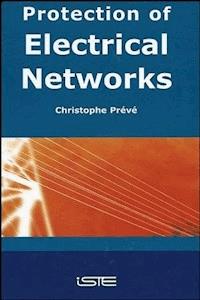
This book, designed for engineers, technicians, designers and operators working with electrical networks, contains theoretical and practical information on the design and set-up of protection systems. Protection of Electrical Networks first discusses network structures and grounding systems together with problems that can occur in networks. It goes on to cover current and voltage transformers, protection functions, circuit breakers and fuses. Practical explanations of how protection systems function are given, and these, together with tables of settings, make this book suitable for any reader, irrespective of their initial level of knowledge.
Sie lesen das E-Book in den Legimi-Apps auf:
Seitenzahl: 417
Veröffentlichungsjahr: 2013
Ähnliche



















Table of Contents
Chapter 1. Network Structures
1.1. General structure of the private distribution network
1.2. The supply source
1.3. HV consumer substations
1.4. MV power supply
1.5. MV networks inside the site
1.6. LV networks inside the site
1.7. Industrial networks with internal generation
1.8. Examples of standard networks
Chapter 2. Earthing Systems
2.1. Earthing systems at low voltage
2.2. Medium voltage earthing systems
2.3. Creating neutral earthing
2.4. Specific installation characteristics in LV unearthed systems
2.5. Specific installation characteristics of an MV unearthed system
Chapter 3. Main Faults Occurring in Networks and Machines
3.1. Short-circuits
3.2. Other types of faults
Chapter 4. Short-circuits
4.1. Establishment of short-circuit currents and wave form
4.2. Short-circuit current calculating method
4.3. Circulation of phase-to-earth fault currents
4.4. Calculation and importance of the minimum short-circuit current
Chapter 5. Consequences of Short-circuits
5.1. Thermal effect
5.2. Electrodynamic effect
5.3. Voltage drops
5.4. Transient overvoltages
5.5. Touch voltages
5.6. Switching surges
5.7. Induced voltage in remote control circuits
Chapter 6. Instrument Transformers
6.1. Current transformers
6.2. Voltage transformers
Chapter 7. Protection Functions and their Applications
7.1. Phase overcurrent protection (ANSI code 50 or 51)
7.2. Earth fault protection (ANSI code 50 N or 51 N, 50 G or 51 G)
7.3. Directional overcurrent protection (ANSI code 67)
7.4. Directional earth fault protection (ANSI code 67 N)
7.5. Directional earth fault protection for compensated neutral networks (ANSI code 67 N)
7.6. Differential protection
7.7. Thermal overload protection (ANSI code 49)
7.8. Negative phase unbalance protection (ANSI code 46)
7.9. Excessive start-up time and locked rotor protection (ANSI code 51 LR)
7.10. Protection against too many successive start-ups (ANSI code 66)
7.11. Phase undercurrent protection (ANSI code 37)
7.12. Undervoltage protection (ANSI code 27)
7.13. Remanent undervoltage protection (ANSI code 27)
7.14. Positive sequence undervoltage and phase rotation direction protection (ANSI code 27 d – 47)
7.15. Overvoltage protection (ANSI code 59)
7.16. Residual overvoltage protection (ANSI code 59 N)
7.17. Under or overfrequency protection (ANSI code 81)
7.18. Protection against reversals in reactive power (ANSI code 32 Q)
7.19. Protection against reversals in active power (ANSI code 32 P)
7.20. Tank earth leakage protection (ANSI code 50 or 51)
7.21. Protection against neutral earthing impedance overloads (ANSI code 50 N or 51 N)
7.22. Overall network earth fault protection by monitoring the current flowing through the earthing connection (ANSI code 50 N or 51 N, 50 G or 51 G)
7.23. Protection using temperature monitoring (ANSI code 38 – 49 T)
7.24. Voltage restrained overcurrent protection (ANSI code 50 V or 51 V)
7.25. Protection by gas, pressure and temperature detection (DGPT)
7.26. Neutral to neutral unbalance protection (ANSI code 50 N or 51 N)
Chapter 8. Overcurrent Switching Devices
8.1. Low voltage circuit-breakers
8.2. MV circuit-breakers (according to standard IEC 62271-100)
8.3. Low voltage fuses
8.4. MV fuses
Chapter 9. Different Selectivity Systems .
9.1. Amperemetric selectivity
9.2. Time-graded selectivity
9.3. Logic selectivity
9.4. Directional selectivity
9.5. Selectivity by differential protection
9.6. Selectivity between fuses and circuit-breakers
Chapter 10. Protection of Network Elements
10.1. Network protection
10.2. Busbar protection
10.3. Transformer protection
10.4. Motor protection
10.5. AC generator protection
10.6. Capacitor bank protection
10.8. Protection of direct current installations
10.9. Protection of uninterruptible power supplies (UPS)
Appendix A. Transient Current Calculation of Short-circuit Fed by Utility Network
Appendix B. Calculation of Inrush Current During Capacitor Bank Energization
Appendix C. Voltage Peak Value and Current r.m.s Value, at the Secondary of a Saturated Current Transformer
Index
First published in Great Britain and the United States in 2006 by ISTE Ltd
Apart from any fair dealing for the purposes of research or private study, or criticism or review, as permitted under the Copyright, Designs and Patents Act 1988, this publication may only be reproduced, stored or transmitted, in any form or by any means, with the prior permission in writing of the publishers, or in the case of reprographic reproduction in accordance with the terms and licenses issued by the CLA. Enquiries concerning reproduction outside these terms should be sent to the publishers at the undermentioned address:
ISTE Ltd6 Fitzroy SquareLondon W1T 5DXUK
ISTE USA4308 Patrice RoadNewport Beach, CA 92663USA
www.iste.co.uk
© ISTE Ltd, 2006
The rights of Christophe Prévé to be identified as the author of this work have been asserted by him in accordance with the Copyright, Designs and Patents Act 1988.
Library of Congress Cataloging-in-Publication Data
Prévé, Christophe, 1964-
Protection of electrical networks / Christophe Prévé.
p. cm.
Includes index.
ISBN-13: 978-1-905209-06-4
ISBN-10: 1-905209-06-1
1. Electric networks--Protection. I. Title.
TK454.2.P76 2006
621.319'2--dc22
2006008664
British Library Cataloguing-in-Publication Data
A CIP record for this book is available from the British Library
ISBN 10: 1-905209-06-1
ISBN 13: 978-1-905209-06-4
Chapter 1
Network Structures
Definition
Standard IEC 60038 defines voltage ratings as follows:
Low voltage (LV): for a phase-to-phase voltage of between 100 V and 1,000 V, the standard ratings are: 400 V - 690 V - 1,000 V (at 50 Hz).
Medium voltage (MV): for a phase-to-phase voltage between 1,000 V and 35 kV, the standard ratings are: 3.3 kV - 6.6 kV - 11 kV - 22 kV - 33 kV.
High voltage (HV): for a phase-to-phase voltage between 35 kV and 230 kV, the standard ratings are: 45 kV - 66 kV - 110 kV - 132 kV - 150 kV - 220 kV.
In this chapter we will look at:
types of HV and MV consumer substations;
structure of MV networks inside a site;
structure of LV networks inside a site;
structure of systems with a back-up power supply.
Six standard examples of industrial network structures are given at the end of the chapter.
Each structure is commented upon and divided up so that each functional aspect can be considered.
(NC) means that the switch or circuit-breaker is closed in normal conditions.
(NO) means that the switch or circuit-breaker is open in normal conditions.
Figure 1-1: structure of a private distribution network
1.1. General structure of the private distribution network
Generally, with an HV power supply, a private distribution network comprises (see Figure 1-1):
an HV consumer substation fed by one or more sources and made up of one or more busbars and circuit-breakers;
an internal generation source;
one or more HV/MV transformers;
a main MV switchboard made up of one or more busbars;
an internal MV network feeding secondary switchboards or MV/LV substations;
MV loads;
MV/LV transformers;
low voltage switchboards and networks;
low voltage loads.
1.2. The supply source
The power supply of industrial networks can be LV, MV or HV. The voltage rating of the supply source depends on the consumer supply power. The greater the power required, the higher the voltage must be.
1.3. HV consumer substations
The most usual supply arrangements adopted in HV consumer substations are:
Single power supply (see Figure 1-2)
Advantage:
reduced cost.
Disadvantage:
low reliability.
Note: the isolators associated with the HV circuit-breakers have not been shown.
Figure 1-2: single fed HV consumer substation
Dual power supply (see Figure 1-3)
Figure 1-3: dual fed HV consumer substation
Operating mode:
normal:
- Both incoming circuit-breakers are closed, as well as the coupler isolator.
- The transformers are thus simultaneously fed by two sources.
disturbed:
- If one source is lost, the other provides the total power supply.
Advantages:
Very reliable in that each source has a total network capacity.
Maintenance of the busbar possible while it is still partially operating.
Disadvantages:
More costly solution.
Only allows partial operation of the busbar if maintenance is being carried out on it.
Note: the isolators associated with the HV circuit-breakers have not been shown.
Dual fed double bus system (see Figure 1-4)
Operating mode:
normal:
- Source 1 feeds busbar BB1 and feeders Out1 and Out2.
- Source 2 feeds busbar BB2 and feeders Out3 and Out4.
- The bus coupler circuit-breaker can be kept closed or open.
disturbed:
- If one source is lost, the other provides the total power supply.
- If a fault occurs on a busbar (or maintenance is carried out on it), the bus coupler circuit-breaker is tripped and the other busbar feeds all the outgoing lines.
Advantages:
Reliable power supply.
Highly flexible use for the attribution of sources and loads and for busbar maintenance.
Busbar transfer possible without interruption.
Disadvantage:
More costly in relation to the single busbar system.
Note: the isolators associated with the HV circuit-breakers have not been shown.
Figure 1-4: dual fed double bus HV consumer substation
1.4. MV power supply
We shall first look at the different MV service connections and then at the MV consumer substation.
1.4.1. Different MV service connections
Depending on the type of MV network, the following supply arrangements are commonly adopted.
Lesen Sie weiter in der vollständigen Ausgabe!
Lesen Sie weiter in der vollständigen Ausgabe!
Lesen Sie weiter in der vollständigen Ausgabe!
Lesen Sie weiter in der vollständigen Ausgabe!
Lesen Sie weiter in der vollständigen Ausgabe!
Lesen Sie weiter in der vollständigen Ausgabe!
Lesen Sie weiter in der vollständigen Ausgabe!
Lesen Sie weiter in der vollständigen Ausgabe!
Lesen Sie weiter in der vollständigen Ausgabe!
Lesen Sie weiter in der vollständigen Ausgabe!
Lesen Sie weiter in der vollständigen Ausgabe!
Lesen Sie weiter in der vollständigen Ausgabe!
Lesen Sie weiter in der vollständigen Ausgabe!




