


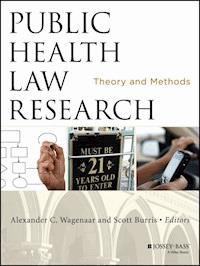
Public Health Law Research E-Book
83,99 €
Mehr erfahren.
- Herausgeber: John Wiley & Sons
- Kategorie: Fachliteratur
- Sprache: Englisch
Public Health Law Research: Theory and Methods definitively explores the mechanisms, theories and models central to public health law research – a growing field dedicated to measuring and studying law as a central means for advancing public health.
Editors Alexander C. Wagenaar and Scott Burris outline integrated theory drawn from numerous disciplines in the social and behavioral sciences; specific mechanisms of legal effect and guidelines for collecting and coding empirical datasets of statutory and case law; optimal research designs for randomized trials and natural experiments for public health law evaluation; and methods for qualitative and cost-benefit studies of law.. They also discuss the challenge of effectively translating the results of scientific evaluations into public health laws and highlight the impact of this growing field.
“How exactly the law can best be used as a tool for protecting and enhancing the public’s health has long been the subject of solely opinion and anecdote. Enter Public Health Law Research, a discipline designed to bring the bright light of science to the relationships between law and health. This book is a giant step forward in illuminating that subject.” -- Stephen Teret, JD, MPH, Professor, Director, Center for Law and the Public's Health, Johns Hopkins Bloomberg School of Public Health
“Wagenaar and Burris bring a dose of much needed rigor to the empirical study of which public health law interventions really matter, and which don’t.” -- Bernard S. Black, JD, Chabraja Professor, Northwestern University Law School and Kellogg School of Management
Companion Web site: www.josseybass.com/go/wagenaar
Sie lesen das E-Book in den Legimi-Apps auf:
Seitenzahl: 890
Veröffentlichungsjahr: 2013
Ähnliche




















Contents
Figures and Tables
Foreword
Preface
Acknowledgments
The Editors
The Contributors
Part One: Framing Public Health Law Research
Chapter 1. A Framework for Public Health Law Research
Defining Public Health Law Research
A Causal Diagram for PHLR
PHLR in Practice
Conclusion
Summary
Further Reading
Chapter 2. Law in Public Health Systems and Services Research
Integrating PHLR and PHSSR
Existing Research
The Path Forward
Conclusion
Summary
Further Reading
Part Two: Understanding How Law Influences Environments and Behavior
Chapter 3. Perspectives from Public Health
How Laws Affect Population Health
Studying Causal Mechanisms
Measures to Study the Effects of Laws
Conclusion
Summary
Further Reading
Chapter 4. Law and Society Approaches
Concepts, Methods, and Mechanisms
Law, Inequality, and Health
Conclusion
Summary
Further Reading
Chapter 5. Criminological Theories
Theory in Criminology
Theory for Public Health Law Research
Measuring Deterrence and Labeling in PHLR
Public Health Law Research Challenges
Conclusion
Summary
Further Reading
Chapter 6. Procedural Justice Theory
Complying with the Law
Legitimacy
Procedural Justice
Measuring Legitimacy and Compliance
Mechanisms Through Which Law Affects Public Health
Conclusion
Summary
Further Reading
Chapter 7. Economic Theory
Laws, Regulations, and Economic Behavior
Market Failures
Policy Interventions to Address Market Failures
Tax Credits and Deductions
Measurement Issues
Conclusion
Summary
Further Reading
Chapter 8. The Theory of Triadic Influence
Health-Behavior Laws and Regulations from a Social Psychological Perspective
Social Psychological Causal Mechanisms
The Theory of Triadic Influence
Practical Measures
Conclusion
Summary
Further Reading
Chapter 9. Integrating Diverse Theories for Public Health Law Evaluation
The Value of Opening the Black Box
Integrating Diverse Theories in Public Health Law Research
Conclusion
Summary
Further Reading
Part Three: Identifying and Measuring Legal Variables
Chapter 10. Picturing Public Health Law Research
Varieties of Visual Representation
Elements and Conventions of Causal Diagrams
Variations on the Theme
What Makes a Good Causal Diagram?
How to Create an Effective Causal Diagram
Conclusion
Summary
Further Reading
Chapter 11. Measuring Statutory Law and Regulations for Empirical Research
The Impetus Behind Measuring—or Mapping—Law
The Process for Measuring Law
Challenges and Next Steps
Conclusion
Summary
Further Reading
Chapter 12. Coding Case Law for Public Health Law Evaluation
What Content Analysis Can and Cannot Tell Us
Guidelines for Identifying and Coding Case Law
Conclusion
Summary
Further Reading
Part Four: Designing Public Health Law Evaluations
Chapter 13. Evaluating Public Health Law Using Randomized Experiments
A Potential Outcomes Model of Causal Effects
Random Assignment and Selection Bias
Key Assumptions for Measuring the Effect of the Intended Treatment
Interpretation and Extrapolation of Experimental Results
Applications of Randomized Controlled Trials to Law and Health
Conclusion
Summary
Further Reading
Chapter 14. Natural Experiments
Design Elements for Strong Legal Evaluations
Conclusion
Summary
Further Reading
Chapter 15. Qualitative Research Strategies for Public Health Law Evaluation
Qualitative Research in Context
Data-Collection Methods and Sources
Research Strategies
Standards of Research Quality
Conclusion
Summary
Further Reading
Chapter 16. Cost-Effectiveness and Cost-Benefit Analysis of Public Health Laws
Steps in Conducting an Economic Evaluation
Special Issues in Economic Evaluation of Public Health Laws
Comparing Cost-Outcome Estimates
Complexity in Communicating Economic Evaluation Results
Conclusion
Summary
Further Reading
Chapter 17. The Future of Public Health Law Research
Continuing Quality Improvement
Conclusion
Summary
Further Reading
References
Name Index
Subject Index
Cover design by JPuda
Cover images: sign © Kameleon007/istockphoto; hand drawing © BrianAJackson/istockphoto; texting © monkeypics/istockphoto; arches © Kameleon007/istockphoto
Copyright © 2013 by John Wiley & Sons, Inc. All rights reserved.
Published by Jossey-Bass
A Wiley Imprint
One Montgomery Street, Suite 1200, San Francisco, CA 94104-4594—www.josseybass.com
No part of this publication may be reproduced, stored in a retrieval system, or transmitted in any form or by any means, electronic, mechanical, photocopying, recording, scanning, or otherwise, except as permitted under Section 107 or 108 of the 1976 United States Copyright Act, without either the prior written permission of the publisher, or authorization through payment of the appropriate per-copy fee to the Copyright Clearance Center, Inc., 222 Rosewood Drive, Danvers, MA 01923, 978-750-8400, fax 978-646-8600, or on the Web at www.copyright.com. Requests to the publisher for permission should be addressed to the Permissions Department, John Wiley & Sons, Inc., 111 River Street, Hoboken, NJ 07030, 201-748-6011, fax 201-748-6008, or online at www.wiley.com/go/permissions.
Limit of Liability/Disclaimer of Warranty: While the publisher and author have used their best efforts in preparing this book, they make no representations or warranties with respect to the accuracy or completeness of the contents of this book and specifically disclaim any implied warranties of merchantability or fitness for a particular purpose. No warranty may be created or extended by sales representatives or written sales materials. The advice and strategies contained herein may not be suitable for your situation. You should consult with a professional where appropriate. Neither the publisher nor author shall be liable for any loss of profit or any other commercial damages, including but not limited to special, incidental, consequential, or other damages. Readers should be aware that Internet Web sites offered as citations and/or sources for further information may have changed or disappeared between the time this was written and when it is read.
Jossey-Bass books and products are available through most bookstores. To contact Jossey-Bass directly call our Customer Care Department within the U.S. at 800-956-7739, outside the U.S. at 317-572-3986, or fax 317-572-4002.
Wiley publishes in a variety of print and electronic formats and by print-on-demand. Some material included with standard print versions of this book may not be included in e-books or in print-on-demand. If this book refers to media such as a CD or DVD that is not included in the version you purchased, you may download this material at http://booksupport.wiley.com. For more information about Wiley products, visit www.wiley.com.
Library of Congress Cataloging-in-Publication Data
Public health law research : theory and methods / Alexander C. Wagenaar, Scott Burris, editors. — 1st ed.
p. cm.
Includes bibliographical references and index.
ISBN 978-1-118-13762-8 (pbk.); ISBN 978-1-118-41923-6 (ebk.); ISBN 978-1-118-42088-1 (ebk.); ISBN 978-1-118-59118-5 (ebk.)
I. Wagenaar, Alexander C. II. Burris, Scott.
[DNLM: 1. Health Services Research. 2. Public Health—legislation & jurisprudence. WA 33.1]
KF3821
344.7304’1—dc23
2013012424
Figures and Tables
Figures
1.1
Influence of Public Health Law
2.1
Effects of Law and Legal Practices on Public Health System Performance
3.1
A Public Health Perspective on How Law Affects Population Health
4.1
How Formal Law and Legality Influence Health
4.2
How Upstream Change in Regulatory Law Ultimately Affects Health
4.3
Process by Which New Health-Related Law Influences Health Through Organizational Politics
4.4
How Law Is Linked to Health Through Multiple Pathways of Meaning-Making
4.5
Law Affects Health Through Inequality
5.1
Deterrence Theory
5.2
Labeling Theory
5.3
An Integrated Model from Criminology
6.1
Procedural Justice Mechanisms Through Which Law Affects Public Health
7.1
How Economic Factors Affect Population Health
7.2
Cigarette Prices and Cigarette Sales, United States, 1970–2010
8.1
The Theory of Triadic Influence
10.1
Some Conventions of Causal Diagrams
10.2
Types of Involuntary Outpatient Commitment
10.3
Schematic Representation of AOT Processes in Nine Areas of New York State
10.4
New York State Office of Mental Health Diagram Explaining AOT to the Public
10.5
An Integrated Theory of Drinking Behavior
10.6
Use of Theory of Planned Behavior to Frame Distracted Driving Behaviors
10.7
Conceptual Model of the Impact of Tobacco Control Policies Over Time
10.8
Conceptual Model of the Effect of Law on Public Health Outcomes
10.9
How Stronger Patent Laws Could Improve Antimicrobial Effectiveness
11.1
Process for Measuring Law
14.1
Observed Effect: Simple Pre-Post Design Versus Time-Series Design
14.2
Observed Effect: Annual Versus Monthly Measures
14.3
Time Series Illustrating Seasonality
14.4
Possible Patterns of Policy Effects Over Time
14.5
Hierarchical Multilevel Time-Series Design: Legal Drinking Age Example
16.1
Costs and Benefits from a Sustained Compulsory Breath-Testing Program in New Zealand by Perspective
Tables
1.1
Typology of Public Health Law Research Studies
3.1
Data Sources for Measuring Population Health and Related Outcomes
8.1
Social Psychological Theories Informing Mechanisms of Legal Effect
11.1
Types of Law by Level and Source
13.1
Examples of Randomized Controlled Trials in Health Law and Policy
16.1
2008 Motorcycle Fatalities in the United States and Predicted Fatalities Without Helmet Use
16.2
Estimated Costs and Benefits per Year by Riding Helmeted
16.3
Cost-Outcome Estimates for Voluntary Motorcycle Helmet Use from Various Perspectives
16.4
Costs and Cost-Outcome Estimates per Newly Helmeted Rider for a Motorcycle Helmet Law (in 2010 dollars)
16.5
League Table of Costs, Savings, Benefit-Cost Ratio, and Cost per QALY Gained for Public Health Laws, Enforcement, and Sanctioning (in 2010 dollars)
16.6
Minimum Societal Ratios of Benefits to Government Costs Required for Government to Break Even on a Public Health Law or Program, by Public Health Problem Addressed and Level of Government
Foreword
This book represents a major milestone in the development of public health law research, both as a field of study and as a tool for using law and policy to improve health. A vibrant community of innovative scientists engaged in rigorous public health law research is essential for making informed decisions on the laws and policies that will lead to better health.
For the Robert Wood Johnson Foundation, this book represents a unique and lasting contribution to the field of public health law. The Foundation conceived and funded a national program for public health law research to make the case for laws that improve health. At this writing, the Public Health Law Research program has funded sixty studies in its first four years. Many of those studies have already had an impact at the local, state, and national levels. For example, a program study has shown how local laws in Rochester, New York, have made a difference in children’s exposure to lead. Another program study on New Jersey’s graduated driver licensing laws has shown how the law reduced teen car crashes and saved lives. And yet another program study on drug patent laws and their impact on public health has already been cited by the United States Solicitor General in documents filed before the U.S. Supreme Court.
Some of the studies funded by the Public Health Law Research program raised new questions. Others provided new insights. Collectively, they point to a need for a critical review of the basic concepts, theories, mechanisms, and measurement techniques of public health law research. That this need has been recognized and acted on is a tribute to the leadership of the Public Health Law Research program and the authors who have contributed to this book.
The intersection of law, policy, advocacy, and health is complex. Applied at the right time, in the right places, with the right partners, laws and policies have the potential to create lasting positive changes in the lives of people. I am confident that this book will enhance the quality of public health law research. It will strengthen the role of research in policy deliberations. And that will heighten the ability of policy makers, advocates, and leaders to craft and implement effective laws and policies to improve health for years to come.
I want to express my gratitude to the authors, editors, and all who have made this book possible. To the reader, I invite you to take full advantage of the insights and wisdom herein and apply them to your work to improve health.
Michelle A. Larkin, JD, MS, RN
Assistant Vice President, Health Group
Robert Wood Johnson Foundation
April 2013
Preface
“Each individual in society has a right to be protected in the enjoyment of his life . . . . And it is the duty of the State to extend over the people its guardian care, that those who cannot or will not protect themselves, may nevertheless be protected; and that those who can and desire to do it, may have the means of doing it more easily. This right and authority should be exercised by wise laws, wisely administered; and when this is neglected the State should be held answerable for the consequences of this neglect. If legislators and public officers knew the number of lives unnecessarily destroyed, and the suffering unnecessarily occasioned by a wrong movement or by no movement at all, this great matter would be more carefully studied, and errors would not be so frequently committed.”
—Lemuel Shattuck, Report of a General Plan for the Promotion of Public and Personal Health, 1850 (p. 304).
Modern public health practice began with counting. The idea that disease and injury could be prevented started with what became the science of epidemiology—people counting cases and documenting their distribution. The idea of preventable disease led directly to the idea that society has the opportunity and indeed the obligation to take a strong hand in doing the preventing. When we take collective action, we usually do it through government, acting on behalf of the community. Once government is in the picture, law is there, too.
Law matters to public health. It is a tool for intervention to promote healthier places and people. It sets the powers, duties, and limitations of health agencies. Sometimes laws and legal practices with no deliberate relation to health have positive or negative effects on our health. Yet if we go back to the roots of modern public health practice—to epidemiology—and we look at public health as it is practiced today, we can see why it is not enough to assert the important roles of law in public health. Science is the lifeblood of public health, the source of much of its effectiveness and legitimacy. Effective public health work begins with understanding the nature, effects, and distribution of the threats to our health and the facilitators of our well-being, and extends to carefully evaluating the interventions designed to support our thriving. So it must also be with law. If law matters to public health, we have to be able to show how, under what circumstances, to what degree. We have to produce evidence. Public health law research (PHLR) is the field devoted to creating and disseminating that evidence.
This book describes scientific theory and methods for investigating the development, implementation, and effects of public health law. The empirical study of law can be conducted in many disciplines, or in collaboration between disciplines. Either way, it is an exercise applying normal scientific methods. There is no special science of public health law research. Epidemiology, economics, physiology, and sociology do not change when law is the topic of investigation. That said, there are unique challenges to studying law, and a set of theory, measurement, and research design tools that specifically help to meet those challenges. Public Health Law Research is not a general primer on scientific research methods. Its focus is on the problems that tend to arise in public health law research—and their solutions. And so it is intended for many kinds of readers: experienced social science researchers who are interested in adding public health law research to their repertoire; experienced health scientists who wish to expand their research from interventions at the individual or small-group levels to community or society-wide “treatments” operating through law; legal scholars interested in how scientists approach the study of law; policy analysts seeking improved ability to assess the methods behind empirical evaluations of laws and policies; students and novice scientists who can hone their general skills through the study of public health law; and nonscientists who are seeking a general orientation to PHLR.
The book is presented in four parts, each beginning with an introduction delineating the topics to be covered. Part One is an introduction to the basic concepts of the field of PHLR. Part Two presents a rich collection of theories that researchers have used to study how law influences behavior—the mechanisms or processes through which a rule manages to have measurable effects on what people do and how they fare. Part Three is devoted to special questions of measurement that arise when law is the independent variable. Finally, with this grounding in how law works and how it can be measured, Part Four considers the various study designs for public health law research.
Lemuel Shattuck’s words were true when he wrote them of Massachusetts in 1850, and they are true of every state today. We all lose when lives are unnecessarily lost or reduced by preventable ills. None of us can, alone, create the conditions in which we can be healthy. Through careful scientific study, researchers can help society use its resources for health effectively and efficiently, and avoid errors in the deployment of law.
A.C.W.
S. B.
Acknowledgments
The editors and authors acknowledge the invaluable support of the Robert Wood Johnson Foundation through their financial and programmatic support for the Public Health Law Research program, based at the Temple University Beasley School of Law. Opinions expressed herein are the responsibility of the editors and authors and do not necessarily represent the view of the Robert Wood Johnson Foundation. The editors thank the Public Health Law Research Program Methods Core members, Jennifer K. Ibrahim, Michelle M. Mello, Jeffrey W. Swanson, and Jennifer Wood for their assistance in devising the plan for the book. We also thank those who reviewed and commented on individual chapters, including the members of the Methods Core, Evan Anderson, Philip Cook, Thomas Getzen, Eleanor Kinney, Angie McGowan, Anthony Moulton, Prabhu Ponkshe, F. Douglas Scutchfield, Jonathan Shuster, and The Milbank Quarterly’s anonymous reviewers. Tim Akers, Marice Ashe, Dhrubajyoti Bhattacharya, Michelle Larkin, and Roberto Potter provided valuable feedback in the early stages of the manuscript’s development. Marice Ashe, Anne Barry, Lisa Ikemoto, and Jean O’Connor provided thoughtful and constructive comments on the complete draft manuscript. Finally, we thank Jillian Penrod for her careful and sure management of the complicated process of assembling a book like this, and Heidi Grunwald for her careful and sure management of everything else we do at Public Health Law Research.
This book is dedicated to everyone who uses science
to make the case for laws that improve health.
The Editors
Alexander C. Wagenaar, Ph.D., is professor of health outcomes and policy and a professor in the Institute for Child Health Policy at the University of Florida, College of Medicine. He has published one previous book, numerous book chapters, and over 170 scientific articles on social epidemiology, public health policy, legal evaluations, community intervention trials, alcohol and tobacco studies, violence prevention, traffic safety, and injury control. He currently serves as associate director of the Robert Wood Johnson Foundation’s Public Health Law Research Program, based at Temple University Beasley School of Law. He is a scientific reviewer for dozens of journals, and serves on the editorial boards of Prevention Science and the Journal of Safety Research. In 1999, Dr. Wagenaar received the Jellinek award for lifetime achievement in research on alcohol. In 2001 he received the Innovator’s Award from the Robert Wood Johnson Foundation, and in 2004 was named by the Institute for Scientific Information as a Highly Cited Researcher, an honor limited to less than one-half of one percent of published scientists worldwide. In 2009 he received the Prevention Science Award from the Society for Prevention Research for contributions of his three decades of research in advancing the methods and outcomes of prevention research. In 2010 he received an honorary Research Professorship award from the University of Florida Foundation.
Scott Burris, J.D., is a professor of law at Temple Law School, where he directs the Center for Health Law, Policy and Practice and the Robert Wood Johnson Foundation’s Public Health Law Research program. He is the author of over one hundred books, book chapters, articles, and reports on issues including discrimination against people with HIV and other disabilities; HIV policy; research ethics; and the health effects of criminal law and drug policy. His work has been supported by organizations including the Robert Wood Johnson Foundation, the Open Society Institute, the National Institutes of Health, and the Centers for Disease Control and Prevention. He has served as a consultant on public health law with organizations ranging from the United Nations Development Programme and the American Psychological Association to the Institute of Medicine and the producers of the Oscar-winning film Philadelphia. Burris is a graduate of Washington University in St. Louis and the Yale Law School.
The Contributors
Evan D. Anderson, J.D., was formerly the Senior Legal Fellow at the Robert Wood Johnson’s Public Health Law Research program. His work focuses on empirical legal studies, with an emphasis on the measurement of law for policy evaluation. His education training includes economics, epidemiology, and law. Prior to joining the Public Health Law Research program, Mr. Anderson was a research associate at the Johns Hopkins Bloomberg School of Public Health and a fellow at the Center for Law and the Public’s Health: A Collaborative at Johns Hopkins and Georgetown Universities.
Allison J. Carnegie, Ph.D., received a joint degree in the Department of Political Science and the Department of Economics at Yale University. Her research interests include international relations, political economy, quantitative methods, and formal theory. Her work has been published in the American Journal of Political Science and the Election Law Journal. She has been awarded the Falk, Ethel Boies Morgan, Kaufman, and Yale University Dissertation fellowships.
Frank J. Chaloupka, Ph.D., is a distinguished professor at the University of Illinois at Chicago, where he has been on the faculty since 1988. He is director of the UIC Health Policy Center and director of the new WHO Collaborating Centre on the Economics of Tobacco and Tobacco Control. Dr. Chaloupka holds appointments in the College of Liberal Arts and Sciences’ Department of Economics and the School of Public Health’s Division of Health Policy and Administration. He is a fellow at the University of Illinois’ Institute for Government and Public Affairs, and is a research associate in the National Bureau of Economic Research’s Health Economics Program and Children’s Program. Dr. Chaloupka is codirector of Bridging the Gap: Research Informing Policy and Practice for Healthy Youth Behavior and director of BTG’s ImpacTeen Project. He is also codirector of the International Tobacco Evidence Network.
Brian R. Flay, D.Phil., is professor of public health at Oregon State University, where he also directs the Youth Core of the Hallie Ford Center for Healthy Children and Families. Prior to moving to OSU, he was distinguished professor of Community Health Sciences (Public Health) and Psychology at the University of Illinois at Chicago (UIC). He received his D.Phil. degree in social psychology from Waikato University (New Zealand) in 1976. After receiving postdoctoral training in evaluation research and social psychology at Northwestern University under a Fulbright/Hays Fellowship, he started research on health promotion and disease prevention at the University of Waterloo (Canada). He was then at the University of Southern California for eight years. He was at UIC from 1987 to 2005, where he started the Prevention Research Center, now the Institute for Health Research and Policy (IHRP), a cluster of university-wide centers focusing on health behavior, health promotion and disease prevention, health in the elderly, health services, and health policy.
Alan S. Gerber, Ph.D., is the Charles C. and Dorathea S. Dilley Professor of Political Science at Yale and founding director of the Yale Center for the Study of American Politics. He was an undergraduate at Yale and received his Ph.D. degree in economics from MIT. He is the author of two books and dozens of articles, and his research interests include experimental research methods, research design, campaigns and elections, political psychology, and public opinion. Gerber is a National Bureau of Economic Research faculty research fellow in political economy and was elected to the American Academy of Arts and Sciences in 2009. He spent 2004–2005 as a fellow at the Center for Advanced Studies in the Behavioral Sciences at Stanford University. In 2003, Gerber received the Heinz I. Eulau Award for best article published in the American Political Science Review during 2002.
Donald P. Green, Ph.D., is professor of political science at Columbia University. The author of four books and more than one hundred essays, Green’s research interests span a wide array of topics: voting behavior, partisanship, campaign finance, hate crime, and research methods. With Alan Gerber, he recently coauthored a textbook on this research method titled Field Experiments: Design, Analysis, and Interpretation (2012). As director of the Institution for Social and Policy Studies at Yale University (1996–2011), Green launched its field experimental initiative and founded an experimental data archive. He was elected to the American Academy of Arts and Sciences in 2003 and was awarded the Heinz I. Eulau Award for best article published in the American Political Science Review during 2009.
Mark Hall, J.D., is one of the nation’s leading scholars in the areas of health care law and policy and bio- and medical ethics. The author or editor of fifteen books, including Making Medical Spending Decisions (Oxford University Press), and Health Care Law and Ethics (Aspen), he is currently engaged in research in the areas of consumer-driven health care, doctor-patient trust, insurance regulation, and genetics. He has published scholarship in the law reviews at Berkeley, Chicago, Duke, Michigan, Pennsylvania, and Stanford, and his articles have been reprinted in a dozen casebooks and anthologies. Mark also teaches in the M.B.A. program at the Babcock School and is on the research faculty at Wake Forest’s Medical School. He regularly consults with government officials, foundations, and think tanks about health care public policy issues.
Delia Hendrie, M.A., is a senior research fellow at Curtin University Health Innovation Research Institute in Perth, Western Australia. She teaches health economics and financial management in postgraduate programs in health policy and management. Delia is also a lecturer in the School of Population Health at the University of Western Australia and has a role in research in the Road Accident Prevention Research Unit, where she utilizes her wide experience in economics and health economics research, in both Australia and South Africa. She has published articles in such journals as Australian Health Review, Journal of Burn Care & Research, and Injury Prevention and contributed a chapter on cost-benefit analysis to Neurotrauma and Critical Care of the Brain.
Jennifer K. Ibrahim, Ph.D., M.P.H., M.A., is an associate professor in the Department of Public Health at Temple University. She earned a B.S. degree from Boston College in 1997, an M.P.H. degree from the University of Massachusetts Amherst in 1999, and a Ph.D. degree in health services and policy analysis and an M.A. in political science from the University of California, Berkeley, in 2002. Prior to joining the faculty at Temple University, she was an American Legacy Foundation postdoctoral fellow at the University of California, San Francisco. Ibrahim’s area of research interest is in health policy development and implementation, particularly at the state and local levels. Most recently, she has been investigating means to address tobacco use through policy modifications and integration within existing public health systems. In addition, Ibrahim is beginning new projects exploring the infrastructure, communications, and policies regarding domestic food safety.
Wesley G. Jennings, Ph.D., is an assistant professor in the Department of Criminology and has a Courtesy Assistant Professor Appointment in the Department of Mental Health Law and Policy at the University of South Florida College of Behavioral and Community Sciences. He received his doctorate degree in criminology from the University of Florida in 2007. He has published over sixty peer-reviewed articles, and his major research interests include longitudinal data analysis, semi-parametric group-based modeling, sex offending, gender, and race and ethnicity. He is also currently a co-investigator on a National Institute of Justice–funded project examining sex offender recidivism and collateral consequences. In addition, he is the current editor of the American Journal of Criminal Justice and a recent recipient of the 2011 William S. Simon/Anderson Publishing Outstanding Paper Award from the Academy of Criminal Justice Sciences.
Kelli A. Komro, Ph.D., M.P.H., is a professor of health outcomes and policy in the College of Medicine, associate director of the Institute for Child Health Policy, and research foundation professor at the University of Florida. Her work has focused on developing complex community-wide preventive interventions to reduce child health disparities, both in the United States and internationally. Her large NIH-funded trials have focused on specific underserved populations of youth, including urban central-city African Americans; urban central-city Hispanics and Latinos; Native Americans, specifically Cherokee Indians; and rural, largely white, poor populations. She is the author of over eighty publications on child health disparities, theory and intervention design, community trial and longitudinal research designs, and measurement. NIH has continually funded her research since the 1990s. She is the recipient of two national mentoring awards and a University of Florida College of Medicine teaching award. Professor Komro is an epidemiologist and a graduate of the University of Minnesota School of Public Health.
Glen P. Mays, Ph.D., serves as the F. Douglas Scutchfield Endowed Professor of Health Services and Systems Research at the University of Kentucky College of Public Health. Prior to joining the University of Kentucky in August 2011, he served as professor and chairman of the Department of Health Policy and Management in the Fay W. Boozman College of Public Health at the University of Arkansas for Medical Sciences, where he also directed the Ph.D. program in Health Systems Research. Dr. Mays’s research focuses on strategies for organizing and financing public health services, preventive care, and chronic disease management for underserved populations. Currently, he directs the Public Health Practice-Based Research Networks Program funded by the Robert Wood Johnson Foundation, which brings together public health agencies and researchers from around the nation to study innovations in public health practice. Mays also serves as co-principal-investigator of the Robert Wood Johnson Foundation–funded National Coordinating Center for Public Health Services and Systems Research at the University of Kentucky. Mays earned an undergraduate degree in political science from Brown University, earned M.P.H. and Ph.D. degrees in health policy and administration from UNC-Chapel Hill, and completed a postdoctoral fellowship in health economics at Harvard Medical School.
Michelle M. Mello, J.D., Ph.D., is professor of law and public health in the Department of Health Policy and Management at the Harvard School of Public Health. Dr. Mello conducts empirical research into issues at the intersection of law, ethics, and health policy. She is the author of more than a hundred articles and book chapters on the medical malpractice system, medical errors and patient safety, research ethics, the obesity epidemic, pharmaceuticals, clinical ethics, and other topics. Among other current projects, Dr. Mello is studying disclosure and compensation of medical injuries as the recipient of a Robert Wood Johnson Foundation (RWJF) Investigator Award in Health Policy Research. In 2006, she received the Alice S. Hersh New Investigator Award from AcademyHealth for exceptional promise for contributions to the field of health services research. Dr. Mello is director of the Program in Law and Public Health at the Harvard School of Public Health and chair of the school’s Institutional Review Board. She teaches courses in public health law and public health ethics. Dr. Mello currently serves as a key consultant to the National Program Office of RWJF’s Public Health Law Research program and a member of the Institute of Medicine’s Committee on Ethical and Scientific Issues in Studying the Safety of Approved Drugs. She holds a J.D. degree from the Yale Law School; a Ph.D. degree in health policy and administration from the University of North Carolina at Chapel Hill; an M.Phil. degree from Oxford University, where she was a Marshall Scholar; and a B.A. degree from Stanford University.
Avital Mentovich, Ph.D.c, received B.A. degrees in psychology, philosophy, and law, and practiced law for several years as a criminal and constitutional lawyer. She is pursuing a Ph.D. degree in social psychology at New York University.
Tom Mieczkowski, Ph.D., is professor and chair of the Department of Criminology in the College of Behavioral and Community Sciences at the University of South Florida. He is a researcher and academic whose interests have included drug smuggling, theories of syndicated crime organizations, street gangs, drug distribution organizations and methods, drug epidemiology, validation of various drug detection technologies, and estimation of drug prevalence and incidence using bioassays and survey methods. Dr. Mieczkowski has published over a hundred scholarly articles and book chapters, and three books. Since receiving his Ph.D. degree from Detroit’s Wayne State University in 1985, he has received more than $1 million in research funding. He is a member of the International Association of Forensic Toxicology, The British Academy of Forensic Sciences, The European Hair Research Society, and The American Society of Criminology.
Ted R. Miller, Ph.D., is a principal research scientist at the Pacific Institute for Research and Evaluation’s Center for Public Health Improvement and Innovation. He has led more than 150 studies, including 25 surveys, dozens of statistical analyses of large data bases, and more than 50 economic analyses. His primary emphasis areas include health economics, injury prevention, substance abuse prevention, and, in earlier years, housing, economic development, environmental, and public finance analyses. He founded the Children’s Safety Network Economics and Insurance Resource Center, which has worked since 1992 to forge child safety partnerships between insurers and advocates. His cost estimates are used by the U.S. Department of Transportation, the U.S. Consumer Product Safety Commission, the Justice Department, and several foreign governments. Increasingly, Dr. Miller has extended his costing methods to analyze other health problems and societal ills. Dr. Miller is a fellow in the Association for the Advancement of Automotive Medicine. He was the 1999 recipient of the Excellence in Science Award from the American Public Health Association’s Injury Control and Emergency Health Services Section and received the Vision Award from the State and Territorial Injury Prevention Directors Association in 2005.
Ryan J. O’Mara is an M.D.-Ph.D. student and Institute for Child Health Policy research fellow at the University of Florida, College of Medicine. Currently training at the intersection of medicine, public health, and social policy, he is working to identify behavioral and social determinants of health, to develop and evaluate social policies and interventions to improve population health and well-being, and to prepare to fill leadership positions in advocacy and public service. To date, he has authored over a dozen papers on youth risk behavior with relevance to public health laws and policies. He has served on numerous local government boards, coalitions, and task forces to assist translating empirical research into policy strategies to address community public health and safety issues. Mr. O’Mara received his B.S. and M.S. degrees in health behavior at the University of Florida.
Marc B. Schure holds master’s degrees in adult education and health promotion. He has worked with community members on a variety of public health promotion research projects ranging from community-based obesity prevention to environmental health in family residences to measuring community health. Currently, Mr. Schure is working as a research assistant at Oregon State University while pursuing a doctoral degree in public health, with an emphasis on healthy aging. His research interests include resilience in older adults, the role of depression on physical functioning and disability, and community-based health promotion programs aimed at improving the quality of life for older adults. He is expected to graduate with a Ph.D. degree in public health in spring of 2013.
F. Douglas Scutchfield, M.D., Sc.D., received his M.D. degree from the University of Kentucky, where he was selected as a member of Alpha Omega Alpha. He completed internship and residency training at Northwestern University, the Centers for Disease Control and Prevention, and the University of Kentucky. At the University of Kentucky, Dr. Scutchfield held administrative responsibilities of founding director of the School of Public Health and founding director of the Center for Health Services Research and Management. He holds faculty appointments in the Department of Preventive Medicine and Environmental Health, the Department of Family Practice, the Department of Health Services, and the Martin School of Public Policy and Administration. Dr. Scutchfield was also the founder of the Graduate School of Public Health at San Diego State University. His current research focuses on community health, public health organization and delivery, quality of care issues, and democracy in health care decision making. He currently serves as editor of the American Journal of Preventive Medicine.
Robin Stryker, J.D., is professor of sociology and an affiliated professor of law at the University of Arizona. She has two interrelated research programs, one in American regulatory law and politics, the other in cross-national study of the welfare state and labor markets. She has written on sociological theory and methods, and on a variety of substantive topics, including organizations and institutional change, law’s legitimacy, globalization and the welfare state; cross-national family policy and gendered labor markets; law, science, and public policy; the political economy and culture of labor, antitrust, and employment regulation; affirmative action and pay equity; and U.S. political culture and welfare reform. Supported by National Science Foundation grants (2005–2009; 2010–2012) and a John Simon Guggenheim Foundation Fellowship (2008–2009), she is writing a book on the role of economic, sociological, psychological, and statistical expertise in equal employment opportunity law and politics, 1965 to the present, and she is coediting a book on domestic and global legal rights and their translation into practice.
Jeffrey W. Swanson, Ph.D., is professor of psychiatry and behavioral sciences at Duke University School of Medicine. He is a medical sociologist (Ph.D., Yale, 1985) with expertise in psychiatric epidemiology and mental health law and policy studies. Swanson is author or coauthor of more than 175 research publications on topics including violence and severe mental illness, effects of involuntary outpatient commitment law, and psychiatric advance directives. Swanson was principal investigator of the first major study of the implementation of psychiatric advance directive laws for adults with severe mental illness in the United States, funded by a grant from the National Institute of Mental Health and the John D. and Catherine T. MacArthur Foundation. He is the recipient of an Independent Research Scientist Career Award from the National Institute of Mental Health in support of his research program on violence and severe mental illness. He is a member of the John D. and Catherine T. MacArthur Foundation Research Network on Mandated Community Treatment. He directs research for the National Resource Center on Psychiatric Advance Directives. He formerly served as associate editor of Administration and Policy in Mental Health and Mental Health Services Research. Swanson received the 2011 Carl Taube Award from the American Public Health Association and the 2010 Eugene C. Hargrove, M.D. Award from the North Carolina Psychiatric Foundation, both for outstanding career contributions to mental health research.
Sue Thomas, Ph.D., is senior research scientist and director of the Pacific Institute for Research and Evaluation (PIRE)-Santa Cruz. Reflecting the PIRE-Santa Cruz office specialty in measuring law for social science research, Dr. Thomas has published five books and dozens of journal articles, book chapters, encyclopedia entries, and book reviews on women, politics, and policy. Among her publications are two widely recognized books published by Oxford University Press: How Women Legislate and Women and Elective Office: Past, Present and Future. She is also coauthor of an award-winning text on American government, now in its thirteenth edition. Dr. Thomas’s published work has been recognized with two awards: the top-cited article in Political Research Quarterly in its first sixty years, and the Jeffrey Pressman Award for the best article published in Policy Studies Review in 1995. In addition to her work at PIRE, Dr. Thomas has taught courses at University of California, Santa Cruz, and has served as an associate editor and book editor of Politics & Gender. Before joining PIRE, Dr. Thomas was associate professor of government and director of women’s studies at Georgetown University.
Charles Tremper, J.D., Ph.D., is a principal with Perutilis Research & Consulting. He has been a professor of law and psychology at the University of Nebraska, and a visiting scholar at Yale University. His recent work focuses on issues at the intersections of law, policy, social science, and technology. He has published in each of these fields as well as in privacy, evaluation, criminology, education, risk management, mental health, and the environment. Dr. Tremper received his B.A., J.D., and Ph.D. degrees from UCLA.
Tom R. Tyler, Ph.D., is the Macklin Fleming Professor of Law and Professor of Psychology at Yale Law School. He is also a professor (by courtesy) at the Yale School of Management. Dr. Tyler’s research explores the role of justice in shaping people’s relationships with groups, organizations, communities, and societies. In particular, he examines the role of judgments about the justice or injustice of group procedures in shaping legitimacy, compliance, and cooperation. He is the author of several books, including Why People Cooperate (2011); Legitimacy and Criminal Justice (2007); Why People Obey the Law (2006); Trust in the Law (2002); and Cooperation in Groups (2000). He was awarded the Harry Kalven prize for “paradigm shifting scholarship in the study of law and society” by the Law and Society Association in 2000, and in 2012 was honored by the International Society for Justice Research with its Lifetime Achievement Award for innovative research on social justice. He holds a B.A. degree in psychology from Columbia and M.A. and Ph.D. degrees in social psychology from the University of California at Los Angeles.
Jennifer Wood, Ph.D., is an associate professor of criminal justice at Temple University and is a Methods Core member of Robert Wood Johnson’s Public Health Law Research program. Her work focuses on the delivery of policing and security in the context of wider shifts in regulation and governance. Her current research examines the nexus between security and public health, and is exploring more effective ways for local policing and crime prevention initiatives to contribute to health outcomes, with an emphasis on mental health as well as violence-related injury. She teaches courses on qualitative research, criminal behavior, crime and social policy, and policing. She is coauthor of Imagining Security (2007, with Clifford Shearing); coeditor of Democracy, Society and the Governance of Security (2006, with Benoît Dupont); and coeditor of Fighting Crime Together: The Challenges of Policing and Security Networks (2006, with Jenny Fleming). Prior to joining Temple University in 2007, Dr. Wood was a fellow at the Regulatory Institutions Network, Australian National University.
Part One
Framing Public Health Law Research
Part One focuses on the position of public health law research (PHLR) in the broader context of public health science and the study of law. Chapter 1 defines public health law research as the scientific study of the relation of law and legal practices to population health, and presents a framework for understanding this emerging field. Law is broadly defined in PHLR, including both “law on the books”—constitutions, statutes, regulations—and “law on the streets”—the rules as put into action by law enforcement agents and people and organizations subject to law. Three kinds of public health law are differentiated: interventional public health law (in which the objective is to address a public health problem), incidental public health law (all law without public health aims but with public health effects), and infrastructural public health law (which shapes public health agencies and systems). The third category, infrastructural law, is a point of intersection between PHLR and public health systems and services research; Chapter 2 explores this relationship and its research needs. The breath of law with possible public health effects, combined with the breath of health problems of concern to public health scientists and practitioners, highlights the size and scope of the field and the tremendous untapped opportunities for scientific research to advance the effective use of law to promote the health of the population.
Chapter 1
A Framework for Public Health Law Researcha
Scott Burris
Alexander C. Wagenaar
Jeffrey W. Swanson
Jennifer K. Ibrahim
Jennifer Wood
Michelle M. Mello
Learning Objectives
Describe the field of public health law research.
Differentiate three types of public health law.
Identify principle types of public health law research.
Law is an important discipline within public health (Gostin, Burris, & Lazzarini, 1999). Legal “powers, duties and restraints” structure the mission of public health agencies and shape how it is carried out (Gostin, 2008). Law is a prominent intervention tool to achieve particular public health goals. Laws and their implementation also have important unintended effects, both positive and negative, on population health. Although public health law has a long pedigree in the United States (Tobey, 1939), it was one of the fields of public health that fell into neglect during the time that public health was thought to have conquered infectious disease. Over the past two decades, though, the reemergence of infectious disease as a major public health concern and a growing awareness of the complexity of health regulation at the local, national, and global levels have restored law to an important place within public health and academic law. No longer confined to end-of-the-day conference panels on “legal and ethical issues,” public health law now has its own office at the Centers for Disease Control and Prevention, academic centers, journals, national and international professional societies, and a shelf of important treatises (Larkin & McGowan, 2008).
Lesen Sie weiter in der vollständigen Ausgabe!
Lesen Sie weiter in der vollständigen Ausgabe!
Lesen Sie weiter in der vollständigen Ausgabe!
Lesen Sie weiter in der vollständigen Ausgabe!
Lesen Sie weiter in der vollständigen Ausgabe!
Lesen Sie weiter in der vollständigen Ausgabe!
Lesen Sie weiter in der vollständigen Ausgabe!
Lesen Sie weiter in der vollständigen Ausgabe!
Lesen Sie weiter in der vollständigen Ausgabe!
Lesen Sie weiter in der vollständigen Ausgabe!
Lesen Sie weiter in der vollständigen Ausgabe!
Lesen Sie weiter in der vollständigen Ausgabe!
Lesen Sie weiter in der vollständigen Ausgabe!
Lesen Sie weiter in der vollständigen Ausgabe!
Lesen Sie weiter in der vollständigen Ausgabe!
Lesen Sie weiter in der vollständigen Ausgabe!
Lesen Sie weiter in der vollständigen Ausgabe!
Lesen Sie weiter in der vollständigen Ausgabe!
Lesen Sie weiter in der vollständigen Ausgabe!
Lesen Sie weiter in der vollständigen Ausgabe!
Lesen Sie weiter in der vollständigen Ausgabe!
Lesen Sie weiter in der vollständigen Ausgabe!




