


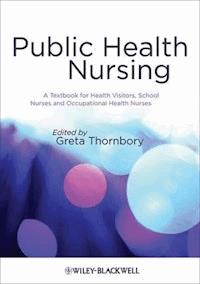
Public Health Nursing E-Book
44,99 €
Mehr erfahren.
- Herausgeber: John Wiley & Sons
- Kategorie: Fachliteratur
- Sprache: Englisch
Public Health Nursing is an essential resource for all health visiting students, school nursing students, and occupational health nursing students, that reflects the current key changes in community public health nursing. It is a key textbook for specialist practitioner programmes, and those new to the public health arena.
Written by relevant experts in the field, this practical textbook uniquely explores the three main specialties of Public Health Nursing: Health Visiting, School Nursing and Occupational Health Nursing. A particular strength of the book is the way it shows the diversity of each discipline and how they each address Public Health in vastly different ways according to the needs of their relevant population.
This will be essential reading for all students on the Specialist Community Public Health Nursing (SCPHN) programmes offered across the UK.
Key features:
-
Focuses on the specialist community public health nursing part of the NMC register
-
Multidisciplinary, with contributors from all three specialisms
-
Concerned with improving the health of the population, rather than treating the diseases of individual patients
-
Focuses on practice and competencies
Sie lesen das E-Book in den Legimi-Apps auf:
Seitenzahl: 486
Veröffentlichungsjahr: 2013
Ähnliche




















Contents
Contributors
Forewords
Health Visiting
School Nursing
Occupational Health Nursing
Preface
Acknowledgements
Abbreviations
Chapter 1 What Is Public Health?
Introduction
The development of modern public health
Successes and challenges in public health
Implications for public health practitioners
Summary
References
Chapter 2 Public Health Nursing
Introduction
The definition of nursing and public health nursing
The role of the statutory bodies: the statutory and mandatory aspects of SCPHN registration
The role of professional bodies
The developing role of public health: prevention and health promotion
The challenges for public health nursing
Improving the role – what are the solutions?
Summary
References
Chapter 3 Theoretical Perspectives of Health Visiting
Introduction
Historical perspective
Health visiting in context: the current debate
Extending the boundaries
Community health visiting
Health visiting diaries: what health visitors need to know
Social capital: the myth of a collective and cohesive partnership
Summary
References
Chapter 4 Health Visiting in Practice
Introduction
Health inequalities
Motivation
Assessing need
Summary
References
Chapter 5 The Development of School Nursing
Introduction
History of the school health service
School nursing in the twenty-first century
Accountability
Safeguarding children
Vulnerable groups
Accountability to the employer
Accountability to the profession
The development of the role of the SCPHN – school nurse
Summary
References
Chapter 6 School Nursing and School Health Practice
Introduction
Structure of school health teams
Specialist community public health nursing and school nursing
Search for health needs
Health needs assessments and school health plans
Facilitating health-enhancing activities
Stimulating an awareness of health needs
Influencing policy development
Summary
References
Chapter 7 What Is Occupational Health?
Introduction
The history of OH services
Delivering OH services
Good health is good business: the legal aspects
Good health is good business: the financial aspects
Health promotion
Summary
References
Chapter 8 Occupational Health Nursing Practice
Introduction
The role of the OHN
Health surveillance
Other considerations for monitoring health at work
Managing absence, disability and rehabilitation
Summary
References
Chapter 9 Education and Continuing Professional Development of Public Health Nurses
Introduction
Education and CPD in relation to professional registration
Personal development
Pedagogy and andragogy
Personal learning styles
Academic levels of study
European quality framework
The need for evidence-based practice
Contributing to the CPD of self and others
Summary
References
Appendix
Public health resources
Index
This edition first published 2009
© 2009 Blackwell Publishing Ltd
Blackwell Publishing was acquired by John Wiley & Sons in February 2007. Blackwell’s publishing programme has been merged with Wiley’s global Scientific, Technical, and Medical business to form Wiley-Blackwell.
Registered office
John Wiley & Sons Ltd, The Atrium, Southern Gate, Chichester, West Sussex, PO19 8SQ, United Kingdom
Editorial offices
9600 Garsington Road, Oxford, OX4 2DQ, United Kingdom
2121 State Avenue, Ames, Iowa 50014-8300, USA
For details of our global editorial offices, for customer services and for information about how to apply for permission to reuse the copyright material in this book please see our website at www.wiley.com/wiley-blackwell.
The right of the author to be identified as the author of this work has been asserted in accordance with the Copyright, Designs and Patents Act 1988.
All rights reserved. No part of this publication may be reproduced, stored in a retrieval system, or transmitted, in any form or by any means, electronic, mechanical, photocopying, recording or otherwise, except as permitted by the UK Copyright, Designs and Patents Act 1988, without the prior permission of the publisher.
Wiley also publishes its books in a variety of electronic formats. Some content that appears in print may not be available in electronic books.
Designations used by companies to distinguish their products are often claimed as trademarks. All brand names and product names used in this book are trade names, service marks, trademarks or registered trademarks of their respective owners. The publisher is not associated with any product or vendor mentioned in this book. This publication is designed to provide accurate and authoritative information in regard to the subject matter covered. It is sold on the understanding that the publisher is not engaged in rendering professional services. If professional advice or other expert assistance is required, the services of a competent professional should be sought.
Library of Congress Cataloging-in-Publication Data
Public health nursing : a textbook for health visitors, school nurses, and occupational health nurses/edited by Greta Thornbory.
p.; cm.
Includes bibliographical references and index.
ISBN 978-1-4051-8007-8 (pbk.: alk. paper) 1. Public health nursing–Textbooks.
I. Thornbory, Greta.
[DNLM: 1. Public Health Nursing–Great Britain. WY 108 P9762 2009]
RT97.P838 2009
610.73′4–dc22
2009009963
Contributors
Gillian Coverdale, MPH, BSc (Hons), RGN, SCPHN School Nursing, Cert Ed Senior Lecturer/Course Leader (Specialist Community Public Health Nursing – School Nursing), Leeds Metropolitan University
Rebecca Elliott, M Med Sci Primary and Community Care, BSc (Hons) OH, RGN, SCPHN OH, PGCE
Senior Lecturer/Course Leader, BSc (Hons), PGDip/MSc Specialist Community Public Health Nursing (Occupational Health), Leeds Metropolitan University
Cécile Knai, MPH, PhD
Research Fellow in Public Health, Health Services Research Unit, London School of Hygiene & Tropical Medicine
Faith Muir, MA (Ed), BA (Hons), SCPHN (HV), RGN, Dip Child Protection, CPT Senior Lecturer, Specialist Community Public Health Nursing (Health Visiting)/Masters of Public Health, University of Wolverhampton
Paul Reynolds, MA (Ed), BSc (Hons), RGN, SCPHN (HV), Practice Teacher Senior Lecturer, Pathway Leader Specialist Community Public Health Nursing (Health Visiting), University of Wolverhampton
Sarah Sherwin, MA (Ed), BSc (Hons), RGN, SCPHN School Nursing, Diploma Health Education, Practice Teacher
Senior Lecturer and Course Leader for School Nursing, School of Health, University of Wolverhampton
Mary Smith, MSc Child Health, LLM, BA, RGN, RM, SCPHN (HV), PGCE (FE) Senior Lecturer, University of Glamorgan, Pontypridd, Course Leader for Specialist Community Public Health Nursing (Health Visiting, School Nursing and Occupational Health Nursing)
Greta Thornbory, TD, MSc OH, RGN, SCPHN OH, Dip N OH, PGCEA, CMIOSH Occupational Health and Educational Consultant, previously Senior Lecturer and Programme Director of both OH and CPD, Institute of Advanced Nursing Education, Royal College of Nursing
The Royal College of Nursing Public Health Department 1952. (Reproduced by permission of RCN Archives)
Forewords
Health Visiting
Throughout the history of health visiting, public health has been the underpinning aspect of the work of health visitors. This book articulates the changing role of health visitors in providing a dynamic service whilst engaging in innovative ways to tackle the complex needs of society today. The search for health needs have been identified by professional organisations as an important aspect of health visiting practice. The authors clearly define health within a public health dimension, whilst detailing the concept of health promotion as the process, which facilitates change and allows the health visitor to deliver a service, which acknowledges the demands of a multifarious approach.
The phenomenon of social capital as pivotal to public health and health policy gives the reader insight into the challenges of health visiting in an ever-changing society. The four principles of health visiting are clearly identified as central to health visiting practice. Although it is acknowledged in current legislation there is still much to achieve as far as public health is concerned, the authors state that the role of health visiting is less clear and health visitor numbers are reducing allowing them less time to focus on early intervention in health issues.
This book focuses on the importance of health visitors being politically aware in order to tackle the effect of poverty especially on the development of children. The authors emphasise the importance of community profiling which has long been a desirable attribute of health visiting activities.
This book also provides a sound underpinning for student health visitors as well as being reminders of the role health visitors have in public health to those health visitors and their managers in practice. The authors have captured the essential components of public health practice and the role that health visitors can play.
Dr Ingrid CallwoodHead of Division, Community Health, University of Wolverhampton
School Nursing
In the century since school nursing began, understanding of child development, education and nursing skills have been transformed. Chapter 5 maps developments in both school environments and the National Health Service. The current health of the school-aged population predicts of adult health for decades ahead – and economic well-being, and social stability. The new Department for Children, Schools and Families (DCSF) recognises this pervasive public health role of school nurses. The DCSF values school nursing expertise in delivering strategies for population health because of its unique impact on outcomes for children. This impact can be seen both in school and across wider community settings. Society’s response to illness, adversity or abuse for individual children mirrors its deepest values. While enlightened policies such as the Special Educational Needs and Disability Act 2001 reflected noble aims, a 2008 survey for Every Disabled Child Matters revealed not one Primary Care Trust could quantify their spend on services for disabled children. England produced model specialist services for mental illness in young people, but now at the community level English adolescents have the worst mental well-being in the Western World. I discussed these concerns with the Children’s Commissioner for England (around giving 11 Million children a ‘voice’): he emphasised the folly of the media ‘demonising’ teenagers. School nurses can work alongside young people in a responsive and accountable way that anticipates transitions and their growing capacity for responsibility. School nursing evolved unique ethical foundations that encompass ‘vulnerable’ individuals, groups of children and networks of parents or professionals. Those ethics underpin the duty of care described here.
Nurses work for the school-aged population within teams, within a variety of settings. Chapter 6 illustrates the standards for Specialist Community Public Health Nursing, relating this nurse to the wider school health service. Consultation with young people and a capacity to advocate for children based on evidence of their health needs are key skills to nurture. When professional training and development was going through a period of neglect concerns were often expressed about the poor evidence base for practice and the paucity of efforts to explain school nursing to other professions, especially general practitioners or service commissioners. Clear practical examples of school health expertise are provided here, e.g. for the epidemic of obesity sweeping the UK. The promotion of ‘positive mental health’ gives a good grounding for coming initiatives like Targeted Mental Health in Schools. These chapters foresee the professional need to enhance ‘collaborative working’ across all the agencies involved in young people’s well-being. SCPHNs have been at the forefront of recent developments to integrate services for every child (ages 0–19) and the professional bodies have seized this challenge to combine innovation with evidence-based practice. The example given of raised standards in personal, social and health education, through an effective collaboration between school nurses and both primary and secondary school teachers, shows us all the way ahead.
Woody CaanProfessor of Public Health, Department of Child & Family Health,Anglia Ruskin University, Cambridge
Occupational Health Nursing
The contribution of occupational health (OH) nurses to public health is not new as they have promoted health and practiced at a strategic level for many years. Their contemporary public health role is recognised by the Nursing and Midwifery Council (NMC) as those holding an NMC-validated qualification in OH nursing can register as specialist community public health nurses.
OH nurses by definition practice with a specific client group – the workforce. They undertake a proactive role in reducing health inequalities amongst that population. These specialists are involved in policy development and undertake a population-based approach rather than merely providing care to individuals, these are important elements of public health practice.
The workforce is a captive audience for a range of health-promoting activities and never before has the OH nurse’s contribution to public health been higher profile. Dame Carol Black’s recent review of the health of Britain’s working-age population, Working for a Healthier Tomorrow, has been a particular influence on public health and on OH nursing practice in particular. Black’s review emphasises the premise that promoting, improving and maintaining the health of the working-age population makes a significant contribution to the nation’s economic growth and social justice.
An experienced OH nurse educationalist and consultant has edited this book which provides a succinct overview of a workplace-focused public health strategy. It explores the four levels of primordial, primary, secondary and tertiary prevention linking these to contemporary OHN practice and highlights the role of the OHN in advising and supporting employers in ensuring a healthy and productive workforce. It is written in such a way that nurses new to OH nursing as well as those with more experience will benefit from its exploration of the role and function of the OHN within a multidisciplinary team.
Anne HarrissReaderin Educational Development and Course Director,Specialist Community Public Health Nursing (Occupational Health)Programmes,London South Bank University
Preface
Public health (PH) nursing is not a new nursing discipline, but with the advent of the Nursing and Midwifery Council pulling together the nursing disciplines that work in the field of public health it has been necessary to address the issue with a textbook on the subject. Specialist education and training is required to prepare the qualified nurse to undertake PH nursing work as there is evidence that PH is currently taking centre stage in the challenge to improve the population’s health and nursing should be playing an active part.
This book is a basic text aimed at those nurses new to the PH arena and who are undertaking specialist education and training. It is written by relevant experts in the field and the three main specialties of PH nursing, health visitors, who care for families and children up to five; school nurses, who care for the school-aged child and occupational health nurses, who care for the health and well-being of people at work. It does not aim to be all embracing of each discipline, it is designed to be read in conjunction with each discipline’s specialist textbooks and the references and resources given in the book should act as pointers for further more in-depth reading and information.
One of the book’s main aims is to show the diversity of each discipline and how they each address PH in vastly different ways according to the needs of their relevant population. The book starts by exploring the term public health and then how it relates to nursing. The chapters that follow then address each discipline in turn and conclude with a chapter on the all-important continuing professional development.
Greta Thornbory
Acknowledgements
I would like to thank the following people for their contributions, help, advice and support in writing this book: All the chapter contributors for their endless patience and for being on time; Rachel Coombs at Wiley-Blackwell for her advice and support with this project; Dr Stuart Whitaker who kindly undertook the job of critical reader; Anne Harriss and Robert Dunn who have given me endless support; All the PH practitioners who have provided examples from practice and they include: Lee Bromwich, Caroline Forrest, Sharon George, Sue Jones, Cassie Parsons, Anne Roberts, Angie Waldron, Penny Wilson, Denize Bainbridge, Christina Butterworth, Jenny Mason, Sandra Neylon, Sue Gee and Gillian Eastwood.
Finally, to Sue Hincliffe who encouraged me on the road to writing.
Greta Thornbory
Abbreviations
ACAS
Advisory, Conciliation and Arbitration Service
AOHNE
Association of Occupational Health Nurse Educators
AOHNP
Association of Occupational Health Nurse Practitioners
BOHS
British Occupational Hygiene Society
CAMHS
Child and Adolescent Mental Health Services
CBI
Confederation of British Industry
CDC
Centre for Disease Control and Prevention
CETHV
Council for the Education and Training of Health Visitors
CHPP
Child Health Promotion Programme
CIPD
Chartered Institute of Personnel and Development
CPD
Continuing Professional Development
CPHVA
Community Practitioners and Health Visitors Association
CTHV
Council for the Training of Health Visitors
DDA
Disability Discrimination Act 2005
DEA
Disabled Employment Advisor
DPA
Data Protection Act 1998
DSE
Display Screen Equipment (previously VDU or visual display unit)
EAP
Employee Assistance Programme
EEF
Engineering Employers Federation
ELCI
Employers Liability Compulsory Insurance
EU
European Union
FAO
United Nations’ Food and Agriculture Organization
GMC
General Medical Council
GP
General Practitioner
HASAWA
Health and Safety at Work (etc.) Act 1974
HPC
Health Professions Council
HPV
Human Papilloma Virus
HR
Human Resources
HSE
Health and Safety Executive
HV
Health Visitor
ILO
International Labor Organization
IOSH
Institute of Occupational Safety and Health
LEA
Local Education Authority
LLM
Master of Laws
MHSW
Management of Health and Safety at Work Regulations 1999
MMR
Measles, Mumps and Rubella
MSDs
Musculoskeletal Disorders
NATHNAC
National Travel Health Network and Centre
NAW
National Assembly for Wales
NFSHE
National Forum for School Health Educators
NHS
National Health Service
NMC
Nursing and Midwifery Council
OFSTED
Office for Standards in Education
OH
Occupational Health
OHN
Occupational Health Nurse
OM
Occupational Medicine
PCT
Primary Care Trust
PGCE
Post Graduate Certificate of Education
PGCEA
Post Graduate Certificate of Education of Adults
PH
Public Health
PSA
Public Sector Agreement
PSHE
Personal, Social and Health Education
RCN
Royal College of Nursing
RTWI
Return to Work Interviews
SAPHNA
School and Public Health Nurses Association
SCPHN
Specialist Community Public Health Nurses
SMEs
Small- and Medium-Sized Enterprises
SNs
School Nurses
UKCC
United Kingdom Central Council
UKSC
United Kingdom Standing Conference
VRA
Vocational Rehabilitation Association
WHO
World Health Organization
Chapter 1
What Is Public Health?
Cécile Knai
Introduction
This chapter attempts to answer the question ‘What is public health?’ and at one level, the answer is simple and straightforward: public health aims at preventing health problems before they occur and focuses on populations rather than on individuals. As we will see in the chapter, there are different ways of going about this task. The more convenient linear, two-dimensional way holds that there is a cause and there is a disease, and to address the disease one needs to address the cause. According to this line of thought, disease is brought about by specific aetiological agents which affect the body’s structure and function, with illness a separate ‘subjective experience of dysfunction’ [1]. This biomedical model has been argued as being narrow: the reality is that achieving public health is a complex task with an ill-defined scope. This is not for lack of effort on behalf of public health practitioners. Indeed, as discussed below, an enormous amount of effort and debate and political commitment have converged over time so that the field of public health is a field in its own right, with educational and professional specialisations. The approach to health has shifted from a relatively narrow approach to a broader conception of what health means, as expressed by the World Health Organization (WHO) definition which has not been amended since 1948: ‘Health is a state of complete physical, mental and social well-being and not merely the absence of disease or infirmity’ [2]. Moreover, the understanding of public health and the extent to which governments should intervene to support population health will vary according to the sociopolitical stance of countries [3, 4].
Lesen Sie weiter in der vollständigen Ausgabe!
Lesen Sie weiter in der vollständigen Ausgabe!
Lesen Sie weiter in der vollständigen Ausgabe!
Lesen Sie weiter in der vollständigen Ausgabe!
Lesen Sie weiter in der vollständigen Ausgabe!
Lesen Sie weiter in der vollständigen Ausgabe!
Lesen Sie weiter in der vollständigen Ausgabe!
Lesen Sie weiter in der vollständigen Ausgabe!
Lesen Sie weiter in der vollständigen Ausgabe!
Lesen Sie weiter in der vollständigen Ausgabe!




