


4,99 €
Mehr erfahren.
- Herausgeber: BoD - Books on Demand
- Kategorie: Gesellschafts- und Liebesromane
- Sprache: Englisch
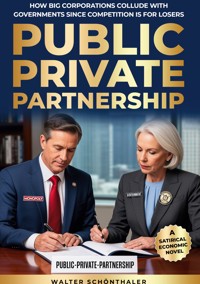
Public-Private Partnership is a satirical novel about a family-run company´s battle with Stakeholder Inc, a powerful political corporation. . The business model of political enterprises such as Stakeholder Inc. is simple yet highly effective. Rather than owning any means of production themselves, they avoid competition. Instead, they cooperate with political institutions through public private partnerships protecting them from competition in their business area. Data from Transparency International Integrity Watch illustrates the rapid growth of this PPP business model. As these cooperations advance, it is becoming increasingly difficult to distinguish where the private sector ends, and the government begins. This growing intermingling of the economy and politics is known as corporatism.
Das E-Book können Sie in Legimi-Apps oder einer beliebigen App lesen, die das folgende Format unterstützen:
Seitenzahl: 216
Veröffentlichungsjahr: 2025
Ähnliche


















Author's Preface
Public-Private Partnership is a satirical novel that addresses how political companies harm small and medium-sized businesses through public-private partnerships.
The eminent Austrian economist and politician Joseph Schumpeter (1883–1950) coined the term "creative destruction," among other things.
Less well known is the fact that Schumpeter described two contrasting types of businessmen: the "entrepreneur" and the "arbitrage businessman."
According to Schumpeter, entrepreneurs in the real economy create economic added value and increase prosperity (gross national product) through innovative concepts, products, processes, and services.
These entrepreneurs are characterized primarily by their constant desire to improve their economic position through innovation. This entrepreneurial spirit generates innovation, drives economic growth, and spurs social change. The focus of an entrepreneurial businessperson's thinking is creating profit through customer satisfaction. Goods and services exist to fulfill needs. If goods and services do not meet needs or are produced too expensively, economic entrepreneurs will disappear from the market. Thus, economic entrepreneurs are incentivized to completely satisfy customer needs.
According to Schumpeter, the second group of entrepreneurs are arbitrage entrepreneurs.
"The arbitrage entrepreneur uses information to his advantage." In the real world, there are always information differences between "insiders" and "outsiders." 1
Recently, arbitrage entrepreneurs have increasingly entered the political arena.
Benjamin Mudlack, author of the book Neues Geld für eine freie Welt, describes Schumpeter's arbitrage entrepreneurs as "political entrepreneurs."2
Political entrepreneurs do not own any means of production. Instead, they engage in hostile actions, such as creating and enforcing laws that establish rights with the threat of violence. These laws indirectly give political entrepreneurs access to the means of production. This takes the form of levying taxes or creating bureaucratic measures. Like politics, lobbying should be regarded as political entrepreneurship. Political entrepreneurship is diametrically opposed to the voluntary/market economy. It does not generate production or prosperity. Instead, it feeds off the prosperity created by economic entrepreneurs. Therefore, political entrepreneurs cannot exist without the productive forces of economic entrepreneurs.
Political entrepreneurs exploit the productive forces of economic entrepreneurs and small-to-medium businesses to gain political influence. As they do not own any means of production, political entrepreneurs, such as capital pools or asset managers, form public–private partnerships (PPPs) with politicians and are contractually protected from competition in their specific areas.
Data from Transparency International Integrity Watch shows the rapid advance of this PPP business model.3
In PPPs, it is difficult to distinguish where the private sector ends and where the government begins. Private monopoly corporations, or "strategic partners" as the World Economic Forum calls them, have become government enforcement agents against their citizens. The surveillance corporation Palantir works with government organizations, intelligence agencies, large corporations, and quasi-governmental organizations (NGOs).
Why have these PPP models become so popular that they have become the "mission," the raison d'être, of the World Economic Forum? There is a simple, logical explanation for this. Private corporations can do what governments are not permitted to do under the Constitution, fundamental rights, and human rights.
Although the conflict between the economic enterprises of small and medium-sized businesses and the political enterprises of monopoly corporations is clearly visible, the mainstream media are unable to distinguish between these two contradictory business models.
This is not only because political entrepreneurs finance many mainstream media outlets. Media outlets dependent on their owners and advertisers also fail to report fairly because politicians and media professionals, hardly any of whom have ever worked in the private sector, are unable to recognize the difference between the two types of entrepreneurs.
Political entrepreneurs and their organizations invest in politics and the media. Their political influence is constantly growing.
They like to meddle in politics and appreciate the discreet confidentiality of public–private partnerships. However, they seem to hate competition, as evidenced by their actions and statements.
Entrepreneur Peter Thiel has been playing an important role in US politics for around a decade.
US President Donald Trump is loud, extroverted, and clearly loves being the center of attention—always. One of his earliest supporters from Silicon Valley, German-born entrepreneur Peter Thiel, is different. Thiel prefers to operate behind the scenes. Unlike the eccentric Elon Musk, Thiel is also relatively unknown.
Thiel studied philosophy and law at Stanford University, where he earned his bachelor's degree in 1989. In 1992, Thiel received his doctorate from Stanford Law School. He worked briefly for a New York Wall Street law firm. In 1996, Thiel founded his first venture capital fund (Thiel Capital).
Thiel has been a billionaire investor for many years. Thiel co-founded PayPal and made Facebook big. He is also the founder of the surveillance software company Palantir. In 2025, Thiel was ranked 131st among the richest people in the world.
Peter Thiel is considered an influential pioneer of the current “vibe shift,” i.e., the cultural shift in the US significantly to the right. Thiel is often described as a right-wing libertarian.
Public opinion seems to have become suddenly more conservative since Trump's re-election last year. For example, large corporations ended diversity programs immediately after the election.
In his book Zero to One: How Innovation Saves Society (Campus Verlag, 2014), Peter Thiel — one of the most successful political entrepreneurs — describes his views on innovative entrepreneurship. I have selected nine key issues from the book.
1. People who sell themselves are politicians.4
"People who sell themselves are politicians," writes Thiel, one of the most successful, powerful, and intelligent political entrepreneurs.
Sebastian Kurz, the former chancellor of Austria, got a job as a "global strategist" at Thiel's IT surveillance company, Palantir, after leaving politics. Kurz has now created his own "Mini-Palantir" with the IT surveillance company "Dream Security" and his partner, Shalev Hulio. (former NSO Group, Pegasus Spyware)
2. Market economy is the opposite of capitalism.
Peter Thiel does not consider the market economy and capitalism to be similar, let alone identical, concepts. Rather, he sees them as opposites. He describes his business viewpoint on this issue as follows: "In reality, however, capitalism is the opposite of competition. Capitalism is based on the accumulation of capital, but in perfect competition, all profits are lost."
According to Peter Thiel, there are two types of companies.
The first type are entrepreneurs who have successfully eliminated their competition and established monopolies. Examples include PayPal, Palantir, Microsoft, Amazon, Apple, Facebook/Meta, Google/Alphabet, and the one hundred "strategic partner corporations" of the World Economic Forum. 5
The second type are the notorious "losers" who face competition in the real economy - without political backing.
This explains why the asset management companies and quasi-monopolists of the platform economy, who produce nothing themselves but merely act as intermediaries, have been able to increase their profits so much since the 2020 Coronavirus lockdowns.
The measures introduced to combat the Coronavirus pandemic radically transformed the political, economic, social, technological, and legal environments virtually overnight. These measures sent large parts of the real economy into state dependency through multiple lockdowns, which are professional bans for small and medium-sized businesses.
3. Competition is for losers.6
"If you are an entrepreneur starting a business, you should always aim to achieve a monopoly and avoid competition. That's why competition is for losers."
For Thiel, competition is an ideology that primarily prevents him from skimming monopoly profits.
"Competition is, first and foremost, an ideology, the ideology that permeates our entire society and distorts our thinking. We preach competition, believe in its necessity, and live by its precepts. We are trapped in it because the more we compete, the less we earn."
The value of a product or service for consumers on a competitive market is not the key performance indicator. For Thiel, it is the extractable 'shareholder value' in the form of profit. This would be acceptable if monopolists did not exclude competitors from market competition through political influence.
4. Monopolists tell fairy tales to protect themselves.7
Monopolists tell fairy tales to protect themselves. They know boasting about their monopoly position will attract the attention of competition regulators.
Since they are interested in continuing to reap undisturbed profits, they do everything they can to conceal their monopoly position. In my opinion, Peter Thiel is right on this point. Storytelling has never been easier for monopolists than it is today—if you have the necessary funds.
Edward Bernays is one of the founders of organized storytelling. Formerly known as "propaganda," it is now referred to as storytelling, public relations, or public relations work.
"The conscious and intelligent manipulation of the organized habits and opinions of the masses is an important element in democratic society. Those who manipulate this invisible mechanism of society constitute an invisible government, which is the true ruling power of our country. We are governed, our minds are formed, our tastes are formed, and our ideas are suggested largely by men we have never heard of." 8
5. The best start-ups are a little like cults.
If you have the chance to work for Peter Thiel in a start-up, consider what the boss thinks about it. "The best start-ups are a little like cults." The biggest difference is that cults are wrong in their fanaticism. However, employees of a successful start-up are fanatically committed to something the rest of the world cannot see. Don't worry if people in your profession don't understand your company. Be happy if you are called a cult. 9
6. Money makes money.
"For whoever has will be given more, and they will have an abundance. Whoever is in need will be ordered to share, and they will be given their fill," says the Bible. Albert Einstein came to the same conclusion when he described compound interest as the eighth wonder of the world, the greatest human invention, and the most powerful force in the universe. 10
If compound interest is truly the most powerful force in the universe, then one might wonder if Einstein really invented the theory of relativity. Assuming the Bible quote is true, one might also assume that "advertorials" (editorial masking of an advertisement, also known as "surreptitious advertising") existed in biblical times.
7. A world without secrets would be a just world.
"Injustice presupposes that a decisive moral insight has not yet prevailed. In a democratic society, injustice only persists if it is not recognized as such by the people." 11
When Peter Thiel wrote his book in 2014, he probably didn't completely anticipate what happened five years later, starting with the Corona-Crisis and followed by Climate business, CO2 taxation and CO2 certificates, War in the Ukraine, ESG, pipeline blow ups, Agenda 2030, C-15 cities, the destruction of the German and Austrian economy and that 134 central banks are working on the introduction of Central Bank Digital Currencies (CBDC) maybe combined with social credit systems, based on a combination of CBDC, digital ID and backed by his IT surveillance company Palantir.
8. Some secrets are more dangerous than others.
As Faust says to Wagner: "The few who recognized it were foolish enough not to guard their hearts. They revealed their feelings and insights to the mob. They were crucified and banished."12
This may sound threatening when you consider how many people who knew secrets have died "suddenly and unexpectedly."
9. You must be able to afford morality.
"The Google motto 'Don't be evil' is, of course, part of a marketing strategy, but it is also typical of a company that is so successful that it can worry about morality without jeopardizing its own existence."
In business, money is either important or irrelevant. Monopolists can afford to think about things other than money. 13
Many news agencies, leading media outlets, nongovernmental organizations (NGOs), think tanks, lobbyists, and politicians depend on the financial support of political companies.
The tide will only turn when the sponsors of colorful advertisements, advertorials, and special supplements withdraw.
Not only the political entrepreneur but also their business partners may then be "demystified," as in the case of the political favorite and grand arbitrageur René Benko 14
We can then observe how admiration for self-made men turns to contempt.
The corporatism of public-private partnerships and political enterprises damages the macro-environment of small and medium-sized enterprises, the backbone of the European economy. Since the launch of the Corona-Crisis in February 2020, we have seen several global business models of political enterprises emerge.
All these models are based on fear and contradict each other, as well as themselves:
Business & Control Model #1: the Corona crisis, epidemic testing, gene injections, lockdowns for SMEs and unvalidated PCR tests.
Business & Control Model #2: war, debt and 'The Great Expropriation'.
Business & Control Model #3: climate business, CO₂ taxation, CO₂ climate certificates and CO₂ pricing.
Business & Control Model #4 could be based on a combination of digital central bank money, digital ID and a potential social credit CO₂ system.
ECB President Christine Lagarde has announced a test run of the Digital Euro for October 2025. More recent information suggests the Digital Euro (CBDC) will be introduced by the end of 2028.
Since December 2024, the German economy must cope with an increasing exodus of companies, as reported by the German news program Tagesschau.15
Deteriorating economic conditions and increasing level of uncertainty are damaging the international competitiveness of Germany's and Austria's typical "hidden champions" (market leaders in niche markets):
High, volatile energy costs; constantly increasing, impossible-to-comply-with regulations; ideology-driven politics, uncontrolled migration; and consequently, an increasingly divided population are to blame.
We are not only witnessing entrepreneurs withdrawing from Germany and Austria but also the triumph of political entrepreneurs and the politicians who support them.
Consequently, the EU, and Austria and Germany in particular, have been mired in stubborn stagflation for almost four years. Small and medium-sized enterprises, the foundation of entrepreneurship and the backbone of our society, are continuously being financially drained by inflation, ever-rising taxes, and rampant bureaucracy.
The triumph of political entrepreneurs
"Creative destruction," the famous term coined by Schumpeter, is indeed taking place. However, this process is moving in the opposite direction of the dynamic innovation process described by Schumpeter.
Today's form of 'creative destruction' is not driven by entrepreneurs, but by central banks and political enterprises in public-private partnerships with governments and global non-governmental organizations (NGOs).
A public-private partnership (PPP) is the opposite of a market economy and competition. It is the antithesis of creative destruction that brought decades of growth and prosperity through innovation. Following a period of creative destruction by entrepreneurs that positively impacted citizens' prosperity from 1950 until around the turn of the millennium, we have experienced a phase of contractual mergers between large corporations and governments for several years.
The international Schumpeter Prize recognizes innovative achievements in economics, politics, and economic sciences. The prize commemorates Joseph A. Schumpeter (1883–1950), an Austrian-born economist who taught at Harvard University and was one of the most influential economists and social scientists of the 20th century.
His work covered economic theory, politics, and practice. Schumpeter worked at Harvard University, among other places, and had a lasting impact on the concept of innovation, including the concepts of "creative destruction," "entrepreneur," and "arbitrage entrepreneur."
The last Schumpeter Prize was awarded in 2022.
If you think the current prize was awarded to an economic entrepreneur, you are mistaken. The last two prizes, in 2022 and 2019, were awarded by the jury to a EU commissioner and a political entrepreneur, respectively.
Margrethe Vestager, a civil servant, politician, and former EU Commissioner for Competition, was awarded the 2022 Schumpeter Prize.
She is a member of the radical left-wing party Radikale Venstre (RV).
Wikipedia writes about the winner of the Schumpeter Prize: "Margrethe Vestager (born April 13, 1968, in Glostrup) is a politician from the left-liberal party Radikale Venstre (RV)."From 2014 to 2024, she was the EU Commissioner for Competition. From 2019 to 2024, she was also the Executive Vice President and Commissioner for Digital Affairs in the von der Leyen Commission. 16
The second-to-last Schumpeter Prize, awarded in 2019, was not given to an entrepreneur who created innovative products or services, but to political entrepreneur George Soros.
Wikipedia writes about the 2019 winner: "George Soros (born György Schwartz on August 12, 1930, in Budapest) is an American investor and philanthropist. In the 1990s, he became known for currency speculation, including against the British pound." 17
Schumpeter's predictions
What would Joseph A. Schumpeter, who was also the Austrian finance minister in 1919, have said about the prize named after him, the current state of our economy and society, and "our" politicians?
We don't know, but we can guess. Schumpeter criticized the fact that the capitalist system was digging its own grave by creating a social atmosphere and societal structures that threatened its own survival. The decline of bourgeois values and the growing power of bureaucracy and large corporations would spell the system's end in the long run.
"The state of a nation's currency is a symptom of all its conditions."
"A dog is more likely to stock up on sausages than a democratic government is to stock up on budget reserves."
"Created by wars that required it, the machine now creates the wars it requires" (Joseph Alois Schumpeter, quotes).
Small and medium-sized businesses are embedded in political, economic, social, technological, ecological, and legal frameworks.
A market economy requires stable conditions. This is why every business model begins with a careful, crystal-clear PESTEL (political, economic, technological, ecological, legal) analysis of the macroenvironment in which the company operates.
Unfortunately, start-ups operate in constantly changing conditions due to political interference, particularly from EU commissioners. Without reliable framework conditions, however, it is impossible to effectively plan a business model or business plan. Even the best entrepreneur cannot succeed if political and legal conditions suddenly change, fundamental rights and freedoms are suspended, and new EU regulations, directives, and laws are constantly enacted.
How can entrepreneurs develop, plan, and implement innovative products and services in such an uncertain environment? In a free and democratic country, I believe entrepreneurs of the real economy should invest, not the state.
So, why did I write this novel?
In principle, it's about the most important system of rules: the monetary system, the most powerful system of all. There are many fascinating quotes about it, including one from Henry Ford who said that if people understood the monetary system, there would be a revolution by tomorrow morning. 18
I wanted to include two storylines in the novel: the battle for the mineral water monopoly and the discussion between a boy and an old man represented by one- and 20-cent coins under a supermarket cash register.
As a boomer, born in 1954, I am fascinated by this topic, and it's fitting that the boy doesn't believe the old man. We didn't believe everything our parents told us either. Ultimately, that's what it's all about.
It's about narratives. I looked up an official definition of "narrative": What are narratives? According to Wikipedia, they are stories that have a cultural impact. Throughout our lives, we have been presented with many such stories.
However, most of the stories we remember as true are ones we haven't experienced ourselves. We believe that we have experienced more than 90% of the stories we have been told because we have internalized these narratives and perceived them as part of ourselves.
Consider the story of the Marlboro Man. Marlboro is a brand of cigarettes, and the Marlboro Man rode around smoking on his horse and playing the free-and-easy cowboy. Then he died of lung cancer.
After this, the narrative took a bizarre turn when smokers noticed that the pictures on cigarette packs had changed. From then on, the Marlboro Man was no longer on Marlboro cigarette packets; instead, there were shocking images about smoking and lung cancer. Just as a child's belief in Santa Claus is shattered at a certain age, the narrative was completely turned upside down with the Marlboro Man's death.
However, we shouldn't believe everything the mainstream media tells us. Storytelling is an important point in the stories generated by those who use them for their business models. Basically, everyone can believe what they want.
The events of 9/11 in September 2001, the subprime crisis 2007/2008 and early 2020, in the wake of the Coronavirus crisis, were the catalyst for writing this book. Since then, there have been continuous attempts to instill new narratives of fear, i.e., new stories, into our minds.
These stories, which are spread in the public media, can be believed or not believed. Everyone is free to do so.
The events of early 2020, in the wake of the crisis and public-private cooperation, the mission statement of the World Economic Forum, which is published on their website were some of the reasons for writing this novel about Public-Private Partnership. 19
1 Schumpeter, J.A. (1991), Business Cycles, Göttingen, Vandenhoeck
2 Mudlack, B. (2025), Neues Geld für eine freie Welt – Warum das Geldsystem kein Herrschaftssystem sein darf, p.547
3https://data.integritywatch.eu
4 Thiel (P.) mit Masters (B.), (2014), Zero to One – Wie Innovation unsere Gesellschaft rettet, Campus Verlag, Frankfurt/New York
5https://www.weforum.org/communities/strategic-partnership-b5337725-fac7-4f8a-9a4f-c89072b96a0d/
6 Thiel (Peter), 2014, Lecture 5: Business Strategy and Monopoly https://www.youtube.com/watch?v=3Fx5Q8xGU8k/
7 Thiel (P.) mit Masters (B.), (2014), Zero to One – Wie Innovation unsere Gesellschaft rettet, Campus, Frankfurt/New York, p.30
8 Bernays (E.), Propaganda, 1955, Desert Books, p.37
9 Thiel (P.) mit Masters (B.), (2014), Zero to One – Wie Innovation unsere Gesellschaft rettet, Campus, Frankfurt/New York, p. 104
10 Thiel (P.) mit Masters (B.), (2014), Zero to One – Wie Innovation unsere Gesellschaft rettet, Campus, Frankfurt/New York, p.83
11 Ibid., p.99
12 Thiel (P.) mit Masters (B.), (2014), Zero to One – Wie Innovation unsere Gesellschaft rettet, Campus, Frankfurt/New York, p. 104
13 Thiel (P.) mit Masters (B.), (2014), Zero to One – Wie Innovation unsere Gesellschaft rettet, Campus, Frankfurt/New York,, p. 34
14https://www.zdf.de/nachrichten/wirtschaft/rene-benko-betrug-ermittlungen-u-haft-100.html
15https://www.tagesschau.de/wirtschaft/wirtschaftsverbaende-abwanderung-100.html
16https://de.wikipedia.org/Margrethe_Vestager
17https://en.wikipedia.org/George_Soros
18https://goodreads.com/quotes/34770-it-is-well-enough-that-underlings-of-the-nation-do
19https://www.weforum.org/about/world-economic-forum/
Table of Contents
Prologue
Rapota
It's the economy, stupid!
Schickelgruber
Five lockdowns against the middle class
The Metaverse
Public–Private Partnerships
Dissenbach
Eugenicus
The retreat of the entrepreneurs
Public Relations
Asperger
The Art of Pfidshigogerl
Love is in the air
The Stakeholder Killer
The Assassination
Artificial Intelligence
Freedom and solidarity
TikTok
The Young Fatal Leaders
Prologue
Once upon a time, a female career student with excesses in smoking and gothic clothing had bought a bottle of hard liquor from a supermarket located in the Vienna suburb of Erdberg, close to Fiakerplatz.
She paid with a ten and received two coins in change: a twenty-cent piece and a single Eurocent. When hastily trying to stow the liquor in her backpack, her tobacco-browned fingers lost grip of both coins, which fell under the checkout counter and remained there at a secluded place where neither customers nor personnel could discover them.
The situation of the two lonesome coins got worse when an employee wiped them farther into oblivion with a floor mop into a gap between the mopboard and the floor.
Despite the fact the floor was wiped clean at the end of each working day cleaning equipment happened to get as close as a few millimeters when it was used, the chances that the two lost coins might get recovered shrank day by day. In endless months, it became evident to the electrons inside their alloy made of copper, aluminum, zinc and tin that they couldn’t get free from their imprisonment to see themselves happily reentering their purpose of existence: the regular flow of money. With all remaining might in their quantum-size ganglia, they longed to serve as small change again, but it was all in vain.
The earliest moment of being discovered seemed the installation of a new scanner, but since the chain store had been just recently opened, that seemed ages away. In fact, the tragedy of the twenty-cent piece and the one cent piece took place at the very opening of the store when the chairman of the discount market chain personally attended the grand opening in Vienna-Erdberg.
Would it take until the demolition of the site for the coins to be freed? Would they still be fit for use as means of payment then? Already now they were hardly of value. Possibly they would just remain in the rubble even after having been detected since nobody would care. Perhaps some employees would throw them into a jar together with other worthless coins and let them rot there, a transfer from one jail to another.
A stoned student of communication sciences all dressed in weird gothic funeral fashion and distracted by lover’s grief had ruined the exciting and diversified career of those two ‘zvutshgerl’s [Austrian for ‘small ones’] during a fit of comfort shopping in the Erdberg store as she had passed on her distress to the coins, unknowingly and accidentally, by sending them to the floor.
As time went by and weeks became months, an unprecedented phenomenon occurred between the two of them.
We are sorry no scientist will ever have an opportunity to investigate it, neither the Heisenberg model of localized magnetic moments, nor the Stoner theory of band electron magnetism will ever be applied or tested by the happenings under the counter.
We simply must declare it a result of the combination of deadly dull boredom and absence of perspective that created strange means of communication between the coins, chatting about memories and history stored in some unknown quantum trace of the alloy.
This is how our story starts, narrated by ‘Koin Senior’ – what the twenty-cent piece calls himself – to the smaller ‘Koin Junior’ during long days and nights when they were kept prisoner of a discount market of the Stakeholder Group, stuck deep under a checkout counter…




