


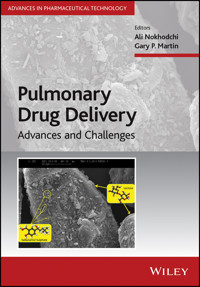
Pulmonary Drug Delivery E-Book
127,99 €
Mehr erfahren.
- Herausgeber: John Wiley & Sons
- Kategorie: Wissenschaft und neue Technologien
- Serie: Advances in Pharmaceutical Technology
- Sprache: Englisch
Drug therapy via inhalation route is at the cutting edge of modern drug delivery research. There has been significant progress on the understanding of drug therapy via inhalation products. However, there are still problems associated with their formulation design, including the interaction between the active pharmaceutical ingredient(s) (APIs), excipients and devices. This book seeks to cover some of the most pertinent issues and challenges of such formulation design associated with industrial production and desirable clinical outcome.
The chapter topics have been selected with a view to integrating the factors that require consideration in the selection and design of device and formulation components which impact upon patient usability and clinical effectiveness. The challenges involved with the delivery of macromolecules by inhalation to both adult and pediatric patients are also covered.
Written by leading international experts from both academia and industry, the book will help readers (formulation design scientists, researchers and post-graduate and specialized undergraduate students) develop a deep understanding of key aspects of inhalation formulations as well as detail ongoing challenges and advances associated with their development.
Sie lesen das E-Book in den Legimi-Apps auf:
Seitenzahl: 914
Veröffentlichungsjahr: 2015
Ähnliche




















Table of Contents
Cover
A Wiley Book Series
Title Page
Copyright
List of Contributors
Advances in Pharmaceutical Technology
Series Preface
Preface
Chapter 1: Lung Anatomy and Physiology and Their Implications for Pulmonary Drug Delivery
Abbreviations
1.1 Introduction
1.2 Anatomy and Physiology of Lungs
1.3 Mechanisms of Aerosol Deposition
1.4 Drug Absorption
1.5 Physiological Factors Affecting the Therapeutic Effectiveness of Drugs Delivered by the Pulmonary Route
1.6 Computer Simulations to Describe Aerosol Deposition in Health and Disease
1.7 Conclusions
References
Chapter 2: The Role of Functional Lung Imaging in the Improvement of Pulmonary Drug Delivery
Abbreviations
2.1 Introduction
2.2 Established Functional Lung Imaging Technologies
2.3 Emerging Technologies
2.4 Conclusion
References
Chapter 3: Dry Powder Inhalation for Pulmonary Delivery: Recent Advances and Continuing Challenges
Abbreviations
3.1 Introduction
3.2 Dry Powder Inhaler Devices
3.3 New Developments in DPI Formulations and Delivery
3.4 Characterization Methods of Dry Powder Inhaler Formulations
3.5 Conclusion
References
Chapter 4: Pulmonary Drug Delivery to the Pediatric Population – A State-of-the-Art Review
Abbreviations
4.1 Introduction
4.2 Patient Consideration
4.3 Delivery Systems for the Pediatric Population
4.4 Recommendations
4.5 Conclusion
References
Chapter 5: Formulation Strategies for Pulmonary Delivery of Poorly Soluble Drugs
Abbreviations
5.1 Introduction
5.2 Co-solvents
5.3 Cyclodextrins
5.4 PEGylation
5.5 Reduction of Size to Micro-/Nanoparticles
5.6 Solid Dispersion/Amorphization
5.7 Micelles
5.8 Liposomes
5.9 Solid Lipid Nanoparticles and Nanostructured Lipid Carriers
5.10 Conclusion
References
Chapter 6: Lipidic Micro- and Nano-Carriers for Pulmonary Drug Delivery—A State-of-the-Art Review
Abbreviations
6.1 Introduction
6.2 Pulmonary Drug Delivery
6.3 Liposomal Pulmonary Delivery
6.4 Nebulization of Liposomes
6.5 Liposomal Dry-powder Inhalers
6.6 Solid Lipid Microparticles in Pulmonary Drug Delivery
6.7 Solid Lipid Nanoparticles in Pulmonary Drug Delivery
6.8 Nanostructured Lipid Carrier (NLC) in Pulmonary Drug Delivery
6.9 Nanoemulsions in Pulmonary Drug Delivery
6.10 Conclusion and Perspectives
References
Chapter 7: Chemical and Compositional Characterisation of Lactose as a Carrier in Dry Powder Inhalers
Abbreviations
7.1 Introduction
7.2 Production of Lactose
7.3 Lactose: Chemical Forms, Solid-State Composition, Physicochemical Properties
7.4 Epimerisation of Lactose
7.5 Analysis of Lactose
7.6 The Influence of the Chemical and Solid-State Composition of Lactose Carriers on the Aerosolisation of DPI Formulations
7.7 Conclusions
References
Chapter 8: Particle Engineering for Improved Pulmonary Drug Delivery Through Dry Powder Inhalers
Abbreviations
8.1 Introduction
8.2 Dry Powder Inhalers
8.3 Particle Engineering to Improve the Performance of DPIs
8.4 Engineered Carrier Particles for Improved Pulmonary Drug Delivery from Dry Powder Inhalers
8.5 Relationships between Physical Properties of Engineered Particles and Dry Powder Inhaler Performance
8.6 Conclusions
References
Chapter 9: Particle Surface Roughness – Its Characterisation and Impact on Dry Powder Inhaler Performance
Abbreviations
9.1 Introduction
9.2 What is Surface Roughness?
9.3 Measurement of Particle Surface Roughness
9.4 Impact of Surface Roughness on Carrier Performance – Theoretical Considerations
9.5 Particle Surface Modification
9.6 Conclusion
References
Chapter 10: Dissolution: A Critical Performance Characteristic of Inhaled Products?
Abbreviations
10.1 Introduction
10.2 Dissolution of Inhaled Products
10.3 Particle Testing and Dissolution Media
10.4 Dissolution Test Apparatus
10.5 Data Analysis and Interpretation
10.6 Conclusions
References
Chapter 11: Drug Delivery Strategies for Pulmonary Administration of Antibiotics
Abbreviations
11.1 Introduction
11.2 Antibiotics Used for the Treatment of Pneumoniae
11.3 Antibiotic Products for Inhalation Approved on the Market
11.4 Nebulisation
11.5 Antibiotic Dry Powders for Inhalation
11.6 Device and Payload of Dose
11.7 Conclusions
References
Chapter 12: Molecular Targeted Therapy of Lung Cancer: Challenges and Promises
Abbreviations
12.1 Introduction
12.2 An Overview on Lung Cancer
12.3 Molecular Features of Lung Cancer
12.4 Targeted Therapy of Solid Tumors: How and What to Target?
12.5 Final Remarks
References
Chapter 13: Defining and Controlling Blend Evolution in Inhalation Powder Formulations using a Novel Colourimetric Method
Abbreviations
13.1 Introduction
13.2 Uses and Validation
13.3 Comments on the Applied Suitability and Robustness in of the Tracer Method
13.4 Conclusions
Acknowledgements
References
Chapter 14: Polymer-based Delivery Systems for the Pulmonary Delivery of Biopharmaceuticals
Abbreviations
14.1 Introduction
14.2 Pulmonary Delivery of Macromolecules
14.3 Polymeric Delivery Systems
14.4 Preparation of Polymeric Nano/microparticles
14.5 Formulation of Nanoparticles as Dry Powders
14.6 Carrier Properties
14.7 Toxicity of Polymeric Delivery Systems
14.9 Pulmonary Delivery of Polymeric Particles
14.10 Conclusions
References
Chapter 15: Quality by Design: Concept for Product Development of Dry-powder Inhalers
Abbreviations
15.1 Introduction
15.2 Quality Target Product Profile (QTPP)
15.3 Critical Quality Attributes (CQA)
15.4 Quality Risk Management
15.5 Design of Experiments
15.6 Design Space
15.7 Control Strategies
15.8 Continual Improvement
15.9 Process Analytical Technology/Application in DPI
15.10 Particle Size
15.11 Crystallinity and Polymorphism
15.12 Scale-up and Blend Homogeneity
15.13 Applying of QbD Principles to Analytical Methods
15.14 Conclusion
References
Chapter 16: Future Patient Requirements on Inhalation Devices: The Balance between Patient, Commercial, Regulatory and Technical Requirements
16.1 Introduction
16.2 Requirements
16.3 Requirement Specifications
16.4 Product Development
16.5 Conclusions
References
Index
End User License Agreement
Pages
xiii
xiv
xv
xvii
xviii
xix
xx
1
2
3
11
4
5
6
7
8
9
10
12
13
14
18
15
16
17
19
20
21
22
23
24
25
26
27
28
29
30
31
32
33
34
35
36
37
38
39
40
41
42
43
44
45
46
47
48
49
50
51
52
53
55
54
56
57
58
59
60
61
62
63
64
65
66
67
68
69
70
71
72
73
74
75
76
77
78
79
80
81
82
83
84
85
87
88
89
90
91
92
93
94
95
96
97
98
99
100
101
102
103
104
105
106
107
108
109
110
111
112
113
114
115
116
117
118
119
120
121
123
124
125
126
127
128
129
130
131
132
133
134
135
136
137
138
139
140
141
142
143
144
145
146
147
148
149
150
151
152
153
154
155
156
157
158
159
160
161
162
163
164
165
166
167
168
169
171
172
173
174
175
176
177
178
179
180
181
182
183
184
185
186
187
188
189
190
191
192
193
194
195
196
197
199
200
201
202
203
204
205
206
207
208
209
210
211
212
213
214
215
216
217
218
219
220
221
222
223
224
225
226
227
228
229
230
231
232
233
234
235
236
237
238
239
240
241
242
243
244
245
246
247
248
249
250
251
252
253
254
255
256
257
258
259
260
261
263
264
265
266
267
268
269
270
271
272
273
274
275
276
277
278
279
280
281
282
283
285
286
287
288
289
290
291
292
293
294
295
296
297
298
299
301
302
303
304
305
306
307
308
309
310
311
312
313
314
315
316
317
318
319
321
322
323
324
325
326
327
328
329
330
331
332
333
334
335
336
337
338
339
340
341
342
343
344
345
346
347
348
349
350
351
352
353
354
355
356
357
358
359
360
Guide
Cover
Table of Contents
Preface
Begin Reading
List of Illustrations
Chapter 1: Lung Anatomy and Physiology and Their Implications for Pulmonary Drug Delivery
Figure 1.1 Mechanism of deposition of particles in the respiratory tract
Figure 1.2 Clearance mechanisms for particles deposited in the respiratory tract
Chapter 2: The Role of Functional Lung Imaging in the Improvement of Pulmonary Drug Delivery
Figure 2.1 The pulmonary drug delivery cycle
Figure 2.2 Synchrotron phase-contrast imaging of a newborn rabbit pup lung. Propagation-based phase-contrast images acquired using monochromatic synchrotron radiation (right) provides enhanced detail of the fine structures of the lung when compared to absorption-based imaging (left). Significantly more detail of the lung is visible in the phase-contrast image. Images were acquired at the BL20B2 beamline at the SPring-8 Synchrotron, Japan
Figure 2.3 Distribution of flow throughout the airway tree, measured using functional lung imaging (Source: Reproduced with permission from [50])
Figure 2.4 Laboratory propagation-based phase-contrast imaging. Image of a newborn rabbit pup lung acquired on a liquid-metal-jet laboratory X-ray source. The image quality is comparable to synchrotron-based phase-contrast imaging demonstrating the viability of the translation of phase-contrast imaging techniques to the laboratory and ultimately the clinic
Figure 2.5 Integration of functional lung imaging with pulmonary drug delivery treatment
Chapter 3: Dry Powder Inhalation for Pulmonary Delivery: Recent Advances and Continuing Challenges
Figure 3.1 Schematic diagram of the forces acting on the particles during circulation in an air classifier dry powder inhaler, where F
C
is the centrifugal force and F
D
is the drag force (Source: Reprinted from [5], with permission from Elsevier)
Figure 3.2 Elkira Genuair® inhaler device showing the visual feedback mechanism (source:http://www.medicines.ie/printfriendlydocument.aspx?documentid=15795&companyid=2130)
Figure 3.3 Schematic diagram of the design of the DreamBoat device™ (source: http://www.mannkindtechnologies.com/DeviceTechnology/DreamBoatReusableInhalers.aspx)
Figure 3.4 Schematic diagram of the bead-containing dry powder inhaler (Respira Therapeutics) showing the relative motion of a drug-coated bead within the dispersion chamber http://respiratherapeutics.com/pubs/Aerosol_Performance_of_Large_Drug-Coated_Beads_across_Multiple_Inhalation_Flow_Rates_AAPS_2011.pdf
Figure 3.5 The SEM image of hydroxyapatite (HA) particles produced by using poly(sodium-4-styrene-sufonate) – 40 g/L and urea 0.5 M, at 150°C (Source: Reproduced from [62], with permission from Elsevier)
Figure 3.6 Schematic diagram of the next generation cascade impactor showing the collection stages (source: http://www.copleyscientific.com/editorials.asp?c=194&d=3)
Chapter 4: Pulmonary Drug Delivery to the Pediatric Population – A State-of-the-Art Review
Figure 4.1 The upper airway of adults (left) compared with that of infants (right): A, pharynx and supraglottic – less rigid; B, epiglottis – narrow, floppy, and closer to the palate; C, larynx – higher and very close to the base of the tongue (Source: Reproduced from [10], with permission from Elsevier)
Figure 4.2 Preferred dosage form versus age for pulmonary delivery: applicability and preference (adapted from [2])
Figure 4.3 Aerochamber® mask (Source: Reproduced with permission from [54]. Copyright © 2008, John Wiley & Sons)
Figure 4.4 Pacifier-equipped mask (Source: Reproduced from [58], with permission from BMJ Publishing Group Ltd)
Figure 4.5 Funhaler® (Source: Reproduced with permission from [54]. Copyright © 2008, John Wiley & Sons)
Figure 4.6 Aerochamber® and Flow Vu® (Source: Reproduced with permission from [54]. Copyright © 2008, John Wiley & Sons)
Figure 4.7 Nebulizer attached at the top of the Baby air® hood (Source: Reproduced from [56] with permission from Elsevier)
Figure 4.8 Aerosol deposition measured scintigraphically after hood and mask treatments (Source: Reproduced from [62], with permission from BMJ Publishing Group Ltd)
Chapter 5: Formulation Strategies for Pulmonary Delivery of Poorly Soluble Drugs
Figure 5.1 The in vivo lung deposition, dissolution, and fate of poorly water-soluble drug particles in the conducting (d
ae
>3 µm) or respiratory zone (d
ae
<3 µm) of the lower respiratory airways
Figure 5.2 In vitro dissolution profiles in (A) supersaturation conditions (n=3, mean ± standard deviation) or (B) in “SINK” conditions (n=3, mean ± standard deviation) and (C) the lung and plasma pharmacokinetic parameters after endotracheal insufflation into mice lungs (n=5, mean ± standard deviation) of dry powders F1 (micron-sized crystalline ITZ in mannitol), F2 (SD with amorphous ITZ in mannitol) and F3 (SD with amorphous ITZ and phospholipids in mannitol) (Source: Reproduced from [55], with permission from Elsevier)
Chapter 6: Lipidic Micro- and Nano-Carriers for Pulmonary Drug Delivery—A State-of-the-Art Review
Figure 6.1 Carriers for colloidal drug delivery
Figure 6.2 The proposed structures of lipidic nanoparticles, including liposomes, solid lipid nanoparticles (SLNs), nanostructured lipid carriers (NLCs), and lipid emulsions (LEs) adapted from reference [10]
Figure 6.3 Trojan particles (a) schematic representation and (b) SEM micrographs of Trojan hybrid superparamagnetic iron oxide-loaded microparticles (Source: Adapted from [28], with permission from Elsevier)
Chapter 7: Chemical and Compositional Characterisation of Lactose as a Carrier in Dry Powder Inhalers
Figure 7.1 Production of whey protein products. The production process involves either lactose crystallisation, drying or demineralisation of whey powder
Figure 7.2 The anomers of lactose molecule
Figure 7.3 Solid-state forms of lactose (Source: Reproduced from [45], with permission from Elsevier)
Figure 7.4 A representation of the epimerisation mechanism of lactose
Figure 7.5 PXRD of (a) crystalline β-lactose (as received), (b) crystalline α-lactose (as received), (c) freeze-dried lactose, (d) spray-dried lactose (both freeze-dried and spray-dried samples were analysed at t = 0 time point where the feed solution was dried after 30 min of its preparation time); t = 0 refers to immediately after 48 h of secondary drying of the spray- and freeze-dried material over P
2
O
5
(Source: Reproduced from [30] with kind permission from Springer Science and Business Media)
Figure 7.6 A
1
H-NMR spectrum (400 MHz) of crystalline α-lactose solution as received (0.7% w/v in DMSO); the inset shows the enlarged α and β anomer region (6–7 ppm) (Source: Reproduced from [30] with kind permission from Springer Science and Business Media)
Figure 7.7 The two anomers of lactose showing the difference in distance between C1 and its surrounding environment
Figure 7.8 An overlay of NMR spectra of (a) crystalline β-lactose (as received), (b) crystalline α-lactose monohydrate (as received), (c) freeze-dried lactose (analysed at t = 0 time point where the lactose solution was freeze-dried after 30 min of its preparation), (d) spray-dried lactose (analysed at 0 time point where the lactose solution was spray-dried within 30 min of its preparation); t = 0 refers to analysis immediately after 48 h of secondary drying of the spray- and freeze-dried material over P
2
O
5
(Source: Reproduced from [30] with kind permission from Springer Science and Business Media)
Figure 7.9 Infrared spectra of α-lactose monohydrate (a), β-lactose (b) and anhydrous α-lactose (c) and the molecular compounds of lactose 5α-/3β-lactose (d) and 3α-/2β-lactose (e) (Source: Reproduced from [45], with permission from Elsevier)
Figure 7.10 A DSC trace of α-lactose monohydrate (Source: Reproduced with permission from [23])
Figure 7.11 An optical rotation plot of 4% w/v α-lactose monohydrate in water (fitted to exponential decay), experimental parameters are λ= 589 nm, 10 cm path length and 25°C; single hatch time frame when spray-drying took place; cross hatch time frame when equilibrium ratio is attained (Source: Reproduced from [30] with kind permission from Springer Science and Business Media)
Chapter 8: Particle Engineering for Improved Pulmonary Drug Delivery Through Dry Powder Inhalers
Figure 8.1 Some common DPI devices
Figure 8.2 Engineered drug particles prepared by antisolvent crystallization for DPI systems: (a) salbutamol sulphate (Source: Reproduced from [16], with permission from Elsevier) and (b) budesonide (Source: Reproduced with permission from [17]. Copyright © 2008, American Chemical Society)
Figure 8.3 SEM photographs for different particles used in DPI systems: (a) gentamicin (Source: Reproduced from [27], with permission from Elsevier), (b) cromolyn (Source: Reproduced with permission from [28]. Copyright © 2007 Wiley-Liss, Inc.), (c) budesonide (Source: Reproduced from [29] with kind permission from Springer Science and Business Media) and excipient: (d) mannitol (Source: Reproduced from [31], with permission from Elsevier)
Figure 8.4 Schematic representation of drug–carrier interactions of a micronized drug and a spray-dried drug (SEM images taken from Louey et al. (Source: Reproduced from [32] with kind permission from Springer Science and Business Media)
Figure 8.5 (a) Salmeterol xinafoate (Source: Reproduced with permission from [52]. Copyright © 1999, American Chemical Society), (b) budesonide (Source: Reproduced from [59], with permission from Elsevier) and (c) lactose engineered particles prepared by SCF technology (Source: Reproduced from [60], with permission from Elsevier)
Figure 8.6 SEM photographs for (a) mannitol crystallized from acetone, (b) from ethanol, (c) cooling crystallized mannitol (CCM) (Source: Reproduced with permission from [64]. Copyright © 2012, American Chemical Society) and (d) and freeze-dried mannitol (unpublished SEMs)
Figure 8.7 SEM images, (♦) elongation ratio (ER), () roughness (mean±SE, n ≥3000) for (a) CM (commercial mannitol), (b) CL (commercial lactose) and different crystallized mannitol–lactose particles: (c) 20:0, (d) 15:05, (e) 10:10, (f) 05:15 and (g) 0:20 (Source: Reproduced from [71] with kind permission from Springer Science and Business Media)
Figure 8.8 Relationships between lactose VMD and (•, % CV)(a), (, RD), (◊, ED)(b), (▴, MMAD), (Δ, GSD)(c), (♦, IL)(d), (, FPF)(e), and (+) constant K(f) of budesonide obtained from formulations containing different lactose size fraction powders (mean ± SD, n ≥ 3) (Source: Reproduced from [102], with kind permission from Elsevier)
Figure 8.9 Relationships between carrier ER and salbutamol sulphate recovered dose (RD), emitted dose (ED) (a); emission (EM) (b), fine particle dose (FPD) (c) and fine particle fraction (d)(mean±SD, n = 3) (Source: Reproduced from [121], with kind permission from Elsevier)
Figure 8.10 Schematic representation of drug–carrier contact geometry in the case of carrier particles with (a) smooth surface, (b) optimal rough surface and (c) extensively rough surface
Chapter 9: Particle Surface Roughness – Its Characterisation and Impact on Dry Powder Inhaler Performance
Figure 9.1 Surface roughness at different length scales
Figure 9.2 The mechanisms of drug detachment from carrier surface
Chapter 10: Dissolution: A Critical Performance Characteristic of Inhaled Products?
Figure 10.1 Twin stage impinger scheme and its modification for particle collection, membrane with beclometasone dipropionate deposited on the surface and Franz cell (4.2 ml receptor compartment)
Figure 10.2 Dissolution profiles in vitro of BDP microparticles emitted from the MDI products with different composition; (FF = formoterol fumarate)
Figure 10.3 Salmeterol xinafoate release rate from dry powder blends prepared by high shear mixer at different energy input (rpm), (adapted from Ref. [19])
Figure 10.4 Release profiles of budesonide in PBS media containing 0.02% DPPC, 0.02% polysorbate 80, and 0.2% polysorbate 80. T is the number of actuations (adapted from Ref. [13])
Figure 10.5 Dissolution apparatus used to test powder formulations
Figure 10.6 A Transwell filter membrane insert used in some dissolution apparatus
Chapter 11: Drug Delivery Strategies for Pulmonary Administration of Antibiotics
Figure 11.1 Two early steam nebulisers for drug product aerosolisation
Figure 11.2 PARI BOY SX (jet nebuliser, left) and eFlow® rapid mesh nebuliser system (Source: Kindly supplied by PARI GmbH, Starnberg, Germany)
Figure 11.3 Tobi PodHaler® (Novartis) on the left (a) and scanning electron microscope image of PulmoSphere™ tobramycin particles on the right (b)
Figure 11.4 Tobramycin spray-dried microparticles containing a 1% w/w of sodium stearate (a) and relationship between sodium stearate concentration, dissolution time (circle) and deposition performance (square) (b)
Figure 11.5 Scanning electron microscopy images of dry powder of capreomycin: leucine in the ratio: 50:50 (a), 60:40 (b), 70:30 (c), 80:20 (d)
Figure 11.6 Scanning electron microscope images of ciprofloxacin raw material (left), ciprofloxacin spray-dried powder from water solution (middle) and ciprofloxacin spray-dried powder with stearic acid (right)
Figure 11.7 Effect of loaded amount of ciprofloxacin powder in the capsule on the aerodynamic parameters: Mass Median Aerodynamic Diameter (MMAD), Fine Particle Fraction (FPF) and Fine Particle Dose (FPD)
Figure 11.8 The amounts of ciprofloxacin powder depositing on the different NGI stages, (Dev=device; T=throat)
Chapter 12: Molecular Targeted Therapy of Lung Cancer: Challenges and Promises
Figure 12.1 Schematic representation of the tumor development process (TDP). During TDP, the cancer cells within the primary tumor achieve some sort of capability to strike the neighboring tissue (1: progression). The cancerous cells after destroying the extracellular matrix gain access to the lymphatic and blood vessels (2: intravasation), traverse through the vessels (3: dissemination), leave the traveling vessels (4: extravasation), negotiate the new microenvironment, survive and proliferate (5: dormancy) forming micrometastatic secondary tumor (6: colonization). EMT: epithelial–mesenchymal transition. MET: mesenchymal–epithelial transition (Source: Adapted with permission from [8]. Copyright © BioImpacts, TUOMS Publishing Group)
Figure 12.2 Human lung cancer morphological characteristics. (A) X-ray image of the lung cancer showing nodules of malignancy, (B) Schematic representation of human lung cancer, (C) cellular morphology of adenocarcinoma, (D) carcinoid tumor, (E) giant cell carcinoma, (F) mucoepidermoid carcinoma, (G) squamous cell carcinoma, (H) small-cell carcinoma (Source: Images presented in panels C, D, E, F, G and H were courtesy of Dr. B. Shokouhi, Department of Pathology at Tabriz University of Medical Sciences)
Figure 12.3 Targeted therapy of solid tumors. Targeted multifunctional nanomedicines (TMNs) and theranostics (TMTs), after systematic administration (i.v.), can extravasate due to the enhanced permeability and retention (EPR) effect, on the basis that the tumor vasculature is irregularly unintegrated with gaps and pores (with a size range of 100–1200 nm). Once accumulated within the tumor microenvironment (TME), TMNs and TMTs can actively attach to the related antigen through an integrated “homing device.” Within the TME, there exists a complex situation in terms of immune system responses that include lymphocytes (T and B cells) as well as tumor-associated macrophages (TAMs)
Figure 12.4 Schematic representation of selected types of lipid- or polymer-based targeted multifunctional nanomedicines (TMNs) and theranostics (TMTs)
Chapter 13: Defining and Controlling Blend Evolution in Inhalation Powder Formulations using a Novel Colourimetric Method
Figure 13.1 CIE (1976) colour space showing both Cartesian and cylindrical coordinate system for a measured sample A (Source: Reproduced from [19], with permission from Elsevier)
Figure 13.2 Dry pigment particles can take the form of (a) primary particles, (b) agglomerates and (c) aggregates. These forms affect the size distribution and optical properties of the pigment
Figure 13.3 Schematic of two mechanisms responsible for changes in a tracer blend's colour change as it is mixed; namely the dispersion or spread of tracer (a–b) and the de-agglomeration of tracer, exposing and isolating primary particles (b–c) (Source: Reproduced from [19], with permission from Elsevier)
Figure 13.4 Particle size distribution of agglomerates and aggregates that the raw iron oxide tracer assumes (Source: Data obtained from laser diffraction (Malvern Mastersizer Scirocco 2000, Malvern Instruments Ltd, UK))
Figure 13.5 Scanning electron microscope (SEM) images of tracer showing its spherical primary particles assembling into large aggregates (a) as well as agglomerates and small aggregates (b)
Figure 13.6 Changes to the CIE colour space causes by the dispersion (a) and de-agglomeration (b) of tracer. As a blend's colour values are measured over mixing time they can be constructed into a curve in the CIE colour space (c) (Source: Reproduced from [19], with permission from Elsevier)
Figure 13.7 Blend colour data in the L*C*h colour space. Measurements for each mixer and mixing condition all fall onto a single curve based on the formulation (Source: Reproduced from [19], with permission from Elsevier)
Figure 13.8 Measured degrees of dispersion (C*) and de-agglomeration (h) for each blend. Various symbols represent different mixers and mixing speeds, with low-intensity mixers and low speeds in Region 1 (Source: Reproduced from [19], with permission from Elsevier)
Figure 13.9 Schematic of use of colour curves to predict mixing time for a new mixer that will ensure similar mixing and blend quality (Sounce: Reproduced from [19], with permission from Elsevier)
Figure 13.10 Content uniformity measurements for each blend and system over time (Source: Reproduced with permission from [36]. Copyright © D. Barling, 2014)
Figure 13.11 Total energy inputs for each blend as a function of hue intensity showing correlation between both values (Source: Reproduced with permission from [36]. Copyright © D. Barling, 2014)
Figure 13.12 Formulation curves in the C*-h plane for formulations varying in the weight percentage of fine grade lactose (LH230). Hollow and solid shapes represent tumbled and mechanofused blends, respectively (Source: Reproduced with permission from [36]. Copyright © D. Barling, 2014)
Chapter 14: Polymer-based Delivery Systems for the Pulmonary Delivery of Biopharmaceuticals
Figure 14.1 Diagram of (a) a protein, (b) a polymeric micelle, (c) a dendritic carrier and (d) a polymeric micro/nano particle
Figure 14.2 Schematic representation of (a) emulsification/solvent evaporation technique, (b) emulsification and solvent displacement technique, (c) salting-out technique (Source: Reproduced from [5]. With kind permission from Springer Science and Business Media)
Figure 14.3 Inhalable polymer based nano/microparticles morphology
Chapter 15: Quality by Design: Concept for Product Development of Dry-powder Inhalers
Figure 15.1 Formulation variables, process variables, device and the critical quality attributes of the DPI
Figure 15.2 The QbD elements to develop DPI
Chapter 16: Future Patient Requirements on Inhalation Devices: The Balance between Patient, Commercial, Regulatory and Technical Requirements
Figure 16.1 Understanding the user
Figure 16.2 Conflicting user requirements
Figure 16.3 Fundamental parts of an inhalation product
Figure 16.4 Performance requirements of a DPI, with dark areas representing the respirable fraction of drug
Figure 16.5 An outline of requirement hierarchy
Figure 16.6 Extended customer definition
Figure 16.7 The conflicting requirements of an inhalation product (Cpk is the process capability index)
Figure 16.8 An outline of prototype strategy
List of Tables
Chapter 4: Pulmonary Drug Delivery to the Pediatric Population – A State-of-the-Art Review
Table 4.1 Normal values of pulmonary volumes and ventilation parameters related to the age of children, adapted from [8]
Table 4.2 Preferred dosage form versus age for pulmonary delivery: applicability and preference (adapted from [2])
Table 4.3 Main advantages and disadvantages of nebulizers with some listed examples of available devices
Table 4.4 Main advantages and disadvantages of pressurized metered dose inhalers
Table 4.5 Examples of available DPIs, classified according to their resistance, modified from [12]
Table 4.6 Main advantages and disadvantages of DPIs
Table 4.7 The volumes of aerosol chambers produced by different manufacturers
Table 4.8 Age recommendations for the pulmonary drug delivery device, adapted from [69]
Table 4.9 Device recommended in relation to the inspiratory flow rate, modified from [12]
Chapter 5: Formulation Strategies for Pulmonary Delivery of Poorly Soluble Drugs
Table 5.1 Pharmacological class, physicochemical properties (molecular weight, aqueous solubility and log P), and formulation strategies for pulmonary delivery, with the respective development status reported for the different poorly water-soluble drugs described in this chapter
Table 5.2 List of excipients from functional classes useful for formulating poorly water-soluble drugs and that are approved, commercially established, “GRAS”, or have good potential for inhalation
Table 5.3 A summary of the possible formulation strategies under consideration for the inhaled delivery of poorly water-soluble drugs including possible excipients, ease of scale-up (+:easy, −:difficult), the improvement in aqueous solubility that is achievable (+++:high, ++:moderate, +:low), the in situ risk/release dependent on the lung environment, lung tolerance, and the risk of instability during long-term storage or inhalation
Chapter 6: Lipidic Micro- and Nano-Carriers for Pulmonary Drug Delivery—A State-of-the-Art Review
Table 6.1 Applications of lipidic carriers for delivery of drugs via the pulmonary route for the treatment of lung diseases and systemic delivery
Chapter 7: Chemical and Compositional Characterisation of Lactose as a Carrier in Dry Powder Inhalers
Table 7.1 Melting points (°C) and heat of melting (J/g) of different lactose solid forms (Source: Reproduced from [45], with permission from Elsevier)
Table 7.2 The β/α ratio of different forms of lactose determined from the areas of the peaks attributed to the carbon 1 β- and α-protons. T = 0 refers to analysis immediately after 48 h of secondary drying of the spray- and freeze-dried material over P
2
O
5
, t = 56 d of secondary drying (The SD of the β/α was calculated based on the individual β/α ratio) (Source: Adopted from [30] with kind permission from Springer Science and Business Media)
Chapter 8: Particle Engineering for Improved Pulmonary Drug Delivery Through Dry Powder Inhalers
Table 8.1 Comparison between drug carrier, Pulmosphere® and large porous particle DPI formulations
Chapter 9: Particle Surface Roughness – Its Characterisation and Impact on Dry Powder Inhaler Performance
Table 9.1 Summary of the roughness parameters used for inhalable particles
Chapter 10: Dissolution: A Critical Performance Characteristic of Inhaled Products?
Table 10.1 Considerations for design of dissolution methods as product quality indicators
Table 10.2 Reported analytical methods for dissolution testing of the respirable fraction of inhaled products
Chapter 11: Drug Delivery Strategies for Pulmonary Administration of Antibiotics
Table 11.1 List of the antibiotic products for inhalation available on the market, (MIU= Million International Units)
Table 11.2 MMAD, respirable dose, respirable fraction, output, output rate of three experimental air-jet nebulizers using sodium fluoride 2 mL in the reservoir
Table 11.3 Drug deposition in vivo after pulmonary administration of tobramycin inhalation powder (Tobi PodHaler®) and tobramycin solution for nebulisation (Tobi®) in healthy volunteers (data taken from Ref. [35])
Table 11.4 Composition and aerodynamic performance of ciprofloxacin powders prepared by spray-drying (the data taken from [50])
Chapter 14: Polymer-based Delivery Systems for the Pulmonary Delivery of Biopharmaceuticals
Table 14.1 Examples of polymer-based particulate systems for pulmonary delivery containing biopharmaceuticals
a
Table 14.2 Formulation of nanoparticles for pulmonary delivery
Advances in Pharmaceutical Technology
A Wiley Book Series
Series Editors:
Dennis Douroumis, University of Greenwich, UK
Alfred Fahr, Friedrich–Schiller University of Jena, Germany
Jrgen Siepmann, University of Lille, France
Martin Snowden, University of Greenwich, UK
Vladimir Torchilin, Northeastern University, USA
Titles in the Series
Hot-Melt Extrusion: Pharmaceutical Applications
Edited by Dionysios Douroumis
Drug Delivery Strategies for Poorly Water-Soluble Drugs
Edited by Dionysios Douroumis and Alfred Fahr
Computational Pharmaceutics Application of Molecular Modeling in Drug Delivery
Edited by Defang Ouyang and Sean C. Smith
Forthcoming titles:
Novel Delivery Systems for Transdermal and Intradermal Drug Delivery
Edited by Ryan F. Donnelly and Thakur Raghu Raj Singh
Pulmonary Drug Delivery
Advances and Challenges
Edited by
ALI NOKHODCHI AND GARY P. MARTIN
This edition first published 2015
©2015 John Wiley & Sons, Ltd
Registered office
John Wiley & Sons Ltd, The Atrium, Southern Gate, Chichester, West Sussex, PO19 8SQ, United Kingdom
For details of our global editorial offices, for customer services, and for information about how to apply for permission to reuse the copyright material in this book please see our website at www.wiley.com.
The right of the author to be identified as the author of this work has been asserted in accordance with the Copyright, Designs, and Patents Act 1988.
All rights reserved. No part of this publication may be reproduced, stored in a retrieval system, or transmitted, in any form or by any means, electronic, mechanical, photocopying, recording, or otherwise, except as permitted by the UK Copyright, Designs and Patents Act 1988, without the prior permission of the publisher.
Wiley also publishes its books in a variety of electronic formats. Some content that appears in print may not be available in electronic books.
Designations used by companies to distinguish their products are often claimed as trademarks. All brand names and product names used in this book are trade names, service marks, trademarks, or registered trademarks of their respective owners. The publisher is not associated with any product or vendor mentioned in this book.
Limit of Liability/Disclaimer of Warranty: While the publisher and author have used their best efforts in preparing this book, they make no representations or warranties with respect to the accuracy or completeness of the contents of this book and specifically disclaim any implied warranties of merchantability or fitness for a particular purpose. It is sold on the understanding that the publisher is not engaged in rendering professional services and neither the publisher nor the author shall be liable for damages arising herefrom. If professional advice or other expert assistance is required, the services of a competent professional should be sought.
The advice and strategies contained herein may not be suitable for every situation. In view of ongoing research, equipment modifications, changes in governmental regulations, and the constant flow of information relating to the use of experimental reagents, equipment, and devices, the reader is urged to review and evaluate the information provided in the package insert or instructions for each chemical, piece of equipment, reagent, or device for, among other things, any changes in the instructions or indication of usage and for added warnings and precautions. The fact that an organization or Website is referred to in this work as a citation and/or a potential source of further information does not mean that the author or the publisher endorses the information the organization or Website may provide or recommendations it may make. Further, readers should be aware that Internet Websites listed in this work may have changed or disappeared between when this work was written and when it is read. No warranty may be created or extended by any promotional statements for this work. Neither the publisher nor the author shall be liable for any damages arising herefrom.
Library of Congress Cataloging-in-Publication Data
Pulmonary drug delivery : advances and challenges / Edited by Ali Nokhodchi and Gary P. Martin.
pages cm
Includes bibliographical references and index.
ISBN 978-1-118-79954-3 (pbk.)
1. Drug delivery systems. 2. Pulmonary pharmacology. I. Nokhodchi, Ali, editor. II. Martin, Gary P., 1954- editor.
RS199.5.P84 2015
615.1—dc23
2015015477
A catalogue record for this book is available from the British Library.
ISBN: 9781118799543
List of Contributors
Iman M
.
Alfagih
, School of Pharmacy and Biomolecular Sciences, Liverpool John Moores University, UK; College of Pharmacy, Woman Students Medical Studies and Science Sections, King Saud University, Saudi Arabia
Hatim S
.
AlKhatib
, Department of Pharmaceutics and Pharmaceutical Technology, Faculty of Pharmacy, University of Jordan, Jordan
Karim Amighi
, Laboratory of Pharmaceutics and Biopharmaceutics, Faculty of Pharmacy, Université Libre de Bruxelles (ULB), Belgium
Anna Giulia Balducci
, Interdepartmental Center, Biopharmanet-TEC, University of Parma, Italy; PlumeStars s.r.l., Parma, Italy
Jaleh Barar
, Faculty of Pharmacy, Tabriz University of Medical Sciences, Iran
David Barling
, Drug Delivery, Disposition and Dynamics, Monash Institute of Pharmaceutical Sciences, University of Monash, Australia
Ruggero Bettini
, Department of Pharmacy, University of Parma, Italy
Francesca Buttini
, Department of Pharmacy, University of Parma, Italy; Institute of Pharmaceutical Science, King's College London, UK
Simone R
.
Carvalho
, Division of Pharmaceutics, The University of Texas at Austin, College of Pharmacy, USA
Lai Wah Chan
, GEA-NUS Pharmaceutical Processing Research Laboratory, Department of Pharmacy, National University of Singapore, Singapore
Paolo Colombo
, Department of Pharmacy, University of Parma, Italy
Nabil Darwazeh
, Tabuk Pharmaceutical Research Co., Amman, Jordan
Stephen Dubsky
, Department of Mechanical and Aerospace Engineering, Faculty of Engineering, Monash University, Australia
Marie-Pierre Flament
, Faculty of Engineering and Management of Health, University of Lille 2, France
Ben Forbes
, Institute of Pharmaceutical Science, King's College London, UK
Andreas Fouras
, Department of Mechanical and Aerospace Engineering, Faculty of Engineering, Monash University, Australia
Lucila Garcia-Contreras
, Department of Pharmaceutical Sciences, College of Pharmacy, The University of Oklahoma Health Sciences Center, USA
Mark Gumbleton
, Welsh School of Pharmacy, Cardiff University, Wales
Hamed Hamishehkar
, Drug Applied Research Center, Tabriz University of Medical Sciences, Iran
Karen Hapgood
, Drug Delivery, Disposition and Dynamics, Monash Institute of Pharmaceutical Sciences, University of Monash, Australia
Paul Wan Sia Heng
, GEA-NUS Pharmaceutical Processing Research Laboratory, Department of Pharmacy, National University of Singapore, Singapore
Gillian A. Hutcheon
, School of Pharmacy and Biomolecular Sciences, Liverpool John Moores University, UK
Mariam Ibrahim
, Department of Pharmaceutical Sciences, College of Pharmacy, The University of Oklahoma Health Sciences Center, USA
Rim Jawad
, Institute of Pharmaceutical Science, King's College London, UK
Waseem Kaialy
, School of Pharmacy, Faculty of Science and Engineering, University of Wolverhampton, UK
Nitesh K
.
Kunda
, School of Pharmacy and Biomolecular Sciences, Liverpool John Moores University, UK
Orest Lastow
, Iconovo AB, Medicon Village, Lund, Sweden
Celine Valeria Liew
, GEA-NUS Pharmaceutical Processing Research Laboratory, Department of Pharmacy, National University of Singapore, Singapore
Gary P
.
Martin
, Institute of Pharmaceutical Science, King's College London, UK
David Morton
, Drug Delivery, Disposition and Dynamics, Monash Institute of Pharmaceutical Sciences, University of Monash, Australia
Sami Nazzal
, College of Health and Pharmaceutical Sciences, School of Pharmacy, University of Louisiana at Monroe, USA
Ali Nokhodchi
, School of Life Sciences, University of Sussex, UK; Drug Applied Research Center and Faculty of Pharmacy, Tabriz University of Medical Sciences, Iran
Yadollah Omidi
, Faculty of Pharmacy, Tabriz University of Medical Sciences, Iran
Jay I
.
Peters
, Department of Medicine, Division of Pulmonary Diseases/Critical Care Medicine, The University of Texas Health Science Center at San Antonio, USA
Yahya Rahimpour
, Biotechnology Research Center and Student Research Committee, Tabriz University of Medical Sciences, Iran
Paul G
.
Royall
, Institute of Pharmaceutical Science, King's College London, UK
Nathalie Hauet Richer
, Institute of Pharmaceutical Science, King's College London, UK
Imran Y
.
Saleem
, School of Pharmacy and Biomolecular Sciences, Liverpool John Moores University, UK
Al Sayyed Sallam
, Al Taqaddom Pharmaceutical Industries Co., Jordan
Bernice Mei Jin Tan
, GEA-NUS Pharmaceutical Processing Research Laboratory, Department of Pharmacy, National University of Singapore, Singapore
Rahul K
.
Verma
, Department of Pharmaceutical Sciences, College of Pharmacy, The University of Oklahoma Health Sciences Center, USA
Alan B
.
Watts
, College of Pharmacy, Drug Dynamics Institute, The University of Texas at Austin, USA
Nathalie Wauthoz
, Laboratory of Pharmaceutics and Biopharmaceutics, Faculty of Pharmacy, Université Libre de Bruxelles (ULB), Belgium
Robert O
.
Williams III
, Division of Pharmaceutics, The University of Texas at Austin, College of Pharmacy, USA
Advances in Pharmaceutical Technology
Series Preface
The series Advances in Pharmaceutical Technology covers the principles, methods, and technologies that the pharmaceutical industry use to turn a candidate molecule or new chemical entity into a final drug form and hence a new medicine. The series will explore means of optimizing the therapeutic performance of a drug molecule by designing and manufacturing the best and most innovative of new formulations. The processes associated with the testing of new drugs, the key steps involved in the clinical trials process, and the most recent approaches utilized in the manufacture of new medicinal products will all be reported. The focus of the series will very much be on new and emerging technologies and the latest methods used in the drug development process.
Lesen Sie weiter in der vollständigen Ausgabe!
Lesen Sie weiter in der vollständigen Ausgabe!
Lesen Sie weiter in der vollständigen Ausgabe!
Lesen Sie weiter in der vollständigen Ausgabe!
Lesen Sie weiter in der vollständigen Ausgabe!
Lesen Sie weiter in der vollständigen Ausgabe!
Lesen Sie weiter in der vollständigen Ausgabe!
Lesen Sie weiter in der vollständigen Ausgabe!
Lesen Sie weiter in der vollständigen Ausgabe!
Lesen Sie weiter in der vollständigen Ausgabe!
Lesen Sie weiter in der vollständigen Ausgabe!
Lesen Sie weiter in der vollständigen Ausgabe!
Lesen Sie weiter in der vollständigen Ausgabe!
Lesen Sie weiter in der vollständigen Ausgabe!
Lesen Sie weiter in der vollständigen Ausgabe!
Lesen Sie weiter in der vollständigen Ausgabe!
Lesen Sie weiter in der vollständigen Ausgabe!
Lesen Sie weiter in der vollständigen Ausgabe!
Lesen Sie weiter in der vollständigen Ausgabe!




