


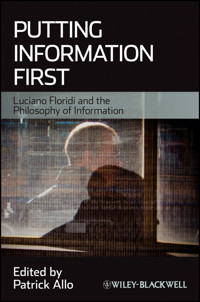
Putting Information First E-Book
21,99 €
Mehr erfahren.
- Herausgeber: John Wiley & Sons
- Kategorie: Geisteswissenschaft
- Sprache: Englisch
Putting Information First focuses on Luciano Floridi's contributions to the philosophy of information. Respected scholars stimulate the debate on the most distinctive and controversial views he defended, and present the philosophy of information as a specific way of doing philosophy. * Contains eight essays by leading scholars, a reply by Luciano Floridi, and an epilogue by Terrell W. Bynum * Explains the importance of philosophy of information as a specific way of doing philosophy * Focuses directly on the work of Luciano Floridi in the area of philosophy of information, but also connects to contemporary concerns in philosophy more generally * Illustrates several debates that arise from core themes in the philosophy of information
Sie lesen das E-Book in den Legimi-Apps auf:
Seitenzahl: 440
Veröffentlichungsjahr: 2011
Ähnliche




















CONTENTS
Notes on Contributors
Chapter 1: Putting Information First: Luciano Floridi and the Philosophy of Information
First Misconception
Second Misconception
The Chapters
Conclusion
Acknowledgments
References
Chapter 2: The Value of Knowledge and the Pursuit of Survival
Signaling Games and Repeated Play
The True Belief Game as a Signaling Game
Nash Equilibria and ESS in the True-Belief Signaling Game
The Value of Knowledge
Appendix
Acknowledgments
References
Chapter 3: Knowledge Transmissibility and Pluralistic Ignorance: A First Stab
1. Pluralistic Ignorance
2. Modal Operator Epistemology
3. Agents and Inquiry Methods
4. Multimodal Systems
5. Knowledge Transmissibility
6. Knowledge Transmissibility and Public Announcement
7. Knowledge Transmissibility and Pluralistic Ignorance
References
Chapter 4: Meeting Floridi’s Challenge to Artificial Intelligence from the Knowledge-Game Test for Self-Consciousness
1. Introduction
2. Preliminaries
3. The Knowledge-Game Quartet
4. AI, Contra Floridi, Can Handle KG4
5. Objections
6. Conclusion
Acknowledgments
References
Chapter 5: Information Without Truth
1. Information and the Veridicality Thesis
2. Information as a Mongrel Concept
3. Natural Information Without Truth
4. Nonnatural Information: The Case for the Veridicality Thesis
5. Nonnatural Information Without Truth
6. An Objection
7. Conclusion
Acknowledgments
References
Chapter 6: Information and Knowledge À la Floridi
Information and Meaning
Information and Knowledge
Acknowledgments
References
Chapter 7: Abstraction, Law, and Freedom in Computer Science
Introduction
Computer Science as the Master of Its Domain
The Concept of Law in Computer Science
Computer Science Laws as Invariants
The Interplay of Freedom and Constraint
Conclusion
References
Chapter 8: Structuralism and Information
Information and Structural Realism
Partial Information and Partial Structures
Partial Structures, Structural Objects, and Informational Structuralism
Conclusion
Acknowledgments
References
Chapter 9: Why Information Ethics must Begin with Virtue Ethics
History, Historicism, and Context
Impartialism and Universalism Within the Limits of Reason Alone
You Can’t See Nothing from Nowhere
Sociopoiesis: Justice Means Competition Is Cooperation
Reverence from the Inside Out
References
Chapter 10: The Philosophy of Information: Ten Years Later
Comments and Replies
Conclusion
Acknowledgments
References
Chapter 11: Philosophy in the Information Age
Two Philosophers of the Information Age
Wiener’s Role in the Birth of the Information Revolution
Wiener on the Nature of the Universe
Digital Physics
Human Nature
Artificial Agents
Wiener on Society in the Information Age
The Philosophy of Information: Floridi’s Ambitious Project
Floridi on the Nature and Goodness of the Universe
Information Ethics
Artificial Agents and Ethics
Human Nature and the Information Society
Concluding Remarks: Comparing Wiener and Floridi
Acknowledgments
References
Index
MHAPHILOSOPHY
METAPHILOSOPHY SERIES IN PHILOSOPHY
Series Editors Armen T. Marsoobian, Brian J. Huschle, and Eric Cavallero
The Philosophy of Interpretation, edited by Joseph Margolis and Tom Rockmore (2000)
Global Justice, edited by Thomas W. Pogge (2001)
Cyberphilosophy: The Intersection of Computing and Philosophy, edited by James H. Moor and Terrell Ward Bynum (2002)
Moral and Epistemic Virtues, edited by Michael Brady and Duncan Pritchard (2003)
The Range of Pragmatism and the Limits of Philosophy, edited by Richard Shusterman (2004)
The Philosophical Challenge of September 11, edited by Tom Rockmore, Joseph Margolis, and Armen T. Marsoobian (2005)
Global Institutions and Responsibilities: Achieving Global Justice, edited by Christian Barry and Thomas W. Pogge (2005)
Genocide’s Aftermath: Responsibility and Repair, edited by Claudia Card and Armen T. Marsoobian (2007)
Stem Cell Research: The Ethical Issues, edited by Lori Gruen, Laura Grabel, and Peter Singer (2007)
Cognitive Disability and Its Challenge to Moral Philosophy, edited by Eva Feder Kittay and Licia Carlson (2010)
Virtue and Vice, Moral and Epistemic, edited by Heather Battaly (2010)
Global Democracy and Exclusion, edited by Ronald Tinnevelt and Helder De Schutter (2010)
Putting Information First: Luciano Floridi and the Philosophy of Information, edited by Patrick Allo (2010)
This edition first published 2010
Originally published as volume 41, no. 3 (April 2010) of Metaphilosophy Chapters © 2010 The Authors
Book compilation © 2010 by Blackwell Publishing Ltd and Metaphilosophy LLC
Blackwell Publishing was acquired by John Wiley & Sons in February 2007. Blackwell’s publishing program has been merged with Wiley’s global Scientific, Technical, and Medical business to form Wiley-Blackwell.
Registered Office
John Wiley & Sons Ltd, The Atrium, Southern Gate, Chichester, West Sussex, PO19 8SQ, United Kingdom
Editorial Offices
350 Main Street, Malden, MA 02148-5020, USA
9600 Garsington Road, Oxford, OX4 2DQ, UK
The Atrium, Southern Gate, Chichester, West Sussex, PO19 8SQ, UK
For details of our global editorial offices, for customer services, and for information about how to apply for permission to reuse the copyright material in this book please see our website at www.wiley.com/wiley-blackwell.
The right of Patrick Allo to be identified as the author of the editorial material in this work has been asserted in accordance with the UK Copyright, Designs and Patents Act 1988.
All rights reserved. No part of this publication may be reproduced, stored in a retrieval system, or transmitted, in any form or by any means, electronic, mechanical, photocopying, recording or otherwise, except as permitted by the UK Copyright, Designs and Patents Act 1988, without the prior permission of the publisher.
Wiley also publishes its books in a variety of electronic formats. Some content that appears in print may not be available in electronic books.
Designations used by companies to distinguish their products are often claimed as trademarks. All brand names and product names used in this book are trade names, service marks, trademarks or registered trademarks of their respective owners. The publisher is not associated with any product or vendor mentioned in this book. This publication is designed to provide accurate and authoritative information in regard to the subject matter covered. It is sold on the understanding that the publisher is not engaged in rendering professional services. If professional advice or other expert assistance is required, the services of a competent professional should be sought.
Library of Congress Cataloging-in-Publication data is available for this book.
9781444338676 (paperback)
A catalogue record for this book is available from the British Library.
NOTES ON CONTRIBUTORS
Fred Adams is professor and chair of Linguistics and Cognitive Science and professor of philosophy at the University of Delaware. He has more than a hundred publications in epistemology, philosophy of language, philosophy of mind, and cognitive science. Among his recent publications is his book Bounds of Cognition (with Ken Aizawa; Wiley-Blackwell, 2008).
Patrick Alio is a postdoctoral fellow of the Research Foundation—Flanders (FWO) who is based at the Centre for Logic and Philosophy of Science at the Vrije Universiteit Brussel in Belgium, and he is also affiliated with the Information Ethics Group (IEG) at the University of Oxford. His research is on the interface between philosophy of logic, formal epistemology, and philosophy of information.
Selmer Bringsjord is professor of cognitive science, computer science, logic, and management at Rensselaer Polytechnic Institute and Director of the Rensselaer AI and Reasoning Laboratory. He specializes in the logico-mathematical and philosophical foundations of AI and cognitive science, and in building AI systems. His books include Superminds (Kluwer), What Robots Can and Can’t Be (Kluwer), Artificial Intelligence and Literary Creativity (with Dave Ferrucci, Erlbaum), Abortion (Hackett), and Soft Wars (Penguin), a novel.
Otavio Bueno is professor of philosophy at the University of Miami. His work focuses on the philosophies of science, mathematics, and logic. He has published articles in Noûs, Mind, Philosophy of Science, Synthese, Australasian Journal of Philosophy, Erkenntnis, Analysis, Journal of Philosophical Logic, and Philosophia Mathematica. He edited, with Øystein Linnebo, New Waves in Philosophy of Mathematics (Palgrave Macmillan, 2009). His work has been funded by the National Science Foundation, among other institutions.
Terrell Ward Bynum is director of the Research Center on Computing and Society and professor of philosophy at Southern Connecticut State University. He has been chair of the Committee on Philosophy and Computers of the American Philosophical Association, as well as chair of the Committee on Professional Ethics of the Association for Computing Machinery. He is a recipient of the Barwise Prize of the APA, the Weisenbaum Award of the International Association for Ethics and Information Technology, and the Covey Award of the International Association for Computing and Philosophy.
Timothy R. Colburn is associate professor of computer science at the University of Minnesota—Duluth. He received his Ph.D. in philosophy from Brown University and his M.S. in computer science from Michigan State University. He has worked as a philosophy and computer science professor, a software engineer, and a research scientist in artificial intelligence for the aerospace and defense industries. He is the author of Philosophy and Computer Science and editor of Program Verification: Fundamental Issues in Computer Science.
Luciano Floridi is professor of philosophy at the University of Hertfordshire (Research Chair in Philosophy of Information and UNESCO Chair in Information and Computer Ethics) and fellow of St Cross College, University of Oxford. In 2010, he was elected fellow of the Center for Information Policy Research, University of Wisconsin. His most recent books are: The Cambridge Handbook of Information and Computer Ethics (CUP, 2010), Information: A Very Short Introduction (OUP, 2010) and The Philosophy of Information (OUP, 2011).
Vincent F. Hendricks is professor of formal philosophy at the University of Copenhagen and Columbia University. He is editor in chief of the journal Synthese, and among his many books are The Agency (forthcoming), Mainstream and Formal Epistemology (2006), Thought2Talk (2006), Formal Philosophy (2005), and The Convergence of Scientific Knowledge (2001).
Gualtiero Piccinini is associate professor of philosophy at the University of Missouri—St. Louis. He works in the philosophy of mind and related sciences. Recent publications include “First-Person Data, Publicity, and Self-Measurement” (Philosophers’ Imprint, 2009), “The Mind as Neural Software? Understanding Functionalism, Computationalism, and Computational Functionalism” (Philosophy and Phenomenological Research, 2010), and “Information Processing, Computation, and Cognition” (with Andrea Scarantino, Journal of Biological Physics, 2010).
Sherrilyn Roush is associate professor of philosophy at the University of California, Berkeley. She is the author of Tracking Truth: Knowledge, Evidence, and Science (Oxford, 2005) and more recently of “Randomized Controlled Trials and the Flow of Information,” “Second-Guessing: A Self-Help Manual,” “Closure on Skepticism,” and “Optimism About the Pessimistic Induction.” Her main current project is on fallibility, self-doubt, and justified belief, which has led to a second-order generalization of Bayesianism that allows us coherently to acknowledge and adjust for information about our unreliability.
Andrea Scarantino is assistant professor of philosophy at Georgia State University. He works in the philosophy of mind, with primary focus on emotions. Recent publications include “Insights and Blindspots of the Cognitivist Theory of Emotions” (British Journal for the Philosophy of Science), “Core Affect and Natural Affective Kinds” (Philosophy of Science), and “Computation vs. Information Processing: Why Their Difference Matters to Cognitive Science” (with Gualtiero Piccinini, Studies in History and Philosophy of Science).
Gary M. Shute is associate professor of computer science at the University of Minnesota—Duluth. He has a B.A. in mathematics from South Dakota State University and a Ph.D. in mathematics from Michigan State University. He has taught a wide variety of computer science courses, including machine organization, computer architecture, operating systems, computer networks, data structures, software engineering, and object-oriented design. More recently, he has focused on understanding the human mind and its ability to make sense of the world.
Richard Volkman is professor of philosophy at Southern Connecticut State University and associate director of the Research Center on Computing and Society. His research evaluates the impact of information technologies on our abilities to lead the good life. Since the relevant information is decentralized, tacit, and local, this project involves articulating individualist moral and political philosophy for the information age and addressing the associated issues, such as intellectual property, identity, privacy, and digital culture.
Chapter 1
PUTTING INFORMATION FIRST: LUCIANO FLORIDI AND THE PHILOSOPHY OF INFORMATION
PATRICK ALLO
This collection of chapters is devoted to Luciano Floridi’s contributions to the philosophy of information. As Floridi explains in his replies near the end of the collection, his own work during the past ten years has been almost co-extensive with the philosophy of information. Some might find this claim problematic. After all, doesn’t the philosophy of information go all the way back to Leibniz? Or shouldn’t we acknowledge the crucial role played by Wiener, Turing, Simon, Dretske, and many other fathers of the philosophy of information? Of course, the informational turn in philosophy cannot be reduced to work done in the past decade, let alone work done by one person (see the epilogue by Terrell Ward Bynum and the concluding section of Floridi’s replies). Yet, what I want to emphasise is that while there has been a clearly discernible informational turn in recent (and not so recent) philosophy, Floridi gave that turn a more radical twist by claiming that taking the informational turn means redefining philosophy. This is why there is a conception of the philosophy of information that Floridi may rightly call his own.
In this introduction, I want to do two things: situate the contributions to this collection in the broader context of the philosophy of information, and say something more general about Floridi’s unique understanding of what the philosophy of information is (or should be). I’ll start with the latter, and then use my sketch of the philosophy of information as a map to situate the various chapters.
Let’s start with an analogy. The philosophy of information is much like the philosophy of probability. The two have similar subject matter, a mathematically well-understood notion, but are stuck with widely divergent and often incompatible interpretations: chances, frequencies, subjective probabilities, propensities, and so on, for the former; qualitative, quantitative, syntactical, semantical, and so on, for the latter. If there is a core notion of information, then that core is composed only of formal properties, with Shannon’s communication theory doing the unifying work. Likewise, classical probabilities satisfy the Kolmogorov axioms, but these do not settle what probabilities are. In both cases, the unification doesn’t immediately extend beyond the logico-mathematical framework. We can expand this analogy even further. The philosophy of probability isn’t just about interpretations but also covers philosophical applications of probability theory like Bayesian epistemology and philosophical issues that arise from the application of probability theory. Similarly, the philosophy of information isn’t exclusively about the concepts of information and computation, it is also concerned with applications of informational and computational methods and models to philosophical problems, as exemplified in this definition by Floridi:
[T]he philosophical field concerned with (a) the critical investigation of the conceptual nature and basic principles of information, including its dynamics, utilisation, and sciences, and (b) the elaboration and application of information-theoretic and computational methodologies to philosophical problems.
(Floridi 2002, 137)
Such applications include, for example, the formulation of an information-based epistemology (Floridi 2006 and forthcoming), the use of the notion of strongly semantic information in an analysis of relevance (Floridi 2008a), and the defence of an informational ontology as a means to resolve a central debate between two brands of structural realism (Floridi 2008b).
So far, the analogy seems quite compelling. When compared to the picture of the philosophy of information that arises from a recent handbook (van Benthem and Adriaans 2008), the analogy is in fact quite accurate. This is because the philosophy of information is most commonly understood as referring either to a number of philosophies of information or to the philosophical study of different formal theories of information. When Floridi refers to the philosophy of information, he has something quite different in mind, something that is at once more specific, larger in scope, and more ambitious. In short, he thinks that there is just one philosophy of information, that it doesn’t apply merely to the study of information in the narrow sense (i.e., the technical notion), and that its ultimate goal is to transform the nature of philosophical theorising. Clearly, the philosophy of probability doesn’t have any of these features. This is why the analogy is instructive. It illustrates where Floridi’s use of the label “philosophy of information” diverges from the generic use of that label. Unless otherwise stated, I use the term “philosophy of information” (PI) in this introduction in the sense intended by Floridi.
Let me illustrate the specificity of PI by means of two common misconceptions about it. Misconceptions about PI often go hand in hand with the objection that there is no such thing as the philosophy of information. This doesn’t mean that all these misconceptions are actually found in print. Though some are inspired by actual opinions, they are better thought of as typical instances of a more general attitude. In most cases, the relevant objections are right about specific features of PI but misconstrue or underestimate the range of the whole enterprise.
Correcting the received view is one thing, but for purposes of situating the different chapters in this collection I need a more positive view of PI. To that end, I describe it along three dimensions: (a) its subject matter, (b) its methods, and (c) the substantial views it propounds. This is already implicit in Floridi’s claim that PI is a mature discipline because it introduces unique topics and original methodologies, and leads to new theories (Floridi 2002, 124).
As we shall see, the chapters in this collection engage PI along one or more of these dimensions. But first let us turn to the misconceptions.
First Misconception
Because there is no agreement on a unified notion of information, there cannot yet be an agreement on what the philosophy of information is. What this objection presupposes is that there is only one reading of “the philosophy of information,” namely, as the philosophy of the one true concept of information. Hence, as long as this unique concept is missing there cannot be a single philosophy of information either.
The real misconception in this case isn’t just the disputable assumption that a unified theory of information is desirable or philosophically fruitful, it is the stronger claim that the unification of a field or discipline like PI should always and exclusively follow from the unification of its subject matter, namely, the concept of information itself. This is highly problematic. Because of an all too narrow identification of PI with its core subject matter, it can only be one of two things: an exceedingly reductive enterprise or an eclectic collection of philosophies of information. Such pessimism is not justified. With regard to its subject matter, Floridi emphasises integration instead of unification: “On the whole, its task is to develop not a unified theory of information but rather an integrated family of theories that analyse, evaluate, and explain the various principles and concepts of information, their dynamics and utilisation, with special attention to systemic issues arising from different contexts of application and interconnections with other key concepts in philosophy, such as being, knowledge, truth, life, and meaning” (Floridi 2002, 137). More important, this quote also emphasises that the search for integration should not exclusively be grounded in the nature of information but should also reflect the uses of the information. That is, it should not only focus on what information really is but also shed light on why information is a cognitively valuable commodity and how the concept of information can play an explanatory role in the sciences. Integration, then, is about showing how different notions of information can play different and often complementary roles, both in our own epistemic and intellectual lives and for the working scientist. Obviously, such integration no longer requires a unified notion of information.
Second Misconception
The informational turn in philosophy is in the first place a trend that cuts across several (often technically oriented) sub-disciplines, especially epistemology and the philosophy of mind and language. So even if we can have an integrated conception of information, this integration will not diminish the fact that there is no single discipline called the philosophy of information. Since the integration is driven by methodological concerns (the use of information as a commodity and as an explanatory notion), PI can only play an auxiliary role. At its best, it is something that will be integrated into normal philosophical theorising. At its worst, it is a passing fashion with no enduring influence.
Whether or not PI will have a lasting influence is something only the future will tell. Yet, if it has any influence, it shouldn’t be reduced to mere methodological recommendations. This is because the methodology of PI comes with more substantial philosophical insights, still methodological in nature but not neutral on substantial issues like the nature and purpose of philosophical theorising. The methodological canon of PI-style philosophy—the method of abstraction, minimalism, and constructionism—is indeed packed with views as to which questions are worth pursuing, and how they should be pursued. Since it would take us too far to show how each of these methods favours particular types of questions and recommends a specific way of answering them, let me make use of an example. Consider the following quote from Popper’s “Epistemology Without a Knowing Subject”: “An objectivist epistemology which studies the third world [the objective content of thoughts] can help to throw an immense amount of light upon the second world of subjective consciousness . . .; but the converse is not true” (Popper 1968, 338).
Given that similar considerations inspire Floridi’s own take on epistemology, we can use this as a proxy for his views. The question we should then ask is where the methodological recommendations end, and where the substantial views about the nature of knowledge begin. This isn’t obvious. Clearly, saying that our theory of knowledge shouldn’t be clouded by mentalistic considerations is a methodological consideration; it can be considered as an application of minimalism to the problem of knowledge. Yet, since it immediately rules out most traditional theories of knowledge, the philosophical import of minimalism exceeds what can be described as mere methodology.
The lesson we learn from this second misconception is that a characterisation of PI in terms of its subject matter and methodological recommendations isn’t entirely adequate. The problem, as we have seen, is that because it underestimates the philosophical import of the methodology of PI, such characterisation cannot account for the radical change PI stands for. With the introduction of new methods and concepts, the nature of philosophy changes as well.
This suggests a three-dimensional characterisation of PI, based on subject matter, method, and substantial views about the aims and purposes of philosophical theorising. Whether or not a substantial view defines the nature of PI is a critical issue. Clearly, not every view defended by Floridi should be situated at the core of PI. In my view, the demand to provide answers rather than analyses (see Floridi’s replies) belongs at the core. By contrast, the much-disputed veridicality thesis (Floridi 2004 and 2005b) belongs to the periphery. It is a crucial part of Floridi’s own work, but not something that defines the kind of theories PI should favour. Somewhere in between, then, we find opinions about what a theory of knowledge should be like, or rather what it shouldn’t be like. I’d like to situate this fairly close to the core, but for most purposes it doesn’t really matter where we draw the line. The point is rather that whatever belongs to the core, and this includes substantial views, shouldn’t be left out of the characterisation of PI.
The Chapters
With the three dimensions of PI in mind, the various chapters in this collection can now be situated relative to how they engage with PI. Some focus on specific topics within it, others adhere to its methodology or specifically challenge views previously defended by Floridi. But most engage with PI along multiple dimensions at the same time. This is the most fruitful approach.
The two chapters in the section on knowledge, by Roush and Hendricks, respectively, do not really challenge Floridi’s work as such but make independent contributions to PI. This is primarily because they adhere to methods that are “minimalist” without being simplistic. Hendricks does so within his own distinctive approach of modal-operator epistemology, and presents the problem of pluralistic ignorance within that setting. The distinctive feature of his approach is the view that knowing doesn’t merely require information; it also requires the ability to process it. Roush, by contrast, uses the idea of the knowledge game (Floridi 2005a) to show how knowledge can be more valuable than mere true belief. She combines Lewis’s signalling games with considerations about evolutionary stable strategies to show that at least a tracking account of knowledge does not face the so-called swamping problem.
Bringsjord picks up the theme of the knowledge game as well, but sticks to its original purpose: showing how one can know that one is not a zombie. By taking the idea that the question “How do you know you’re not a zombie?” is best answered in terms of passing a test, he implicitly subscribes to the methodological assumptions on which Floridi has relied. By being more optimistic about the prospects of artificial intelligence (AI), with a proof to support the claim that logic-based AI could pass Floridi’s most elaborate test, Bringsjord also challenges Floridi’s own views.
The next two chapters engage PI at its traditional core: the concept of information and its relation to knowledge. Scarantino and Piccinini take a new look at what is perhaps Floridi’s most debated view: the suggestion that semantic information is by definition truthful, a view previously defended by Dretske and Grice. Dretske warns that “the tendency in computer science to construe information as anything—whether true or false—capable of being stored on a hard disk is to confuse non-natural meaning (or perhaps just structure) with genuine information. It leaves it a mystery why information should be thought a useful commodity” (Dretske 2009, 383). Scarantino and Piccinini, however, take the distinction between natural and non-natural meaning precisely as their starting point, and argue for a more refined view of semantic information, one that is closer to what cognitive scientists have in mind. Adams initially stays close to Floridi’s analysis of information, and its place within the informational turn in philosophy, by comparing his analysis of “being informed” with the distinctive rejection of closure we find in Dretske’s theory. That’s only one part of Adams’s chapter, which also engages the symbol-grounding problem and questions the stringent constraints Taddeo and Floridi 2005 imposed on any solution to that problem.
Colburn and Shute work in the philosophy of computer science, and in their contribution to the collection they use the notion of a law, as it is used by computer scientists (i.e., as invariant), to investigate two aspects of Floridi’s work. The first is purely methodological, namely, the method of abstraction; the second is more substantial, namely, the notion of a purely computational or informational reality. In both cases, Colburn and Shute reveal close connections and draw our attention to points at which Floridi’s use of these notions diverges from their mainstream use in computer science.
Bueno’s contribution also deals with the idea of an informational reality, but approaches it from the perspective of structural realism (as it is presented in Floridi 2008b). The main question Bueno asks has to do with how Floridi’s proposal leads to a realist position. His answer is based on an alternative proposal: using partial structures and the notion of quasi-truth. The upshot of the proposal is that ontic and epistemic structuralism can still be reconciled, but that an empiricist reading becomes available as well.
Finally, Volkman discusses an aspect of Floridi’s work that has already been a topic in a collection on Floridi (Ess 2008) but could hardly be omitted here: information ethics. In Volkman’s view, the valuable part of information ethics is its emphasis on good construction, and the disputable part is the value it accords to impartiality and the emphasis on foundations. This is why, according to Volkman, information ethics may learn some valuable lessons from virtue ethics.
Conclusion
By way of conclusion, I’d like to do two things. First, recommend the final chapter, by Terrell Ward Bynum, which serves as an epilogue for this collection and is the perfect complement to the specific points I’ve tried to make in this introduction. And second, emphasise once more what I think is the real challenge for the philosophy of information: namely, to have a concrete and lasting influence by engaging the philosophical community at large, and to avoid either becoming a narrow subfield—a philosophy of the concept of information—or ending up as a set of methodological recommendations devoid of real philosophical substance.
Acknowledgments
I would like to thank everyone who contributed to the successful completion of this project, including all the contributors and referees and the editorial team of Metaphilosophy, and Wiley-Blackwell. Special thanks go to Otto Bohlmann for his patience and logistical support during the final stages.
References
Dretske, Fred. 2009. “Information-Theoretic Semantics.” In The Oxford Handbook of the Philosophy of Mind, edited by Brian McLaughlin, Ansgar Beckermann, and Sven Walter, 318–93. Oxford: Oxford University Press.
Ess, Charles, ed. 2008. Luciano Floridi’s Philosophy of Information and Information Ethics: Critical Reflections and the State of the Art, special issue of Ethics and Information Technology 10, no. 2.
Floridi, Luciano. 2002. “What Is the Philosophy of Information?” Metaphilosophy 33, nos. 1–2:123–45.
——. 2004. “Outline of a Theory of Strongly Semantic Information.” Minds and Machines 14, no. 2:197–222.
——. 2005a. “Consciousness, Agents and the Knowledge Game.” Minds and Machines 15, nos. 3–4:415–44.
——. 2005b. “Is Information Meaningful Data?” Philosophy and Phenomenological Research 70, no. 2:351–70.
——. 2006. “The Logic of ‘Being Informed’.” Logique & Analyse 49, no. 196:433–60.
——. 2008a. “Understanding Epistemic Relevance.” Erkenntnis 69, no. 1:69–92.
——. 2008b. “A Defense of Informational Structural Realism.” Synthese 161, no. 2:219–53.
——. Forthcoming. “Semantic Information and the Network Theory of Account.” Synthese.
Popper, Karl R. 1968. “Epistemology Without a Knowing Subject.” In Logic, Methodology and Philosophy of Science III, edited by B. van Rotselaar and J. F. Staal, 333–73. Amsterdam: North-Holland.
Taddeo, Mariarosaria, and Luciano Floridi. 2005. “Solving the Symbol-Grounding Problem: A Critical Review of Fifteen Years of Research.” Journal of Experimental and Theoretical Artificial Intelligence 17, no. 4:419–45.
van Benthem, Johan, and Pieter Adriaans. 2008. Handbook on the Philosophy of Information. Amsterdam: Elsevier.
Chapter 2
THE VALUE OF KNOWLEDGE AND THE PURSUIT OF SURVIVAL
SHERRILYN ROUSH
In honor of Luciano Floridi, for his leadership in bringing information theory to epistemology
It is thought that externalist views of what knowledge is—that do not require conscious access to reasons and arguments but only certain relations in which a person’s belief must stand to the world—have trouble explaining why knowledge is more valuable than mere true belief. Justificatory arguments are intrinsically valuable, some say, but what additional epistemic worth could another relation of your belief to the external world have if the belief already has the relation of being true? (Swinburne 1999, 2000, Kvanvig 2003)
Lesen Sie weiter in der vollständigen Ausgabe!
Lesen Sie weiter in der vollständigen Ausgabe!
Lesen Sie weiter in der vollständigen Ausgabe!
Lesen Sie weiter in der vollständigen Ausgabe!
Lesen Sie weiter in der vollständigen Ausgabe!
Lesen Sie weiter in der vollständigen Ausgabe!
Lesen Sie weiter in der vollständigen Ausgabe!
Lesen Sie weiter in der vollständigen Ausgabe!
Lesen Sie weiter in der vollständigen Ausgabe!
Lesen Sie weiter in der vollständigen Ausgabe!




