


18,49 €
Mehr erfahren.
- Herausgeber: The Crowood Press
- Kategorie: Wissenschaft und neue Technologien
- Sprache: Englisch
West Somerset is an area of great geological diversity, straddling the Tees–Exe Line between highland and lowland Britain. The story of the last 400 million years of Earth history can be gleaned from its rocks: the opening and closing of oceans, the collision of continents and a journey across the Equator. The area may also provide the key to settle the controversy about the origin of South-West England, whose ancient geology is so different from the rest of the country. This unique and diverse geology is also the reason why it is one of the most beautiful and varied stretches of landscape in England. With nearly 170 illustrations, including maps, charts, diagrams and colour photographs, this book describes and explains the evidence for the geological history of the area, from the Palaeozoic, through the Mesozoic to the Pleistocene and Holocene. Regional guides, which discuss the factors that led to the landscape we see today and offer places of interest to visit, cover: the Northern Brendon Hills and Minehead; the Southern Brendon Hills; Wellington and the Blackdown Hills; Wiveliscombe and the Vale of Stogumber; the Quantock Hills; West Somerset coast and the Cannington and Bridgwater Lowlands.
Das E-Book können Sie in Legimi-Apps oder einer beliebigen App lesen, die das folgende Format unterstützen:
Seitenzahl: 294
Veröffentlichungsjahr: 2022
Ähnliche



















The Quantocks and North Somerset Coast
LANDSCAPE AND GEOLOGY
Morte Slates with terminal curvature at Winslade Wood in the Upper Exe Valley.
The Quantocks and North Somerset Coast
LANDSCAPE AND GEOLOGY
Dave Green
First published in 2022 by
The Crowood Press Ltd
Ramsbury, Marlborough
Wiltshire SN8 2HR
www.crowood.com
This e-book first published in 2022
© David Green 2022
All rights reserved. This e-book is copyright material and must not be copied, reproduced, transferred, distributed, leased, licensed or publicly performed or used in any way except as specifically permitted in writing by the publishers, as allowed under the terms and conditions under which it was purchased or as strictly permitted by applicable copyright law. Any unauthorised distribution or use of this text may be a direct infringement of the author’s and publisher’s rights, and those responsible may be liable in law accordingly.
British Library Cataloguing-in-Publication Data
A catalogue record for this book is available from the British Library.
ISBN 978 0 7198 4044 9
Acknowledgements
Before starting this project, I had no idea how much time and effort would go into it, some of it difficult, but most of it, particularly the research, was so stimulating, like a voyage of discovery.
My skills, especially those associated with computing, were not well developed when I started, despite the efforts of Gerry Calderbank to teach me the arts of digital drawing, some of which I remembered. Special thanks must go to Sue Price, who was responsible for transforming the vast majority of the artwork and photography into high-quality digital format, as well as taking many of the photographs. Special thanks, too, to Faith Back, who deployed her professional proof-reading talents to correct my many errors, inconsistencies and lack of clarity. Email conversations with Jonathan Turner and Rob Strachan helped to clear up some of the arguments of interpretation. The staff at BGS (Simon Harris and Stephen Parry) were especially helpful in providing the thin section images on pages 102T, 106T, 107BL, 110 and 137T.
Somerset is not my home, so many visits were made to carry out research, as well as a great deal of online activity, especially in the current circumstances. This was greatly facilitated by the people, librarians, society organizers and landowners of West Somerset, who must be thanked wholeheartedly for their friendliness, helpfulness and cooperation.
Note: Locations in this book are given as Ordnance Survey grid references, prefixed by the letters of the relevant 100km grid squares, ST or SS.
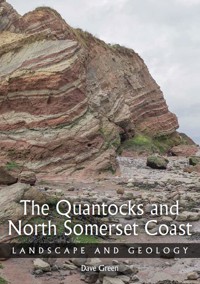
Front cover: Folded Mercia Mudstones at Splash Point, Watchet.
Cover design by Maggie Mellett
Contents
Introduction
1. Geology and Scenery in West Somerset
Geological History
2. The Palaeozoic – Over the Equator for the Great Collision
3. The Mesozoic – North to Hot Deserts and Tropical Seas
4. Evolution of the Modern Landscape
Regional Guides
5. Northern Brendon Hills and Minehead
6. Southern Brendon Hills
7. Wellington and the Blackdown Hills
8. Wiveliscombe and Vale of Stogumber
9. The Quantock Hills
10. The West Somerset Coast
11. Cannington and Bridgwater Lowlands
Further Reading
Index
CHAPTER 1
Geology and Scenery in West Somerset
For the purposes of this book, I am taking West Somerset to mean (very approximately) the area covered by a rectangle between the towns of Minehead, Bridgwater, Taunton and Dulverton. It covers the Bridgwater lowlands, the Vale of Taunton Deane including the Blackdown Hills escarpment and Wellington, the Quantock Hills (designated the very first Area of Outstanding Natural Beauty, in 1957), the Vale of Stogumber, the Brendon Hills and the Exe valley, the Vale of Porlock, the Cleeve lowlands around Minehead and the hills around that town.
It is an area of great contrasts in both geology and the scenery related to it. Inland, there are the uplands of the Quantocks and Brendon Hills, founded on tough, ancient, twisted and partly metamorphosed Devonian rocks, the two hill ranges being separated by the lush and fertile Taunton to Williton valley, eroded into bright red New Red Sandstone laid down in the hot deserts of the Permian and Triassic Periods. It is so strange that this distinctive sheltered vale, with its beautiful, warm stonebuilt villages and sunken lanes, has no formal name, beyond being a northern extension of the Vale of Taunton Deane. Many commercial organizations are starting to use the term ‘Quantock Vale’, but there is an older term, used by A.N. Thomas in his 1940 geological paper on the Triassic rocks: the ‘Vale of Stogumber’. The southern boundary is framed by the imposing escarpment of the Blackdown Hills, composed of silica-rich sediments deposited much later, in the Cretaceous Period.
Looking east from Coombe Cross, near Monksilver. This view shows the northern end of the Vale of Stogumber and the Watchet coastal lowlands towards the north Quantocks and Hinkley Point. The observer is standing on Morte Slates (foreground soil stained red by the former cover of New Red Sandstone) looking down into the gently undulating lowlands, composed of Permian and Triassic rocks. Much of the farming is arable.
A sketch of the topography of West Somerset. Comparison with the geological map should reveal close correlations, such as the contrast between the resistant Palaeozoic and much weaker Mesozoic rocks; also areas where there is little relationship, such as the Brendon Hill plateau, cut across a variety of rock units.
Simplified geological map of West Somerset (OPPOSITE PAGE), and a sketch to show the geology and scenery between Wiveliscombe and Nether Stowey looking north-west along the Vale of Stogumber, with the contrast between the strong Palaeozoic rocks of the Quantock Hills and the weaker Mesozoic rocks of the Vale.
On the coast, late Triassic and early Jurassic sedimentary rocks laid down in a shallow tropical sea around 200 million years ago form the majority of this spectacular cliffed shoreline. Inland, the same rocks form the Cleeve Lowlands, east of Minehead, and the rolling country between East Quantoxhead and Combwich. The exceptions to this are lowlying areas, especially around Bridgwater, that were drowned by the rise of the sea level as the last Ice Age waned and have been reclaimed by drainage schemes over the centuries. These areas have a veneer of recently deposited sediment dating from the last 10,000 years – the Holocene Period – and are extremely flat.
Not all of the scenery of the area is related to underlying rock types; for many millions of years, the Bristol Channel has been an active tectonic zone. As we shall see, some geologists believe it was a crustal scale fracture akin to the famous San Andreas Fault in California, but we know that there are thick Triassic and Jurassic sediments under the channel, laid down in a sinking graben (or rift valley) between faults aligned east to west along the channel. At various times in the last 300 milliom years, the faults have woken into reactivation, causing earthquakes and shattering rocks along the line of the faults. On land, the fault zones have brought rocks of different resistance next to one another (such as the Cothelstone Fault), providing the locus for intense erosion along the narrow zone of broken and weakened rock to form straight deep valleys (the prime example being along the Monksilver Fault), and have allowed some areas to rise and start to be eroded, and some areas to sink, in some cases below sea level. All of the rocks of the area have had sets of cracks (joints) imposed upon them, due to the stresses exerted during these episodes. These have had a profound impact, best visible where the rocks are completely exposed, along the coast.
West Somerset Geology and People
The economy and settlement of the region is also closely related to the underlying geology. The older and more resistant rocks of the uplands have long been exploited for building materials. These include the metamorphic slate of the Oakhampton (Morte Slates) and Treborough (Ilfracombe Slates) quarries, once used for flooring and fireplaces, as well as roofing and walling, but now mainly infilled; and the hard quartzitic sandstones such as the Pickwell Down Sandstone in Wiveliscombe, or the Hangman Grit exploited at West Quantoxhead, used for building stone and latterly as aggregate for tracks, roads and concrete. The weaker New Red Sandstone of the Vale is more easily worked and has been extensively used as building stone, though it is sometimes more susceptible to weathering than the stronger Devonian rocks.
The Blue Anchor Fault (described in Chapter 10).
Bricks and tiles have been made from Triassic Mercia Mudstone in Minehead, Wellington and Taunton, as well as some smaller yards such as Blue Anchor and Wiveliscombe (where Aylesbeare Mudstone was used), and in Bridgwater, where modern alluvial clays were dug. On the coast, harder Triassic and Jurassic limestones have been used for building, producing distinctive pale-grey to cream-coloured buildings.
In the absence of extensive glaciers and their far-travelled load, the soils of the region, and thereby the use to which the land is put, are derived from the local underlying rocks. The harder quartz-rich sandstones of the uplands break down very slowly and do not contain a good supply of elements such as calcium to counteract the acidifying effect of high rainfall and downward leaching of soil nutrients. Consequently, soils are thin, stony, acid and poor in nutrients, producing moorland vegetation of heather, gorse, bracken and coarse grasses used mainly for extensive grazing and often nowadays almost abandoned by agriculture in favour of recreation and forestry.
The Southern Brendon Hills, viewed from the main Brendon Ridge, looking south. The geology is the Upper Morte Slates, forming high ground and used for grazing. The accordance of summit heights suggests that this area was once a plain near sea level that has been uplifted to form a plateau, which was subsequently cut by deeply incised river valleys – here the upper tributaries of the River Tone.
Vernacular architecture in Wiveliscombe. This house, towards the west of the town, is constructed of Pickwell Down Sandstone, a hard-wearing building stone with a distinctive red-purple colour, probably quarried in Alps Quarry, 200m west. Roofing and flooring (and some building stone) came from Oakhampton quarries to the north, working the Upper Morte Slates.
Vellow Pottery. A cordwainer’s house built in the 1830s in the Vale of Stogumber, with older outbuildings. It has been used as a hay barn, a blacksmith’s and, since the 1960s, a pottery. It is constructed from Budleigh Salterton Pebble Beds, a warm red rock mostly made of angular fragments of mainly local Devonian slates and sandstones. The roof was originally covered with slate from Treborough.
Pebble Beds and sandstone used in construction of the Pottery. The cementing sandy matrix is commonly lime-rich, making it soft enough to allow dressing to produce blocks like these. The fragments now stand proud from the matrix that has been chemically weathered.
The mudstones of the upland areas, now metamorphosed to slates, such as the Ilfracombe and Morte Slates, produce less high ground, form thicker soils and retain water, impeding leaching. Consequently, they are mostly farmed, the majority being under permanent pasture and the better drained districts used for arable crops. The tendency towards acid soils in these wet upland areas can be rectified using lime (calcium carbonate), an alkaline substance produced today by crushing limestone, but in the past, without crushing machinery, the easiest way was by ‘burning’ or calcining limestone by heating it to over 850°C in a limekiln with wood and/or coal to drive off carbon dioxide and produce quicklime (calcium oxide) powder. When spread on to the soil, the quicklime was ‘slaked’ back to calcium carbonate by taking up water from the soil and carbon dioxide from the atmosphere. Something of a fad in the eighteenth and nineteenth centuries, the repeated application of these caustic alkaline substances eventually destroyed the soil fauna, therefore also humus production and leading to loss of fertility. A German adage from the late nineteenth century says ‘Lime lime and nothing more, makes fathers rich and sons poor’.
Another major use for quicklime was in the production of lime mortar and for whitewashing buildings. The main source for lime in this area was thin, often impersistent limestones (four or five bands) interbedded with slates in the Ilfracombe Slate of Middle Devonian age, particularly the Rodhuish, Roadwater, Aisholt, Holwell and Leigh Barton Limestones. They were dug in numerous small quarries and burnt in limekilns built nearby in the distinctive, elegant, Somerset style.
The engine house at Burrow Farm Iron Mine high on the Brendon Ridge. The only engine house (housing a beam engine for pumping out the mine and lifting ore) to have survived in the Brendon Hill iron field, but strangely it and its machinery were moved here from Langham Hill mine in 1879, after Burrow Farm had closed in 1868.
Stratigraphic table of the various beds exposed at outcrop in West Somerset.
Farming in the lower ground of the area benefits from a milder and more sheltered climate, gentler slopes and thicker soils derived from Triassic and Jurassic rocks, which break down more easily and often contain calcium carbonate in the form of lime cement holding the rock particles together (such as the Vexford Breccia, or the Mercia Mudstone), limestone itself (such as the Jurassic Blue Lias in the north eastern coastal area, or the Carboniferous Limestone of the Cannington area), or as limestone pebbles in a conglomerate (the Budleigh Salterton Pebble Beds). Slow release of such lime, during the normal breakdown of the underlying rock to form soil, is responsible for the ‘sweeter’ (less acidic) soils in these areas, which have a majority of land devoted to arable cultivation. In addition, quarrying of limestone is still a major activity at Cannington and there used to be a widespread industry throughout the Vale of Stogumber in quarrying the pebbles from the Budleigh Salterton Pebble Beds, producing quicklime in a host of limekilns.
Other industries using geological resources have been important in the past, notably the iron industry based on goethite (iron oxide) and siderite (iron carbonate), supposedly from Roman times and especially in the mid to late nineteenth century, won from veins in the Morte Slates on the Brendon Ridge. Iron ore in this later phase was exported via a tramway, including a huge incline down the north flank of the Brendon Ridge, to Watchet and thence by sea to South Wales, where it was smelted by the Ebbw Vale Company. Copper found in the Roadwater Limestone and Otter Sandstone at Dodington, east of Nether Stowey, was worked in a number of underground mines from the eighteenth century until 1822.
CHAPTER 2
The Palaeozoic – Over the Equator for the Great Collision
Geology deals in extremely large numbers as far as history is concerned: the oldest rocks exposed at the surface in West Somerset are the Lynton Formation, named obviously from their extensive outcrop around the Devon town, but only found in our district at the foot of the Quantock escarpment between Crowcombe and Triscombe, where they appear from below the younger Hangman Sandstone Formation.
The Lynton Formation is mainly slates – originally mudstones and siltstones, containing clay that metamorphosed to mica (a shiny, silvery, sheet-like mineral that used to be used for the front windows of stoves before the invention of heat-resistant glass) and quartz due to heat (about 250–350°C) and pressure (the equivalent of being buried beneath about 7000m of rock) during a continental collision. Radiometric dating of the mica would give a date of about 310 Ma (million years ago), but that is the date of metamorphism, not the date of the laying down of the mud and silt on the sea floor, which happened some 90 Ma earlier.
How We Date Sedimentary Rocks
We cannot directly date sedimentary rocks such as mudstones or sandstones, because the particles from which they are made were eroded from earlier rocks. But they do contain fossils – for example the Lynton Formation contains some crinoid fragments (sea lilies), bivalve molluscs, including early mussels, and other shellfish (brachiopods), which, though much distorted by the heat and pressure, have survived to indicate their place (and of the rock in which they are found) in the evolution of life and hence their relative age compared to older or younger fossils. Geologists, in the nineteenth century in particular, worked out the order in which fossils appeared and assigned names to the periods of time typified by distinctive species of fossils, in this case the Devonian Period, which has very distinctive fossils compared with the older underlying Silurian Period and with the younger overlying Carboniferous Period. The periods are then divided into even smaller units by the less dramatic appearance and disappearance of fossil species within them; the Lynton Formation was deposited in the transition between the Emsian and Eifelian stages of the Devonian (see table on page 13).
Even smaller units of time, known as zones, are assigned on the basis of a particular collection of key (or zone) fossils. The system, using fossils, is followed throughout the world and it only takes one place where volcanic rocks were erupted on to new sediment to enable a radiometric date to be assigned to that sediment and hence to that part of the relative timescale based on fossil evolution.
For these reasons, we believe that the Lynton Slates were deposited as mudstones in a relatively offshore, quiet water (to allow fine mud to settle at depths below the base of the waves), marine (brachiopods and crinoids are marine organisms today) environment at about 400 Ma in the middle of the Devonian Period. Based on the principle of superposition (that younger layers of sediment were laid down on top of older), the rock layers can be grouped into rock units of similar sediments and placed in order, as in the Table on page 13.
Devonian Geography: Tropical Seas, Arid Coastal Plains
What was the geography of the area 400Ma ago? This is a vexed question, with some disagreement between geologists.
When we look south today, across the Dartmoor Granite and the wide outcrop of Carboniferous sediments, the Middle Devonian sediments in south Devon are a complex mixture of shallow-water limestones, including reefs of coral and colonial sponges, and deeper water mudstones, together with volcanic lavas and ashes. This has recently been reinterpreted as a foundered edge of the northern continent of Avalonia, dropping southwards into a narrow (approximately 100km) ocean, the Rheno-Hercynian (from Rhine River and Harz Mountains in Germany). This opened between Avalonia and a southern continental fragment, Armorica, which was once, like Avalonia, part of the supercontinent of Gondwana. The stretching accompanying this caused the crust to split and large slices to founder southwards and rotate along east–west trending faults, the upstanding edges of which were shallow enough to allow reefs to grow and limestones to accumulate, with the intervening troughs receiving muddy sediment. The stretching and thinning allowed pressure to drop on the hot underlying mantle, reducing its melting point and producing magma, which made its way towards the surface by means of the faults.
World palaeogeography in Devonian and Permian times. This diagram, based on palaeomagnetism and distribution of fossils, shows the position of continents (grey) and oceans (pale blue). The dark blue lines are modern shorelines, present only to locate different parts of the world.
Even further south in southern Cornwall there are the remains of a fraction of the Rheno-Hercynian ocean floor and underlying mantle (The Lizard), together with muddy sandstones (greywackes) and shales deposited on that ocean floor in what is known as the Gramscatho Basin. Also deposited here was a vast underwater landslide deposit (or melange), including big blocks of older rocks (especially quartzites of Ordovician age containing trilobites), nowhere exposed in Cornubia but possibly forming part of what lies hidden beneath the Devonian.
To the south, mainly below the English Channel, but exposed at Old Lizard Head and on the Eddystone Rocks, are crystalline igneous and metamorphic rocks, again of Devonian age. Very similar rocks of the same age and arrangement are found to the east in the ‘type’ area in Germany – the Rhenische Schiefergebirge and the Harz Mountains, but much further south than Cornwall and Devon.
Looking north across the Bristol Channel, which has thick Mesozoic (Triassic and Jurassic) sediments covering the older rocks, we find that sediments of equivalent age in South Wales (and most of England) are missing. Upper Devonian rests directly on Lower Devonian, a situation known to geologists as an unconformity, indicating a considerable period (up to 25 Ma, that is, the whole of the Middle Devonian), during which the area was uplifted and eroded – in other words, it was land. This is supported by the types of sediment found below and above the unconformity, for example red sandstones, conglomerates and mudstones, with limestone ‘hard-pans’, or calcretes, formed in the soil by evaporation of groundwater. These sedimentary rocks are collectively known as the Old Red Sandstone, which contain fossils of early plants and freshwater fish and structures that indicate they were deposited from water flowing south in a semi-arid environment. The cause of the uplift was the Acadian Orogeny, traditionally ascribed to the meeting between England (on Avalonia) with Scotland (on Laurentia).
In Somerset and North Devon, the Middle Devonian Lynton Formation Slates are overlain by a very thick (up to 2500m) sequence of purple, grey and green sandstones, with some conglomerates and red mudstones. These constitute the Hangman Sandstone Formation, which, like the Old Red Sandstone in South Wales, contain structures suggesting deposition from rivers flowing south, presumably from the area uplifted to the north and thus under erosion. In turn, they are overlain by the Ilfracombe Formation, comprising mainly mudstones (now often slates), with several important limestones containing corals, crinoids and brachiopods, indicating a shallow, quiet marine environment.
Ways to Interpret the Evidence
A Normal Shoreline
For many years, the accepted explanation for all this was that the southern shoreline of Avalonia (now southern Britain, northern France, the Low Countries and northern Germany, together with southern Newfoundland, Nova Scotia), which, like Baltica (Scandinavia and Russia west of the Urals), had earlier collided with Laurentia (North America and Greenland with Scotland and Northern Ireland) and in the Devonian lay roughly along what is now the Bristol Channel. The shoreline migrated north during periods of relatively high sea level/low land level (for example, the Lynton Formation and Ilfracombe Formation) and retreated south during periods of low relative sea level (for example, during the deposition of the Hangman Sandstone and the Pickwell Down Sandstone). So, South Devon was permanently under the sea and South Wales permanently a semi-arid land surface, with Somerset and North Devon occupying the coastal zone. This, of course, assumes that the Bristol Channel is a later feature, to allow south-flowing rivers to transport their load towards the sea.
A reconstruction of south-west England and South Wales in the Devonian Period. The usual environmental interpretation – with alternating marine and terrestrial sedimentary deposits depending on sea level – along with the up-to-date model of the foundered northern margin of the narrow Rheno-Hercynian Ocean. If the strike-slip movement on the Bristol Channel – Bray Fault is accepted, then it would not be South Wales providing sediment from the north, but the Belgian Ardennes!
Pretannia
Several pieces of evidence from the rocks have called this interpretation into question. First, within the Hangman Sandstone Formation, there are some layers of conglomerate (in the Brendon Hills, the Rawns Member; and in the Quantocks, the Hodders Combe Member – see table on page 13), which contain angular and subangular pebbles (that is, not rounded by lots of impacts with other stones and therefore interpreted not to have travelled very far) of rocks that are not found in South Wales and in fact are found there as fragments in Devonian conglomerates (Ridgeway in Pembrokeshire, Llanishen near Cardiff and Woodhill Bay, Portishead, near Bristol), associated with structures indicating a flow of water from the south. The Old Red Sandstone in South Wales contains abundant garnets, a hard and resistant mineral associated with metamorphic rocks, but the Hangman Sandstones contain hardly any, a strange occurrence if there was a direct link by river. In conclusion, this sedimentary evidence suggests that there was a land area exposing and eroding Precambrian and Lower Palaeozoic rocks, situated where now is the Bristol Channel (dubbed the ‘Bristol Channel land mass’, or, more lyrically, Pretannia, after the first name given to Britain by a fourthcentury BC Greek geographer, Pytheas).
The Lower to Middle Devonian model of a Bristol Channel land mass (Pretannia). This model is an attempt to explain the contradictory evidence regarding the origin of the Hangman Sandstone and the Pickwell Down Sandstone in relation to the traditional explanation of a Welsh source.
This area must have been fairly large and must have been actively uplifted to generate abundant sediment (1000–2500m of Hangman Sandstones) deposited by rivers; something that cannot be said for the present, relatively narrow distance between South Wales and Somerset. However, if the north–south compressional folding and thrust faulting that took place at the end of the Carboniferous, due to the collision between Laurussia and Gondwana – the Variscan Orogeny – is taken into account, it has been calculated that the width of the Bristol Channel area has been shortened by two to three times, producing a not inconsiderable area for a range of mid-Devonian hills.
SW England Moves 400km North-West
A possibly more credible explanation for this can be determined by looking at the wider picture. The types of rock in the south-west peninsula, laid down during the Devonian and Carboniferous periods, have little in common with those of the same age in the rest of England and Wales and do not show any effects of the early to mid-Devonian Acadian Orogeny. The latter was a collisional event that folded rocks in Wales, the Lake District and beneath East Anglia, and produced slates by metamorphosing sediments largely composed of clay. In South Wales, the area was uplifted and no sediments were deposited, whereas in the south-west, deposition continued throughout, indicative of the area sinking to make room for more and more sediment.
However, there are great similarities between the geology of Cornwall, Devon and Somerset and the Rheno-Hercynian zone of Germany and Belgium, exposed in the Harz Mountains, the Rhenische Schiefergebirge and the Ardennes (and also South Portugal), in terms of the sediments and their fossils, age and structures. This includes the inferred position of the Rheno-Hercynian Ocean, shown by the position of the join, or suture, where the two sides eventually collided to close the ocean. On a present geological map of Europe, south-west England does not match up with the main area in Europe. This situation can be corrected by bending the tectonic zones to fit, but there may be a more audacious and speculative solution.
Comparison of the Palaeozoic rocks found either side of the Bristol Channel – Bray Fault.
One of the strangest sections of West Somerset geology lies just to the west of Bridgwater at Cannington, where a large quarry (Cannington Park) exploits typical Carboniferous Limestone, similar to that found in the Mendips, the Avon Gorge and throughout South Wales. This contains typical Lower Carboniferous (Mississippian) fossils, mainly corals and brachiopods, entombed in oolitic and finegrained limestones typical of shallow, clear tropical seas with reefs, lagoons and shifting oolith banks. Boreholes suggest a very similar sequence of limestones to the Mendip area, with possible underlying Old Red Sandstone at the base. It is difficult to determine the exact nature of the geology here because the older Palaeozoic rocks are blanketed by a cover of Triassic rocks deposited well after the Variscan collision on to a low hilly land surface not unlike today’s scenery (except that it was a hot desert!).
A number of the low hills to the west of Bridgwater are made of Palaeozoic rock and were hills in Triassic times, at around 200 Ma, now appearing on the geological map as inliers, protruding from beneath the surrounding cover of younger rocks. Five such inliers around Cannington are of Dinantian age (named for Dinant on the River Meuse in Belgium), in this case the Cannington Limestone, or the overlying Namurian age (named from Namur, also on the Meuse) – in this case the Rodway Siltstone. Although highly fractured and disturbed, these rocks are not metamorphosed, unlike the nearest rocks of the same age exposed as narrow east–west ridges near Dulverton, which are deep-water cherts, formed by the accumulation of millions of planktonic organisms (radiolarians), which made their shells out of silica (that is, quartz) and shales, now metamorphosed to slate, which form the intervening valleys.
Back in the Cannington district, less than a mile from the Carboniferous inliers, are two inliers of Devonian rocks: Pigs Hill, south of the Cottage Inn on the A39, which exposes slates of the Ilfracombe Formation; and Charlynch Hill, lying to the east of the village and exposing Morte Slates. The inference must be that this is a major boundary trending northwest to south-east, which not only displaces the rocks vertically (middle Devonian rocks are at the same level as Lower Carboniferous), but also horizontally. To the south-west are rocks of Devonian and Carboniferous age that are typical of the Rheno-Hercynian zone of the Variscan fold belt, whereas to the north-east are rocks of Devonian and Carboniferous age that are typical of the rest of England and Wales – Old Red Sandstone and Carboniferous Limestone, that lie upon the old Avalonian continent, well to the north of the Rheno-Hercynian zone.
Reconstruction of the geography of Western Europe before 400km of dextral movement on the Bristol Channel Bray Fault. This sketch attempts to give an idea of the position of south-west England before Carboniferous movement to its present position. This has been done by matching up key indicators each side of the fault, particularly the Rheno-Hercynian Ocean suture – the line along which the two continental sides of the ocean met as it closed.
This boundary is the Bristol Channel – Bray Fault, running along the Bristol Channel, turning south-east through Cannington, along the Solent, across the Channel to Dieppe, south-east through Beauvais, north of Paris, then east, finishing at Vittel, south of Nancy, a distance of 700km. By matching rock types and structural zones on either side of the fault, it can be seen that southwest England has moved north-west by up to 400km from its original position in the Devonian/Carboniferous (when Taunton, if it had existed then, would have been right next to the town of Beauvais, 100km south-east of Dieppe, 60km south of Amiens!). This, of course, raises the question as to what lay 400km to the north, on what is now the south side of the Bristol Channel, opposite Wales. There is now no problem in there being a sizeable land mass (Pretannia?) there, which could have supplied both north and south with sediment, but there is no trace of it today, since, as the south-west peninsula moved north, it would have moved west along the fault line and may now be found under the Celtic Sea, south of Ireland!
Note Although this explanation has much to recommend it, there seems little evidence of the existence of such a major feature from subsurface exploration by geophysics, particularly the use of artificial earthquakes to produce seismic images. The dominant structures shown on these are east–west trending thrust faults, dipping south and transporting thrust sheets northwards, leading to the conclusion that the two contrasting geological terranes of south-west England and Avalonia were brought together by thrusting from the south, with some horizontal faulting to bring the Cannington Limestone next to the Ilfracombe Formation. However, it must also be said that the lack of seismic evidence for the fault does not necessarily mean it is not there – it is very hard to detect vertical features with little or no vertical displacement in the subsurface by this method.
The Variscan Continental Collision




