


2,49 €
Mehr erfahren.
- Herausgeber: CKF Publishing
- Kategorie: Wissenschaft und neue Technologien
- Sprache: Englisch
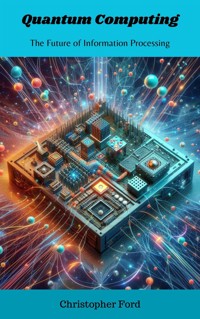
"Quantum Computing: The Future of Information Processing" is an immersive exploration into the revolutionary world of quantum computing, designed to captivate and enlighten both novices and experts in the field. This comprehensive book navigates through the captivating landscape of quantum mechanics and computing, offering an insightful journey into the following aspects:
Unveiling the Quantum Realm:
Embark on a fascinating journey into the quantum realm, discovering the fundamental principles that underpin this revolutionary form of computing. Explore the concepts of superposition, entanglement, and quantum interference that redefine the boundaries of classical computing.
Mastering Quantum Bits (Qubits):
Delve into the enigmatic realm of qubits, the building blocks of quantum computing. Unravel the mysteries behind qubits' superposition and entanglement, unlocking their potential to process information in ways that challenge traditional binary computing.
Quantum Algorithms and Applications:
Experience the sheer power of quantum algorithms, revealing their prowess in solving complex problems exponentially faster than classical counterparts. Discover groundbreaking applications across cryptography, optimization, machine learning, and scientific simulations.
Realizing the Future:
Peer into the future landscape shaped by quantum computing. Explore its potential impact on various industries, from healthcare and finance to cybersecurity, and envision a world transformed by quantum-enabled innovation.
Das E-Book können Sie in Legimi-Apps oder einer beliebigen App lesen, die das folgende Format unterstützen:
Veröffentlichungsjahr: 2024
Ähnliche




















Quantum Computing
The Future of Information Processing
Christopher Ford
2023
Copyright © 2023 by Christopher Ford
Contents
Part I: Foundations of Quantum Mechanics
Introduction to Quantum Mechanics
Key Concepts
Quantum bits (qubits)
Superposition
Entanglement
Quantum gates
Part II: Quantum Algorithms
Overview of key quantum algorithms
Cryptography
Optimization
Machine learning
Part III: Quantum Hardware
Building Quantum Computers
Quantum Hardware Technologies
Part IV: Challenges and Future Directions
Challenges in Quantum Computing
Future of Quantum Computing
Quantum supremacy
Quantum internet
Part V: Practical Considerations
Quantum Programming Languages
Quantum Computing Development Tools
Quantum Simulation Tools
Libraries and SDKs
Addressing ethical implications and security concerns in quantum computing
Glossary of Terms
Part I: Foundations of Quantum Mechanics
Introduction to Quantum Mechanics
Quantum computing's historical context dates from the early 20th century with the emergence of quantum mechanics. The key concepts that underpin quantum computing are rooted in the fundamental principles of quantum physics.
Quantum Mechanics Origins (Early 20th Century)
Pioneered by scientists like Max Planck, Albert Einstein, Niels Bohr, Werner Heisenberg, and Erwin Schrödinger. Planck's introduction of the quantum hypothesis in 1900 laid the groundwork for understanding energy quantization. Einstein's explanation of the photoelectric effect in 1905 and Bohr's atomic model in 1913 contributed to the quantum theory's development.
Foundations of Quantum Mechanics
Heisenberg's Uncertainty Principle (1927) and Schrödinger's Wave Equation (1926) revolutionized the understanding of particles at the quantum level. The Copenhagen interpretation, proposed by Bohr and others, outlined the probabilistic nature of quantum mechanics and the collapse of the wave function upon measurement.
Key Concepts
Qubits (Quantum Bits)
Unlike classical bits (which represent 0 or 1), qubits leverage quantum superposition, existing in multiple states simultaneously until measured.
Superposition
Qubits can exist in a superposition of states, allowing them to hold multiple values simultaneously, enabling parallel computation.
Entanglement
Quantum entanglement links the states of qubits, even when separated by vast distances. Changes to one qubit instantaneously affect its entangled partner.
Quantum Gates
Analogous to classical logic gates, quantum gates manipulate qubits, enabling complex operations like quantum parallelism and quantum entanglement.
The convergence of these concepts laid the groundwork for the theoretical framework of quantum computing, where the harnessing of quantum properties enables computations that vastly surpass classical capabilities in specific problem domains.
Quantum bits (qubits)
Quantum bits, or qubits, serve as the fundamental unit of quantum information. Unlike classical bits, which can only be in a state of 0 or 1, qubits exploit the principles of quantum mechanics, allowing them to exist in multiple states simultaneously.
Characteristics of Qubits:
Superposition:
Qubits can exist in a superposition of both 0 and 1 states at the same time, enabling parallel computations. This property is a foundational aspect of quantum computing's power.
Entanglement:
Qubits can become entangled, meaning the state of one qubit is directly correlated with the state of another, regardless of the physical distance between them. Changes in one qubit instantaneously affect its entangled partner.
Measurement:
When a qubit is measured, it collapses from its superposition of states (0 and 1) to a definite value (0 or 1). The measurement outcome is probabilistic due to the nature of quantum mechanics.
Quantum States:
Qubits can represent not only the classical 0 and 1 states but also an infinite combination of these states, thanks to superposition, thereby exponentially increasing computational possibilities.
Representation of Qubits:
Mathematical Representation:
Qubits are represented mathematically as complex numbers, utilizing Dirac notation (|0⟩ and |1⟩) or Bloch sphere representation to describe their states.
Physical Realization:
Various physical systems can serve as qubits, including atoms, ions, photons, superconducting circuits, and quantum dots. These systems are manipulated to create and control qubits for quantum computations.
The unique properties of qubits, especially superposition and entanglement, form the basis for quantum parallelism, enabling quantum computers to potentially solve certain problems significantly faster than classical computers. However, harnessing these properties while mitigating the effects of decoherence and errors remains a significant challenge in realizing practical quantum computers.
Superposition
Superposition is a fundamental principle in quantum mechanics that allows quantum systems, such as qubits in quantum computing, to exist in multiple states simultaneously.
Key Points about Superposition:
State Combination:
A qubit in superposition can represent a combination of both classical states (0 and 1) simultaneously, rather than being restricted to one state or the other.
Probabilistic Nature:
While in superposition, the qubit isn't in a definite state until measured. Instead, it holds a probabilistic combination of states, with each state's probability determined by its coefficients.
Exponential Computational Power:
Superposition enables a quantum computer to process multiple calculations at once by performing operations on all possible combinations of states simultaneously. This property leads to exponential computational power for certain problems compared to classical computers.
Quantum Parallelism:
The ability to explore multiple solutions simultaneously underpins quantum parallelism, offering the potential for significantly faster computations in specific domains, like factoring large numbers or searching unsorted databases.
Measurement and Collapse:
When measured, a qubit in superposition collapses to a definite state (0 or 1) with a probability determined by its coefficients. The act of measurement forces the qubit out of superposition, revealing a specific state.
Superposition is a foundational property in quantum computing, enabling the parallel processing of information and forming the basis for quantum algorithms like Grover's algorithm and quantum Fourier transform used in Shor's algorithm, demonstrating the immense potential for solving certain complex problems efficiently.




