


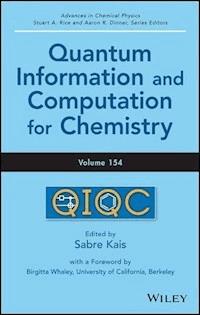
Quantum Information and Computation for Chemistry, Volume 154 E-Book
181,99 €
Mehr erfahren.
- Herausgeber: John Wiley & Sons
- Kategorie: Wissenschaft und neue Technologien
- Serie: Advances in Chemical Physics
- Sprache: Englisch
Examines the intersection of quantum information and chemical physics The Advances in Chemical Physics series is dedicated to reviewing new and emerging topics as well as the latest developments in traditional areas of study in the field of chemical physics. Each volume features detailed comprehensive analyses coupled with individual points of view that integrate the many disciplines of science that are needed for a full understanding of chemical physics. This volume of the series explores the latest research findings, applications, and new research paths from the quantum information science community. It examines topics in quantum computation and quantum information that are related to or intersect with key topics in chemical physics. The reviews address both what chemistry can contribute to quantum information and what quantum information can contribute to the study of chemical systems, surveying both theoretical and experimental quantum information research within the field of chemical physics. With contributions from an international team of leading experts, Volume 154 offers seventeen detailed reviews, including: * Introduction to quantum information and computation for chemistry * Quantum computing approach to non-relativistic and relativistic molecular energy calculations * Quantum algorithms for continuous problems and their applications * Photonic toolbox for quantum simulation * Vibrational energy and information transfer through molecular chains * Tensor networks for entanglement evolution Reviews published in Advances in Chemical Physics are typically longer than those published in journals, providing the space needed for readers to fully grasp the topic: the fundamentals as well as the latest discoveries, applications, and emerging avenues of research. Extensive cross-referencing enables readers to explore the primary research studies underlying each topic.
Sie lesen das E-Book in den Legimi-Apps auf:
Seitenzahl: 1111
Veröffentlichungsjahr: 2014
Ähnliche




















Editorial Board
Kurt Binder, Condensed Matter Theory Group, Institut Für Physik, Johannes Gutenberg-Universität, Mainz, Germany
William T. Coffey, Department of Electronic and Electrical Engineering, Printing House, Trinity College, Dublin, Ireland
Karl F. Freed, Department of Chemistry, James Franck Institute, University of Chicago, Chicago, Illinois, USA
Daan Frenkel, Department of Chemistry, Trinity College, University of Cambridge, Cambridge, UK
Pierre Gaspard, Center for Nonlinear Phenomena and Complex Systems, Université Libre de Bruxelles, Brussels, Belgium
Martin Gruebele, Departments of Physics and Chemistry, Center for Biophysics and Computational Biology, University of Illinois at Urbana-Champaign, Urbana, Illinois, USA
Gerhard Hummer, Theoretical Biophysics Section, NIDDK-National Institutes of Health, Bethesda, Maryland, USA
Ronnie Kosloff, Department of Physical Chemistry, Institute of Chemistry and Fritz Haber Center for Molecular Dynamics, The Hebrew University of Jerusalem, Israel
Ka Yee Lee, Department of Chemistry, James Franck Institute, University of Chicago, Chicago, Illinois, USA
Todd J. Martinez, Department of Chemistry, Photon Science, Stanford University, Stanford, California, USA
Shaul Mukamel, Department of Chemistry, School of Physical Sciences, University of California, Irvine, California, USA
Jose N. Onuchic, Department of Physics, Center for Theoretical Biological Physics, Rice University, Houston, Texas, USA
Stephen Quake, Department of Bioengineering, Stanford University, Palo Alto, California, USA
Mark Ratner, Department of Chemistry, Northwestern University, Evanston, Illinois, USA
David Reichman, Department of Chemistry, Columbia University, New York City, New York, USA
George Schatz, Department of Chemistry, Northwestern University, Evanston, Illinois, USA
Steven J. Sibener, Department of Chemistry, James Franck Institute, University of Chicago, Chicago, Illinois, USA
Andrei Tokmakoff, Department of Chemistry, James Franck Institute, University of Chicago, Chicago, Illinois, USA
Donald G. Truhlar, Department of Chemistry, University of Minnesota, Minneapolis, Minnesota, USA
John C. Tully, Department of Chemistry, Yale University, New Haven, Connecticut, USA
Copyright 2014 by John Wiley & Sons, Inc. All rights reserved.
Published by John Wiley & Sons, Inc., Hoboken, New Jersey.
Published simultaneously in Canada.
No part of this publication may be reproduced, stored in a retrieval system, or transmitted in any form or by any means, electronic, mechanical, photocopying, recording, scanning, or otherwise, except as permitted under Section 107 or 108 of the 1976 United States Copyright Act, without either the prior written permission of the Publisher, or authorization through payment of the appropriate per-copy fee to the Copyright Clearance Center, Inc., 222 Rosewood Drive, Danvers, MA 01923, (978) 750-8400, fax (978) 750-4470, or on the web at www.copyright.com. Requests to the Publisher for permission should be addressed to the Permissions Department, John Wiley & Sons, Inc., 111 River Street, Hoboken, NJ 07030, (201) 748-6011, fax (201) 748-6008, or online at http://www.wiley.com/go/permission.
Limit of Liability/Disclaimer of Warranty: While the publisher and author have used their best efforts in preparing this book, they make no representations or warranties with respect to the accuracy or completeness of the contents of this book and specifically disclaim any implied warranties of merchantability or fitness for a particular purpose. No warranty may be created or extended by sales representatives or written sales materials. The advice and strategies contained herein may not be suitable for your situation. You should consult with a professional where appropriate. Neither the publisher nor author shall be liable for any loss of profit or any other commercial damages, including but not limited to special, incidental, consequential, or other damages.
For general information on our other products and services or for technical support, please contact our Customer Care Department within the United States at (800) 762-2974, outside the United States at (317) 572-3993 or fax (317) 572-4002.
Wiley also publishes its books in a variety of electronic formats. Some content that appears in print may not be available in electronic formats. For more information about Wiley products, visit our web site at www.wiley.com.
Library of Congress Cataloging-in-Publication Data:
ISBN: 978-1-118-49566-7
Contributors to Volume 154
Alán Aspuru-Guzik, Department of Chemistry and Chemical Biology, Harvard University, 12 Oxford Street, Cambridge, MA 02138, USA
Jonathan Baugh, Institute for Quantum Computing, University of Waterloo, Waterloo, Ontario, N2L 3G1, Canada; Departments of Physics and Astronomy, University of Waterloo, Waterloo, Ontario, N2L 3G1, Canada; Department of Chemistry, University of Waterloo, Waterloo, Ontario, N2L 3G1, Canada
Jacob Biamonte, ISI Foundation, Via Alassio 11/c, 10126, Torino, Italy; Centre for Quantum Technologies, National University of Singapore, Block S15, 3 Science Drive 2, Singapore 117543, Singapore
Sergio Boixo, Department of Chemistry and Chemical Biology, Harvard University, 12 Oxford Street, Cambridge, MA 02138, USA; Google, 340 Main St, Venice, CA 90291, USA
Kenneth R. Brown, School of Chemistry and Biochemistry, School of Computational Science and Engineering, School of Physics, Georgia Institute of Technology, Ford Environmental Science and Technology Building, 311 Ferst Dr, Atlanta, GA 30332-0400, USA
Garnet Kin-Lic Chan, Department of Chemistry and Chemical Biology, Cornell University, Ithaca, NY 14850, USA
Robin CôTé, Department of Physics, U-3046, University of Connecticut, 2152 Hillside Road, Storrs, CT 06269-3046, USA
Ben Criger, Institute for Quantum Computing, University of Waterloo, Waterloo, Ontario, N2L 3G1, Canada; Departments of Physics and Astronomy, University of Waterloo, Waterloo, Ontario, N2L 3G1, Canada
Borivoje Daki, Faculty of Physics, University of Vienna, Boltzmanngasse 5, A-1090 Vienna, Austria
R. De Vivie-Riedle, Department Chemie, Ludwig-Maximilians-Universität, Butenandt-Str. 11, 81377 München, Germany
Frank Gaitan, Laboratory for Physical Sciences, 8050 Greenmead Drive, College Park, MD 20740-4004, USA
C. Gollub, Department Chemie, Ludwig-Maximilians-Universität, Butenandt-Str. 11, 81377 München, Germany
Sabre Kais, Department of Chemistry and Physics, Purdue University, 560 Oval Drive, West Lafayette, IN 47907, USA; Qatar Environment & Energy Research Institute (QEERI), Doha, Qatar; Santa Fe Institute, Santa Fe, NM 87501, USA
Graham Kells, Dahlem Center for Complex Quantum Systems, Fachbereich Physik, Freie Universität Berlin, Arminallee 14, D-14195 Berlin, Germany
Jesse M. Kinder, Department of Chemistry and Chemical Biology, Cornell University, Ithaca, NY 14850, USA
M. Kowalewski, Department Chemie, Ludwig-Maximilians-Universität, Butenandt-Str. 11, 81377 München, Germany
Daniel A. Lidar, Departments of Electrical Engineering, Chemistry, and Physics, and Center for Quantum Information Science & Technology, University of Southern California, Los Angeles, CA 90089, USA
Peter J. Love, Department of Physics, Haverford College, 370 Lancaster Avenue, Haverford, PA 19041, USA
Xiao-Song Ma, Faculty of Physics, University of Vienna, Boltzmanngasse 5, A-1090 Vienna, Austria; Institute for Quantum Optics and Quantum Information (IQOQI), Austrian Academy of Sciences, Boltzmanngasse 3, A-1090 Vienna, Austria
David A. Mazziotti, Department of Chemistry and the James Franck Institute, The University of Chicago, Chicago, IL 60637, USA
J. True Merrill, School of Chemistry and Biochemistry, School of Computational Science and Engineering, School of Physics, Georgia Institute of Technology, Ford Environmental Science and Technology Building, 311 Ferst Dr, Atlanta, GA 30332-0400, USA
Sebastian Meznaric, Clarendon Laboratory, University of Oxford, Parks Road, Oxford OX1 3PU, UK
Franco Nori, CEMS, RIKEN, Saitama 351-0198, Japan; Physics Department, University of Michigan, Ann Arbor, MI 48109-1040, USA
A. Papageorgiou, Department of Computer Science, Columbia University, New York, NY 10027, USA
Daniel Park, Institute for Quantum Computing, University of Waterloo, Waterloo, Ontario, N2L 3G1, Canada; Departments of Physics and Astronomy, University of Waterloo, Waterloo, Ontario, N2L 3G1, Canada
Jií Pittner, J. Heyrovský Institute of Physical Chemistry, Academy of Sciences of the Czech Republic, v.v.i., Dolejškova 3, 18223 Prague 8, Czech Republic
Claire C. Ralph, Department of Chemistry and Chemical Biology, Cornell University, Ithaca, NY 14850, USA
Gehad Sadiek, Department of Physics, King Saud University, Riyadh, Saudi Arabia; Department of Physics, Ain Shams University, Cairo 11566, Egypt
Nolan Skochdopole, Department of Chemistry and the James Franck Institute, The University of Chicago, Chicago, IL 60637, USA
David G. Tempel, Department of Chemistry and Chemical Biology, Harvard University, 12 Oxford Street, Cambridge, MA 02138, USA; Department of Physics, Harvard University, 17 Oxford Street, Cambridge, MA 02138, USA
J. F. Traub, Department of Computer Science, Columbia University, New York, NY 10027, USA
U. Troppmann, Department Chemie, Ludwig-Maximilians-Universität, Butenandt-Str. 11, 81377 München, Germany
Jií Vala, Department of Mathematical Physics, National University of Ireland Maynooth, Maynooth, Co. Kildare, Ireland; School of Theoretical Physics, Dublin Institute for Advanced Studies, 10 Burlington Road, Dublin 4, Ireland
Libor Veis, J. Heyrovský Institute of Physical Chemistry, Academy of Sciences of the Czech Republic, v.v.i., Dolejškova 3, 18223 Prague 8, Czech Republic; Department of Physical and Macromolecular Chemistry, Faculty of Science, Charles University in Prague, Hlavova 8, 12840 Prague 2, Czech Republic
P. Von Den Hoff, Department Chemie, Ludwig-Maximilians-Universität, Butenandt-Str. 11, 81377 München, Germany
Philip Walther, Faculty of Physics, University of Vienna, Boltzmanngasse 5, A-1090 Vienna, Austria; Institute for Quantum Optics and Quantum Information (IQOQI), Austrian Academy of Sciences, Boltzmanngasse 3, A-1090 Vienna, Austria
Paul Watts, Department of Mathematical Physics, National University of Ireland Maynooth, Maynooth, Co. Kildare, Ireland; School of Theoretical Physics, Dublin Institute for Advanced Studies, 10 Burlington Road, Dublin 4, Ireland
James D. Whitfield, Department of Chemistry and Chemical Biology, Harvard University, 12 Oxford Street, Cambridge, MA 02138, USA; NEC Laboratories America, 4 Independence Way, Princeton, NJ 08540, USA; Department of Physics, Columbia University, 538 West 120th Street, New York, NY 10027, USA
Qing Xu, Department of Chemistry, Purdue University, 560 Oval Drive, West Lafayette, IN 47907, USA
Man-Hong Yung, Center for Quantum Information, Institute for Interdisciplinary Information Sciences, Tsinghua University, Beijing 100084, P. R. China; Department of Chemistry and Chemical Biology, Harvard University, 12 Oxford Street, Cambridge, MA 02138, USA
Foreword
Quantum mechanics and information theory were key new areas for scientific progress in the 20th century. Toward the end of the 1900s, when both of these fields were generally regarded as mature, a small community of researchers in physics, computer science, mathematics, and chemistry began to explore the fertile ground at the intersection of these two areas. Formulation of a quantum version of information theory and analysis of computational and communication protocols with quantum, rather than classical states, led to a powerful new paradigm for computation. Dramatic theoretical results were achieved in the mid-1990s with the presentation of both a quantum algorithm for solving factorization problems with an exponential speedup relative to the best-known classical algorithm and a protocol for performing fault-tolerant quantum computation (i.e., computation allowing for errors but in which these errors are guaranteed not to propagate). These two key results, both due to Peter Shor, motivated the launch of experimental efforts to realize physical implementations of quantum computations. Initially restricted to a small set of candidate physical systems, experimental studies have since multiplied to encompass an increasingly wide range of physical qubit systems, ranging from photons to solid-state quantum circuits. As the study of physical candidates for viable qubit arrays for computation has grown and as attention turns to more complex quantum systems that promise scalability, many quantum theorists active in the field are exploring the use of information theoretic concepts to bring new insights and understanding to the study of quantum systems. Theorists and experimentalists alike are also increasingly heavily focused on quantum simulation, the art of making one Hamiltonian emulate another, according to Feynman's original proposal (1982) for a quantum computer.
Today, the field of quantum information science covers an increasingly broad range of physical systems in addition to theoretical topics in mathematics, computer science, and information theory. As a result, the community of scientists working in this field is quite diverse and interdisciplinary. The unifying feature of the community is interest in a fully quantum description of both information processing and the physical systems that might enable it to be realized in a controllable and programmable fashion. Chemical physics, rooted in quantum physics and the intellectual home of molecular quantum mechanics, is centrally located in this interdisciplinary community. The chemical physicist's interest and expertise in analysis and control of molecular systems bring key tools and perspectives to the twin challenges of experimentally realizing quantum computation and of using quantum information theory for analysis of chemical problems in the full quantum regime. I use the latter term instead of the simpler and oft-used term quantum chemistry, which has unfortunately become associated almost exclusively with the specific subdiscipline of electronic structure of atoms and molecules. For quantum information science however, the field quantum chemistry covers much more, namely, the set of molecular phenomena that require a full quantum description for energetics, structure, and dynamics, whether electronic or nuclear, local or collective in nature.
This volume brings together chapters from the quantum information science community that describe topics in quantum computation and quantum information related to or overlapping with key topics in chemical physics. The motivation for this volume may be summarized by two questions. First, what can chemistry contribute to quantum information? Second, what can quantum information contribute to the study of chemical systems? The contributions in this volume address both perspectives, while surveying theoretical and experimental quantum information-related research within chemical physics.
In Chapter 1, Sabre Kais introduces the fields of quantum information, quantum computation, and quantum simulation, outlining their relevance and impact for chemistry. In Chapter 2, Peter Love presents ideas from electronic structure theory that might facilitate quantum computation and quantum simulation. Alan Aspuru-Guzik and Joseph Traub describe quantum algorithms that are relevant for efficient solution of a range of problems in both physics and chemistry, in Chapters 3 and 6, respectively. Libor Veis and Jií Pittner discuss the solution for both nonrelativistic and relativistic electronic energies via quantum computations in Chapter 4. Several contributions specifically address the relation between quantum computation and electronic structure calculations in terms of the two motivating questions stated earlier. Two contributions examine the use and impact of electronic structure calculations for quantum computation. In Chapter 5, Frank Gaitan and Franco Nori review an approach based on use of density functional theory to generate efficient calculation of energy gaps for adiabatic quantum computation. In Chapter 7, Jesse Kinder, Claire Ralph, and Garnet Chan discuss the use of matrix product states for understanding the dynamics of complex electronic states. The understanding offered by quantum information theoretic concepts for realizing correlations in complex quantum systems is also the focus of Gehad Sadiek and Sabre Kais's discussion of entanglement for spin systems in Chapter 15.
Other authors address the realization of high-fidelity quantum operations, a key requirement of implementation of all quantum information processing. In Chapter 10, True Merrill and Ken Brown discuss the use of compensating pulse sequences from NMR for correcting unknown errors in the quantum bits (qubits). In Chapter 11, Daniel Lidar compares the benefits of passive versus active error correction, with analysis of decoherence-free subspaces, noiseless subsystems, and dynamical decoupling pulse sequences. Fault tolerance, the ability to effectively compute despite a bounded rate of error, is also a powerful driver for development of the topological materials that Jií Vala describes in Chapter 16. The exotic “topological” phases of these materials are characterized by massive ground-state degeneracy, an energy gap for all local excitations and anyonic excitations—properties that mathematicians have shown guarantee a remarkable natural fault tolerance for quantum computation.
Several experimentalists have contributed chapters describing specific physical implementations of qubits and outlining experimental schemes for the realization of quantum computation, quantum simulation, or quantum communication. Ben Criger, Daniel Park, and Jonathan Baugh describe spin-based quantum information processing in Chapter 8. Xiao-Song Ma, Borivoje Draki, and Philip Walther describe the use of photonic systems for quantum simulation of chemical phenomena in Chapter 9. Regina de Vivie-Riedle describes how information may be transferred through molecular chains by taking advantage of vibrational energy transfer (Chapter 13), and Robin Côté summarizes the application of the rapidly growing field of ultracold molecules to quantum information processing (Chapter 14). Finally, David Mazziotti examines the roles of electron correlation, entanglement, and redundancy in the energy flow within the pigment–protein structure of a light-harvesting complex in Chapter 12.
The contributions to this volume represent just a partial overview of the synergy that has developed over the past 10 years between quantum information sciences and chemical physics. Many more areas of overlap have not been addressed in detail here, notably coherent quantum control of atoms and molecules. However, we hope this selection of chapters will provide a useful introduction and perspective to current directions in quantum information and its relation to the diverse set of quantum phenomena and theoretical methods that are central to the chemical physics community.
University of California, BerkeleyBirgitta WhaleyPreface to the Series
Advances in science often involve initial development of individual specialized fields of study within traditional disciplines, followed by broadening and overlap, or even merging, of those specialized fields, leading to a blurring of the lines between traditional disciplines. The pace of that blurring has accelerated in the past few decades, and much of the important and exciting research carried out today seeks to synthesize elements from different fields of knowledge. Examples of such research areas include biophysics and studies of nanostructured materials. As the study of the forces that govern the structure and dynamics of molecular systems, chemical physics encompasses these and many other emerging research directions. Unfortunately, the flood of scientific literature has been accompanied by losses in the shared vocabulary and approaches of the traditional disciplines. Scientific journals are exerting pressure to be ever more concise in the descriptions of studies, to the point that much valuable experience, if recorded at all, is hidden in supplements and dissipated with time. These trends in science and publishing make this series, Advances in Chemical Physics, a much needed resource.
Advances in Chemical Physics is devoted to helping the reader obtain general information about a wide variety of topics in chemical physics, a field that we interpret broadly. Our intent is to have experts present comprehensive analyses of subjects of interest and to encourage the expression of individual points of view. We hope this approach to the presentation of an overview of a subject will both stimulate new research and serve as a personalized learning text for beginners in a field.
Stuart A. RiceAaron R. Dinner
Introduction to Quantum Information and Computation for Chemistry
Sabre Kais
Department of Chemistry and Physics, Purdue University, 560 Oval Drive, West Lafayette, IN 47907, USA; Qatar Environment & Energy Research Institute (QEERI), Doha, Qatar; Santa Fe Institute, Santa Fe, NM 87501, USA
I. Introduction
The development and use of quantum computers for chemical applications has the potential for revolutionary impact on the way computing is done in the future [1–7]. Major challenge opportunities are abundant (see next fifteen chapters). One key example is developing and implementing quantum algorithms for solving chemical problems thought to be intractable for classical computers. Other challenges include the role of quantum entanglement, coherence, and superposition in photosynthesis and complex chemical reactions. Theoretical chemists have encountered and analyzed these quantum effects from the view of physical chemistry for decades. Therefore, combining results and insights from the quantum information community with those of the chemical physics community might lead to a fresh understanding of important chemical processes. In particular, we will discuss the role of entanglement in photosynthesis, in dissociation of molecules, and in the mechanism with which birds determine magnetic north. This chapter is intended to survey some of the most important recent results in quantum computation and quantum information, with potential applications in quantum chemistry. To start with, we give a comprehensive overview of the basics of quantum computing (the gate model), followed by introducing quantum simulation, where the phase estimation algorithm (PEA) plays a key role. Then we demonstrate how PEA combined with Hamiltonian simulation and multiplicative inversion can enable us to solve some types of linear systems of equations described by . Then our subject turns from gate model quantum computing (GMQC) to adiabatic quantum computing (AQC) and topological quantum computing, which have gained increasing attention in the recent years due to their rapid progress in both theoretical and experimental areas. Finally, applications of the concepts of quantum information theory are usually related to the powerful and counter intuitive quantum mechanical effects of superposition, interference, and entanglement.
Throughout history, man has learned to build tools to aid computation. From abacuses to digital microprocessors, these tools epitomize the fact that laws of physics support computation. Therefore, a natural question arises: “Which physical laws can we use for computation?” For a long period of time, questions such as this were not considered relevant because computation devices were built exclusively based on classical physics. It was not until the 1970s and 1980s when Feynmann [8], Deutsch [9], Benioff [10], and Bennett [11] proposed the idea of using quantum mechanics to perform calculation that the possibility of building a quantum computing device started to gain some attention.
What they conjectured then is what we call today a quantum computer. A quantum computer is a device that takes direct advantage of quantum mechanical phenomena such as superposition and entanglement to perform calculations [12]. Because they compute in ways that classical computers cannot, for certain problems quantum algorithms provide exponential speedups over their classical counterparts. As an example, in solving problems related to factoring large numbers [13] and simulation of quantum systems [14–28], quantum algorithms are able to find the answer exponentially faster than classical algorithms. Recently, it has also been proposed that a quantum computer can be useful for solving linear systems of equations with exponential speedup over the best-known classical algorithms [29]. In the problem of factoring large numbers, the quantum exponential speedup is rooted in the fact that a quantum computer can perform discrete Fourier transform exponentially faster than classical computers [12]. Hence, any algorithm that involves Fourier transform as a subroutine can potentially be sped up exponentially on a quantum computer. For example, efficient quantum algorithms for performing discrete sine and cosine transforms using quantum Fourier transform have been proposed [30]. To illustrate the tremendous power of the exponential speedup with concrete numbers, consider the following example: the problem of factoring a 60-digit number takes a classical computer 3 × 10 years (about 20 times the age of universe) to solve, while a quantum computer can be expected to factor a 60-digit number within 10 seconds. The same order of speedup applies for problems of quantum simulation.
Lesen Sie weiter in der vollständigen Ausgabe!
Lesen Sie weiter in der vollständigen Ausgabe!
Lesen Sie weiter in der vollständigen Ausgabe!
Lesen Sie weiter in der vollständigen Ausgabe!
Lesen Sie weiter in der vollständigen Ausgabe!
Lesen Sie weiter in der vollständigen Ausgabe!
Lesen Sie weiter in der vollständigen Ausgabe!
Lesen Sie weiter in der vollständigen Ausgabe!
Lesen Sie weiter in der vollständigen Ausgabe!
Lesen Sie weiter in der vollständigen Ausgabe!
Lesen Sie weiter in der vollständigen Ausgabe!
Lesen Sie weiter in der vollständigen Ausgabe!
Lesen Sie weiter in der vollständigen Ausgabe!
Lesen Sie weiter in der vollständigen Ausgabe!
Lesen Sie weiter in der vollständigen Ausgabe!
Lesen Sie weiter in der vollständigen Ausgabe!
Lesen Sie weiter in der vollständigen Ausgabe!
Lesen Sie weiter in der vollständigen Ausgabe!




