


133,99 €
Mehr erfahren.
- Herausgeber: Wiley-VCH Verlag GmbH & Co. KGaA
- Kategorie: Wissenschaft und neue Technologien
- Sprache: Englisch
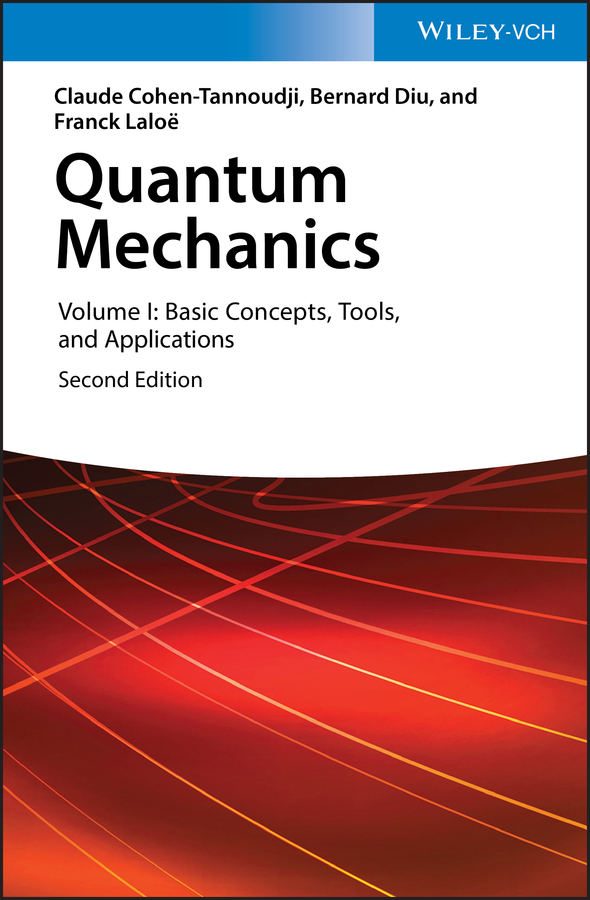
This new edition of the unrivalled textbook introduces the fundamental concepts of quantum mechanics such as waves, particles and probability before explaining the postulates of quantum mechanics in detail. In the proven didactic manner, the textbook then covers the classical scope of introductory quantum mechanics, namely simple two-level systems, the one-dimensional harmonic oscillator, the quantized angular momentum and particles in a central potential. The entire book has been revised to take into account new developments in quantum mechanics curricula.
The textbook retains its typical style also in the new edition: it explains the fundamental concepts in chapters which are elaborated in accompanying complements that provide more detailed discussions, examples and applications.
* The quantum mechanics classic in a new edition: written by 1997 Nobel laureate Claude Cohen-Tannoudji and his colleagues Bernard Diu and Franck Laloë
* As easily comprehensible as possible: all steps of the physical background and its mathematical representation are spelled out explicitly
* Comprehensive: in addition to the fundamentals themselves, the book contains more than 350 worked examples plus exercises
Claude Cohen-Tannoudji was a researcher at the Kastler-Brossel laboratory of the Ecole Normale Supérieure in Paris where he also studied and received his PhD in 1962. In 1973 he became Professor of atomic and molecular physics at the Collège des France. His main research interests were optical pumping, quantum optics and atom-photon interactions. In 1997, Claude Cohen-Tannoudji, together with Steven Chu and William D. Phillips, was awarded the Nobel Prize in Physics for his research on laser cooling and trapping of neutral atoms.
Bernard Diu was Professor at the Denis Diderot University (Paris VII). He was engaged in research at the Laboratory of Theoretical Physics and High Energy where his focus was on strong interactions physics and statistical mechanics.
Franck Laloë was a researcher at the Kastler-Brossel laboratory of the Ecole Normale Supérieure in Paris. His first assignment was with the University of Paris VI before he was appointed to the CNRS, the French National Research Center. His research was focused on optical pumping, statistical mechanics of quantum gases, musical acoustics and the foundations of quantum mechanics.
Sie lesen das E-Book in den Legimi-Apps auf:
Seitenzahl: 1473
Veröffentlichungsjahr: 2020
Ähnliche

















Table of Contents
Cover
Foreword
Acknowledgments
Chapter I: Waves and particles. Introduction to the fundamental ideas of quantum mechanics
A. Electromagnetic waves and photons
B. Material particles and matter waves
C. Quantum description of a particle. Wave packets
D. Particle in a time-independent scalar potential
COMPLEMENTS OF CHAPTER I, READER’S GUIDE
Complement A
I
Order of magnitude of the wavelengths associated with material particles
Complement B
I
Constraints imposed by the uncertainty relations
1. Macroscopic system
2. Microscopic system
Complement C
I
Heisenberg relation and atomic parameters
Complement D
I
An experiment illustrating the Heisenberg relations
Complement E
I
A simple treatment of a two-dimensional wave packet
1. Introduction
2. Angular dispersion and lateral dimensions
3. Discussion
Complement F
I
The relationship between one- and three-dimensional problems
1. Three-dimensional wave packet
2. Justification of one-dimensional models
Complement G
I
One-dimensional Gaussian wave packet: spreading of the wave packet
1. Definition of a Gaussian wave packet
2. Calculation of ∆x and ∆p; uncertainty relation
3. Evolution of the wave packet
Complement H
I
Stationary states of a particle in one-dimensional square potentials
1. Behavior of a stationary wave function φ(x)
2. Some simple cases
Complement J
I
Behavior of a wave packet at a potential step
1. Total reflection: E < V
0
2. Partial reflection: E > V
0
Complement K
I
Exercises
2. Bound state of a particle in a “delta function potential”
3. Transmission of a “delta function” potential barrier
4. Return to exercise 2, using this time the Fourier transform.
5. Well consisting of two delta functions
Chapter II: The mathematical tools of quantum mechanics
A. Space of the one-particle wave function
B. State space. Dirac notation
C. Representations in state space
D. Eigenvalue equations. Observables
E. Two important examples of representations and observables
F. Tensor product of state spaces
11
COMPLEMENTS OF CHAPTER II, , READER’S GUIDE
Complement A
II
The Schwarz inequality
Complement B
II
Review of some useful properties of linear operators
1. Trace of an operator
2. Commutator algebra
3. Restriction of an operator to a subspace
4. Functions of operators
5. Derivative of an operator
Complement C
II
Unitary operators
1. General properties of unitary operators
2. Unitary transformations of operators
3. The infinitesimal unitary operator
Complement D
II
A more detailed study of the { |r〉 }and { |P〉 } representations
1. The { |r〉 } representation
2. The { |P〉 } representation
Complement E
II
Some general properties of two observables, Q and P, whose commutator is equal to
1. The operator S(λ): definition, properties
2. Eigenvalues and eigenvectors of Q
3. The q representation
4. The representation. The symmetric nature of the P and Q observables
Complement F
II
The parity operator
1. The parity operator
2. Even and odd operators
4. Application to an important special case
Complement G
II
An application of the properties of the tensor product: the two-dimensional infinite well
1. Definition; eigenstates
2. Study of the energy levels
Complement H
II
Exercises
Dirac notation. Commutators. Eigenvectors and eigenvalues
Complete sets of commuting observables, C.S.C.O.
Solution of exercise 11
Solution of exercise 12
Chapter III: The postulates of quantum mechanics
A. Introduction
B. Statement of the postulates
C. The physical interpretation of the postulates concerning observables and their measurement
D. The physical implications of the Schrödinger equation
E. The superposition principle and physical predictions
COMPLEMENTS OF CHAPTER III, READER’S GUIDE
Complement A
III
Particle in an infinite potential well
1. Distribution of the momentum values in a stationary state
2. Evolution of the particle’s wave function
3. Perturbation created by a position measurement
Complement B
III
Study of the probability current in some special cases
1. Expression for the current in constant potential regions
2. Application to potential step problems
3. Probability current of incident and evanescent waves, in the case of reflection from a two-dimensional potential step
Complement C
III
Root mean square deviations of two conjugate observables
1. The Heisenberg relation for P and Q
2. The “minimum” wave packet
Complement D
III
Measurements bearing on only one part of a physical system
1. Calculation of the physical predictions
2. Physical meaning of a tensor product state
3. Physical meaning of a state that is not a tensor product
Complement E
III
The density operator
1. Outline of the problem
2. The concept of a statistical mixture of states
3. The pure case. Introduction of the density operator
4. A statistical mixture of states (non-pure case)
5. Use of the density operator: some applications
Complement F
III
The evolution operator
1. General properties
2. Case of conservative systems
Complement G
III
The Schrödinger and Heisenberg pictures
Complement H
III
Gauge invariance
1. Outline of the problem: scalar and vector potentials associated with an electromagnetic field; concept of a gauge
2. Gauge invariance in classical mechanics
3. Gauge invariance in quantum mechanics
Complement J
III
Propagator for the Schrödinger equation
1. Introduction
2. Existence and properties of a propagator K(2, 1)
3. Lagrangian formulation of quantum mechanics
Complement K
III
Unstable states. Lifetime
1. Introduction
2. Definition of the lifetime
3. Phenomenological description of the instability of a state
Complement L
III
Exercises
Complement M
III
Bound states in a “potential well” of arbitrary shape
1. Quantization of the bound state energies
2. Minimum value of the ground state energy
Complement N
III
Unbound states of a particle in the presence of a potential well or barrier of arbitrary shape
1. Transmission matrix M(k)
2. Transmission and reflection coefficients
3. Example
Complement O
III
Quantum properties of a particle in a one-dimensional periodic structure
1. Passage through several successive identical potential barriers
2. Discussion: the concept of an allowed or forbidden energy band
3. Quantization of energy levels in a periodic potential; effect of boundary conditions
Chapter IV: Application of the postulates to simple cases: spin 1/2 and two-level systems
A. Spin 1/2 particle: quantization of the angular momentum
B. Illustration of the postulates in the case of a spin 1/2
C. General study of two-level systems
COMPLEMENTS OF CHAPTER IV, READER’S GUIDE
Complement A
IV
The Pauli matrices
1. Definition; eigenvalues and eigenvectors
2. Simple properties
3. A convenient basis of the 2 2 matrix space
Complement B
IV
Diagonalization of a 2 2 Hermitian matrix
1. Introduction
2. Changing the eigenvalue origin
3. Calculation of the eigenvalues and eigenvectors
Complement C
IV
Fictitious spin 1/2 associated with a two-level system
1. Introduction
2. Interpretation of the Hamiltonian in terms of fictitious spin
3. Geometrical interpretation of the various effects discussed in § C of Chapter IV
Complement D
IV
System of two spin 1/2 particles
1. Quantum mechanical description
2. Prediction of the measurement results
Complement E
IV
Spin 1 2 density matrix
1. Introduction
2. Density matrix of a perfectly polarized spin (pure case)
3. Example of a statistical mixture: unpolarized spin
4. Spin 1/2 at thermodynamic equilibrium in a static field
5. Expansion of the density matrix in terms of the Pauli matrices
Complement F
IV
Spin 1/2 particle in a static and a rotating magnetic fields: magnetic resonance
1. Classical treatment; rotating reference frame
2. Quantum mechanical treatment
3. Relation between the classical treatment and the quantum mechanical treatment: evolution of M
4. Bloch equations
Complement G
IV
A simple model of the ammonia molecule
1. Description of the model
2. Eigenfunctions and eigenvalues of the Hamiltonian
3. The ammonia molecule considered as a two-level system
Complement H
IV
Effects of a coupling between a stable state and an unstable state
1. Introduction. Notation
2. Influence of a weak coupling on states of different energies
3. Influence of an arbitrary coupling on states of the same energy
Chapter V: The one-dimensional harmonic oscillator
A. Introduction
B. Eigenvalues of the Hamiltonian
C. Eigenstates of the Hamiltonian
D. Discussion
Complement A
V
Some examples of harmonic oscillators
1. Vibration of the nuclei of a diatomic molecule
2. Vibration of the nuclei in a crystal
3. Torsional oscillations of a molecule: ethylene
4. Heavy muonic atoms
Complement B
V
Study of the stationary states in the representation. Hermite polynomials
1. Hermite polynomials
2. The eigenfunctions of the harmonic oscillator Hamiltonian
Complement C
V
Solving the eigenvalue equation of the harmonic oscillator by the polynomial method
1. Changing the function and the variable
2. The polynomial method
Complement D
V
Study of the stationary states in the representation
1. Wave functions in momentum space
2. Discussion
Complement E
V
The isotropic three-dimensional harmonic oscillator
1. The Hamiltonian operator
2. Separation of the variables in Cartesian coordinates
3. Degeneracy of the energy levels
Complement F
V
A charged harmonic oscillator in a uniform electric field
1. Eigenvalue equation of in the representation
2. Discussion
3. Use of the translation operator
Complement G
V
Coherent “quasi-classical” states of the harmonic oscillator
1. Quasi-classical states
2. Properties of the states
3. Time evolution of a quasi-classical state
4. Example: quantum mechanical treatment of a macroscopic oscillator
Complement H
V
Normal vibrational modes of two coupled harmonic oscillators
1. Vibration of the two coupled in classical mechanics
2. Vibrational states of the system in quantum mechanics
Complement J
V
Vibrational modes of an infinite linear chain of coupled harmonic oscillators; phonons
1. Classical treatment
2. Quantum mechanical treatment
3. Application to the study of crystal vibrations: phonons
Complement K
V
Vibrational modes of a continuous physical system. Application to radiation; photons
1. Outline of the problem
2. Vibrational modes of a continuous mechanical system: example of a vibrating string
3. Vibrational modes of radiation: photons
Complement L
V
One-dimensional harmonic oscillator in thermodynamic equilibrium at a temperature T
1. Mean value of the energy
2. Discussion
3. Applications
4. Probability distribution of the observable X
Complement M
V
Exercises
Chapter VI: General properties of angular momentum in quantum mechanics
A. Introduction: the importance of angular momentum
B. Commutation relations characteristic of angular momentum
C. General theory of angular momentum
D. Application to orbital angular momentum
Complement A
VI
Spherical harmonics
1. Calculation of spherical harmonics
2. Properties of spherical harmonics
Complement B
VI
Angular momentum and rotations
1. Introduction
2. Brief study of geometrical rotations
3. Rotation operators in state space. Example: a spinless particle
4. Rotation operators in the state space of an arbitrary system
5. Rotation of observables
6. Rotation invariance
Complement C
VI
Rotation of diatomic molecules
1. Introduction
2. Rigid rotator. Classical study
3. Quantization of the rigid rotator
4. Experimental evidence for the rotation of molecules
Complement D
VI
Angular momentum of stationary states of a two-dimensional harmonic oscillator
1. Introduction
2. Classification of the stationary states by the quantum numbers n
x
and n
y
3. Classification of the stationary states in terms of their angular momenta
4. Quasi-classical states
Complement E
VI
A charged particle in a magnetic field: Landau levels
1. Review of the classical problem
2. General quantum mechanical properties of a particle in a magnetic field
3. Case of a uniform magnetic field
Chapter VII: Particle in a central potential. The hydrogen atom
A. Stationary states of a particle in a central potential
B. Motion of the center of mass and relative motion for a system of two interacting particles
C. The hydrogen atom
COMPLEMENTS OF CHAPTER VII, READER’S GUIDE
Complement A
VII
Hydrogen-like systems
1. Hydrogen-like systems with one electron
2. Hydrogen-like systems without an electron
Complement B
VII
A soluble example of a central potential: the isotropic three-dimensional harmonic oscillator
1. Solving the radial equation
2. Energy levels and stationary wave functions
Complement C
VII
Probability currents associated with the stationary states of the hydrogen atom
1. General expression for the probability current
2. Application to the stationary states of the hydrogen atom
Complement D
VII
The hydrogen atom placed in a uniform magnetic field. Paramagnetism and diamagnetism. The Zeeman effect
1. The Hamiltonian of the problem. The paramagnetic term and the diamagnetic term
2. The Zeeman effect
Complement E
VII
Some atomic orbitals. Hybrid orbitals
1. Introduction
2. Atomic orbitals associated with real wave functions
3. sp hybridization
4. sp
2
hybridization
5. sp
3
hybridization
Complement F
VII
Vibrational-rotational levels of diatomic molecules
1. Introduction
2. Approximate solution of the radial equation
3. Evaluation of some corrections
Complement G
VII
Exercises
1. Particle in a cylindrically symmetric potential
2. Three-dimensional harmonic oscillator in a uniform magnetic field
Index [The notation (ex.) refers to an exercise]
End User License Agreement
List of Tables
Chapter VII
Table I: Eigenfunctions common to the Hamiltonian H
xy
and the observable L
z
, for the first levels of the two-dimensional harmonic oscillator.
Table VI-1: Schematic representation of the construction of the (2j + 1) g(j) vectors of a “standard basis” associated with a fixed value of j. Starting with each of the g(j) vectors |k, j, j of the first line, one uses the action of J_ to construct the (2j + 1) vectors of the corresponding column.
Guide
Cover
Table of Contents
Begin Reading
Pages
vii
ii
iii
iv
v
vi
1
2
3
4
5
6
7
8
9
10
11
12
13
14
15
16
17
18
19
20
21
22
23
24
25
26
28
29
30
31
32
33
35
36
37
39
40
41
42
43
45
46
47
49
50
51
52
53
54
55
56
57
58
59
60
61
62
63
64
65
66
67
68
69
70
71
72
73
74
75
76
77
78
79
80
81
83
84
85
86
87
88
89
90
91
92
93
94
95
96
97
98
99
100
101
102
103
104
105
106
107
108
109
110
111
112
113
114
115
116
117
118
119
120
121
122
123
124
125
126
127
128
129
130
131
132
133
134
135
136
137
138
139
140
141
142
143
144
145
146
147
148
149
150
151
152
153
154
155
156
157
159
161
163
164
165
166
167
168
169
170
171
172
173
174
175
176
177
178
179
181
182
183
184
185
187
188
189
190
191
193
194
195
196
197
198
199
201
202
203
204
205
206
207
208
209
210
211
213
214
215
216
217
218
219
220
221
222
223
224
225
226
227
228
229
230
231
232
233
234
235
236
237
238
239
240
241
242
243
244
245
246
247
248
249
250
251
252
253
254
255
256
257
258
259
260
261
262
263
264
265
266
267
268
269
271
272
273
274
275
276
277
278
279
280
281
283
284
285
286
287
288
289
290
291
292
293
294
295
296
297
299
300
301
302
303
304
305
306
307
308
309
310
311
312
313
314
315
316
317
318
319
321
322
323
324
325
326
327
328
329
330
331
332
333
334
335
336
337
338
339
340
341
342
343
344
345
346
347
348
349
350
351
352
353
354
355
356
359
360
361
362
363
364
365
367
368
369
370
371
372
373
374
375
376
377
378
379
380
381
382
383
384
385
386
387
388
389
390
391
393
394
395
396
397
398
399
400
401
402
403
404
405
406
407
408
409
410
411
412
413
414
415
416
417
418
419
420
421
423
425
426
427
430
431
432
433
435
436
437
438
439
440
441
442
443
444
445
446
447
449
450
451
452
453
455
456
457
458
459
460
461
462
463
464
465
466
467
469
470
471
472
473
474
475
476
477
478
479
480
481
482
483
484
485
486
487
488
489
490
491
492
493
494
495
496
497
498
499
500
501
502
503
504
505
506
507
508
509
510
511
512
513
514
515
516
517
518
519
520
521
522
523
525
526
527
528
529
530
531
532
533
534
535
536
537
538
539
540
541
542
543
544
545
547
548
549
550
551
552
553
555
556
557
558
559
560
561
563
564
565
566
567
569
570
571
572
573
575
576
577
578
579
580
581
583
584
585
586
587
588
589
590
591
592
593
594
595
596
597
598
599
600
601
602
603
604
605
606
607
608
609
611
612
613
614
615
616
617
618
619
620
621
622
623
624
625
626
627
628
629
631
632
633
634
635
636
637
638
639
640
641
642
643
644
645
646
647
648
649
650
651
652
653
654
655
656
657
658
659
660
661
662
663
664
665
666
667
668
669
670
671
672
673
674
675
676
677
678
679
680
681
682
683
684
685
686
687
688
689
690
691
692
693
694
695
696
697
698
699
700
701
705
706
707
708
709
710
711
712
713
714
715
716
717
718
719
720
721
722
723
724
725
726
727
728
729
730
731
732
733
734
735
736
737
738
739
740
741
742
743
744
745
746
747
748
749
750
751
752
753
755
756
757
758
759
760
761
762
763
764
765
766
767
768
769
771
772
773
774
775
776
777
778
779
780
781
782
783
784
785
786
787
788
789
790
791
792
793
795
796
797
798
799
800
801
802
803
804
805
806
807
808
809
810
811
812
813
814
815
816
817
818
819
820
821
822
823
824
825
826
827
828
829
830
831
833
834
835
836
837
838
839
840
841
842
843
844
845
846
847
848
849
850
851
852
853
854
855
856
857
858
859
860
861
862
863
864
865
866
867
869
870
871
872
873
874
875
876
877
878
879
880
881
882
883
885
886
887
888
889
890
891
892
893
894
895
896
897
899
900
901
902
903
904
905
906
907
908
909
910
911
912
913
914
915
916
917
918
919
920
921
923




