


3,95 €
Mehr erfahren.
- Herausgeber: Spectrum Ink Publishing
- Kategorie: Bildung
- Sprache: Englisch
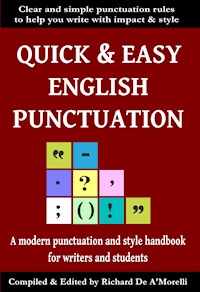
Learn how to use commas, semicolons, and other punctuation correctly. This essential handbook for writers and students presents a well-organized collection of English punctuation rules and simple examples that will help you write with impact and style.
Punctuation is more important than you might think. It allows your words to tell their story. These small but crucial marks in your sentences are like road signs; without them, readers can get lost in a jumble of words. Learning basic rules of punctuation is a must if you want to write well. Fortunately, the rules are easy to learn, and you will find many helpful shortcuts in this new book.
The author, a distinguished editor with thirty years of experience, offers bite-size tutorials and simple advice on how to use commas, parentheses, dashes, and other punctuation marks in all kinds of writing, both fiction and nonfiction. In addition to learning easy rules to help you correctly punctuate whatever you write, you will discover that these rules are not set in stone—you can rearrange your sentences and use punctuation creatively to make your writing more concise and interesting.
Quick & Easy English Punctuation is aimed at these readers who may benefit from this useful guide:
-- Writers of all skill levels will learn how to recognize and fix punctuation errors in their manuscripts, and how punctuation can be used creatively to add clarity and sparkle to their sentences.
-- Students can use these rules to correctly punctuate term papers and other academic writing.
-- Teachers can use this book to help students quickly grasp basic concepts of English punctuation.
-- ESL/EFL learners will benefit from the many short, easy-to-understand examples featured in the book.
-- Employees can follow these rules to create punctuation-perfect reports, manuals, and other documents in the workplace.
Read any chapter of this book, follow the simple rules, and you will see a fast improvement in the quality of your writing. Read a chapter a day, and in two weeks, you should have a solid understanding of punctuation and be able to add a touch of style and polish to everything you write.
This handy desktop reference expands on the author’s bestselling writing guide, Elements of Style 2017. It includes material drawn from that book but delves deeper into punctuation, providing more examples and an additional eighty pages of content. Once you have mastered the concepts in this book, you may wish to read Elements of Style 2017, which offers a comprehensive primer on English grammar, available in e-book and paperback editions at major booksellers worldwide.
Das E-Book können Sie in Legimi-Apps oder einer beliebigen App lesen, die das folgende Format unterstützen:
Seitenzahl: 187
Veröffentlichungsjahr: 2017
Ähnliche














Quick & EasyEnglishPunctuationCompiled & Edited byRichard De A’Morelli
Spectrum Ink Publishing
“Tomorrow’s Great Classics Today”
Quick & Easy English Punctuation
Copyright © 2017 by Spectrum Ink Publishing
Published simultaneously in Canada & the United States
First Edition: 11 February 2017
All rights reserved worldwide under U.S., Canadian, and international copyright treaties. No part of this book may be reproduced or transmitted by any means including photocopying, scanning, or digital reproduction. This content may not be posted on any blog, website, or social network without the publisher’s knowledge and written consent, except for brief quotations embodied in critical articles and reviews.
The views expressed in this work are solely those of the author and do not necessarily reflect the views of the publisher. The publisher hereby disclaims all such views and statements.
ISBN numbers:
978-1-988236-21-6 ~ mobi
978-1-988236-50-6 ~ paperback
Spectrum Ink Canada
Vancouver, British Columbia
Spectrum Ink USA
San Luis Obispo, California
Online:
http://vu.org/books
What This Book Will Do for You
Punctuation, often misused or dismissed as trivial by many writers, is more important than you might think. It allows your words to tell their story. These small but crucial marks in your sentences are like road signs; without them, readers can get lost in a confusing jumble of words. Learning basic rules of punctuation is a must if you want to write well. Fortunately, the rules are easy to learn, and you will find many helpful shortcuts in these pages.
This book is intended as a desktop reference on English punctuation for writers, college students, ESL learners, and those in the workplace who are called upon to create well-written documents. It offers bite-size tutorials and simple advice on how to use commas, semicolons, and other punctuation marks in all kinds of writing, both fiction and nonfiction. It also will teach you that punctuation rules are not set in stone; rather, you have choices. You’ll discover that you can rearrange your sentences and use punctuation creatively to make your writing more interesting.
Quick & Easy English Punctuation is aimed at these readers who may benefit from this useful guide:
✔Writers of all skill levels will learn how to recognize and fix punctuation errors in their manuscripts, and how to use the various marks to add clarity and sparkle to their prose.
✔Students can use these rules to correctly punctuate term papers and other academic writing.
✔Teachers can use this book to help students learn basic concepts of punctuation without the stress and tears.
✔ESL/EFL learners will benefit from the many short, easy-to-understand examples provided in the book.
✔Employees can follow these rules to create well-written reports, manuals, and other documents in the workplace.
Read any chapter of this book, follow the simple punctuation rules, and you will see a fast improvement in the quality of your writing. Read a chapter a day, and in two weeks, you will be sufficiently adept in punctuation that you’ll be able to add a touch of style and polish to everything you write.
This book expands on the author’s bestselling writing guide, Elements of Style 2017. It includes material drawn from that book but delves deeper into the subject of punctuation, providing more examples and an additional eighty pages of content. Once you have mastered the concepts in this book, you may wish to continue on to Elements of Style 2017, which offers a comprehensive primer on English grammar.
Acknowledgments
The content in this book is comprised of original material remixed with updated and revised content drawn from a variety of copyrighted sources used with permission, and public domain materials including: Practical Grammar and Composition (Thomas Wood); English Punctuation by Benjamin G. Benedict; A Practical Handbook for Writers and Students by Paul Allardyce; NARA Style Guide (National Archives); Guide to Marking Written Assignments (Ian Johnston); EIA Writing Style Guide (U.S. Energy Information Administration); and Government Printing Style Manual (2008 ed.).
Cover graphic elements licensed from Adobe Stock Photos.
This book makes frequent references to The Chicago Manual of Style (16th Edition) and AP Stylebook for writers of American English; and to Oxford Style Guide for writers of British English. Examples and discussion on stylistic differences are provided throughout the book. This current work is not intended as a substitute for any of these style guides. It may be used as a learning tool and a quick-reference alternative, but editors and publishers should rely on the latest version of their preferred style guide as the final authority.
Table of Contents
Chapter 1: Why Punctuation Matters
Chapter 2: The Full Stop (Period)
Chapter 3: The Comma
Chapter 4: The Semicolon
Chapter 5: The Colon
Chapter 6: The Question Mark
Chapter 7: The Exclamation Point
Chapter 8: Dashes and Hyphens
Chapter 9: The Ellipsis
Chapter 10: Parentheses & Brackets
Chapter 11: Quotation Marks
Chapter 12: Apostrophes
Chapter 13: Other Symbols
Conclusion
Glossary
About the Author
More Books from Spectrum Ink
Chapter 1
Why Punctuation Matters
“The night is falling down around us. Meteors rain like fireworks, quick rips in the seam of the dark... Every second, another streak of silver glows: parentheses, exclamation points, commas —a whole grammar made of light.”
Jodi PicoultMy Sister’s Keeper
Many writers assume that grammar is boring and punctuation is trivial. In reality, grammar is the mortar that holds your words together in a coherent fashion, and punctuation is the finishing touch that makes good writing great and written language more effective by allowing words to tell their story. The lowly commas, periods, and other marks inserted into your sentences are like road signs; without them, readers would get lost in a confusing jumble of words. Punctuation directs the reader's eye from word to word, from one sentence to the next, indicating thoughtful pauses by commas, graceful transitions to new thoughts by periods, interrupted action by dashes and ellipses, queries raised by question marks, anger and surprise by exclamation points, and more. By using these marks artfully, you provide a window into your thoughts and the inner sanctuary of your mind where the winds of creativity blow; where you hear the whispered pauses and stops in your narratives and dialogue, represented by the punctuation marks that you write into your sentences.
Author and literary agent Noah Lukeman observes in A Dash of Style: “There is an underlying rhythm to all text. Sentences crashing fall like the waves of the sea, and work unconsciously on the reader. Punctuation is the music of language. As a conductor can influence the experience of the song by manipulating its rhythm, so can punctuation influence the reading experience, bringing out the best (or worst) in a text.”
Without punctuation, everything we write would be susceptible to ambiguity and misinterpretation. Even when punctuation is used, but it is used incorrectly, readers are at risk of serious misunderstandings. You might think short sentences would have clear meanings, but just a few words can be perplexing if punctuated incorrectly. Consider this example, where the meaning is quite different, depending on whether two commas are used or omitted:
The prisoner said the witness was a despicable thief.
The prisoner, said the witness, was a despicable thief.
Many hilarious examples of short sentences with flawed or missing punctuation have been featured in memes shared on social networks. Here’s another:
Let’s eat Grandma! I’m starving!
Poor Grandma. For lack of a comma, she is at risk of becoming someone’s dinner. When we insert the missing comma, grandma’s fate is brighter.
Let’s eat, Grandma! I’m starving!
Punctuation as it is used today is a relatively recent innovation. The invention of the printing press made it necessary to have a well-defined system for using the various marks that had existed for centuries. Previously, the personal preferences of scribes had determined how these marks were written. With the dawn of an era in which books could be reproduced faster and more easily than by hand copying came the need for a systematic approach to recording and sharing the written word. A widely understood system of punctuating those writings to enhance clarity was also a necessity.
Early writings dating back to the dawn of the Latin alphabet, which was introduced by the Etruscans in the eighth century BCE, contained strings of letters with no spacing between words or sentences, and no punctuation marks of any kind. The first such mark to be used was the dot, or period. Its purpose was to provide a resting place for the eye and to help a little in grouping the letters into clauses and sentences. It was used at the end of a sentence, to indicate abbreviations, and as an aesthetic ornament between the letters of an inscription.
Later, during the manuscript period, a variety of marks and systems of pointing came into use. For a considerable time, the location of the dot indicated its force. Placed high, it had the force of a period. Placed in a middle position (·) it had the force of a comma. Placed low (.) it had the force of a semicolon.
The invention of the printing press by Johannes Gutenberg (c. 1398- 1468), a German blacksmith, heralded new requirements. The early printers were scholars too, and for years, their main concern was the sharing of ancient writings with the world, so they had to be the students, critics, and editors of the old manuscripts they printed. They borrowed most of their punctuation from Greek grammarians, but sometimes adapted the meanings. The semicolon, for instance, is the Greek mark of interrogation, or question mark.
The punctuation marks now in use, and that we will discuss in this present book are:
1. Full stop: marks the end of a sentence
2. Comma: separates clauses and phrases
3. Semicolon: separates different statements
4. Colon: the transition point of the sentence
5. Question mark: asks a question for an answer
6. Exclamation point: expresses surprise, shock, or anger
7. Dash: marks abruptness or irregularity, indicates range
8. Hyphen: breaks words; also forms compound words
9. Ellipsis: indicates omission from a quoted passage
10. Parentheses: enclose interpolations in the sentence
11. Brackets: enclose irregularities in the sentence
12. Quotation mark: sets off quoted words and passages
13. Apostrophe: marks elisions and the possessive case
14. Other symbols widely used in contemporary writing
Two systems of punctuation are used in the English language: the open system, sometimes called the easy system, and the close system. The open system omits points wherever possible, and it is used in common forms of composition. The closed system uses points wherever possible and when such points are of importance in precise composition of every sort, such as contracts and legal documents. The tendency today, sometimes pushed too far, is toward an extremely open style of punctuation. The general attitude of writers is that you must justify the use of a punctuation mark rather justify its omission.
The chapters in this book provide a detailed overview of the functions of punctuation marks and everyday rules for their use. These rules are flexible, though, and they are useless if not applied intelligently. No set of rules could ever be devised that would work in every situation or relieve the writer, editor, or proofreader from the necessity of thinking. Writing and editing cannot be reduced to an exact science, and the same applies to proofreading and the use of punctuation.
In addition to the rules of grammar and punctuation, so-called style rules help writers aim for consistency and high quality in their prose. These rules clarify a wide range of issues, from rules on capitalization and punctuation, to hyphenating compound nouns and questions on whether to use commas, parentheses, or dashes to set off a particular clause. Style rules fill in the gray areas that exist because grammar rules tend to be broad.
The goal of style is to enforce consistency—a must for writers who wish to make a favorable impression on readers and express written ideas in the clearest manner possible. For instance, every major style guide includes a rule that advises how numbers should be written. The most widely used handbook, The Chicago Manual of Style, recommends that numbers up to one hundred inclusive should be spelled out, and numbers over one hundred should be written as digits. So, we would write: The alphabet has twenty-six letters, and a year has 365 days.
When we stray from consistent adherence to style rules, we may end up with a haphazard jumble of digits and spelled-out numbers as in the following passage:
✘Nine men stood by the wall, and 4 women stood next to the 2 cars. When the police approached the 9 men, they scattered, and the four women jumped into the two cars and sped away.
The lack of consistency in the way that the numbers are handled in the above sentence detracts from the clarity and overall quality of the writing and should always be avoided. Let’s rewrite the sentence using Chicago Style, spelling out the numbers, and we will eliminate the unnecessary repetition of those numbers in the second sentence. The result flows considerably better:
☺Nine men stood by the wall, and four women stood next to the two cars. When the police approached the men, they scattered, and the women jumped into the cars and sped away.
Some novice writers believe that following style rules is unnecessary, and diligent self-editing and proofreading aren’t important—after all, it’s the story that counts, right? But that’s not the case. Reader surveys confirm that today’s book buyers expect published material to be well-written and edited, with few or no typos. Self-published books thrown up on Amazon.com with little attention given to editing typically sell poorly and receive negative reviews from readers.
Numerous writing style guides exist today. The most popular include The Chicago Manual of Style, the bible of editors in fiction genres and relied upon by some nonfiction publishers too; AP Stylebook, used by most journalists who write for news publications and websites; APA format, developed by the American Psychological Association and used in education, psychology, and social science writing; MLA Style, an academic style used in the humanities and English studies. In the United Kingdom, the principal authority on style is The Oxford Style Guide. Other lesser known style guides are used today in government, academia, science, and in the publishing industry.
Style guides are filled with rules on grammar and punctuation. A professional editor may spend months learning the nuances of these rules. This presents a high bar for writers who want to submit a manuscript to a publisher with the imprimatur of being cleanly edited and proofread, and for those who wish to self-publish but cannot afford the expense of an editor or proofreader. Adding confusion to mix, some of the advice given by the leading style guides is contradictory. For instance, Chicago Style requires the use of the serial or Oxford comma, while AP Style advises against it. So, if you are editing to AP Style and use a serial comma, it’s an error; if you are following Chicago Style and don’t use a serial comma, that’s an error. Some writers today don’t even know what a serial comma is! For the sake of clarity, it is a comma placed before the coordinating conjunction in a list of three or more items. The first sentence below has a serial comma after pencils; it is omitted in the second sentence.
Chicago Style:
She bought pens, pencils, and paper.
AP Style:
She bought pens, pencils and paper.
Similarly, Chicago Style and AP Style both require that the period at the end of a dialogue passage be placed inside the closing quotation mark. But Oxford Style advises that the period should be placed outside the closing quote mark as shown below:
Chicago and AP Style:
Mary said, “Some of these rules are confusing.”
Oxford Style:
Mary said, “Some of these rules are confusing”.
Ultimately, whichever style manual you follow, study the guidelines and then diligently adhere to them to achieve consistency throughout the creative process of writing, editing, and proofreading. Unlike grammar, which gives us a set of rules that generally should not be broken, style rules are more flexible and, to some extent, reflect the preferences of individual publishers (house rules). These guidelines help us decide when to spell numbers, whether to use serial commas, which words should be capitalized or hyphenated, and address many other small but essential questions.
At the same time, it’s important to recognize that style guides may differ, and no two editors will ever produce the same result, even if they both follow the same rules, because editing, like writing, is a creative process that involves some degree of subjectivity. Even so, adhering to style rules will enhance readability and give your work the finished quality and polish your readers will likely expect and will certainly appreciate.
Good writing is built on patterns, so whether you are writing a news story, a press release, a science fiction novel, or a sizzling love story, develop a consistent writing style and stay with it. Don’t refer to an iPhone in one paragraph, a cell phone in the next paragraph, and a mobile device on the following page. Switching back and forth does not add interest to your prose; it merely confuses readers and makes it more difficult for them to follow what you are saying.
These next chapters will introduce you to the basic rules of English punctuation and capitalization. If you apply them consistently, your writing quality will quickly improve. On that note, let’s begin this learning adventure!
Chapter 2
The Full Stop (Period)
“Punctuation marks are the traffic signals of language: they tell us to slow down, notice this, take a detour, and stop.”
Lynne Truss
Eats, Shoots & Leaves
The full stop, or period, is the simplest punctuation mark in the English language. It marks the end of a statement or command that forms a complete sentence. Of Greek origin, it came into use around 300 BCE. The term period became popular in the eighteenth century when printers began using it to refer to a full point—a dot on the baseline of printed matter. By the 1800s, it was synonymous with full stop in British English. Today, the term is used more commonly in American English. Besides terminating a declaratory sentence, the period has a number of other uses as described below.
2.01 Every full sentence that is not an interrogatory (a question), exclamatory (expresses surprise, anger, or shock), or an interrupted thought (see Rule 2.07), must be terminated with a full stop.
2.02 Sentences and main clauses should not be run together without a clear and appropriate break between the end of one main independent idea and the start of the next one. This error creates a run-on sentence, or fused sentence, a basic punctuation error that can cause ambiguity and confusion for readers.
The first example below is a run-on sentence because it lacks a clear break between the two main ideas. The reader cannot tell where exactly the first idea ends and the second idea begins. In the second sentence, a full stop is placed at the end of the first complete idea.
✘We arrived at the crime scene first an hour later, the police drove up.
☺We arrived at the scene first. An hour later, the police drove up.
2.03 Use a full stop after a single word that stands as a sentence; for example, a short reply to an interrogatory, such as Yes, No, and Maybe.
“Yes. I ate the ice cream.”
2.04 As a general rule, do not insert a period until the sentence is grammatically complete. But some parts of the sentence may be implied or left for the reader to fill in.
Roman emperor Marcus Aurelius observed: “Very little is needed to make a happy life; it is all within yourself, in your way of thinking.” Great thinker. Great saying.
The phrases Great thinker and Great saying arenot complete sentences but are treated as such and terminated with a full stop because each phrase implies a complete idea that the reader will grasp. Sentence fragments such as these should be avoided in formal and technical writing, but they are used in fiction and casual forms of writing.
2.05 Use a period after an indirect question (a question meant as a suggestion or declaratory statement where no answer is expected). When the indirect question is exclamatory, as in the fourth sentence reflecting indignation, an exclamation point may be used instead.
What did you expect me to say.
Will you shut up.
May we have your attention.
Just who do you think you are!
2.06 Do not use a period after a quotation mark that is preceded by another terminating mark, such as a period or a question mark.
✘Mary said: “Hurry up or we will leave without you.”.
☺Mary said: “Hurry up or we will leave without you.”
✘The teacher asked, “What is your problem?”.
☺The teacher asked, “What is your problem?”
✘Jim frowned and mumbled, “But I thought…”.
☺Jim frowned and mumbled, “But I thought…”
2.07 When a sentence is deliberately interrupted or left unfinished, a dash or ellipsis may be used in place of a full stop. Generally, use a dash to indicate abrupt interruption, and an ellipsis to indicate that the sentence trails off.
Sentence ends abruptly; use a dash:
The doorbell rang, and when Jill opened the front door, she shouted, “No! How can you be—”
Sentence trails off; use an ellipsis:
The doorbell rang, and when Jill opened the front door, she whispered, “Oh, it’s you…”
2.08 Do not place a period at the end of a sentence if the last word in the sentence is an abbreviation that also ends with a period.
✘The product was manufactured by Alcoa Inc..
☺The product was manufactured by Alcoa Inc.
2.09 Use a single space after the full stop between sentences. Double spacing after sentences was common back in the day of typewriters, but today, this practice is considered by most to be old-fashioned and should be avoided.
2.10 When writing time expressions, use a colon to separate the hours and minutes, and follow the numbers with a.m. or p.m. Some style guides indicate that A.M. and P.M. are acceptable, or the periods may be omitted from the upper case letters, as in 8:30 AM. Do not use lower case letters without periods, since am




