


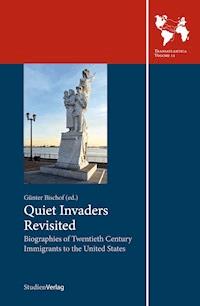
Quiet Invaders Revisited E-Book
Erhalten Sie Zugang zu diesem und mehr als 300000 Büchern ab EUR 5,99 monatlich.
- Herausgeber: StudienVerlag
- Kategorie: Geisteswissenschaft
- Serie: Transatlantica
- Sprache: Englisch
Österreichische Einwanderung in die USA Die vorliegende Publikation beleuchtet das Thema der Migration von Österreichern in die USA genauer, das bis heute ein immer noch sehr unerforschtes Gebiet ist. Seit kurzer Zeit erlebt die Forschung allerdings einen neuen Aufschwung, es herrscht großes Interesse vor allem in der Biografieforschung. Die vorliegenden Beiträge basieren auf einer Tagung, die im Juni 2015 in Wien zum gleichnamigen Thema stattgefunden hat. Es handelt sich hauptsächlich um Fallstudien über emigrierte Österreicher, die ihre Heimat aus wirtschaftlichen, politischen oder karrieretechnischen Gründen verlassen haben. Alle mussten sich mit einer schwierigen Einwanderungspolitik der USA auseinandersetzen, trotzdem ist den meisten von ihnen eine erfolgreiche Integration in die amerikanische Gesellschaft gelungen. ************************************************************************************** The essays in this book argue that the United States served as a great attraction for economic betterment to Austrian migrants before and World War I; yet a third of these migrants actually remigrated. Remigration was less likely after World War I as the economic situation deteriorated in Europe and the political situation landscape became desperate for Jews and the opponents of the Hitler regime. Most of the Austrians migrating to the U.S. in the World War II era stayed. For the roughly 30,000 Jews who had been brutally kicked out of their homes after the "Anschluss" and managed to snag immigration papers to the U.S., returning to desperately poor and still anti-Semitic Austria was not an option. These case studies show that integrating and assimilating into the American mainstream often was a difficult process that might take two generations. Many of the intellectuals and academics never fully felt at home in the U.S. as they viewed American culture shallow and American values too materialistic.
Sie lesen das E-Book in den Legimi-Apps auf:
Seitenzahl: 720
Veröffentlichungsjahr: 2017
Das E-Book (TTS) können Sie hören im Abo „Legimi Premium” in Legimi-Apps auf:
Ähnliche




















TRANSATLANTICAGünter Bischof, Editor
Volume 11: Günter BischofQuiet Invaders RevisitedBiographies of Twentieth Century Immigrants to the United States
Günter Bischof (ed.)
Quiet Invaders Revisited
Biographies of Twentieth Century Immigrants to the United States
StudienVerlag
InnsbruckWienBozen
Table of Contents
Introduction
Günter Bischof
“Quiet Invaders” Revisited: Austrian Immigration to the United States
I. Austrian Migration to North America: The Larger Trajectories
Annemarie Steidl/James W. Oberly
The Transatlantic Experience: Migrants from Austria-Hungary in the United States, 1870–1930
Andrea Strutz
Austrian Immigration to Canada and Contributions of Austrian Migrants to Canadian Life in the Twentieth Century
Brooke Penaloza Patzak
Anthropologist Leo Frachtenberg and the Politics of Biting Your Tongue in World War I America
Philipp Strobl
The Origins of ‘Little Burgenland’: A Close Look at Austria’s Most Important Area of Emigration, 1900–1930
II. Austrian Emigrants/Refugees after World War I: Escaping Economic Hardship and/or Political Persecution
Katharina Prager
Berthold Viertel – A Migration Career and No Comeback in Exile
Vera Kropf
The Agent with the Typewriter: Ilse Lichtblau Lahn – An Invisible Invader in Hollwood. Outline of a Story in Three Acts
Dominik Hofman-Wellenhof
Ruth Klüger’s and Frederic Morton’s Assimilation to America – A Success Story?
Stefan Maurer
“Living with Austrian Literature”: The ‘Austrian Literature Association’ and the Émigré Germanists in the United States
Janek Wassermann
Beyond Hayek and Mises: The Preservation of an Austrian School of Economics in America
III. Austrian Refugees/Migrants in the World War II Era: Staying or Returning?
Robert Lackner
“You did not have to feed me, nor to clothe, nor to educate me; I came complete”: Dietrich W. Botstiber’s Escape from the City of Music
Theresia Klugsberger
Hans Habe’s American Years
Hartmut Krones
Writing Hollywood’s Music: Hanns Eisler
Kerstin Putz
Improvised Lives: Günther Anders’s American Exile
Berthold Molden
Of Secret Wars and Quiet Invasions: How Friedrich Katz Wrote His Way into America
Alexander Pinwinkler
An Austrian Catholic Mission in America: P. Thomas Michels OSB (1892–1979) and the Legitimist Movement in the United States and the Early Second Republic
Martina Kaller
The American Way of Life As Seen Through the Lenses of Ivan Illich (1926–2002)
Eva Maltschnig
“I just had to answer to him”: Exploring the Marriages of Austrian War Brides
IV. Conclusion
Volker Depkat
The Challenges of Biography and Migration History
List of authors
Introduction
“Quiet Invaders” Revisited: Austrian Immigration to the United States
Günter Bischof
Arnold Schwarzenegger is a larger than life character, whose spectacular career in California as a body-building world champion, Hollywood superstar, and two-term governor of California has made him the most recognizable Austrian immigrant to the U.S. “Ah’noold’s” swachbuckling presence in the American media and around the world has made him the quintessential Austrian-American. Nothing has been quiet about Schwarzenegger’s presence in the United States.1 Others like the spectacularly successful biochemist Norbert Bischofberger have been more quiet and modest about their success as Austrian immigrants to the U.S., even though, with a lesser public persona, their accomplishments may be bigger than Schwarzenegger’s.2 The life stories of such individual Austrian immigrants to the U.S. and the enormous “breaks” in their lives may tell us more about Austrian immigration to America than the social history of mass migration.3
The Austrian Annemarie Steidl, the German Wladimir Fischer-Nebmaier, and the American James W. Oberly have recently authored a major new study on migration from the Austro-Hungarian Empire in the late 19th and early 20th centuries.4 They stress the point that the peoples of the Habsburg Monarchy often first migrated within the empire to find better job opportunities and seeking a better life. Many, however, made the bold step and crossed the Atlantic, too. In fact, some 3,7 million migrants from the Habsburg Monarchy came across the Atlantic between 1880 and 1914 (altogether 4 million from 1819–1910); in the first decade of the 20th century, migrants from Austria-Hungary were the largest group among immigrants to the U.S., with some 1,7 million migrants from the Habsburg Monarchy coming to the United States; constituting almost 28 percent of the immigrant population during this decade, this was the largest cohort of immigrants to the U.S. Based on careful demographic studies both of Austrian and Hungarian sources, as well as American immigration and extensive shipping records, these numbers are the best approximations we are bound to have.
The “new immigrants” coming after 1880 were mostly Slavs (South Slavs, Poles, Slovaks, Ukrainians), and Hungarians and settled in the booming big industrial cities of the East and Midwest, providing cheap labor for industrializing America; before that time, most migrants to America from the Habsburg lands had been Bohemians going to the agricultural frontiers in the West, Germans (from Vorarlberg and Tyrol), and Jews.5
The trio of authors quickly insist, however, that they are not writing a traditional history of e/immigration to the United States. Their focus is the transatlantic migration of these masses of people, which often included multiple crossings of the Atlantic, almost like seasonal laborers. A considerable number of these “transnational people” were interested in return migration – 40 percent of return migrants make this number much higher than one would expect. In other words, they did not conceive of their migration to America as a move to the “promised land,” as American exceptionalism would have it. Rather, these migrants came to work for a few years in back-breaking yet well-paying industrial jobs, only to return to the olden country, buy a piece of land, and live happily ever after.6
Our three authors are not so much interested in the assimilation and acculturation of these migrants but rather how “identity managers” within their communities tried to help them maintain their traditional old world identities in the new world. The “Americanization” process of these migrants, then, was slow and twisted and took three generations to accomplish, if they stayed in the U.S. While our authors are interested in upward mobility, there is no talk about making it into the “middle class” (traditionally the end point of immigrants in achieving the “American dream”).7
The mass of these diverse migrants from the lands of the Habsburg Monarchy were “sojourner workers” and changed jobs often, when working for the gigantic American steel and car corporations. They were thinking humans and did not want to do the work of mindless “oxen” as American managers had envisioned for them. They lost jobs often during economic slumps in the boom-and-bust American economy. The second generation might make it “from-rags-to-respectability” but few advanced “from-rags-to-riches.” Most sent much of the money earned in the U.S. back to their families as remittances.8
Steidl, Fischer-Nebmaier, and Oberley for their “macro-level” migration study (see Depkat in this volume) utilize the massive data of modern quantitative research methods to follow marriage patterns among migrants from the Habsburg Monarchy. They find that in the first and even second generation (“cohort”) few married outside their traditional ethnic and religious groups. Only in the third generation did half of them marry Americans and people outside their group. Jews married Jews, Czechs married Czechs, etc. – you get the idea.9
Previous scholarship on immigrants to the United States from the late Habsburg Monarchy and post-World War I Austria, had been methodologically less sophisticated. In 1968 the American cultural diplomat E. Wilder Spaulding, who worked in the U.S. Embassy in Vienna for many years, presented a broad analysis of (German-)Austrian immigration to the United States from the first Salzburgers who came to Georgia in the 1730s to the large Jewish exodus in the World War II era. He was mainly interested in the “pull factors” – what brought Austrians to the U.S.? Spaulding was very interested in the rapid assimilation into American society of these Austrians. He argued that in general they were educated and learned English quickly and therefore became Americans easily. Austrians tended not to associate in fraternal societies and never formed a strong ethnic lobby to pressure Congress on behalf of Austrian issues. He concluded: “they constituted – quite unlike so many other peoples who came here to shout the achievements of their homelands and of their compatriots from the housetop – the quiet immigration.”10
Based on Austrian records and shipping records, Johann Chmelar has studied the emigration from Austria-Hungary from 1900 to the eve of World War I. His is a traditional study of statistical/demographic analysis, isolating especially the “push” factors that made poor people from agricultural Galicia and Dalmatia look for better opportunities in the new world.11 Such scholarship is often comparative with various ethnic groups from the late Danubian Monarchy being juxtaposed in their experiences in America.12 The entry on “Austrians” in The Harvard Encyclopedia of American Ethnic Groups “buys” Spaulding’s notion of Austrian as “quiet invaders.” It covers the terrain from the “Salzburgers” – the first Austrian group of some 50 families to come the U.S. in 1734 into rural Georgia were Protestant expellees from the Catholic Archbishopric of Salzburg – to the trickle of Austrians who came to the U.S. in the 1970s.13 Recent scholarly discourses on immigration have concentrated on the issue of race and the degree of “whiteness” of immigrants. Slavs and Jews migrating from the Habsburg Monarchy to the United States (like Irish and Italian immigrants to the U.S.) were not considered “white” upon arrival. Being judged “white” mattered since a 1790 Act of Congress allowed only “free white” immigrants to be naturalized. Citizenship came with being deemed Caucasian – “whiteness” like all racial categories was constructed.14
We have studies characterizing the local factors that contributed to the emigration to the U.S. of people from individual states (Bundesländer), like the Vorarlbergers, Carinthians, or Burgenländers.15 There are also individual testimonies such as the diary of a man from the Tyrol who joined the “gold rush” to California in the early 1850s.16 Particularly the cohort of Burgenländers leaving their impoverished province newly attached to Austria after World War I has attracted considerable scholarly attention.17 There was a huge exodus of Jews and anti-Nazi non-Jews in the World War II era. Quite a few of them (like Hans Habe in this volume) joined the US Army and came back to Europe fighting the Nazis.18 The most vigorous scholarship on Austrian “migrants” to the United States has been the field of Jewish refugees and exiles who left Austria to save their lives, or were expelled from Austria during the Nazi period/the World War II era.19 This scholarship is often very detailed in terms of the specific groups of refugees that were kicked out of Austria after the March 1938 “Anschluss” and the scholarly and artistic contributions they made to the American society.20 The Vienna historian of science Friedrich Stadler has made rich contributions in this field as a scholar and scholarly manager of research and organizer of conferences.21
The scholarship on the “scientific emigration” is also very sophisticated in its methodologies. The Graz sociologist Christian Fleck has authored two major monographs on the exodus of well-known social scientists and economists from Austria, as well as the international aid societies that often helped these scholars find new places “to establish” themselves in new work places in Great Britain and the United States.22 In his latest book he has also touched upon individual life stories to map out the difficult terrain for refugee scholars to find a footing in the new world – the famous sociologist Karl Lazarsfeld being one of them.23 Such individual biographies of well-known Austrian immigrants present a more complex and diffuse picture of the migration process – some failed and even committed suicide, while others succeeded.24 Individual immigrant lives of major figures have even generated full-fledged biographies.25 Successful immigrants who made a good living in the U.S. have penned autobiographies and stressed the many stresses and paradoxes of immigrant lives.26 Many of the portraits in this volume will map such lives and their difficult processes of making it in the United States. Günther Anders has written eloquently about the “ignominy” and the many “break-downs” of World War II era emigrants on the run from place to place: “as it fell to us to be hunted from one world in which we found ourselves beached to the next and as we were forced to soak up new content again and again, content that the previous one bore no relation to, these stretches of time, each linked to a different world, have now come to lie across each other.”27
Nicole M. Phelps recently has penned a major study of U.S. relations with the Habsburg Empire from 1815 to 1918. While her study focusses on diplomatic relations, her two chapters on consular relations frequently deal with migration issues. As migration from the Habsburg crown lands increased to the U.S. in the late 19th century, so did return migration. American consuls in Austria soon had to deal with the protection of American citizens who returned to their native lands. Some were arrested for crimes they had committed before their emigration, many others were pressed by Habsburg authorities into military service, especially on the eve of, and during, World War I. American consuls often grappled with citizenship issues, especially the problems of dual citizenship. As travelling became cheaper and more comfortable, thousands of emigrants from the Monarchy returned to their native lands for business or personal reasons. She concludes her study with a devastating critique of Woodrow Wilson’s diplomacy towards the Dual Monarchy during World War I and calls the Wilson administration the “gravediggers of the Habsburg Monarchy.”28 World War I indeed was the turning point in Austrian(-Hungarian) migration to the U.S. as new American quota laws passed by Congress in 1921 and 1924 reduced mass migration to a trickle after the war and ended the era of mass migration to the United States as this study suggests too.29 We note that considerable scholarly attention has been given to Austrian migrant cohorts and individuals coming to the U.S. Yet this scholarship is often in far flung places and never has been fully integrated into a major study like this one.
Here are short cameo summaries, then, of individual Austrian immigrant biographies to the United States portrayed in this volume, representing the “micro-level” of the larger migration narrative (see Depkat’s essay in this volume).30 They demonstrate above all that the process of assimilation/acculturation/incorporation/ integration into American society was a varied, drawn-out and often difficult one; immigrants had to “negotiate a new identity” and few managed to adjust as “quietly” as Spaulding’s work suggested almost 50 years ago.31 These “negotiations” in order to fit into the American fabric were often messy, as immigrants encountered nativism (or anti-semitism), McCarthyite anti-communism, and language barriers – many had a hard time learning the English language to perfection. Some managed to marry rich heiresses and adjusted well, others gave in to their failings to adjust and chose to return back to Europe after the war. High rates of remigration always were a good indicator that the “negotiations” towards adopting a new identity did not work out so well.
Annemarie Steidl’s and James W. Oberly’s chapter is a summary of their much larger study about Austrian(-Hungarian) migration to the United States from the post-Civil War era to the eve of World War II.32 In their state of the art research based on archival records from all over the late Dual Monarchy, to shipping records, American national, regional, and local archival files, along with the careful study of U.S. census records, especially the University of Minnesota’s machine-readable massive microdata sets, they have been fine-tuning our knowledge of Austrian migration to the United States. On the one hand they present more precise data of Austro-Hungarian migration to the eve of World War I, showing that with well over a million ethnic migrants from the Dual Monarchy in the decade before World War I were the largest immigrant cohort to the U.S. While prior to this vast exodus Czechs from Bohemian and German speakers from Vorarlberg were the largest Austro-Hungarian immigrant cohorts, after 1900 it was mostly Poles, Ukrainians and Jews from the province of Galicia in the Austrian half, as well as Slovak, Hungarian and South Slav ethnics from the Hungarian half of the Habsburg Empire. Nearly two thirds of the migrants to the U.S. were men (most of the young), with the exception of Ukrainians and Croats they had high literacy rates. On the other hand they give us an appreciation of the significance of return migration, as before the eve of World War I up to 35 percent of Austro-Hungarian migrants returned home for short- or long-term stays – migrants from the Hungarian half in slightly larger numbers. They also show how 41 percent of migrants from the Monarchy became naturalized citizens of the U.S. in 1900, and a growing number after World War I (almost 65 percent by 1930).
Andrea Strutz is the rare scholar who is studying Austrian migration to Canada. For most of the migrants from the Habsburg Monarchy Canada was not the migration destination of first choice – most preferred to head for the United States. Before 1900, only some 25,000 people from the Monarchy migrated to Canada. But when the Western frontier provinces were looking for settlers after 1900, 232,000 migrants from the Dual Monarchy headed for Canada. Between 1876 and 1910, 3.55 million Austro-Hungarian migrated overseas (80 percent of them to the U.S., 8 percent to Canada, 5 percent to Argentina). After World War I and into the World War II era, exclusionary Canadian immigration policy stopped the migrant/refugee flow from Austria almost entirely. After World War II, some 24,000 Austrian migrants entered Canada until 1957, most of them economic migrants (the years 1950 to 1957 seeing the bulk of Austrian immigration to Canada). In two fascinating case studies based on oral history interviews, Strutz presents the immigration stories of two Austrian immigrants. The Jewish refugee from Vienna Josef Kates (born Josef Katz) entered as an “enemy alien” in 1940 and had to suffer through 2 years of internment before he was allowed to study. With a PhD in physics from the University of Toronto he became one of Canada’s great pioneers in computer science and a celebrated scientist and university president. The Vienna artist Ernestine Tahedl with a degree from the Vienna University of Applied Arts came to Canada in 1963 to embark on a lucrative career as an artist with a specialty in the traditional skill of stained glass. Both these life stories tell us that the immigration and integration into Canadian life trajectory of immigrants depended largely on the context of time and place, when they entered and where they started their careers.
Brooke Penaloza Patzak’s story of the linguist Leo Frachtenberg is a curious and complex tale on an “Austrian” adjusting to America in the World War I era. Frachtenberg was born in Cernowitz and emigrated to the U.S. in 1904, part of the vast cohort of Jews from Galicia that were looking for a better life in the U.S. He studied with the famous German-born anthropologist Franz Boas at Columbia University, specializing in native American languages. After obtaining his PhD he became a citizen in 1912 and married an American woman. Boas set him up with the prestigious Bureau of American Ethnology in Washington, D.C., part of the Smithsonian Institution. World War I turned out to be a game changer for Frachtenberg. He made some ambiguous statements about Germany during the war that suggested he might harbor dual loyalties. With America’s entry into the war in 1917, hyphenated German-Americans/Austrian-Americans became suspicious, especially if they maintained a nuanced understanding of the war, which might have suggested to some a lack of patriotism. Some of his co-workers suggested that Frachtenberg was “unpatriotic” and maybe even “treasonous” (some of his antagonists may have been anti-semites too). He was fired from his position and never really recovered from this humiliation. Even before the FBI was founded, a similar organization in the Justice Department demanded 100 percent Americanism and foreshadowed another era after World War II, when putative “communists” like Hanns Eisler were ejected from the country (see below). Frachtenberg apparently was a loud and contentious man and thus does not fit the model of “quiet invader.”
Philip Strobl’s contribution deals with the large cohort of Burgenländers who left before and in even larger numbers after World War I. The Burgenland was a slice of Western Hungarian territory attached after World War I to Austria by the victorious Allies in the Paris Peace conference. People living in this very rural and agrarian area were desperately poor before World War I and even poorer after the war, when the dislocations of the war and famine struck the newly created Austria. Burgenländers had been migrants looking for work in the 19th century and continued that tradition into the twentieth century. Increasingly they were looking for work and a new start in America until the quota laws of 1921/1924 interrupted this migratory flow. People from Vienna and the poverty-stricken Burgenland were the largest group of emigrants from the newly created Austria after the war. Among the almost 72,000 Austrians who were looking for new opportunities by way of migration, some 22,500 hailed from the Burgenland. Strobl’s chapter concentrates on the “push”-factors that caused this large outflow of Burgenländers.
Next to the Burgenländers, the largest cohort of Austrians who left – after the mid-1930s fled – the country in the interwar period (1918–1938) were the Jews of Vienna. Like the Viertels, many of the famous economists (both Jews and gentiles, see below) and social scientists like Karl Lazarsfeld33, some began to leave Austria in the early 1930s for career reasons. Quite a few of them managed to snag coveted fellowships from the Laura Spellman Rockefeller Fund of the Rockefeller Foundation, which often led to subsequent employment by American universities. The far larger portion of Jews who found refuge in the U.S. during the “Anschluss era”, were expelled by the Nazis after the annexation and occupation of Austria by the Third Reich in March 1938. Most of these Jews were from Vienna and were humiliated, their property confiscated (“Arisierungen”), persecuted, and driven out of the country by the Austrian Nazis in the course of 1938. Some 130,000 Jews left Austria/ the Ostmark and migrating to all four corners of the world. Ca. 30,000 were lucky enough to get affidavits and visas to come to the United States.34 Sitting out World War II in the U.S., they joined the U.S. Army, continued their careers, and became American citizens. Most stayed in their new found homeland after the war.
Austrians left the country in the 1920s not only for economic reasons but also migrated to America as a means to improve their career chances and better their lives. The actor and writer/director Salka and Berthold Viertel had both made a name for themselves in the world of theater and were headed to Hollywood in 1928 to launch careers in the film business, as Katharina Prager’s chapter explains. They did not plan to make their migration permanent but returned to Vienna after a successful stint in California. While Salka came back to Europe after World War II – having worked with stars like Greta Garbo and raising the Viertels’ two boys in Los Angeles – the successful Hollywood director Berthold returned to Berlin in 1932, without negotiating a new contract before he left. Having been socialized in the highly rarified intellectual climate of “fin-de-siècle Vienna”, they both felt like “strangers in a strange land.” The ascent of the Nazis destroyed Salka Viertel’s chances to continue working in Central Europe, given his Jewish background. He returned to Hollywood via London, without being able to relaunch his promising career in the film industry. The rise of the Nazis turned their temporary migration to America into exile. While their children fully “assimilated” into the American way-of-life, Berthold Viertel never did and withdrew into the large Central European exile community in L.A.
Actress Ilse Lichtblau-Lahn was another Jew from Vienna who left for Hollywood in the later 1920s. Her principal motive seems to have been starting a new career in the film industry as did her close Viennese friend the later film director Edgar G. Ulmer. Vera Kropf presents an excellent case study of the serendipity of biographical research on people who worked in the second rank and never made it to stardom. Towards the end of World War II, Lahn eventually landed a job with the famous Paul Kohner Talent Agency as a literary agent reading and improving film scripts for the next 50 years. Given that Lahn did not leave any personal papers for researchers, most of her life is a mystery and needs to be pieced together from lose ends. She was married twice to Americans and supported blacklisted script writers against the assault of the House Un-American Activities Committee (HUAC) after World War II. She initially entered the country via the Mexican border, maybe without a visa? Kropf interprets Lahn’s life, lived largely in obscurity, from a gender perspective. Given the lack of records and the many obstacles a woman faced in Hollywood to launch a career, her life was lived “invisibly” and in silence. Like the Viertels – Lahn must have known them – “the agent with the typewriter” was troubled about lowering her European high brow cultural standards and adjust to Hollywood’s “laws of commercialized industry.”
Frederic Morton and Ruth Klüger were also Viennese Jews forced to leave their home town as a result of the “Anschluss” and the takeover of the Nazis in 1938. While Ruth, still a young girl, survived various concentration camps (Theresienstadt, Auschwitz) with her mother, Frederic and his family succeeded in getting U.S. visas. Mandelbaum/Morton came to New York City before the war, Ruth and her managed to snag visas from a DP-camp in Bavaria after the war and came to New York in 1947. Dominik Hofmann-Wellenhof’s careful analysis of both their autobiographical writings compares their respective difficult adaptation to the American way of life. Unlike Günther Anders, Morton learned English well and taught it on the college level before he became a highly successful author of non-fiction books. Klueger got a PhD in German Studies from UC Berkeley and became a professor of German at Princeton and UC Riverside. Both found the process of “assimilation” difficult. Morton had a life-long feeling of being an “eternal wanderer” between the worlds of Vienna and New York; Klüger, burdened by her wartime Holocaust experience, eventually adjusted well to Southern California as people lived in the present and ignored the past. For Klüger, superficial California offered an escape from her “crushing memories” – “a sanctuary from the past.” Klüger carried bad memories of her childhood Vienna with her all of her life, while Morton remained fond of Vienna, returned often, and became a celebrated honorary citizen of his hometown later in his life.
Stefan Maurer analyzes the “fractured biographies” of a cohort of German Studies scholars that either came to the U.S. to establish themselves in the field, or left Austria with their families as youngsters to save their lives. Most of them were from Vienna. Once they were established in American academia, they became influential both in the U.S. and in Europe by moving German Studies into new fields such as Jewish studies and Exile Studies, reflecting their personal background. They brought Jewish authors like Franz Kafka into the canon of German literature. Wolfgang Kraus and the Austrian Literary Association invited many of them back for lectures and short-term stays. Their new methodological approaches were not quickly adopted by their Austrian colleagues yet sparked a “transatlantic dialogue.” In spite of their stellar standing in American academe, they were not asked to come back and teach in Austria. As they became fully assimilated into American society and institutional life – and with their bad personal memories of life in Vienna in the “Anschluss”-era – remigration was not an option.
Remigration was not an option either for maybe the best-known cohort of Austrian migrants to the U.S., the economists associated with the “Austrian School.” Janek Wasserman’s chapter on the Austrian economists shows how the best known figures among them began leaving in the early 1930s to London, Geneva and eventually the United States, often on grants from the Rockefeller Foundation. Josef Schumpeter, who is usually not grouped with the “Austrian School”, went to Harvard via Bonn. Friedrich v. Hayek came to the U.S. via the London School of Economics. Gottfried von Haberler, ended up at Harvard too via the League of Nations in Geneva. Morgenstern and v. Machlup spent much of their careers at Princeton. Wasserman demonstrates how they have to be seen as a group of Austrian colleagues who networked and supported one another in the U.S. as they became influential and joined the mainstream. While they tried to uphold their intellectual heritage of the “Austrian School”, they eventually blended into the mainstream of the American agenda of economic thinking. Most of them did not consider to every return to Austria after the war, they did get engaged in helping to build institutions that fostered the liberal and cosmopolitan Vienna they had known in the 1920s (like the Institute for Advanced Study in Vienna). While they smoothly integrated into American life, they maintained their distinctiveness as a cohort –the “Austrian School” – attracting many followers in the U.S. to this day. Their postwar careers thus played out in a transatlantic framework and intellectual discourses.
World War II was the big divide of the Twentieth Century. The war left much of Central Europe (including Austria) devastated. The larger cities were bombed out, economic assets lay in shambles or were transported off by the Soviets at the end of the war, transportation networks were interrupted, people were hungry and depressed. Many Austrians had been killed during the war, hundreds of thousands of Austrian soldiers that had served in Hitler’s Wehrmacht did not return, were missing, or were captive POWs in Allied camps. More than half a million Austrians needed to be “denazified” – some had to be punished for their participation in war crimes. Moreover, more than a million refugees and displaced persons from all over Europe crowded into destitute Austria at the end of the war. Austria was not an attractive place to return to for Austrian wartime refugees. Given the country’s precarious condition, Austrians did not want those they had persecuted before the war to come back to their erstwhile homeland after the war.
For those who had left Austria before World War II and had found a solid foothold in the United States during the war, remigration was not an option. The case of Dietrich W. Bostiber is an example of an “economic immigrant” who came to America as the putative land of “milk and honey”, as Robert Lackner’s chapter suggests. Botstiber came from a well-to-do upper middle-class family. His father was a well-known Jewish music manager in Vienna who lost his job after the “Anschluss.”35 Dietrich was more technically inclined and butted heads with his father as a young man. When he attended technical university in Vienna during the Great Depression years in Austria, the allure of the America dream and its rewards for well-trained hardworking young people became ever more powerful. With distant relatives in America, Dietrich applied for a visa to the U.S. years before the “Anschluss” and finally got his papers after the Nazis annexed Austria. He came to the U.S. late in 1938 and settled in Philadelphia pursuing a career as an engineer. His “way up” as a job-hopper was hard and took a while; in spite of his superb qualifications, the assimilation process was slow and extended, argues Lackner. Coming from Nazi Germany, US authorities classified him as an “enemy alien” and naturalization was slow – it took him five years to gain citizenship. He eventually fell on his feet, started a company and died a rich man, setting up a foundation that is funding research in Austrian-American relations to this day.36 Here was an immigrant who was grateful to the U.S. for opening its doors, if only reluctantly, who established a powerful legacy.
The Austro-Hungarian émigré Hans Habe is the focus of Theresia Klugsberger’s contribution. Habe’s is a classical tale of twentieth century wartime dislocations. Born in the Austro-Hungarian empire on the Hungarian side, his family moved to Vienna after World War I (he took on Austrian citizenship). Like his father, he became a successful journalist in Vienna and later in Geneva. Denaturalized of his Austrian citizenship he managed to acquire Bolivian citizenship and get himself admitted to the United States in late 1940 with the help of Varian Fry and the American Joint Distribution Committee via Lisbon (after having volunteered briefly for the French Army). He then resumed his career as a successful novelist and journalist, married an American heiress in his third marriage, and enlisted in the U.S. Army, which also brought him the American citizenship during the war. He launched a spectacular career as a rising officer in the U.S. Army as a public lecturer, keeping American audiences informed about the political situation in Europe. He delivered hundreds of lectures all over the U.S. and learned his English that way, yet German always remained his favorite tongue to write in. He then became an instructor of hundreds of German and Austrian exiles at the Military Intelligence Training Center in Camp Ritchie (Maryland). He trained them in psychological warfare techniques (“psywarriors”). This experience made him very aware of “the deep solitude of exile.” His career in the Army then took him into North Africa and Sicily and France and in the end into the occupation of Germany, where his task was to establish a democratic press. As the founding editor of the Neue Zeitung in Munich he exerted a powerful influence in postwar Germany. He moved back to his beloved Austria and then Switzerland and continued his work as a novelist and journalist. Habe had a huge public presence in the U.S. as a bestseller author and – due to his marriage – moved in some of the most distinguished East Coast circles during the war and was anything but a quiet invader.37
The career of Hanns Eisler who was successful in writing Hollywood film music after his migration to the U.S. is a curious one. Hartmut Krones tells the story of the talented musician who was also mentored by Arnold Schönberg, another Austrian migrant to the U.S. Eisler became a supporter of the Communist Party in Berlin and wrote music for workers. After Hitler’s seizure of power, Eisler – a Jew – found work from Paris to Moscow and also composed music for the Republicans in the Spanish Civil War before finding a safe-haven in the United States. With a “non-quota visa” he faced many problems with U.S. immigration and had to sit out many months in Mexico to secure a permanent visa. His career then ascended quickly as a Hollywood composer – two of his film scores were nominated for Oscars. With the unleashing of the Cold War, the domestic politics of anti-communism caught up with him. The infamous “House Committee on Un-American Activities” (HUAC) considered Eisler one of the chief communist agents in Hollywood and deported him back to Europe in 1948.
Günther Anders was another Jewish refugee (born in Breslau, he studied in Germany) who found a heaven in the United States during World War II, albeit a temporary one, returning to Vienna in 1950. As Kerstin Putz’ chapter shows, especially some refugee writers encountered so many difficulties in the U.S. that they never found a firm footing to begin the process of “establishing” themselves in American society. Anders was a job hopper both in New York and Los Angeles and back to New York. With solid training in philosophy and the social sciences he would have liked to continue his career as a writer, and maybe even find a foothold in academia. As he later wrote in his celebrated essay “The Emigrant” he never felt comfortable writing in English.38 Being devoted to his German mother tongue as a writer proved to be a major obstacle in terms of fully assimilating and adopting an American life style, especially as an intellectual. Being close to the Frankfurt School within the purview of the New School for Social Research in New York City, where he also taught courses, he also became a major critic of American technology, especially nuclear weapons. His life as a refugee was “improvised” – his biography a ruptured one. He returned to Europe in 1950 and settled in Vienna with his Viennese-born second wife. Like Berthold Viertel, the option of remigration was always in the air for refugees just like it had been considered by a third of the migrants at the turn of the century.
While Eisler claimed never to have been a dues-paying communist party member, Friedrich Katz actually was a member of the Austrian and then East German Communist Parties. Katz, too, was a Jew from Vienna (like his namesake in Andrea Strutz’s paper). He and his family left Austria after the ”Anschluss” and survived the war in Mexico City. He returned to Vienna, attended the university there after the war and received a PhD in Latin American history. Given his Communist Party membership he did not get a job in Austria but managed to snag a professorship at the Humboldt University in East Berlin.39 As Berthold Molden’s contribution explains, Katz’s celebrated work on German relations with Mexico (1870–1920) became the basis of his spectacular academic career as a Latin Americanist at the University of Chicago. Katz republished the book in English in 1981 as The Secret War in Mexico: Europe, the United States, and the Mexican Revolution and Molden uses the reception of the book as a window to analyze the quasi intellectual and institutional “assimilation” of this scholar into the mainstream of American academe. In spite of his spectacular success as America’s premier Mexicanist, the process of naturalization took Katz much longer. It took American immigration/ homeland security authorities almost 30 years to grant the Austria immigrant with a Communist past citizenship. At the age of 80 he finally became a citizen in 2007.
When the Hitler regime took over Austria in 1938, it forced both Jews (on the left) and gentile Austrians (on the right, like Austro-fascists, monarchists, etc.) to leave the country to save their lives. Alexander Pinwinkler narrates the story of the Benedictine monk and theologian P. Thomas Michels to manifest the range of trajectories that Austrians’ migration to the United States during the World War II era might take. Michels was born in Germany but moved to a convent in Salzburg where he started a distinguished career as a university professor. He became an active supporter of the Dollfuss and Schuschnigg regime and their plan to start a Catholic University in Salzburg. His prominent role as a supporter of Austro-fascism led him to leave Austria during the days of the “Anschluss.” He made it to the United States, where the Benedictine network eased his adjustment into American society. He remained a staunch European who never fully adjusted to American values. Next to teaching, he became active in Austrian conservative Christian and legitimist Monarchist émigré circles. He never took American citizenship and returned to Salzburg in 1947 to continue his project of launching a Catholic university in Salzburg, which never succeeded.
Ivan Illich probably knew Michels since he studied at the “Pontific Faculty” in Salzburg in the early 1950s – the Catholic University Michels intended to make a permanent institution and failed. As Catholic priests who spent much time in America they could not have been more different. The conservative Michels returned to Europe from his American exile as soon as possible – the progressive Illich moved to the U.S. as a stateless person, gaining immediate citizenship upon arrival as Martina Kaller’s contribution tells us. Illich was an iconoclast and lived very modestly and never felt “at home” in affluent America. In fact, he moved in with the poor Puerto Ricans and became their parish priest in Washington Heights (Harlem), where many Jewish refugees had settled in the late 1930s. Illich came to admire Puerto Rican culture and moved to the Caribbean island that reminded him of his native Brač on the Croatian coast. Eventually he founded a language program in Cuevernavaca (Mexico)—a university of sorts—trying to “de-Yankeefy” American missionaries and development workers. The school attracted students throughout the 1960s and into the 1970s and brought the priest Illich into serious trouble with the church authorities in Mexico and the Vatican. Back in the United States he became a serious critic of “the American dream.” Illich certainly does not fit the model of the “quiet invader” whom embraces the American way of life and the American value system eagerly.
Another sizable cohort of Austrian women left the country for the United States after World War II for economic and personal reasons. Some 5,000 Austrian women married American occupation soldiers during the decade of four-power occupation (1945–1955) and moved to the U.S. with their GI-husbands. The attraction (pull factor) was not the U.S. per se but its individual representatives staying in Europe after the war for political reasons. The GIs were well-fed and “rich” with their access to PX-stores and consumer wealth. The courtship period was often short and fellow Austrians often detested these “Ami-whores” who seemed to be going straight for American consumerism. As Eva Maltschnig shows in a number of individual case studies, the motives were often very different and complex. These women were usually from lower class backgrounds and ordinary Austrians during a time when the dislocations of World War II left the domestic Austrian marriage market in shambles. As wives wed to Americans, obtaining immigration papers was relatively easy, even though the U.S. government initially was not thrilled to admit thousands of GI-brides from Germany and Austria. Once they had moved to the U.S. these GI-brides had to adjust to new situations, not necessarily governed by upward mobility. Their husbands usually were domineering patriarchs and their husbands’ families did not necessarily warmly welcome these strangers. Still, they blended in quickly and started families and raised children; some joined the workforce. Returning to Austria was hardly an option even if family life went sour. These GI-brides may have been the quintessential “quiet invaders.”
Volker Depkat has contributed a thoughtful concluding chapter to this volume. He is an expert on the genre of biographical and autobiographical theory and practice. He presents a brief history of biographical study and notes how in the past quarter century the writing of “new biography” has become influenced by the American revolution in “rights consciousness” as well as poststructuralism. “New biography” is less interested in “historical facts” and more interested in the identity formation of individual selves. Writing lives today means above all interest in “narrativity, practices, uses and functions of biography in processes of cultural meaning-making and social self-description.” “New biography”, then, is a hybrid field and has become a method of historical research, a form of literature and a phenomenon of popular culture, in Depkat’s analysis. These recent debates on biography and autobiography have affected the writing of immigrant biographies. In his final analysis, Depkat connects these theoretical findings to how they play out in the immigrant biographies collected in this volume.
As these essays demonstrate, the United States served as a great attraction for economic betterment to Austrian migrants entering before and immediately after World War I. Before the Great War, a third of these migrants actually remigrated. Remigration was less likely after World War I as the economic situation deteriorated in Europe and the U.S. and the political situation became desperate for Jews and all those people who opposed the Hitler regime. 95 percent of the Austrians migrating to the U.S. in the World War II era stayed. For the roughly 30,000 Jews who had been brutally kicked out of the country after the Anschluss and managed to snag immigration papers to the U.S., returning to desperately poor and still anti-Semitic Austria was not an option. As all these case studies show, however, integrating and assimilating into the American mainstream often was a difficult and lengthy process. Especially amongst intellectuals and academic, any never fully felt at home in the U.S. as they considered American culture and values too shallow and materialistic. American authorities did not make the process of naturalization easy with their strict immigration regime and their treatment of many immigrants during the war as “enemy aliens.” For many learning the English language properly was an obstacle – children often fared better than adults. Integration/assimilation never was as smooth a process as Spaulding’s “quiet invaders” thesis purported it to be.
The essays published here were first delivered in a June 2015 symposium that took place on the gorgeous new campus of the Wirtschaftsuniversität Wien (only Theresia Klugsberger’s essay was added to the initial conference papers later). Center Austria: The Austrian Marshall Plan Center for European Studies at the University of New Orleans was the principal organizer of the conference. Professor Peter Berger and his team at the Institute of Social and Economic History at the Vienna University of Economics and Business were gracious hosts and co-organizers. Bettina Gerdenich and Ursula Németh at the WU’s Institute of Social and Economic History were particularly helpful in the crucial organizational matters in the run-up to the conference, including hotels, receptions, and printing of programs. At Center Austria Gertraud Griessner und Catherine Cauley, a History Department intern delegated to help with the conference organization, were particularly supportive with the organizational agenda and the execution of the meeting in Vienna. Edward Lawrence, my graduate assistant in the History Department at UNO, was most helpful in aligning all the footnotes. Edward was also kind enough to prepare the index – his help was crucial all around. Tobias Auböck was kind enough to enter the final corrections into the manuscript. Inge Fink from the UNO English Department, did her usual superb job in copy-editing all these essays and turning them into presentable English. Robert L. Dupont, the chair of the UNO History Department, as always supported the editor of this volume in all of his endeavors.
All such international meetings need sponsors to pull it off. In this case the Botstiber Foundation of Media, Pennsylvania, was instrumental in funding the program and the publication with a special grant to do research on Austrian immigrant biographies to the U.S. The Botstiber Institute for Austrian-American Relations also has funded individual projects of contributors to this volume, such as Janek Wassermann’s, Robert Lackner’s and Theresia Klugsberger’s research. Terrance Kline and Valerie Arapis have been instrumental at Botstiber in facilitating such support as has Siegfried Beer, the director of the Botstiber Institute for Austrian-American Relations in initially organizing the grant. In Austria the “Österreichische Gesellschaft für Unternehmensgeschichte” through the Wirtschaftsuniversität Wien supported the meeting, as did the Federal Ministry of Europe, Integration and Foreign Affairs as well as the Österreichische Kulturvereinigung with special grants. We are grateful to Ambassador Wolfgang Waldner as head of the Ministry’s Cultural Section, and the Kulturvereinigung’s director Ambassador Christian Prosl for facilitating the support of these two entities.
Norbert Bischofberger, the very successful Austrian chief scientist and executive vice president at Gilead Science in Foster City, California, graced our meeting with an opening keynote address. In a fascinating lecture, Bischofberger described the fundraising challenges, the intense research climate, and the pressure to succeed in a highly successful start-up company in the supercharged atmosphere of Silicon Valley. Volker Depkat graciously joined the conference for a final keynote on theoretical aspects of writing immigrant biographies. In spite of a demanding schedule as dean of liberal arts at the University of Regensburg, he has kindly agreed to contribute the concluding chapter to this volume weaving his theoretical considerations into the fabric of the individual chapters. A number of distinguished colleagues acted as chairs and commentators during the sessions of the Vienna symposium. We are thankful to Peter Berger, Hanjoerg Klausinger, Günther Stocker, Siegfried Beer, Friedrich Stadler, and Oliver Rathkolb for their participation and intellectual contributions to strengthen the conference papers.
New Orleans, June 2016
__________
1 Günter Bischof/Philipp Strobl, California Dreaming: Arnold the Quintessential American Immigrant, in: Michael Butter/Patrick Keller/Simon Wendt, eds., Arnold Schwarzenegger – Interdisciplinary Perspectives on Body and Image (American Studies – A Monograph Series, vol. 198), Heidelberg, 2011, pp. 237–262
2 Kerry A. Dolan/Zina Moukheiber, The Golden Age of Antiviral Drugs, Forbes, October 27, 2003; he was elected the “most successful Austrian abroad” in 2014, see http://www.vorarlbergernachrichten.at/markt/2014/09/04/waelder-ist-auslandsoesterreicher-2014.vn#registered (June 23, 2016).
3 See, for example, the revealing special issue on the biographies of German-American immigrant entrepreneurs in Bulletin of the German Historical Institute 55 (Fall 2014), 39–101; see also Reinhard Sieder, ed., Brüchiges Leben: Biographien in sozialen Systemen, Vienna 1999, and Ulla Kriebernegg/Gerald Lamprecht/Roberta Maierhofer/Andrea Strutz, eds., “Nach Amerika nämlich!”: Jüdische Migrationen in die Amerikas, Göttingen 2012.
4 Annemarie Steidl/Wladimir Fischer-Nebmaier/James W. Oberly, From a Multiethnic Empire to a Nation of Nations: Austro Hungarian Migrants in the US, 1870–1940 (TRANSATLANTICA vol. 10), Innsbruck 2016; another major new work where mass migration from the Habsburg territories plays a major role too is Tara Zahra, The Great Departure: Mass Migration from Eastern Europe and the Making of the Free World, New York 2016, esp. chps. 1–2; see also Martin Pollak, Kaiser von Amerika: Die grosse Flucht aus Galizien, Vienna 2010.
5 Many also went to Latin America, see Ursula Prutsch, Auswanderungen, in: Johannes Feichtinger/ Heidemarie Uhl, eds., Habsbrg Neu Denken: Vielfalt und Ambivalenz in Zentraleuropa, Vienna 2016, 19–26; see also various essays on migration in Klaus Eisterer/Günter Bischof, eds., Transatlantic Relations: Austria and Latin America in the 19th and 20th Centuries (TRANSATLANTICA vol. 1), Innsbruck 2006..
6 Zahra makes similar points, see Great Departure, 1–2, 8–9, 112–118.
7 Steidl/Fischer-Nebmaier/Oberly, From a Multiethnic Empire to a Nation of Nations, ch. 5.
8 Ibid., ch. 4.
9 Ibid., ch. 1.
10 E. Wilder Spaulding, The Quiet Invaders: The Story of the Austrian Impact upon America, Vienna 1968, 1.
11 Johann Chmelar, “The Austrian Emigration, 1900–1914,” in: Donald Fleming and Bernard Bailyn, eds., Dislocation and Emigration: The Social Background of American Immigration (Perspectives in American History 7), Cambridge, MA 1973, 275–378. This is an English summary of his 1972 University of Vienna dissertation “Die Auswanderung aus dem im Reichrsrat vertreteten Königreichen und Ländern in den Jahren 1905–1914.”
12 Walter Hölbling and Reinhold Wagnleitner, ed., The European Emigrant Experience in the U.S.A. (Buchreihe zu den Arbeiten aus Anglistik und Amerikanistik 5), Tübingen 1992.
13 Frederick C. Luebke, “Austrians,” in: Stephan Thernstrom, ed., The Harvard Encyclopedia of American Ethnic Groups, Cambridge, MA, 1980, 164–171.
14 Matthew Frye Jacobson, Whiteness of a Different Color: European Immigrants and the Alchemy of Race, Cambridge, MA, 1998, 1–38 and passim; David R. Roediger, Working Toward Whiteness: How Immigrants Became White. The Strange Journey from Ellis Island to the Suburbs, New York 2005; see also Peter Kolchin, Whiteness Studies: The New History of Race in America, The Journal of American History (June 2002), 154–173.
15 Meinrad Pichler, Auswanderer: Von Vorarlberg in die USA 1800–1938, Bregenz 1993; In the case of Carinthians and Burgenländers, the publications were exhibition catalogues, see Werner Koroschitz, ed., Der Onkel aus Amerika – Aufbruch in eine neue Welt:, Villach 2006, and …nach Amerika (Burgenländische Forschungen IX), Eisenstadt 1992.
16 The extensive and well-researched introduction by the editor and the diary entries provide ample evidence that the small group of “Tiroler”, who left their native land, were adventurers and men out on their luck looking for quick riches in California, see Thomas Albrich, ed., Goldjäger aus Tirol: “Von Kitzbühel nach Kalifornien über Kufstein”: Das Tagebuch des Joseph Steigenberger 1851/52, Innsbruck, 2008.
17 Walter Dumjovits, Die Amerikawanderung der Burgenländer, Stegersbach 1975 (3rd rev. ed. Güssing 2012); Philipp L. Strobl, “‘Too Little to Live and too Much to Die’: The Burgenländers’ Immigration to the United States during the Interwar Period,” MA thesis University of New Orleans 2010, now published in an expanded German edition, idem, “…um der Notlage dieser Tage zu entfliehen”: Amerikanwanderung der Zwischenkriegszeit, Wien 2015.
18 Peter Eppel, ed., Österreicher im Exil: USA 1938–1945. Eine Dokumentation, 2 vols., Vienna 1995; Florian Traussnig, Militärischer Widerstand von aussen: Österreicher in US-Armee und Kriegsdienst im Zweiten Weltkrieg, Vienna 2016.
19 Zahra, The Great Departure, 143–179; Helga Embacher, Die USA als Aufnahmeland von jüdischen Verfolgten des NS-Regimes und Holocaustüberlebenden, in: Kriebernigg et al., eds., “Nach Amerika nämlich!“, 111–134. See also the prosopgraphy of Jewish exiles, not all of them going to the US, in Thomas Trenkler, Das Zeitalter der Verluste: Gespräche über ein Dunkles Kapitel, Vienna 2013.
20 Günter Bischof, Austria’s Loss – America’s Gain: Finis Austriae – The “Anschluss” and the Expulsion/ Migration of Jewish Austrians to the U.S., in: idem, Relationships/Beziehungsgeschichten: Austria and the United States in the Twentieth Century (TRANSATLANTICA 4), Innsbruck 2014, 57–82.
21 Friedrich Stadler, ed., Vertriebene Vernunft I: Emigration und Exil österreichischer Wissenschaft 1930–1940, Vienna 1987; idem, ed., Vertriebene Vernunft II: Emigration und Exil österreichischer Wissenschaft, Vienna 1988; see also Peter Weibel and Friedrich Stadler, eds., Vertreibung der Vernunft: The Cultural Exodus from Austria, Vienna 1993.
22 Christian Fleck, Transatlantische Bereicherungen: Zur Erfindung der empirischen Sozialforschung, Frankfurt, 2007; idem, Etablierung in der Fremde: Vertriebene Wissenschaftler in den USA nach 1933, Frankfurt 2015.
23 See also Karl Lazarsfeld autobiographical essay, which Fleck deconstructs in his chapter, “An Episode in the History of Social Science Research,” in: Donald Fleming/Bernard Bailyn, eds., The Intellectual Migration: Europe and America, 1930–1960, Cambridge, MA 1969, 270–337.
24 While the case studies of Edgar Zilsel and Gustav Ichheiser ended in failure and suicide, Paul Lazarsfeld and Josef Schumpeter had spectacular academic careers at Columbia and Harvard Universities, see Fleck, Etablierung in der Fremde, 251–400.
25 Thomas McCraw, Prophet of Innovation: Joseph Schumpeter and Creative Destruction, Cambridge, MA 2007; Andrea Köhler-Ludescher, Paul Watzlawik: Die Biographie, Berne 2014; Georg Raska/Christoph Lind, Hermann Leopoldi, Hersch Kohn: Eine Biographie, Vienna 2012; Dominik Hofmann-Wellenhof, Autobiographische Darstellungen von Identitätskrisen im Exil: Frederic Mortons und Ruth Klügers Suche nach Brücken in einer neuen Heimat (TRANSATLANTICA vol. 9), Innsbruck 2016.
26 Notable among them are Ruth Kluger, Still Alive: A Holocaust Girllhood Remembered, New York 2001; Raul Hilberg, Unerbetene Erinnerung: Der Weg eines Holocaust-Forschers, Frankfurt a.M 1994; Marjorie Perloff, Wien: America: Paradoxien einer Emigration, transl. Günter Haika, Vienna 2013; Frederic Morton Runaway Waltz: A Memoir from Vienna to New York, New York 2005; Dietrich W. Botstiber, Not on the Mayflower, Media, PA, 2007; Egon Schwarz, Refuge: Chronicle of a Flight from Hitler, Riverside, CA, 2007; Gerda Lerner, Fireweed: A Political Autobiography, Philadelphia 2002.
27 Günther Anders, “The Emigré,” trans. Otmar Binder, repr. In Günter Bischof/Jason Dawsey/Bernhard Fetz, eds., The Life and Work of Günther Anders: Émigré, Iconoclast, Philosopher, Man of Letters (TRANSATLANTICA, vol. 8), Innsbruck 2014, 171–186 (here 173); the experience of rejection and resentment of Jewish immigrants is also a theme addresses in the essays, Kriebernigg et al., eds. “Nach Amerika nämlich!”.
28 Nicole M. Phelps, U.S. Habsburg Relations from 1815to the Paris Peace Conference: Sovereignty Transformed, Cambridge 2013, 219–20 (citation).
29 Mai M. Nagai, Impossible Subjects: Illegal Aliens and the Making of Modern America, Princeton 20014; Zahra, The Great Departure, 105–142.
30 See also the two recent massive volumes of Austrian exile biographies in other parts of the world, Margit Franz/ Heimo Halbrainer, eds., Going East – Going South: Österreichisches Exil in Asien und Afrika, Graz 2014; Margit Franz, Gateway India: Deutschsprachiges Exil in Indien zwischen britischer Kolonialherrschaft, Maharadschas und Ghandi, Graz 2015; On Jewish migration to Palestine, see Victoria Kumar, Land der Verheissung – Ort der Zuflucht: Jüdische Emigration und nationalsozialistische Vertreibung aus Österreich nach Palästina 1920 bis 1945, Innsbruck 2016; see also Theresia Klugsberger/Ruth Pleyer, eds., Bertha Zuckerkandl: Flucht! Von Bourges nach Algier m Sommer 1940, Vienna, 2013.
31 “I define assimilation as a process of mutual adaptation between native and newcomer, characterized by an ongoing negotiation that each newcomer conducts over the price of opportunity in the United States,” see Alan M Kraut, Doing as Americans Do: The Post-migration Negotiation of Identity in the United States, in Journal of American History (December 2014), 707–725 (here 711).
32 Steidl/Fischer-Nebmaier/Oberley, From Multiethnic Empire to a Nation of Nations.
33 Lazarsfeld, An Episode in the History of Social Science Research, in: Fleming/Bailyn, eds., The Intellectual Migration: Europe and America, 1930–1960, Cambridge, MA 1969, 270–337; Fleck, Etablierung in der Fremde, 333–373.
34 Bischof, Austria’s Loss – America’s Gain: Finis Austriae, 57–82; for the personal perspective of one who suffered through this ordeal as a young man, see Egon Schwarz, Mass Emigration and Intellectual Exile from National Socialism: The Austrian Case, Austrian History Yearbook 27 (1996), 1–20 (here 6).
35 See also Robert Lackner, Hugo Botstiber und das Wiener Konzerthaus: Leben und Wirken eines Kulturmanagers vom Fin de Siècle bis zum Anschluss, Vienna 2016.
36 See their website http://www.botstiber.org/ (accessed June 15, 2016).
37 The radical socialist youth leader Joseph Buttinger was another Austrian refugee in the U.S. who married an American heiress. In his case, the wealth of his wife helped many Austrian exiles gain a new footing in New York by organizing affidavits and paying for their first apartments, see Philipp Strobl, Thinking Cosmopolitan or How Joseph Buttinger Became Joe Buttinger,” in: Gunter Bischof/ Fritz Plasser/Eva Maltschnig, eds., Austrian Lives (Contemporary Austrian Studies, vol. 21), New Orleans-Innsbruck 2012, 92–122.
38 Anders stresses how some emigrants “immersed themselves fanatically in their mother tongue […] not only motivated by their clumsiness in foreign languages or only by the possibility of writing in German afforded them of assuaging even a little their longing for home [Heimweh].” See Anders, The Émigré, 185.
39 See also Martina Kaller/David Mayer/Berthold Molden, Friedrich Katz: Essays on the Life and Work of a Transnational Historian, Vienna 2012.
I. Austrian Migrationto North America:The Larger Trajectories
The Transatlantic Experience: Migrants from Austria-Hungary in the United States, 1870–1930
Annemarie Steidl and James W. Oberly
From 1820 to 1920, up to 3.7 million people left the Habsburg Lands and headed overseas; five out of six of these transoceanic migrants chose the United States of America as their destination. Records of US immigration authorities show that various people from Imperial Austria and the Kingdom of Hungary were the largest single group among the new arrivals during the period from 1902 to 1911, comprising 27.9 percent of all migrants, followed by the Kingdom of Italy and the Russian Empire. The following paper will give a brief overview of transatlantic mass mobility from Imperial Austria and the Kingdom of Hungary by focusing on migrants moving to the US, their demographic and socio-economic characteristics, as well as their settlement and naturalization patterns.1
Nineteenth-century industrialization, the urbanization accompanying it, and the political and economic liberalization encouraging it made massive and voluntary transatlantic migration possible. The growing demand for low-skilled wageworkers in mines, factories and sweat shops, construction, and urban services, especially in the United States, triggered overseas migration. Starting in the mid-nineteenth century, more and more jobs, mainly short-term, attracted Europeans as the American economy was more labor-intensive, and even urban service jobs and factories relied heavily on temporary employments.2 By the end of the century, knowledge of the New World and the advantages of moving overseas were wide-spread all over Europe, which provided perfect conditions for the growing mobile labor force from Central Europe.




